VIFF 2023 Review: Apolonia, Apolonia

French painter Apolonia Sokol and her attempt to make a career as an artist is the subject of the documentary Apolonia, Apolonia.

Those of you who are into the new artists may or may not know who French painter Apolonia Sokol is. The documentary Apolonia, Apolonia appears to be a documentary about Sokol, but becomes a lot more.

The film starts in 2013 as Apolonia gets herself ready for her art exhibit. The film then flashes back to 2009 when Danish film maker Lea Glob first meet the young Apolonia after just graduating from the Ecole National Superior de Beaux-Arts de Paris. She talks of her childhood of just growing up, the daughter of two actors, with her mother in an artist’s flat owned by a Parisian theatre company. She also reveals she had cancer as a child and was not expected to survive but the nuns prayed over her and she made it. As Apolonia has graduated, she decides she wants to be a professional artist. She feels it’s in her. She’s grown up her whole life around the artistic friends. Her artistic influence throughout her life is inseparable from her. Though it comes right after her professor tells her that her paintings are less interesting than her personality.

Undaunted, she starts her first works in Paris. She decides with her first paintings what her art will be about. They won’t simply be portraits of people, mostly women. She aims to get to know the subjects she paints more intimately and wants that reflected in her paintings. For painting women, she has a goal of redefining the modern woman through her paintings. She sets up her works in her flat which she continues to hold parties with many artistic types. Soon the theatre building she’s lived in her whole life is repossessed and her mother has to find a new apartment. One woman she meets from a party, a Ukrainian woman named Oksana, soon becomes Apolonia’s girlfriend and she starts living in her apartment with the mother. Oksana, who formed a feminist activist group at her college called Femen, is very understanding of Apolonia’s artistic goals, unlike Apolonia’s recent ex-boyfriend. Early in her pursuits, she has many art exhibitions in Paris and various cities in France. Apolonia continues her works just as both Oksana and her mother are living in the apartment and it makes things cramped.

It’s only a matter of time until Apolonia captures the eye of someone big in the arts world. His name is Stefan Simchowitz and he is famous for being a renowned art collector. Simchowitz sees promise in Apolonia’s works and he offers her a ‘big break’ where she can have her art viewed in Los Angeles by some of the biggest names in the art world. There is one catch; the deal includes a minimum number of paintings to create. This becomes a case of both ambition and frustration for Apolonia. She struggles with that demand with the number of paintings she tries to do simultaneously, with the expense of her flat in Los Angeles, with the expense of her painting materials, and her loved ones being thousands of miles away. When the works are finally launched on display, her works get a lot of good reviews. She also gets some critiques including one critic saying that her works look more forced than inspired.

Over time, Apolonia continues to paint and continues to showcase her works around the world in France, Denmark, other American cities, Argentina and Turkey. As her exposure grows, things become more difficult for her. She questions her artistry and if it should even submit to commercial pressures. Things also stand in the way with the relations with people closest to her. The relationship with Oksana ends and her new love is a man. She’s still insistent on not being a mother, and even has an abortion. Then in 2018 while doing an exhibit in another country, Oksana commits suicide. It breaks Apolonia’s heart, but she paints her memory in her next paintings. Then suddenly, the filmmaker herself becomes hospitalized after giving birth. Lea, the director, is not supposed to make it, but she recovers. Flashing forward to the 2020’s, Apolonia has been honored for her works by the artistic board of the French government. She reflects on all it took for her to make it to this level.

This is a telling documentary. It is very rare for a documentary to showcase an artist and their attempt to make it in the arts work from their very start to when they finally make it. As we follow the artist’s path, we can easily see why Apolonia would want to be an artist. She was surrounded by the arts and artistic people throughout her life. It eventually becomes her turn to express herself. We get a look at all the works she creates and why she paints she does. We see all the difficulties Apolonia goes through to achieve her renown such as her first exhibitions, her first contract, the cost of creating the many works expected of her, the critics she has to deal with, the sexism in the arts world, the loss of her former girlfriend. Even family situations as her father wants her to become a mother but her grandmother is fine if she doesn’t have children. It’s a long 13 year struggle that comes with the triumph in the end. Anyone who’s interested in making it as an artist should see this. It will show them a lot and remind others familiar with the arts world it’s still hard to make it as an artist. Always was.

Those who watch this documentary will also see it’s not just about Apolonia Sokol. The film is also about the documentarian herself. As she continues to film Apolonia and her life, she grows as a human. Apolonia’s emergence as a great in the world of art coincides with Lea’s emergence as a documentarian and also as she grows as a person. In a bizarre twist of fate, Lea also cheats death as she was given a low chance of surviving after her child’s birth. Just like Apolonia was given a low chance of surviving her childhood bout with cancer. Sometimes it seems the two were fated to be together.

This documentary is unique that it mixes three different stories into one and somehow pieces it together well. It first comes as a film that follows a young emerging artist as she works to establish herself. It shows the works she does, her inspiration, her free personality and the sexist hurdles she tries to overcome. It also shows her in her personal life. It shows her as she tries to establish herself as an adult and faces the pressures from family and others to find someone she can commit herself to or even the pressure to become a mother. It also shows her relationships: first with a Ukrainian woman named Oksana, then with a French man. There’s also dealing with Oksana’s suicide which hurts Apolonia to this day. Finally there’s the filmmaker herself Lea Glob. Just as Lea helps make Apolonia in her film, it becomes a case where Apolonia makes Lea. Definitely a documentary that goes beyond its original mission.

Top accolades belong to Lea Glob. From first meeting Apolonia in 2009 to constantly coming back to her to tracing her career’s biggest moments, she captures an artist in the making. She captures an artist’s soul with a fierce feminist attitude that she includes in her works. She captures the difficulties Apolonia faces to make it as an artist, especially sexism and capitalism. She captures Apolonia’s relationships with the people around her and some of the heartbreak she experiences. She also captures her own unity with Apolonia as she is also an against-all-odds survivor story too. One could joke the two may be long lost sisters!

This film has already won many a documentary award at film festivals. Among them, wins in documentary categories at the Amsterdam International Documentary Festival, Hong Kong Film Festival, the CPH: DOX Festival, the Goteberg Film Fest and the One World International Human Rights film Festival

Apolonia, Apolonia is a documentary intended to track the growth and progress of a rising artist, but it also tracks the growth and progress of the film maker herself. It’s rare to see and it captures your intrigue too.
London 1908: The First Time Around

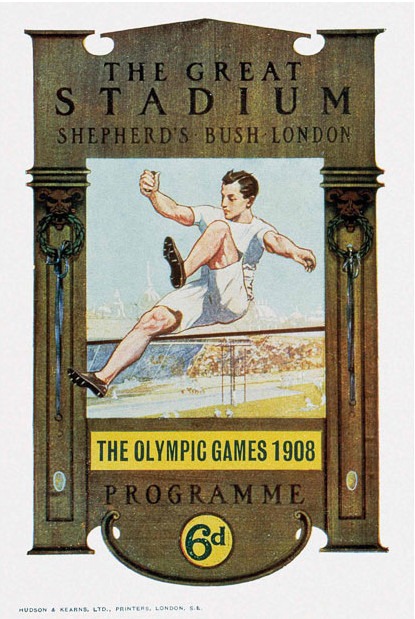
I made mention back in my post of Olympians to watch that this is the third time that London has hosted the Olympic Games. The first time was back in 1908. This was only the fourth time an Olympic Games was held. Boy have a lot of changes happened since. Also it had its share of memorable moments.

LONDON TO THE RESCUE

One thing few know is that London was not meant to host the Games of the IV Olympiad, Rome was. However Mount Vesuvius erupted in 1906 devastating much of central Italy, especially Naples. The Italian government then devoted its funds to recovery from the disaster. London was then selected to host. For the record, Rome would have to wait until 1960 to host the Olympic Games.

As for the Games, they were six-months long: beginning April 27th and ending October 31st. Twelve of the 24 sports at these Games were held in the White City Stadium which was constructed in a short time for only £60,000 and built to hold 68,000. The running track was three laps to the mile, contained a 100-metre pool for swimming and diving, a 660-yard cycling track, and platforms for wrestling and gymnastics in the middle. After the Olympics it would host the 1934 Empire Games, greyhound racing, speedway and a World Cup match in 1966. It was eventually demolished in 1985. White City now consists of buildings for the BBC including a media village. The BBC now plans to either demolish some of the buildings or convert it into a University campus. There is one reminder of these London Olympics that still exists there: a marker commemorating the finish line.

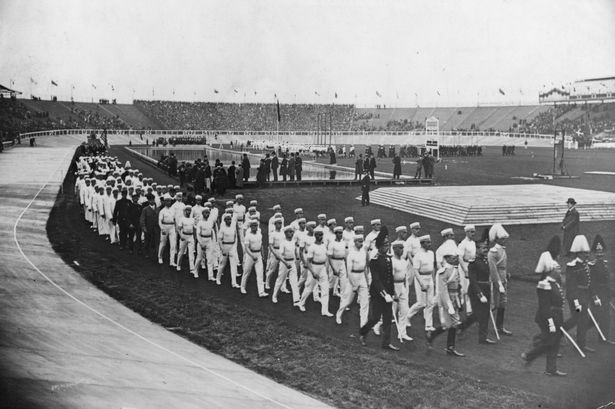
Opening Ceremonies of the Games of the IV Olympiad in London’s White City Stadium.

NATIONAL TEAMS

Athletes from many nations have competed in Olympic Games since it started but it would be these Olympic Games that there would be national teams fully recognized at these Games: 22 in total. It would even be signified by the parade of nations at the Opening Ceremonies. Each nation marched behind their national flag. First was Finland marching behind the Russian flag since Finland was under the Russian Empire. Many chose not to march over a flag at all. The Swedish flag was not displayed over the stadium so members of the Swedish team decided not to march in the ceremony. Finally the USA raised eyebrows highest of all when they were only nation not to dip their flag to King Edward VII. Popular belief is because flag bearer Ralph Rose said: “The flag dips to no earthly king.” To this day the American flag is the one flag that has never dipped to a head-of-state’s presence at any opening ceremonies. One interesting fact is that Australia and New Zealand competed together as Australasia. One more note is that Irish athletes competed for Great Britain. That left many Irish unhappy as they wanted to compete for their own team. Even though the Olympics were meant to bring nations together in brotherhood of sport, we shouldn’t forget there were still national tensions at the time and they were not left on the sidelines during the Olympics.

As for Canadian athletes, they have been competing at the Olympic Games since 1900. Here in 1908 they were able to march under their own flag. They sent 87 athletes in eleven sports. Flag bearer was Edward Archibald who would win a bronze in the pole vault.

FIRST AND ONLY

The London Olympic Games would feature a lot of sports and events that would be held at these games only. One is jeu de paume: a form of tennis that the Brits refer to as ‘real tennis’. In fact the Olympic Report of those games refer to this as “tennis (jeu de paume)” while the more familiar tennis was referred to as ‘lawn tennis’. There were eleven competitors: nine British and two American. American Jay Gould II won. It was contested at the Queens Club, as was Rackets. Rackets would also make a one-time only appearance at these Games with all entries being British. Also contested as an Olympic sport for the first and only time were Water Motorsports. They were a demonstration sport in 1900 but a full-medal sport here. They were dropped as Baron Pierre de Coubertin, president of the International Olympic Committee, insisted that the Olympics not consist of motorized sports.

NO LONGER HERE

The unique thing is that there were not only sports and events at these London Games that were there for these Games only but also sports and events that would eventually be eliminated from the Olympic Program and are no longer part of the Program to this day. Sports at London that are no longer contested at the Olympics are lacrosse, polo and tug-of-war. That’s right! Tug-of-war was an Olympic sport from 1900 to 1920. Here in London all teams that won were British. The Americans withdrew after their protest against the footwear worn by the team of the footwear of the Liverpool Police was dismissed. Lacrosse was conducted as a medal sport for the first time in 1904 and for the last time here. Canada won both times. Here in London it was a single game between Canada and Great Britain which Canada won 14-10. Polo would be contested for the second Olympics of five Olympic Games it would be contested in. All competing teams were British.

As for events no longer contested, there were separate indoor and outdoor tennis competitions. Shooting events had events at distances of 300m and 1000 yards and there were even individual and team events for many events. Yachting events were classified by boat length instead of style. Cycling had events in 20 km and 100 km and even a tandem event. Archery events had two different styles of archery. Figure skating, which I will touch on later, had both as singles and s special figures event for men. Track and field has the most discontinued events: 5 miles, race walking events of 3500m and 10 miles, a medley relay of various distances, a three-mile team event, standing long jump and high jump, a Greek-style discus throw and a freestyle javelin throw where one could hold anywhere.

Interesting that there is one sport contested at the London Games which will make a return at the Rio Games of 2016. Rugby Union debuted at the Paris Games in 1900 and London would be the second Games of four to contest Rugby. It consisted of a single match between Britain and Australasia with Australasia winning 32-3. Ironically it would be the Paris Games of 1924 where Rugby would make its finale. The professionalism, popularity and globalization of Rugby in recent decades has allowed for its reacceptance into the Olympic Program in time for the next Olympics.

FIGURE SKATING AT A SUMMER GAMES?

Sounds weird but it’s true. Figure skating made its debut at these games and was contested at the Prince’s Skating Club on October 28th and 29th. There were two men’s categories: singles and special figures. There was also a woman’s singles and pairs. The two singles winners were two names that would be legends in their sport: Ulrich Salchow of Sweden and Madge Syers of Britain. Contesting figure skating at a Summer Olympics seems odd but it would not be the last time. The Antwerp Games of 1920 would bring figure skating back and would also have ice hockey. It’s because of those two times those winter sports were contested at a Summer Olympics that would lead to a push for a Winter Olympic games that would first be contested in 1924. As odd as it was here in London, it would have its significance later on.

SPORTING SURPRISES

One thing we should remember is that sports weren’t as organized as they are now. Because of it, there were many surprises, shockers and controversies in the various sports competitions. First off was the overwhelming number of British entries in many events including the team events. Not surprisingly Britain won 146 medals including 56 golds in the 100 events. No surprise was that the famed Henley Regatta was used for rowing. A wrestling final between Finns Verner Weckman and Yrjo Saarela took 11 hours to decide. The water motorsports all resulted in a single boat making it to the finish line in each race contested. Gymnastic teams were unlimited in the number of athletes they could field. Platform and springboard diving events included 5m and 10m platforms as well as 1m and 3m springboards. The sprint event in cycling was declared void as the time limit was exceeded in the final. The athletics events were guided under the Amateur Athletics Association of England. The limit of competitors per nation was twelve. Race walking made its debut. Athletics events consisted of a medley relay of 200-200-400-800m.

I’ve already mentioned some of the controversies. I’ll bring up the two biggest later. One thing about the lack of organization of the sports was that it became apparent that international sporting federations had to be formed to have set rules guidelining the sports in the years to come. FINA–the federation in charge of aquatic sports–would be formed immediately after the Olympic aquatic sports competitions here in London. The IAAF for track and field, FILA for wrestling, and the FIE for Fencing would follow years later.

Off topic, Canada would win sixteen medals including three gold. Its gold medals came in lacrosse, Walter Ewing in trap shooting and Bobby Kerr in the men’s 200m. The most medals came in track and field. Medals also came in cycling, rowing and wresting.

Also of interest, there were only twenty-two women competing in London in tennis, archery, figure skating and yachting. Yachting was the only mixed sport at the time.

A RACE TO REMEMBER FOR THE WRONG REASONS

Of all the controversies of these London Olympics, the biggest would be in the men’s 400m. There were sixteen heats with only the winner qualifying for the semifinals. There would be four semifinals the following day where only the winner would move on to the finals. The final was held the following day. the finalists were Americans John Carpenter, William Robbins and John Taylor with Brit Wyndham Halswelle completing the field. The final ended with Carpenter first, Halswelle second, Robbins third and Taylor fourth. One of the British umpires of the event, Roscoe Badger, noticed Carpenter maneuvering as to prevent Halswelle from passing which was forbidden under British rules but legal under American rules. Badger signaled to the judges to declare the race void. This led to a 30-minute argument between British and American officials. There was an official inquiry the following day where the judges disqualified Carpenter and ordered the final to be rerun the next day without Carpenter. The following day only Halswelle showed up. The two other Americans Robbins and Taylor refused to participate in protest of Carpenter’s disqualification. Halswelle simply jogged his way to the gold. This still remains the one and only walkover win in Olympic track and field. This would also be the biggest argument for an international athletics federation. The IAAF would be formed in 1912.

MARATHON: A FINISH TO REMEMBER

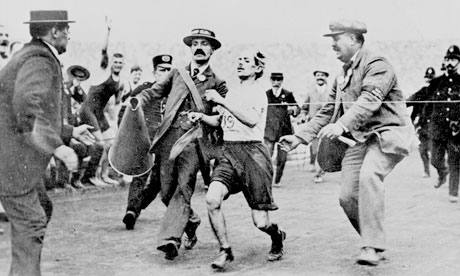
The most memorable image of the 1908 London Games. Dorando assisted to the marathon finish.

The marathon run of these Olympics were remembered for two main reasons. The first is the distance. Although the marathon run was originally 25 miles, it was changed to 26 miles for the sake of having the start at Windsor Castle. It would be changed again at the request of Princess Mary so that the start would be beneath the windows of the Royal Nursery. New distance was 26 miles, 385 yards. That would return as the marathon distance at the 1924 Paris Olympics and would be the standard distance for the marathon run from then on.

The second was the final lap which will go down as arguably the most memorable moment of the London Games of 1908. The first runner in the stadium was Dorando Pietri of Italy. He appeared exhausted and he ran into the stadium in the wrong direction. Officials directed him in the right direction. then he collapsed and picked himself up. He would collapse and get back up many times. Then an American runner Johnny Hayes came into the stadium heading to the finish line. Dorando had just collapsed yards from the finish line as Hayes was nearing the finish. Two officials then assisted Dorando to his feet and led him to the finish line. Hayes crossed the line 32 seconds later and launched a protest. This led to Dorando being disqualified and Hayes winning the gold medal. Dorando was however rewarded the next day by a sympathetic Queen Alexandra a gold or silver-gilt cup in recognition of his courage.

So there you have it. A trip back in time with the first London Games. Interesting that 104 years have passed and they’re still memorable for both the bad and the good. One thing we should remember is that the Olympic Games were still young and these were the first successful Olympic Games since the very first Games back in Athens in 1896. That was an accomplishment in itself.

WORKS CITED:

WIKIPEDIA: 1908 Summer Olympics. Wikipedia.com. 2012. Wikimedia Foundation Inc. <http://en.wikipedia.org/wiki/1908_Summer_Olympics>

WIKIPEDIA: White City Stadium. Wikipedia.com. 2012. Wikimedia Foundation Inc. <http://en.wikipedia.org/wiki/White_City_Stadium>

WIKIPEDIA: Athletics at the 1908 Summer Olympics – Men’s 400 metres. Wikipedia.com. 2012. Wikimedia Foundation Inc. <http://en.wikipedia.org/wiki/Athletics_at_the_1908_Summer_Olympics_%E2%80%93_Men%27s_400_metres>

WIKIPEDIA: Athletics at the 1908 Summer Olympics – Men’s marathon. Wikipedia.com. 2012. Wikimedia Foundation Inc. <http://en.wikipedia.org/wiki/Athletics_at_the_1908_Summer_Olympics_%E2%80%93_Men%27s_marathon>