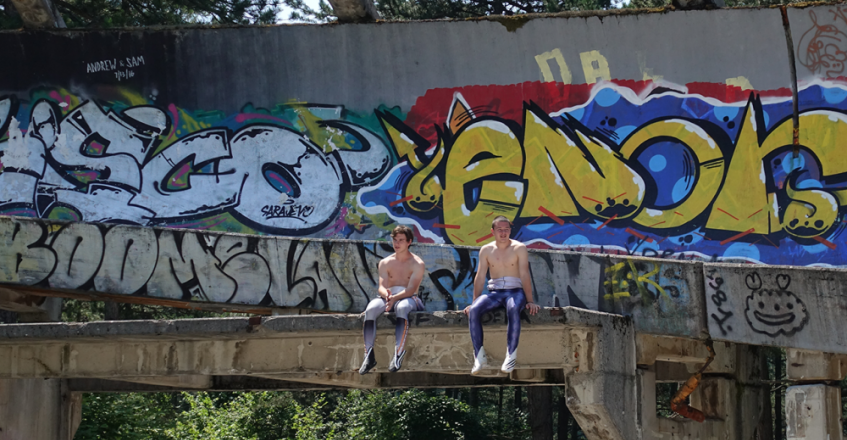
You might wonder why would anyone be interested in a documentary about something from the 1984 Winter Olympic Games? The Track isn’t solely about a track used for the 1984 Winter Olympics, but making a future happen.
It’s February 2018 in Sarajevo, Bosnia and the Pyeongchang Winter Olympics are happening. Three teenage boys in Sarajevo — Zlatan, Mirza and Hamza — are watching the luge competition with their coach Senad and observing how the best lugers steer their sleds. They have a luge track a distance away because of the Sarajevo Winter Olympics from 1984, but it’s hard to sled on. During the Balkan War from 1992 to 1995, the track was subject to a lot of bullet damage. In the decades that followed, little had been done to repair it back to the world class form it had during the Olympics and before the Balkan War.
Despite the shabby graffiti-ridden cement track, the three boys still have the dream to compete at the next Olympics and Senad is willing to coach them. Fortunately, one of the boys is an engineering student and he is able to help create a roller luge to ride on a concrete track. Also Senad is willing to help use concrete patches to help fix up the track. For all of them, the fixing, building and training comes at a big expense for them as they won’t be receiving much government funding.
One thing about this is it is coming as it is hard to be a young person in Bosnia-Hercegovina. In the decades that followed the end of the war, the nation of Bosnia-Hercegovina has struggled to rebuild itself. The war devastated a lot of populations. In the Balkan nations, many young people feel they have to leave for another nation in order to get wealth. The corruption of the governments that have since led Bosnia has caused additional problems. As for sport, there’s very little money going around for Olympic sports and luge hardly gets much, if any money. Despite all that, all three boys and the coach still stay strong with their dream.
One thing about this Olympic dream is four years is a long way. As the three are young, they’re in that stage of life trying to decide about what their future will be. Some come from difficult family situations where they may have to supply them with an income. One comes from a family where the father left them and he has to look out for his mother and younger sisters. It may have them questioning if doing luge is worth their time. To add to it, the coach Senad makes it clear his health is ailing. It’s hard to coach the three especially since he would be paid very little for coaching.
The year 2018 is about getting the roller sleds ready, the track patched up and the boys watching luge competitions to see how it’s done. The summer is used as a time to use the roller sleds for their luging. It’s not an easy thing to do as the track is also a tourist attraction. 2019, the practices still continue for the boys as they ponder their futures. Training gets better as the track is better patched up and the sledders are able to do more sledding. They even enter international junior competitions such as one in Calgary. 2020 is a setback not just for them, but the whole world as the COVID pandemic. They have to use makeshift training methods for training. The pressure of it all gets to the point Zlatan can’t do it anymore.
As 2021 begins, the COVID pandemic is still active but the training has to get more serious. Senad adds two new cross training methods for the two. He adds in running up the Igman Olympic Jumps, another abandoned Olympic site, as part of their cross-training. He also includes indoor training at the Zetra Olympic Hall — the former Olympic arena rebuilt as a multi-purpose recreation facility — to develop their speed and conditioning more. Mirza, Senad and Hamza make television appearances. Senad goes as far as talking about his failing health in one interview.
Then the 2021-2022 luge season. For either Mirza and Hamza to qualify for the Olympic Games, they need to achieve a qualifying time and a qualifying place during the Luge world Cup circuit. This would be tough for them as they will finally sled on ice. The first attempt was Altenberg, Germany in December 2021. It did not happen as Mirza, the one with the best chances, fell from his sled near the end. He’s unhappy about it, but he has to ready himself as there’s the next meet in Innsbruck the following week. In Innsbruck, he completes both his runs and achieves the qualifying time. His Olympic berth is guaranteed! At the Beijing Olympics, Mirza is one of the two flagbearers for Bosnia during the Opening Ceremony. He competes the next day and finishes last. Nevertheless, he is proud of his achievement of competing. He also talks about his increase in social media popularity. As Mirza and Senad are back at home and on the track, they reflect and talk about their ‘impossible possibility.’
This documentary is not just about athletes dreaming of the Olympic Games. This is also about restoring life to an Olympic site that was devastated. This is about four people and their families trying to make dreams come true despite the difficulties of their livelihoods. This is about giving some vitality to a nation still recovering from a devastating war that lasted 3 1/2 years and they’re still picking up the pieces from. During that war, over 100,000 people were killed, over 2.2 million people were displaced and Sarajevo became the longest-sieged capital city ever. I myself remember watching the Sarajevo Olympics when I was a child. I also remember nonstop news stories of the Bosnian War as I was a college student and I often wondered if it would ever end. Since then, the nation has struggled to rebuild, government corruption has been common and many people have had to find opportunity in other nations.
The documentary shows how the three boys and their coach are training for their athletic dreams, but it also shows how the boys are also growing into young men. The documentary takes place over a four-year time frame. Their athletic dreams face frequent obstacles like their family situations, their maturation into adults, trying to decide their futures, and dealing with living in a nation with limited opportunity. It’s not like they live in Germany, Austria, Italy, the US or Canada where they can juggle it all with less difficulty. They have little to no funding, they have difficult living situations and they’re training on a shabby track. It’s almost like they’re the Olympic amateurs of past decades before professionals were allowed to compete starting in the 1980’s. It’s an against-all-odds story where they won.
If there’s one flaw of the documentary, I think it’s about the limited amount of footage in the film. It does a good job of showing the four training and of their family situation, but I feel the film could have also focused more on the background of the Olympic track and why it became shabby over time. It does often mention of the Sarajevo Olympics of 1984 and of the Bosnian War in the 1990’s, but it’s mostly brief moments. Seeing them train for their dream was great to see, but past references could have been added in more. Even more footage of what the track looked like in its Olympic glory days would be great. Despite what I want, that does not stop in telling a good story of Olympic dreams.
Top respect for director Ryan Sidhoo. He knows the story is about them and he has them tell the story as it happens over the four -year period. We often see these up-close-and-personal stories of Olympians before they compete in their big moment, but this is unique that it’s over this four-year period. Although there were some areas where it could have been better, I feel Ryan did an excellent job of showing their stories. Oh, and for those wondering about for the upcoming Cortina Olympics this coming February, Mirza is still luging. For the 2024-2025 season, he finished 20th in the World Cup standings and looks poised to compete at the upcoming Olympics and do much better than his placing in Beijing. Only this coming luge season will tell by how well he does.
The Track is more than just a documentary of Olympic dreams. It’s a story of hope for sport, for a nation, and for the young. The chronology of telling the story over four years tells you why this story is about a lot more.


 Jon The Blogcentric