VIFF 2017 Review: Dragonfly Eyes

dragonfly_eyes-h_2017
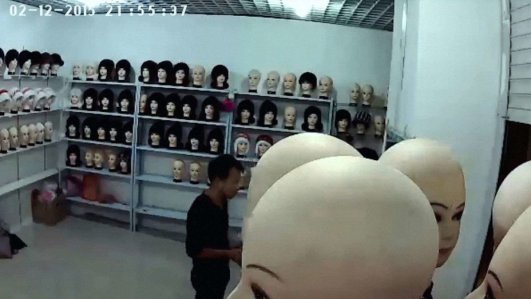
Dragonfly Eyes is a feature drama done through surveillance footage. This is one of the many surveillance images used in the film.

Dragonfly Eyes is a Chinese experimental film that attempts to use surveillance camera footage as a way to tell a story. It’s a unique story in its own.

The story begins in a Buddhist monastery. A young girl named Qing Ting, which means ‘dragonfly,’ has left the monastery in search of a better life. Ke Fan is a young man working a job at a cow farm. One day he catches the attention of Qing Ting. They have conversation, but it’s brief. She knows him and his farm work, but she tries to keep a public distance from him. She’s concerned for her social status about how she’ll look conversating with a ‘farm boy.’

Eventually she admits that she does love him and the two become a couple. However Qing Ting loses her job at a cleaner’s when a pushy rich woman gets more demanding and then demands Qing Ting be fired. Ke Fan swears to Qing Ting he will gets revenge for her. He does just that by driving in front of the rich couple’s car and smashing in their front at a red light. The incident lands Ke Fan a four-year prison term.

Four years have passed and Ke Fan is released from prison. The first thing he does is try to look for Qing Ting. He goes to where she used to live, goes to her former jobs. No sign. Then he learns of an internet celebrity by the name of Xiao Xiao. He sees her and notices that it’s Qing Ting. He tries to conversate with her, but she keeps on denying she’s Qing Ting. Then one day, she gives negative comments about a singing star. That leads to a lot of online flack delivered to her. Xiao Xiao is devastated and it drives her to suicide. Ke Fan learns of this. He feels what he must do is undergo plastic surgery to have Qing Ting’s face. After the operation, he returns to the monastery where she used to serve. It is there she chooses to stay.

This is definitely a film you can call experimental. You can also describe it as ambitious for Xu Bing. One thing we learn is that China is a country full of surveillance cameras. The average person’s face is seen on surveillance cameras 300 times a day. The cameras are all state-run. It is through this that Xu Bing came up with the idea to do a fictional story through use of surveillance. I tried to be as observant as I could with the film. I was trying to spot out if Xu Bing was using the same actors to play Ke Fan and Qing Ting. One thing about the film is that the parts are voiced over by Lui Yongfang for Qing Ting and Su Shangqing for Ke Fan.

I do give Xu Bing kudos for trying to make a film of this caliber and this experimental. However I have to say that it is flawed. The biggest thing is a story that appeared to make sense from time to time, but ended in a bizarre fashion. How does one try to keep the spirit of a deceased person alive by undergoing plastic surgery to look like them? The scene where Ke Fan joins the monastery made a little more sense as it can be seen as a way to keep Qing Ting’s spirit alive. However the plastic surgery really has me wondering.

I can understand that Xu Bing is trying to make more than one statement to make in this film. I think through the character of Qing Ting, he trying to make a statement of one being consumed by materialism. We have a young girl who leaves the monastery and then gets consumed in the modern world of materialism, and then she commits suicide. Also I feel with this film using surveillance camera footage, I think he’s also trying to make a statement about the chaos of this world we live in. It’s noted when the film goes from footage used as part of the drama shifting to general surveillance footage consisting of car crashes, people on the go, a disaster, a woman drowning in a pond, and even business footage. Whatever statements Xu is trying to make, it doesn’t come across smoothly and it comes across rather confusing. I will acknowledge Xu’s Dragonfly Eyes as a brave first-attempt at a ‘surveillance-drama’ and anticipate better in the years to come.

Dragonfly Eyes is an ambition attempt at creating a live-action film through surveillance footage, but it comes off as messy and confusing.

VIFF 2016 Review: The Eyes Of My Mother

eyesofmymo
The Eyes Of My Mother tells a story of how a young girl named Francisca inherits a blood lust.

I knew with The Eyes Of My Mother being an Altered states film, I would be taken into the world of either the bizarre, sinister or paranormal. I got sinister this time but I was not too impressed.

The film begins with a truck driver stopping to what appears to be a body in the road. The woman is very much alive but tortured physically. Flashback to at least 25 years earlier. Young Francesca is the young daughter of a Portuguese farming couple. The parents used to be cow ranchers back in their home.

One day, they’re visited by a man named Charlie who needs to use the phone. You can tell by Charlie’s face that he’s not worth your trust. Francisca witnesses Charlie bludgeoning her mother in the bathtub. The father responds by keeping Charlie captive and tortured in the barn. Francisca asked Charlie what it was like killing her mother. He responds: “It’s amazing.”

Many years pass. Francisca develops a blood lust of her own. She keeps Charlie tortured. However she also kills her old ailing father in the bathtub. She kills a stranger named Lucy. She appears to kill a mother named Kimiko and has taken to looking after Kimiko’s son Antonio. Actually Kimiko is alive but tortured in the barn the same way Charlie is: shackled and eyes dug out. Somehow Kimiko develops the strength and the willpower to find her way out on the barn. She however ends up on a road where a truck driver stops to see what’s up. This sets up for an ending that’s too brief.

Stories of ‘bloodlust’ are not that uncommon. If you’ve studied MacBeth, you get possibly the most renowned example of bloodlust. Here in this film, we hear why the feeling of bloodlust from both Charlie and older Francisca: because of its ‘amazing’ feeling. The feel of power from killing or torturing someone with your own hands can give one a feeling of satisfaction. Just ask soldiers, just ask dictators, just ask… the list is endless.

Here’s a case of the ‘bloodlust’ going from Charlie: the killer of Francesca’s mother, to Francisca. She acquires a lust for murder at her own hands from Charlie. She also acquires a desire for torture as demonstrated by her father on Charlie. The whole story revolves around Francisca and her own lust for murder and torture on others. Even the incorporation of the Portuguese language in her conversation takes the element of bloodlust into being like poetry. Even making it sensual.

That’s the best traits of the film: portraying a unique method of acquiring bloodlust and even making it poetic. However the film has a lot of noticeable weaknesses. We see Francesca has acquired this bloodlust but the film doesn’t make it convincing enough in her ability to receive it. It’s like she just received it. She may have been taught the love of murder by Charlie and the love of torture from her father but it doesn’t appear she acquires this bloodlust that believably. It’s like it just happened briefly. The other weakness is that it ended on a weak note and too abruptly. I feel that 77 minutes was too short of a time to have a film like this and the ending just seemed to be the weakest part of the film. Too sudden and too fast.

Despite the noticeable flaw, this is a good debut for Nicolas Pesce as a director and a writer. His first effort has won awards at the Fantastic Film Festival and was nominated at the AFI Fest for American Independents. Kika Magalhaes is another impressive newcomer as she does a great job in embodying her character’s madness. The other supporting characters also did a good job in their roles. Will Brill as Charlie is the one that stood out as you sensed right from the start it would be Charlie starting the trouble.

The Eyes Of My Mother makes for a good Halloween film. It’s very sinister but very poetic and charming at the same time. Nevertheless the flaws are noticeable in the film.

Movie Review: Big Eyes

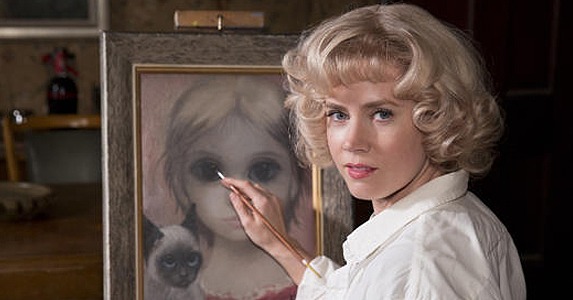
Amy Adams plays artist Margaret Keane in Big Eyes: a story of possibly the biggest art forgery of our time.

Remember those popular Big Eyes paintings from the 60’s? Did you know about the story of art forgery behind it? Some of you will first think that the film Big Eyes is about art. As true as that is, it’s also a drama about art forgery and the ones caught in the middle. This is especially of intrigue to those who remember the ‘big eyes’ paintings from the 60’s.

The film begins with Margaret Ulbrich arriving in San Francisco with her daughter. She has recently divorced her husband and is hoping to make it as an artist. Art is not only her best skill but it’s her one and only skill in terms of employability. At first she’s hired by a furniture factory to paint drawings on children’s furniture. She does drawings of caricatures in a San Francisco market to make extra change.

Soon she catches the attention of a successful ‘artist’ by the name of Walter Keane. He’s impressed with her ‘big eyes’ caricatures she draws. They’re based off the wide eyes of her daughter Jane and Margaret even says that children’s eyes are the windows to their souls.  Walter promises Margaret that he can make her art famous. He’s a good salesman as he knows how to sell real estate and his own art: painting of Paris where he claims to have been inspired by the city even though spending a mere week in it. She agrees and the two marry.

This comes as a welcome relief for Margaret as she is threatened to lose custody of Jane because she can’t afford to care for her. This is also a relief for Walter as his paintings of Paris are declining in sales. Soon Walter promotes the big eyes paintings at restaurants. He’s even willing to create phony brawls to stimulate news hype. Whatever he does, it works and the big eyes painting are catching a ton of renown.

However the secret of the success is exposed to Margaret and it’s ugly. Walter is claiming the paintings as his own. As the paintings become more popular and Walter becomes more famous, they become more and more in demand. That leads Walter to keep Amy in a hidden room where she’s to paint all the portraits. She’s practically exiled away from everyone including friends and her own daughter. Further friction grows when Margaret learns the truth about the Paris paintings. They were actually painted by an artist going by S. Cenic. Somehow Walter is able to talk his way out of it.

The real turning point is when the giant painting of a crowd of big-eyed children to be displayed at a pavilion during Expo 1964 is dissed by art critic John Canaday as ‘appalling.’ Keane can’t take it. He tries to stab Canaday but fails. He tried locking Margaret and Jane in a closet and setting it ablaze. Fortunately they escape and find a new life for themselves in Hawaii. However it’s after a visit from two Jehovah’s Witnesses that Margaret is prompted to bring Walter to justice. The trial goes with Walter playing his own attorney and doing a big song and dance for the jury but there comes the moment of truth. The film ends rather conventionally but will leave the audience satisfied justice was done.

One thing we should not forget is that art forgery is nothing new. There have been imposters claiming paintings and other works of art in the past. However this makes for an intriguing story. There are many elements why one would consider this intriguing. One would be people who remember the big eyes painting and still like them to this day. Another would be because of the conniving nature of Walter who knows how to get his way until the score is finally settled. I’m sure there’s something many people can find intriguing with the film to want to see it.

However the film doesn’t make itself too clear about what it is primarily all about. I do give the film credit for showing a story of art forgery and both the artist and scammer. I do give credit for showcasing the thriving and influential San Francisco art scene form the 50’s and 60’s. I also give the film credit about showing just how much of a conniver Walter Keane was to the point he felt he could kill a critic and even connive a judge in the court of law. And I especially give the film credit for showing the mother-daughter relationship involved with the story. In fact that was one of my favorite parts of the film where after Margaret left Walter, Margaret became a typical mother again and Jane became a typical daughter again. However it does leave one to wonder if it was mostly to do about the art or to do about the forgery behind it? It’s very possible to balance those two elements out appropriately on film but I just wonder if it was balanced out right.

Amy Adams did a very good job of portraying Margaret Keane. However I’ve seen better acting performances from her in the past. Christoph Waltz was also very good as the conniving Walter Keane. He succeeds at making you hate Walter and get annoyed with him. However there are times in which I think his role of Walter is a bit too close to his Oscar-winning roles of Hans Landa and King Schultz. Danny Huston also did well in the role of Dick Nolan. However it does seem odd how the narrator of all that’s happening gets so little screen time. There were additional good performances in minor roles from Terence Stamp and Jason Schwartzman.

Tim Burton did a good job of directing a film that doesn’t seem too much like your typical Tim Burton film. Interesting fact is that Burton owns two of Keane’s paintings.

Scriptwriters Scott Alexander and Larry Karaszewski did a good job with the script even though it lacked consistency and focus. The set designers and costumers did a very good job in setting the scenes to the time of the film. And the score by Danny Elfman also fit the movie well.

Big Eyes is an intriguing look at the artist, the art and the forgery behind it. Even though the story was a bit off in terms of focus to its central theme, it does keep one interested.