Canada 2015 Shows How Far Women’s Football Has Come

The Women's World Cup only started 24 years ago.
The Women’s World Cup was contested for the first time only 24 years ago.

The 2015 FIFA Women’s World Cup starts today. It will be a competition between 24 countries and broadcast to billions worldwide. An enormous event and a huge celebration of the sport but it was a long time coming.

ITS ROUGH BUT HOPEFUL START

Back in the early centuries when football was just invented and games were being played for leisure, women were welcomed participants. There was even the British Ladies Football Club founded in 1894 but was frowned upon by the predominantly male society and received no financial support. Men saw it as a threat to the ‘masculinity’ of the game. A stigma that surprisingly still exists today.
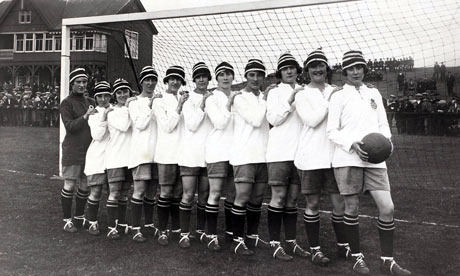
An English women's football team from 1920. Hard to believe the FA banned them for decades!
An English women’s football team from 1920. Hard to believe the FA banned them for decades!

Women’s football saw an increase during World War I and the men were off and fighting. However women’s football received a blow in 1921 when the Football Association (the FA), outlaws the play of women’s games on FA-associated pitches. Despite that, the English Ladies Football Association was formed after the ban was instituted.

It wasn’t just England that looked down upon women’s football. Many other countries would look down too. Once again the stigma of the ‘masculinity’ of the game. Even Brazil had a case where women’s football was growing up to 40 teams in the 1940’s until it too was banned. The ban wasn’t lifted until 1979.

WOMEN’S FOOTBALL  GAINS STRENGTH

You can’t keep the desire down. The FA’s ban on women was eventually dropped in 1971 shortly after the Women’s FA was founded in 1969. In North America while soccer was starting to grow in popularity around the beginning of the 1970’s, girls teams were organized along with boys teams. That may explain why the US and Canada do well. In the 1980’s, women’s national teams were formed like the U.S. team in 1985 and the Canadian team in Winnipeg on Canada Day 1986 (July 1st). Japan became the first country to have a female semi-professional league: the L-League founded in 1989 that still exists today.

A WORLD CUP AND OLYMPIC GOLD EMERGE

As women’s national teams were emerging, FIFA knew they had to do something to encourage the competition but were reluctant to give women their own World Cup. In fact FIFA organized the FIFA Women’s Invitational Tournament in Taiwan in 1988. It was actually a test to see how successful of a competition it would be. Contested over two weeks, it was a success and weeks later, FIFA approved implementing a Women’s World Cup competition.
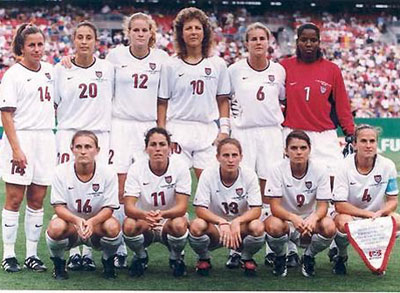
The 1991 US women's World Cup team: the first ever Women's World Cup winners.
The 1991 US women’s World Cup team: the first ever Women’s World Cup winners.

The first FIFA Women’s World Cup was held in China back in 1991. FIFA was still reluctant to call it the World Cup so it was called the 1st FIFA World Championship for Women’s Football for the M&Ms Cup. Twelve countries competed in six venues across the country. Ticket sales were a success with a total of over 50,000–an average of almost 20,000 per match–and the U.S. won the Cup with their teammate Michelle Akers the highest scorer of the tournament with 10 goals.

The success of the 1995 tournament helped paved the way for further World Cup competitions and women’s football being added to the Olympic program starting in 1996. The 1995 World Cup in Sweden however was met with lackluster success as ticket sales were only above 112,000: a sign that women’s football had a long way to go in Europe. Things looked a lot more positive with women’s football contested at the Atlanta Olympics the following year. Despite having only eight teams playing for the gold, ticket sales totaled almost 700,000 including 76,489 for the final which the U.S. won.
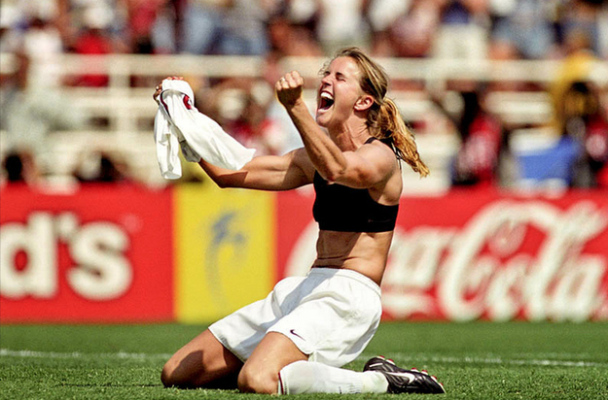
Brandi Chastain's shirtless celebration from USA 1999. One of the most iconic images of the Women's World Cup.
Brandi Chastain’s shirtless celebration from USA 1999. One of the most iconic images of the Women’s World Cup.

It’s no wonder the U.S. hosted the next World Cup in 1999. The U.S. really did an intense job of marketing the event and it paid off. Ticket sales totaled over 1.2 million– more than double that of China 1991 and ten times that of Sweden 1995– and the Rose Bowl Stadium was sold out for both the third-place match and the final for the Cup with 90,185 each.

The Women’s World Cup would have continued success over the years. Even if none of the successive tournaments have broken the attendance record of USA 1999, they’ve still given impressive results such as the 1.156 million who saw games in China in 2007. The 845,000 tickets sold during Germany 2011 showed Europe’s increasing welcoming of women’s football even though the top male continents like Europe and South America still lag behind that of Asia and North America.

PRESENT AND FUTURE

Despite the increase of fanfare and support in women’s football, it’s still lagging behind in terms of parity with the men’s sport. It’s not like tennis, golf, athletics or swimming where female athletes are almost on par with the men. Nor is it like figure skating or gymnastics where the women actually steal the show from the men. There are many countries that still see football as a ‘men’s sport’ and the women are given lackluster attention. There was even a row last week when EA sports video games announced in their FIFA 16 game, women’s players would be included for the first time. There were a lot of sexist tweets on Twitter, overshadowing the 98% of tweets that were positive and welcoming of women’s inclusion in the game.

Nevertheless great strides have been made over the years. Since the 1990’s there have been women’s continental tournaments like the Women’s Euro and the Copa America Feminina. Professional leagues in Europe like the Bundesliga, Premier League and France’s Division 1 have included a women’s league and top men’s team have included women’s braches of their team. England even contests the FA Women’s Cup annually. Women’s football is still supported well with high school teams and NCAA college teams. The MLS has also included female branches of teams. In Brazil, Marta has become a beloved athlete of the country and has even received welcome from other male players like Pele and Neymar whom describes Marta as ‘craque’ (Portuguese for phenomenal).

FIFA also has a special section of their organization focusing on women’s football dedicated to improving the game and its availability to young girls and women around the globe. Every World Cup since 1995 there has been a symposium on women’s football and this year’s symposium is slated for Vancouver from July 3rd-5th. This year FIFA included campaigns such as the Live Your Goals social media campaign through the #LiveYourGoals hashtag. Another FIFA campaign is the ‘No Barriers’ campaign through video commercials. Its goal is to increase the global number of young girls and women playing football form 30 million to 45 million by the 2019 Women’s World Cup.

There’s no question man’s football has no further to go. It’s already universal and the most popular sport in the world. Women’s football is still growing but never before has the future of women’s football looked more ambitious and more promising.

WORKS CITED:

WIKIPEDIA: Women’s Association Football. Wikipedia.com. 2015. Wikimedia Foundation Inc.<Women’s Association Football>

Oxenham, Gwendolyn. “Pele With A Skirt: The Unequal Fortunes Of Brazil’s Soccer Stars” The Atlantic. 4 June 2015<Atlantic Article: Neymar and Marta>

From Jersey Shore To Jersey Bores: Will Stars’ 15 Minutes End Soon?

Exactly a year ago, hardly anyone had heard of anyone named Pauly D, The Sitch, Snooki or JWoww. Now they’re household names thanks to a show on MTV called Jersey Shore. Yes, their names as well as expressions like Guido, Guidette and GTL are everywhere. To go with it, the stars of the show haver been enjoying their time of celebrity. The big question is how long will their celebrity last? Do they have what it takes to continue on?

 The show started on MTV in December of 2009. It followed the lives of eight young people from New York staying along the Jersey Shore. Most were of Italian-American descent. The pilot garnered basic pilot attention but steadily grew week after week. It captured things like the stars’ dating, their images, their sex lives, their partying, their fist-pumping and their bad behavior. The popularity allowed for a season two to be made with them in Miami Beach. The third season marked a return to the Shore. Since then, the show has gone on to become the highest rated series on MTV, a quote book and a sticker book was published and a CD compilation was released. Even the bunch have become stars and household names and their public appearances garner a lot of attention, like Mike ‘The Situation’ Sorrentino was one of the stars competing on Dancing With The Stars, Nicole ‘Snooki’ Polizzi’s arrest in July 2010 garnered national attention, Snooki became a popular Halloween costume, and Snooki and Jenni ‘JWoww’ Farley wrote separate books.

It’s interesting how the popularity of reality television has changed television popularity for better or for worse. Ever since MTV debuted The Real World back in 1992, it introduced a new phenomenon of television: reality television. The docudrama broadcast youth culture from sexuality to prejudice to drug abuse. It caught the attention of many people in its first season. Many credit The Real World for introducing and shaping reality television as we know it. Some would be unhappy with the latter years’ focus on immature and irresponsible behavior. More reality shows came to MTV and its rating successes would cause an extinction of music videos, thus causing a second MTV channel to be created.  The reality show also led to the start of reality shows being introduced to main network television. Before 2000, did we hold Survivor parties? Or were we interested in The Bachelor’s dating life? Did we look forward to seeing Paris Hilton’s latest attempt at nailing a job? Until five years ago, television scriptwriters appeared to be an endangered species. Actors with skill were now being overlooked in favor of notorious personalities. Although scripted television series’ did make a return to the public norm five years ago, reality TV changed television forever.

With the success of reality TV shows came the stardom of its players. The Real World made stars out of their players like Puck for his poor hygiene and violent behavior and Pedro Zamora for his struggle with AIDS and homophobia. Once reality television came to network TV, it allowed for more stars like Richard Hatch, the first Survivor winner, and Alex Michel, the first Bachelor. Even stars who were long out of the spotlight returned to the public eye through shows like The Surreal Life, Celebrity Boxing and I’m A Celebrity, Get Me Out of Here. It really surprised a lot of acting wannabes who learned their craft for a career only to be overtaken in the fame game by these personalities. Reality television stars remind us that fame is not something you work towards or earn. It’s something you grab if the general public is willing to give it to you. However up to the early 2000’s, most reality show stars would see their star go as instantly as it came.

Consistent fame via reality television would start coming when stars knew how to build on their TV fame. The first big result came upon the heels of The Simple Life, a show about the shenanigans of two spoiled stupid girls: hotel heiress Paris Hilton and friend Nicole Richie, daughter of musician Lionel Richie. The show focused on their antics while working on a farm and travelling throughout the US and their notorious antics made stars of them both. Even after the shows’ ends, they were able to keep their stars active as the paparazzi and tabloid writers documented and photographed their every move. Paris’ raunchy car wash commercial for a fast food restaurant and even their bouts with the law made for more popular copy than government affairs. The girls know how to work the tabloid brigade to their advantage in the fame game. That would continue with Kim Kardashian and the Kardashian sisters in the show Keeping Up With The Kardashians. Upon the success of the show, she posed nude for Playboy, appeared in FHM Magazine and has had model offers galore. She even launched her own tanning spray, fragrance and jewelry alongside her sisters. Then came Spencer Pratt and Heidi Montag of The Hills. Their romance, smug attitudes and sleaze became the water cooler talk of 2007. Heidi and Spencer knew how to work the tabloids to their advantage with their romance, religious conversions, marriage, phony divorce and notorious behavior including Heidi’s plastic surgery. They even wrote an unapologetic tongue-in-cheek book entitled How To Become Famous. They won’t deny thier love for publicity stunts. Even Spencer said: “There are only two people in the world that are bigger fame whores than us and that’s Brangelina.” Weird how in the past, after one’s star died off, they’d have to rely on their talent to keep themselves active. Not with this crop of stars.

Now comes the stars of Jersey Shore. What are their chances of longevity after the show tanks? And believe me, it eventually will.  Snooki and JWoww have released books, JWoww had a temporary clothing line called Filthy Couture, The Situation appeared as a dancer on Dancing With The Stars and has endorsed many products, and Paul ‘Pauly D’ DelVecchio has even cut a rap record. All results minus The Sitch’s dancing have been dismal failures. It’s going to be hard for them to carry on their fame after the end of Jersey Shore. It’s going to be even harder for them to try something new and catchy that hasn’t been done before by Paris, the Kardashians or Speidi. Also none seem interested in making a tabloid sensation of themselves. Even their backstage spat at the 2010 MTV Video Music Awards that made the cover of Us Magazine didn’t raise enough eyebrows. They do a lot of the talk show and late night show rounds, all coming across as likeable. Only time will tell whether they have what it takes to keep their fame active.

Or maybe it could be that they’re not worried about their future fame. For starters, they may all come across as dim bulbs on Shore but they’re actually quite smart and more responsible than thought. Before Jersey Shore, the stars all had either working jobs or studying their career pursuits. Snooki graduated from high school and attended community college with the intent of becoming a veterinarian. The Sitch managed a fitness center and turned to modeling after losing his job. Pauly D worked as a DJ. JWoww is a master at computer programming and has her own graphic design company. And Vinny Guadagnino was studying political science at the State University of New York before he heard of the Jersey Shore auditions. So they’re not complete fails at life and may be able to carry themselves after the limelight fades away.

Fan or not, the Jersey Shore stars are hard to escape. They’ve become a new reality television phenomenon and have a long road ahead of them if they want to keep their fame alive. Whether they choose to continue on the road to fame or find a career alternative, only time will tell where they end up years from now.