It’s a given. Whenever there’s a Euro or a World Cup, I do a rundown of the teams that will be competing. Those of you who remember I did it for the 2014 World Cup, I’m back. As I did for 2014, I will again do a separate blog for each of the eight Group Stage groups. Once again, I will give a preview of the twelve stadiums that will be the stages for this event and save the stadium for the Grand Final for last. Now let’s start with Group A. For the record, my summary of the teams will be done in their drawn World Cup order rather than their FIFA ranking of May 2018. FIFA ranking of that month will appear in brackets.
GROUP A:
 -Russia (66)- Russia had its glory days on the World Cup scene back during the days of the USSR. Since the USSR dissolved in 1992, Russia has qualified for three World Cups but always ended its trip in the group stage. It’s been a frustration. They went through two top ranked Dutch coaches Guss Hiddink and Dick Advocaat and Italian coach Fabio Capello, but would always come up short. Just before Euro 2016, they went back to a Russian coach, Leonid Slutsky, but again fell out in the group stage. Since Euro 2016, they’ve stuck to having a Russian coach. This time it’s Stanislav Cherchesov whose managed Dynamo Moscow and Legia Warsaw in the past.
The Russian team still remain an enigma. Only three of the team’s players play for teams outside Russia. Their recent game results also come into question. They’ve played six games since the Confederations Cup, but only won one: against South Korea 4-2. They’ve since had to deal with losses to big-name teams like Argentina, Brazil and France. The world Cup draw is made so that the host nation doesn’t have that hard of a time to make it past the group stage. Russia’s chances look comfortable as Uruguay appears to be its only tough rival. How far Russia goes is up for the world to see.
 -Saudi Arabia (67)- The Saudi team looked like it was heading to better times after they made it past the Round of 16 at World Cup 1994. However the big reluctance to export players to the bigger European clubs has always proved to be the biggest obstacle. The Saudi team would face an exit at the Group Stage during the next three World Cups.
Russia 2018 marks the first World Cup since 2006 with the presence of the Saudi team. All but three of their team members play for Saudi teams. The other three play for La Liga teams from Spain. As for play, Saudi Arabia does not have a very consistent record for the past year. Their biggest win this past year came through Greece. However they’ve also had to endure losses to Belgium, Iraq and Portugal. However anything’s possible in football and the Saudi’s could surprise in Russia.
 -Egypt (46)- This is only the second time Egypt has been to the World Cup. The only other time is in 1990. However Egypt is ready to play well. They’ve hired Argentine coach Hector Cuper to coach the team. The team’s players play for various team in Egypt, Europe and the US. However many consider the heart and soul of the team to be led by 26 year-old Mohamed Salah who as a striker for Liverpool won 2017 CAF footballer of the year. Many see Salah as an emerging great and could boost team Egypt in the future.
Their record leading up to World Cup 2018 is very much in question. Their only wins this past year have come against African teams. Their last win against a team from outside Africa was Bosnia-Hercegovina back in 2014. This year they’ve faced losses to Portugal and Greece. Russia is another proving point for ‘The Pharoahs.’ They may be out in the group stage or they may surprise everyone.
 -Uruguay (17)- This is the team from Group A that has the most clout. For a long time, Uruguay was seen as a team that was a blast from the past. Their biggest glory days came with World Cup wins in 1930 and 1950 and Olympic gold medals in 1924 and 1928. However a resurgence of Uruguay on the world scene starting with World Cup 2010 has catapulted the team back to the top of the world elite. It started with Diego Forlan and has now transferred to Luis Suarez. Uruguay’s stint at the 2014 ended in disgrace after Suarez was banned from nine games following a biting incident on an Italian player. And to think Chewy Louie was the player that infamously blocked a potential goal from Ghana at 2010.
Since the incident, Suarez has kept his promise of not ever biting another opponent. He has matured a lot as a player since and serves as Uruguay’s top star. However Uruguay is not just Suarez. The team also boasts another top striker in Edinson Cavani, midfielder Cristian Rodriguez and top defencemen Diego Godin and Maxi Pereira. Uruguay can prove themselves to be a top force to be reckoned with here in Russia.
So there’s my review of the first World Cup group. As for predictions, I’ll just settle for predicting the two countries that will advance past the Group Stage right now, and I predict it will be Russia and Uruguay.
STADIUM SPOTLIGHT
Once again, I get to focus on the various stadia that are hosting the World Cup. I figure the arenas are worth talking about. Russia will have has twelve stadia that will facilitate for the World Cup including two in Moscow. Only three are older than ten years old. All are situated in the European cluster of Russia. Just like Brazil in 2014, Russia all twelve of the stadiums will hold four Group Stage matches but they will be matches for four different groups. Also just like in Brazil 2014, all six of the Group Stage games for each individual group will again be played in six different stadiums, and not all will be that close by. Once again, a lot of traveling around for the 32 teams in a huge cluster of a country. One of which, they will have to cross the border of Lithuania to play in.
It’s confusing, but no less confusing than Brazil 2014. Here I’ll give you my first taste of my Stadium Spotlight of 2018. Note that each stadium I show in my Stadium Spotlight feature will be a stadium that will contest Group Stage matches for each respective group. These two I will focus on will host Group Stage matches in Group A. So without further ado, here are the two stadiums in focus:
-YEKATERINBURG: Central Stadium
Year Opened: 1957
World Cup Capacity: 35,696
World Cup Groups Hosting: A, C, F, H
Central Stadium is one of only two stadiums at this World Cup that was built in the 20th Century. Though there’s no doubt they’ve had to undergo extensive renovations over the years including preparations for this year’s World Cup. Actually the arena was a stadium for speed skating. The shift to football and other sports have been the focus since the downfall of the USSR.
The stadium will have 12,000 temporary seats for the World Cup. After the World Cup, it will be the host venue for team FC Ural Yekaterinburg. In addition, there are plans to add a fitness centre and a Valeological centre.
-SAMARA: Cosmos Arena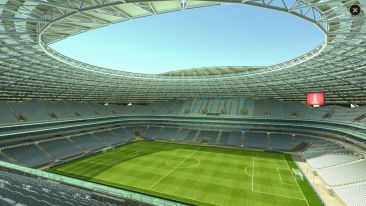
Year Opened: 2018
World Cup Capacity: 42,374
World Cup Groups Hosting: A, C, E, H
Additional World Cup Matches Contested: Round of 16 (E1 vs. F2) & a quarter-final
Cosmos is one of many stadiums built fresh for this World Cup. It came at a cost of $320 million. The building of the stadium was first meant to be built on an island close to the city, but the intended construction of a bridge, and the public’s uproar over its total expense, led it to be built in the north area of the city.
After the World Cup, it will be the host venue of team FC Krylia Sovetov Samara.
And there you go. My first preview of the World Cup teams and stadiums. Seven more groups and ten more stadiums to review before World Cup 2018 starts. Stay tuned for more.
 Jon The Blogcentric