Will Italy win for the second time? Or England for the first?
Fifty matches, 140 goals, eleven venues and eleven countries. And an event format current UEFA president Aleksandar Cerefin says is too troubling and won’t happen again. I didn’t have a problem with it. Despite it, now the field is narrowed down to the two for the Cup: Italy and England. For Italy, this will be their fourth time playing for the Cup. Their one win came in 1968 and it came after two hugely controversial semifinals. For England, this is their first time ever qualifying for the final! Yes, I find it hard to believe too. Ever since 1996, they’ve been singing ‘It’s Coming Home’ in hopes they win whatever big trophy they’re chasing and now is more chance than ever! For this, I will do my review of Italy vs. England and make my prediction.
Head-To-Head Stats:
Italy vs. England isn’t normally one of the bigger rivalries in football. Italy’s more legendary rivalries are with Germany, Brazil, eastern neighbors Croatia, Spain and France in recent years. England has bigger rivalries with Germany, Argentina and northern neighbors Scotland. Italy and England have played each other 27 times. Italy has won ten times while England has won eight. The last time Italy played England, it was a March 2018 friendly and it ended in a 1-1 draw.
Team Breakdown:
ITALY: It’s hard to believe a team with one of the biggest football legacies of four World Cups has only won a single Euro. It was all the way back in 1968, and after both semifinals consisted of major controversies. In fact Italy’s case was they played a scoreless draw against the Soviet and there wasn’t a penalty kick system like we have now. So a coin-toss was used to decide Italy’s win! Since 1968, they have made it to the final twice: in 2000 and 2012. The Forza Azzurri have always been one of the most dazzling teams in the world, but they can also end up being one of the most unpredictable teams too. There have been many times in tournaments when even if they didn’t win, they would go further than expected. However there are times when Italy has delivered below pre-event expectations. That has especially been the case after they won the World Cup in 2006. However it was right after their failure to qualify for the 2018 World Cup that it was aware there had to be changes not only in the team, but the Italian football system.
Since their World Cup failure, they have a new head of the Italian Football Federation (FIGC) Gabriele Gravina and a new coach in Roberto Mancini. Ever since Mancini took hold of the Italian team, the Azzurri have only lost two games with the last loss being in September 2018. They capped hugely successful, 2019 with straight wins. 2021 was also hugely successful with straight wins until the Euro semifinal where they drew 1-1 against Spain. Their win on penalty kicks is a victory for them as Italy is one of the weaker teams at penalty kick rounds. Italy came to this Euro with a lot to prove and prove they did. The final is another opportunity for them to prove themselves. They showed they can score well and that they have good defense. However even coach Mancini admits that England is a stronger team. He even warned his team to be cautious of players like Harry Kane and Raheem Sterling. That could be their one glitch as they may not be able to fend off England’s star strikers. Another is Emerson Palmieri as the replacement goalkeeper. He plays in the Premier League with Chelsea and some England players may be familiar with his weaknesses. Nevertheless, Italy can rise to the challenge and possibly win their second Euro over in Wembley Stadium.
ENGLAND: Hard to believe this is the first-ever Euro final England has made it to! It’s just as surprising as their one World Cup, which was won in 1966 in old Wembley Stadium. Euro 2020 would be poetic if they won their first Euro in the new Wembley Stadium. Yes, it does seem like England’s win of the 1966 World Cup has made them a one-hit-wonder in football. England has almost always fielded the national team with the most talent and the most skill combined. However its inability to go far on the international stage has almost always seems to be the team not being able to come together and play as a team unit. That often seems to be the case. Ever since their World Cup win, the best England has done at the World Cup was two fourth places. Also the best they ever did at Euro was a third place.
2016 appears to be the turning point. This was after England came off possibly its most dreadful performance as a national team with Roy Hodgson. It involved an out in the Group Stage at World Cup 2014 and an out in the Round of 16 at Euro 2016. After Euro 2016, the English team hired Gareth Southgate as the manager. A former national team player himself, Southgate was coach of the national under-21 team at the time. It turned out to be the best move for England. Southgate’s England squad made it to the semifinals of World Cup 2018: the first time since 1990 and only the third time even England make the Top 4 at the World Cup.
Then Euro came. The current English team consists of some of the best veterans and many top rising talents. All but three play for Premier League teams with one playing for Atletico Madrid and two playing for Germany’s Bundesliga teams. England and Southgate had a lot to prove to the eyes of the world here at the Euro 2020 and boy have they been proving it. It the Group Stage, their only non-win was a scoreless draw against Scotland, but their other two matches were wins of 1-0. In the Round of 16, they beat their common rival Germany 2-0. They would show dominance in their quarterfinal against Ukraine by winning 4-0. The semifinal was the first Euro 2020 where England conceded a single goal. Despite it, England was able to recover and win the semi 2-1 in added extra time to qualify for their first-ever Euro final!
England overcame a lot of ‘team demons’ in order to get where they are now. Back at the 2018 World Cup, they won their Round of 16 game against Colombia on penalty kicks. That was the first time ever in four tries that England won a World Cup match on penalty kicks. Even here in Euro 2020, winning over Germany, a team they commonly lose to in major tournaments, shows how much team chemistry between England has improved over Southgate. However England does have their imperfections. You can look at their semifinal win, for starter. The controversy of a fan flashing a laser pointer to the eyes of Danish goalkeeper Kasper Schmeichel as Harry Kane was about to make his penalty kick has given their win a tarnish. The English team has been fined by UEFA for this. Another case, as far as play goes, is that Italy has been noticed to have better midfielders than England. That could hurt England during some key moments. Whatever the situation, Wembley Stadium tonight is their chance to tell the world ‘It’s Coming Home’ instead of ‘It’s Coming To Rome.’
My Final Verdict:
This is a tough call and this is a game that could end up as a draw even at the end of added extra time. However I feel I will have to predict England to win this 2-1.
And there you go! That is my focus on the Euro 2020 final and my prediction. You can bet there will be a ton of excitement over in Wembley Stadium and lots to look forward to. Can excitement and national pride repeat itself 55 years later? Only time will tell!
Four teams left. Who will be the finalists for Sunday?
Hard to believe it took 135 goals in the 48 matches in 11 stadiums in 11 nations to decide the four semifinalists. Anyways the four semifinalists have all been decided: Denmark, England, Italy and Spain. All semifinals and the final for the Cup will be held in London’s Wembley Stadium. You can expect a lot of chants of ‘It’s Coming Home’ to echo. In the meantime, here’s my focus and predictions on the two Euro 2020 semi-finals:
SEMIFINAL #1: ITALY vs. SPAIN
Head-to-Head Stuff: Spain and Italy have played each other 33 times. Nine times they drew. The other 26 times, the results have been split! Their last head-to-head match was in September 2017 during World Cup qualifying which Spain won 3-0. Spain has won five of the last ten meetings including the 2012 Euro final for the Cup. Italy’s only won two of the last ten but their last win over Spain was a Euro 2016 rematch in the Round of 16 where they won 2-0!
Team By Team Analysis:
ITALY: Italy is a team that went from a national embarrassment to success in most recent years. We’re talking about a nation with one of the world’s biggest football legacies with three World Cup and winning Euro 1968. However recent years after their most recent World Cup win in 2006 would soon expose some of Italy’s weaknesses. They failed to win a game at the 2010 which they were defending World Cup champions and found themselves out in the Group Stage. Another out in the Group Stage happened at the 2014 World Cup. 2016 failed to redeem them as they were out in the quarterfinals of the Euro that year. And them World Cup qualifying. Italy was in Group G which was won by Spain. With Italy being second in the group, they were given a playoff chance where they were drawn against Sweden. The first game, that was played in Sweden, the Swedes won 1-0. The second game was to be in Italy, which seemed to assure they would take it. The whole game went scoreless and Sweden was the team going to the World Cup. World Cup 2018 was only the third World Cup without the Italian team present!
What happened after worked in their favor. There would be a new lead of the Italian Football Federation and the team would be managed under Roberto Mancini. The team also showed promise as they would finish third at the under-20 World Cup and fourth at the 2019 under-20 World Cup, showing a lot of potential for young talent to rise. The results turned out to be very winning. Italy’s last loss was to Portugal in September 2018. Italy went through straight wins in 2019. 2020 was a case where they won five of their eight matches and 2021 has been another case of nothing but wins so far. At Euro 2020, they won all three of their Group Stage matches without conceding a single goal. Italy would go on to win their Round of 16 match against Austria and their quarterfinal against Belgium.
Italy find themselves in the semifinal against Spain. Every Euro game, they’ve been showing their renewed strength and reminding people why Italy is a football superpower. However the Spaniards are an experienced team and they might lose out to them. Also if it becomes a case for penalty kicks, it can be a losing battle for Italy as penalty kicks are one of their weaknesses. It will all be decided Tuesday.
SPAIN: Spain is a team that for a long time has been commonly known as ‘football’s greatest underachievers.’ They have always been a team loaded with talent, but couldn’t seem to deliver during the biggest events. Then something changed around the late-2000’s. Spain won their second Euro in 2008. Could it be that Spain could win the World Cup in the near future? The World Cup in 2010 answered that with a big “Yes!” It started off with a loss on their first game, but game after game was win after win up to winning the Cup. Spain continued their success with a win of the 2012 Euro and runners-up at the 2013 Confederations Cup. Then the downfall. At the 2014 World Cup, Spain became the latest defending champion to be out in the Group Stage. Further humiliation came when Spain was out in the Round of 16 at Euro 2016 and the Round Of 16 at the 2018 World Cup.
Things have changed ever since Luis Enrique, who himself represent Spain at three World Cups and Euro 1996. The team began to regroup and reorganize itself better. Of the 35 matches Spain has played since the 2018 World Cup before Euro 2020, they have only lost three matches and won eighteen. Here at the Euro, they started out slowly with drawing the first two games, which is common for Spain, and then let out its best team traits by first winning 5-0 to Slovakia. This then led to a Round of 16 win against Croatia 5-3 in added extra time and a penalty kick win over Switzerland in the quarterfinals. Spain has what it takes to win the semifinal and even the Euro.
They know how to deliver. They just need to do all the right moves in order to make it happen. We should remember that Spain’s 3-3 tie against Croatia after regulation was because of an own-goal. They’re just as capable of losing to Italy as they are winning over Italy. They can’t afford any more bad mistakes or slack play as they’re getting closer to the final.
My Final Verdict:
Fourth straight Euro Italy and Spain cross paths. First was 2008 in the quarterfinals, then 2012 was group play and the final for the Cup, 2016 was the Round of 16, now this semifinal! This is a tough one considering both the head-to-head statistics and the way the two teams have played here in Euro 2020. I anticipate it will end up a 2-2 draw after added extra time that will go to penalty kicks, which Spain will win.
SEMIFINAL #2: ENGLAND vs. DENMARK
Head-To-Head Stuff: England and Denmark have faced each other 21 times. England won 12 of those games. Five have been draws. Denmark has won four. Three of those Denmark victories have been in the last six meet-ups. The most recent being a 1-0 victory over England in October 2020.
Team By Team Analysis:
ENGLAND: England has always been known to have a wealth of talent. And rightly so. Its Premier League showcases the best English football talent has to offer. However the difficulty always comes when trying to get a national team together. So many players who play great for their clubs, and they bring it to the national team. However the national team almost always falls short. Like the team players can’t function properly as a unified team unit. England did win one World Cup all the way back in 1966, but it’s been a struggle since with the most being two fourth-place finishes. England is the only team in the semifinals who never won a Euro; their best result being third-places in 1968 and 1996. However it was 2104 when England appeared to really hit rock bottom when they were out in the Group Stage of World Cup 2014 without a win. Being ousted in the Round of 16 at Euro 2016 didn’t help much either.
Then things changed when they introduced Gareth Southgate, a former Team England player himself, as head manager. Things really improved as the team started to show improvements in their play together. The 2018 World Cup was a case where they finished fourth, but they showed a remarkable improvement in their play and even won their first ever World Cup match on penalty kicks against Colombia! England has since shown impressive play since them. Before Euro 2020, they’ve only lost five of the 30 games they’ve played since and won 21 games. Since Euro began, they haven’t been like Italy and had straight wins, but they do have a tournament milestone that they have not conceded a single goal in the tournament so far. They appear to be getting better every game. For their Round of 16 match against Germany, they won on home soil: 2-0. And to think during Euro 1996, Southgate, who was a player for England at the time, was the one who delivered the missed penalty in the semifinal which got England out! Their 4-0 win over Ukraine was dazzling to watch.
England has the luxury of a talented team that performs better than ever as a team unit. Not to mention the home advantage with the semis and final in Wembley stadium. However it could fall apart right there. Plus that 1-0 loss to Denmark was back in October 2020, so not all that recent. England will have to keep on playing as well as they have in recent games if they want to reach the final for the Cup.
DENMARK: Normally you don’t think of Denmark as a football superpower. I mean they only competed in their first World Cup in 1986 and their best World Cup finish has been the quarterfinals all the way back in 1998. However Euro tells of bigger success. This is Denmark’s fourth time ever in the Top 4. Past success includes a third-place in 1984 and a win in 1992. Denmark did have a downturn in their success as they failed to qualify for the 2014 World Cup and 2016 Euro. Things changed after they were taken on by Norwegian manager Age Hareide. In qualifying for the World Cup, Denmark finished second in their group against Poland, was pitted against the Republic of Ireland in their playoff matches and won 5-1. Denmark would then go on to finish in the Round of 16. After that was the switch to a Danish manager, Kasper Hjulmand, who has helped make the improvements in the team.
The Danes played their first game in Copenhagen expecting to show the world what they’re made of. Instead the first half of their first game against Finland had a shocker of a moment when midfielder Christian Eriksen suddenly collapsed. The whole stadium was in shock. The whole Danish team was distraught and his wife was heartbroken. The game was ordered to stop. Over time, it became apparent that Eriksen was alive and conscious. Eventually he was taken to a nearby hospital where his condition was diagnosed as cardiac arrest. A bombshell would come the following day that he was deceased for five minutes!
Once it was clear Eriksen was alive and being hospitalized UEFA gave the go-ahead to resume the game more than an hour after it stopped. Many did not like the idea. In the end, Finland won 1-0. Denmark has not fully recovered from the shock when they were to play Belgium. They lost 2-1. Over time, the Danish team overcame the shock. Eriksen recovered well enough to visit his team mates. For their last game against Russia, they really showed what they were made of by winning 4-1. Their Round of 16 match was against Wales which they won 4-0, and then their quarterfinal over the Czech Republic which they won 2-1. As has happened in the past, Denmark has delivered the unexpected. They can deliver the unexpected again in Wembley. However it could easily be the end for them if they don’t play as well as they have in recent games. It can be just as much Denmark’s as it can be England’s on Wednesday. It’s about which team delivers the most.
CHRISTIAN ERIKSEN Update: For those wondering what happened to Christian Eriksen since his cardiac arrest, he has been released from the hospital and has met with teammates in Helsingor, but more importantly, he did undergo a successful operation beforehand on June 18 and he’s since returned to be with is family. No word if he’ll play professional football again. Most leagues won’t allow a footballer to play again after they suffer cardiac arrest.
My Final Verdict: This is a tough prediction, especially since the last England vs. Denmark match was a Danish victory, but I think the win will be England 2-1.
And there you have it. My predictions for the two semifinals of Euro 2020. Hard to believe the final for the Cup is coming so soon. Hard to believe we all had to wait forever for it! Anyways, stay toond!
Okay last week I took you way back to the first time London hosted an Olympic Games back in 1908. The second time London hosted was back in 1948. I don’t know if you have seen film footage of past Olympic Games but I have seen mostly through Bud Greenspan’s The Olympiad series and I have to say the London Games of 1948 were definitely a Games to remember for all the right reasons. It brought athletes from around the world back into an arena, brought athletic achievement back into the spotlight and even gave the world a heroine.
WAR IS OVER
One thing we should remember is that these Olympic Games were the first Olympic Games in twelve years and they were staged just three years after World War II ended. When World War I happened, the 1916 Olympics scheduled for Berlin were cancelled. World War II would lead to the cancellations of the Tokyo Games of 1940 and the London Games of 1944. The last Summer Olympics held before these London Games were held back in 1936 in Berlin and they were most memorable for showcasing the Nazi ideology that would eventually lead to the start of World War II. As the London Games were about to begin, most of the world was still trying to recover from the war. These Games were to be dubbed the ‘Austerity Games’ because of such. Europe was especially devastated during wartime and the UK was still giving out food rations at the time. Even though the Olympics were intended to bring together the countries of the world, wounds from World War II were not fully healed. As a result, Germany and Japan were not invited to these Games. The USSR was invited but declined.
As for staging the events, there was no way to afford new facilities. All events were staged in existing venues. The 25 year-old Wembley Stadium hosted the athletics competitions, equestrian events, hockey and football tournaments and the ceremonies. The well-established Henley Regatta hosted the rowing and canoeing events. Empire Pool, originally built for the 1934 Empire Games, hosted the aquatic events and boxing finals. The 11 year-old Empress Hall Earl’s Court hosted gymnastics, weightlifting, wrestling and boxing preliminaries. The track cycling events were held at the Herne Hill Velodrome built in 1891. Basketball was held at the Harringay Arena built in 1936. Sailing events were held in Torquay, a town in Southwest England on the English Channel. As for athlete accommodations, there was no Olympic Village constructed and athletes were housed in existing accommodations instead. Male athletes stayed at RAF camps in nearby cities and female athletes were housed in London college dorms. Athletes were also subject to the food rations. Actually athletes were given increased rations: the same amount as dockers and miners. BBC was to broadcast a total of 60 hours of live broadcast of the Games. Broadcasting rights was a mere £1000.
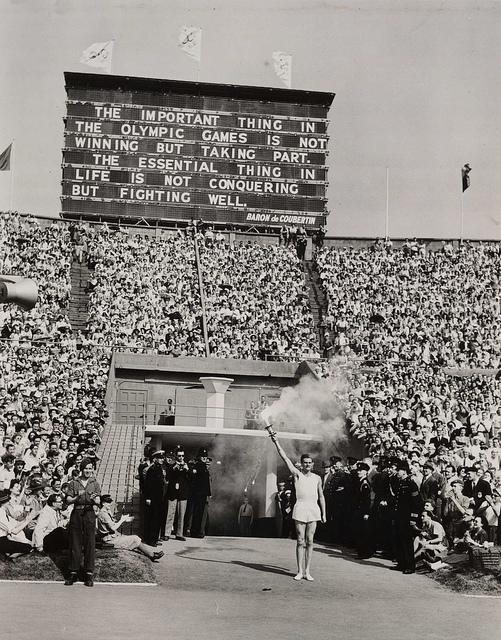
As for the torch relay, the torch was lit in ancient Greece and was carried through Italy, Switzerland and France before arrived in England at Dover one day before the Opening Ceremonies.
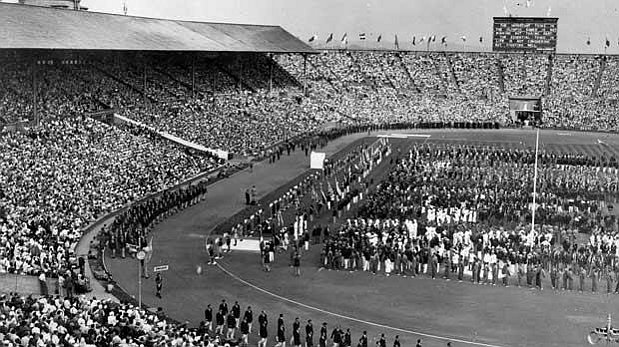
The Opening Ceremonies in London bring back the Olympic spirit after a 12-year hiatus.
OPENING CEREMONIES
The 1948 Olympic Games opened at 2pm on a sunny Saturday on July 29th. Army bands began the pageantry and the Royal Family arrived at 2:45pm. The parade of nations started around 3pm and lasted 50 minutes with 59 nations parading starting with Greece by tradition, the other nations marching in alphabetical order, and ending by tradition with the host nation Great Britain. Fourteen countries including Jamaica and Korea marched in the opening ceremonies for the first time. Each nation was obliged to bring their own flag to the ceremonies. Lord Burghley, president of the British Olympic Council who headed the organization of these Games, greeted the athletes to “keen but friendly rivalry” and said London represented a “warm flame of hope for a better understanding in the world which has burned so low.” King George VI formally declared the Games open. 2,500 pigeons were released, symbolizing the doves of peace. The Olympic Flag was raised to a 35 ft. flagpole near the end of the stadium. The torch entered the stadium carried by 23 year-old British runner John Mark and was greeted by a 21-gun salute. Mark lit the Flame located inside the Wembley Stadium. The Olympic Oath was taken by 39 year-old hurdler Donald Findlay, a silver-medalist from 1936 who was able to make the British Olympic team that year. Then the athletes proceeded out of the stadium to the two weeks of competition.
COMPETITION HIGHLIGHTS
The 1948 London Games delivered in terms of competition. 136 events were contested in seventeen sports. The USA–a country that was one of the least effected by World War II– was the top medal winner with 84 medals including 38 golds. Sweden won the second-most with 44 medals including 16 golds. France and Hungary both won ten gold medals each.
The competitions themselves featured a lot of excellent feats from athletes who would be remembered for all time. In athletics, Harrison Dillard was the surprise winner of the men’s 100m dash beating out his favored teammate Barney Ewell. Both would run in the 4*100 relay where the American team was originally disqualified for exchanging the baton outside the exchange zone but a film replay would reinstate their first-place finish. Arthur Wint won Jamaica’s first ever gold medal in the men’s 400m. American Mal Whitfield would win the first of his two consecutive 800m gold medals here. The legendary Emil Zatopek of Czechoslovakia would begin his legendary Olympic career with a win in the 10000m and a silver in the 5000m. Micheline Ostermeyer of France won the women’s shot put and discus. Sweden dominated the steeplechase and walks. High jumper Alice Coachman would become the first ever African-American woman to win Olympic gold. Bob Mathias won the first of his two consecutive decathlon gold medals here. His win here just a week before his 18th birthday would make him the youngest ever male gold medalist in track and field. However the two biggest moments of the athletics events will be discussed later in this blog.
In swimming all men’s events were won by Americans. Women’s swimming was divided between the Americans, Danes and Dutch. Diving was completely dominated by the Americans with Victoria Draves winning gold in both springboard and platform. The legendary Sammy Lee of the USA would win the first of his platform golds and a bronze in springboard.
Men’s gymnastics was won mostly by Finland. A unique moment occurred when three men–all Finnish–tied for first place in the men’s pommel horse. Thus three gold medals were awarded. There was only one single event for women in gymnastics: a team competition which Czechoslovakia won. The USA won no gold medals in boxing but a Hungarian boxer, Laszlo Papp, would win the first of his three career Olympic golds: the first of only three boxers to do so. Swedish kayaker Gert Frederiksen would win two gold medals here and would go on to an Olympic career of eight total medals, six of them gold. Equestrian events had the strongest showings from the Americans, French and the Mexicans. Hungarian fencer Ilona Elek–a Jewish survivor of World War II thanks to Raoul Wallenberg–became the only gold medalist from 1936 to repeat here in London. Sweden won in soccer. Danish yachtsman Paul Elvstrom won the first of his four consecutive gold medals at Torquay. The Americans and Egyptians were the standouts in weightlifting while the Swedes and the Turks were the top winners in wrestling. And while there’s excitement over double-amputee Oscar Pistorius running in London this year, here at these Games Hungarian shooter Karoly Takacs won a gold medal with his left hand after losing his right hand in a grenade blast ten years earlier.
For those of you that took an interest in all the discontinued events from the first London Olympics, the discontinued stuff isn’t as interesting as the ones back in 1908. All the sports contested at the London Games of 1948 are still contested at these London Games. There are some discontinued events. In athletics, the 10km road walk would be replaced by the 20km walk. The Star boat is the only one of the five sailing events from 1948 that’s contested in 2012. In rowing there were pairs and fours both with and without a coxwain while the only rowing event in 2012 with a coxwain is the eights event. Cycling had a tandem event and canoeing had three events over a distance of 10,000 metres.
As for the host country Great Britain, athletes won a total of 23 medals: the sixth-most of all countries at these Games. Their medal haul was their biggest since 1924 and most of their medals came in athletics, rowing, cycling and sailing. Their gold medal total of three was one of the lowest gold medal totals Britain has ever had and lower than the four won at the previous Olympics in Berlin. As for Canada, no Canadian athlete won a gold medal. These would be the second of only five Summer Olympics where Canada didn’t win a gold medal. Canada did win three medals: a bronze won by the women’s 4*100m relay team in athletics and both a silver and a bronze won in canoeing.
SIGNS OF A CHANGED WORLD
Even though these Olympics were meant to ease political barriers, it’s not to say these Games were immune to politics. Countries now governed under Communist regimes would compete in London for the first time and they would give the first signs of the changes of post-World War II politics. Back in February of that year, the Soviet allied ‘Czech coup’ led to Czechoslovakia’s inclusion into the Soviet bloc. Just after Czechoslovakia’s women’s gymnastics team won the gold medal, 57 year-old Marie Provaznikova, the Czechoslovakian president of the International Gymnastics Federation, refused to return home because: “there is no freedom of speech, of the press or of assembly.” Provaznikova made history as the first Olympic participant to defect. Defections during the Olympic Games would later be common over the decades of the Cold War.
MARATHON: THE LAST LAP AGAIN
Remember how back at the London Games of 1908 there was a dramatic last lap of the marathon? Well there would be another dramatic last lap again 40 years later. Two and a half hours after the start, the first runner into the stadium was Etienne Gailly of Belgium. Gailly was never a serious threat for a medal and he was quite inexperienced at running the marathon distance. He went out hard into the race under unusually hot and humid conditions. He held the lead for most of the race and was even first into Wembley Stadium but by the time he entered, he was visibly exhausted and stumbled as he ran. Delfo Cabrera of Argentina, running in his first marathon, entered the stadium second and passed Gailly en route to winning the gold medal. Third into the stadium was Britain’s Tom Richards. Gailly fell and Richards passed him to finish second. Gailly picked himself up again but fell along the homestretch. Gailly had made a promise to himself before the run that when he crosses the finish line, he will have won a medal. Time was soon running out as South African Johannes Coleman was fourth into the stadium. Fortunately Gailly mustered enough energy to get up and beat Coleman to the bronze medal by 200 meters. A promise kept.
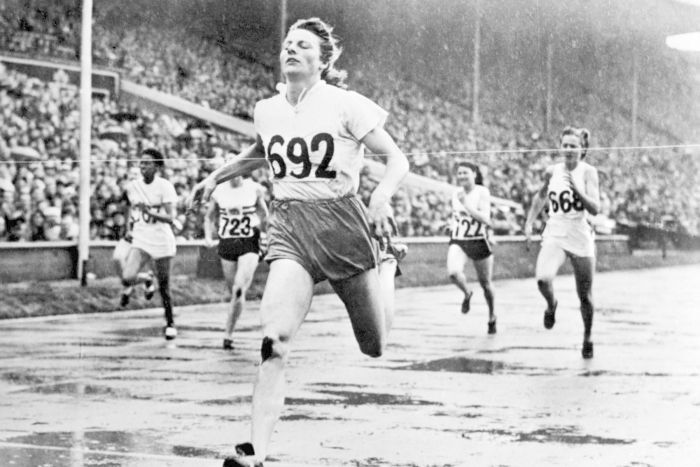
MOTHER COURAGE: Fanny Blankers-Koen’s four golds in London did a lot for women in sport.
THE FLYING DUTCHWOMAN
Of all the performances that dazzled, there was one athlete that could truly be called the star of the Games. Back in 1935 a 17 year-old Francina Koen dreamed of competing in the Olympic Games as a swimmer. A swimming coach told her: “We have many great swimmers in Holland but no woman can run like you.” At his advice she chose track and it turned out to be the right decision. She would be coached by Jan Blankers and represented the Netherlands in track and field at the Berlin Games of 1936, finishing 6th in high jump and was part of the Netherlands’ 5th-place 4*100m relay. However the biggest highlight of those games was meeting four-time gold medalist Jesse Owens and getting his autograph. It would remain her most cherished possession.
After the 1936 Berlin Games, Fanny would soon become the top woman in track and field winning meets and setting world record. However World War II would cause the 1940 and 1944 Olympics to be cancelled. During the time in between she married Jan Blankers and would come to be known as Fanny Blankers-Koen. She continued training for the Olympics during the wartime. Even after she gave birth to two children, they would eventually become involved with her training regimen. Her athletic activity would help her and the Blankers family to thrive despite the harsh conditions of World War II. Despite it all, most people looked down upon Fanny for her training for sport instead of being a full-time housewife. We shouldn’t forget that woman athletes didn’t have a favorable impression at the time.
Fanny was one of the 390 female athletes competing in seven sports here in London: less than 10% of the total number of athletes at these Games. Here in London she was to compete in four events. She knew this would be her best chances for Olympic gold in her career as her peak years occurred during the cancelled Games of 1940 and 1944.
Her first event in London was the 100m dash. She easily won her heat and semi-final. She won the final in Olympic record time. Her second event was the 80m hurdles. At the finish of the final, it appeared that Fanny and British runner Maureen Gardner hit the tape together both in Olympic record time. The playing of God Save The King by the band let to further confusion. It was then revealed that Blankers-Koen won by inches and the playing of God Save The King was because King George VI and family entered the stadium. Then came to 200m. She won her heat but homesickness set in before the semifinal and she cried to her husband. Her husband Jan was sympathetic and reminded her if she continues on, she will equal Jesse Owens’ feat of four golds. She continued on and won the 200m with the widest margin in Olympic history. Then came the 4*100m relay to which Fanny was to run the anchor leg for the Netherlands. At the time Fanny took the baton, the Netherlands was in 3rd place but Fanny made up the distance by driving the Dutch team to victory. Like her idol Jesse Owens, Fanny won four gold medals: the first female athlete in Olympic history to do so in a single Games. She would later be dubbed the ‘Flying Housewife’ and ‘Mother Courage’. She still remains one of the best female athletes of all time, ranking her amongst the greats like Babe Didriksen and Jackie Joyner-Kersee. After the London Games, she returned to Amsterdam to a hero’s welcome even bigger than the celebrations at the end of World War II. Her feats were best summed up by one journalist: “Holland has won four gold medals in athletics and Fanny has been a part of them all.”
The 1948 Olympic Games closed in Wembley Stadium on August 14, 1948. 64 years have passed since these London Games but its importance has never withered over time. These Games took place twelve years after the last Olympic Games and a mere three years after World War II had ended. These Olympics showed that even years after such a brutal global war and even while many of the world’s nations–even Great Britain itself– were still trying to recover from the damage, the human spirit can triumph again in sports competition. They also showed that Baron de Coubertin’s dream of the world gathering together once again and competing harmoniously in friendly competition can be revived successfully.
It is because of this that the London Games of 1948 left its biggest legacy that is still admired today. I don’t know of any other Olympic Games that have been able to make such a significant statement. It is because of this that I consider the London Games of 1948 to be the best Summer Olympics ever. Not necessarily for the sake of the sports achievements or the level of competition, but what it meant for the world and for the Olympic movement. To think Lord Burghley declared at the Opening Ceremonies: “A visionary dream has today become a glorious reality. At the end of the worldwide struggle in 1945, many institutions and associations were found to have withered and only the strongest had survived. How, many wondered, had the great Olympic Movement prospered?” These London Games showed the world how.

 ITALY: It’s hard to believe a team with one of the biggest football legacies of four World Cups has only won a single Euro. It was all the way back in 1968, and after both semifinals consisted of major controversies. In fact Italy’s case was they played a scoreless draw against the Soviet and there wasn’t a penalty kick system like we have now. So a coin-toss was used to decide Italy’s win! Since 1968, they have made it to the final twice: in 2000 and 2012. The Forza Azzurri have always been one of the most dazzling teams in the world, but they can also end up being one of the most unpredictable teams too. There have been many times in tournaments when even if they didn’t win, they would go further than expected. However there are times when Italy has delivered below pre-event expectations. That has especially been the case after they won the World Cup in 2006. However it was right after their failure to qualify for the 2018 World Cup that it was aware there had to be changes not only in the team, but the Italian football system.
 ENGLAND: Hard to believe this is the first-ever Euro final England has made it to! It’s just as surprising as their one World Cup, which was won in 1966 in old Wembley Stadium. Euro 2020 would be poetic if they won their first Euro in the new Wembley Stadium. Yes, it does seem like England’s win of the 1966 World Cup has made them a one-hit-wonder in football. England has almost always fielded the national team with the most talent and the most skill combined. However its inability to go far on the international stage has almost always seems to be the team not being able to come together and play as a team unit. That often seems to be the case. Ever since their World Cup win, the best England has done at the World Cup was two fourth places. Also the best they ever did at Euro was a third place.
 ITALY: Italy is a team that went from a national embarrassment to success in most recent years. We’re talking about a nation with one of the world’s biggest football legacies with three World Cup and winning Euro 1968. However recent years after their most recent World Cup win in 2006 would soon expose some of Italy’s weaknesses. They failed to win a game at the 2010 which they were defending World Cup champions and found themselves out in the Group Stage. Another out in the Group Stage happened at the 2014 World Cup. 2016 failed to redeem them as they were out in the quarterfinals of the Euro that year. And them World Cup qualifying. Italy was in Group G which was won by Spain. With Italy being second in the group, they were given a playoff chance where they were drawn against Sweden. The first game, that was played in Sweden, the Swedes won 1-0. The second game was to be in Italy, which seemed to assure they would take it. The whole game went scoreless and Sweden was the team going to the World Cup. World Cup 2018 was only the third World Cup without the Italian team present!
 SPAIN: Spain is a team that for a long time has been commonly known as ‘football’s greatest underachievers.’ They have always been a team loaded with talent, but couldn’t seem to deliver during the biggest events. Then something changed around the late-2000’s. Spain won their second Euro in 2008. Could it be that Spain could win the World Cup in the near future? The World Cup in 2010 answered that with a big “Yes!” It started off with a loss on their first game, but game after game was win after win up to winning the Cup. Spain continued their success with a win of the 2012 Euro and runners-up at the 2013 Confederations Cup. Then the downfall. At the 2014 World Cup, Spain became the latest defending champion to be out in the Group Stage. Further humiliation came when Spain was out in the Round of 16 at Euro 2016 and the Round Of 16 at the 2018 World Cup.
 DENMARK: Normally you don’t think of Denmark as a football superpower. I mean they only competed in their first World Cup in 1986 and their best World Cup finish has been the quarterfinals all the way back in 1998. However Euro tells of bigger success. This is Denmark’s fourth time ever in the Top 4. Past success includes a third-place in 1984 and a win in 1992. Denmark did have a downturn in their success as they failed to qualify for the 2014 World Cup and 2016 Euro. Things changed after they were taken on by Norwegian manager Age Hareide. In qualifying for the World Cup, Denmark finished second in their group against Poland, was pitted against the Republic of Ireland in their playoff matches and won 5-1. Denmark would then go on to finish in the Round of 16. After that was the switch to a Danish manager, Kasper Hjulmand, who has helped make the improvements in the team.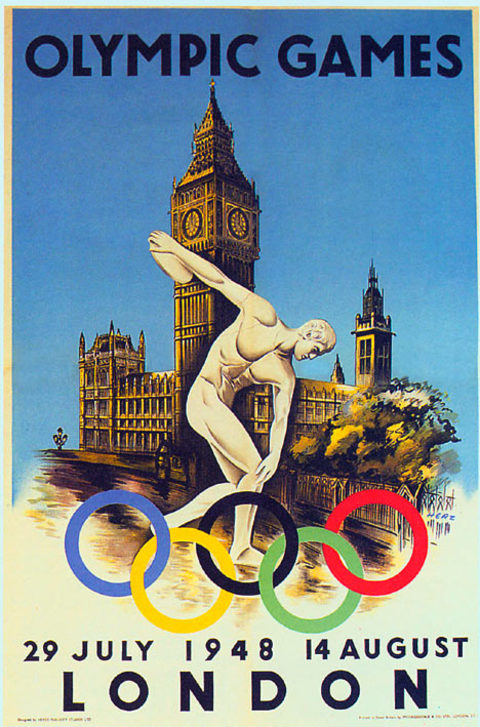
 Jon The Blogcentric