World Cup 2014 Preview: Group A

Those of you that have known my writing over the years have  known that when I do soccer blogging of major events, I do a rundown of the teams that will be competing. Some of you may have guessed I’d be doing it again for the World Cup, and you are right. However I’m doing a separate blog for each of the eight Group Stage groups. So much to preview, so little space. With this being my first blog of the upcoming World Cup, then it’s no question the first blog will be done on Group A. For the record, my summary of  the teams will be done in their drawn World Cup order rather than their FIFA ranking of May 2014. FIFA ranking of that month will appear in brackets.

GROUP A:

Brazil-Brazil (4)-No other country has as much of a football legacy as Brazil. Brazil is the only country that can boast competing at all nineteen past World Cups and the only country to have won the World Cup five. The World Cup arena has been an excellent showcase of Brazilian football at its best and it has inspired the world around. However we’ve also seen Brazil choke at times, especially in recent competitions. Just ask France. They’re known as Brazil’s ‘achilles heel’ and have handed Brazil some surprising defeats including the 1998 world Cup final and the 2006 World Cup quarterfinal. In both cases, Brazil was the defending World Cup holder. Brazil’s recent chokes were more humbling as they choked to the Netherlands in the 2010 World Cup quarterfinal and at the 2011 Copa America, they lost their quarterfinal in what was Brazil’s worst-ever Copa America performance.

Brazil can’t take any chances at this World Cup more than any World Cup. They’re the host country and all the world expects them to win. They especially want to rid their compatriots of the 1950 ‘Maracanazo,’ which I will talk about in another blog. Yes, Brazil may have won the World Cup more than any other country but of the eight countries that have won the World Cup, Brazil and Spain are the only ones to fail to do so as host country. Brazil hopes to end this ignominy this time around. After their Copa America debacle, they sacked their coach in favor of Luiz Felipe Scolari who helped coach Brazil to its last World Cup in 2002. The return to Scolari has paid off as Brazil won last year’s Confederation Cup defeating reigning World Cup holders Spain 3-0. Since the return of Scolari, Brazil’s overall record has been excellent losing only twice: to England and Switzerland. No doubt they’ll face huge pressure but the Confederations Cup proved that Brazil is back in action and ready to deliver.

Croatia ficed-Croatia (20)- If you were to do a pound-for-pound rational of football teams, Croatia should rank amongst the top. Croatia is one of only two countries in FIFA’s current Top 20 with a population of less than 5 million . Uruguay being the only other country. Ever since their independence in 1991, Croatia has proved itself a formidable force in football, especially at the 1998 World Cup where they finished third. However that was the last World Cup where they even advanced past the Group Stage. 2002 and 2006 appearances didn’t pan out and a failure to qualify in 2010 almost made the Vatreni’s glory a thing of the past. However Croatia is looking to mount a comeback. In 2012, they signed on a new president in Davor Suker, himself a former great as the top goalscorer at the 1998 World Cup. The role of manager was replaced by former team captain Niko Kovac. The team successfully qualified for the World Cup. They also have a good mix of talent from veterans like Darijo Srna and Luka Modric and fresh young talents like Dejan Lovren and Mateo Kovacic. Croatia is one country that’s very capable of causing a surprise.

Mexico-Mexico (19)- Mexico is without a doubt the best team in the CONCACAF as far as legacy goes. No other North American team has qualified for the World Cup as often. However its greatness has appeared to have alluded them in the past couple of years. They failed to advance past the Group Stage of last year’s Confederations Cup, they lost to Panama in the semifinals of the CONCACAF Gold Cup and almost missed  qualifying for the World Cup in a qualifier against Costa Rica where they trailed 1-0 after 80 minutes. Two goals in the last 10 minutes kept them alive where they’d go on to beat New Zealand for the wildcard berth. Mexico has made efforts to make their near-loss to Costa Rica a thing of the past. They have not lost a game since but they have come across some tight ties like a scoreless draw against Nigeria and even a 2-2 tie against the US last month. Mexico hopes to be ready for Brazil. Miguel Herrera is one tough coach who favors home grown talent over talent from European leagues. That could be the factor that could either spell success or failure. Only the World Cup stage will decide that.

Cameroon-Cameroon (50)- Older people may remember Cameroon as the team that came from nowhere in 1990 to win 1-0 against defending champions Argentina. Cameroon charmed the world that year by reaching the quarterfinals and becoming the first African team to do so. However their glory appears to be a thing of the past. Cameroon has not advanced past the Group Stage since. This time around doesn’t show too much promise. They do have a German coach, Volker Finke, and have good talent in Samuel Eto’o and Alex Song but they do face a heavy battle in group play. Already this year, they’ve had mixed results with a 5-1 loss to Portugal and a 2-0 win against Macedonia. Nevertheless it’s too soon to judge. I’ve seen teams where nothing was expected of them and they’d advance far.

STADIUM SPOTLIGHT

This is a new feature. This is where I get to focus on the various stadia that are hosting the World Cup. I figure the arenas are worth talking about. Brazil has twelve stadia that will facilitate for the World Cup: seven just opened within the past year. The crazy thing is how the Group Stage play is organized. Usually in most cases at a World Cup, the country would have organized certain Group Stage groups playing at a set stage of stadiums. In Brazil’s case, a country with twelve stadiums may have three stadiums in cities close to each other to host the Group Stage games of two groups. Division that simple. Brazil has done it weird. All twelve of the stadiums will hold four Group Stage matches but they will be matches for four different groups. Additionally, all six of the Group Stage games for each individual group will be played in six different stadiums, and not all will be that close by. That will mean a lot of traveling around for the 32 teams, especially in a country of over 3 million square miles.

It’s confusing but hopefully it won’t interfere with the play as badly as the vuvuzelas did at the last World Cup. As for stadiums, Brazil has twelve good stadiums. Five are old and traditional but renovated in time. Seven are new built especially for the sake of hosting the World Cup. Here I’ll give you my first taste of my Stadium Spotlight. Note that each stadium I show in my Stadium Spotlight feature will be a stadium that will contest Group Stage matches for each respective group. These two I will focus on will host Group Stage matches in Group A. So without further ado, here are the two stadiums in focus:

-NATAL: Estadio das DunasDunas
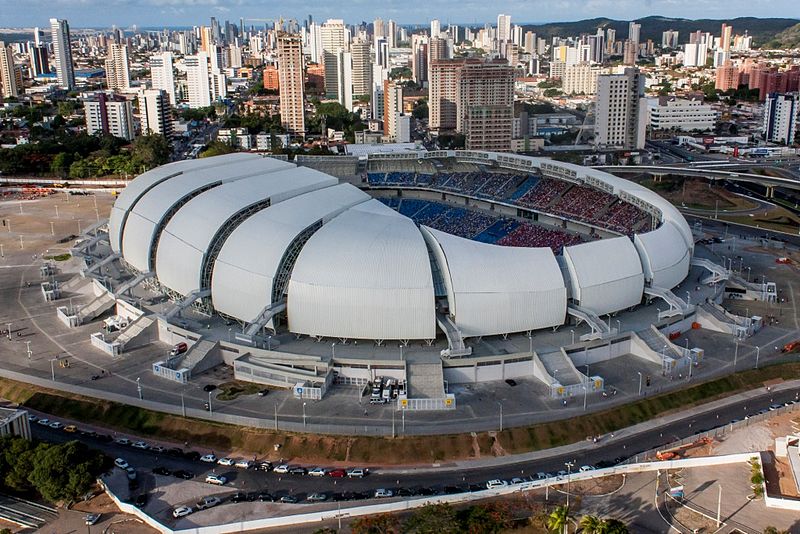
Year Opened: 2014

World Cup Capacity: 42,086

World Cup Groups Hosting: A, C, D, G

One of seven new stadiums built especially for this World Cup, the most unique thing of the stadium is definitely the roof. While Brazil had made headlines with difficulties of building and completing stadiums in time for the World Cup, this stadium however earned praises from FIFA not just for the stadium itself but for development of areas surrounding the stadium which I will talk about later. This stadium finished in good time and officially opened this January. After the World Cup, the stadium capacity is to be extended to 45,000 seats and to be the stage of home games for both the America Futebol Clube and ABC Futebol Clube. The area surrounding the stadium has planned a shopping centre, commercial buildings, hotels of international standard and an artificial lake.

-MANAUS: Arena AmazoniaAmazonia
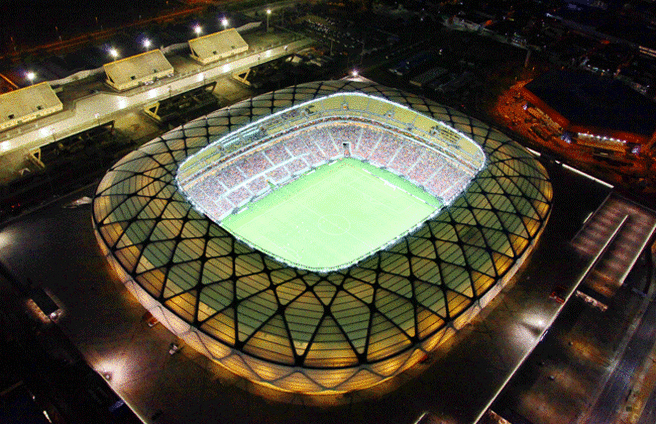
Year Opened: 2014

World Cup Capacity: 42,374

World Cup Groups Hosting: A, D, E, G

There was some criticism from England’s manager Roy Hodgson about Manaus hosting World Cup matches. He should watch his tongue as England will be playing the very first World Cup match of his group there, against Italy. This was one new stadium that actually was under question whether it would be ready for the World Cup. The stadium has been completed and was officially opened in March. The stadium has a full capacity of 46,000 and is to be the host stadium of Nacional FC after the World Cup, replacing the now-demolished Vivaldao Stadium.

And there you go. My first preview of the World Cup teams and stadiums. As for predictions, I’ll just settle for predicting the two countries that will advance past the Group Stage right now, and I predict it will be Brazil and Croatia.

Seven more groups and ten more stadiums to review before World Cup 2014 starts. Stay tuned for more.
Sochi 2014: Making Press For More Than Just The Games

The Sochi Olympics has made news who won what medals. And a lot more.

DISCLAIMER: I’ll admit that I originally planned to post this blog on the day of the opening ceremonies. In retrospect, I’m glad that I waited until the halfway point because I learned more about them in the last while.

The Olympic Games are being held in Sochi, Russia from February 7th to 23rd. 2800 athletes from 88 countries will be competing in the 98 medal events in fifteen different sports. In this, I will look at the city of Sochi, the new events, what Russia and especially Putin plan to get out of these games and the side-news that has been making headlines before the Olympics.

SOCHI THE CITY:

Sochi is a city in Russia with a population of 420,000. Sochi sits at the foot of the Sochi River on the east coast of the Black Sea just 20 miles north of the Russia-Georgia border with the Caucasus Mountains on the horizon. The city had been formed over various years of wars and conquering tribes. It was after both  the Caucasus War and the Russo-Turkish War that was ceded to the Russians back in 1829. British intervention would occur in monitoring the weapons of the war. The Fort of Alexandria would be constructed in 1838 at the mouth of the Sochi River. That would later have an impact on forming the city. Many more forts would be set up close to the Fort of Alexandria including the Fort Dakhovsky. Fighting would continue until the end of the Caucasus War in 1864.

Starting in 1866 people of various ethnicities settled around the coast of the Black Sea. In 1874 the first Russian Orthodox church was built on the former Fort Dakhovsky and the settlement was renamed the Dakhovsky Posad. The Sochi Lighthouse was built in 1890 and the Dahkovsky Posad renamed themselves the Sochi Posad and incorporated themselves into the Black Sea governate. Sochi opened its first sea resort in 1909 and the town was granted full town status in 1917. Then came the war between Russia and Georgia. The war ended in 1923 with Sochi declared Russian territory. Joseph Stalin helped promote Sochi as a fashionable resort. After the fall of the USSR, Sochi has been promoted in Russia as the capital of summer.

THE GAMES AND THEIR HOPES:

These Olympic Games cost $51 billion to build: $39 million more than originally anticipated and more than any other Olympic Games in history. This was not only for the sake of building more facilities for hosting events. This also included telecommunications improvements in the region, power infrastructure upgrades, transportation improvements on all means of transportation, over 10,000 additional hotel rooms and six additional post offices.

The Olympic sites have been divided into two clusters: the Coastal Cluster inside the town and the Mountain Cluster into the Caucasus Mountains. The Coastal Cluster consists of the Olympic Park containing the Olympic Flame, the Fisht Olympic Stadium, two hockey arenas, a figure skating arena, a speed skating oval, a curling centre, the Olympic village, and the International broadcasting centre. The Mountain Cluster–located in the area called Krasnaya Polyana or ‘Red Hills’–consists of five venues including a Nordic skiing complex, a ski jumping centre, an alpine resort including an extreme park for snowboarding and freestyle skiing, a sliding centre and an Olympic village.

This isn’t all completely in vain for the sake of these seventeen days, or at least they’re not intended to be. The city of Sochi is expecting to make big improvements and grow considerably after the Olympic Games. Fisht Olympic Stadium plans to be continued as a football facility after the Olympics and is even one of the venues for the 2018 World Cup. The city of Sochi itself is signed on to be host of the Russian Formula 1 Grand Prix from 2014 to 2020. The RusSki Gorki ski jumping hills are to be used as a training facility for jumpers and two smaller hills for youth training are planned to be added after the Games. The ski hills at Rosa Khutor have been designed by a 1972 Olympic champion and plan to be part of future World Cup seasons. In fact Vladimir Putin is hoping to have Sochi become a winter resort that can compete with the resorts of France, Switzerland and Italy. In fact Putin had a conversation with one world leader where he said: “The rich travel to France and Switzerland to go skiing. Why not Krasnaya Polyana?”

Even as shown in the Opening Ceremonies, the Games hope to present a positive picture of Russia especially since it has made a lot of bad news in terms of politics, social problems, alcoholism, poverty, crime and even terrorism. Putin is hoping to improve ties with other countries. Putin is also hoping to improve the family structure in Russia with declining birth rates. Putin is also hoping these Games will stimulate the Russian economy. Let’s hope those $51 billion pay off, Vlad.

Even for venues planned for just those seventeen days, they too have post-games uses planned for them. The Bolshoi Ice Dome, the biggest of the hockey/skating venues, has plans for further ice events and concerts. Shayba Arena is a temporary hockey venue which is planned to be dismantled and shipped off to another city. The Iceberg Skating Palace has two post-games options of remaining an ice arena or a cycling velodrome. The Adler Oval for speed skating is slated to be an exhibition centre after the Games. The Ice Cube Curling Centre plans to stay a sports facility but can be moved to another location. Whether the plans will follow through and whether they will pay off in the end is something only the future will tell.

NEW TO THE PROGRAM:

Back in Vancouver there were 86 events. Here in Sochi there were an additional 12 events added to the program:

  • Figure Skating Team Event-There will be three mixed events where both men and women compete together contested for the first time here in Sochi. The Figure Skating Team event consists of ten countries competing in both short programs and free skates of men’s singles, ladies’ singles, pairs and dance. Points are based on the country’s entry’s placeage in each program. Team with the highest total of points wins the gold.
  • Freestyle Skiing Halfpipe (men and women)- The halfpipe event that’s one of the highlights of the snowboarding events have now been added to freestyle skiing.
  • Slopestyle events in snowboarding and freestyle skiing (men and women)- It’s like skateboarding on snow. Consists of first skiing or boarding on rails and then doing daring jumps off the three kickers. Points are scored on difficulty and execution.
  • Snowboarding Parallel Slalom (men and women)- Since 2002, snowboarding has had the Parallel Giant Slalom where two racers are paired together for two runs with last racer standing as winner. This Olympics marks the debut of the Parallel Slalom with tighter turns. Same method of deciding the winner as the Parallel Giant Slalom.
  • Biathlon Mixed Relay-two women on each team ski and shoot for 6 km, two men ski and shoot for 7.5 km. Not even cross-country skiing has a mixed relay.
  • Luge Team Relay-the relay consists of a men’s singles sledder going down first, touches a touch-sensitive pad that releases the gate for the next sled, the ladies’ singled sledder, to go down and then she touches the pad to let the men’s doubles sled go. The team with the fastest combined time wins.
  • Women’s ski jumping (normal hill)-You may remember before the 2010 Vancouver Olympics there was a brouhaha about getting Women’s Ski Jumping added to the Olympic program. The IOC decided the event wasn’t competitive enough to be added to those Games. Since then the event has become competitive enough to be added to the Olympic program. Women will compete in one event: the normal hill.

GAMES PROBLEMS:

With every Olympic Games come problems and they will get a lot of notice in the months leading up to an Olympic Games. Same with Sochi and there were two issues that received huge notice:

PUTIN’S ANTI-GAY LAWS

The administration of Vladimir Putin has not sit well with the many human rights groups on various issues but the biggest firestorm in the last few months came because of recent laws passed against the GLBT population and didn’t appear to make tourists immune to those laws. The laws were the prevention of distribution of “propaganda of non-traditional sexual relations” to minors, which effectively makes it illegal to suggest that gay relationships are equal to heterosexual relationships or to distribute material on gay rights and even bans gay pride parades. The media has reported of an arrest of a gay rights activist and an increase in ‘hate crimes’ against the GLBT population including against GLBT minors.

The laws have been protested against a multitude of people including GLBT rights activists and their supporters, famous celebrities like Lady Gaga and 27 Nobel Prize winners from arts and sciences. Putin has responded to the pressure by saying that GLBT tourist during the Sochi Olympics will not be under threat. Some heads of state chose not to come to these Olympic Games allegedly because of the laws. Thomas Bach wants to keep the Olympic arena free of politics just like past presidents of the IOC and has even threatened to ban athletes who protest the laws. As harsh as that is, we shouldn’t forget we’re dealing with the same IOC that punished the two black sprinters from 1968 that gave the ‘black power’ salute on the victory podium. I’m sure most of you know the story. Bach has responded back to the protests both in pre-Olympic announcements and in his speech during the opening ceremonies: “Have the courage to address your disagreements in a peaceful, direct political dialogue and not on the backs of these athletes.”

My Personal Vent: Personally I wasn’t happy about all those protests over Putin’s anti-gay laws. Now, don’t get me wrong. Yes, it is a problem. However it’s one of a whole whack of human rights problems inside the Russian Federation under Putin right now. The GLBT community isn’t the only set of people being hit hard or legally punished in Putin’s regime. Remember the free speech problem many months ago involving feminist punk band Pussy Riot? Even that’s one of many. The reason why I found it irritating is because I saw it as another case of the GLBT community ‘hijacking’ issues. Much the same way they ‘hijacked’ the issue of Eminem’s lyrics in 2000 while the GLBT people were one of many groups of people verbally slammed in Eminem’s records. And how they ‘hijacked’ the bullying suicides issue in 2010. It didn’t last as recent suicides from bullying involving non-GLBT teens like Amanda Todd and Rehtaeh Parsons reminded the public that bullying suicides occur indiscriminately. I don’t have a problem with pre-Olympic protests but I do wish other groups of people were just as loud at speaking their concerns rather than GLBT activists hogging the show.

ETHNIC CIRCASSIAN DISSENT:

A bit of a history lesson. The Circassian peoples used to have the area around Sochi and the Krasnaya Polyana as their own centuries ago. Unfortunately most Circassians were killed during the genocide and ethnic cleansing of the Russian-Circassian War from 1763 to 1864. Today there are 900,000 ethnic Circassians in Russia.

Some Circassian groups objected to the Games being held on land that was held by their ancestors before the war. There are two other factors that also leave many Circassians unhappy with the Games. One is the fact the Games are being held in 2014 which coincides with the 150th anniversary of the end of the Russian-Circassian war. The second being events held on the Krasnaya Polyana which were named the ‘Red Hills’ because of the bloodshed of a group of Circassians that attempted to return to their homes in a bloody battle in 1864.

Reactions amongst Circassians have been mixed. Some demand the Games be moved outside Russia unless Russia apologizes. Some accept the Games but want symbols of Circassian history be included the same way indigenous culture was included in past Games like Vancouver in 2010 and Sydney in 2000. There has been no response as to what has been done in this matter.

THREATS OF TERRORISM

The threat of terrorism has been taken seriously since the death of 11 Israeli athletes at the 1972 Munich Olympics. Sochi is located in an area prone to terrorism. It’s located close to a set of provinces in the North Caucasus such as Chechnya, Dagestan and Ingushetia to name a few. A lot of them have been fighting over their rights of their ethnicity and of their religion. Chechnya has been in the news the most firstly because of the First Chechen War that occurred between 1994 and 1996 just as Russia was defining itself in the post-USSR era. Wars have continued and Putin has responded with many human rights group call brutal force.

Islamic Chechen terrorists have declared a jihad and created a lot of terrorism since the First Chechen War which first started with hotel bombings in Russia in 1999 and has consisted of many incidents since. Most within the past five years like numerous car bombs, an express train bombing, Moscow subway bombings, an attack on Chechen parliament, a bombing at Moscow’s international airport and even links to last year’s Boston Marathon bombing.

The Chechen Islamist commander Dokka Umarov called for an attack in the Games back in July 2013 stating that the Games will be held: “on the bones of many Muslims killed.” Athletes that were to compete before the Games and many national Olympic Committees received threatening e-mails from terrorist groups threatening to blow them up. It got to the point the US ski and snowboard agency hired a private security agency to protect them during the Games. Even the US government added to the scare a week before when they talked about the possibility of ‘toothpaste bombs’ that can be made in tubes of toothpaste of 100ml or more.

Security during these Games will be handled by 40,000 law enforcement officials including police and the Russian Armed Forces. Putin even signed a Presidential Decree at the beginning of the year declaring that any protest in Sochi or the surrounding areas be approved by the Federal Security Services. There’s also an unmanned aerial vehicle squadron with defense rockets to protect Olympic airspace. There are four gunboats along the Black Sea to protect the coastline. Forces are also set up along the Russia-Georgia border and even the US has agreed to lend Navy ships and other assets for security purposes.

The closest thing to an incident was on February 7th during the opening ceremonies when a Pegasus Air Line from Kharkiv, Ukraine to Istanbul, Turkey was hijacked by a person claiming to have a bomb and wanted it flown to Sochi. The plane arrived at its destination in Istanbul and the passenger was arrested with no weapons or bombs found on the place. Since then there have been no incidents occurring.

The Sochi Olympics sure made a lot of news in the months leading up to their opening. They are currently making news mostly for the good in the days of competition held. The Games end on February 23rd with the Paralympics opening on March 7th. It remains to be seen whether the Games will pay off, whether they will continue to run smoothly without incident and whether Sochi and Russia itself make improvements in the months and years after.

WORK CITED:

WIKIPEDIA: 2014 Winter Olympics. Wikipedia.com. 2014. Wikimedia Foundation Inc. <http://en.wikipedia.org/wiki/2014_Winter_Olympics>

Sochi 2014: Seven Canadians To Watch

Canada Olympic

You all remember Vancouver 2010. Canada won the most ever Winter Olympic golds in a single games with 14. Canada is not the host nation for the Winter Olympics anymore. That pressure now belongs to Russia. Nevertheless Team Canada will face pressures of its own over in Sochi both as individuals and as a team. One thing we should take into account is how some countries perform in the Olympics after they were host nation. Below is a chart of host countries and their various medal hauls. The #/# guide is golds/total medals:

Olympic Chart 1

As noted in that chart, some get better like Canada in 1992. Some still stay the same and some do noticeably worse like Japan in 2002 and Italy in 2010. Sports Illustrated predicts Canada to win a total of 31 medals including eleven gold. That’s an awful lot but not impossible.

In the meantime, here’s a look at some Canadians favored to do well in Sochi, if not win:

Patrick Chan – Figure Skating: Canada has a proud legacy in figure skating. So proud you could say figure skating is rightfully third behind hockey and curling as our national sport. Our legacy is there. Canada has also left every Winter Olympics since 1984 with at least one medal in Figure Skating. Canada is one of only five countries to win twenty or more Olympic medals in figure skating. We have Olympic champions in three of the four returning figure skating categories. The only one we don’t have is in the Men’s Singles event. Four bronze medalists, two double-silver medalists but never a gold medalist. This could finally be the year.

Patrick Chan has Canada’s best chances. He’s been national champion since 2008 at the tender age of 17, a world Championships medalist every year since 2009 and a World Champion three times starting in 2011. He has looked good this season, winning two of his three international competitions this year losing only the Grand Prix of Figure Skating.

He has looked good in practice here in Sochi and appears confident he will win. However he will have rivalries from Kazakhstan’s Denis Ten who finished behind him at last year’s Worlds and Russia’s Evgeni Plushenko who’s making a comeback. Also expected to challenge is Spain’s Javier Fernandez and Japan’s Yuzuru Hanyu: the latter two of which are coached by Canadian double-silver medalist Brian Orser. In fact it was Hanyu who gave Chan his only defeat this year at the Grand Prix back in December. So will he be the first Canadian men’s champion or the seventh medalist? It will all be decided on the 13th and 14th.

Erik Guay – Alpine Skiing: Remember the Crazy Canucks? Yeah, Canada had an impressive legacy in Alpine Skiing on both the World Cup circuit and the Olympic Games in decades past. Nancy Greene, Kathy Kreiner, Ken Read, Steve Podborski, Kerrin Lee-Gartner, we all remember them. Problem is it seems like it’s all in the past. The last Olympic medal was a 1994 bronze in Men’s Downhill by Ed Podivinsky.

Canada’s top bet to get back on the Olympic podium is Erik Guay. Guay is 2010 World Cup winner in the Super-G and 2011 World Champion in the Downhill. This year he has ranked in the Top 3 in the men’s downhill on the World Cup circuit. However he was sidelined temporarily in January due to a minor knee injury. But he’s confident he will be ready to perform on February 9th. Actually Erik is not the only Canadian alpine skier with good chances to win a medal. Healthy medal chances also come with Marie-Michele Gagnon who is currently ranked fourth in World Cup standings in the slalom and just won her first ever World Cup race–a super-combined event–just last month in Austria. Will a new generation of Crazy Canucks arrive in Sochi? The Rosa Khutor Alpine Resort will set the stage.

Alexandre Bilodeau – Freestyle Skiing: Alexandre isn’t just simply the first Canadian to win gold during Vancouver 2010. He’s the first ever to win gold on Canadian soil as the 1976 Summer Games in Montreal and the 1988 Winter Games in Calgary failed to produce a Canadian Olympic champion.

Since Vancouver he has made many public appearances and has graduated from college. His competitive drive has not deterred. He has won moguls silver at the past two World Championships and has already won three of the six moguls events on the World Cup circuit. He is a big favorite to win at what he says will be his last Olympics but his top challenge will come from fellow Canadian Mikael Kingsbury who is 2012 and 2013 World Cup winner in moguls, World moguls champion in 2013 and has won the other three World Cup events from this year. In fact Sports Illustrated predicts Kingsbury to win gold and Bilodeau to win silver. The stage for Canadian vs. Canadian will take place February 10th.

Charles Hamelin – Short-Track Speed Skating: There’s a lot of talk for the possibility of the first ever Canadian four-time Olympic champion. One possibility, actually three, is in women’s hockey which I will talk about later. Another possibility is in men’s short track speed skating with Charles Hamelin.

You could say that short track is in his blood. His younger brother Francois was part of Canada’s gold medal-winning relay and his father Yves is the current national director of the national short track team. Hamelin has had an illustrious career which includes two Olympic golds from Vancouver and a silver from Turin in 2006 as well as 26 World Championship medals, eight of them gold. In fact at last year’s World Championships, Hamelin was part of the gold medal-winning relay and won three individual bronzes.

Charles comes to Sochi as the reigning leader in the overall World Cup standings as well as leading the 1000m and 1500m. His path to more gold will not go unchallenged. His top threats come from Russia’s Viktor Ahn and South Korea’s Sin Da-Woon. Plus there’s the sport itself which is known for its slipperiness and frequent falls. It will all be decided at the Iceberg Skating Palace.

Alex Harvey – Nordic Skiing: Skiing sure runs in the family. It was natural that Alex Harvey take up cross-country skiing. His father Pierre was Canada’s best ever cross country skier when he was competing during the 80’s. In fact I myself remember back during the Calgary Olympics Pierre was giving Canada its best-ever finishes in the cross country events. Sure they were between 14th and 20th but they were still new achievements for Canadian skiers.

Alex, who was actually born in September of that year, has taken achievement to new levels. He now has Canada’s best ever men’s finish at an Olympic Games: fourth in team sprint with teammate Devon Kershaw. He and Kershaw would become World Champions in that event in 2011. Harvey won bronze in the sprint at last year’s Worlds. This season he has won two World Cup races. Sports Illustrated predicts him to win bronze in the sprint. However he’s pressed to win Canada’s first even men’s cross country medal by teammate Devon Kershaw who finished second to Harvey in a World Cup sprint event. He will also be challenged in winning the sprint event by World Champion Nikita Kryukov of Russia, World Cup sprint leader Josef Wenzl of Germany and Italy’s Federico Pellegrino who’s ranked second in the sprints. The Laura Biathlon and Ski Complex is the stage.

The Dufour-LaPointe sisters (Justine, Maxime and Chloe) – Freestyle Skiing: It’s not uncommon that you have siblings competing together at the same Olympics. Sometimes in the same event. But three? And all three of them in the same event? That’s the case of the Dufour-Lapointe sisters in moguls: Maxime who turns 25 on the 9th, 22 year-old Chloe and 19 year-old Justine.

The first excitement came when Chloe qualified for the Vancouver Games. Bigger excitement came  when Justine won bronze at last year’s World Championships. However the excitement has been happening this year on the World Cup circuit. All six World Cup meets this year has seen at least one of the three on the podium with Justine winning two events and Chloe winning one. Currently on the World Cup circuit Justine ranks second, Maxime third and Chloe fourth. It’s possible the sisters could even sweep in Sochi. However blocking their path is defending Olympic champion, 2013 World Champion and World Cup leader Hannah Kearney of the U.S. American Heidi Kloser of the U.S. who is ranked fifth in the World Cup also poses a challenge as well as Japan’s Miki Ito who finished second at last year’s Worlds. It will all be decided February 8th.

Canada’s Hockey Team (men and women): Every Winter Olympics you can’t avoid the talk of Canada’s chances in hockey. Especially in men’s hockey. Hey, our national pride is at stake and winning it makes our OlympicsEver since NHL players were allowed to compete for the first time back in 1998, it’s always the challenge to prove themselves first among at least six equals. But we’ve succeeded with wins in 2002 and back in Vancouver. However we’ve found ourselves off the podium in 1998 and ousted in the quarterfinals in 2006.

Team Canada’s 24 members are all NHL players and eleven were part of Canada’s gold medal-winning team from 2010. Sidney Crosby who scored the ‘golden goal’ back in Vancouver is the captain this time. Team Canada has failed to win a World Championship medal ever since Vancouver but is predicted by Sports Illustrated to win bronze. They face challenges from 2013 World Champions Sweden whom SI predict to win and from the home country of Russia. It will all be decided at the Bolshoi Ice Dome by the 23rd.

As for the women, Canada has very good chances to win gold again. If they do, three women–Haylee Wickenheiser, Caroline Ouellette and Jayna Hefford–could become the first Canadians to win four Olympic golds. However their top rival as always is the United States. In fact the U.S. beat Canada for the 2011 and 2013 World Championships. It’s just a question of which of the two will take it on the 20th. Or a question of if a European team will upset. It’s possible.

So there you go. Those are some Canadians to look for at the Sochi Games. I know they’re more than seven but I couldn’t resist adding more. Besides people who like my Olympic writing probably don’t mind anyways. Besides since I wrote about the athletes from around the world yesterday, I figure you were due some Canadians.

They should provide for a lot of great moments and more national heroes. Interesting how ever since the 90’s Canada has become a superpower in winter sports like Austria and Norway. Before them we either had a lousy winter and a good summer or a good winter but a lousy summer. There have been one or two years where we had both a lousy winter and summer but that’s in the past. Anyways let the Games begin!

Sochi 2014: Ten To Watch

Olympic Flame

I can tell that a lot of my visitors liked my blogs to do about the London Olympic Games. Heck, the last time someone clicked on one of my ‘athletes to watch’ blogs from those games was just today! Even my blogs reviewing the London Games of 2012 and the other two times still received recent hits. Seeing that has inspired me to do more Olympic writing. And it definitely inspires me to write about these ones to watch for the Sochi Games of 2014.

I know there’s been a lot of talk about outside factors involving the Sochi Games. In this blog I’m sticking to talking about what the Games are supposed to be about: the athletes. Here are ten athletes who are poised to dazzle us or even thrill us from February 7th to the 22nd.

-Marit Bjorgen/Norway – Nordic Skiing: Norway has won more Winter Olympic medals than any other nation. And it’s no wonder. Winter sports are in their blood with their biggest legacies in Cross Country Skiing, Ski Jumping, Nordic Combined and Long Track Speed Skating. Even recently they’ve been showing excellent prowess in Alpine Skiing and Freestyle Skiing. One of the best female skiers ever, Marit Bjorgen, will be competing in her fourth Olympics here in Sochi.

Marit has an illustrious career starting quietly with silvers in 2002 and 2006. Vancouver 2010 was her moment as she won five medals, three of them gold. She has also won the overall World Cup title three years and nineteen World Championship medals including twelve total gold. At last year’s World Championships, she really had the show in her hands as she won four gold and a silver.

Here in Sochi, she comes with probably the most expectations of any female Nordic skier. She’s expected to perform big and has the credentials for it. However she does face rivalry. She is currently ranked third in the World Cup overall standings with her 25 year-old Norwegian teammate Therese Johaug leading in the distance events and 25 year-old German Denise Herrmann leading in the sprint events. She’s also expected to receive rivalry from her traditional rival Poland’s Justyna Kowalczyk. Nevertheless if there’s one female skier who can most rise to the challenge, it’s her.

-Ted Ligety/U.S.A. – Alpine Skiing: The United States has always been a force in Alpine Skiing. This century has seen a lot of big names like Lindsay Vonn, Bode Miller and Julia Mancuso. Another name on the list is Ted Ligety. At the 2006 Olympics, Ted came from nowhere to take gold in the combined event. Since then he has been most dominant in the giant slalom event but has had seasons with ups and downs. He was finished on top of the World Cup giant slalom event in 2008, 2010, 2011 and 2013. However he had a lackluster 2010 Winter Olympics where his best finish was fifth. 2013 not only saw him win his fourth World Cup giant slalom title but a third place finish overall and winning three gold medals at the World Championships.

Interesting is that he has his own ski business. As for this season, it hasn’t been so easy for Ted. He’s had four World Cup wins but finds himself fourth overall and third in the giant slalom. He faces a strong challenge from Austrian Marcel Hirscher and France’s Alexis Pinturault in the giant slalom. It will all boil down on each race day. Especially the giant slalom on February 19th.

-Tina Maze/Slovenia – Alpine Skiing: Slovenia has never won a Winter Olympic gold medal. Two silvers and five bronzes but never a gold. That could change thanks to Tina Maze. She has had an excellent career as a skier that includes Slovenia’s two silvers, both won in Vancouver 2010, and six World Cham,pionship medals. Two of them gold. However her biggest year was 2013 when she won three World Championship medals including gold in the Super-G and the World Cup overall title which she won with the highest total points ever.

This season has been a difficult one for her as she has struggled in consistency in races and it wasn’t until just two weeks ago she finally won her first World Cup race of the season: a downhill. She will be hard pressed to repeat her winning with threats from Germany’s Maria Riesch-Hoefl and 18 year-old American sensation Mikaele Shiffrin. Also it may be possible Slovenia’s first ever Winter Olympic gold could be won by another athlete like ski jumper Petr Prevc or snowboarder Žan Košir.  Nevertheless the Olympics can be anyone’s game in Alpine Skiing and it just could be Tina’s.

-Shaun White/U.S.A. – Snowboarding: What else is there to say about the ‘Flying Tomato?’ His has definitely been one of the most popular Winter Olympians in recent years, if not the most. He has won numerous X Games medals, he has made the cover of Rolling Stone twice and is commonly seen in endorsements. Already he has made Olympic history as the first snowboarder to win back-to-back gold medals, in the Halfpipe event. This year is a unique year as he will be trying for a threepeat in the halfpipe.

Shaun has been absent for the 2013 World Championships but has continuous won events in X Games competitions. He is expected to win the halpipe again but he does however face some hungry young guns like Switzerland’s Yuri Podladchikov and Japan’s Taku Hiraoka trying to take him down.

He was also expected to be a top contender in the new slopestyle event this year. However it was not to be as he fell days ago after hitting the rail hard during a training run and was injured. He chose to withdraw from that event but reassures all that he will be ready for the halfpipe. However there have been other boarders who suffered falls on the course at the Rosa Khutor Extreme Park and their injuries caused them to withdraw before even competing and two even requiring hospitalizing. His fate will be decided on the halfpipe on the 11th.

-Shani Davis/U.S.A. – Long-Track Speed Skating: The threepeat in Olympic Long Track Speed Skating is a feat only accomplished twice and by women. First was by American Bonnie Blair in the 500m from 1988 to 1994. The second was Germany’s Claudia Pechstein in the 5000m from 1994 to 2002. We have the chance for a male to do it here in Sochi with Shani Davis.

Davis has been a speed skater known for a controversial career. First came before the 2002 Winter Olympics when he was a short track speed skater. He finished second in a race at the US Olympic trials but it was under investigation of race fixing between him and club teammates Rusty Smith and Apolo Anton Ohno. It was taken before a court of arbitration and none of the skaters were found guilty. Davis however would not skate in Salt Lake City.

Davis would later switch to long track speed skating and became the fastest at the 1000m. For the 2006 Turin Olympics Davis qualified for three individual events and won gold in the 1000m and silver in the 1500m. However it was his non-participation in the Team Pursuit event that caught a lot of flack. Many people felt he should’ve been put on but David neglected making room for some skaters who were just competing in pursuit. The incident has kept him being at odds with U.S. Speedskating. Under less controversy, Davis again won 1000m gold and 1500m silver.

Here in Sochi, Davis is expected to win 1000m and become the first man to win three consecutive golds in a single event. It’s not without its challenges. At last year’s World Championships, he finished third behind Kazakhstan’s Denis Kuzin and South Korea’s Mo Tae Bum. However Davis has won the 1000m in three of the four World Cup meets this year. Plus he is still strong in the 1500m winning silver at last years’ Worlds. It will all be decided at the Adler Oval.

-Germany’s Luge Relay Team: There are five new events at the Sochi Winter Olympics. One of which is the Team Relay event in the luge. In this event there’s one male luger, one female and one doubles team. Each have a single run but when one luger finishes their run, they hit a touch-sensitive pad to open the start gate for the next sled of the team. Fastest total time wins. It should be no surprise that Germany is the team expected to win. German lugers have won 27 of the 40 gold medals in luge since it was added to the Olympics back in 1964. Germany also won all three singles and doubles categories at last year’s World Championships. So it’s no surprise they won the Team Relay at those championships too using the sledders that won the single-sled competitions in the relay.

One thing we should take note is that the relay will take place the day after the last single-sled competition–men’s doubles–will be held. It is possible that the three World Championship-winning sledders–Felix Loch in men’s singles, Natalie Giesenberger in women’s singles, and the doubles team of Tobias Wendl and Tobias Arlt–could either win gold or be Germany’s best finisher in their respective event and thus on the relay team. But anything can happen in the heat of Olympic competition and there could be a different German competitor that finishes best on the team. Whatever sledders they include in the relay, you can be sure they’ll win it.

-Kim Yu-Na/South Korea – Figure Skating: Those of you remember the Vancouver Winter Olympics will remember a figure skater from South Korea named Kim Yu Na. She not only won gold but took figure skating to a new level of excellence with new world records in points. She became the first South Korean to win a figure skating medal.

Continuing after the Vancouver Olympics has not been easy. There was period for the first few years she lacked motivation and even sat out the 2011-2012 season. By the 2012-2013 season, she decided to return not just to competition but to her childhood coaches back in Korea. It was successful as she returned to her title of World Champion winning by the biggest margin since the new scoring system was adopted in 2005.

However the 2013-2014 season has been rather challenging. She actually had to drop out of the Skate Canada competition because of a metatarsal injury on her right foot. She recovered in time to compete at the Golden Spin of Zagreb competition in December and won. Nevertheless she’s expected to be rivaled by Japan’s Mao Asada who won silver behind her in Vancouver, 15 year-old Russian newcomer Julia Lipnitskaya who just won the European Championships and American Gracie Gold. Kim plans on becoming a member of the IOC after the Sochi Games. In the meantime, she has one last thing to prove in the Olympic stage.

-Sara Takanashi/Japan – Ski Jumping:  Women’s Ski Jumping makes its debut in Sochi. There will be only one event: the Normal Hill. The heavy favorite to win is 17 year-old jumper Sara Takanashi. Last year she won the World Cup in women’s Ski jumping and won a silver medal in the Normal Hill event losing to American Sarah Hendrickson. This year Takanashi has had a stellar year with ten international victories including her most recent wins last weekend in Austria.

Despite her stellar year, she is not alone at the top. She’s expected to receive a challenge from American Sarah Hendrickson who beat her at the World Championships as well as challenges from Austria’s Jacqueline Seifriedsberger and Germany’s Carina Vogt. Nevertheless it will all be decided at the RusSki Gorki Jumping Centre. Watch herstory be made February 11th.

-Tatiana Volosozhar & Maxim Trankov/Russia – Figure Skating: You can’t expect a list of athletes to watch not to include those from the host country, can you? Russia has a legacy in pairs figure skating going back as far as the days of the U.S.S.R. It all started with the Protopopovs in 1964 and 1968. It continued with Irina Rodnina and her male partners from 1972 to 1980. Continuing on in 1984, the dominance continued even after the break-up of the U.S.S.R. as pairs competing for Russia would continue to finish on top. By the 21st century it looked like Russia’s dominance was waning as a Russian pair tied a Canadian pair for the gold in 2002 and the Russian pair that won gold in 2006 was the only Russian pair to even make the podium. Then in Vancouver 2010, not a single Russian pair made it on the podium for the first time since 1960.

With the Sochi Olympics coming, you could bet they want to bring Russia back on top in pairs figure skating and they found it in the pair of Tatiana Volosozhar and Maxim Trankov. Back at the Vancouver Olympics, they not only skated with different partners but different countries. Maxim finished in 7th competing for Russia and Tatiana finished 8th competing for Ukraine. She then made the trip to Russia shortly after Vancouver when it became obvious there were no male partners in Ukraine for her to progress further. Since her teaming up with Trankov, it’s been victorious as the two won world Championship silvers in 2011 and 2012 and then won the World last year: the first Russian pair since 2005 to win the World Championships.

This year the pair have been solid winning all but one of the five competitions they’ve entered. They come to Sochi as the heavy favorites and the ones to bring Russian superiority back to pairs figure skating. However it will not go unchallenged as their top threat has been their traditional rivals of Germany’s Savchenko and Szolkowy who were World Champions in 2011 and 2012 and have given the Russians their only loss this season. Nevertheless it will all be decided at the Iceberg Skating Palace on the 11th and 12th.

-Russia’s National Hockey Team (men and women): I’m sure all of you can remember the days of Soviet dominance in ice hockey. Ever since the U.S.S.R. started competing at the winter Olympics in 1956, their hockey team was invincible with players that were better than even the best NHL pros. In the ten Winter Olympics they played, they won eight times losing only to the Americans in the two Olympics the U.S.A. hosted in 1960 and 1980. Since the Unified Team’s win of the gold in 1992, Russia has since found itself amongst equals in the hockey world but have not returned to the top. Since Russia first competed on their own starting in 1994, the men’s hockey team have only won 1998 silver and 2002 bronze with the gold medals divided amongst Sweden, Canada and the Czech Republic.

This time Russia has the whole nation expecting them to win here. And I mean whole. Even Vladimir Putin told Aleksandr Ovechkin that he wants to see Russia’s team win the gold. Sixteen of the 25 members play for the NHL. Other NHL stars on the team including Ovechkin are Evgeny Malkin and Pavel Datsyuk. The other nine players are from Russian professional leagues. They come to Sochi as 2012 World Champions and they’re expected to repeat here, even though they finished off the podium last year. It is possible as the men’s competition is usually a competition of at least six equals. Sports Illustrated predicts Sweden to win with Russia coming in second and Canada third. Only the next two weeks will tell the tale.

As for the women, women’s hockey has traditionally been a case of Canada vs. the U.S. with one other Scandinavian team as a lightweight rival. Russia has only competed in three of the four times women’s hockey has been contested and has never made the semi-finals. The women are hoping things will change especially after winning bronze at last year’s World Championships. The women have nowhere else to go but up and I’m confident they can make their country proud here.

So there you have it. Those are ten athletes to watch out for in Sochi. I know they’re not guaranteed to win. I know the Olympics that the gold medal doesn’t go to the one with the most pre-Games accolades. The gold medal goes to the one who’s the most there at that moment. Nevertheless it will be interesting to see whether they seize it or not these two weeks.

Also those of you wondering why no Canadians on my list? Well I have a separate blog of Canadians to watch.

Philip Seymour Hoffman: 1967-2014

PSHI wasn’t planning on posting this. Actually I was planning my next blog to be another Best Picture review. Instead I post this because of how shocking it is. And of how much I admired him and his works.

Philip was born in Fairport, New York (just outside of Rochester) on July 23, 1967, one of four children to family court judge Marilyn O’Connor and Xerox executive Gordon Hoffman. His parents divorced when he was 9. Hoffman’s past-time in high school was wrestling but switched to acting after a neck injury caused him to quit. Talent was noticed at a young age as he was selected at 17 to attend the 1984 theatre school at the New York State Summer School Of The Arts in Saratoga Springs. He graduated from Fairport High School in 1985 and attended the Circle in the Square Theatre’s summer program. He would go on to attend New York University’s Tisch School Of The Arts and graduated with a BFA in 1989. Soon after he had a bout of alcohol and drug addiction which we would attend rehab for shortly after and eventually overcome.

He made his acting debut on television acting in a 1991 Law & Order episode. His first film role came in 1992’s Scent Of A Woman. Minor roles in film continued for Hoffman over the next few years. In 1995 he joined the LAbyrinth Theatre Company where he staged and performed in numerous productions. However his breakthrough came in 1997 when he had a scene-stealing supporting role as Scotty J. in Paul Thomas Anderson’s Boogie Nights. Hoffman would act in three more Paul Thomas Anderson movies: 1999’s Magnolia, 2002’s Punch Drunk Love and 2012’s The Master. Over the next few years, Hoffman’s reputation as an actor would grow with more excellent performances in independent films like The Big Lebowski, Happiness, The Talented Mr. Ripley, and  State And Main. He also showed he could act well in popcorn films like Patch Adams and Almost Famous. In theatre, he would earn a Tony Award nomination for Best Actor in 2000 for playing Lee in the readaptation of Sam Shepard’s True West.

Further excellent performances continued for him in films like Love Liza (which was written by his brother Gordy), Owning Mahowny and the TV miniseries Empire Falls. He also continued to do come off well in box office fare like Cold Mountain and Along Came Polly. Theatre accolades would continue with his second Tony nomination coming in 2003 for his supporting performance in Long Day’s Journey Into Night. However big critical acclaim in film. kept on alluding him until 2005’s Capote. There he was to play Truman Capote in a biopic directed by former Tisch classmate Bennett Miller. He was even said to act in character even after scene shooting ended.  It was there where Hoffman won the Academy Award for Best Actor for his performance. And Miller received his first and so far only Best Director nomination.

Things became better for Hoffman commercially as he would play villain Owen Davian in Mission Impossible 3 months later. In 2007 he received Golden Globe nominations for Best Actor in the independent comedy The Savages and Best Supporting Actor for playing Gust Avrakotos in Charlie Wilson’s War opposite Tom Hanks. It’s his role in Charlie Wilson’s War that would earn him his second Oscar nomination. Hoffman would return as an Oscar nominee the following year in the Supporting Actor category again as Fr. Brendan Flynn in the film adaptation of the Broadway play Doubt opposite Meryl Streep and Amy Adams.

Hoffman would continue acting in film, both independent and commercial. He would also continue acting and directing in theatre. He wouldn’t get too much notice or acclaim over the next two years but his work continued to be consistent. He would again steal scenes in 2011’s The Ides Of March and Moneyball as frumpy Coach Art Howe. 2012 was another big year for Hoffman as it would be acclaim in both his theatre and his film acting. On stage he blew Broadway crowds away during the summer with his performance of Willy Loman in Death Of A Salesman and played controlling yet charismatic religious leader Lancaster Dodd in The Master. 2013 would give him more exposure to the commercial movie crowd as he entered into the Hunger Games trilogy as Plutarch Heavensbee in 2013’s Catching Fire. He had already finished playing Plutarch in the first Mockingjay film and had just finished most of the shooting for the second as of February 1st.

Outside of acting, Hoffman shied away from the spotlight. In 1999, he statrted dating Mimi O’Donnell. It would prove to be a permanent union and both he and Mimi had three children. He was open about his past alcohol and drug abuse from which experienced upon graduating from Tisch. He said of his experiences: “I abused anything I could get my hands on and I liked it all.” He recovered successfully and would describe himself as a teetotaler from his past experience but a relapse would eventually happen. In May 2013, he openly confessed to abusing heroine and prescription pills and checked himself into a rehab clinic for ten days.

On Sunday February 2nd, Hoffman was found dead by playwright and friend David Bar Katz in the bathroom of his Manhattan office apartment. A hypodermic needle was found in his arm according to the police. Heroin was also found in the apartment. He was 46 years old.

I hate to bring up the topic of tabloid gossip at a time like this but that topic is unavoidable. Especially when a famous actor dies in such a way. There’s no question in the weeks and months after, there will be a lot of questions about this. There will be some journalists who will want to interview Mimi O’Donnell or close family relatives about this situation. Cast mates of past movies will also be questioned. Even the rehab clinic Hoffman has been attending since his relapse will face its fair share of journalists. I myself am shocked to hear of that. Years ago I read his IMDB profile and it said he does not drink alcohol because of his past experience with alcoholism. I was happy feeling that there was an actor that can be free from scandal. I never knew about his relapse. This is especially surprising since you normally hear about such deaths of actors hugely in the public eye. And Philip was the opposite. He was mostly private, rarely attended A-list events, had friends who were mostly in theatre rather than in the Hollywood business, had an unmarried relationship to the same woman since 1999 and raised his kids quietly. I guess we’ll only know the whole story in the future.

One thing to say is I don’t want to focus on the surroundings of his death. Even though I feel like asking ‘What happened,’ I’ll keep my mouth shut for now. One thing I will say is that I will always admire Philip Seymour Hoffman for the actor that he was. I’m able to separate myself from actors as actors and actors as people. Whenever I admire actors, I admire them for their acting jobs. They’d have to give me a good reason for me to admire their lifestyle. Anyways Philip Seymour Hoffman was an excellent actor. He really knew how to embrace the character both physically and emotionally. He was more than a top character actor, he knew how to make the roles multidimensional. I’ve seen many of his performances and he never let me down once. He always delivered.

I’ve always considered Philip to be one of the best actors of my generation. I also must confess I was secretly predicting and hoping that Philip would  be the next Tom Hanks. It just showed how naive I was to the present acting system. There was a time when an actor had the ability to be both a master of their craft and a top box office draw. That was common form the 30’s to the 60’s. Then there was a time in the 70’s when the big money-winning movies and the serious films had a gap between them that really widened in that decade. With that came a bigger gap between the on-screen craftmasters and the money-winning A-listers. That was especially noticeable in the 80’s. The reason why Tom Hanks was so beloved was that he was one of those rarities who was able to deliver in their craft and bring in top box office dollar.

I felt that Philip had the potential to do just that. I just wasn’t aware at the time of the types of actors that were able to win over the box office dollars. Turns out it’s back to being a looks thing again. Especially in the wake of the Twilight movies. I should know that 5′ 10″ and slightly pudgy won’t make you an A-lister. In fact one New York journalist summed up the physical appearance of Hoffman as: “a stocky, often sleepy-looking man with blond, generally uncombed hair who favored the rumpled clothes more associated with an out-of-work actor than a star.” That was just his nature. He was more interested in being an actor than a star.

Like I said Philip never let me down. Whether it was a role in a popular popcorn movie or if it was in a serious independent production, Philip always delivered. Even his co-stars would vouch for that. I believe that’s the legacy Philip will leave behind. Character acting performances that he didn’t just play but embodied and he knew how to grab your attention. I will always admire him for that.

Rest In Peace, Philip Seymour Hoffman. And thank you for captivating us over the years.

WORK CITED:

WIKIPEDIA: Philip Seymour Hoffman. Wikipedia.com. 2014. Wikimedia Foundation Inc. <http://en.wikipedia.org/wiki/Philip_Seymour_Hoffman>

2014 World Cup Group Stage: Luck Of The Draw

The stage was set Friday to decide the eight First Round groups for next year's FIFA World Cup in Brazil.
The stage was set Friday to decide the eight First Round groups for next year’s FIFA World Cup in Brazil.

You could say it took a lot to determine the 32 countries that qualified for the 2014 FIFA World Cup: thirty months, six confederations, 204 countries or teams, 820 matches, and a total of 2303 goals to decide the 31 berths up for grabs. Finally on November 20th, all thirty-one berths up for contention were all decided. However deciding the eight groups of four for the Group Stage was also another tricky matter. Yeah, just when you thought it would get easier.

Yesterday, the eight First Round groups were decided at the Costa de Sauipe resort in Bahia. It was broadcast live around the world. I myself saw the live telecast at 9am my time. The draw to form the eight groups for each World Cup involves a process with a lot of thought: four countries per group with continental separation. That would mean each continent other than Europe would have only one of their countries in a First Round group. Europe by means of fielding thirteen berths this World Cup would have a maximum of two countries per group. That’s always been the case since the World Cup expanded to 32 countries back in 1998.

The respective continent’s confederations contested their matches conducted their own qualifying format for deciding their qualifiers for the World Cup. There were even two countries that qualified via a ‘wildcard’ berth where they’d have to play a team from another continent twice. The thirty-two qualifying countries were all decided more than two weeks ago. Seeded teams which I will talk about later are in italics:

  • Host Nation: Brazil
  • South America: Argentina, Chile, Colombia, Ecuador, Uruguay
  • Europe: Belgium, Bosnia-Hercegovina, Croatia, England, France, Germany, Greece, Italy, Netherlands, Portugal, Russia, Spain, Switzerland
  • Africa: Algeria, Cameroon, Ghana, Ivory Coast, Nigeria
  • The CONCACAF (North and Central America, Caribbean): Costa Rica, Honduras, Mexico, U.S.A.
  • Asia: Australia, Iran, Japan, South Korea

That list of qualifiers does provide for some interesting notes. Australia has played for the Asian confederation (AFC) since 2006 because of its superiority in Oceania’s confederation (OFC). Also Spain, the defending World Cup nation, still had to play qualifying matches as the defending World Cup team no longer qualifies its own automatic berth: a FIFA rule in effect starting with the 2006 World Cup.

Dividing the groups into four teams of appropriate continental separation would include something else involved: a seeded pot. Host Brazil was already allocated to Group A: a FIFA regulation in effect starting with the 2006 World Cup. Each of the other seven groups would have to have one of the teams amongst the Top 7 of FIFA’s World rankings from October 2013. In order from 1st to 7th, they were:

  • Spain
  • Germany
  • Argentina
  • Colombia
  • Belgium
  • Uruguay
  • Switzerland

There always was a seeded pot for drawing groups for the World Cup that would involve a complicated system involving a multitude of ranks, previous World Cup places and other factors. This time around the seeding was just on that one FIFA ranking list. Sure, it was odd to see countries normally not amongst the top seeds like Belgium and Switzerland in the mix but finally creating a seeded pot was that simple.

The pots meant for continental separation amongst the groups were not that easy. One easy element was that Pot 3 consisted of teams from Asia and the CONCACAF: continents that both fielded four berths. As you could tell, the seeded pot consisted of three South American teams and four European teams. That’s where complications and confusions would arise as Pot 2 would consist of Africa and South America. Pot 2 ended up with seven countries since three of South America’s five berths were seeded teams. Pot 4 consisted of the nine non-seeded European teams. So how do you solve this problem of those pots with the continental maximums?

Yeah, explaining continental limits and parities is easy. Making it happen in the groups this year is the hard part. So FIFA under Sepp Blatter decided to make the following procedures to even it up:

  • Draw one European team from Pot 4 and place into Pot 2 for four even pots of eight with the teams assuming the first position of their group.
  • Draw from Pot 1 to decide the first teams for Groups B to H.
  • Draw amongst the four seeded South American teams and place the drawn out team in auxiliary pot  ‘Pot X’ for the sake of continental separation.
  • Place the European team drawn out of Pot 3 with the South American team from Pot X.
  • Draw from the remaining pots to determine the other qualifying teams.
  • After the Pot 1 teams were drawn, draw the positions of the teams of the other three groups as the draw goes group by group.

Yes, it’s hard to make sense. It’s hard to explain. And it’s hard to make it all work out. It’s not like the last World Cup where there were five seeded European teams and you’d easily have a European pot of eight. Nevertheless it was accomplished. The European team from Pot 3 that was drawn out first was Italy. The seeded South American team that was put into Pot X was Uruguay which was already drawn to Group D. That would mean Uruguay and Italy would both be in the same group. The remaining teams would also be drawn out evenly.

So after all that confusion and fretting, all the First Round groups were drawn out. The parity and continental separations took place as FIFA wanted it: maximum two European teams and maximum one team from the other continents in each group. So here are the eight First Round groups for the 2014 FIFA World Cup:

Group A

  • Brazil
  • Croatia
  • Mexico
  • Cameroon

Group B

  • Spain
  • Netherlands
  • Chile
  • Australia

Group C

  • Colombia
  • Greece
  • Ivory Coast
  • Japan

Group D

  • Uruguay
  • Costa Rica
  • England
  • Italy

Group E

  • Switzerland
  • Ecuador
  • France
  • Honduras

Group F

  • Argentina
  • Bosnia-Hercegovina
  • Iran
  • Nigeria

Group G

  • Germany
  • Ghana
  • Portugal
  • U.S.A.

Group H

  • Belgium
  • Algeria
  • Russia
  • South Korea

The group set-ups sure have gotten a lot of people talking. Some people have noticed that some groups are so tightly put together, it’s hard to declare the one group to call the ‘Group Of Death.’ Some are stating it’s Group D with Uruguay, England and Italy. Some are saying it’s Group G with all four of its teams being top contenders. Some are even saying it’s Group B with their very first match—Spain vs. Netherlands—a re-contest of the 2010 World Cup finalists.

Whatever the situation, all 32 teams have to be ready to face their Group Stage opponents and put their best foot forward if they want to advance and be the last team standing that wins the 2014 World Cup. The world will be watching from June 12th to July 13th. I myself will be doing group-by-group reviews on my blog in the weeks leading up to the start. Stay tuned for more action.

Next Winter Olympics Marks Women’s Ski Jumping Debut


On Wednesday, April 6th, it was made official mention by the International Olympic Committee. Six new events will be added to the Winter Olympic program and one of which will be Women’s Ski Jumping.

For those who were living in Vancouver, this was a big news story before the 2010 Winter Olympics were to begin. Of the fifteen sports to be contested at the Vancouver Olympics, two of which–ski jumping and nordic combined– would not have women competing. This was disheartening to many young women who were competing in ski jumping, including at the 2009 World Nordic Championships. IOC president Jacques Rogge had always maintained the it was due to the level of the competition. It was not competitive enough and not World class enough. Many of the young women complained it was discrimination. In fact some even pointed to Canada’s Charter Of Human Rights, which prevents gender discrimination. They tried in three different courts to get their case heard and it was always the same result: While it was discriminating, the IOC decision overrides any other court. There was definitely disappointment. World Champion Lindsay Van of the USA made things look bad for them by describing the Canadian justice system as ‘weak’ and the IOC as the ‘Taliban.’

Just before the IOC was to announce new events for the 2014 Winter Olympics in Sochi, Russia, the World Nordic Championships were held again this year. The entries in the women’s ski jump event went from 36 women from 13 countries in 2009 to 43 women from 15 countries this time. The competition results were a lot stronger this time too. Then came the official announcement from the IOC of the new events added to the Winter Olympic programs.  Women’s Ski Jumping – Small Hill was one of the six added to the program. The announcement was greeted with celebration from the women whom some have fought as long as seven years to get it included onto the Olympic program. Some have even said Sochi may be the first gender-equal Winter Olympics. One exception is that the sport of Nordic Combined (combined event of jumping and skiing) has yet to have a women’s event.

One of the common beliefs people shared around this subject was that the International Olympic Committee was sexist. Sexism was further echoed during the Vancouver Olympics when IOC president Jacques Rogge demanded that women’s hockey up its competitive level in eight years or it will face removal. This came after Canada won a preliminary round against Slovakia 18-0 en route to a gold medal-winning final against the USA: the third USA vs. Canada gold medal final out of four Olympics contested. One thing we should remember is that the IOC wants parity amongst sports on an even level. Every sport has a demand placed of having national federations in so many countries over so many continents for Olympic eligibility. Baseball and Softball were eliminated from the Olympic program for London 2012 because of that reason. I know it was disheartened for many to see no Women’s Ski Jumping event at the 2010 Winter Olympics, especially since ski jumping has been contested since the first Winter Olympics in 1924, but it’s because of that lack of parity and competitiveness that women’s ski jumping was left off the Olympic program in 2010. In fact it didn’t even have a World Championship event before the new events for 2010 were announced. The first ever women’s competition was held in 2009. Now it had it’s chance to demonstrate again at the 2011 World Championships and it proved itself worthy of being contested at the next Winter Olympics in 2014.

Already many women ski jumper who retired after being disheartened by their losing campaign at getting an even for Vancouver have immediately come out of retirement or are now reconsidering. Lindsay Van herself said she’s taking things one day at a time. In the meantime, gender parity is one step closer at the Winter Olympics. All that remains now for full parity is a Women’s Nordic Combined. Then we’ll really have a gender neutral Winter Olympics.