VIFF 2024 Review: Frewaka

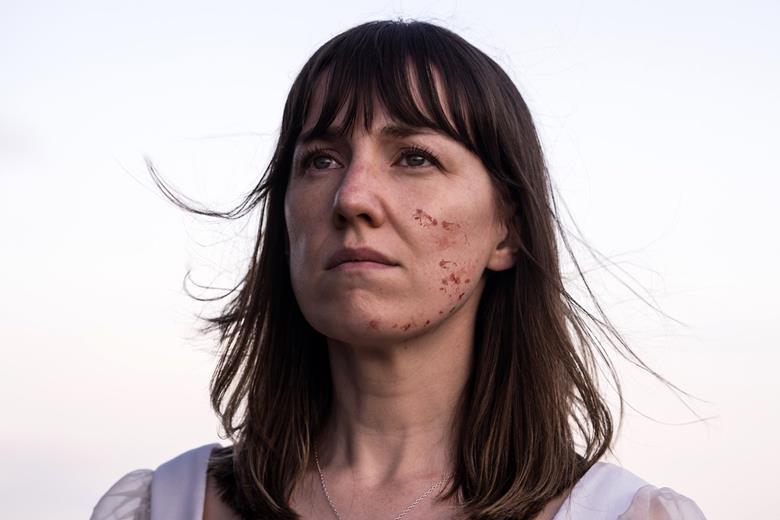
Clare Monnelly plays a student nurse who senses something troubling and beyond her control in her patient’s house in Frewaka.

It’s very rare to see a film in the Gaelic language at the VIFF. Frewaka, from the Altered States series, is that film and a lot more.

The film begins in 1973. There’s a wedding in a local village. The wedding is crashed by village locals in traditional fashion wearing straw masks. The man looks fine about it as it’s tradition but the bride, named Peig, is unhappy about something. She goes outdoors as she’s sick but she spots something mysterious about the goat. The husband tries to look for Peig but can’t find her. Only her wedding ring on the ground. Peig is missing and it begins the story of the runaway bride of the village. Cutting to the present and to a reclusive elderly woman living in an apartment full of Catholic paraphernalia. She hangs herself as one of her crosses lights up red.

The film then cuts to another story in the present of a young woman named Siobhan, or ‘Shoo,’ who has just graduated form nursing school. Shoo’s mother has just died; the woman who hung herself. Shoo clears out her place emotionless, surprising her Ukrainian girlfriend Mila. Shoo never made amends with her mother after the years of abuse. Shoo is suddenly given a last-minute assignment to do palliative care with a woman in a remote village in the North. Shoo is hired mostly for her knowledge of Gaelic as the woman doesn’t speak any English and most of the villagers only speak Gaelic as well. This may come at what should be a very inconvenient time for Shoo, but she accepts it without a problem, leaving the pregnant Mila behind to deal with the stuff.

Shoo may be hard-headed and hard-hearted towards the work she’s about to do but she senses something isn’t right about this. She first senses this as she goes to the town and asks directions to the woman’s place. Two villagers at the store tell her not to go to the house. She also notices as one farm boy from the town looks at her strangely. Then she goes to the woman’s house. The woman’s name is Peig: the ‘runaway bride’ from 1973. She’s elderly now and she’s agoraphobic to the point she won’t leave the house. Shoo senses something very uneasy about Peig’s house. It’s big with a lot of rooms, but aging, crumbly and full of bad taxidermy and various talisman. What Shoo finds most frightening is Peig’s cellar door. It’s painted red and has many good-luck symbols nailed on surrounding it. Jarring noises and phantom images come from that cellar door. Even Peig herself feels that cellar has a frightening spiritual threshold, which she refers to as ‘them.’

Looking after Peig turns out to be a frustration for Shoo. Very often, Peig goes into her dementia and won’t take her medicine. There are many times Peig refuses to leave the house, possibly fearing that something will take her away. Despite that during the time, Peig and Shoo form a bond. The bond seems positive at first, but soon Shoo is haunted by her own past memories. In that time, Shoo feels a drawing that she herself feels she must go to that cellar door to find out what’s inside. Is it the ‘them’ that Peig keeps on referring to? In addition, Shoo also senses the same haunting feeling Peig does, including a crucifix that lights up red just like her late mother’s.

Over the next days, the nursing agency is contacting Shoo about her reports of incompetence on the job and Mila is infuriated with Shoo as she feels she left her abandoned pregnant and with her late mother’s stuff to manage. But Shoo is fixated on the cellar door and the hauntings in Peig’s house. Finally she does go into the cellar and finds out what’s inside. Inside are key clues to Peig’s past, including the ‘runaway bride’ story. Shoo also discovers what is so haunting down there. Within time, Shoo herself becomes consumed by the hauntings and with the appearances of the masked villagers similar to that at Peig’s wedding and they overtake Shoo to leave a haunting ending.

It seems to be a thing now to make a smart horror film. We all remember the guilty pleasure horror movies of the 80’s and 90’s that were for to shock us, scare us or disgust us or even try to add bizarre humor to get us laughing. These past ten years, there have been a lot more smarter horror movies that are a lot like psychological dramas. Some have even made critics’ lists as the best film of the year. This film is another film that makes the attempt at becoming a smart horror film and it does a very good job. This film is also a horror film that includes a lot of cultural elements as well. We see it in the Irish folklore and Irish mythology shown in various scenes and even in villagers and their broom masks. Adding that in is what makes this horror film unique. I think every culture has some mystical spirits or mystical hauntings from old folklore.

It’s not just Irish folklore that add into the affect of horror in the film. There are also ugly pieces of Irish history. One thing that has been vocal in recent decades is how the Catholic Church mistreated people in the past. It’s also been especially vocal in how it treated women. We hear about stories with the Magdalene laundries, we hear other past abuse stories. It’s also possible that Peig’s marriage at the beginning could have been a marriage arranged with some Catholic input and something Peig could not see herself living through it. That could also explain that crucifix in the film that lights up red. Of how Catholicism is now seen more as a curse than a help in Ireland.

This is an impressive horror drama. It tells of a bond between two women who are complete opposites. One is an ailing former runaway bride. The other is a lesbian who chose her girlfriend but gives her neglect. One has lived in the village all her life and as a recluse. The other has lived in the big city her life, well-educated and speaks Gaelic well. They appear to be opposites but over time, both will show to have some things in common. Both have had abusive influences in their life. In both cases, it was religious-based. Both are haunted by the cellar door, what they think is inside the cellar and what is actually inside. As what causes Peig’s fears reveal itself, the ugly irresponsible side of Shoo is revealed. All of it just slowly unravels itself as time presses on and adds to the eerie feeling of the film and for the shock ending.

This is an impressive work from writer/director Aislinn Clarke. This is her first self-made feature since 2018’s The Devil’s Doorway. Although I have not seen it, the storyline from the premise descriptions I’ve read has some similarities with Frewaka. Here, Clarke gives another story of religious spirits haunting those around. It’s well-written and we’ll pieced together. The beginning could have been organized better but the story does make better sense as it goes along and keeps it being the thriller it’s intended to be. Clare Donnelly does a great performance as Shoo. She does very well as a woman who’s strong and stern but soon becomes consumed of what haunts the house. Also great is Brid Ni Neachtain as the elderly Peig who has lived a lifetime of being haunted and traumatized. She is very convincing in her character.

Frewaka is not just a supernatural thriller that one would see in VIFF’s Altered States films. It’s also a film that shows some unique aspects of Irish paganism or Irish occult and ugly parts of Irish history. The elements are just as intriguing as the story itself.
Movie Review: Corpus Christi (Boże Ciało)

Corpus Christi
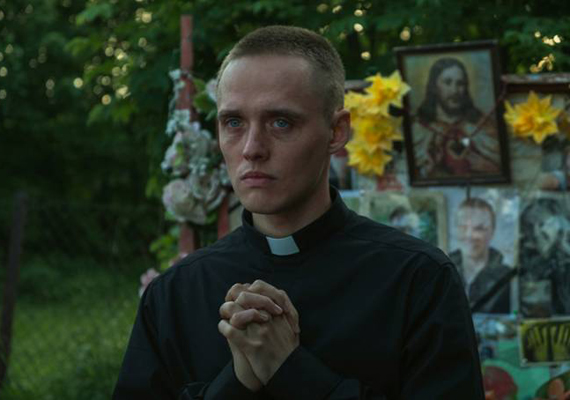
Bartosz Bielenia plays a parolee who poses as a priest in a small town in Corpus Christi.

Just around this time with the Oscars drawing closer, you would’ve thought my interest in the foreign films would be finished, right? When I saw Polish film Corpus Christi was playing, it caught my intrigue with the story. I thought it was worth seeing.

The film begins in a juvenile prison. Prisoners are prone to the same harsh actions, beatings and retaliations of other prisoners. 20 year-old Daniel knows he could be one. He killed someone when he was a teenager and was sentenced to juvenile prison, or ‘juvie’ as it’s commonly called, for manslaughter. Daniel has found a personal escape in religion. A priest, Father Tomasz, performs mass at the prison every Sunday. Daniel is the most willing participant as he even sings Psalm 23 for the mass. Every night he prays the rosary. Parole is nearing for him, which is a relief as one of his fellow prisoners named ‘Pinczer’ is threatening him. He wants to become a priest, but Father Tomasz says he can’t because of his criminal past. They’re not allowed in the seminary. As soon as Daniel achieves parole, it’s obvious he’s not ready for the priesthood as he happily does drugs and has sex at parties. He does however own a priest’s shirt.

For his parole, Daniel has to do sawmill work at a mill in a small Polish town specifically for parolees. He notices a church and introduces himself as ‘Father Tomasz’ to a young girl praying named Eliza and introduces himself as ‘Father Tomasz.’ He’s then introduced to her mother Lidia, the church secretary, and the ailing priest. Daniel is given the job to perform priestly duties. Daniel’s first mass goes excellently, and people believe him to be the temporary priest. Daniel soon notices as he walks around town people praying to a memorial to six young people. They died in a car accident which the driver hit them head-on. The image of the driver, who also died, is not on the memorial.

Over time, Daniel becomes more involved in the community with each mass he serves. He even wins the liking of the town mayor. Daniel even takes the opportunity to help those that constantly pray by the memorial to help overcome their feelings. Eliza and Lidia are among those as Jakub, Lidia’s son and Eliza’s brother, was one of the fatalities. He also notices how some people shout ‘the whore’ when dealing with their grief. He finds out people have been directing their anger to the driver’s widow. When meeting with the widow, he learns that people have been sending her hate-mail.

Daniel tries to think of a solution, but he later learns Pinczer, one of his rivals from prison who was called ‘Bonus,’ knows he’s posing as a priest. He demands 5000 Euros or else he will expose the truth of ‘Father Tomasz.’ Daniel tries to continue on as a priest and even works at making the town confront their unnecessary anger to the widow by showing them all the hate-mail they sent her. Soon her husband is given a proper burial and is attended by all: even those that lost a child in the accident. However it soon becomes apparent that Daniel’s secret will be exposed. It does happen and the aftermath becomes a case where you can watch and draw your own conclusions about the town, Eliza and Daniel.

One thing that caught my attention is that this film is based on true events. It may not be a true story, but it is of a collection of true events. Director Jan Komasa made mention in a Los Angeles Times interview that he has taken notice that there are several unordained men who have posed as priests. Many of those men believe they are doing priestly duties for the right reasons. The issue of fake priests is one that the clergy in Poland know of, but they sweep the issue under the rug. Scriptwriter Mateusz Pacewicz said in the same interview that he became very fixated about the idea of these fake priests and their spiritual passion. He even wrote a short story of it and that would lead him to write the screenplay for this film.

This is a film that will cause a lot of people with strong Catholic values to think a lot about. Some may even be outraged of a positive depiction of a fake priest. What we have here is a young man who found himself in God possibly through prison ministry. Daniel has this problem with him as he’s a killer and he’s reminded his past crimes will not allow him into the seminary. However he sees the town where he is to do his parole duties as his chance to be a priest. We should remember during his short time as a priest, he didn’t do anything to hurt the citizens of the town. He didn’t rob from the people, he didn’t disturb any masses. Instead he became a symbol of help and hope. He helped the townspeople overcome the losses they were enduring. He got the people to stop with their unnecessary hostilities towards the widow of the killer. He even helped the widow get back to being accepted rather than be the subject of a town’s wrath.

The film allows to both question and even make your own judgments about what happens in the story. First off it makes you wonder if Daniel posed as a priest because he feels he was meant to be one or to avoid an act of vengeance from the other parolees at the sawmill. It’s not made obvious but one can even sense in the film that Eliza always knew Daniel was not ‘Father Tomasz.’ I sensed that in the scene where Daniel was asked for his priest card and she says it’s in the laundry she was working with. Even that sex scene between Eliza and Daniel suggests that; an ordained priest would not have sex or else we would be forced to resign. However Eliza knew Daniel was the right man to bring peace to the town. Eliza also wanted healing along with the people of the town, including hard-hearted Lidia. Eliza felt she knew Tomasz could bring healing and was the only other person who felt making peace with the killer’s widow and allowing a dignified burial of his ashes can make the town heal.

The ending will especially get one thinking as what has happened and what has happened next for Eliza and Daniel. Even as Daniel learns after being recaptured that he was meant to be a criminal, he should be thankful he was able to be a priest and had the chance to do the right things while doing so. It’s possible being a priest during that time brought out his best personal traits while prison brought out his worst traits. It’s interesting to see that a killer who poses as a priest was the one that got the town to heal from the tragedy.

I commend the direction of the film by Komasa and the script by Pacewicz. This is a story that will keep you interested from start to finish. It has a lot to say and will allow one to draw their own conclusions of what the overall message of the film is. I don’t think the film is too critical of religion. We should remember Poland is a very religious country and the only European country where more than half of the population (65% to be exact) attends religious service at least once a month. Showing an anti-Catholic film in Poland is sure to spark outrage. I do feel both Komasa and Pacewicz were trying to make a critical statement without being disrespectful to the Roman Catholic Church. The statement being in Poland, anyone can be a priest.

Also excellent acting from Bartosz Bielenia. He did a great job as a man with immense faith but had something to hide. Eliza Rycembel was also very good at playing Eliza. She was good at knowing the truth of Daniel but being supportive in silent manner. Also very good was Alexandra Konieczna. Her best parts were the moments where she didn’t speak, but you call tell her emotions by her body language. Actually the acting from all involved was very believable and very good at telling the story. They were all very good at showing extreme emotion without going over the top.

Corpus Christi is the twelfth film representing Poland to be nominated for the Academy Award for Best International Feature Film (formerly Best Foreign Language Film).’ It was a highlight at last year’s Toronto Film Festival, it won the Edipo Re Award at last year’s Venice Film Festival, and Bielenia won the FIPRESCI Prize for Best Actor at this past Palm Springs Film Festival as well as the Best Actor award at the Stockholm Film Festival.

Corpus Christi is remarkable as it’s a film that will leave you asking more questions than giving you answers about the story. The film will also get you thinking about morality and how people judge others, or how flawed people deal with their feelings. You will be left thinking at the end.

WORK CITED:

Ellwood, Gregory. “Scammers or spiritually motivated, fake priests figure in Poland’s ‘Corpus Christi.'” Los Angeles Times. 1 Jan 2020. <https://www.latimes.com/entertainment-arts/movies/story/2020-01-01/corpus-christi-delves-into-fake-priest-trend-in-poland>