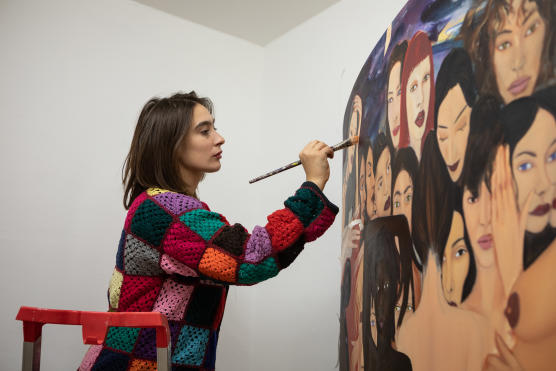
Those of you who are into the new artists may or may not know who French painter Apolonia Sokol is. The documentary Apolonia, Apolonia appears to be a documentary about Sokol, but becomes a lot more.
The film starts in 2013 as Apolonia gets herself ready for her art exhibit. The film then flashes back to 2009 when Danish film maker Lea Glob first meet the young Apolonia after just graduating from the Ecole National Superior de Beaux-Arts de Paris. She talks of her childhood of just growing up, the daughter of two actors, with her mother in an artist’s flat owned by a Parisian theatre company. She also reveals she had cancer as a child and was not expected to survive but the nuns prayed over her and she made it. As Apolonia has graduated, she decides she wants to be a professional artist. She feels it’s in her. She’s grown up her whole life around the artistic friends. Her artistic influence throughout her life is inseparable from her. Though it comes right after her professor tells her that her paintings are less interesting than her personality.
Undaunted, she starts her first works in Paris. She decides with her first paintings what her art will be about. They won’t simply be portraits of people, mostly women. She aims to get to know the subjects she paints more intimately and wants that reflected in her paintings. For painting women, she has a goal of redefining the modern woman through her paintings. She sets up her works in her flat which she continues to hold parties with many artistic types. Soon the theatre building she’s lived in her whole life is repossessed and her mother has to find a new apartment. One woman she meets from a party, a Ukrainian woman named Oksana, soon becomes Apolonia’s girlfriend and she starts living in her apartment with the mother. Oksana, who formed a feminist activist group at her college called Femen, is very understanding of Apolonia’s artistic goals, unlike Apolonia’s recent ex-boyfriend. Early in her pursuits, she has many art exhibitions in Paris and various cities in France. Apolonia continues her works just as both Oksana and her mother are living in the apartment and it makes things cramped.
It’s only a matter of time until Apolonia captures the eye of someone big in the arts world. His name is Stefan Simchowitz and he is famous for being a renowned art collector. Simchowitz sees promise in Apolonia’s works and he offers her a ‘big break’ where she can have her art viewed in Los Angeles by some of the biggest names in the art world. There is one catch; the deal includes a minimum number of paintings to create. This becomes a case of both ambition and frustration for Apolonia. She struggles with that demand with the number of paintings she tries to do simultaneously, with the expense of her flat in Los Angeles, with the expense of her painting materials, and her loved ones being thousands of miles away. When the works are finally launched on display, her works get a lot of good reviews. She also gets some critiques including one critic saying that her works look more forced than inspired.
Over time, Apolonia continues to paint and continues to showcase her works around the world in France, Denmark, other American cities, Argentina and Turkey. As her exposure grows, things become more difficult for her. She questions her artistry and if it should even submit to commercial pressures. Things also stand in the way with the relations with people closest to her. The relationship with Oksana ends and her new love is a man. She’s still insistent on not being a mother, and even has an abortion. Then in 2018 while doing an exhibit in another country, Oksana commits suicide. It breaks Apolonia’s heart, but she paints her memory in her next paintings. Then suddenly, the filmmaker herself becomes hospitalized after giving birth. Lea, the director, is not supposed to make it, but she recovers. Flashing forward to the 2020’s, Apolonia has been honored for her works by the artistic board of the French government. She reflects on all it took for her to make it to this level.
This is a telling documentary. It is very rare for a documentary to showcase an artist and their attempt to make it in the arts work from their very start to when they finally make it. As we follow the artist’s path, we can easily see why Apolonia would want to be an artist. She was surrounded by the arts and artistic people throughout her life. It eventually becomes her turn to express herself. We get a look at all the works she creates and why she paints she does. We see all the difficulties Apolonia goes through to achieve her renown such as her first exhibitions, her first contract, the cost of creating the many works expected of her, the critics she has to deal with, the sexism in the arts world, the loss of her former girlfriend. Even family situations as her father wants her to become a mother but her grandmother is fine if she doesn’t have children. It’s a long 13 year struggle that comes with the triumph in the end. Anyone who’s interested in making it as an artist should see this. It will show them a lot and remind others familiar with the arts world it’s still hard to make it as an artist. Always was.
Those who watch this documentary will also see it’s not just about Apolonia Sokol. The film is also about the documentarian herself. As she continues to film Apolonia and her life, she grows as a human. Apolonia’s emergence as a great in the world of art coincides with Lea’s emergence as a documentarian and also as she grows as a person. In a bizarre twist of fate, Lea also cheats death as she was given a low chance of surviving after her child’s birth. Just like Apolonia was given a low chance of surviving her childhood bout with cancer. Sometimes it seems the two were fated to be together.
This documentary is unique that it mixes three different stories into one and somehow pieces it together well. It first comes as a film that follows a young emerging artist as she works to establish herself. It shows the works she does, her inspiration, her free personality and the sexist hurdles she tries to overcome. It also shows her in her personal life. It shows her as she tries to establish herself as an adult and faces the pressures from family and others to find someone she can commit herself to or even the pressure to become a mother. It also shows her relationships: first with a Ukrainian woman named Oksana, then with a French man. There’s also dealing with Oksana’s suicide which hurts Apolonia to this day. Finally there’s the filmmaker herself Lea Glob. Just as Lea helps make Apolonia in her film, it becomes a case where Apolonia makes Lea. Definitely a documentary that goes beyond its original mission.
Top accolades belong to Lea Glob. From first meeting Apolonia in 2009 to constantly coming back to her to tracing her career’s biggest moments, she captures an artist in the making. She captures an artist’s soul with a fierce feminist attitude that she includes in her works. She captures the difficulties Apolonia faces to make it as an artist, especially sexism and capitalism. She captures Apolonia’s relationships with the people around her and some of the heartbreak she experiences. She also captures her own unity with Apolonia as she is also an against-all-odds survivor story too. One could joke the two may be long lost sisters!
This film has already won many a documentary award at film festivals. Among them, wins in documentary categories at the Amsterdam International Documentary Festival, Hong Kong Film Festival, the CPH: DOX Festival, the Goteberg Film Fest and the One World International Human Rights film Festival
Apolonia, Apolonia is a documentary intended to track the growth and progress of a rising artist, but it also tracks the growth and progress of the film maker herself. It’s rare to see and it captures your intrigue too.
 Jon The Blogcentric