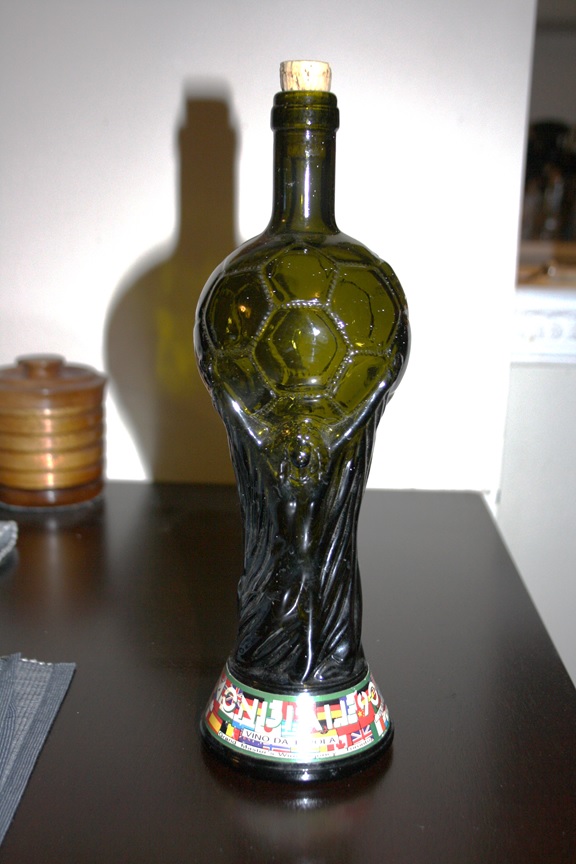
Like it? That’s an Italian wine bottle shaped in the World Cup. I got it back in 1990 when Italy hosted, and finished third.
This is the match neither of the two teams wanted to play but really have no other choice. Doesn’t it make you wonder who wins the Third-Place Match at the World Cup? The team that’s the least disheartened? Or the team that most feels they have one last thing to prove? A neat bit of trivia: the third-place match is the one World Cup match that has never come down to a penalty shootout and went into extra time only once in the World Cup’s history. Whatever the situation, the two semifinal losers will duke it out for one last World Cup shot in the Estádio Nacional Mané Garrincha.
I don’t think very many people make predictions for the third-place match. Maybe they do. Whatever the situation, I thin I’ll make a prediction for Saturday’s game. First a rundown of the two teams. Starting with past head-to-head results.
Past Head-To-Head Results: Netherlands and Brazil have squared off eleven times before: Netherlands won three, Brazil three and five draws and both teams have scored a total of 15 goals against each other. The World Cup has been the stage for four of those previous rivalries. First was in 1974 during second-round group play which the Netherlands won 2-0. Second time was in the 1994 quarterfinals where Brazil was the victor that time 3-2. Third time was the following World Cup in the semifinals where they tied 1-1 only for Brazil to win in a penalty shoot out. Fourth time was at the last World Cup in the quarterfinals where Brazil pretty much gave it away with an own-goal and Oranje won 2-1. So what does the fifth World Cup rivalry look like?
NETHERLANDS: Here’s a team that’s struggling to get their first World Cup win. Three times the bridesmaid (1974, 1978 and 2010), never the bride. Here in 2014, they were brilliant in the group stage winning all their games and humiliating defending champions Spain 5-1. They continued to look good with their 2-1 win over Mexico in the Round of 16. However there was a sign they would struggle when they played to a scoreless draw against Costa Rica in the quarterfinals. Hey, don’t underestimate Costa Rica’s defense. Fortunately their replacement goalkeeper Tim Krul was the right choice as he blocked two Costa Rican penalty kicks to help Netherlands advance to the semifinals.
Then their semifinal against Argentina. Netherlands had slightly more ball possession while Argentina had five attempts on target compared to three from the Dutch. Nevertheless it was awfully bleak for a game like that. The two were just tough rivals. So after 120 scoreless minutes, it took penalty kicks to decide. This time head goalkeeper Cillessen was kept in. However the penalty kicks from Ron Vlaar and Wesley Sneijder were no match for Argentina’s Sergio Romero. It only took a four in a row from Argentina to take them to the final.
So now that the Dutch are out of contention for the Cup, will they win this match? They have played one third-place match before back in 1998 to Croatia and lost 2-1. They have shown in plays against Argentina and Costa Rica that they can control the ball and they can control their opponents, even when they don’t score. They showed in their 5-1 win against Spain they can really seize the moment and challenge a top rival. However the fact they haven’t scored a goal since the Round of 16 really makes me question if the ‘Orange Magic’ has faded. Also who knows how hungry Brazil is? And I’ll get to them later. If they want to win, they should maintain the same control they had during the field play time they had. Also Cillessen should be on guard. Until the penalty shoot out against Argentina, he has only conceded four goals this World Cup. Natherlands has the ability but do they have the hunger?
BRAZIL: To be honest, there were actually bigger humiliations at this World Cup than Tuesday’s Mineirazo. Like defending champs Spain losing 5-1 to the Netherlands and then 2-0 to Chile to be out of the running. Or how about England failing to win a game for the first time since 1958? Even Italy being ousted in Group Stage for the second World Cup in a row is a pretty big embarrassment. Nevertheless Tuesday’s 7-1 loss to Germany right in front of a home crowd as World Cup host nation really bruised the nation’s football ego. A nation that had the biggest World Cup legacy had their current teams weaknesses exposed by Germany on a home stage and in front of the eyes of the World. And they still have to fight one last time.
No doubt this was a team that was showing signs of struggle. Coach Scolari knew the difficulties he had to deal with and team psychologist Regina Brandao really had to work with the team. The setbacks of Neymar getting his back broken and Thiago Silva being banned from the semifinal match was sure to almost everybody this would set Brazil back, but nobody expected a disaster like this.
Now that the third-place match is ahead, there may be question if Brazil will be ready physically. Neymar of course won’t be there. Thiago Silva can be eligible to play again which should be crucial as he was critical to their defense. Also the question if Fred will be on the roster especially after his bad play during the game. Also there is the big question of whether Brazil will be there for the game mentally. You can bet that between Tuesday and Saturday, Brandao will have to work better than she ever has. Of all current players on Brazil’s team, it’s probably Julio Cesar that would probably be the one most hurt mentally. He’s the one that let those seven goals in.
There have been big-name athletes and teams that would have to perform right after a humiliating performance. Some would be the all-or-nothing type and deliver half-heartedly and then there are some that would deliver for pride and come out shining despite losing it all. That’s what it would come down to with Brazil’s play on Saturday. Brazil has played three third-place matches in past World Cups and won two but this is a different third-place match for the team. We know how hurt they are but how will they deliver on their last shot for glory?
Prediction: Okay, you all know what my pick is. I’ll tell you who I think will win and who I want to win. I think it will be the Netherlands 2-1. I think Brazil might not have recovered from Tuesday’s match psychologically. Though I could be wrong. Actually I hope I’m wrong because I want Brazil to win for pride. In fact I sent the Brazilian team a tweet: “Finish the way a true athlete would and WIN ON SATURDAY!”
Update (11 July): Actually I did some thinking in the past 24 hours and even did some reading. And I didn’t let statistics get in the way, even though World Cup host nations have played the third-place match four times before and won three times. Actually I based my opinion on team attitude. That is a critical factor for the third-place match. And my new prediction is Brazil 2-1. The Netherlands lacks motivation. Coach Louis Van Gaal sees the game as pointless, Wesley Sneijders said the only match that matters is the one for the Cup and Arjen Robben has appeared equally disinterested. However the Brazilians are very motivated for this match. And rightly so. Scolari has encouraged the team to play the match out for pride and the honor of the Brazilian team. I’m sure after the embarrassment on Tuesday, that is the motivation they will need. Even the teammates agree, and Thiago Silva is eligible to play again. Go Brasil!
Brazil 2014 hoped to make the 1950 World Cup final a thing of the past. Instead it created a new bad memory of a nightmarish 7-1 loss to Germany in Tuesday’s semifinal.
“We tried to do what we could, we did what we thought was our best and we lost to a great team who ended the match with four goals scored in extraordinary manner. I’d ask the people to excuse us for this mistake. I’m sorry we couldn’t get to the final. This is a loss. A catastrophic, terrible loss. The worst loss by a Brazilian national team ever, yes. But we have to learn to deal with that. Who is responsible? Who is responsible for picking the team? I am. It’s me. So the catastrophic result can be shared by the whole group, and my players will tell you we will share our responsibilities, but who decided the tactics? I did. So the person responsible is me. I did what I thought was best. This was only our third defeat in 28 matches, even if it was a terrible defeat. Naturally, if I were to think of my life as a player, as a coach, as a teacher, this was the worst day of my life. But life goes on.”
-Luiz Felipe Scolari,
coach of Brazil’s 2014 World Cup team
It was to be another proving point for Brazil. They made it to the semifinals. It was a long three weeks. The team known as the Seleciao had moments of glory like their opening 3-1 win over Croatia and 4-1 win over Cameroon. However they have shown their vulnerability with a 0-0 draw against Mexico and a 1-1 draw against Chile where they advanced by winning the penalty kicks. Their previous game, the quarterfinal against Colombia, was another win for them: 2-1.
However despite the win, there was concern as Thiago Silva, their top defender, was given a yellow card penalty which would prevent him from playing in the semifinal. Not to mention the sudden back injury to Neymar Jr. There was talk. Will Brazil win? Can they compensate from their sudden losses? There were many that were doubtful and predicted the win to go to Germany. There were some that were optimistic like Ronaldo and coach Luiz Felipe Scolari. They still felt like Brazil had very good chances.
So the stage was set. Brazil was to play their semifinal against Germany at the Mineirao in Belo Horizonte. Just ten days earlier, they played Chile in their Round of 16 match in that same stadium. Just five days earlier, an underpass in Belo Horizonte specially created as part of a highway upgrade for the World Cup collapsed killing two and injuring 23.
The game began as expected with the two teams being led onto the field by Brazilian schoolchildren. The national anthems were played with the whole stadium engulfed in singing Hino Nacional Brasileiro. The team also gave a special tribute to Neymar who was still being treated for his fractured vertebrae.
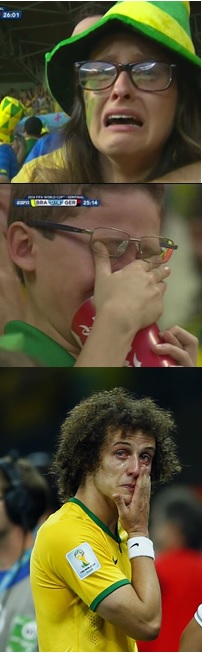
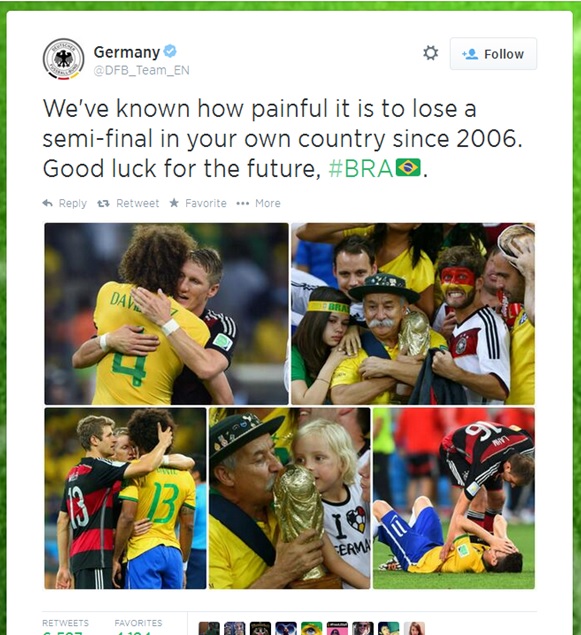
Images of Brazil’s heartbreak: (from top) young woman, young boy, and a distraught David Luiz.
Then the kickoff happened. Play went as it normally did with Brazil having much control of the ball with the occasional steal from Germany. Then in the 11th minute, Germany had a chance to score via a corner kick from Toni Kroos. Thomas Mueller gave a header into the Brazilian net. Germany drew first blood 1-0. The opposing team drawing first was something Brazil was familiar with and has won matches before with that start. Then in the 23rd minute, and attempt at a goal was sent by Germany and Brazilian goalkeeper Julio Cesar tried to stop it, only to have it bounce off him and be in a clear path for Miroslav Klose to score the second goal of the match and a World Cup record 16th goal of his career. Ironically the old record holder Ronaldo was in the stand watching.
It was obvious something was wrong and the crowd was already silent but what would soon come would be like a nightmare to the Brazilian’s eyes. Just as things were about to settle again, the ball was immediately stolen by Germany and Toni Kroos scored another goal one minute after Klose. Then two minutes later, another goal from Kroos! And both from one-touch shots. Everyone from Germans to broken-hearted Brazilians were stunned. Then just as the game looked like it would settle down soon, along came Sami Khedira in the 29th minute and scored goal #5. No doubt it was all over by then. It would take a major miracle for Brazil to win this game. Fifteen minutes would pass with the ball being shifted possession to Brazil and then to Germany. You could tell by the look on their face and the errors the Brazilians were causing that the team was panicking. Then the half-time whistle blew. It was obvious Brazil was going to lose. Heartbroken fans were already leaving the stadium.
The first minute of the second half came with substitutions for both teams. Germany only substituted one player but Brazil substituted two: Hulk and Fernandinho for Paulinho and Ramires. Later on Brazil, obviously desperate to redeem itself, gave many good attacks and attempts on goals but they either missed or were saved by German goalkeeper Manuel Neuer. At the 58th minute, Germany substituted Miroslav Klose with Andre Schuerrle. However it was only eleven minutes later when Schuerrle gave a tap-in to the Brazilian net to make the score 6-0. Several more desperate attempts to score from Brazil came but to no avail. Brazil even substituted Fred, who many described as giving the worst performance in World Cup history, for Willian at the 70th minute. Fred was given a hostile reaction from the fans as he walked off. Then right at the 79th minute, it was Schuerrle again and he gave a half-volley to beat Julio Cesar at the near-post to make it goal #7. And just when you think Germany’s given them enough, Mesut Oezil gives an attempt for goal #8 but his effort goes off wide. Then almost immediately after, Brazilian Oscar scores Brazil’s one and only goal at the 90th minute. But there was no celebrating from Oscar and very little cheer from the crowd. Even a television announcer described it as possibly the least celebrated home team goal in World Cup history.
Then Mexican referee Marco Rodriguez blew the final whistle. The score was official: Brazil 1 – Germany 7. Germany was going to the final for the Cup for a record-setting eighth time. Brazil however was just dazed and confused with what happened. Some were in tears. Some just lay on the field in humiliation and some even prayed. Some Brazilian fans booed the Brazilian team and gave them the thumbs down. Germany celebrated but kept its celebration modest. Then many German players went to the distraught players, consoled them and gave them comfort since they knew it was a moment of heartbreak for the Brazilians. That was probably the best display of sportsmanship at this World Cup and it was great to see since this World Cup had been plagued with a lot of unsportsmanlike behavior.
That game was unbelievable to say the least. Usually for a 7-1 result to happen at a World Cup game, it would be in a Group Stage match and usually between a strong team and lesser team. But 7-1 in a semifinal? And between the two countries with the biggest World Cup legacies? Even when I saw it at the Vancouver Alpen Club, I went from cheering the first goal to doubting what I saw after the second goal to having complete disbelief goal after goal. I’m sure there were lots of other Germany fans that were stunned silent like me.
No doubt this loss hit Brazil hard. This loss was also a big hit to the Brazilian National Team. No question this match resulted in some embarrassing statistics:
Brazil’s biggest loss ever in a World Cup match.
Biggest loss of any World Cup host nation.
Most lopsided semifinal in World Cup history.
Tied with a 6-0 defeat to Uruguay in 1920 for the biggest defeat of the Brazilian national team.
Brazilian national team’s first loss on home soil since 1975.
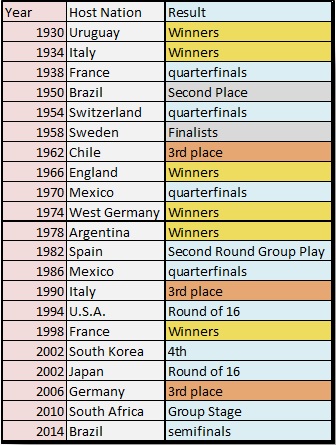
If there’s one thing that this match shows is that host nations face a pressure unique to other countries at the World Cup. Host nations of the World Cup have been big and small nations. Nations with a minor football legacy and nations that have a huge legacy. Some nations do very well and even win the Cup. However some have choked and some failed to live up to expectations. Below is a list of host nations and their results:
As you can see six host nations have won the Cup. However three have hosted a second time and didn’t win: Italy and Germany both finished 3rd in their second hosting and France lost their quarterfinal 60 years before winning as hosts. South Africa had the misfortune not just to simply lose out in the Group Stage but became the first country in World Cup history to do so. Until then, every host nation advanced past the first round.
There have been a lot of cases where even amongst host nations that didn’t win the Cup, they would have their best ever World Cup result such as Sweden being finalists, Chile finishing 3rd, South Korea finishing 4th and Mexico making the quarterfinals on both occasions. Actually until 1994, those were the only two times Mexico advanced past the Group Stage.
However there have been cases before where host nations failed to live up to par like France in 1938 and Switzerland in 1954. Spain is another example. They were hoping being host in 1982 would break their reputation as being football’s greatest underachievers. Instead it saw them being ousted in the second round of group play.
However there were many times when even in defeat, it would mark a turnaround for the country’s football team. France became a better team after their 1938 humiliation, Brazil won five World Cups after the Maracanazo, Mexico has advanced past the Group Stage every year since hosting the second time in 1986, the U.S.A. has gone from being a joke in the football world to a major contender since 1994, Japan has seen football grow since hosting and Spain became World champions in 2010.
There’s no doubt that Brazil had a lot of pressure going into the game. Heck, there was a lot of pressure on the players even before the 23-man team was decided. It got to the point head coach Luiz Felipe Scolari brought in team psychologist Regina Brandao to assess the psychological profile of 50 players for Scolari to decide the cut. However pressure was so tense during the Round of 16 match against Chile which Brazil won after penalty kicks, sever players cried prior to the shoot-out. Scolari called Brandao in immediately after to try and ease the situation before the quarterfinal against Colombia, in which they won 2-1. Nevertheless the absence of Thiago Silva because of his accumulation of yellow cards was going to affect Brazil’s defense and they knew it. Neymar being hospitalized with a fractured vertebrae during the match was another blow. Nevertheless it appeared things might not hurt Brazil so much as they continued to play consistently without them.
However that was one match and the semifinal was another. The Brazilian team appeared confident at the start but it soon became evident that something was amiss. However it was evident after Germany’s four-goal streak in six minutes that something was direly wrong. Brazil just didn’t look like Brazil anymore. You could tell the sense of panic in the faces of the players and even in some of the blunders. The goal saving by Manuel Neuer made things even more frustrating especially since Brazil delivered some great chances. Overall Brazil was better than Germany in many other statistics: 52% ball possession, 18 shots taken compared to Germany’s 14, two more corner kicks and three less fouls committed. The shots on target statistic may not look like a big deal–ten for Germany and eight for Brazil– but the final score showed that Brazil definitely had their weaknesses exposed in front of the world and on home turf. Even thinking back to their past games and the glitches they had there, I sometimes think that the loss was a collapse waiting to happen.
You may remember from my blog on 1950 how heartbroken Brazil was to the point some committed suicide. I haven’t heard of any news of suicides yet. Nevertheless reactions have been mixed. There were definitely a lot of people crying. There were also a lot of angry people: some even going as far as calling Brazil ‘losers.’ A lot of negative tweets on Twitter. There was even flag-burning in Sao Paulo and a robbery at a party in Rio de Janeiro. Some even chanted obscenities at President Rousseff during the game. The media is also questioning whether she will be re-elected in the upcoming election this year. As for the media, Brazilian newspapers gave front page titles like The Disgrace Of All Disgraces, The Biggest Shame In History and Historical Humiliation. Just like the 1950 loss has since been called the Maracanazo, this game is starting to be called the Mineirazo. Oh yeah, it’s interesting to note that the German team had to be escorted out of the stadium by police. Also it was worth noting that former Brazilian player Cafu was denied access to the Brazilian dressing room, even though he went there to give words of comfort to the team.
There were however still supporters, both in Brazil and outside. The Brazilian team gave a simple post on their Twitter: “It is the unionthatis strength. Saturdaywe haveanother battleand we have togo on.Pain isall of us. Thank you!” There’s even a hashtag: #EuAindaAcredito Pele gave a well-wish: “We’ll get the sixth title in Russia.” Cafu sent an encouraging tweet: “Viva Brasil! Iam very proud tobeaBrazilianis nota defeat thatwillbring us down. Come together!!” Even Germany gave words of support:
“”My nightmares never got so bad… As a supporter, of course, I am deeply sorry because I share the same sorrow of all supporters. But I also know that we are a country that has one very peculiar feature. We rise to the challenge of adversity. Being able to overcome defeat I think is the feature and hallmark of a major national team and of a great country.”
-Dilma Roussef
As for Brazil, this will remain a big question of how things go. No doubt the team is hurt and no doubt the nation is broken-hearted. Coach Scolari has accepted the blame for what happened. The players have their own feelings. However it’s not over for Brazil yet. There is still the third-place match against the Netherlands in Brasilia the day before the World Cup match will be played. Brazil could go out there and lose again. Or they could go out there and play for pride. Also I think if the fans truly love the Selecao, they’d gladly cheer them on during the third-place match. Heck, I saw fan passion from fans of Spain during their game against Australia even though they knew Spain was out of it.
As for the status of football in Brazil, I don’t think this match will hurt it. Brazil has a proud legacy of producing some of the finest talents and frequently creating winning teams. I’m sure that boys and girls across Brazil will still dream of playing for the national team and winning the World Cup. A defeat like that should not crush their dreams. As for reactions as devastating as what happened in 1950, we’ll have to wait and see. I just received word from my uncle that 250 people in Brazil were killed in football-related riots. Hopefully nothing tragic happens in the aftermath of this match. Also I look back at how the white uniforms in 1950 were considered bad luck. After this, will holding the World Cup in Brazil be seen as bad luck?
Isn’t it something how Spain’s early ouster inspired me to look at being defending champion more closely. Now it’s Brazil’s big loss to Germany that has me looking at the pressures of being the host team. Two unique pressures, both having its own weight and both being make-or-break. No wonder winning the World Cup is such a marathon full of drama.
The World Cup in 1950 was to be Brazil’s shining moment. Instead it delivered a heartbreak that still haunts them to this day.
You may remember a while back I talked about Brazil’s football legacy but refrained from talking about 1950, the first time they hosted. The first time they hosted was intended to be a grand moment for the country and especially their football team. In fact the Maracana was built to be the grand stage for Brazil’s win. Unfortunately the Cup ended with a heartache that still haunts the country to this day.
WAR IS OVER, THE WORLD CUP IS BACK
1950 was to be the fourth time the FIFA World Cup would be held. It started in 1930 but the 1942 World Cup had to be cancelled because of World War II. The 1946 World Cup was also cancelled as the world was still recovering from the end of that war just one year earlier. Just like 1948 was the year that brought the Olympic Games back to life, 1950 was the year the World Cup came back. However Germany and Japan were still part of the international sanctioned list and were banned from competing, just like they were banned from the 1948 Olympic Games. Brazil and Italy were given automatic berths: Brazil as host country and Italy as defending champions. The four British nations of England, Scotland, Wales and Northern Ireland returned to FIFA after seventeen years of ‘exiling’ themselves.
WE WANT OUT
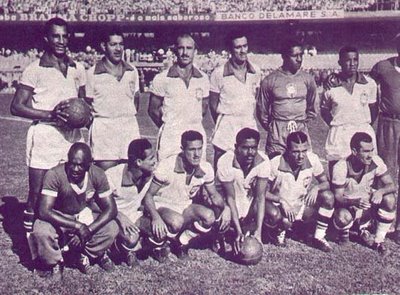
The 1950 Brazil team. Before 1950, Brazil’s best finish at the World Cup was third in 1938.
Seven spots were allocated to European countries, six to American countries and one to an Asian country. If you think it’s hectic getting teams to qualify for the World Cup, you should hear about 1950. Not because of competitive play but more because of international politics and football politics. Iron curtain countries like the USSR and two countries that participated in 1938–Hungary and finalist Czechoslovakia– refused to participate. Argentina, Peru and Ecuador withdrew after the qualifying round, possibly because of a dispute with the Brazilian Football Federation. The Philippines, Burma and Indonesia withdrew leaving India to receive the Asian berth by default. Austria declined to participate in qualifying feeling its team wasn’t good enough and Belgium withdrew from the qualification tournament which allowed Switzerland and Turkey to qualify without playing their final round of matches.
With the qualification done, it was off to the World Cup, right? Scotland withdrew because the very prideful chairman of the Scottish Football Federation insisted Scotland would only travel to Brazil as winners of the Home Championship. When England showed up, Scotland withdrew, even though England planned to attend even without the Championship. Turkey withdrew because of the huge cost of traveling to Brazil. FIFA invited two European nations who failed in qualifying–Portugal and France–to fill the gap. Only France accepted.
Now with the fifteen teams set for Brazil, that should lead to straight competition, but that led to more withdrawals. First came the draw on May 22, 1950 in Rio de Janeiro. India was the first drawn team to withdraw because of travel costs. France then withdrew because of the cost and time to travel between the cities. That left the World Cup with a field of only thirteen teams. Just like 1930 again! After all that, here’s how the teams worked out:
Group 1: Brazil, Mexico, Switzerland and Yugoslavia
Group 2: England, Chile, Spain and the United States
Group 3: Italy, Paraguay and Sweden
Group 4: Uruguay and Bolivia
ON WITH THE CUP
After all that hassle, the World Cup finally began on June 24, 1950. This would be the first world Cup since the inaugural 1930 World Cup where group play would be contested and would be the only World Cup where group play would decide the winner. It was Brazil’s idea to do this because more games meant more ticket sales to help compensate for the expenses of the stadiums. FIFA at first rejected the idea but agreed when Brazil threatened to pull out as hosts. The matches were held in six stadiums in six cities: Rio De Janeiro, Sao Paulo, Belo Horizonte, Curitiba, Porto Alegre and Recife. Four of the six stadiums were long into existence before the World Cup. There were only two that were build especially for the Cup: Estadio Raimundo Sampaio in Belo Horizonte and the Maracana in Rio.
Because of the uneven number of teams per group, it was decided that only the team that finished first advances. Group 4 had no problem deciding the advancer as that only required a single game, which Uruguay won 8-0 over Bolivia. In Group 3, Sweden was the winner with a win against Italy 3-2 and a draw against Paraguay 2-2.
Groups 1 and 2 were the two fully contested groups and they provided the most action. Group 1 was a no-brainer right from the start. Brazil delivered an attack style of play that would take them to the top of the group with a 4-0 win over Mexico, a 2-2 tie against Switzerland and a 2-0 win over Yugoslavia.
World Cup 1950 wasn’t all Brazil, Brazil. It also was the stage for the American’s 1-0 upset over England with Joe Gaetjens (right) scoring the winning goal.
Group 2 was not exactly remembered for its winner Spain or for Spain’s wins of 3-1 over the US, 2-0 over Chile or 1-0 over England. Instead Group 2 was known for one of the biggest soccer upsets of the time. The US vs. England match first appeared to be England’s for the taking since England, known then as the ‘Kings of Football,’ had the pros on their team while the American team was made up of part-time players who made their income from the jobs they worked. However the English and the 13,000 in attendance at the Estacio Independencia in Belo Horizonte were stunned when American Joseph Gaetjens, who was actually not an American citizen, scored the first goal in the 38th minute. Despite strong challenging play from both sides throughout the game, there were no other goals scored. The Americans’ 1-0 win over the English is still considered one of the biggest upsets in World Cup history.
The aftermath of this was also interesting. It made huge news in World Cup countries and almost made huge news in England but was trumped by the news the English cricket team lost to the West Indies for the first time ever. The English were nitpicky about the win saying that the team ‘had arrived through Ellis Island,’ referring to the assumption most Americans on that team were children of immigrants or immigrants themselves. For the record, three members of the American team including Gaetjens were not yet American citizens. In the United States, the win only made sidelined news. The Americans were still disinterested in soccer as they still promoted their ‘all-American’ sports like baseball, football and basketball. The win would gain appreciation by the Americans over time and especially in the last 25 years with the Americans slowly welcoming soccer especially after hosting the 1994 World Cup and the formation and success of MLS (Major League Soccer). The game has recently been dubbed by the Americans as the ‘Miracle Match’ and even spawned a small 2005 film “The Game Of Their Lives.’
ANOTHER SET OF GROUP PLAY?
Because of the uneven numbers of the groups in the first round, it was not only decided that only those that finish first in their group advance but also that it be group-style play to decide the winner.Also that ticket sales thing also has a lot to do with it too. This would be the only time in World Cup history in which group play would decide the winner. In group order, the finalists were Brazil, Spain, Sweden and Uruguay. All of the games in the ‘winners group’ were played either in Sao Paulo’s Estadio de Pacaembu or the Maracana. All teams played all their matches on the same day and at the same time. Brazil’s matches in this round were all contested at the Maracana.
The group play of the winners started July 9th with a 2-2 draw between Uruguay and Spain. Brazil delighted a crowd of 139,000 with a 7-1 win against Sweden which included four goals from Ademir. On July 13th Brazil continued their winning ways in front of a crowd of 153,000 with a 6-1 victory over Spain which included the Cup’s only ‘own goal’ by Spaniard Jose Parra Martinez. Uruguay gained some boost with a 3-2 win over Sweden with the winning goal coming with five minutes to go. The two games on July 16th were still group games however many still believed they played the role as 3rd Place Final and Final because of the end result and the team’s overall placing. Sweden beat Spain 3-1 in Pacaembu with a measly attendance of 11,000 and would finish the World Cup in third place.
A FINAL GAME TO BE REMEMBERED
“Down through its history, only three people have managed to silence the Maracana: the Pope, Frank Sinatra and me.”
-Alcides Ghiggia
Okay, here it was. This was Brazil’s for the winning. They were in excellent position to win the World Cup. They’ve already proven to the world their greatness. Even if Brazil tied Uruguay, they could still win the World Cup because Brazil had two wins while Uruguay had a win and a tie. The general public were not the only ones claiming Brazil to be the victors days before the match even started. The specialized press were too. In fact the Brazilian newspaper O Mundo printed an early edition paper that day with the Brazilian team on the front page with the headline ‘These are the World champions.” There was a song composed days before the game entitled Brasil os vencedores (Brazil The Victors) and was to be played once Brazil won. Even Julie Rimet, president of FIFA and founder of the World Cup, anticipated Brazil would win and even had prepared a speech in Portuguese to congratulate anticipated winners Brazil after their win. Unlike now, medals were not awarded to teams at the World Cup who finished in the Top 3 but the Brazilian Football Confederation has already made 22 gold medals with the names of the players engraved on them.
On the morning of July 16th, the streets were already full of energy and there was even a ‘makeshift carnival’ with thousands of signs celebrating the world title and chants of ‘Brazil must win!” The Maracana was bustling in its own way. One thing we should remember is that the Maracana stadium consisted of two tiers of stands and much of the stands were standing area. This is the reason why unlike today they could field a capacity of over 100,000. At this match, the official paid attendance registered 173,380 attended while many estimate the actual attendance was over 210,000. This still remains as a world record for attendance for a team sports match.
As Brazil were in the dressing room, confident of victory in their spiffy white shirts and blue collars, Uruguay has other plans. Uruguay’s captain Obdulio Varela brought as many copies of O Mundo that had ‘These are the World champions” on the front page, laid them on their bathroom door and encouraged his teammates to urinate on them. In Uruguay’s locker room prior to the match, coach Juan Lopez informed the team that their best chance of surviving of surviving the powerful offensive line of Brazil would come through adopting a defensive strategy. After he left, Varela stood up and addressed the team himself, saying “Juancito is a good man, but today, he is wrong. If we play defensively against Brazil, our fate will be no different from Spain or Sweden”. Varela then delivered an emotional speech about how they must face all the odds and not to be intimidated by the fans or the opposing team. In response to his squad’s underdog status, the captain delivered the memorable line, “Boys, outsiders don’t play. Let’s start the show.”
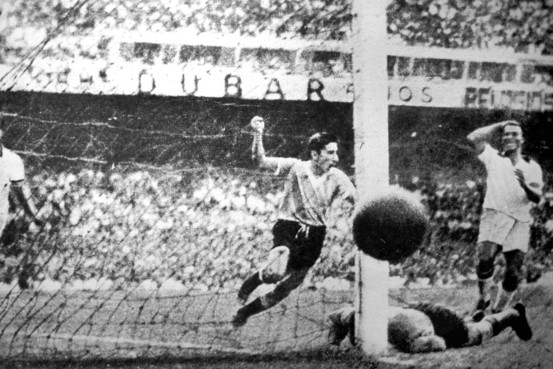
The goal scored by Alcides Ghiggia (centre) in the 79th minutes stunned the Maracana silent and would break the hearts of Brazil.
As expected, the game began with Brazil playing aggressively and attacking against the majority of the Uruguayan defensive line for the first half. However unlike Spain and Sweden, Uruguay was successful in maintaining their defense and the first half ended scoreless.
First blood was drawn at the 47th minute when Sao Paulo forward Friaca shot low past the goalkeeper to give Brazil the first goal of the game. Captain Varela immediately took the ball after the goal and disputed its validity, arguing that it was offside. Varela’s argument was obviously intentional to the point he even forced the referee, Englishman George Reader, to bring out an interpreter. The protest was unsuccessful but it succeeded in calming the crowd down. Then Varela took the ball to the centre of the field and shouted to his teammates: “Now it’s time to win.”
Uruguay was able to find control of the game and Brazil soon had its defensive frailty exposed. Juan Alberto Schiaffino scored the equalizer for Uruguay in the 66th minute. Then in the 79th minute, Alcides Ghiggia ran down the right side of the field, dribbled past Brazilian defender Bigode and scored another goal. The crowd was virtually silenced; Uruguay was now the leader. The silence continued for the remainder of the play until Reader blew the final whistle. It was official: Uruguay won the Cup by defeating Brazil 2-1.
THE AFTERMATH: BOTH IMMEDIATE AND IN THE LONG RUN
“The maximum punishment in Brazil is 30 years imprisonment, but I have been paying, for something I am not even responsible for, by now, for 50 years.”
-Moacir Barbosa
When the sudden news was official, many said there was a ‘traumatic and disturbing absolute silence’ except for the celebrating by the Uruguayan team and delegation. In Brazil, many newspapers refused to accept the fact that their team had been defeated. Radio journalist Ary Barroso retired, albeit briefly. At least two or three people on the top tier of the stands of the Maracana were so distraught by the loss, they committed suicide. Yes, there were peole so distraught over Brazil’s loss, they committed suicide. One man in the stands even had a heart attack. The gold medals were immediately disposed of. The song Brazil the Victors was never played. The nation was just heartbroken over the loss. The game remains one of the biggest upsets in football history and Brazil commonly refers to that game as the Maracanazo, or “blow at the Maracana.” Even Pele talks of how his father cried saying: “Brazil lost!”
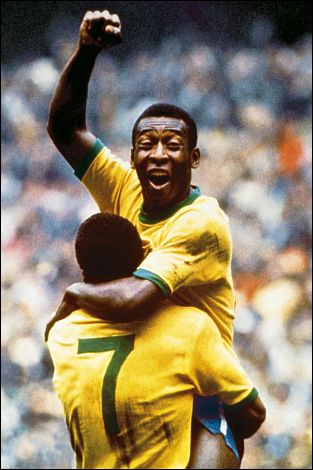
In the years to come, the game was influential for a lot of superstition. For one thing, Brazil refused to have a white-and-blue uniform and would soon adopt their famous yellow shirt with blue collar that still exists today. White is seen as bad luck in Brazil. The players of the time were vilified by the fans and were sometimes seen as bad luck. Many went into silent retirement while some never played for the national team again. Only two players that didn’t play in the final played for Brazil’s team in later World Cups. The defeat would weigh down on Brazil’s team so much, they brought a psychiatrist to the 1958 World Cup to remove the haunts of the memories of that game. Whatever the situation, the Brazilian team of 1958 which featured a 17 year-old Pele capturing the world’s imagination won the World Cup: the first of five total World Cups won by Brazil.
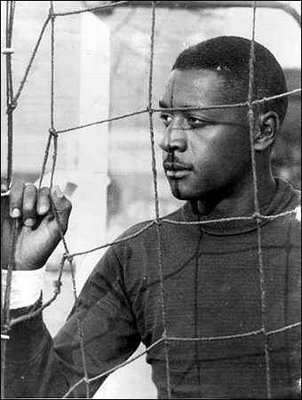
Brazilian goalkeeper Moacir Barbosa would be blamed and even vilified for Brazil’s loss for the rest of his life.
However of all the players from Brazil, it was goalkeeper Moacir Barbosa that got hit the hardest. He received the biggest flack and biggest blame for the Maracanazo and it seems like Brazil never forgave him. He was still able to play professionally for another thirteen years and was even part of Brazil’s national team until 1953 but he was commonly shunned by the nation. There was even one time he was in a store in Brazil and a mother pointed at him and said to her small son: “Look at him, son. He is the man who made all of Brazil cry.” Little changed over the years. In 1993 the president of the Brazilian Football Confederation refused to let him be a commentator. In 1994, the Brazilian national team did not want him to visit them because they feared he would give them bad luck. If there was one good thing, his wife stayed married to him for a total of 50 years until her death in 1997. He managed administration at the Maracana but was always at a shortage for money after leaving. He did however received assistance from sources such as Brazilian football team Vasco da Gama and his wife’s friend after her death. The friend remembered his last years: “He even cried on my shoulder. Until the end he used to always say: ‘I’m not guilty. There were 11 of us.'” Moacir Barbosa died of a heart attack in 2000 at the age of 79. He was penniless at the time.
One interesting note is what happened to Alcides Ghiggia who scored that heartstopping goal. He would continue to have a prolific career as a professional player until 1968 and was even signed onto European teams like AC Milan and AS Roma during a time when it was extremely rare for South American players to play for teams outside their home country. As of today, the 87 year-old Ghiggia is the only surviving member of Uruguay’s World Cup winning team from 1950.
Interesting note is that on December 29, 2009, Brazil honored Ghiggia by celebrating that decisive goal by having Ghiggia plant his feet in a mould to take his place along greats like Pele, Eusebio and Franz Beckenbauer. The reception to Ghiggia was surprisingly warm and Ghiggia himself was overcome by emotion to the warmth. Ghiggia also made a return appearance to Brazil during the draw for the groups of the 2014 World Cup in December 2013. Each country that had won a World Cup in the past was allowed to send one of its great players to participate in the draw. Uruguay sent Ghiggia. There was however one negative thing as of recent. Ghiggia has been invited to the opening games of both the 2006 and 2010 World Cup but it was revealed by him that he was not on the guest list for this World Cup. I wonder who did it too? Whatever the situation, FIFA spokesperson Delia Fischer insisted the day before that Ghiggia and a guest will have at ticket. Ghiggia has also commented on this World Cup: “I hope Brazil become world champions, so they can all enjoy it here.”
The Brazilian team this year are hoping to finally make that bad memory of 1950 a think of the past. So far Brazil have been doing very well even if they’re not the most spectacular team out there. They opened with a 3-1 win over Croatia but left people shocked with a 0-0 draw against Mexico. They did reassure people that they will win with a 4-1 win over Cameroon to close out the Group Stage. They did win the Round of 16 match against Chile on penalty kicks after a 1-1 draw. For those concerned since that, don’t be. There have been many teams in the last 28 years that had a match lead to penalty kicks before they played in the final for the Cup and won.
Brazil is often praised and even fancied in the way they treat football like a religion. However their reaction to their loss in 1950 is a negative side of that. Sure the loss to Uruguay was a shock but it’s a shame how they went about it. You know how when the Boston Red Sox won the 2004 World Series and fans then showed a sign saying “We forgive Bill Buckner” in reference to Buckner’s Series-costing fumble in Game 6 of the 1986 Series? I hope that if Brazil wins the World Cup, there should be someone in the stands with a sign saying: “Nós perdoamosMoacirBarbosa (We forgive Moacir Barbosa).”
Brazil has a football legacy like no other nation and its legendary player Pele is commonly regarded as the epitome of its greatness.
We all love Brazilian football because at its best, Brazilian football is the paradigm of how we want football to be played. We want it musical, we want amazing skills but we want the kind of friendship and the teamwork also beautifully mixed and working together.
-Alex Bellos, author
Remember back when I did my blog on Russia’s Winter Olympic Legacy I mentioned my naive belief as a kid that if a country had a big sporting legacy, they deserved to host an Olympics? Anyways I would also have that naive belief for hosting the World Cup too. It’s not that embarrassing since every country that’s won the World Cup has hosted in the past. If I thought that now, it would be kind of embarrassing because of how expensive it is. Whatever the situation, you can’t deny Brazil’s legacy.
BEFORE THERE WAS A WORLD CUP
So the question is how did a British sport like football become almost religion-like in Brazil? Well there are some beliefs but no real conclusion on who first introduced it. Some believe it was introduced to Brazil by a Scottish expatriate by the name of Thomas Donohue. In fact the first ever football match contested in Brazil was played in a pitch marked out by Donohue near his workplace in Bangu back in April, 1894. Some believe it was introduced to Brazil by Charles William Miller, son of John Miller who worked on a railway construction project in Sao Paulo in the 1870’s. Charles not only learned football while studying in Southhampton but when he return home from his studies in 1892, he brought with him some football equipment and a rule book. He introduced it through the Sao Paulo Athletic Club. Miller was a great coach to the team and he was even able to get two English teams to play against the Athletic Club and other teams in Sao Paulo. You could say the rest is history.
Eventually Brazil would get its own national football federation–the Brazilian Football Federation–on June 8, 1914 and their first international match was a match between a team combined team from a club from Rio and a club from Sao Paulo against English club Exeter City shortly thereafter.
A SO-SO START
Those who are into World Cup trivia may know that Brazil has been in every World Cup since it started in 1930. It’s not to say that they began with a bang. In fact the BFF was not the best at organizing national teams for quite a while. In 1930, organizing national teams was a relatively new idea at the time so you can imagine getting a team for the very first World Cup would be through the same thought process today. In fact only thirteen countries, including Brazil, though the inaugural World Cup was worth competing in. Back at the first World Cup, there was only one group of four teams and three groups of three teams. Brazil faced Yugoslavia and Bolivia in their group. They lost to Yugoslavia 2-1 and won against Bolivia 4-0. Despite finishing second, they did not advance as only the #1 team from each group advanced and Yugoslavia finished #1. Their next World Cup, Italy in 1934, was also lackluster as the whole tournament was a last-team standing competition–no First Round group play at all–and Brazil lost its opening match: against Spain 3-1. That ended their World Cup run fast.
However things were really starting to look up for Brazil in France in 1938. Their team was much better and it featured the legendary Leonidas. As in 1934, it was a last-team-standing format from start to finish. Brazil won its opening match against Poland 6-5 with Leonidas scoring a hat-trick and won its quarterfinal against Czechoslovakia. Actually they needed a second quarterfinal to play as they tied the first 1-1. Brazil won the second 2-1. However they were stopped in the semifinals by eventual winner Italy 2-1. Brazil did win the third place match against Sweden 4-2 and Leonidas was the top scorer with 7 goals. Too bad the Golden Foot award wasn’t awarded back then.
Brazil hosted in 1950. I’ll actually save that competition for another blog as I will tell about the infamous Maracanazo and the crazy aftermath that happened since. Few players from 1950 returned in 1954. Brazil was ousted in the quarterfinals by Hungary 4-2.
THE GOLDEN ERA
The era from 1958 to 1970 has to be Brazil’s most treasured because that was when the Brazilian national team was at its best and enchated the world. It all started in 1958 when coach Vicente Feola coached the team and even gave them a list of forty things not to do including smoke in front of journalists. They even brought a psychiatrist to the team. Whatever the situation, Brazil was brilliant in group play with two wins and a draw, winning their quarterfinal against Wales 1-0, their semi against France 5-2 and then winning their final against hosts Sweden 5-2. The top goalscorer may have been Just Fontaine but it was the second-highest scorer–a 17 year-old Brazilian named Pele–that captured the imagination of the world. Even in the group stage, he dazzled crowds with his flare and his goal-scoring ability. Another key note is that Pele wore the number 10 at that World Cup it’s been since common trait that most national teams designate the number 10 to their best players. Pele however won the FIFA Silver Ball award for being the second-best overall player at the World Cup. The winner of the Golden Ball was another Brazilian, Didi, who actually scored a single goal but delivered the best midfield efforts of the tournament.
Pele’s fame grew as did his football playing prowess and the whole Brazilian team garnered fame with him. In Chile in 1962, Pele was back and expected to star again. He did score in the first game but was sidelined with an injury during the second game. That would cause him to miss the rest of the tournament. Nevertheless Brazil performed well as his replacement Amarildo scored three goals and two players, Garrincha and Vava, scored four goals each. Garrincha was considered to be the top player of the tournament. The team also did a noble thing after defeating hosts Chile in the semifinals. They carried the Chilean flag out on the field.
In England in 1966, it appeared success was starting to get to Brazil. They began well with a 2-0 win against Bulgaria that included a goal each by stars Pele and Garrincha but it was all downhill after that with 3-1 losses against Hungary and Portugal. That left Brazil 3rd in the group and out of the tournament: the second of five instances when the defending World Cup champion failed to advance past the Group Stage.
Then came Mexico in 1970. Mario Zagallo, who played for Brazil during its World Cup wins in 1958 and 1962, was assigned coach by the president of Brazil. The president also demanded that many players including the aging Pele be put on the team. Pele first seemed uncomfortable with his role but things changed once the contest started. Brazil won all their Group Stage matches, won their quarterfinal against Peru 4-2, their semifinal against Uruguay 3-1 and then their final against Italy 4-1. Jairzinho was the top goalscorer of the team with 7 goals but it was Pele who won the Golden Ball award for being the best overall player with a performance that included four goals. And to think Pele thought at the beginning he wasn’t good enough for the team. Pele also won the FIFA fair play trophy for not receiving a single yellow or red card. Pele also has the distinction of being the only player to play for three World Cup winning teams. Zagallo made history by becoming the first ever to win the World Cup both as a player and as a coach. Germany’s Franz Beckenbauer is the only other one to do so. On top of that Brazil was given the distinction of being allowed to keep the Jules Rimet trophy for winning the World Cup three times. The 1970 team for Brazil is still considered by many to be the best team ever in World Cup history. The odd irony is that it was only a matter of months until the Jules Rimet trophy was stolen. It was never found.
THE DRY SPELL
After 1970, Pele was no longer part of Brazil’s national team and there was a brand new World Cup trophy that made its debut in 1974 and is the current trophy today. It seems like those marked the end of Brazil’s magic at the time because Brazil would struggle to regain its winning sense. 1974 and 1978 World Cups consisted of not only group play for the opening round but also for a second round for the eight that qualified. The top teams at the end of the second round of Group Play played in the final for the Cup, the second-place teams played for third place and the other four teams headed straight home. In both cases, Brazil came second. Brazil again found itself out of the competition because of second round group play in Spain in 1982. In 1986 started the current format of Group Play and the last-team-standing format that started with a Round of 16. Whatever the situation, Brazil was brilliant in Group Play wining all their games and even winning their Round of 16 game against Poland but drew 1-1 to France in the quarterfinals and then lost the penalty kicks round. 1990 added further insult as Brazil again won all three of their group play games but fell to Argentina 1-0 in the Round of 16.
It was a question to many of why. Was it the format of play? Was it the change of system where Brazilian players were now mostly playing in Europe instead of playing with Brazilian clubs as was the case in Pele’s day? It’s still a wonder.
CALL IT A COMEBACK
These past twenty years have actually seen a resurgence of Brazil’s greatness and even write a new legacy for them. It first started at the 1994 World Cup. This time they came packed with stars like Romario, Bebeto, Taffarel, Dunga and Jorginho. The group were very good, if unspectacular, being very solid in the rounds leading up to the final. The final was a classic rematch against Italy. The game was an unspectacular 0-0 which led to a penalty kicks contest. Brazil won 4-3 and became the first country to win the World Cup four times.
1998 saw the emergence of another young Brazilian with the potential to become a great, Ronaldo. He and the Brazilian team were very good leading up to the final but it was the home country French team that really caught the world’s attention at that World Cup. France has commonly been known as Brazil’s ‘achilles heel’ and they gave Brazil their loss 3-0. Under the guidance of coach Luis Felipe Scolari, Brazil came back in 2002 with the help of the three R’s–Ronaldo, Rivaldo and Ronaldinho– and won the World Cup without a loss. Ronaldo won the Golden Boot award for his scoring of eight goals, the most goals scored in a single World Cup since 1970.
Brazil has continued to maintain a record of consistency since the 2002 World Cup and has continued to produce new stars. Even manager Carlos Alberto Ferreira formed a playing system known as the ‘magic square’ that proved very successful in competitions leading up to the Cup. The ‘square’ appeared to work well in the first rounds of the 2006 World Cup despite the underperforming of star Ronaldinho at the time but they fell in the quarterfinals to their traditional top rival France 1-0. To the surprise of most, Brazil was out in the quarterfinals. Brazil continued to be favored leading up to the 2010 World Cup and even won their ‘group of death’ albeit unspectacularly but fell again in the quarterfinals. This time to the Netherlands 2-1. Further disappointment came at the 2011 Copa America when Brazil lost in the quarterfinals but a major upper came when they won the Confederations Cup against World Cup winners Spain 3-0. Here at this World Cup, Brazil tried to attempt the one football feat they don’t own: winning the World Cup on home soil. They brought Luis Felipe Scolari back to help them win it. They’re also relying heavily on the young great Neymar who has already scored two goals in World Cup play. The remaining three weeks will decide.
Brazil has had a football legacy and it has had its downsides too. You can understand why a country this passionate about football believes that a win of the World Cup is the only acceptable result. You can understand the pressure that the current Brazilian faces leading into this World Cup. You can also understand why a country like Brazil has won more World Cups than any other country and continued to churn out legend after legend. It’s no wonder no country has delivered more football magic than Brazil.
DISCLAIMER: Before I begin my blog, I want to give you all a quick reference post for my Group Stage predictions for this year’s World Cup. Title will open the link to my predictions:
As for predictions for the knockout rounds, I’ll wait until the qualifiers are decided. Meanwhile I will give a prediction for the final for those curious: Brazil vs. Argentina which Brazil wins. Let’s see if it hold up. Anyways enough of predictions! On with my blog!
“For any country, organizing a cup is like playing a game, sweating and often suffering, with the possibility of extra-time and penalty kicks, but the final result and celebration are worth the effort.”
-Dilma Rousseff, president of Brazil
The 2014 World Cup opened on June 12th with a spectacular opening ceremony at 3pm in the newly built Arena de Sao Paulo. The competition started with the opening game of hosts Brazil vs. Croatia. Each team by now has played at least one match to get things rolling. Even in the months and years leading to the competition, the World Cup made headlines and continues to make headlines now for all the activity on the field and off.
NOTHING LESS THAN THE WIN
Football is a matter of life and death in Brazil. Literally. I’ll get to the Maracanazo in one of my future blogs but you will understand why Brazil has to win. And nothing less. Brazil has won the World Cup five times, more than any other country. They’re one country with such a legacy in football that anything less than the World Cup is unacceptable. In fact it’s the Maracanazo that Brazil no longer wears white. Brazil comes to this tournament not ranked #1. Actually they’ve been ousted in the quarterfinals these past two World Cups. However hosting the World Cup in a country that treats football like a religion would consider the loss of the World Cup like a stab at the heart. They have coach Luis Felipe Scolari who coached Brazil to win the 2002 World Cup heading the team consisting of veterans like Thiago Silva, Dani Alves, Jefferson and Frad as well as newcomers like Oscar, Bernard and rising phenom Neymar. Will they deliver to the challenge or will they choke under pressure? Already they started with a good win against Croatia 3-1 but just yesterday they had a 0-0 draw against Mexico. Makes me wondering if they found Mexico too much of a challenge or they were saving themselves for later. We’ll see. There isn’t a single team in the world Brazil can’t beat. However it is possible for some teams to beat them. Hope it’s not here.
CONSTRUCTION OBSTRUCTIONS
As you may have noticed when I did my blogs about the stadiums, I made comments about the construction problems that happened along the way. There were even construction fatalities like back in November when a crane inside the Arena de Sao Paulo toppled and killed two workers. This bad planning is nothing new in Brazil. Brazil has a habit of building things slower than expected. However it was already noted by FIFA as far back as 2011. Stadium expenditures were originally expected to cost $1.1 million. Instead stadium works cost $3.6 billion. Some of you may remember from the Confederations Cup that Brazil had six stadiums ready for that competition. There still six more remaining. FIFA gave Brazil a deadline of December 31, 2013 to have all the stadiums completed. Six were incomplete by that time. As you may have noticed in my group blogs, there were many stadiums that took until April or May for completion. Even the condition of the Arena de Sao Paulo was in question just 24 hours before it was to host the opening ceremonies and opening match.
It wasn’t just the building of new stadiums that was the problem. Airports in many of the cities needed upgrading to cope with a huge influx of tourists coming in. Thirteen needed upgrading and it was predicted in 2011, ten would not be ready. That led to Brazilian president Dilma Rousseff to auction off many of the airports to the private sector. There were even monorail projects planned for many of the host cities but many were not completed. Some even had to be downgraded if they wanted to finish on time. In May 2014, FIFA reported that only 36 of the 93 major projects had already been completed. However FIFA secretary Jeroma Valcke did make note that many of the projects were meant to continue after the World Cup including ‘legacy projects’ sponsored by FIFA costing $20 million and coming completely at FIFA’s expense.
The slagging preparations of Brazil has garnered criticism from all around. FIFA has expressed their disappointment, even many journalists have dismissed this as the most trouble-plagued or the worst-organized World Cup in history. Even Brazil’s legendary players of the past had things to say about Brazil’s preparation problems. Romario, now a political figure, criticized Brazil’s handling of the preparations but said: “FIFA’s requirements were excessive.” Ronaldo spoke of his embarrassment of the country’s infrastructure and how: ” a series of investments were promised but won’t be delivered – only 30% will be delivered.” Pele however has been the most outspoken in his disappointment but he especially focused his disappointment on the expense of the World Cup: ”It’s clear that politically speaking, the money spent to build the stadiums was a lot, and in some cases was more than it should have been. Some of this money could have been invested in schools, in hospitals. … Brazil needs it.”
FORGET ABOUT THE PRICETAG?
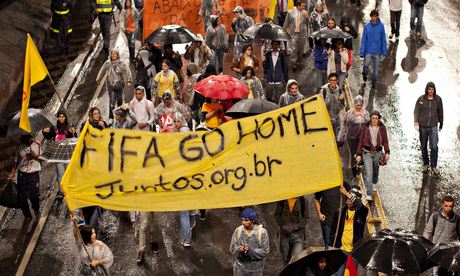
Just like during last year’s Confederations Cup, Brazilians continued their protesting around FIFA’s World Cup over its huge expense.
After Pele’s quote, you may be asking how expensive is this World Cup going to cost? Well, not as expensive as the $51 billion Putin and his Russia spent on the Sochi Winter Olympics but high enough. Brazil’s World Cup comes at an estimated price tag of $14 billion: close to the $15 billion spent on the past three World Cups combined. $3.6 billion were spent on either building new stadiums or fixing them for FIFA regulations. The other money was spent on the infrastructure and transit projects that I just talked about. With them being unfinished, you may wonder what’s to blame? The spending or the poor planning? There was even an additional $900 million spent on security. It planned to have one police officer for every 50 spectators. Totals include 150,000 public security professionals and military along with 20,000 private security personnel. Other security innovations include facial recognition systems and unmanned security robots. Sure FIFA promised that they’d give $2 billion to the event but that can only go so far. Even Romario has described this World Cup as ‘the biggest theft in history’ which he believes expenditure will total $100 billion in the long run.
The projects, both successful and incomplete, and the costs that came with it sure did a lot to the opinions of the Brazilian public. A Brazilian polling company published results that stated the approval rating from the Brazilian public to the World Cup had dropped from 79% back in 2008 to only 48% back this April. 55% of respondents believed the event will give more harm than good to Brazil. Even FIFA president Sepp Blatter admitted: “Brazilians were a bit discontented because they were given a lot.”
Funny that this was not the case when Brazil hosted the World Cup back in 1950. Back then, they only needed six stadiums to contest the match and only two new ones were built. Funny how times change, especially in terms of huge sports events.
PROTESTS PART TWO
You may remember I posted a blog about the protests happening around the time of the Confederations Cup. The protests were successful in bringing changes to Brazil in most areas, if not all. Back in the original blog I pointed out that Brazil is a developing country that has made a lot of developments and improvements in the quality of life in the past 30 years. I still stand by that belief however I won’t deny that there are still a lot of problems in Brazil still outstanding. The most notable being health care and rampant crime. In fact I saw a news story around the World Cup about growing up in the slums of Rio. Crime and gang problems are so bad even the police are afraid to go in to install law and order. It’s exactly like it was depicted in the 2003 film City of God. Brazil being a developing country determined to succeed does get reminders how they’re lagging in some areas and I’m sure will over time. The big protest focus around the World Cup has been about the government’s financial management of the company. I’m sure with a World Cup as expensive as that, you can’t blame them for being disappointed.
One thing about the Confederations Cup is that both President Rousseff and FIFA president Blatter were booed before their speeches. Because of that there were no speeches at the World Cup opening ceremonies. Last years protests not only made news for them happening around the time of the Confederations Cup but also that the protests reached the stadiums. Protests leading up to the World Cup led to organizers stepping up its security. The security this time have been successful from preventing protests from reaching the stadium. It’s not to say it’s without noticeable incident. In fact two CNN journalists who were covering the protests around the June 12th opening game, Shasta Darlington and Barbara Arvantidis, were injured.
Reaction to the protests has been understandable but still disapproving. Rousseff came to the defense of the expenditures saying: “the federal money spent on the stadiums is in the form of financing that will be duly repaid by the companies and governments that are exploiting these stadiums.” She also reiterated that all the construction and infrastructure were for long-term benefits for Brazilians. We shouldn’t forget in two of the stadiums I profiled, there will be extensive land development plans for two of the new stadiums so it’s not just about having bigger stadiums. Sepp Blatter has spoken his disapproval saying the protesters “Should not use football to make their demands heard” and that expenditures were “on items that are for the future, not just for the World Cup.” Pele himself, though understanding of the protesters’ anger, but is critical of them: ”Some of this money could have been invested in schools, in hospitals. … Brazil needs it. That’s clear. On that point, I agree (with the protests). But I lament what protesters are doing, which is breaking and burning everything. It’s money that we will have to spend again.”
FIFA’S BLATTER UNDER FIRE
FIFA’s president Sepp Blatter has come under fire under allegations of bribery and corruption.
It’s not just the World Cup that’s facing the heat. FIFA president Sepp Blatter has come under fire for corruption. Back in 2011, Qatar won the rights to host the 2022 World Cup. Lately there have been reports that Qatar paid for votes. It’s a wonder too for the World Cup to go to a country only 4,500 square miles wide and with a population of just over 2 million people. Qatar has denied any wrongdoing but the British paper The Sunday Times is insistent in their allegations. Already there’s talk within the FIFA membership with the most vocal opposition coming from head of the Dutch Football Association Michael van Praag and FIFA has conducted an investigation into the matter headed by FIFA investigator Michael Garcia. However it will not be handed to a FIFA jury until just days after the World Cup and Blatter says no decisions will be taken until September or October. The 78 year-old Blatter who has been president of FIFA since 1998 has always maintained that this term will be his last but already the media and certain members of FIFA want him to resign soon in the wake of the scandal and even five of FIFA’s six major corporate sponsors are demanding a thorough investigation of the allegations. FIFA has claimed it’s racism behind the accusations and Blatter himself has described the outcry as the “storm against FIFA” and “discrimination and racism” as most of those accused of accepting bribes are from African countries. The response to the scandal is something that will only be defined over time.
So there you go. This is a taste of what’s in store for the World Cup. Sure there are the pressures on the field but lots off the field too. How those get managed are bound to get some healthy media attention. Some will even require time to decide its fates. You can guarantee even after the World Cup is finished and the winning team is crowned, neither FIFA nor Brazil will stop making headlines.
Those of you that have known my writing over the years have known that when I do soccer blogging of major events, I do a rundown of the teams that will be competing. Some of you may have guessed I’d be doing it again for the World Cup, and you are right. However I’m doing a separate blog for each of the eight Group Stage groups. So much to preview, so little space. With this being my first blog of the upcoming World Cup, then it’s no question the first blog will be done on Group A. For the record, my summary of the teams will be done in their drawn World Cup order rather than their FIFA ranking of May 2014. FIFA ranking of that month will appear in brackets.
GROUP A:
-Brazil (4)-No other country has as much of a football legacy as Brazil. Brazil is the only country that can boast competing at all nineteen past World Cups and the only country to have won the World Cup five. The World Cup arena has been an excellent showcase of Brazilian football at its best and it has inspired the world around. However we’ve also seen Brazil choke at times, especially in recent competitions. Just ask France. They’re known as Brazil’s ‘achilles heel’ and have handed Brazil some surprising defeats including the 1998 world Cup final and the 2006 World Cup quarterfinal. In both cases, Brazil was the defending World Cup holder. Brazil’s recent chokes were more humbling as they choked to the Netherlands in the 2010 World Cup quarterfinal and at the 2011 Copa America, they lost their quarterfinal in what was Brazil’s worst-ever Copa America performance.
Brazil can’t take any chances at this World Cup more than any World Cup. They’re the host country and all the world expects them to win. They especially want to rid their compatriots of the 1950 ‘Maracanazo,’ which I will talk about in another blog. Yes, Brazil may have won the World Cup more than any other country but of the eight countries that have won the World Cup, Brazil and Spain are the only ones to fail to do so as host country. Brazil hopes to end this ignominy this time around. After their Copa America debacle, they sacked their coach in favor of Luiz Felipe Scolari who helped coach Brazil to its last World Cup in 2002. The return to Scolari has paid off as Brazil won last year’s Confederation Cup defeating reigning World Cup holders Spain 3-0. Since the return of Scolari, Brazil’s overall record has been excellent losing only twice: to England and Switzerland. No doubt they’ll face huge pressure but the Confederations Cup proved that Brazil is back in action and ready to deliver.
-Croatia (20)- If you were to do a pound-for-pound rational of football teams, Croatia should rank amongst the top. Croatia is one of only two countries in FIFA’s current Top 20 with a population of less than 5 million . Uruguay being the only other country. Ever since their independence in 1991, Croatia has proved itself a formidable force in football, especially at the 1998 World Cup where they finished third. However that was the last World Cup where they even advanced past the Group Stage. 2002 and 2006 appearances didn’t pan out and a failure to qualify in 2010 almost made the Vatreni’s glory a thing of the past. However Croatia is looking to mount a comeback. In 2012, they signed on a new president in Davor Suker, himself a former great as the top goalscorer at the 1998 World Cup. The role of manager was replaced by former team captain Niko Kovac. The team successfully qualified for the World Cup. They also have a good mix of talent from veterans like Darijo Srna and Luka Modric and fresh young talents like Dejan Lovren and Mateo Kovacic. Croatia is one country that’s very capable of causing a surprise.
-Mexico (19)- Mexico is without a doubt the best team in the CONCACAF as far as legacy goes. No other North American team has qualified for the World Cup as often. However its greatness has appeared to have alluded them in the past couple of years. They failed to advance past the Group Stage of last year’s Confederations Cup, they lost to Panama in the semifinals of the CONCACAF Gold Cup and almost missed qualifying for the World Cup in a qualifier against Costa Rica where they trailed 1-0 after 80 minutes. Two goals in the last 10 minutes kept them alive where they’d go on to beat New Zealand for the wildcard berth. Mexico has made efforts to make their near-loss to Costa Rica a thing of the past. They have not lost a game since but they have come across some tight ties like a scoreless draw against Nigeria and even a 2-2 tie against the US last month. Mexico hopes to be ready for Brazil. Miguel Herrera is one tough coach who favors home grown talent over talent from European leagues. That could be the factor that could either spell success or failure. Only the World Cup stage will decide that.
-Cameroon (50)- Older people may remember Cameroon as the team that came from nowhere in 1990 to win 1-0 against defending champions Argentina. Cameroon charmed the world that year by reaching the quarterfinals and becoming the first African team to do so. However their glory appears to be a thing of the past. Cameroon has not advanced past the Group Stage since. This time around doesn’t show too much promise. They do have a German coach, Volker Finke, and have good talent in Samuel Eto’o and Alex Song but they do face a heavy battle in group play. Already this year, they’ve had mixed results with a 5-1 loss to Portugal and a 2-0 win against Macedonia. Nevertheless it’s too soon to judge. I’ve seen teams where nothing was expected of them and they’d advance far.
STADIUM SPOTLIGHT
This is a new feature. This is where I get to focus on the various stadia that are hosting the World Cup. I figure the arenas are worth talking about. Brazil has twelve stadia that will facilitate for the World Cup: seven just opened within the past year. The crazy thing is how the Group Stage play is organized. Usually in most cases at a World Cup, the country would have organized certain Group Stage groups playing at a set stage of stadiums. In Brazil’s case, a country with twelve stadiums may have three stadiums in cities close to each other to host the Group Stage games of two groups. Division that simple. Brazil has done it weird. All twelve of the stadiums will hold four Group Stage matches but they will be matches for four different groups. Additionally, all six of the Group Stage games for each individual group will be played in six different stadiums, and not all will be that close by. That will mean a lot of traveling around for the 32 teams, especially in a country of over 3 million square miles.
It’s confusing but hopefully it won’t interfere with the play as badly as the vuvuzelas did at the last World Cup. As for stadiums, Brazil has twelve good stadiums. Five are old and traditional but renovated in time. Seven are new built especially for the sake of hosting the World Cup. Here I’ll give you my first taste of my Stadium Spotlight. Note that each stadium I show in my Stadium Spotlight feature will be a stadium that will contest Group Stage matches for each respective group. These two I will focus on will host Group Stage matches in Group A. So without further ado, here are the two stadiums in focus:
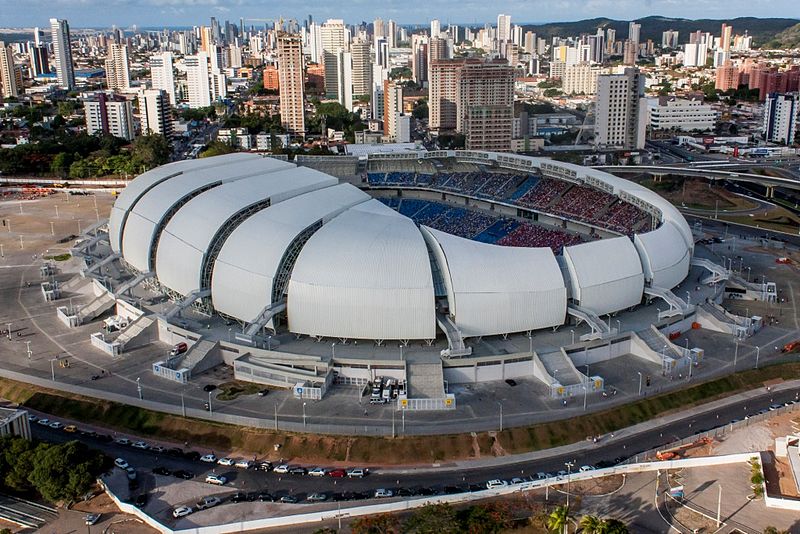
-NATAL: Estadio das Dunas
Year Opened: 2014
World Cup Capacity: 42,086
World Cup Groups Hosting: A, C, D, G
One of seven new stadiums built especially for this World Cup, the most unique thing of the stadium is definitely the roof. While Brazil had made headlines with difficulties of building and completing stadiums in time for the World Cup, this stadium however earned praises from FIFA not just for the stadium itself but for development of areas surrounding the stadium which I will talk about later. This stadium finished in good time and officially opened this January. After the World Cup, the stadium capacity is to be extended to 45,000 seats and to be the stage of home games for both the America Futebol Clube and ABC Futebol Clube. The area surrounding the stadium has planned a shopping centre, commercial buildings, hotels of international standard and an artificial lake.
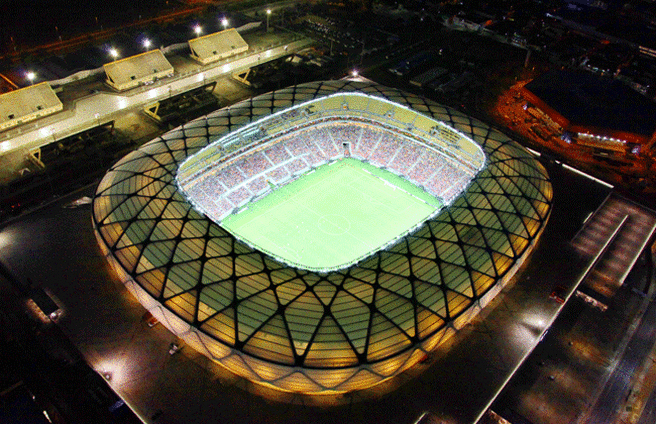
-MANAUS: Arena Amazonia
Year Opened: 2014
World Cup Capacity: 42,374
World Cup Groups Hosting: A, D, E, G
There was some criticism from England’s manager Roy Hodgson about Manaus hosting World Cup matches. He should watch his tongue as England will be playing the very first World Cup match of his group there, against Italy. This was one new stadium that actually was under question whether it would be ready for the World Cup. The stadium has been completed and was officially opened in March. The stadium has a full capacity of 46,000 and is to be the host stadium of Nacional FC after the World Cup, replacing the now-demolished Vivaldao Stadium.
And there you go. My first preview of the World Cup teams and stadiums. As for predictions, I’ll just settle for predicting the two countries that will advance past the Group Stage right now, and I predict it will be Brazil and Croatia.
Seven more groups and ten more stadiums to review before World Cup 2014 starts. Stay tuned for more.
 NETHERLANDS: Here’s a team that’s struggling to get their first World Cup win. Three times the bridesmaid (1974, 1978 and 2010), never the bride. Here in 2014, they were brilliant in the group stage winning all their games and humiliating defending champions Spain 5-1. They continued to look good with their 2-1 win over Mexico in the Round of 16. However there was a sign they would struggle when they played to a scoreless draw against Costa Rica in the quarterfinals. Hey, don’t underestimate Costa Rica’s defense. Fortunately their replacement goalkeeper Tim Krul was the right choice as he blocked two Costa Rican penalty kicks to help Netherlands advance to the semifinals.
 BRAZIL: To be honest, there were actually bigger humiliations at this World Cup than Tuesday’s Mineirazo. Like defending champs Spain losing 5-1 to the Netherlands and then 2-0 to Chile to be out of the running. Or how about England failing to win a game for the first time since 1958? Even Italy being ousted in Group Stage for the second World Cup in a row is a pretty big embarrassment. Nevertheless Tuesday’s 7-1 loss to Germany right in front of a home crowd as World Cup host nation really bruised the nation’s football ego. A nation that had the biggest World Cup legacy had their current teams weaknesses exposed by Germany on a home stage and in front of the eyes of the World. And they still have to fight one last time.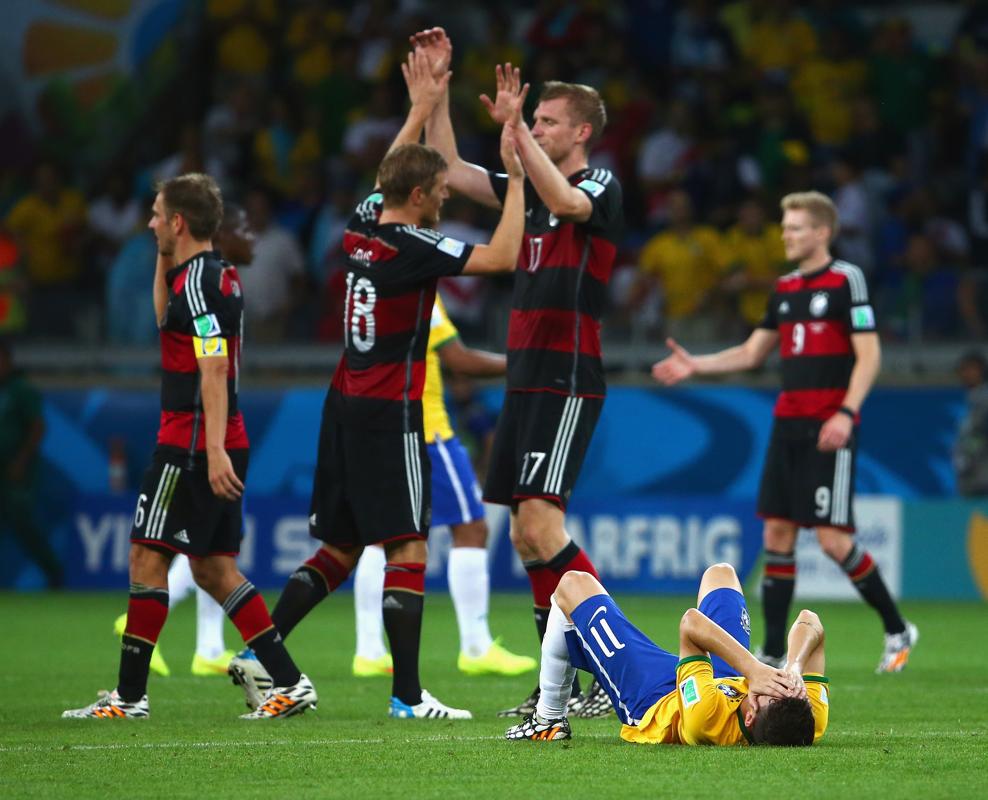




 Jon The Blogcentric