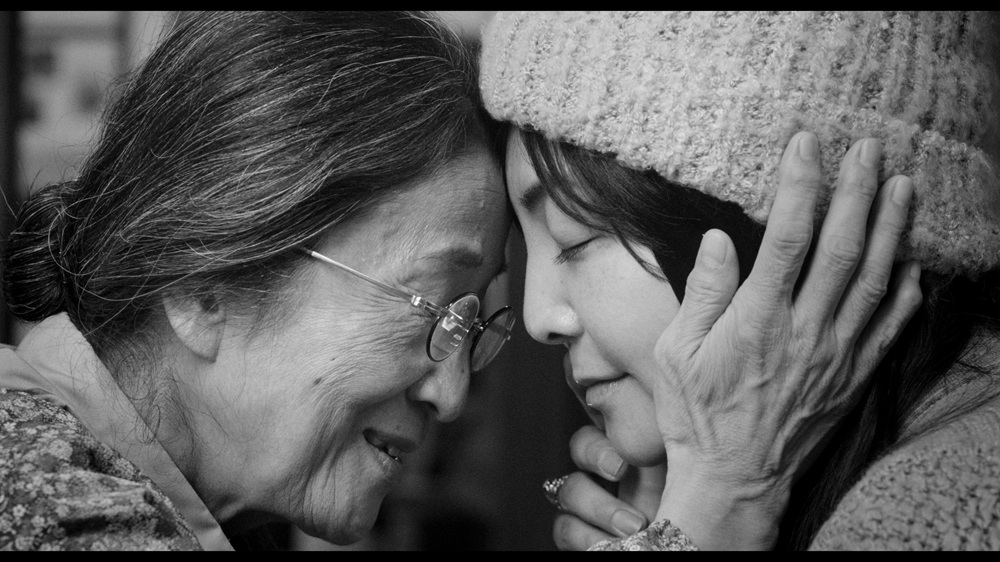
One thing about the Vancouver Film Festival is you will find some unique films from local filmmakers. The Japanese-language film Akashi is one of those films and it was met with great fanfare.
The film begins with Kana returning to Tokyo, Japan from Toronto, Canada. Kana is an advertising professional who dreams of breaking through as an artist. The purpose for the trip is a sad one: her grandmother’s passing. She is welcomed warmly by her parents, siblings, niece, nephew and in-laws. Kana is the only one of the children who has not yet married. In Canada, she’s been more focused on getting a prestigious arts grant and is awaiting the news of her third attempt at it.
As she’s in the home of her grandparents, memories come back to her. As she sees her grandfather’s artwork on the walls, it reminds her of how he used to teach her how to draw when she was younger and how it would lead to her own dream to be an artist. As she sees photos of her grandmother, she is reminded of the last talk she had with her. Her grandmother told her the marriage was arranged shortly after World War II and her grandfather actually loved another woman named Wakaku.
As she’s on a shopping errand before the funeral, she goes to a local store. In the store is Hiro, the boyfriend she had before she left for Canada. As they dated, Hiro had dreams of becoming an actor and the relationship was a case of two lovers with artistic dreams. Kana does not want Hiro to know she’s here and hides, but a sudden phone call from Shelby, her work colleague in Toronto, gives it away. Hiro is surprised to see her and the two talk for a while.
Kana is staying with her family for that week’s period. The funeral happens and they hold the service, tearfully paying their last respects. As Kana spends more time with her family, she starts observing her parents and how they struggled to keep a marriage and a family together while they were pursuing their professions. Now she sees it in her brother and sister and how they’re trying to raise their two children. This causes her to spend more time with Hiro. She starts to sense maybe Hiro was the one she was meant to be with.
Things become more frustrating for Kana as she learns that the drama group he’s with is not that successful. This comes over time she tries to learn more about the love between her grandfather and the other woman Wakaku. It’s in her grandfather’s drawings and notes that she learns more about what was covered up over time. Even though her grandfather was arranged to be marries to her grandmother, his love for Wakaku never died. Any interaction between the two had to be kept private. It’s noticeable as in one encounter in an art gallery, Wakaku and the grandfather had to give small talk and not have people notice. One boyfriend of Wakaku’s did find out about the love in the 1950’s and blamed her miscarried pregnancy on him, but it was the boyfriend that impregnated her.
As Kana is nearing the end of her visit, she has to make decisions. As she’s about to leave, she tells Hiro that she can’t be his. Hiro is heartbroken to hear the news. He takes it as another failure in his life. She gets the news of her attempt for her grant from Shelby. Again, it was unsuccessful. She also has a meeting with Wakaku on the day she is to leave. She sees Wakaku and learns she never married. She hears from Wakaku all that happened. Wakaku even appeared at her grandfather’s funeral. For which, the grandmother had no ill feeling and thanked her for loving him. The film appears to end with a telephone interaction between Hiro and Kana that appears she will live out a similar love story like her grandparents.
One theme of this film is about making resolve of the past and making sense of what love is. Kana sees the strong but difficult marriage of her parents and the marital situations of her own siblings. She has the reflection of her own relationship with Hiro and doesn’t know if it’s worth pursuing again. Then there’s the loveless marriage of the grandparents and knowing of the other woman. It is through talking with the other woman that Kana can resolve the dark secret in her family. Hidden truths no longer have to haunt her or the family. The marriage of her grandparents happened in post-World War II Japan and times were difficult as the nation was rebuilding itself. All personal lives and all family’s lives in Japan were affected by it in some way. It was a hard time for the family and for the grandmother to marry a man she didn’t love, but she held no hard feelings to the other woman in the end.
The film has many more themes to it. Another element of the story is about how things relate to in her own life. Kana is a struggling artist. Despite having a good job with an advertising agency, she still wants to make it as an artist. Meanwhile she reunites with her boyfriend who has still not become too successful as an actor. Her other siblings have bustling but difficult careers and her parents are retiring. This comes as she’s waiting to see if her application for the grant, her third attempt, will come through or not. As this all happens during her grandmother’s funeral, it’s there she finally gets the answers about the ‘other woman’ she learned of years ago. It’s there she learned of grandfather’s true love and gets a look at the relationship of her own parents and her siblings. It’s as she sees and learns what goes around her, she’s trying to question her own life and her own love. All this in a week’s period of time. To add to it, she begins the film as the family member who has been away for so many years and appears out of place at the start. At the end, she gets her feeling of belonging back. It’s almost like everything in question at the beginning was answered in the end.
This film is unique that it has most of the story in black and white, but both the story of the affair of Wakaku and the grandfather and the mental interaction of Kana and Hiro at the end in color. I think Yoshida had a reason to make it that way. I think it may be because the color was to represent the love that’s meant to be, despite the barriers and friction separating them. The story itself is slow and can get intense at times, but it does tell its story very well.
This film is an accomplishment for actor/writer/director Mayumi Yoshida. It’s a feature-length film nine years in the developing. It started as a stage play, adapted into a short film in 2017 and eventually evolved into a feature-length film. The audience at the Playhouse Theatre cheered loudly as a Japanese-born Vancouver local made her dream happen! The story is based on a conversation Yoshida had with her own grandmother back in 2011 shortly after the earthquake and tsunami that year. In an interview, she mentioned she noticed how her grandmother’s generation and her own generation look at love and marriage differently and has often reflected on the popular misconception of the young that the older generations had it better and easier. The film may be slow at times and appears to try and keep solitude even in the biggest moments of friction, but it tells the story well and pieces the puzzle together in good form.
Additional good acting performances are from Hana Kino. Her portrayal as the grandmother who kept secrets and eventually found peace in the end added to the drama of the story. Ryo Tajima is also very good as Hiro. His portrayal as the ex-boyfriend who still loves Kana makes for a very telling situation of modern love in a story about love between three generations. The performances of Kimura Bun as the younger grandfather and Sayaka Kunisada as the young Wakako is acted very well and makes for a believable scenario of the complications of love at the time. Even that single-scene performance of Chieko Matsubara as the older Wakaku makes you feel for the ‘other woman.’ The best technical aspects of the film are the cinematography from Jaryl Lim, the colorizing from David Tomiak, and the piano-driven score from Andrew Yong Hoon Lee.
Akashi is a film that’s simply more than a woman returning home. It’s about making peace and resolve with the past while making decisions about her own life. Although it may be slower than it should be, it’s still nice to see and showcases the skills of a promising director.
 Jon The Blogcentric