World Cup 2014 Preview: Group C

Group C may look like a more relaxed group as compared to groups like Group B, Group D or Group G, but don’t be so quick to dismiss. There have been teams from nowhere that would come to surprise and finish high, if not win. Group C may come with one of those surprisers and it could be any of the four teams. All four have reputations of being ‘sleeping giants’ and it could be right here in Brazil where they finally arrive. Here’s my rundown:

Colombia-Colombia (5)- Colombia is one of many great teams who never had the change to deliver well at the World Cup. There was a period in the 90’s when they were one of the best teams in the world but during those three World Cups, they only made it past the Group Stage once and even then only got as far as the Round of 16. It’s a question of what it was: not all being together, political tension at the time, best players sidelined. We’ll never know. But now there’s a new Colombian team picking up where the previous one left off. They’re currently ranked in FIFA’s Top 5 and they’re hoping to deliver this time around. They have the players and the clout. They also have a good coach in Jose Pekerman who often selects players for a specific role rather than their profile. He was successful in coaching Argentina to the quarterfinals in 2006. They’ve even played well in recent games, tying Netherlands 0-0 and beating Belgium 2-0. Colombia can finally arrive on the World Cup scene here in Brazil.

Greece ficed-Greece (10)- This is one team whose prowess over the years has grown considerably. Their first World Cup was in 1994 and they were uninspiring: losing all three of their matches and scoring no goals while conceding ten. Things have really picked up for Greek football since. They were the surprise winners of Euro 2004. They returned to the World Cup and even though they didn’t advance past the Group Stage, they still had the benefit of winning a game: 2-1 against Nigeria. For 2014, they’re a top-ranked team in good hands with Portuguese coach Fernando Santos who has been very successful coaching in both Portugal and Greece. He guided Greece to the quarterfinals of Euro 2012 and to a consistent track record since, losing only to Bosnia-Hercegovina and South Korea. This is possibly Greece’s best team ever and there’s no better time than now for them to prove themselves.

Ivory Coast-Ivory Coast (21)- At every World Cup since 1986, there’s been at least one African country that advances past the Group Stage. Some have made it as far as the quarterfinals. Many have expected the Ivory Coast–or Cote d’Ivoire– to be that team but ‘The Elephants’ have played below expectations in their two World Cup appearances in 2006 and 2010. Even though they have Didier Drogba, one of the greatest African football players ever, he can’t be a one-man team. Nevertheless the team has been very consistent in recent years. Much from the help of French coach Sabri Lamouchi who has guided the team these past couple of years. They finished second in the African Cup of Nations in 2012 and even tied Belgium 2-2 in a friendly this year. Even at 36, Drogba still looks and plays strong and the team consists of other good talents like Manchester City star Yaya Toure and promising young gun Serge Aurier. This could finally be The Elephants’ year.

Japan-Japan (47)- No other nation has experienced increased growth of football in the last 20 years the way Japan has. It all started with the creation of the J League in 1993 when football really took off and helped Japan qualify for their first World Cup in 1998. They’ve qualified for every World Cup since even co-hosting in 2002 where they made it to the Round of 16 for the first time. Success continues for the Blue Samurais. They’re coached by Italian Alberto Zaccheroni They feature star players in the top European leagues including Keisuke Honda with AC Milan and Shinji Kagawa with Manchester United. From the first year Zaccheroni assumed the role of Japan’s coach, they won the 2011 Asian Cup. They’ve has mixed results in international play these past two years but have shown their strength trough ties against the Netherlands 2-2 and wins against France 1-0, Belgium 3-2, Ghana 3-1 and South Korea 2-1. They may rank low on FIFA’s chart but they could perform above expectations here.

Now my prediction for the two that will advance. It’s a toughie but I believe it will be Colombia and Greece that will advance.

STADIUM SPOTLIGHT

Now that I’m done all the stadiums that will just hold Group Stage, I’ll now be focusing on stadiums that will host matches in the knockout rounds. One is brand new while one is older and has a reputation. Both will be known for their capacity and features and are both expected to have sufficient post-World Cup use.

-RECIFE : Arena PernambucoPernambuco
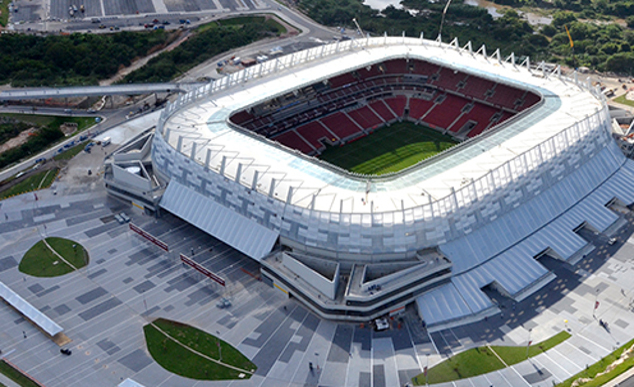
Year Opened: 2013

World Cup Capacity: 46,154

World Cup Groups Hosting: A, C, D, G

Additional World Cup Matches Contested: Round of 16 (D1 vs. C2)

Pernambuco is a new stadium that was built not just for the World Cup but for last year’s Confederations Cup too. Pernambuco is a new stadium not just built for the World Cup and for Recife to have a new football stadium but also to give a financial boost to a deprived area of the city. Plans for the surrounding area include a university campus, indoor arena, hotel and convention centre, plus commercial, business and residential units and a large entertainment complex with shopping centres, cinemas, bars and restaurants. The biggest feature of the stadium is its intent to be a ‘Green Arena’ relying on solar power and even serving the purpose of being a solar power plant to power 6,000 people when not used for game play and be part of the research and development of solar power in Brazil. Football club Nautico Capibaribe is expected to make this stadium home after the World Cup.

-FORTALEZA: Estadio CastelaoFBL-BRAZIL-WC2014-FORTALEZA-CASTELAO ARENA
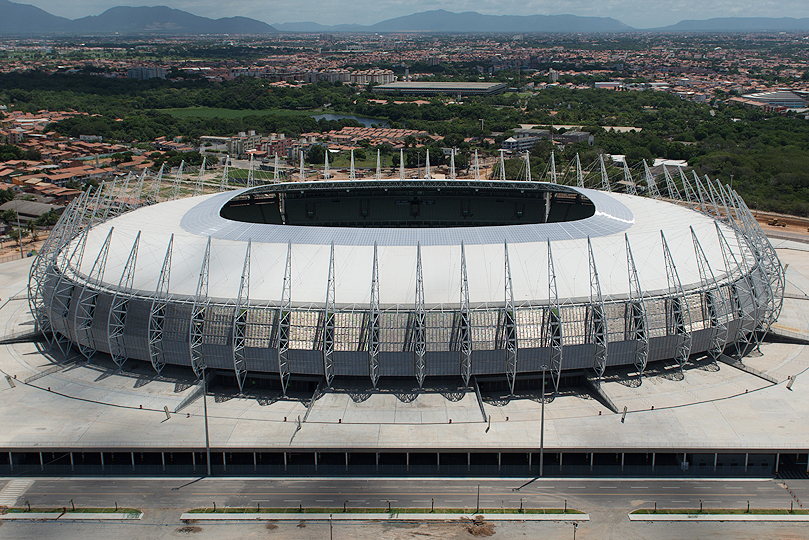
Year Opened: 1973

World Cup Capacity: 67,037

World Cup Groups Hosting: A, C, D, G

Additional World Cup Matches Contested: Round of 16 (B1 vs. A2) & one quarter-final

Castelao is one of the few stadiums at this year’s World Cup to go through two major renovation projects. The first came in 2000 and it was a three-stage project that lasted a year. Then once it was assigned as a hosting venue for the World Cup, it was given a twenty-month reconstruction project starting in March2011: a mere ten years after the first set of renovations were completed. Whatever the situation, Castelao was the first World Cup venue to be completed, back in December 2011. Castelao was one of the venues for last year’s Confederations Cup. Castelao Stadium has always been a venue that has hosted big events in the past. Castelao plans to continue to host major concerts and serve as host venue for Ceara and Fortaleza Sporting Clubs.

And there you have it. My take on Group C and two more stadiums reviewed. Five more groups and six more stadiums to go.

2013 Confederations Cup: More Than A Soccer Tournament

The FIFA Confederations Cup is as much of a pre-World Cup test event as it is a major international soccer tournament.
The Confederations Cup is as much a pre-World Cup test event as it is a major soccer tournament.

So 2014 has the World Cup and 2012 had the Euro. I guess that means 2013 will be devoid of big-time international soccer excitement, right? Wrong! 2013 is the year of the Confederations Cup, an eight-team competition held in Brazil. It’s good and important for a lot of reasons.

A TOURNAMENT GROWS IN SIGNIFICANCE:

The Confederations Cup is more of an intercontinental competition than international. Six of the eight teams that are competing here have earned their berth by winning their respective continent’s confederation championship. The only exceptions being the World Cup winner and the host country. That’s how the Confederations Cup is contested.

The idea of having a soccer competition of the best of the continents was an idea that evolved over 21 years. Actually the first attempt at such a competition came not with the participation of FIFA. It came through the royal family of Saudi Arabia through a competition called the King Fahd Cup. The first King Fahd Cup was contested in Riyadh, Saudi Arabia over five days in October 1992 and consisted of Saudi Arabia, which was the Asian Cup holder at the time, CONCACAF Gold Cup winner USA, African Cup Of Nations holder Ivory Coast and South America’s Cop America holder Argentina who won the Cup. The King Fahd cup was contested once more in 1995 and expanded to six teams: five continental cup winners and host Saudi Arabia.

By 1997, FIFA became involved and the King Fahd Cup had been renamed the Confederations Cup. This is the turning point with the Cup being contested the year before the World Cup and with the competition consisting of the eight teams through the qualifying format that still exists today. There were however two exceptions as two second-place teams from their continent’s championships competed: Czech Republic because Euro winners Germany declined to participate and United Arab Emirates because the hosting Saudis had already qualified as hosts. This would also be a new standard for the Cup  that if one of the continental cup holders already earned their berth as either host nation or World Cup holder, the runner-up team would be given the continent’s berth.

After the 1997 tournament, the Confederations Cup would be contested bi-annually and in a different country every year. The 2001 tournament featured a unique twist as the host countries were Japan and South Korea, the host of the following year’s World Cup. That would be the norm from now on in which the Cup held the year before the World Cup would be hosted by the World Cup host nation(s). Six of the stadiums that were to be for the World Cup the following year were the sites for the Confederations Cup.

The Confederations Cup would continue being a bi-annual competition. Germany, the host nation of the 2006 world Cup, would continue the tradition by hosting the 2005 Confederations Cup with five of the venues for the following year’s World Cup used for this event. Since 2005 in Germany, the Confederations Cup has become a quadrennial event and seen as a warm-up event for the following year’s World Cup. South Africa used it to prepare for their hosting of the World Cup and you can be sure Brazil will do the same here. Six venues that will participate in next year’s World Cup including the legendary Maracana stadium will stage this competition. You could say the Confederations Cup has really grown a lot in the last decade.

WITH THE WORLD CUP A YEAR AWAY…:

You can be sure with the Cup being contested, the media will be paying close attention to how prepared Brazil is for this event and how ready they will appear to look with the World Cup just a year away. Already the media has paid high attention to Brazil’s troubled preparations for the World Cup. FIFA and even local critics have complained of construction delays and cost overruns. Few infrastructure projects were completed and even the 3G network couldn’t work properly. Even the official musical instrument of the World Cup was a failure as fans of losing teams would throw it on the field. Only two of the six stadiums participating in the Confederations Cup were completed by December and two cities were almost axed from hosting. In fact delays have caused FIFA to make an exception in their pre-World Cup demand that the host country hold three major competitions.

It’s not to say it’s all bad. Tickets for the World Cup and the Confederations Cup were a success. Also a record number of volunteers for both the Confederations Cup and World Cup signed up. Even exports from Brazil look optimistic as Brazil anticipates to export $1 billion from this Cup. Brazil has openly vowed it will be ready for the World Cup and even FIFA believes they’re confident Brazil will be ready. There’s only one year to go.

TEAM BY TEAM ANALYSIS:

Now enough talk about hosting the tournament. Let’s move onto the teams and see how well they stack up for this. All but two teams are winners of their respective country’s continental championship. The two exceptions are Brazil who qualifies as hosts and Italy which was runner-up at Euro but qualified since the winner Spain already qualified as World Cup winner. Here’s how they pare up group by group with their current FIFA ranking in brackets:

GROUP A:

-Brazil (22)- You’d think a country like Brazil with a legacy and depth of talent would enter the competition as the favorites but it’s actually not the case. Brazil first surprised everybody at the 2010 World Cup with a quarterfinal loss to the Netherlands. They surprised soccer fans even more by being ousted in the quarterfinals of the 2011 Copa America. Brazil just wasn’t Brazil. Lately Brazil has been making some changes like bringing back coach Luis Felipe Scolari who helped coach Brazil to the 2002 World Cup. Their play has gotten better in a slowly but surely pace. They may have tied Italy 3-3 three months ago but just last week they won a friendly against France who has been traditionally considered Brazil’s ‘Achilles Heel.’ The Confederations Cup could be a turning point for Brazil and send a message how much their team has improved and how far they would have to go to win the World Cup. I’m sure the world will be watching.

-Italy (8)- If you remember last year’s Euro, you’d remember it for Italy’s comeback as much as for Spain’s win. Italy was a team that was direly in need of improving after the 2010 World Cup and their qualification for the finals shows how far they came. Their play in World Cup qualifying matches have also been excellent. However they’re not immune to choking as noticed in a 2-2 friendly against Haiti. Nevertheless this tournament can also send a strong message to Italy how their team looks en route to the World Cup.

-Mexico (17)- Mexico has always been considered the ‘sleeping giant’ of soccer. The team has always been loaded with talent and skill but they have yet to prove themselves in a big way at a major tournament. They may be the current CONCACAF Gold Cup holders but even now with World Cup qualifying for the CONCACAF they still find themselves third in the standings with the USA leading. This group being the ‘group of death’ in the Cup could also pose a challenge. Nevertheless Mexico could pull one of the big upsets of the tournament. We also shouldn’t forget Mexico won the gold medal in London. It’s a given in any tournament to never count Mexico out.

-Japan (32)- If there’s one continent that has grown the most in terms of soccer play in the last two decades, it has to be Asia. And Japan has to be one of its strongest examples of accelerated success. Nevertheless Japan finds itself in a tight situation here in the Cup against three teams known for their legacies and their consistency of play. But don’t count Japan out. They’re the first team to earn a World Cup 2014 berth on play by already leading their AFC qualifying group by a huge margin. Plus they’ve won three of their six matches in 2013. So if any team can most give the biggest surprise at the Cup, it’s Japan.

GROUP B:

-Spain (1)- How about that? Spain has gone in five years from being ‘soccer’s greatest underachievers’ into the top team in the world. Two straight Euros and a World Cup. They sure have come out of their shell and they come to the Cup as the favorites to win. Heck they haven’t had a single loss not just in 2013 but 2012 too. They look to have an easy Group Stage play but play in the semis and possible finals could make things more challenging for Spain. Just because a team is #1 and undefeated for two years doesn’t mean their infallible. We shouldn’t forget they lost to the USA in the semis at 2009’s Confederations Cup. Here could be yet another achievement in Spain’s recent legacy or a sudden reminder of their own weaknesses. Only the next two weeks will tell.

-Uruguay (19)- Uruguay has to be the comeback story right now. It seemed as though Uruguay’s soccer legacy was a thing of the past. Their prowess from the 30’s to the 50’s captured the imagination of the world. However it was their fourth place finish at the 1970 World Cup that appeared to mark the end of Uruguay’s greatness. However recent years has seen Uruguay make a comeback with a fourth-place finish at the 2010 World Cup and the win of the 2011 Copa America. But before you can shout out that Uruguay was back in a big way, it hasn’t been completely easy. They currently stand fifth in the standings of World Cup qualifying play for the CONMEBOL. Nevertheless while their play against South American teams have been a bit of a struggle, their play against other international teams have been quite impressive. This tournament can also send a message to the Uruguayan team in terms of what they need to do to qualify for the World Cup.

-Nigeria (31)- Nigeria has always been one of the top African teams. They look impressive in world Cup qualifying right now. The big question is their international play. Not much is known and past international and World Cup play has not given to impressive results. One result that did send a strong message was a 2-2 tie against Mexico two weeks ago. Nigeria could prove to be a stronger team here than most experts think.

-Tahiti (138)- Usually the OFC Nations Cup goes to either Australia or New Zealand. Last year it went to little Tahiti! Tahiti has become the least populous nation ever to win a continental championship. Here at the Cup, Tahiti’s biggest victory is just simply qualifying. Not much is expected since all the other teams have stronger depth in talent and international experience. In fact Tahiti is the only team at the Cup that doesn’t have a chance in even qualifying for the World Cup as the Oceania contestant for a berth against a CONCACAF team is New Zealand. Nevertheless the Cup can be a valuable learning experience for Tahiti. They’ve had hardly any international experience outside of Oceania. Now’s their chance to experience play against some of the best teams in the World. Despite their meager chances of qualifying for further play, Tahiti is probably the only team at the Cup with nothing really to lose and everything else to gain.

So there’s my rundown of the eight teams for the Confederations Cup. I’m not going to hazard predictions until the Group play is done and the semifinal berths have been decided. In the meantime stay tuned to see who will win the 2013 Confederations Cup. And stay tuned to see how ready Brazil appears to be for hosting next year’s World Cup. Both should be interesting to see.

In The Wake Of The Japanese Tsunami, Are You Prepared?

Ever since the late evening of Thursday March 10th leading into Friday the 11th, the story of the Japanese tsunami and aftermath has dominated our headlines. We constantly see images, both professional and amateur, as well as the latest news updates. It’s both alarming and upsetting. It’s also a sobering reminder that something like this can strike close to home, especially if you live on either the east coast or west coast.

The news first broke this past Thursday night or very early Friday morning. A powerful earthquake in the Pacific Ocean just 100 miles east of Japan’s northern coast caused a tsunami that hit the coast of Japan, especially the city of Sendai, really hard. The quake measured 9.0 on the Richter scale and is the seventh-highest ever recorded. Replays of the wave’s crashing caught on amateur video has left many shocked. Some who were up during the early morning hours were able to see live footage of the wave as it was travelling towards the west coasts of the Americas.  The destruction to the Japanese coast and surrounding areas has been in the news daily. The statistics of destruction and human loss are growing. Many anticipate the final death toll to reach around 20,000.

Another shocking thing about this disaster is that it comes more than six years after the 2004 tsunami in the Indian Ocean which claimed a total of almost a quarter-million lives in many countries. That ranks as the deadliest tsunami in history. I’m sure many of us still have images of the disaster fresh in our minds.

Those living near the west coasts of the Americas had the least damage to deal with. Hawaii was hardest hit but there was no loss of life and damage was minimal. Even the west coasts of the Americas had their own damage to deal with but the most damage individual areas faced was one or two million dollars. We were pretty lucky. Nevertheless one thing citizens living  on or near coastal land need to remember is that a tsunami can strike at anytime. Where there’s a coast by an ocean, sea or lake, there’s a tsunami danger. The big question is do we know how to take action?

For one thing, warning systems are an excellent start for prevention. First part involves network sensors to detect threatening waves. Second part involves  a communications infrastructure to issue timely alarms to permit evacuation of coastal areas. This can beneficial since the tsunami from days ago was distant enough from the Americas to allow ample time for warning. Although beneficial, they are imperfect as in the case for Japan in this instance. Tsunamis can come as fast as 600 miles/hour and the earthquake epicenter for this tsunami was 100 miles east of the coast. This wouldn’t allow for ample time to save enough property or enough lives. Nevertheless new advances in warning are still yet to come. After the 2004 Indian Ocean tsunami, an Internation Early Warning Programme was proposed immediately after and it resulted in the Indian Ocean Tsunami Warning System. I’m sure after the Japanese tsunami, there will me more pressure to follow through on the Internation Early Warning Programme and propose for more technological advancements.

Technological devices are also helpful. One such is the DART buoy: DART standing for Deep-ocean Assessment and Reporting of Tsunamis. These buoys are held in place off coast to detect possible tsunami threats along with a Bottom Pressure Recording package to detect pressure changes of the tsunamis. The United States has 39 DART buoys in the Pacific and Atlantic Oceans and The Caribbean Sea. Since 2009, other countries have started to use DART buoys for tsunami detection. Another such is a tsunami warning system like the Pacific Tsunami Warning System based in Honolulu which records seismic activity in the Pacific Ocean. Although not every Ocean earthquake causes a tsunami, the computers assist in analyzing the tsunami risk of every earthquake that occurs in the Pacific Ocean and the adjoining land masses.

Then there’s also local preventative measures. Some are natural, like mangroves, coastal vegetation and coral reefs which helped to cause the least damage during the 2004 Indian Ocean tsunami. Others are constructed like seawalls and floodgates. Japan has constructed some seawalls that are as tall as 15 feet to protect populated areas. Seawalls may have to be expanded in the wake of the most recent tsunami. All Pacific Rim countries have organized evacuation routes and practice evacuation procedures.  In Japan, such preparation is mandatory for government, local authorities, emergency services and the population. Vancouver even has some disaster relief routes. There’s even preparation information and a program from BC’s Ministry of Safety and Solicitor General. It’s up to the governments to inform the public at risk to be informed how to take action.

The tsunami in northern Japan is a chilling and sobering wake up call to those who live on or near coastal areas. This will undoubtedly leave many questioning if such a disaster can happen to them and how would they respond. This will also leave government agencies time to question whether they have the right technological means to detect warnings necessary for alerts and possible evacuations. Hopefully none of us will have to experience what those in northern Japan are dealing with right now.

WORKS CITED:

WIKIPEDIA: Tsunami.Wikipedia.com. 2011. Wikimedia Foundation Inc. <http://en.wikipedia.org/wiki/Tsunami>

WIKIPEDIA: Tsunami Warning System.Wikipedia.com. 2011. Wikimedia Foundation Inc. <http://en.wikipedia.org/wiki/Tsunami_warning_system>

WIKIPEDIA: International Early Warning Programme.Wikipedia.com. 2011. Wikimedia Foundation Inc. <http://en.wikipedia.org/wiki/International_Early_Warning_Programme>

WIKIPEDIA: Deep-ocean Assessment and Reporting of Tsunamis (DART).Wikipedia.com. 2011. Wikimedia Foundation Inc. <http://en.wikipedia.org/wiki/Deep-ocean_Assessment_and_Reporting_of_Tsunamis>