Movie Review: KPop Demon Hunters

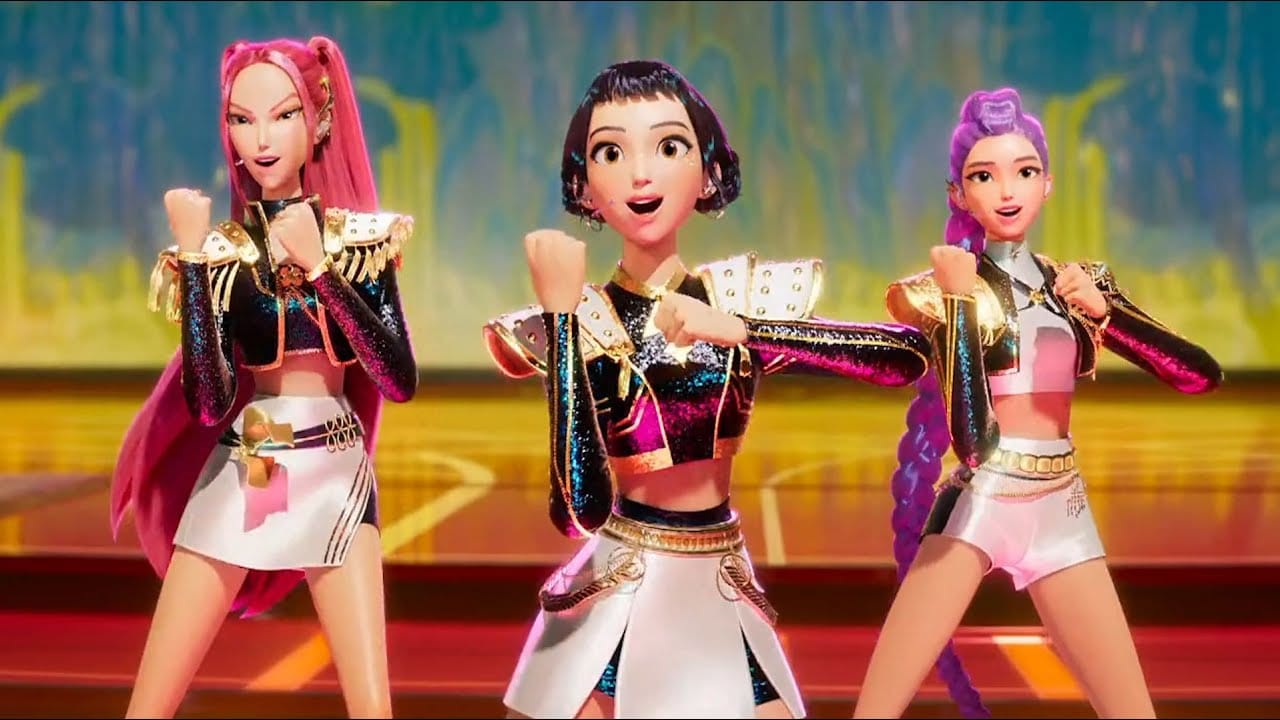
KPop Demon Hunters is about a girl group who are more than just entertainers. They have demons to fight.

I admit I’m one of those late to the ball when it came to watching KPop Demon Hunters. I have not been too excited to see the latest animated films in recent years. What got me to see it is the big awards show buzz and how this film made some hit records chart well in the last few months. I knew I had to see it and I’m glad!

Huntrix is a girl group of three girls named Rumi, Mira and Zoey. They are the top music phenomenon in all of Korea but unknown to their fans is they are demon hunters. This goes back to the ancient past where demons led by the evil ruler Gwi-Ma used to prey on souls of humans. Back then, three women would use their singing voices to create a magical barrier on the demons called the Honmoon. Generation after generation would have their own threesome of singing hunters in hopes of strengthening it to a Golden Honmoon that would banish the demons forever. And now, it’s bestowed on the three girls of Huntrix who are trained by former hunter Celine. Their first test comes when their concert’s helicopter is discovered to have demons on board. They succeed in defeating them and make it to what they hope will be their last concert of their tour on time. To the annoyance of the others, Rumi pushes their upcoming release ‘Golden’ out sooner than they wanted and it tops the charts. That means the girls will have to go back to touring instead of having the relaxing time in the bathhouse at the end of the tour they were hoping for.

Back to the demon world, Gwi-Ma is angered for his latest plot being foiled by Huntrix. Gwi-Ma discovers Jinu: a human-turned-demon. With four other demons, he groups them with Jinu in a promise to erase his human memories and turns them into a boyband Saja Boys, whom he hopes will rival Huntrix and destroy their chances of creating the golden Honmoon. It’s also revealed Rumi of Huntrix is half-hunter, half-demon. Only Celine knows this as she found Rumi orphaned and raised her to be a hunter. The skin pattern on Rumi is the same skin pattern of demons, which explains why she won’t go with Mira and Zoey to the bathhouse. Rumi can’t do away with the memory and it starts affecting her voice as she can’t sing a certain note in ‘Golden.’

One day, the girls of Huntrix see the Saja Boys waking down the street. They think they’re hot until one of them bumps Zoey and instead of picking her up, he says ‘Watch it.” Minutes later, Huntrix see the Saja Boys, those arrogant boys, dazzle the crowd on the street with their song ‘Soda Pop.’ Huntrix are furious that they are trying to steal their #1 spot but they notice the demon skin of all five members. In a location not seen by the public, Huntrix and the Saja Boys get into a battle. Huntrix succeed, but Jinu notices Rumi’s demon pattern. Jinu feels he has to tell his own secret to Rumi privately. In their private meeting, Jinu tells Rumi that 400 years ago, Gwi-Ma promised him fame and recognition and to take his family out of poverty if he just gave himself over to the demon world. He agreed. It made him famous, but it led to his family’s downfall. It’s a feeling of guilt he still holds.

The problem with the Saja Boys’ popularity growing isn’t just how it threatens the #1 status of Huntrix. It also weakens the Honmoon and it allows more demon attacks to occur. The other two girls of Huntrix thinks the way to expose the Saja Boys’ demon identity is by releasing a song titled ‘Takedown.’ The song’s demon-hating lyrics shocks Rumi and it leads to a strain in her relationship with the other two members. Rumi also has to work out a solution for Jinu. She suggests to him if he helps Huntrix win the upcoming Idol Award and strengthen the Honmoon, he can freely live in the human world. Rumi revealing her secret to Jinu helped her get her singing voice back. Jinu tells Rumi that through her, he no longer hears demon voices and agrees to his deal with her to sabotage the Saja Boys. Infuriated, Gwi-Ma reminds Jinu in the demon world that he abandoned his family for a life of fame and privilege and will increase the voices of torture if he follows through on his deal with Rumi.

The Idol Awards happen and because of the fiasco involving ‘Takedown,’ Huntrix has to sing their hit ‘Golden.’ On stage, Rumi is singing solo on stage because Zoey and Mira were lured away by imposter demons sent by Jinu. In the middle of her performance, the song ‘Golden’ is stopped and two other demons sent by Jinu trick Rumi into singing ‘Takedown’ and expose Rumi’s demon pattern to the whole crowd. Rumi is embarrassed by it all and runs off stage. Zoey and Mira are mad for Mira hiding her demon patterns and her meetings with Jinu. All this friction causes further weakening to the Honmoon and more consumed souls which allows Gwi-Ma to enter the human world and put a trance on the public, including Mira and Zoey, and allows them to be consumed by the Zoey. Such an incident causes Rumi to confront Celine over never truly loving her as the Honmoon has been destroyed. It is up to Rumi to solve this.

How does Rumi solve this? With the Saja Boys now on top, Rumi delivers an improvised song to interrupt the Saja’s performance of ‘Your Idol’ and to break Mira and Zoey out of Gwi-Ma’s trance. This helps the three reunite and fight back to free the crowd. That fuels Gwi-Ma’s desire to attack Rumi. Jinu, repentant from all he caused, sacrifices himself by giving Rumi his restored soul. This allows Rumi to get a new source of strength to defeat Gwi-Ma and the other Saja Boys whole creating a new Honmoon. The ending gives the three girls time to finally relax in the bathhouse and Rumi’s hidden truth about her ‘demon skin’ no longer a dark secret: Rumi’s first bath with the other girls! Huntrix is back on top and their fans are all free!

It does seem awfully unusual to do an animated film about the K-Pop phenomenon. It seems especially bizarre that the film be made into an action film about fighting demons. That was the idea of Korean-Canadian director/ Maggie Kang. Kang has fifteen years of scriptwriting experience with many big-name animated films. Kang intended to create a film that paid homage to Korean mythology and shamanism to deliver something unique to animated film. Her intention of this film was to be a ‘love letter to K-pop’ and to her Korean background. The use of Korean singers as fighters of demons is not intended to be a novelty. Kang would describe that song and dance was common in the rituals of Korean shaman women. To take this mythology and to make it into something modern and in the present takes a lot of effort and a careful usage of the culture. Kang and her co-director Chris Applehans succeed with flying colors, both literally and figuratively. To have a film like this win crowds in big numbers both at the box office and Netflix hits, it’s an accomplishment worth big acclaim. Netflix teaming up with Sony Pictures Animation sure delivers a real winner here! Also the film delivers a hint that there’s a sequel coming. In 2029!

As an animated film, it’s not the common cute animated film that are mostly in the big theatres. Actually an animated film of KPop stars who are secret warriors, that looks like something more for older children or even teenagers. Especially with KPop being so popular since the early 2010’s and still continues to do very well on the charts. Outside of the age demographic it’s most suitable for, the film is a dazzler. It is very colorful, loaded with action and drama, does a great job of mixing traditional Korean mythology with modern Korean pop culture, and has a lot of dazzling effects. The music from this film also knows how to catch on in mainstream music markets and on radio. ‘Golden’ hit #1 in many a country and has become one of the most played songs of 2025. The film has kicked of many other hit songs like ‘Soda Pop’ hitting #3 in the US, ‘Your Idol’ hitting #4, ‘How It’s Done’ peaking at #8 and ‘Takedown’ peaking at #21. I think it has been years since a film has unleashed this many hit singles. For many decades, it seemed like hit songs from movies were less common than ever. This film sure changed that!

One thing to notice is that the girls of Huntrix have different voices for their acting and singing voices. Arden Cho does a great job in the acting voice of Rumi. She captures it very well. For Rumi’s singing voice, South Korean singer Ejae who’s had a lot of experience with various KPop acts, delivers excellent singing. That it something how she hits the high note on ‘Golden!’ May Hong is great as the fierce Mira and Ji-young Yoo is excellent in giving Zoey the most comic relief of the film. Ken Jeong is great as the excited manager Bobby. I knew with a film like this, they had to have Ken Jeong! Lee Byung-hun, who also starred in this year’s live-action Korean film No Other Choice, is great in providing the drama of Gwi-Ma. Ahn Hyo-seop, who himself has experience in being with a K-pop boy band named One O One, does a great performance as the troubled Jinu.

KPop Demon Hunters is one animated film more suitable for older children and teenagers. Adults will like it for the culture in its story, its  drama and the special effects. This year’s surprise delight! It even tempted me to think this could be adapted into a stage musical in the future. Do you agree?

Oscars 2019 Best Picture Review: Parasite ( 기생충)

Parasite
Parasite is the story of the Kim family trying to break out of poverty by scamming their way together into serving an upper-class family.

NOTE: This review originally published January 27, 2020 has included many edits done on February 17th after watching this film again.

Foreign-language films have a habit of becoming catchy when you least expect it. This year’s hit foreign film comes from South Korea. It’s titled Parasite and done by renowned director Bong Joon-ho and it’s quite a telling story about the classes.

The Kim family have it hard as they live in a basement shack in a rough area of Seoul. Father Ki-Taek had good restaurant opportunities, but they all folded. Mother Chung-sook used to be a good hammer thrower. Son Ki-Woo is trying to get into a good college and their daughter Ki-Jeong is unsure of her future. They struggle with working menial jobs, have to roam near the windows for free Wifi, have a lot of bugs in their place and sometimes have no choice but to watch drunks urinate outside their window.

Ki-woo’s friend Min-hyuk visits with him before he leaves for college. Min-hyuk has been working as an English tutor for the daughter of a wealthy Park family. Min-hyuk recommends to Ki-woo he take over and even fake university credentials. Min-hyuk trusts Ki-woo way more than those other ‘drunken college boys’ to replace him in the tutoring job. Ki-woo is able to make a successful forgery and he’s hired to be the English tutor to the Park’s daughter Da-Hye. The Kim family hope to get jobs within the Park household. The Parks are hugely admiring about their 7-year-old son’s drawings and are looking for an ‘art tutor.’ Kim Ki-jeong, the daughter, is able to pose as a student from Illinois under the name of Jessica. Ki-jeong is hired and even able to successfully convince the mother something’s psychologically wrong with the son. Now that Ki-jeong is hired, it looks like there aren’t any more positions. Not unless they get the chauffeur and the maid fired. Which is exactly what the Kims do! The limo driver is ordered to drive Ki-jeong close to her block but without him knowing, she takes her panties off and leaves them to get him framed for having sex in the car. It works and the father Kim Ki-taek is hired as the limo driver. Then there’s the maid Moon-gwang. She’s a good servant, who even served the original tenant of the mansion who was the architect. She makes her allergy to peach aware which is perfect! The Kims shave peaches and throw it when she’s around to get her to think she’s come down with tuberculosis. Moon-gwang has to quit and the mother Kim Chung-sook is hired to replace her.

Although all four have jobs in the Park household, they have to disguise they’re not family. That’s not easy as the Park’s son, Park Da-song, notice they all have the same smell. Also all have to make their exact whereabouts secret to them not just so that it’s unknown they live in the same place, but so the Parks don’t know they live in a rutty area. Soon the Parks leave for a camping trip, which they will be using their own car and entrusting Chung-sook as the maid and leaving the others off. As the Parks are away, it’s perfect opportunity for the Kims to have their own party at the place. And they have every reason to. They all made it!

However during their fun on a rainy night, something unexpected happens. They have a visitor at the house. It’s the former maid Moon-gwang. She said she left something important in the bunker. The Kims didn’t know the Parks had a bunker. It’s a bunker a lot of rich people have either to avoid loan sharks or in case nuclear war happens. This bunker was ordered to be built by the first house-owner and something even the Parks don’t know about, but Moon-gwang does. In that hidden room at the bottom of the bunker, Chung-sook discovers Geun-sae, Moon-gwang’s husband, is in it. He has been hiding down there for years to avoid loan sharks over his failed restaurant. When the other Kims discover Moon-gwang and Geun-sae a fight ensues after Moon-gwang threatens to expose their scam. The family and couple use technology to fight for control. However the fight ends when Chung-sook learns the family is coming back sooner than expected because of the heavy rain and they expect ‘ramdon’ with cubed beef. Party’s over, right?

Not quite. The Kims have to hide and Chung-sook kicks Moon-gwang down the stairs for which she receives a fatal head blow. Chung-sook serves the Park family the ramdon after they arrive with the other Kims hiding under the furniture waiting to escape. It’s a long process as the parents sit on the sofa watching Park Da-song play ‘indian’ in his tent out in the rain. The Parks even get sexual on the couch and even talk about the smell of Kim Ki-taek, unknowing that he’s underneath the sofa and hears it all. The three Kims escape the mansion and return back to their home in the rain, only to find it’s almost completely flooded and they’re one of many people from the neighborhood that have to sleep in a makeshift shelter in a gymnasium. The next morning, Ki-woo and Ki-taek have a heart-to-heart talk about life and plans.

All appears not to be lost. The Parks are having the birthday party for Da-song and the staff are invited. All four Kims can assume their guises again. It’s based on the ‘indian’ theme that Da-song loves. It’s if party with family and friends. Ki-taek is to participate with Park Dong-ik in an ‘indian attack’ skit with the birthday cake and is reminded he’s a paid servant. The party goes well but just as Ki-woo returns to the bunker with the scholar’s rock, he encounters an angry Geun-sae. Geun-sae has had it that he’s been down there for so long and that he just lost his wife because of the Kim’s stupidity and selfishness. Geun-sae wants revenge and Ki-woo is first to get it as Geun-sae uses the scholar’s rock to hit him over the head. Then Geun-sae goes out in the yard where the party is and stabs Ki-jeong in the heart. That provokes a seizure from Da-song which Dong-ik orders Ki-Taek to drive him to the hospital. That leads to even bigger chaos as Chung-sook fatally stabs Geun-sae, but Geun-sae is alive long enough to look Dong-ik in the face and shout ‘respect.’ Angry with it all, Ki-taek stabs Dong-ik and runs away out of everyone’s sight.

The aftermath is that Ki-jeong died and Ki-woo was in a coma for weeks. Ki-woo came out of it, but it left him with a brain injury that causes him to laugh unexpectedly. He and Chung-sook were convicted of fraud and impersonation and Ki-taek is at large missing without a trace. The Park house has been resold to a German family who just arrived. Despite the deaths of Moon-gwang, Geun-sae, Kim Ki-jeong and Park Dong-ik, it sold. Even with new owners, Ki-woo notices a light from the bunker flash on and off. Ki-Taek is alive and hiding in the bunker and flashes a message of Morse Code every day hoping his son will see it. Ki-woo has a message of Morse code for his father he hopes to deliver one day. A message of a hope that they can be a family again and how they can live prosperously in that house, and done fairly.

The interesting thing of this film is that it’s very creative in showing the biases poor people have of rich people and the biases rich people have of poor people, and biases both have of certain peoples in general. For all intents and purposes, the Parks hired the Kims who disguise themselves as unrelated workers. The Parks appear to treat the adult Kims as people, but will also treat them as the hired hands they’re supposed to be, so there has to be a limit. With that, all that happens seems to send a message of the biases. We see it in the Park family as they common talk about the smell of poor people, especially Mr. Kim. It seems like poor people have a smell only the Parks can sense. We also see how the Parks seem to think the smallest instance of something wrong is a big problem and the wife believes whatever the Kim’s tell her! We see it in the Kims how they have the belief that the rich are very naive and all four are ready to take full advantage of it. Even at the ‘Kim party’ and how they talk of money being a solve-all.

The film also shows how both the Kims and the Parks can expose their own weaknesses. We see it at the beginning as the Kims think their only way into a better life or even a life of wealth is to scam their way into wealth. We see how Park Da-song likes to fantasize about being an ‘indian’ and the Park family toys around with Native Americans. We see it at events like the birthday party, we see it during the rainflood, we see how Mr. Park has a framed article from an American magazine where he’s named ‘Nathan Park.’ We sense it in the use of English words and phrases, English names and association with the United States like all these elements suggest something about class structure and importance. Even how when Mrs. Park hires Ki-woo, she wants to give him the name ‘Kevin.’ We even see how despite the Parks neglect Moon-gwang and Geun-sae, Geun says ‘respect’ to him. The rich Parks appear to marginalize, but the Kims and the couple still have regard to them. Even seeing how Ki-taek can’t mourn at his daughter’s urn but mourns at an obituary of Nathan says something.

Even without the theme of the wealth gap, this film is also interesting of how the story is constructed. At first you think the film will follow a basic linear path in therms of telling its story. There are even times in which even after one incident happens out of the ordinary, it appears it will still end in normal fashion. However it doesn’t. What you anticipate might be a good ending actually ends up being something totally bizarre. The first half of the film appears like a massacre is the last thing to expect the film to end with, but you’ll be surprised. One source mentions that it ended that way because Korean movies are known to be big on blood and gore, just like a lot of Japanese movies. However it does make one think whether the film and its scenes were done right or not. Sometimes you think it could have been done better if this was done that way. Then you think if it did, this would have to be left out. In the end, you’re left convinced the film was done the right way. Including the massacre scene when Kim Ki-jeong is killed, but Park Dong-ik cares about his son’s seizure instead. Even the scene where Moon-gwang falls and recieves her fatal concussion seems like the right thing to have. Also the aftermath looking like it ends the film right as a redemption of humanity at the end and actually makes you feel for the surviving Kim family, despite Ki-woo’s message of an against-all-odds hope.

I’ll also this film is a welcome reminder of the rich-poor gap in South Korea. If you remember years back, I saw a film called Nameless Gangster. That film showed the conditions of South Korea in the early 1980’s and the protagonist struggled with a limited wage as a fisherman. That’s why he chose to be an organized crime don. Because he felt it was the only way he could get ahead. The film also showed how things became better for South Korea as democracy was implemented just before the Seoul Olympics. I was left with the impression that life for residents got way better since democracy was introduced. Parasite reminds me it is, but there are still people in South Korea that slip through the cracks. On top of that, the gap of rich and poor is just as present in South Korea as it is in any developed nation.

Top accolades for the film go to director Bong Joon-ho. Bong is actually South Korea’s first director to break into North America. He had a good reputation in South Korea, but he expanded into North American film after people take note of 2009’s Mother. His English-language breakthrough came with 2013’s Snowpiercer and critics were impressed. Even after returning back to Korean films, Bong has still caught a lot of attention with films like Sea Fog (which he was producer) and Okja. This is possibly his best work.

This film is very complex as Bong’s not just simply working with a complex story he co-wrote with Han Jin-won, but even working with a lot of complex styles of scene. Bong got the idea from this story from an actual murder of rich people by their servants. It was 1933 in France and the two servants that killed their master were sisters. Bong does a good job in making a great story sending a message about the division of the classes. The little elements that add to the theme of the rich-poor gap like the ‘poor person smell,’ the use of English when they have something significant to say, the storm which makes the Kim family face the music about what they’re doing, the scholar’s rock which goes from a good-luck object to something Geun-sae attempted to kill Kim Ki-woo with before the massacre, the use of Morse Code, Nathan’s constant talk of crossing-the-line and the talk of plans between Ki-woo and Ki-taek, they all help add to the color of the story and to the theme.

Already there are a lot of videos on YouTube that talk of various elements of the film like the multi-leveled house and how the Kims are always beneath the Parks, the use of sunlight in the Park domain, the ending seen as false hope, and the use of bugs during certain scenes. There are scenes that get you wondering as well. Like the scene where Park Da-hye has sex with Kim Ki-woo. Some could say it’s sending the message the two classes aren’t that far apart. Others could say it’s where the rich like to screw the poor. You be the judge! Also you figured halfway into the film that the scam of the Kims would eventually be uncovered, but I bet you didn’t expect it during a massacre at a child’s birthday party!

The acting from all ten actors involved was excellent to see as they all had something to add and they did it all as one team rather than a single actor standing out. If there was anything close to a standout, it had to be Song Kang-ho as the Mr. Kim. He did an excellent job as playing a man who appears to be the one most caught in the middle. Choi Woo-shik was also good as the hopeful but insecure Kim son who starts it all and ends up the voice of reason at the end. The production design was also very good. It was excellent in showing off the modern rich-poor gap of the three classes very well. The cinematography of Hong Kyung-pyo was also excellent. The music from Jung Jae-il also added to the storytelling too.

Parasite begins in normal fashion, leads to a comedic middle, leads to the conclusion in bizarre fashion, and ends on a somber note. It does seem like an odd construction of a film, but Bong makes it work. Plus he has a lot to tell about the gap between rich and poor. It’s a gap we see all too well in our own lives.