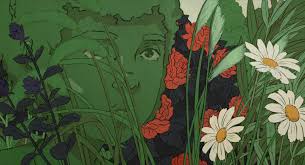
The only feature-length animated film I saw at this year’s VIFF is the Canadian French-language film Death Does Not Exist. It is not your typical animated film as it defies expectation.
Helene is part of a group of young radical climate activists. They have the goal of attacking a rich family and brought guns along to make their message heard and to encourage others to follow their act. The attack becomes full-fledged a hail of gunfire on between both the radicals and the family’s bodyguards follow. People on all sides are killed. Helene’s colleagues, the rich family members, the bodyguards, no one is safe. Just as Helene appears to be the only one of the radicals who survives, she runs off into a forest and is completely lost.
The forest she runs into, which is immediately outside the mansion, is treacherous and wild wolves chase her. Lost in the woods, she comes across many wild creatures. The ground is covered with red leaves, resembling the blood of her comrades. In the woods, she comes across wolves chasing after sheep. She senses it’s telling her a message about herself. As she runs away, she falls and knocks herself unconscious.
As she wakes up, she comes across a childhood version of herself. It’s possible she can start a new life. However, she finds Manon: one of her activist comrades who was gunned down. How is she not dead? As Manon makes meat of a rabbit she killed, she makes Helene confront her own cowardice for leaving them all behind to die. She may be unhappy with Helene leaving them behind, but she offers a second chance.
The moment reoccurs again. Helene’s activist group and the rich family are all alive as if the massacre never happened. Will things change? Again, the massacre blows up and all of Helene’s comrades are gunned down. Again, few from the rich family in the golden mansion survive. The grandmother from the wheelchair, the survivor of the rich family Helene noticed most, survives again.
Instead of running into the woods, Helene goes into the mansion. Will shooting the woman be what she needs to do? It is there that the mansion becomes a forest or jungle of its own with the animals themselves also resembling characters of Helene. Helene soon confronts the grandmother in the wheelchair and has a message to give to her that stuns her. Soon after, Helene confronts an older version of herself and received messages from her. She then moves into images of the future, including one of the mansion being swallowed by the ground and flowers growing where it once stood. The film ends with message Manon delivers at the end.
The film does have a message. It’s that we’ve always lived in a world full of opposites, especially in terms of beliefs and convictions. It’s just now people on either side don’t talk. They just promote their belief and vilify those that believe otherwise. The massacre at the beginning is symbolic of such a situation as incidents that have happened in the past and what could happen in the future if we’re not careful. The world may be in crisis right now, but violence is simply making things worse.
Often the point of this film is that you should stand for what’s right but be cautious about your own actions at the same time. With Helene as the central character, it’s Helene’s consciousness that needs to be examined and exposed to her as she runs away. She’s exposed to her moral weaknesses and what she failed to become, but she also is shown enlightened images of what could happen, if she gets a second chance.
The film does a good job of being picturesque and telling in its imagery. Its images do catch your eye and can captivate the audience, but it can also lead them astray as they watch the story. Often there’s too much imagery happening and it doesn’t always make sense of whether the film is trying to tell a story or dazzle the viewer. Often, the audience can be led astray and become confused of what the whole message is. It does have a lot to say in both dialogue and imagery. It just doesn’t do it in too orderly of a fashion.
This is a good feature-length film directed by Felix Dufour-Laperriere. He’s had over 20 years of experience directing and producing animated film with 2021’s Archipelago being his biggest. Here, he creates a film that is so full of imagery, it took four years to complete. A lot of the imagery works in telling the story, while a lot of it can also lead the viewer astray. It is well done, but its imperfections are noticeable. Zeneb Blanchet does an excellent job in voicing Helene. She is good at capturing Helene’s confusions and insecurities well. She’s also great at making the character of Helene one of the best qualities of the film.
Death Does Not Exist is a slow and confusing animated film, but it’s also very picturesque. It deals with a deep subject matter and a deep message and allows the audience an escape to the beyond as images most tell its intended message.

 Jon The Blogcentric