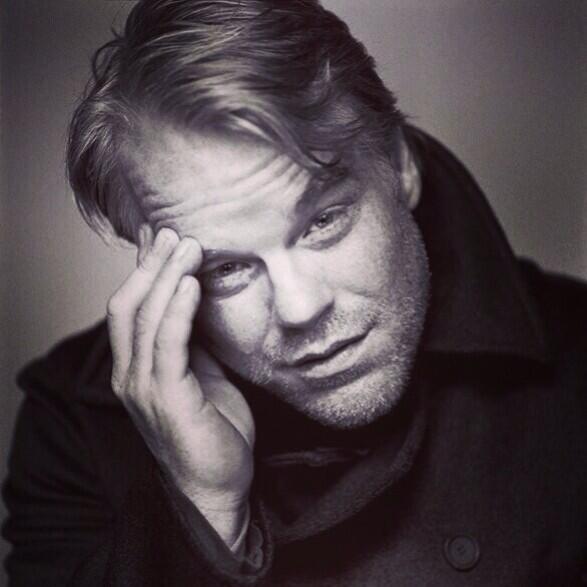
I wasn’t planning on posting this. Actually I was planning my next blog to be another Best Picture review. Instead I post this because of how shocking it is. And of how much I admired him and his works.
Philip was born in Fairport, New York (just outside of Rochester) on July 23, 1967, one of four children to family court judge Marilyn O’Connor and Xerox executive Gordon Hoffman. His parents divorced when he was 9. Hoffman’s past-time in high school was wrestling but switched to acting after a neck injury caused him to quit. Talent was noticed at a young age as he was selected at 17 to attend the 1984 theatre school at the New York State Summer School Of The Arts in Saratoga Springs. He graduated from Fairport High School in 1985 and attended the Circle in the Square Theatre’s summer program. He would go on to attend New York University’s Tisch School Of The Arts and graduated with a BFA in 1989. Soon after he had a bout of alcohol and drug addiction which we would attend rehab for shortly after and eventually overcome.
He made his acting debut on television acting in a 1991 Law & Order episode. His first film role came in 1992’s Scent Of A Woman. Minor roles in film continued for Hoffman over the next few years. In 1995 he joined the LAbyrinth Theatre Company where he staged and performed in numerous productions. However his breakthrough came in 1997 when he had a scene-stealing supporting role as Scotty J. in Paul Thomas Anderson’s Boogie Nights. Hoffman would act in three more Paul Thomas Anderson movies: 1999’s Magnolia, 2002’s Punch Drunk Love and 2012’s The Master. Over the next few years, Hoffman’s reputation as an actor would grow with more excellent performances in independent films like The Big Lebowski, Happiness, The Talented Mr. Ripley, and State And Main. He also showed he could act well in popcorn films like Patch Adams and Almost Famous. In theatre, he would earn a Tony Award nomination for Best Actor in 2000 for playing Lee in the readaptation of Sam Shepard’s True West.
Further excellent performances continued for him in films like Love Liza (which was written by his brother Gordy), Owning Mahowny and the TV miniseries Empire Falls. He also continued to do come off well in box office fare like Cold Mountain and Along Came Polly. Theatre accolades would continue with his second Tony nomination coming in 2003 for his supporting performance in Long Day’s Journey Into Night. However big critical acclaim in film. kept on alluding him until 2005’s Capote. There he was to play Truman Capote in a biopic directed by former Tisch classmate Bennett Miller. He was even said to act in character even after scene shooting ended. It was there where Hoffman won the Academy Award for Best Actor for his performance. And Miller received his first and so far only Best Director nomination.
Things became better for Hoffman commercially as he would play villain Owen Davian in Mission Impossible 3 months later. In 2007 he received Golden Globe nominations for Best Actor in the independent comedy The Savages and Best Supporting Actor for playing Gust Avrakotos in Charlie Wilson’s War opposite Tom Hanks. It’s his role in Charlie Wilson’s War that would earn him his second Oscar nomination. Hoffman would return as an Oscar nominee the following year in the Supporting Actor category again as Fr. Brendan Flynn in the film adaptation of the Broadway play Doubt opposite Meryl Streep and Amy Adams.
Hoffman would continue acting in film, both independent and commercial. He would also continue acting and directing in theatre. He wouldn’t get too much notice or acclaim over the next two years but his work continued to be consistent. He would again steal scenes in 2011’s The Ides Of March and Moneyballas frumpy Coach Art Howe. 2012 was another big year for Hoffman as it would be acclaim in both his theatre and his film acting. On stage he blew Broadway crowds away during the summer with his performance of Willy Loman in Death Of A Salesman and played controlling yet charismatic religious leader Lancaster Dodd in The Master. 2013 would give him more exposure to the commercial movie crowd as he entered into the Hunger Games trilogy as Plutarch Heavensbee in 2013’s Catching Fire. He had already finished playing Plutarch in the first Mockingjay film and had just finished most of the shooting for the second as of February 1st.
Outside of acting, Hoffman shied away from the spotlight. In 1999, he statrted dating Mimi O’Donnell. It would prove to be a permanent union and both he and Mimi had three children. He was open about his past alcohol and drug abuse from which experienced upon graduating from Tisch. He said of his experiences: “I abused anything I could get my hands on and I liked it all.” He recovered successfully and would describe himself as a teetotaler from his past experience but a relapse would eventually happen. In May 2013, he openly confessed to abusing heroine and prescription pills and checked himself into a rehab clinic for ten days.
On Sunday February 2nd, Hoffman was found dead by playwright and friend David Bar Katz in the bathroom of his Manhattan office apartment. A hypodermic needle was found in his arm according to the police. Heroin was also found in the apartment. He was 46 years old.
I hate to bring up the topic of tabloid gossip at a time like this but that topic is unavoidable. Especially when a famous actor dies in such a way. There’s no question in the weeks and months after, there will be a lot of questions about this. There will be some journalists who will want to interview Mimi O’Donnell or close family relatives about this situation. Cast mates of past movies will also be questioned. Even the rehab clinic Hoffman has been attending since his relapse will face its fair share of journalists. I myself am shocked to hear of that. Years ago I read his IMDB profile and it said he does not drink alcohol because of his past experience with alcoholism. I was happy feeling that there was an actor that can be free from scandal. I never knew about his relapse. This is especially surprising since you normally hear about such deaths of actors hugely in the public eye. And Philip was the opposite. He was mostly private, rarely attended A-list events, had friends who were mostly in theatre rather than in the Hollywood business, had an unmarried relationship to the same woman since 1999 and raised his kids quietly. I guess we’ll only know the whole story in the future.
One thing to say is I don’t want to focus on the surroundings of his death. Even though I feel like asking ‘What happened,’ I’ll keep my mouth shut for now. One thing I will say is that I will always admire Philip Seymour Hoffman for the actor that he was. I’m able to separate myself from actors as actors and actors as people. Whenever I admire actors, I admire them for their acting jobs. They’d have to give me a good reason for me to admire their lifestyle. Anyways Philip Seymour Hoffman was an excellent actor. He really knew how to embrace the character both physically and emotionally. He was more than a top character actor, he knew how to make the roles multidimensional. I’ve seen many of his performances and he never let me down once. He always delivered.
I’ve always considered Philip to be one of the best actors of my generation. I also must confess I was secretly predicting and hoping that Philip would be the next Tom Hanks. It just showed how naive I was to the present acting system. There was a time when an actor had the ability to be both a master of their craft and a top box office draw. That was common form the 30’s to the 60’s. Then there was a time in the 70’s when the big money-winning movies and the serious films had a gap between them that really widened in that decade. With that came a bigger gap between the on-screen craftmasters and the money-winning A-listers. That was especially noticeable in the 80’s. The reason why Tom Hanks was so beloved was that he was one of those rarities who was able to deliver in their craft and bring in top box office dollar.
I felt that Philip had the potential to do just that. I just wasn’t aware at the time of the types of actors that were able to win over the box office dollars. Turns out it’s back to being a looks thing again. Especially in the wake of the Twilight movies. I should know that 5′ 10″ and slightly pudgy won’t make you an A-lister. In fact one New York journalist summed up the physical appearance of Hoffman as: “a stocky, often sleepy-looking man with blond, generally uncombed hair who favored the rumpled clothes more associated with an out-of-work actor than a star.” That was just his nature. He was more interested in being an actor than a star.
Like I said Philip never let me down. Whether it was a role in a popular popcorn movie or if it was in a serious independent production, Philip always delivered. Even his co-stars would vouch for that. I believe that’s the legacy Philip will leave behind. Character acting performances that he didn’t just play but embodied and he knew how to grab your attention. I will always admire him for that.
Rest In Peace, Philip Seymour Hoffman. And thank you for captivating us over the years.
The Master looks like it’s meant as a depiction of a religious leader of a controversial religion. The question is how true is it? And does it succeed in getting the message across?
Freddie Quell is a Navy veteran who returns home from World War II with an uncertain future and unsettled behavior. How unsettled? He gets violent at the drop of a hat. He’s an easy drunk whose favorite drink is a personal mix of alcohol and other various chemicals. He’s sexually obsessed with sex to the point he masturbates frequently and loves making women out of beach sand just to seduce. Life back in the US is not easy for him to get back to normal. He loses his job as a photographer after starting a fight with one of his customers. He loses a farming job after one of the elderly farmhands gets poisoned from his drinking concoction. Is there any chance for him?
One day he stows away on a ship but it’s not just any ship. This ship is a yacht owned by Lancaster Dodd, a religious leader of a philosophical movement called ‘The Cause’. Dodd allows Freddie to watch the marriage of Dodd’s daughter as long as he makes his mysterious brew for him. Dodd sees a way of getting Freddie into the movement. Dodd asks some deep questions about Freddie and his past, called Processing, which he hopes to heal Freddie’s traumas. Freddie tells Dodd some dark truths about his past and Dodd doesn’t flinch like most. Freddie is blown away by Dodd while Dodd takes a liking to Freddie. Dodd agrees to make Freddie part of The Cause and Freddie becomes an active member in it recruiting other people.
The one problem is that members of The Cause are hoping to improve Freddie’s irrational behavior and he shows no signs of improvement. One example is Freddie assaults a man at a hotel some time after he questions Dodd for his beliefs. Dodd’s wife Peggy tries to make a deal with him that he quits drinking if he wishes to stay. He agrees but shows no intention to quit. Freddie even criticizes Dodd’s son for rejecting his father’s teaching but the son believes he makes it up as he goes along. Dodd is later arrested for practicing medicine without a license and Freddie is arrested for assaulting the officers pursuing Dodd. The time in the jail cell is hard as Dodd and Freddie are in opposite cells. Dodd tries to calm a violent Freddie down but Freddie questions him in a tirade and accuses him of being a fake. Both trade insults in the end. Freddie and Dodd reconcile upon release but those in ‘The Cause’ become more suspicious of him.
Freddie continues with The Cause and its exercises but becomes more frustrated when the results don’t work. Freddie helps Dodd in spreading the word on the street and on the radio. However things turn nasty when Freddie assaults a book publisher who criticizes Dodd’s book. Dodd himself event becomes temperamental around critics of his books.
Already there are strong signals that Freddie is ready to leave The Cause. It came when Dodd gave his colleagues an exercise of motorcycling in the desert to an object in the distance and Freddie cycles away. Freddie returns home to rekindle his relationship with Doris, his girlfriend he wrote to during the war, but learns she married and started a family in the seven years since she lost contact with Freddie. However Freddie has a dream of Dodd telephoning him in a movie theatre and telling him he’s in England and Freddie must join as soon as possible. Freddie goes to England and finds Dodd with wife Peggy. Peggy believes Freddie should leave The Cause since he’s made no improvement. Dodd agrees but still taking a liking to Freddie and gives him an ultimatum: stay and devote his whole life to The Cause or leave and never come back. Freddie leaves and is left to follow his own path.
The film appears to be a depiction of the Church of Scientology and its leader L. Ron Hubbard. There are a lot of similarities to it: Hoffman’s resemblance to Hubbard and the film set in 1950, the same year Hubbard set up his church. Anderson will admit that Lancaster Dodd is a lot like L. Ron Hubbard but not intended to be a direct depiction of him: “This is not the L. Ron Hubbard story.” Some people in the Church Of Scientology had spoken concerns of the film. Anderson even screened the film for Tom Cruise who had acted in Anderson’s Magnolia and had concerns of his own. Nevertheless there has been no talk of lawsuits from the Church of Scientology. Whatever the situation, I can’t say because I never attended the Church of Scientology in my lifetime.
Once again Paul Thomas Anderson writes and directs an excellent effort. Ever since he burst onto the filmmaking scene with Boogie Nights, he was continued to impress with Magnolia, Punch Drunk Love, There Will Be Blood and now again with The Master. One thing Paul Thomas Anderson succeeds in doing again is captivating a svengali-like character. We’ve seen it before in There Will Be Blood where he was able to capture Daniel Plainview and his desire to use and manipulate his way to the top and ultimately face a downfall. We see it here again in Lancaster Dodd who succeeds in being the one in control and convince his followers to his sayings, even if they know they’re a lie. Philip Seymour Hoffman does his own part in making this svengali-like character come to life. He fills the character up with the charming controllingness very common in many svengali-like figures or leader-like characters. That’s a common trait of Philip Seymour Hoffman to embody the character completely. He’s done it in the past to exceptional results and he does it again here.
Just as good at capturing a character is Joaquin Phoenix. He did a good job of playing a very lost character: a navy officer returning from World War II disturbed and uncoothed in behavior. This movie is just as much about the controlled as it is about the controller and Joaquin did a great job in holding his own well despite the easy upstagings of Hoffman. Also good at stealing the scene was Amy Adams. She did an excellent job of playing the wife who was both a controller and the controlled. Another standout effort of the film was the original music of Radiohead’s Jonny Greenwood. He has done music before for There Will Be Blood and he does another excellent work.
As for the movie, it wasn’t that big of a hit at the box office. That’s one of the difficulties of films around the Oscar period from now leading up to the beginning of the new year. Most of the top contending movies for the Academy Awards consist of movies with standout efforts in acting, directing and scriptwriting. However they face the difficulties of trying to win a crowd at the box office which is loaded with mostly commercial fare and the stuff to attract big crowds. It’s trying to compete for that attention amongst the noise. The Master hasn’t been so fortunate. It has only made $15 million at the box office. That’s part of the trials of putting serious fare out.
The Master is a very intriguing movie resembling a popular religious movement and its founder. It could shed a light on the movement and even capture what the founder may be like but it does more, and that’s its best quality.
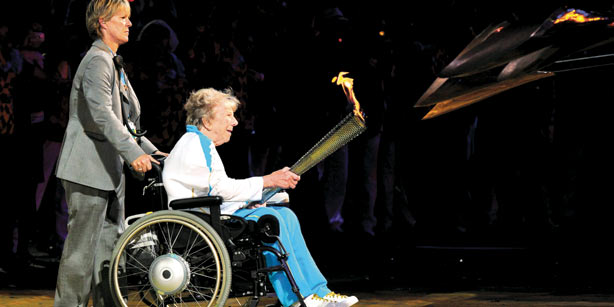
Margaret Maughan lights the cauldron of the 2012 London Paralympics.
On Sunday night, the fourteenth Summer Paralympic Games closed in London. They were contested only a month after the main summer Olympic Games began. These Paralympic Games were another effort of the International Paralympic Committee to help put disabled sport upon the same parallel as able-bodied sport. They became the biggest and best ever.
START AND DEVELOPMENT
Sport for the disabled has existed ever since there were people with disabilities who still wanted to remain active and had the will to make it happen. However the start of formal sport for people with disabilities had its start and development at the Stoke Mandeville hospital in the English town of Stoke Mandeville 55 km northwest of London. It was after World War II and through the iron will of war veterans left permanently injured with either paralysis or amputation to develop sport to stay physically active and through the guidance of neurologist Ludwig Guttmann. It was on July 28, 1948–the day before the main Summer Olympics of London opened–that the Stoke Mandeville Games For The Paralyzed took place. It consisted of a single archery competition between fourteen men and two women, all from the UK.
You could say it was those Stoke Mandeville Games where the Paralympic sports movement would be born. True, but it would take some time and development. The Stoke Mandeville Games would become an annual sports competition and would consist of UK athletes only. In 1952, Dutch athletes participated at the Stoke Mandeville Games making it the first ever International Stoke Mandeville Games. The Games would continue to be contested annually and would continue to become more international. Then a breakthrough occurred in 1960 when Rome, host city of the Summer Olympics that year, agreed to host the International Stoke Mandeville Games just weeks after the main Olympics ended. This was the first time those Games were held outside of Stoke Mandeville and would later be remembered as the first ever Paralympic Games. It consisted of 400 athletes from 23 countries participating in 57 events in eight sports.
Paralympic sport would continue to grow. The International Stoke Mandeville Games would continue to be contested annually in Stoke Mandeville for three more years. Then in 1964, Tokyo would host the Games just weeks after the main Olympics ended just like Rome did four years earlier. The Stoke Mandeville Games continued annually and the 1968 Stoke Games we held just weeks after the main Olympics ended. However they would be held in Tel Aviv, Israel instead of Mexico City which hosted the main Olympics. This would continue on for twenty years where the Stoke Mandeville Games would be held in Stoke Mandeville in non-Olympic years and be held in an international city. There would be two dissimilarities during this period of time. One would be no mention of Stoke Mandeville in the title and having tiles like ‘Olympiad For The Physically Disabled’ or ‘International Games For The Disabled’. Another dissimilarity was the host city as it would be a different host city than the main Olympic Games. Also noteworthy was the creation of the first ‘Winter Olympic Games Of the Disabled’ in 1976. Like the Summer Games, the Winter Games would also be contested in cities that didn’t host the main Winter Olympics. One notable achievement of those Games is that over the years they would be recognized seriously enough for national heads of state to formally open them at their Opening Ceremonies.
Another breakthrough occurred in the summer of 1988 when the Games were held in Seoul, Korea just weeks after they finished hosting the main Olympic Games. This marked a return to the original format of 24 years ago when these Games took place in the same host city of the main Olympic Games and this partnering would continue to be the format to this day. Another notable thing of these Games was that they would be the first such Games to be referred to as the ‘Paralympic’ Games for ‘parallel’, not paralyzed and most people think. The ‘merger’ of the two Games that year would prove to be a great success and would even spawn the formation of the International Paralympic Committee the following year.
Also in case you’re interested, the International Stoke Mandeville Games would later be renamed the World Wheelchair Games and are now called the International Wheelchair and Amputee Sports (IWAS) World Games. They are headed by the International Wheelchair and Amputee Sports Federation, a sports federation separate from the International Paralympic Committee, and take place annually except during Paralympic years and at various cities worldwide.
MY OWN EXPERIENCE: VANCOUVER 2010
As many of you know, I come from Vancouver. Our city hosted to 2010 Winter Olympic Games and the Paralympic Games of that year. I had tickets for the Opening Ceremonies, alpine skiing, nordic skiing and sledge hockey. It was a very good experience. The Opening Ceremonies held on March 12th was a fun occasion which featured a DJ performing for the parade of athletes as they were coming out. The opening ceremonies also involved audience participation and featured a wide array of performers from a breakdancer with Arthrogryposis named ‘Lazylegs’ to an amputee rock band to wheelchair riders practicing halfpipe tricks to a deaf poet. The Ceremonies also paid tribute to two of Canada’s greatest athletes with disabilities: the late Terry Fox and Rick Hansen. There were speeches made by Hansen as well as past Paralympic athletes like Aimee Mullins and Chantal Petitclerc. The ceremony ended with a grand lighting of the flame by teenage athlete Zac Beaumont: a Paralympic snowboarder. He was selected to represent the future of Paralympic sport not just because of his age but also because he was a snowboarder and snowboarding was not part of those Paralympics. Snowboarding will make its Paralympic debut in 2014 under the name Parasnowboarding.
The following day I was to see the alpine skiing competition at Whistler. It was cancelled out due to foggy conditions and heavy snow. Even despite the cancellation, there was an area at the basin of the hill where children and adults could try Paralympic sports on their own. There was sledge skiing trials, sledge hockey trials and even an amputee skiing trials. It was also an introduction to the equipment used for sports competitions like the sledges for sledge skiing and the ski poles for amputee skiers called outriggers whose edges first act like poles then flip to become skis to support balance. Over at a visit to the main Whistler Town Square there were performances by rock bands throughout the square and celebrations galore at the restaurants. The medal ceremonies happened later that night. It was a great occasion and all the athletes were excited for what they achieved and the mood was festive. Whistler would be the competition grounds for all but three medal events of the Paralympic games so these Games were as much Whistler’s as they were Vancouver’s.
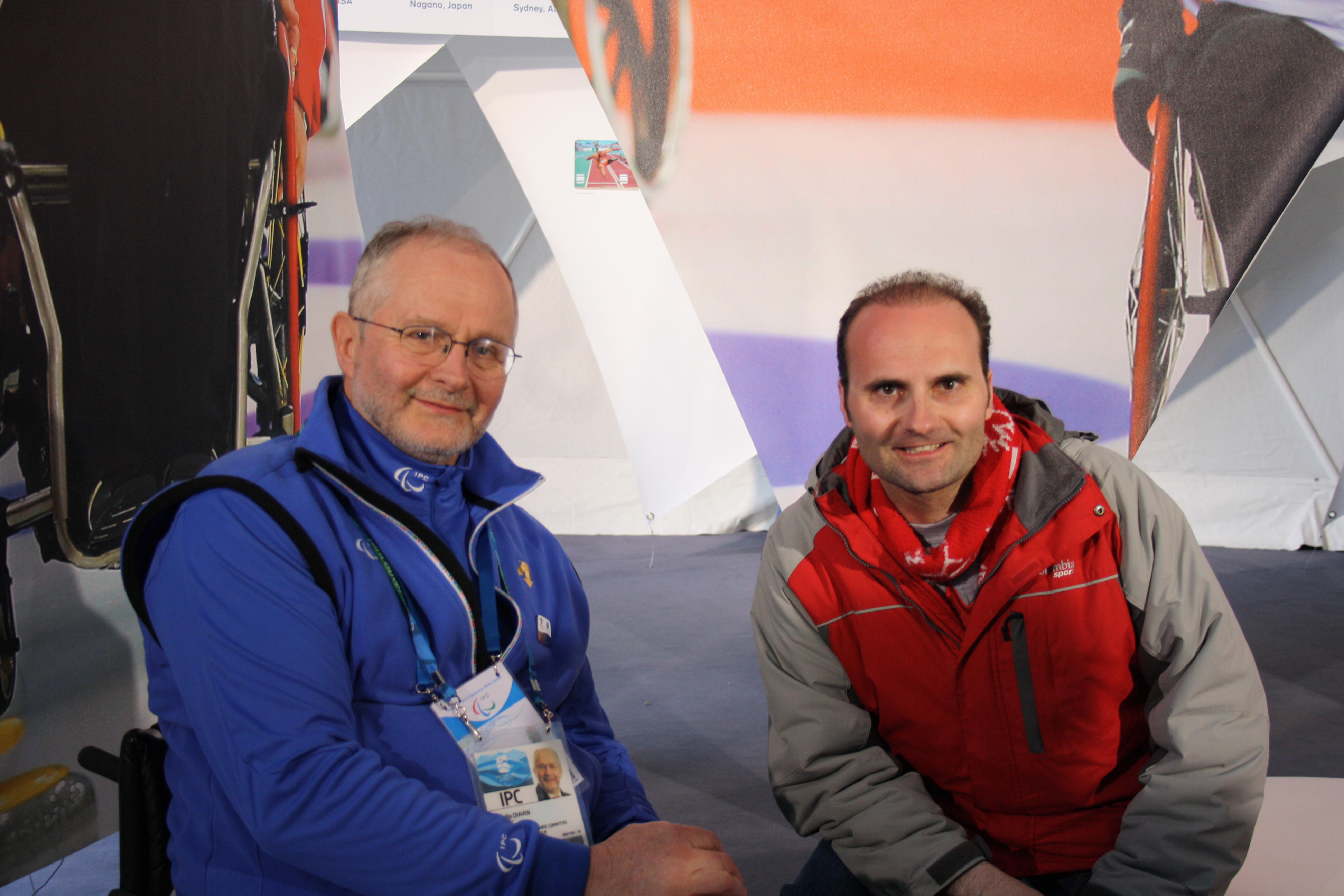
Me with IPC President Sir Philip Craven during Vancouver 2010.
I returned to Whistler Thursday the 18th to watch nordic skiing. There were three types of competitions: sledge, blind and amputee. Both sledge skiers and blind skiers were all ranked by their finish time. Amputee skiers were different as there were different types of amputees through the competition and times had to be adjusted due to the amputee level of each athlete for the sake of a level playing field. A unique thing I learned is that blind skiers, both nordic and alpine, would have guides with full vision guiding them through telecommunication letting them know of what to expect while they’re on course. Often guides for Paralympic athletes have to be athletes of Olympic caliber ability. I also remember groups of schoolchildren were at the events as part of a special promotion from the ticket sales. Later that day i went back to the village where they had a special igloo shaped exhibit called ‘Spirit In Motion’. Inside was an exhibit of Paralympic sports and its history. It was almost like walking through a museum learning all the information. Most of the exhibits were provided by Otto Bock, a German prosthetics company. I was also able to meet Sir Philip Craven, president of the International Paralympic Committee (IPC). We talked for a short bit as he had to head back to Vancouver. I told him I was to see a sledge hockey game tomorrow and that’s when he gave me the news that Canada lost their semifinal to Japan. My heart sunk because I wanted them to make the gold-medal final of course. The day ended with more celebrations over at the Whistler Olympic Plaza. Medals were given out and two of which went to Canadian athletes that were some of the biggest winners of these Games: five-time gold medallist Lauren Woolstecroft, an amputee alpine skier; and three-time gold medalist Brian McKeever, a blind Nordic skier. The ceremonies ended with a concert by Serena Ryder.
Friday the 19th was the day for the bronze medal game of sledge hockey. I was too late to get a ticket for the gold-medal final. This was the match I was hoping NOT to see Team Canada play in. Of course I wanted them to play in the gold-medal match. Sledge hockey has been one Paralympic sport that has caught a lot of attention over the past few years. Canada has also welcomed the sport with open arms and matched have stimulated interest in the sport. Anyways it was held at a hockey stadium over at the UBC Campus. The game was scoreless during the first two periods. Then a goal for Canada happened at the beginning of the third. During the third period, things started looking bad for Canada as they had only one shot on goal while Norway was having plenty. Then the nasty moment came. A foul by a Canadian was committed which allowed Norway a penalty shot. This infuriated the Canadian goalie enough for him to throw his helmet down. When the Norwegian took his penalty shot, he scored. Tied 1-1. Then one of the Canadian players took a bad hit and was lying on the ground. He was lying still and the coach came rushing out onto the ice. The whole arena was silent. Fortunately he was able to get up. The whole area was so relieved he was alright we didn’t seem to care if we won or not. We didn’t; Norway scored the bronze medal-winning goal with less than four seconds to go.
ACCOLADES AND CONTROVERSIES
The Paralympic Games have had their greats over the years. the most medaled Paralympian is American blind swimmer Trischa Zorn who won a total of 55 medals, 41 of them gold, from 1980 to 2004. The most medaled Winter Paralympian is Norwegian Ragnhild Myklebust who won 27 medals including 22 golds in three different winter sports: biathlon, Cross-country skiing, and ice sledge racing. It’s interesting to know that while Michael Phelps is the only Olympian with 10 or more gold medals, there are a total of 39 Paralympians with ten or more. The most medaled Canadian is Chantal Petitclerc, a Wheelchair racer who has won a total of 21 medals including 14 gold. Another Canadian Paralympic legend is Arnie Boldt, a single-leg amputee performer in athletics, who has won a multitude of Paralympic medals and was especially dominant in the high jump. Many consider him to be the best Paralympic athletics performer ever. The most golds in a single games is 12 won by Trischa Zorn at the 1988 Summer Paralympics. While Phelps is the only Olympian to win eight golds in a single games, there are six Paralympians who have won eight or more.
Each Paralympic sport has had their greats. While there’s Zorn and French swimmer Beatrice Hess in swimming, there’s Sweden’s Jonas Jacobsson in shooting, Germany’s Gerd Schoenfelder in alpine skiing, Myklebust in nordic skiing, Petitclerc and Switzerland’s Franz Nietlispach in athletics, and Britain’s Lee Pearson in athletics.
The Paralympic Games are not without their controversies. The biggest example of cheating came at the Sydney Games of 2000 when Spain’s intellectual disability basketball team was ruled to have at least ten members who weren’t intellectually disabled. Mental tests, which were to be conducted before the Games, weren’t conducted. It was later admitted ten members weren’t intellectually disabled and the team was stripped of the gold. That was considered by many to be one of the ‘most outrageous sporting moments’ in history. Intellectually Disabled Basketball has not been contested at the Paralympics ever since and it wouldn’t be until these Paralympics in London where Intellectual Disability sports would make a return, and under close scrutiny.
There have also been doping violations at the Paralympic Games too. The first positive tests came at the 1992 Barcelona Games. The Sydney Games of 2000 was the first Games to ensure their Games met the International Medical and Anti-Doping Code. Out-of-competition tests were introduced at those Games. Those resulted in fourteen athletes testing positive, ten of them powerlifters. There’s even a form of doping unique to Paralympic sport: boosting-where the athlete is induced with autonomic dysreflexia to increase blood pressure. It’s an ongoing problem that still exists.
THE LONDON GAMES THEMSELVES
These Paralympic Games were anticipated to be the biggest ever. Organizers were expecting before the Games to be the first Paralympics to achieve mass market appeal, fueled by the public enthusiasm continuing after the end of the main Olympics in London, the UK’s role in Paralympic sport and growing interest and media in Paralympic Sport. The torch bagan its journey on August 24th with torch lightings in London, Belfast, Edinburgh and Cardiff. All four met in Stoke Mandeville on the 28th, the day before the Games’ opening, to unite to create a special cauldron during a special ceremony commemorating the village’s role in the history of the Paralympics. The flame headed for London was lit and it arrived at the stadium after a 24 hour relay during the opening ceremonies just after being declared open by Queen Elizabeth II. The cauldron was similar to the multi-pedaled cauldron used for the main Olympics and it was lit by Margaret Maughan, Britain’s first Paralympic champion. The opening ceremony was as star-studded as the Olympics featuring acting from Ian McKellen, music from group Orbital and an appearance from Stephen Hawking. The closing ceremony was just as star-studded as it included Coldplay, Rihanna and Jay-Z. The Paralympic flag, by the same tradition as the Olympic flag, was handed from the mayor of London to the mayor of Rio. And British Paralympic champions Jonnie Peacock and Ellie Simmonds extinguished the flame and shared its last flame on torches to others throughout the stadium.
4300 athletes from 156 countries participated at these Games in the 503 events throughout the twenty sports. The competitions were a delight themselves and you could guarantee Olympic appearances by South African runner Oscar Pistorius would stimulate attention. He attracted a lot of attention but was surprised in the 200m run when he was beaten by a Brazilian runner. The sprinting star of those Games was actually a British teenage sprinter Jonnie Peacock. A single-leg amputee, he won the 100m for his disability class. His coach was Dan Pfaff, coach of 1996 Olympic 100m dash champion Donovan Bailey.
The most medaled athletes were Australian swimmers Jacqui Freney and Matthew Cowdrey with eight medals each: all gold for Jacqui and five gold for Matthew. The athletics competition had two quadruple-gold medalists with American Raymond Martin and Brit Dave Weir. Another British athlete, cyclist Sarah Storey, also won four gold medals. The most medaled Canadian was swimmer Summer Mortimer who won seven medals including two gold. Britain’s Sophie Christianson won two gold medals in equestrian. Brazil and Russia won the two football tournaments. The powerlifting events were won mostly by Nigeria, Iran and Egypt. China proved to be as dominant in Paralympic table tennis as they are at Olympic table tennis winning 14 of the 26 golds. China also won six of the twelve wheelchair fencing events.
In terms of the medals race, China won the most with 231 medals, 95 of them gold. Host country Great Britain won the second-most medals with 120 including 34 gold. Russia won the third-most medals with 102 including 36 gold. The USA was fourth in medals with 98 including 31 gold. Canada had its lowest Paralympic medal haul in 40 years with only 31 medals, seven of them gold. Canada usually ends up in the Top 10 on the Paralympic medals chart but ranked 20th at these Games.
GAMES MARKETING
Having the Paralympics start weeks after the main Olympic end and in the same host city has helped establish the Paralympic Games since they were repartnered back in 1988 and as helped them grow considerably. It’s another thing to help promote and market Paralympic sport and get good ticket seat sales. Even though ticket sales are lower than that of the main Olympic Games, it hasn’t been easy to attract good-sized crowds to Paralympic sport. There have been some cases in past Paralympics where some events would ‘give away’ seats to attract crowds. There have been other times when Paralympic events would attract good-sized crowds. I remember back in 2010 the gold medal match for sledge hockey was sold out weeks before it was contested. Thus my purchase of a ticket for bronze medal match. I also remember the Paralympic Games offering discounts for groups of ten or more and even offers for field trips for schoolchildren. The ceremonies were very well-attended. The skiing events I attended also had good sized crowds. The sledge hockey playoff rounds started selling out as the weeks got closer. And the medal matches for wheelchair curling sold out.
London attempted to take it even further by becoming the biggest-selling Paralympic Games in history. They planned to sell a total of 2.7 million tickets. Part of the promotions included introducing the Paralympic mascot Mandeville, named after the Stoke Mandeville Hospital, the same day the main Olympic mascot Wenlock was introduced. Royal Mail released a combined Olympic/Paralympic postage stamp series of 30 stamps each featuring either an Olympic or Paralympic sport. One of which came from Channel 4, the British channel broadcasting the Paralympic Games with 150 hours of live coverage, ran an ad campaign in the weeks leading up called Meet The Superhumans. The Ads were aired over 78 commercial television stations in Britain and was met with huge critical acclaim.
Broadcasting was also very good. Many countries like Britain, Australia, France, Germany, Spain, South Africa devoted five or more hours a day on live coverage. Some countries like Canada and New Zealand had broadcast of ceremonies and a daily hour-long highlights show. The one country with the least coverage was the United States. NBC and its NBC Sports Network only provided a total of 5 1/2 hours of coverage. Only four one-hour highlight shows and a recap show on NBC scheduled for September 16th. There was actually a lot of online broadcast of the Paralympic Games that was more active than broadcast on television. Canada had four online channels broadcasting 580 hours of coverage. Many other countries included their own online broadcast. And the IPC’s own Youtube channel broadcast approximately 780 hours of coverage. Broadcasting rights raised a profit of £10 million, a Paralympic record.
As for tickets, 2.7 million were sold. Even before the main Olympics were over, London’s Paralympic ticket sales had already broken the Paralympic record of 1.8 million for the Beijing Paralympics. By the time the Opening Ceremonies started, a total of 2.4 million were sold. The Opening Ceremonies only had 800 tickets unsold before its start which went to the police and the military along with London Mayor Boris Johnson distributing 1100 to youth athletic clubs. There was even 100,000 contingency tickets sold on September 6 due to popular demand which included multi-event passes and event tickets passed on by sponsors and partners. It’s no wonder this much enthusiasm led Sir Philip Craven to call these ‘the best Paralympic Games ever’ at the closing ceremonies.
LOOKING BACK AND LOOKING AHEAD
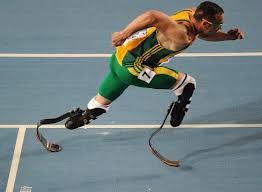
Oscar Pistorius’ popularity has done a lot to stimulate interest in Paralympic sport.
There can be many factors determining why these became the biggest and best Paralympic Games ever. One could be increasing support and funding of Paralympic sport from almost all national Olympic Committees. Some could also say it was due to Britain’s enthusiasm of the main Summer Olympics that poured into these Paralympics. Some could also add it was the Olympic appearance of South African double-amputee sprinter Oscar Pistorius that stirred up excitement. Some could say it was Britain’s contribution to Paralympic sport from the genesis of its formation at the Stoke Mandeville Hospital after World War II to Sir Philip Craven serving as the current President of the IPC. Nevertheless the organizers succeeded in making this the best Paralympic Games ever and leaves a tough act for Rio to follow in 2016.
Despite the success of these Paralympic Games, there are some challenges that lay ahead. First is the connection of the Paralympic Games to the Olympic Games. Since 1988 it has relied on being held shortly after the conclusion of the main Olympics to boost its popularity. That move has been very successful and is under contract to continue to be that way at least until 2020. The question is will this ‘partnership’ continue after or will the Paralympics try to hold their own by being held in a different host city? Also The IOC and IPC have close ties and both Presidents Jacques Rogge and Philip Craven meet regularly. Would the ties continue if there was such a change?
Another is the cultivation of star Paralympic athletes and the support of Paralympic sports. We have one current star Paralympian in Oscar Pistorius, commonly known as ‘The Fastest Man On No Legs’. His quest to compete at the main Olympics since 2008 and his appearances at the main London Olympics have sparked his popularity to where he receives $2 million in endorsement money annually. It’s less than the $20 million Usain Bolt will be getting but the most for any Paralympian ever. I’ve even seen him in two Nike commercials. The question is will there be other newer Paralympic stars in the future to help popularize Paralympic sport. Also the funding for Paralympic athletes. As the Paralympics continue to grow, will the funding of Paralympic athletes continue to grow too? Another is people with disabilities having access to sporting activity. I remember going to the Canada Paralympic Association website before Vancouver 2010 and saw an into that said: “34% of able-bodied people have access to sporting activity. 3% of people with disabilities have access.” Will access to sport for people with disabilities grow over time and how will it be promoted to them? I also remember shortly after the 2010 Vancouver Paralympics there were many bus ads promoting Paralympic sport throughout various buses. That’s one good example. Also the possible increase of more Paralympic Sports. Over time there will be more efforts to make more sports for people with disabilities accessible and competitive. Already I know Parasnowboarding will make its debut at the 2014 Paralympics in Sochi. Will there be new Paralympic sports in Rio and in future Summer Games? Only time will tell and it will have to involve the national and international sports federations and the athletes to get the green light from the International Paralympic Committee.
The 2012 Paralympic Games of London ended with a record bang. Enthusiasm for these Games paralleled that of the main Olympics. The future of Paralympic athletes and Paralympic sport looks bright and more promising than ever. It’s up to the various organizing committees and the athletes to help take Paralympic sport into the future not just for the increase of fanfare and revenue but also for the accessibility for the disabled. Nevertheless after these Paralympics, the future couldn’t look any brighter.
 I wasn’t planning on posting this. Actually I was planning my next blog to be another Best Picture review. Instead I post this because of how shocking it is. And of how much I admired him and his works.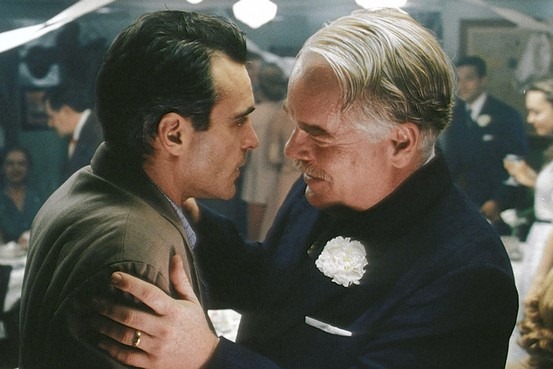
 Jon The Blogcentric