VIFF 2013 Review: A River Changes Course

Daily life around the Tonle Sap River in Cambodia and potential changes is the subject in A River Changes Course.
Daily life around the Tonle Sap River in Cambodia and potential changes is the subject in the documentary A River Changes Course.

A River Changes Course is one of the many documentaries being shown at the VIFF. It has its own message to say and it says it by the way a family lives.

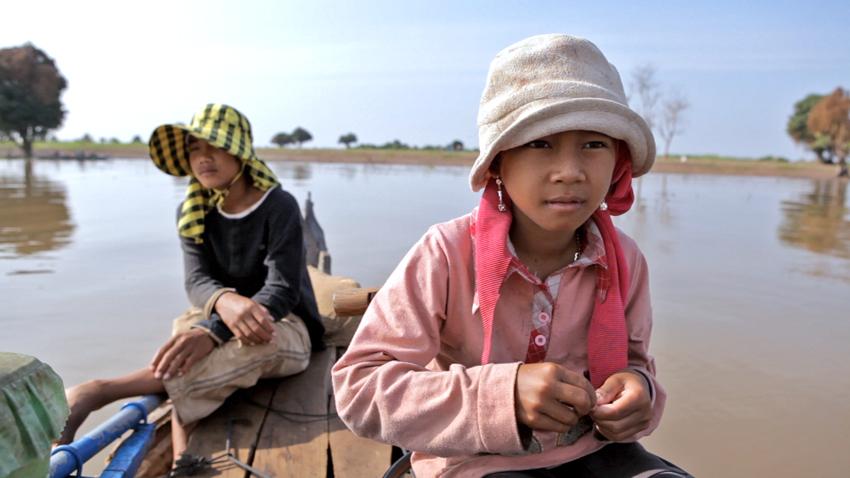
The film focuses on three families that live on the Tonle Sap River: the Math family, the Moh family and the Sabourn family. The Math family is a fishing family who rely on fishing for their income. The Mok family works the rice farms but it’s hard considering the mother has a big family to raise. The Samourn family is an indigenous family living in an agricultural area that help to keep their family with a decent income.

Things have not been easy for either family. Sari Math must quit school to help the family but the fishing population of the river is dwindling. Khieu Mok, the eldest daughter of the Mok family, leaves the family farm for the capital Phnom Penh for a factory job to help pay her family’s debts. And Sav Samourn notices the land she’s always known as home being bulldozed for the sake of factories and farms for export. It hurts her as she always called the area ‘home’ whether through good or bad times.

The object of the film was to get the people to tell their stories. There’s no narrator. There’s just the camera showing the family through their everyday lives. Whether it be fishing from a boat, reaping harvest or working in the factory, or selling what they’ve made, it shows the difficulties they go through to make a living. It even shows the children of the family working in the farms, from the boat or even near the fish market. That shows childhood ends early and one makes a worker of themselves at an early age. It also shows conversations with those in jobs associated with the subjects being filmed. Just as Khieu talks of her difficulties in making a livable wage at the factories, two of her other co-workers talk of their own difficulties. Basically this documentary about the lives of three families in Cambodia showcase the lives of millions.

Even outside of the images of the people working and struggling, other scenes also send a message too. One is of a young boy singing a song with lyrics; “Marry me and I will make you rich.” Many times in the film, you will hear people sing songs in which they composed themselves. Another is seeing the small children in school learning how to read. Another is where the family gathers in a town area to watch television: one television per village. Another is even when it’s raining in the area but the young boys see it as swim time in the river. That’s a reminder that despite the hardships, childhood does exist. Actually all the images that don’t deal directly with the main plot say something.

One thing about the film is that it’s not just a showcase of daily life in Cambodia but it also shows glimpses of hope for the nation. We shouldn’t forget that Cambodia has a troubled past. There’s the dictatorship of the Khmer Rouge under Pol Pot in the late 1970’s where 2 million Cambodians were slaughtered. Cambodia has struggled to rebuild but it hasn’t been easy especially since the country is under a fixed democracy. Agriculture and fishing have always been ways of life in Cambodia but it’s always been conditional depending on the crop year or fish catch. The factory work offer some hope, albeit limited. Just as land is cleared for factory land or cropland for China, Khieu talks about the potential for better chances closer to home. Khieu’s mother talks of her son being a migrant worker in China. Even the images of the young children in school show an image of hope. Especially while Sari is talking in the background of quitting at Grade 7 and lucky to get that far. I believe that’s why it’s titled A River Changes Course as it shows potential changes for Cambodia.

However despite the images of hope for the future, it does come at a price for others. Sav is completely unhappy with the deforestation as this has been a land she has always called home, being indigenous. What’s seen as hope or a future for others can be seen as a big loss for someone like Sav. She even says: “We’ve worked so hard on this land and now they’ve come to destroy it all. Sooner or later it will all be gone.” It also shows that the title A River Changes Course does not completely have a positive meaning.

This documentary is not just a showcase of life in Cambodia but also a ‘homecoming’ for director Kalyanee Mam. She was born in Cambodia and emigrated with her family of nine to the USA in 1980 as refugees of the Khmer Rouge regime. She is a law graduate of Yale and UCLA Law School and has worked as a legal consultant in Syria and Iraq. Mam has also done film work along the way. She completed her first documentary Between The Earth And Sky in 2009. She also worked in the cinematography in the Oscar-winning documentary Inside Job. Mam is now working on another documentary Power of Pearl, due for release in 2015.

Mam also took time at the VIFF showing of A River Changes Course where she told her story of her family escaping Cambodia for the United States and living as refugees. She told about why she did the documentary and also about some of the raw deals Cambodia is getting in terms of creating crops for China, like none of the harvested crop going to Cambodians: all straight to China for ethanol. I myself asked her a question about politics in Cambodia: if it’s a democracy or dictatorship. She told of how fixed a democracy it is right now. Nevertheless she and other Cambodians believe in a hope for the future. In fact Mam made mention that when Khieu casted her ballot, she said it was for a livable wage. A River Changes Course is a chance for her to tell the story of her homeland across the world in hopes for a better tomorrow. In fact you’ll learn more about it at the film’s official website and how you can help too.

A River Changes Course has already received a lot of acclaim. It’s already received the Grand Jury prize for documentaries at this year’s Sundance. It has also won top documentary prizes at the Green Film Festival in Seoul and the San Francisco Film Festival. It has also received other awards such as Best Feature at the Atlanta Film Festival, a Human Rights Award at the River Run Film Festival, a Best Feature award at the Yale Environmental Film Festival, and a Grand Jury Conscience award at the Docville International Documentary Film Festival. I’m sure there’s more to come.

A River Changes Course is Kalyanee Mam’s most acclaimed work yet. It is an accomplishment too as it helps open people’s eyes towards what is happening in her land of origin and raise awareness and help. I believe that art can make for a better future. Much the same way The Killing Fields opened people’s eyes over what happened during the Khmer Rouge, this documentary can shed a big light to its aftermath many decades later.
Disasters In Canada: Three In One Month

Even though it is a good thing, Canada is not normally famous for its disasters. Yes we’ve had the Halifax Explosion, Hurricane Hazel and the Winnipeg Flood of 1950 but they don’t come that often. These past few weeks were a rare exception as Canada had three sudden disasters to deal with.

The Alberta Floods

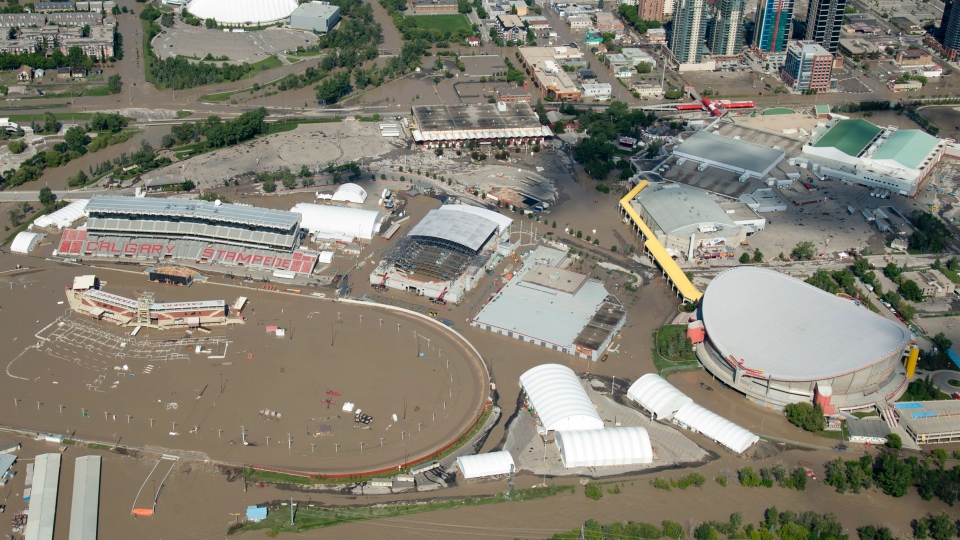
Much of Calgary's downtown was flooded out in what has become the worst flooding in Alberta's history.
Much of Calgary’s downtown including the Stampede racetrack and saddledome was flooded out in  the worst flooding in Alberta’s history.

Alberta’s rivers are not known for their floods. However heavy rainfall throughout the province of Alberta from June 19th to 22nd led to the worst flooding in the province’s history. Seven major Alberta rivers including the Bow and Elbow Rivers were filled hard and were over flooded to the point they caused huge damage to surrounding cities. The damage done to the city of Calgary received the most coverage especially since the flooding damage hit the downtown core bad. That and the fact that the annual Calgary Stampede was about to start. The stampede grounds endured considerable damage. Even venues like the Scotiabank Saddledome reported flooding up to the tenth row. In fact 26 surrounding neighborhoods around the Calgary area were placed under a mandatory evacuation order for three straight days. The 75,000 evacuees made it the largest evacuation in the city’s history.

It wasn’t just Calgary. The town of High River had to evacuate. The Siksika First Nation east of Calgary had to declare evacuation. Even towns of Banff and Canmore had to be cut off after floods and mudslides cut off much of the Trans-Canada Highway. Even cities like Lethbridge, Red Deer and High River had to declare their states of emergency. The flooding resulted in four fatalities in total.

The towns and cities continue their clean-up in the aftermath. One thing that did happen is that the Calgary Stampede went on as planned. Events planned for the Saddledome however were either cancelled or relocated to other locations in the city.

Toronto Flash Flood

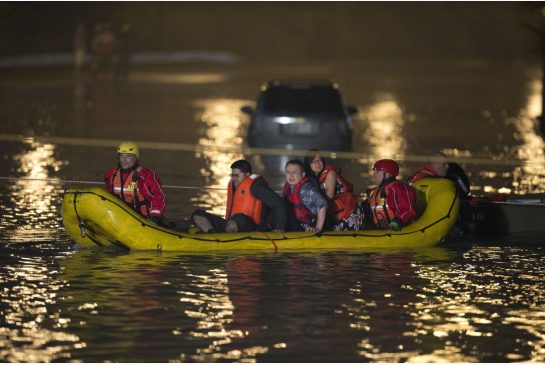
Soaking wet Go Train passengers are rafted to safety during a surprise flash flood in Toronto.
Soaking wet Go Train passengers are rafted to safety during a surprise flash flood in Metro Toronto.

Monday July 8, 2013 was expected to be like any other day in Toronto. If there was to be a thunderstorm, it was expected to be brief and pass by. However the afternoon provided some of the most serious thunderstorm activity faced by Toronto. Rain was delirious. Rainfalls ranging from 97mm in downtown Toronto to 126mm at Pearson Airport caused major flooding in many areas including the freeways and the subway stations. In fact news images showed a GO train with 1400 people that was caught in the floods. Power outages were rampant as 80% of Mississauga was without power as was 300,000 other people who received Toronto Hydro. A big surprise for a city that normally gets an average of 74mm of rain in the whole of July. Fortunately the floods have subsided and fortunately there were no fatalities.

Train Derailment In Quebec

I saved to worst for last. Until a week ago, Lac-Megantic was a simple small town in Quebec close to the Canada/U.S. border. Since the early morning of Saturday July 6th, it’s the centre of possibly the biggest train accident of the year and continues to make more bad news with each day.

It was a simple train trip done many times before: a trip transporting oil from the United States to New Brunswick. Lac Megantic was just simply a town where the train was to pass through without disturbance or incident of any kind. The train set consisted of 72 tanks each filled with 113,000 litres of crude oil and had been transferred from train system to train system.

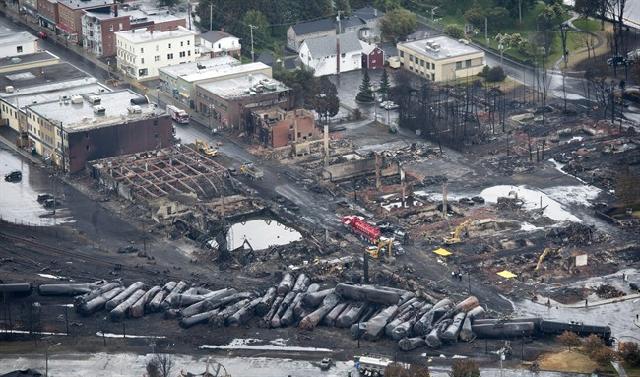
Burned out buildings and burned out oil tankers lay in the aftermath of a train derailment in Lac-Megantic, Quebec.
Burned out buildings and burned out oil tankers lay in the aftermath of a train derailment in the downtown of Lac-Megantic, Quebec.

Two hours before the incident while the train was parked in Nantes, the engineer left the train as he was done his shift. He felt however that it was unsafe since it was spitting oil and thick black smoke and wanted to call an American official about directives for the situation. Actually drivers who were driving along the train 40 minutes earlier complained of thick black smoke coming from the train. The Nantes Fire Department put out the blaze at 11:30pm and the train company employees confirmed the train was safe. However one failed to notice that the locomotive was tampered with. The train tanks, detached from the locomotive, started moving downhill at witnesses considered a dangerous speed. Then the unmanned train derailed in an area of downtown Lac Megantic, the tanks collapsed spilling crude oil on the ground and cause a huge fire 91 to 121 meters in diameter. Between four to six explosions were heard and heat from the fire could be felt as far as two kilometers away. Over 1000 of the town’s 6000 residents had to be evacuated. People in the third floor of burning buildings jumped to avoid being caught in the blaze.

Even as of now, there are no final statistics and new information is being gathered every day. 35 people have been confirmed dead but 15 remain missing. Thirty buildings in the downtown of Lac Megantic have been destroyed by the blaze. Information has surfaced that the locomotive is believed to have been tampered with. I’m sure more clues will come up in the future.

The Aftermath

With every disaster comes action. Not just action from emergency crews but action from all those involved including officials from the various industries affected. Here’s some of the action that has been taken so far. Remember these incidents happened three weeks ago at the most so there is still more action to come:

-The province of Alberta has started to create new flood-mapping standards such as categorizing high-risk flood areas. Some homeowners in high-risk areas are offered to move from their current location with financial assistance from the province or risk being ineligible for any future Disaster Recovery Fund assistance. Homeowners will be given new regulations in the future such as notating homes for sale being in a possible flood-risk zone. Even developers will be made aware of high risk areas.

-The City of Toronto will have to do some rethinking and reassessing certain aspects of the city. Especially the drainage system. Also Toronto transit will have to organize a better system of escape from its trains and subways to avoid a worse scenario. One thing is train riders who had to travel on the still-wet trains the following day were given a $100 credit to cover whatever dry cleaning costs. Hydro One had most of its equipment underground. It will soon review its standards and practices in the aftermath including bringing some equipment above ground.

-Once the clean-up and other activities from the Lac Megantic derailment are completed, you can be sure there will be a full inquiry on this incident. Even without the death count being finalized, this has already become the deadliest train accident in Canada since 1864. Montreal, Maine and Atlantic Railway (MMA) will definitely face the biggest heat from this as well as Transport Canada. Already the Transport Safety Board of Canada has started an investigation on this. The Red Cross has started emergency efforts in the town. Lac Megantic will have to make efforts to rebuild and have makeshift locations for businesses that used to exist before the disaster. You can be sure that certain people will be prosecuted for criminal negligence and the government agencies will set new regulations for dealing with petroleum-filled tanks.

It is a shock to see all of this happening in Canada in the span of one month’s time but it was possible. Nevertheless it is Canadian nature to take immediate action towards something like this. In fact a roof collapse in an Ontario shopping mall last year that caused the deaths of two people made national news and brought fast action. In some countries, you’d need a bigger fatality result to get major action happening. Only time will tell what the end results are and what actions come of these incidents.

WORKS CITED:

Uncredited Author. “Alberta Unveils New Flood Proofing Rules” CBC News cbc.ca 14 July 2013 <http://news.ca.msn.com/top-stories/alberta-unveils-new-flood-proofing-rules-1>

Ogrodnik, Irene. “By the numbers: 2013 Toronto flood” Global News Global News And The Canadian Press. 9 July 2013 <http://globalnews.ca/news/704015/by-the-numbers-2013-toronto-summer-storm/>

Gheciu, Alex Nino. “Toronto flood: Underground equipment sank Hydro One” Toronto Star 11 July 2013 <http://www.thestar.com/news/gta/2013/07/11/toronto_flood_underground_equipment_sunk_hydro_one.html>

WIKIPEDIA: Lac Megantic Derailment. Wikipedia.com. 2012. Wikimedia Foundation Inc. <http://en.wikipedia.org/wiki/Lac-M%C3%A9gantic_derailment>