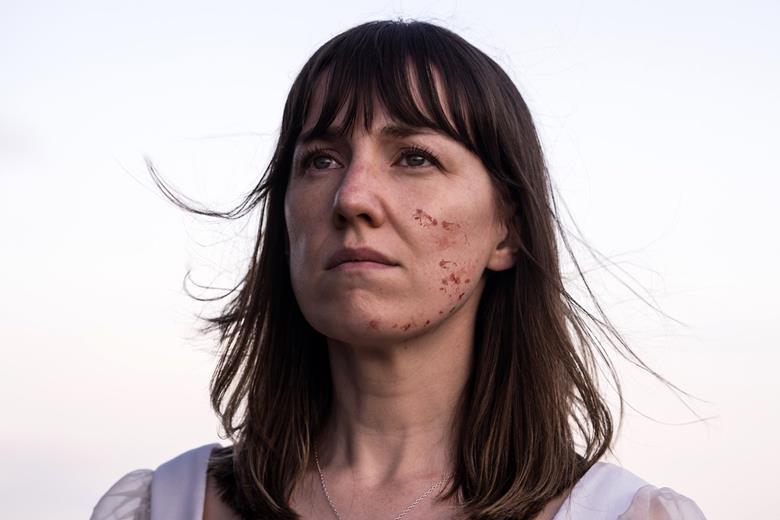
It’s very rare to see a film in the Gaelic language at the VIFF. Frewaka, from the Altered States series, is that film and a lot more.
The film begins in 1973. There’s a wedding in a local village. The wedding is crashed by village locals in traditional fashion wearing straw masks. The man looks fine about it as it’s tradition but the bride, named Peig, is unhappy about something. She goes outdoors as she’s sick but she spots something mysterious about the goat. The husband tries to look for Peig but can’t find her. Only her wedding ring on the ground. Peig is missing and it begins the story of the runaway bride of the village. Cutting to the present and to a reclusive elderly woman living in an apartment full of Catholic paraphernalia. She hangs herself as one of her crosses lights up red.
The film then cuts to another story in the present of a young woman named Siobhan, or ‘Shoo,’ who has just graduated form nursing school. Shoo’s mother has just died; the woman who hung herself. Shoo clears out her place emotionless, surprising her Ukrainian girlfriend Mila. Shoo never made amends with her mother after the years of abuse. Shoo is suddenly given a last-minute assignment to do palliative care with a woman in a remote village in the North. Shoo is hired mostly for her knowledge of Gaelic as the woman doesn’t speak any English and most of the villagers only speak Gaelic as well. This may come at what should be a very inconvenient time for Shoo, but she accepts it without a problem, leaving the pregnant Mila behind to deal with the stuff.
Shoo may be hard-headed and hard-hearted towards the work she’s about to do but she senses something isn’t right about this. She first senses this as she goes to the town and asks directions to the woman’s place. Two villagers at the store tell her not to go to the house. She also notices as one farm boy from the town looks at her strangely. Then she goes to the woman’s house. The woman’s name is Peig: the ‘runaway bride’ from 1973. She’s elderly now and she’s agoraphobic to the point she won’t leave the house. Shoo senses something very uneasy about Peig’s house. It’s big with a lot of rooms, but aging, crumbly and full of bad taxidermy and various talisman. What Shoo finds most frightening is Peig’s cellar door. It’s painted red and has many good-luck symbols nailed on surrounding it. Jarring noises and phantom images come from that cellar door. Even Peig herself feels that cellar has a frightening spiritual threshold, which she refers to as ‘them.’
Looking after Peig turns out to be a frustration for Shoo. Very often, Peig goes into her dementia and won’t take her medicine. There are many times Peig refuses to leave the house, possibly fearing that something will take her away. Despite that during the time, Peig and Shoo form a bond. The bond seems positive at first, but soon Shoo is haunted by her own past memories. In that time, Shoo feels a drawing that she herself feels she must go to that cellar door to find out what’s inside. Is it the ‘them’ that Peig keeps on referring to? In addition, Shoo also senses the same haunting feeling Peig does, including a crucifix that lights up red just like her late mother’s.
Over the next days, the nursing agency is contacting Shoo about her reports of incompetence on the job and Mila is infuriated with Shoo as she feels she left her abandoned pregnant and with her late mother’s stuff to manage. But Shoo is fixated on the cellar door and the hauntings in Peig’s house. Finally she does go into the cellar and finds out what’s inside. Inside are key clues to Peig’s past, including the ‘runaway bride’ story. Shoo also discovers what is so haunting down there. Within time, Shoo herself becomes consumed by the hauntings and with the appearances of the masked villagers similar to that at Peig’s wedding and they overtake Shoo to leave a haunting ending.
It seems to be a thing now to make a smart horror film. We all remember the guilty pleasure horror movies of the 80’s and 90’s that were for to shock us, scare us or disgust us or even try to add bizarre humor to get us laughing. These past ten years, there have been a lot more smarter horror movies that are a lot like psychological dramas. Some have even made critics’ lists as the best film of the year. This film is another film that makes the attempt at becoming a smart horror film and it does a very good job. This film is also a horror film that includes a lot of cultural elements as well. We see it in the Irish folklore and Irish mythology shown in various scenes and even in villagers and their broom masks. Adding that in is what makes this horror film unique. I think every culture has some mystical spirits or mystical hauntings from old folklore.
It’s not just Irish folklore that add into the affect of horror in the film. There are also ugly pieces of Irish history. One thing that has been vocal in recent decades is how the Catholic Church mistreated people in the past. It’s also been especially vocal in how it treated women. We hear about stories with the Magdalene laundries, we hear other past abuse stories. It’s also possible that Peig’s marriage at the beginning could have been a marriage arranged with some Catholic input and something Peig could not see herself living through it. That could also explain that crucifix in the film that lights up red. Of how Catholicism is now seen more as a curse than a help in Ireland.
This is an impressive horror drama. It tells of a bond between two women who are complete opposites. One is an ailing former runaway bride. The other is a lesbian who chose her girlfriend but gives her neglect. One has lived in the village all her life and as a recluse. The other has lived in the big city her life, well-educated and speaks Gaelic well. They appear to be opposites but over time, both will show to have some things in common. Both have had abusive influences in their life. In both cases, it was religious-based. Both are haunted by the cellar door, what they think is inside the cellar and what is actually inside. As what causes Peig’s fears reveal itself, the ugly irresponsible side of Shoo is revealed. All of it just slowly unravels itself as time presses on and adds to the eerie feeling of the film and for the shock ending.
This is an impressive work from writer/director Aislinn Clarke. This is her first self-made feature since 2018’s The Devil’s Doorway. Although I have not seen it, the storyline from the premise descriptions I’ve read has some similarities with Frewaka. Here, Clarke gives another story of religious spirits haunting those around. It’s well-written and we’ll pieced together. The beginning could have been organized better but the story does make better sense as it goes along and keeps it being the thriller it’s intended to be. Clare Donnelly does a great performance as Shoo. She does very well as a woman who’s strong and stern but soon becomes consumed of what haunts the house. Also great is Brid Ni Neachtain as the elderly Peig who has lived a lifetime of being haunted and traumatized. She is very convincing in her character.
Frewaka is not just a supernatural thriller that one would see in VIFF’s Altered States films. It’s also a film that shows some unique aspects of Irish paganism or Irish occult and ugly parts of Irish history. The elements are just as intriguing as the story itself.
 Jon The Blogcentric