2011 Oscars Best Picture Nominee: War Horse

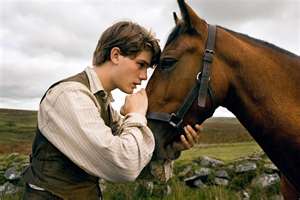
War Horse is the latest live-action drama by Steven Spielberg. It was originally a children’s story written in 1982 and later adapted into a stage play which debuted on Broadway in 2011 and even won a lot of Tonys. Now War Horse comes to the big screen and it’s only right that Steven Spielberg be the one to create it into an epic movie.

The film opens as young Devon boy Albert Naracott watches the birth of thoroughbred colt and watches him grow up. The colt would become his, but at a cost to the family. The father Ted wins him at an auction at an enormously high 40 guineas, thanks to his intent to spite his landlord. The high price would cause him to miss his rent and he would have to pay by autumn. That’s not an easy thing for Ted as he has an injured leg from the Boer War for which he’s not proud of and drinks to hide his guilt. He even hides his medals away.

Meanwhile Albert grows a friendship out of the horse whom he names ‘Joey’. Each time Ted threatens to shoot the horse, Albert tries to prove Joey is worthy of staying. Albert trains Joey into plowing the farm and succeeds in having it all plowed in a single day. However the farm fails because of heavy rain and Ted sells Joey to an Army Captain as World War I has just started. This breaks Albert’s heart and he even tries to enlist, even though he’s underage. However Captain Nicholls ensures Albert Joey will be fine and will make it home. Albert even ties his father’s war pennant to Joey’s bridle.

Joey is trained for battle and faces his first battle with Nicholls on top against the Germans. The Germans however have the latest artillery which are capable not only of killing horses from far away but making horses now useless in war battle. Nicholls is killed in battle but Joey is one of few horses to survive, only to be captured by the Germans and used as an ambulance horse along with Topthorn, a black horse whom was trained by the British. Joey and Topthorn become friends. The two horses then become owned by two young German brothers who plan to desert the army and flee to Italy. Even though they hide themselves and the horses in a French windmill, the brothers are discovered by the German soldiers and executed by firing squad.

The two horses are discovered by a French farm girl named Emilie, an orphaned girl who has brittle bones and lives with her grandfather. They soon become hers and she’s able to hide them successfully after German soldiers raid their house and take their food. She finally rides Joey on her birthday only to have the horse stolen by German soldiers. The horses are then put to the task of pulling heavy artillery. Joey and Topthorn are the only two pulling horses to survive this.

Meanwhile it’s 1918 and Albert is now a soldier for Britain. He and his allies are wounded by a mustard gas explosion in German trenches. Joey and Topthorn are still alive after years of brutal labor by the Germans but Topthorn can’t take it anymore and dies. Soon after, Joey tries to flee and advancing tank only to end up tangled in barbed wire and fall down in the mud. A British and German soldier clip off the wires together and the British soldier wins possession of Joey in a coin-toss. While Albert is recovering from his gas attack, he learns the story of the miracle horse. Meanwhile Joey is to be put down because he is too injured. Just before he’s to be shot, Joey responds to an ‘owl call’ from Albert. Albert and Joey are back together again but it doesn’t end there as there is still the auctioning of the war horses. What happens after is something for you to see for yourself.

One thing about the movie is that this, like a lot of epic films, does not have that stellar of a script or of acting. The script is good in how it takes one through the adventure from one place to the next with its various twists and turns, but nothing really deep. There are even times in which it comes off as fluffy as a movie-of-the-week script. The acting is flawless but nothing of any real challenge either. There was no real actor that stood out with Emily Watson being the top billed actor of the film and newcomer Jeremy Irvine being the lead human protagonist. The acting roles are well-played but often end up as cardboard as your typical acting in an epic movie.

The lead role and the protagonist in the movie is actually Joey the Horse. The story may mainly be about Albert trying to get Joey back to Devon but it’s Joey’s adventure and trials of it all which is what the story is all about. He goes from being born to Albert’s best friend to a horse in battle for Britain to befriending another war horse named Topthorn to a horse on the German side to being a horse of a French farm family to being back with the German side to being found stuck in barbed wire to being reunited with Albert. I may have knocked the script a while back in my review but I have to say one of the best attributes of the script is that it was able to make Joey into a horse with feelings without coming across as cheesy. That scene where Joey says his last goodbye to the deceased Topthorn didn’t come across as cheesy or manipulative. Also the movie ends with some unexpected twists and turns. Just when you think Albert and Joey are finally reunited, it doesn’t guarantee Albert will be taking him back to Devon. Interesting note is that the scriptwriters worked with Michael Morpurgo, author of the novel, to get the right adaptation of the movie.

Although the script and the acting are not the best attributes of the movie, the cinematography, set design and the accompanying score are the best technical qualities. Spielberg picked out some of the best and most appropriate areas of England for filming this movie, including Devon for the countryside and town scenes, Hampshire for cavalry scenes and an airfield in Surrey for the battle scenes. Janusz Kaminski did an excellent job of cinematography. His cinematography duties for this movie were complex as he had to both capture the grittiness of war for the battle scenes and capture the glamor and beauty of the countryside for the various country scenes. Plus you can’t go wrong when you have John Williams to compose your movie’s score.

However the best overall attribute is its ability to capture battles of World War I. Steven Spielberg is already known for his movies that depict wars and it only seemed right that he should be the one to recreate World War I in this movie. Here, he doesn’t disappoint. He’s able to recreate everything from the horse battles to the ground artillery to the trenches of the World War I battles to the first tanks. He also shows the grittiness of war too with the laying of the dead horses in battle to the execution of boys not yet adults to the rats in the trenches to the explosion of mustard gas bombs. Grittiness of war is something Spielberg doesn’t avoid and he doesn’t avoid it here. It’s also interesting noting the horse statistics of World War I that Morpurgo researched to create the War Horse novel. It is believed that there were 10 million horse deaths during the whole war. Of the one million horses sent from the UK to battle, only slightly more than 60,000 returned alive. The rest were killed in battle or slaughtered in France for meat. So War Horse is quite a story of survival.

War Horse may not deserve to win Best Picture as its acting performances, direction and script lack the winning edge but it’s a very good movie on its own. It’s a good family drama for families with older children. I commend Steven Spielberg for making the adaptation of this children’s novel possible on the big screen.
Is The End Of Gadhafi A New Beginning For Libya?

The news just broke days ago. After months of fighting, warfare and rebellion, the rebels deposed Libyan dictator Muammar Gadhafi and have just raided his compound as of now. Gadhafi is currently in hiding but refuses to believe he has been removed from power. The news of Gadhafi’s overthrow was expected over time. After 42 years, many feel this will be a new change for Libya but the question is will it be positive or negative?

Before 1969, Libya was a kingdom with increasing oil wealth. It adopted a constitution to model the freedoms and liberties similar to that of European and North American states. It also received huge foreign influence from countries like the United States, Italy and Great Britain in aiding increased levels of wealth and tourism. While most welcomed these contributions, there were many who saw it as a threat.

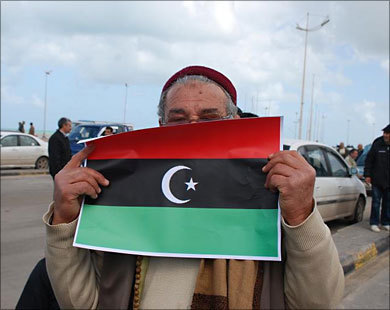
On September 1, 1969, a group of young soldiers led by 27 year-old Muammar Gadhafi staged a coup d’etat on King Idris and launched the Libyan revolution. In 1973 Gadhafi imposed Sharia law on all of Libya, purged of the ‘politically sick’ and a ‘people’s militia would ‘protect the revolution.’ The revolution was both in culture and administration. 20% of workers in Libya were under heavy surveillance by Gadhafi. Executions of dissidents were made public and broadcast on state television. In 1977 Gadhafi officially declared Libya the Great Socialist People’s Libyan Arab Jamahirya and adopted a national flag that was completely green. Gadhafi opposed any Arab country that sided with Israel and even declared a four day war on Egypt. He also supplied arms to any of its allies, both nations and terrorist groups.

Another key note is that Gadhafi was heavily influential in terrorism during the first two decades of his reign.  Some believe he was the tour de force of terrorism at the time that would pave the way for groups like Al Qaeda. He formed the Black September movement which caused many attack in the 1970’s including the Olympic Attack in Munich where 11 Israeli athletes were killed. His terrorists were also instrumental in hijacking airplanes which led to the tight security on airplanes that still continue and become stricter to this day. In 1985, it was discovered by the United States that Gadhafi harbored a camp for training terrorists. This led to President Ronald Reagan to declare an airstrike on Libya in 1986. The strike failed to kill or depose Gadhafi but killed his daughter. His terrorist activities died down soon after but not without one last infamous attack of a bomb on a flying plane exploding over Scotland in 1988, killing hundreds. Even despite his terrorist activities dying down, he still talked tough and sided with Arab leaders who were anti-Israel.

In 2011, people’s movements in Tunisia and Egypt led to the overthrow of their heads of state. The revolutionary spirit spread to other Arab countries including Libya starting in the month of February. Gadhafi quickly condemned the uprising and claimed it was being engineered by Western elements and Israel.  By March, much of Libya had tipped out of Gadhafi’s control where even members of the Libyan army were joining the revolt. Gadhafi loyalists were encouraged to kill the protesters. Soon international forces from the United States, the United Kingdom and France had joined forces to declare a military operation to remove Gadhafi. In June, the International Criminal Court issued an arrest warrant for systematically planning and implementing attacks on civilians. By August 22, 2011, rebel fighters had gained influence and control of Tripoli’s Martyr’s Square. Meanwhile Gadhafi asserts he’s still in Libya and will not concede power to the rebels.

Now the overthrow of Gadhafi is definite or eventual, if not official. There comes the big question. What will come of Libya in the future? Will it become a better stronger country? Or will it face its own problems?

The country is now mostly controlled by Mustafa Abdul Jalil, Gadhafi’s former justice minister who established the National Transitional Council shortly after the Libyan revolt began. The Declaration of the council includes many key aims like: ensuring safety of its citizens and liberating the rest of Libya, restoring normal civilian life, have the military council achieve a doctrine protecting Libyan citizens and defending the borders, draft a new constitution, pave the way for free elections and guide the conduct of foreign policy and international relations.

The policies appear promising but the big question is can it be attained over time? Many Arab countries that have established new freedoms and new liberties have faced the threat from dissidents, terrorists and loyalists of the former dictators. Afghanistan and Iraq have held elections and drafted new constitutions after their revolutions but have constantly faced attacks from many dissident factions that still happen to this day. Also it is possible of another coup d’etat in the future from a new dissident or Gadhafi loyalist with military power. The future of Libya has yet to be determined in the wake of the deposition of Gadhafi that continues as we speak.

Libya also has the 10th largest oil reserves in the world and the 17th highest petroleum production. It’s high petroleum production and low population has given it the fourth-highest GDP in Africa. During Gadhafi’s reign, the money was used to buy arms which led to many of the terrorist attacks. The wealth was not evenly spread out amongst the people. Under a new government in Libya, will the wealth be used more generously for the sake of developing the nation and the quality of life for its citizens? Or will it be a heated political debate in the future?

Since Gadhafi’s official overthrow is eventual, the future of Libya is a big question. The future of the country and the leadership that follows will be a new chapter in the country’s history but which direction it goes, and whether the new intended freedoms and liberties will be successfully carried out, still remains a question that only time can answer.

WORKS CITED:

WIKIPEDIA: Libya. Wikipedia.com. 2011. Wikimedia Foundation Inc. <http://en.wikipedia.org/wiki/Libya>

WIKIPEDIA: National Transitional Council. Wikipedia.com. 2011. Wikimedia Foundation Inc. <http://en.wikipedia.org/wiki/National_Transitional_Council>

South Sudan: The World’s Newest Nation

Hi. This is an article that I have delayed posting here for the longest time. Hope you like it.

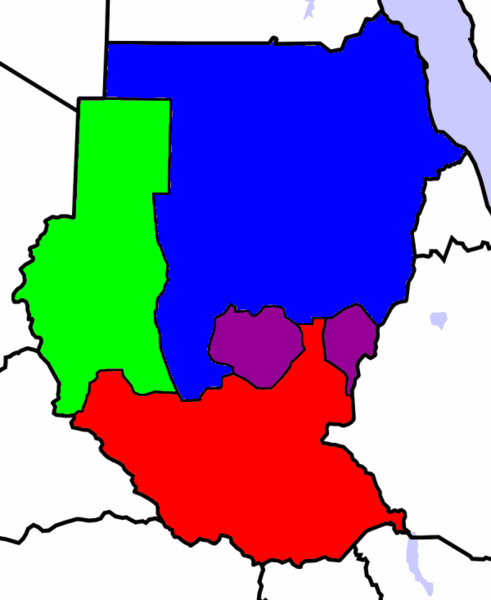
It was declared on July 9, 2011. South Sudan was now an official independent nation of its own. Its population is an estimated 8,000,000. The capital city is Juba, a city of an estimated 400,000 people. Hearing about what the people of South Sudan went through, you’d feel their independence from the main Sudan was hard-earned.

Map of Sudan and regions. Area declared South Sudan is in red.

Firstly Sudan was originally a joint condominium between Britain and Egypt until they declared independence in 1956 as the Republic of Sudan. Despite Sudan being independent, it was not unified. The northern and southern parts of Sudan were sharply divided.  The main divide between the two was based on ethnicity but also about religion; the northern part of Sudan was predominantly Muslim while the southern part of Sudan had a Christian majority. Conflict between Northern Sudan and Southern Sudan had already existed for a year and would continue until 1972. That war would be known as the First Sudanese Civil War. Half a million people were killed. It would take an agreement in Ethiopia in March 1972, known as the Addis Ababa Agreement, that would end that civil war. The goal of the Agreement was to address and appease concerns of the southern Sudan liberation and succession movement. This would help to give some autonomy to the Southern Sudanese region and would give peace to Sudan for almost a decade.

The one thing the Agreement failed to do is dispel the tensions that caused the first Sudanese Civil War. Then in 1983, Sudan’s President Gafar Nimeiry declared all Sudan an Islamic state, The Southern Sudan Autonomous Region was abolished on June 5, 1983 and the Addis Ababa Agreement was ended. This would lead to the Second Sudanese Civil War. This war would last from 1983 to 2005 and would have one of the highest civilian death tolls since World War II. Two million people were killed as a result of the warfare, famine and disease caused by the conflict. Four million people from Southern Sudan have been displaced during the times of the war. At the start of that war, the Sudanese People’s Liberation Movement was formed as both a rebel group and a political party in response to the crises.

The war finally ended in January 2005 after a comprehensive Peace Agreement was signed. The purpose of the agreement, known as the Naivasha Agreement, was to develop democratic governance countrywide and share oil revenues. It further set a timetable by which Southern Sudan would have a referendum on its independence. The referendum happened during the week of January 9-15, 2011. Almost 99% of South Sudanese voted for independence. Independence was declared on July 9, 2011 and the United Nations recognized South Sudan’s independence on July 14th.

Despite being the world’s newest nation, South Sudan still faces problems and challenges in the time ahead. One problem is that the famine that is occurring mostly in Somalia also includes South Sudan and other nations. Another problem is that conflict between Sudan arose again a month ago with the South Kordofan conflict that still exists today. Another problem is of possible intertribal enmity within the country. One challenge South Sudan will have to face in the future is organizing the nation and its rights amongst the people. It is currently on a human rights watch by the UN, and rightly so. The SPLA may have been able to get South Sudan its independence but is also known for human rights atrocities of their own. Even the CIA has suspected of genocide in southern Sudan last year. One thing the elected President of South Sudan, Salva Kiir Mayardit, has promised is respect to freedom of religion. Kiir himself is Catholic with a Muslim son.

South Sudan: the world’s newest nation. Will it be a better, wealthier, more developed, more just country that Sudan was and still is? Or will it have its own problems or atrocities? Only time will tell.

WORKS CITED

WIKIPEDIA: South Sudan. Wikipedia.com. 2011. Wikimedia Foundation Inc. < http://en.wikipedia.org/wiki/South_Sudan >

IMAGE CITED

WIKIMEDIA: Regions Of Sudan. Wikimedia.com. 2011. Wikimedia Foundation Inc. <http://commons.wikimedia.org/wiki/File:Regions_of_Sudan.png&gt;

Movie Review: Of Gods And Men

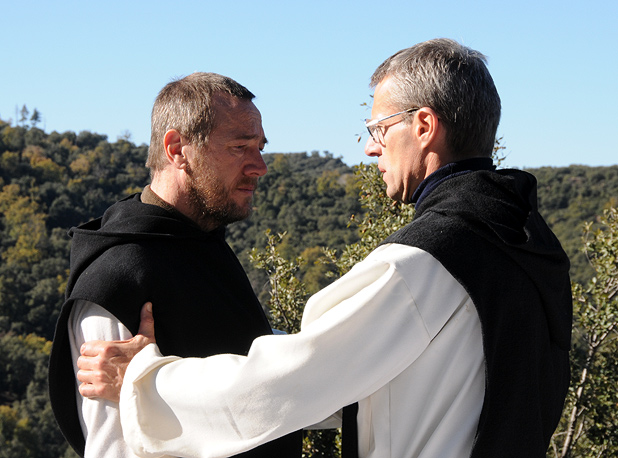
The French/Arabic-language film Of Gods And Men doesn’t have the type of subject matter that would normally bring in a large crowd. The film is about Cicstercian Monks living in a small village in Algeria facing threats from fundamentalist terrorist groups. Nevertheless those lucky enough to see it will love it for what it is.

This film is based on an incident that happened in 1996. Seven French monks from the Algerian village of Tibhirine were found decapitated. The film focuses on the days just before they were killed. They were a group of eight monks who lived in a monastery in Tibhirine. They devoted their lives to monk rituals of gardening, distributing medical help to locals and religious devotions. They were present at the village during times of celebration and they conversed with the villagers regularly. They all did this during a time of the Algerian Civil War. Religious extremists were committing acts of brutality amongst foreigners and their own people. The pressure was felt by the monks. Christian, the leader and resident religious scholar, tells authorities they will not go. However this is hotly debated with the other monks as some fear for their own safety. Christian then gives the men time to decide whether to leave or not. News gets grimmer by the moment. They even face potential threats of their own. Authorities of the Algerian government request they leave for their lives. The villagers however convince them of how vital they are to the community. In the end, as one brother pays a visit to the monastery, they all vote to stay. Late in the night, seven of the nine are found, captured and taken away. Those would be their last minutes known to be alive.

The film has many great qualities. Its best technical quality was the cinematography as it added to the film in showcasing the landscape in its best splendor. The film was well-directed and well-written by French director Xavier Beauvois. The script he co-wrote with Etienne Comar was excellent and very no-nonsense as it cut at the heart of the monks and the village they served. As important as it was to show the events that happened leading up to the times, the script’s biggest focus was on the monks and their lives. It was more about people than events. Even the scene of the last dinner with the music of Swan Lake in the background was done with the focus on the men. 

 The biggest strength of the movie is definitely the acting. Of all performances, the two that stood out were that of Christian the leader and Luc the doctor. Lambert Wilson’s performance of Christian was excellent and the most intense. Often he said more in his scenes of silence than he did with his spoken parts. Michael Lonsdale’s performance of Luc the Doctor was the best supporting performance. There wasn’t a hint of phoniness in it.

As for the monks as a whole, the most remarkable thing about the film is its ability to give three-dimensional portrayal of monk characters. The film not only showed them in their prayer life but also showed the devotion during their prayers. The film showed them in their occupations and how important they were to the village. The film showed their convictions and their beliefs. The film showed the bond between the men. Above all, it was alll done in a three-dimensional manner. This is very rare for a film to accomplish that feat. Even back during the days of the Hays Code–where one of the rules was that religious figures were to be depicted in a positive manner–religious figures were still two-dimensional at the most. Even the negative depictions of religious figures that came once the Hays Code was dropped in the 60’s as ‘censorship’ or ‘restrictive of creativity’–were also two dimensional and often too stockish. This film has to be the most realistic and inside-out portrayal of religious characters, in both character and their vocation, that I’ve ever seen on the big screen. Even 1997’s The Apostle doesn’t compare as Robert Duvall’s portrayal of a minister had more focus on his passion and personal demons than on his vocation.

Also vital is the ending of the film. It is not known who exactly killed the monks. An Islamic extremist group has claimed responsibility but recent documents from the French secret service claim that the Algerian army carried it out as a mistake during the rescue attempt. The film doesn’t pick one group at fault as the monks are captured in the dead of night with the darkness hiding their identity.

There may be some nervous in seeing this film, feeling it might try to ‘convert’ them to Catholicism. For the record, director Xavier Beauvois has not directed a religious film in the past. One thing we should note is that while the monks lived at the monastery, there’s no scene of them trying to convert any of the villagers from Islam. In fact Brother Christian was as knowledgeable about the Koran as he was about the Bible. When religion extremists threatened to shoot the brothers in one instance, Brother Christian quoted a passage from the Koran which caused the leader to drop his gun and order his followers to leave. I believe Beauvois wanted to show that for the monks, the faith was mightier than the sword. Also in the script was a scene where the monks talk about the difference between the Islamics and ‘Islamists’. This is good for a time when religion faces a lot of flack from religious dissenters. I believe that may have been another point from Beauvois that it’s important for one to recognize the believers from the ‘beliefists’.

This film has won a lot of accolades. It won the Grand Prix and the Prize of the Ecumenical Jury at the 2010 Cannes Film Festival. The Grand Prix is second to the Palme d’Or as the most prestigious award at the Festival. Other nominations and awards have followed such as wins at France’s Cesar Awards, nominations at the European Film Awards, nominated for Best Film Not In The English Language at Britain’s BAFTA awards and was France’s official entry for the 2010 Academy Award for the Best Foreign Language Film category. The film was well received by critics here in North America and has a 91% approval rating at Rotten Tomatoes.

Although this is a movie that makes for excellent viewing for Catholic communities, it’s not completely 100% ‘safe’ for everyone. There is a few profanities utters, including one by a monk. There are also some scenes of violence. The most violence is the scene of soldiers being cut at the throat by the extremists. Most of the violence is only seen through news footage.

For writers and directors with religious values, this film offers a ray of hope for those who want to break into film making. It shows that a film showcasing religious values can not only be shown on the big screen but also be written and produced well. That has long been the dilemma ever since the Hays Code has been lifted. This was best summed up in a quote by Catholic scriptwriter/acting school director Barbara Nicolosi-Harrington: 

I realized coming (to Hollywood) that it’s not so much Hollywood is persecuting the Church as much as it was the Church was committing suicide in Hollywood. Big difference. So I basically wrote an article about it saying that Hollywood isn’t anti-Christian as so much as it’s anti-bad art, and we’re just giving it schlock.

She states a major hurdle here as all too often a lot of Christian writers have written a lot of scrpits viewed by Hollywood as sub-standard in skill while the more liberal writers seem to know how to write for the screen. It’s a hugely difficult task to write a film of positive values or strong faith for the general audience without crossing the line of being schmaltzy or manipulative. Of Gods And Men shows that it can be done and it’s just a matter of learning how to do things right.

If you’re fortunate enough to have it come to your city, I highly recommend you see Of Gods And Men. Even if you don’t buy the Catholic faith or want a movie with preachy religious themes, it’s a film worth watching. It’s as much about people and their devotion to their beliefs as it is about an incident that happened. Even with the tragic ending, it tells a lot about the human spirit that will stay with the viewer once they leave the theatre.