Group C may look like a more relaxed group as compared to groups like Group B, Group D or Group G, but don’t be so quick to dismiss. There have been teams from nowhere that would come to surprise and finish high, if not win. Group C may come with one of those surprisers and it could be any of the four teams. All four have reputations of being ‘sleeping giants’ and it could be right here in Brazil where they finally arrive. Here’s my rundown:
 -Colombia (5)- Colombia is one of many great teams who never had the change to deliver well at the World Cup. There was a period in the 90’s when they were one of the best teams in the world but during those three World Cups, they only made it past the Group Stage once and even then only got as far as the Round of 16. It’s a question of what it was: not all being together, political tension at the time, best players sidelined. We’ll never know. But now there’s a new Colombian team picking up where the previous one left off. They’re currently ranked in FIFA’s Top 5 and they’re hoping to deliver this time around. They have the players and the clout. They also have a good coach in Jose Pekerman who often selects players for a specific role rather than their profile. He was successful in coaching Argentina to the quarterfinals in 2006. They’ve even played well in recent games, tying Netherlands 0-0 and beating Belgium 2-0. Colombia can finally arrive on the World Cup scene here in Brazil.
 -Greece (10)- This is one team whose prowess over the years has grown considerably. Their first World Cup was in 1994 and they were uninspiring: losing all three of their matches and scoring no goals while conceding ten. Things have really picked up for Greek football since. They were the surprise winners of Euro 2004. They returned to the World Cup and even though they didn’t advance past the Group Stage, they still had the benefit of winning a game: 2-1 against Nigeria. For 2014, they’re a top-ranked team in good hands with Portuguese coach Fernando Santos who has been very successful coaching in both Portugal and Greece. He guided Greece to the quarterfinals of Euro 2012 and to a consistent track record since, losing only to Bosnia-Hercegovina and South Korea. This is possibly Greece’s best team ever and there’s no better time than now for them to prove themselves.
 -Ivory Coast (21)- At every World Cup since 1986, there’s been at least one African country that advances past the Group Stage. Some have made it as far as the quarterfinals. Many have expected the Ivory Coast–or Cote d’Ivoire– to be that team but ‘The Elephants’ have played below expectations in their two World Cup appearances in 2006 and 2010. Even though they have Didier Drogba, one of the greatest African football players ever, he can’t be a one-man team. Nevertheless the team has been very consistent in recent years. Much from the help of French coach Sabri Lamouchi who has guided the team these past couple of years. They finished second in the African Cup of Nations in 2012 and even tied Belgium 2-2 in a friendly this year. Even at 36, Drogba still looks and plays strong and the team consists of other good talents like Manchester City star Yaya Toure and promising young gun Serge Aurier. This could finally be The Elephants’ year.
 -Japan (47)- No other nation has experienced increased growth of football in the last 20 years the way Japan has. It all started with the creation of the J League in 1993 when football really took off and helped Japan qualify for their first World Cup in 1998. They’ve qualified for every World Cup since even co-hosting in 2002 where they made it to the Round of 16 for the first time. Success continues for the Blue Samurais. They’re coached by Italian Alberto Zaccheroni They feature star players in the top European leagues including Keisuke Honda with AC Milan and Shinji Kagawa with Manchester United. From the first year Zaccheroni assumed the role of Japan’s coach, they won the 2011 Asian Cup. They’ve has mixed results in international play these past two years but have shown their strength trough ties against the Netherlands 2-2 and wins against France 1-0, Belgium 3-2, Ghana 3-1 and South Korea 2-1. They may rank low on FIFA’s chart but they could perform above expectations here.
Now my prediction for the two that will advance. It’s a toughie but I believe it will be Colombia and Greece that will advance.
STADIUM SPOTLIGHT
Now that I’m done all the stadiums that will just hold Group Stage, I’ll now be focusing on stadiums that will host matches in the knockout rounds. One is brand new while one is older and has a reputation. Both will be known for their capacity and features and are both expected to have sufficient post-World Cup use.
-RECIFE : Arena Pernambuco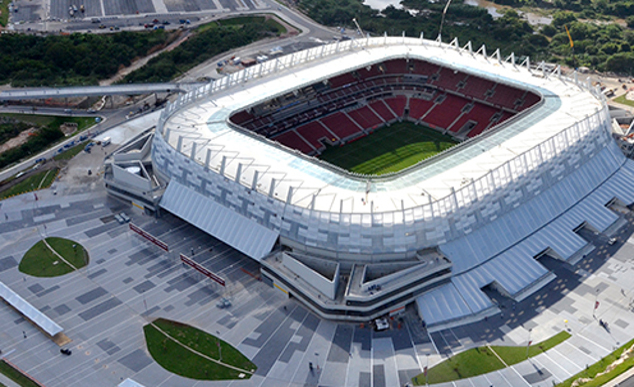
Year Opened: 2013
World Cup Capacity: 46,154
World Cup Groups Hosting: A, C, D, G
Additional World Cup Matches Contested: Round of 16 (D1 vs. C2)
Pernambuco is a new stadium that was built not just for the World Cup but for last year’s Confederations Cup too. Pernambuco is a new stadium not just built for the World Cup and for Recife to have a new football stadium but also to give a financial boost to a deprived area of the city. Plans for the surrounding area include a university campus, indoor arena, hotel and convention centre, plus commercial, business and residential units and a large entertainment complex with shopping centres, cinemas, bars and restaurants. The biggest feature of the stadium is its intent to be a ‘Green Arena’ relying on solar power and even serving the purpose of being a solar power plant to power 6,000 people when not used for game play and be part of the research and development of solar power in Brazil. Football club Nautico Capibaribe is expected to make this stadium home after the World Cup.
-FORTALEZA: Estadio Castelao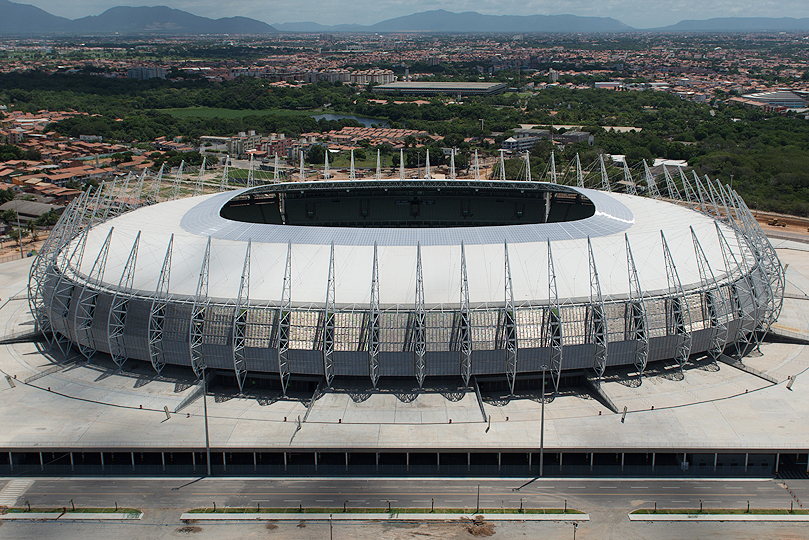
Year Opened: 1973
World Cup Capacity: 67,037
World Cup Groups Hosting: A, C, D, G
Additional World Cup Matches Contested: Round of 16 (B1 vs. A2) & one quarter-final
Castelao is one of the few stadiums at this year’s World Cup to go through two major renovation projects. The first came in 2000 and it was a three-stage project that lasted a year. Then once it was assigned as a hosting venue for the World Cup, it was given a twenty-month reconstruction project starting in March2011: a mere ten years after the first set of renovations were completed. Whatever the situation, Castelao was the first World Cup venue to be completed, back in December 2011. Castelao was one of the venues for last year’s Confederations Cup. Castelao Stadium has always been a venue that has hosted big events in the past. Castelao plans to continue to host major concerts and serve as host venue for Ceara and Fortaleza Sporting Clubs.
And there you have it. My take on Group C and two more stadiums reviewed. Five more groups and six more stadiums to go.