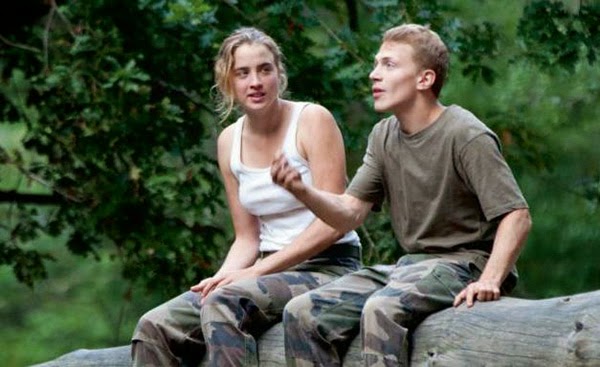
Les Combattants is an unlikely French romance between a girl with a tough attitude and a boy who’s more sensitive.
It was all a result of timing and availability for when I was able to see Love At First Fight or Les Combattants (working title in the US is Fighters). Even though it’s nothing too special, I’m glad I saw it.
Arnaud is a young Frenchman who works for his family’s contractor job in a French coastal city. That all changes when he does work in a family’s yard. He meets Madeleine, a young woman who’s beautiful but has a tough-as-nails personality. It’s tough because she has ambitions of being in the French army. Arnaud on the other hand is more sensitive. Sensitive enough to care for a stray ferret found in the yard.
The first meeting doesn’t go so well. They have as squabble and he bites her! The second time he thinks she’s crazy because she swims with a backpack full of ceramic shingles. Nevertheless he’s still drawn to her despite her negative attitude towards him. He even has army ambitions of his own. However it interferes with the family business while they still have a lot of jobs to do.
The two eventually do things together. However she still maintains a tough hard-as-nails attitude towards everything from a harmless ferret to even nightclubbing. He himself joins the army. The two help each other out and challenge each other along the way. Then an incident happens that causes Madeleine to run away. Arnaud soon finds her. However it’s once they’re out of the training area that they start to reveal their true feelings to each other. Finally Madeleine’s love for him comes out. However all fun ends when Madeleine suffers from food poisoning and Arnaud tries to take her to aid while the town they’re in is engulfed with smoke from a forest fire. The film ends predictably but not as fluffy as your typical Hollywood romance.
This film is an example of how France is making movies of their own. Sure the French are famous for making films. This would qualify more as a movie. Nevertheless there are some film qualities. One is the lack of a score in the background. Yes, there is background music at times but the film is mostly scoreless to get the environment of the story. Even though it’s not as artsy as your typical French film, there are some elements such as when Madeline hits Arnaud during a paintball exercise. Some could say it could resemble cupid shooting an arrow through his heart. Even the place of gender roles as the girl is the hard-ass one compared to the boy can be a French element in film.
As a movie, it’s good. However it’s not all that attention grabbing. It does have a story that can keep one interested once they watch more of the movie but only in that case. One thing I will say is that it does come across way more sensible than most teen romances, especially those from 20 years ago.
The film is devoid of big-name actors, even from France. Nevertheless they did impress. The young actors did well too. Adele Haenel was best as Madeleine. Madeleine could have come across as this stockish hard-ass army girl but her character had dimension to it. She was able to make the transition into the more sensitive feelings of her character very smoothly. Kevin Azais was also good in his role even though he wasn’t given too much of a role to work with. This is the first feature length film by director Thomas Cailley. This film for which he also co-wrote the script with Claude Le Pape is a good story and a good first effort and should lead to more promising work in the future. I can easily see the story itself being made into an American version.
Love At First Fight or Les Combattants is a good young adult romance even if it lacks what would normally bring young adults to the screen. Still it will keep your intrigue.
Mexico has delivered a lot of unique films over the years. One such film that has caught festival attention is Güeros which is filmed entirely in black and white. It makes for a unique story and a unique message within the story.
The film begins with Tomas, a young teenager from Veracruz, getting in trouble for tossing a water balloon off the top of his apartment. It lands on a baby. The baby’s fine but the mother’s had it with him and sends him to his student brother in Mexico City. There he meets his brother Federico, nicknamed ‘Sombra,’ who is supposed to be in university but the college is under strike for five months and has become almost threatening territory. Instead he lives in an evaded apartment with his friend Santos. One of the first things Santos notices is how Tomas is unlike his dark-skinned brother. He’s a Guero: a Mexican of light skin and hair. The apartment they live in is without electricity until Aurora, a mentally impaired girl in the suite down below, hands them an orange cord to steal electricity. It’s not easy for Sombra especially since the nights are cold and he has a hard enough time trying to sleep with the images of tigers in his mind because of his panic attacks but he has put up with it since the beginning. Their one getaway is the car but Sombra is too nervous to leave. Possibly because of his panic attacks.
Tomas already finds the first few days frustrating with limited time for electricity and relying on his Walkman to hear the music of Epigmenio Cruz and his camera to take pictures whenever he wants to. Epigmenio Cruz is no ordinary musician to the boys. He was a musician that ‘made Bob Dylan cry’ and almost launched Mexican rock into the mainstream. Then Tomas reads that Epigmenio was admitted to the hospital with cirrhosis of the liver. Tomas wants to meet him but Sombra won’t let him. Tomas then leaves in a fit of anger, especially after three hellish days of living with what Sombra puts up with. To make matters worse, the neighbors down below find out Sombra’s scheme to get electricity and the father chases after them. It’s then that they finally find Tomas who left to find Epigmenio. Sombra’s reluctant to leave the apartment but agrees to do so temporarily. It’s in the trip to the hospital to find Epigmenio that Sombra’s panic attacks come back.
At the hospital, they don’t find him there. They know he’s still alive but information of his whereabouts are kept secret. In the pursuit to find Epigmenio, the three boys first encounter a gang of thugs. Fortunately they leave before they could get into any more trouble. Then they come across a garden of carrots where they can finally have a chance to eat some real food. The next place they head to is the campus but Sombra is hesitant as he knows how dangerous it is. The three are able to make it in there where they’re able to retrieve Sombra’s girlfriend Ana, one of the activist leaders during the strike. Ana shows all the territories of the strike where the students set up their living quarters. Ana soon agrees to go with the boys to find Epigmenio before he dies.
Along the journey, they go to the city zoo and aquarium and Ana is able to help Sombra confront his fear over tigers. They go across the rich area of town and amongst people staring at their smart phones. They also go to the outer part of the city where they encounter store thugs and a boy who drops a brick from a bridge. Yeah, more bad apples in all shapes and sizes. They also come across a woman who was actually a model for the album of Epigmenio’s the boys have. They’re even introduced to his drawings. It’s right after they learn of his restaurant whereabouts of his that they leave town. This leads them to their destination and finally their chance. After the outcome, they return to the campus in the midst of the protest which Ana joins immediately and Sombra approaches without fear and with no panic attack whatsoever.
The thing about the film is that you think it’s going to be about a certain thing but no matter what you thought it would be about, it’s about something else too. And something you didn’t expect it to be about. I first thought it would be about Tomas growing up or learning something about student life at first. I’m sure most of you thought it was about that trip to see Epigmenio. Even though it was about that as far as the plot is concerned, it’s about more. I’ve sensed it’s about Mexico and its art. The boys are immersed in Epigmenio’s music but they also see and hear other art. They hear the poem Ana says as it talks of the struggle of Mexican people and hope coming from it. We hear Mexican music. We see art amongst the student protesters. We see the superficiality of the rich. We see the pettiness and the struggle of the poor from all sides. We’re also given the plot of student protests. A key factor since news has come out about killing and abductions during student protests in Mexico. Then the four meet Epigmenio for the first time and they tell his they realized why his music means so much to Mexicans including their late father and themselves. Interesting that we never know if they got his autograph or not.
Spoiler Alert: For discussion of the theme, the ending will be revealed in this paragraph. I think that what the top point of what the film was. There was the point of the hardships Mexican people have gone through before and now it’s the young’s turn to be fighters for a better tomorrow. But the top point I believe was to take a visual snapshot at Mexican life through all the four experience both on campus and throughout their trip all over Mexico and show what makes the message of hope in Mexican art. Then the film ends with Tomas taking a picture of his brother in the midst of the protest. It’s like his picture is the making of Tomas’ art. Sometimes in looking back I often think that the scene where Tomas and the three others approaching Epigmenio is almost like the ‘passing of the torch’ of Mexican artistry from Epigmenio who’s near death to Tomas who’s young and full of pictures to take.
Interesting that this is Alonso Ruiz Palacios’ first ever feature-length film. He’s done short films and television before but this is his first feature-length and it’s an excellent work. Sebastian Aguirre also did very good as Tomas. He did a very honest portrayal of a young Mexican teen that wasn’t too over the top or showy. Tenoch Huerta and Ilse Salas were both good in their supporting roles. Sometimes you’re tempted to think the film’s about them. A bonus note is that Gael Garcia Bernal is an associate producer of this film. Unique that a story like this can attract a big name like him. The film has already won awards like Best Debut Feature at the Berlin Film Festival as well as Best New Narrative Feature and Cinematography In A Narrative Feature at the Tribeca Film Fest
Güeros is a unique Mexican film that is worth watching. It’s been said ‘the journey is the destination.’ Such is the case here where the journey is an eye-opener for the four and a message of hope for young Mexicans.
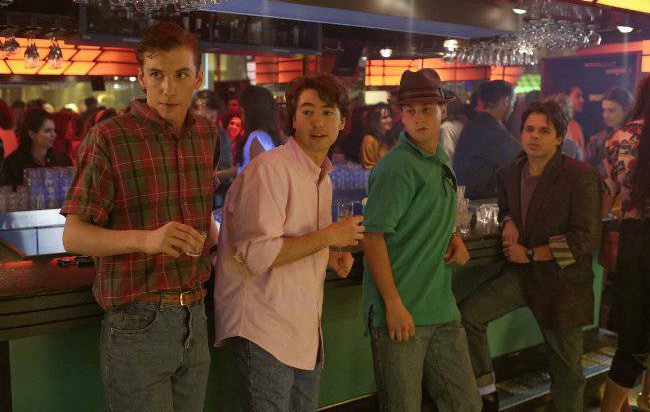
1987 is an autobiographical movie about director Ricardo Trogi in his teen years played by Jean-Carl Boucher (extreme right).
Remember last year when I talked about movies from other countries as much as I talked about films? Well I had the good luck of catching my first movie at the VIFF just recently. It’s a movie from Quebec called 1987 and it’s very entertaining.
The film begins with 17 year-old Ricardo Trogi breaking up an organizational meeting where the ‘powers that be’ organize that a teen should decide at 17 what he wants to do with the rest of his life. Ricardo breaks it up because he knows it won’t work. He’s 17 and he can’t decide.
Flash forward to the plot. Ricardo is about to graduate from high school and he has four big goals for this year: lose his virginity to his girlfriend Marie-Josee, get into night clubs, get a car and strike it rich with his big plan. Sound like big dreams but it’s not going to come true easily. His parents want him to get a job to learn responsibility. All the attempts from him and his three friends to get into Quebec’s top club fail. Marie-Josee is reluctant to go all the way. And his big goal is to open a night club for teens. That takes some doing since he has a $50 bill from Columbia House after falling for their 10 tapes for a penny ‘deal.’ Yeah, I fell for that too.
Things start pretty bumpy. He does get his first car but it’s a shabby Lada. He has a chance to lose his virginity but it’s postponed as he starts work on the one day Marie’s parents are away. His moneymaking chance flops with his first job as a valet. Hey, totaling a BMW will get you out in a record-short two hours. Then it’s by chance with his friends that they notice an expensive car stereo. Fortunately for them, no one’s around to see them steal it. That gives Ricardo an idea of being a stereo peddler to get the money for his night club. It starts to pay off. The more stereos he and his buds get, the more they can sell. Once he reaches 18, he can get into night clubs with his friends and be ‘the man.’ He even gets the notice over there of a Sara, female classmate he liked but the other boys called ‘STD’ behind her back.
However things don’t work as planned. First he finds out Marie-Josee kissed another man. He hears it right on prom night. He leaves her and then goes to the night club where he’s able to win over Sara. However he finds out that ‘STD’ is actually a virgin and confused with life. To make things worse, he finds out his friend and ‘partner in crime’ spends too much time with Marie-Josee. Then comes the Waterloo for him as the police know of his stereo theft. It all ends there. Nevertheless it ends with the director giving a final reflection at the end.
The thing that grabbed me most was that this movie was possibly the most truthful about the 1980’s of all 80’s-themed movies. You know how sometimes when you see a retro movie they don’t entirely get it exactly retro? They include some modern stuff but try to make it look classic? Like those 70’s-like hairstyles worn by the teens of Happy Days? Not in 1987. It grabbed me that this was the 80’s retro film that had to be the most exact when it came to 80’s style from multitude of armbands to plastic glasses on women and aviator glasses on men to girls in big hair to guys in tight jeans. I noticed very little present styles in this. And I’m an 80’s teen! Also that talk of opening a night club for teens. That was a unique 80’s thing. I even remember a teen night club in Winnipeg in the 80’s called Changes.
It’s not just the clothes and teen clubs that made it very precise in depicting the 80’s but also the entertainment they talked about and music played in the soundtrack. They played a lot of signature 80’s songs like Forever Young and Cum On Feel The Noize and there was talk about a U2 song affecting Marie-Josee’s mood. Having the Pet Shop Boys’ It’s A Sin fit the chase scene perfectly and even reminded me that I liked it. There were also a lot of lesser known 80’s gems in there too like Flock of Seagulls’ Space Age Love Song (which I prefer over ‘I Ran’), Run DMC’s It’s Like That and even uniquely Canadian 80’s gems like Luba’s Every Time I See Your Picture and even a Quebec 80’s gem from Martine St.Claire. Another such is the movie poster of The Untouchables which Ricardo thinks it’s about Al Capone being tough. The poster actually is a symbol of Ricardo’s teenage delusion as The Untouchables was about Al Capone getting caught. Eventually the Quebec police would become Ricardo’s Eliot Ness.
Another thing about it is that it was able to make light about a lot of teenager difficulties. Especially the age of 17 when you’re expected to decide what you want to do with your life and a lot of unexpected changes happen. Sure, you graduate high school but often your friends and even your high school sweetheart move on to pursue other things. First off the movie was able to make light of the shitty attitudes in both Nadia’s reclusiveness and Ricardo’s frustrations. It was also to make light of the romantic confusions of Marie-Josee and Sara. It was also able to showcase a lot of the typical teenage stupidities in a funny way. Especially Ricardo’s stupidity of thinking he’s ready to take on the world with his idea and that he can make it big on stealing car radios. The radio heist was especially amusing because he was acting like he was Don Corleone but he was a complete amateur. 16 year-olds in the ‘hood are better at playing the game than Ricardo. Nevertheless it’s funny to watch as most of us have passed the age of 18 and can even see their own past in it. We laugh because all Ricardo and his teen friends go through, even the toughest stuff, are all a case of ‘you live and you learn.’ Even cruel stuff like Sara being nicknamed ‘STD’ can be laughed off as the stupidity we once had.
I didn’t know until recently that 1987 was actually a sequel to 1981, another autobiographical film by Ricardo Trogi in which Jean-Carl Boucher also played Ricardo. I’ve never seen it so I can’t compare 1987 to 1981 at all. I will say it’s a very entertaining film in its own right and Trogi should be very proud of the movie he delivered. Like I say, any 80’s teen can identify with this and laugh along to it. It’s almost like they’re laughing at themselves. Jean-Carl Boucher was very good in his role as Ricardo. He was naturally comedic in the role without coming across as too stockish of a character. He made the comedic side of teen awkwardness look 3D. Actually all the teen actors were very good in their roles as they came off very believable especially in terms of showing teenage confusion and frustration in both comedic and serious lights. The adult actors were also good but it was Sandrine Bisson as the mother who was the best scene stealer. She reminds you of every mother and the crazy frustrated attitude they have. Yeah, juts when you though your mom was weird, it becomes apparent it’s a mom thing.
1987 is a funny movie that can appeal to all sorts of people like teens and grown adults or even people who just like 80’s stuff. It will bring back memories of the time. And of you.
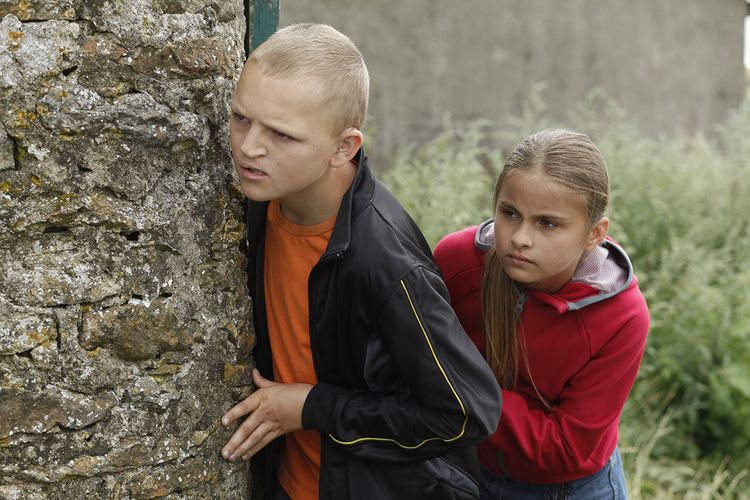
Li’l Quinquin is a story of a young French boy and the summer that changed his life forever.
Last year the first film I saw at the VIFF was a French movie that was three hours long. I’m sure most of you know which one I’m talking about. This year the first movie I see at the VIFF is another three hour long French movie. This time it’s titled Li’l Quinquin and it’s a very different French film.
Quinquin is a young boy growing up on a farm in northern France where his parents for the Lebleu family. He likes playing games with his friends and being bad by razzing people with his firecrackers. He also has a crush on Eve, the girl from the neighboring farm who plays trumpet for the legion and has a sister Aurelie with singing ambitions. It’s the summer and it should be fun time for all the kids in the village.
However the village is hit with shock as one of its people was murdered. Mme Lebleu’s remains were found stuffed in the carcass of a cow found inside a war bunker located near the Lebleu farm Quinquin’s family works. On the case is Commandant van der Weyden: an incompetent officer with uncontrollable facial twitching and a suspicion for certain people like young people like Quinquin. He is assigned to look into this along with his partner Lieutanant Carpentier.
After the funeral for Mme Lebleu–which was bizarrely conducted with a happy organist, Aurelie singing her pop song and the baton team Lebleu instructed twirling at the burial– another murder happens with the remains also stuffed in the cow. This time it’s Mr. Bhiri, the African father whom Mme Lebleu had an affair with. The suspicion continues to grow and van der Weyden pursues others he feel may be linked like Mr. Lebleu and even Mme Campin, the new leader of the baton team who has been known to have an affair with Mr. Lebleu. Meanwhile Quinquin and the kids are still trying to be kids swimming in the ocean, performing during the Bastille Day parade, playing games, Aurelie competing in a local talent contest and winning and Quinquin falling in love with Eve.
Not all of it is innocent fun as two boys of African and Moroccan descent are harassed by Quinquin and his friends. One boy, Mohammed the African who was the son of Mr. Bhiri, is especially harassed. The harassment gets to him as he is interrupted by them as he’s sharing an intimate moment with Aurelie. Meanwhile van der Weyden and Carpentier are being pressed by their superior to find the killer behind all these murders. They try to find out more information like the bunker near the Lebleu farm, the connection with Mme. Campin and even the feudal situation with led to the younger Mr. Lebleu owning Dany, the mentally impaired nephew.
Then things take a turn for the worse in the town. Mohamed goes on a shooting rampage from the top of his house. The rampage ends with him committing suicide. Aurelie finds the news hard to bear. Soon she is found dead inside of a pig. Possibly also a victim of murder. Then Mme Campin is found murdered on the beach but all in one piece. This soon leads van der Weyden to pursue a final answer to who the murderer is. This leads to an ending that is unexpected and anticipated by nobody.
One of the things about this film is that it tries to blend bizarre humor in the midst of what is a grisly set of murders. There are a lot of tragic parts to it but the humor mixes itself into it. The humorous bits seem bizarre at first but later on you think that it did fit the film well and helped make it. I’m unsure what is big in terms of French comedy but it definitely worked well. Even a character like Commandant van der Weyden will remind a lot of people of Inspector Cluseau with his bumbling. One thing about van der Weyden is even with his clumsiness and his twitchy face, he does have a serious side. I think that’s what the focus of the film was: ironies and humor in what is a horrific situation in a town. The humor does fade away after each additional murder happens and as it leads to its conclusion.
The funny thing is how this story of a string of murders intertwines with the life of the little boy Quinquin. Quinquin is just a young farm boy doing what most boys his age do: play games, act tough with his peers and fall in love. He may have been questioned about the murders at first but they don’t begin to affect him. It’s only once those he knows dies within that circle that it does start to change him. Especially since one victim is his girlfriend’s sister. It becomes more obvious later on.
The crazy thing is that the ending is not the clearest. You first think it’s a murder story and we’ll get the answer to who did it at the end. However those who saw it were still left both surprised and confused. Almost as if to debate what the point of the film was. Or maybe the main purpose of the film wasn’t to be about the murders but rather about Quinquin. One thing we notice is how Quinquin only has simple curiosity in the murders or just giving Commandant van der Weyden a hard time at first that is until the victims become people he knows or had somewhat of a connection to. He didn’t have too much of a connection to Mr. and Mme. Lebleu or Mohamed’s father but he knew Mohamed and he knew Aurelie. He went from a typical boy who liked playing naughty games and just falling in love with Eve to having his childhood fun end and being the one person who can console Eve. That could be the main theme of the film rather than it being a ‘whodunit’ story.
The film features a wide variety of themes added into the story. One of the two most present is the theme of nationalism with the whole situation happening in the summer especially around Bastille Day. The theme of racism is present as France may be a country with a lot of immigrants from central and North Africa, there’s still a lot of racism and xenophobia especially in the smaller towns. The second is the theme of disabilities or physical awkwardness. Quinquin is a boy with a harelip. Commandant van der Weyden has uncontrollable facial twitching. Dany is mentally impaired and there’s even a conversation between van der Weyden and his superior in a restaurant while a British family with a mentally impaired son is trying to dine. I feel Dumont is trying to add a point here. I’m sure Dumont was trying to add in more points with bodies being found in animal carcasses or even about Aurelie’s song ‘Cause I Knew’ or even the ties of French inheritances but it’s too much to say and will require a lot of afterthought.
Overall this may be a long film by Bruno Dumont but it tells an intriguing story. Actually it’s not really a film but a four-part miniseries compiled as a big screen film. Most outside of France wouldn’t know this was originally on television. Nevertheless Dumont does a great job here by taking a dark story and mixing surprise humor in there but still keeping the story sensitive. I think he aimed for irony in this series. Bernard Pruvost was a great scene stealer as the commandant. He could have easily been seen as a ‘rip-off’ of Inspector Cluseau’ but he didn’t go over-the-top in terms of his character’s awkwardness or his klutziness. He also made his character’s facial twitching look natural as if it was uncontrollable rather than wooden. Alane Delhaye was very good as Quinquin. He was good at playing a child who was natural and not your typical sugar-coated child character. The end especially was the best part of Delhaye’s performance. Lucy Caron was also good as Eve as she was able to go from your typical carefree girl to a girl now hurt. There were additional good performances from Lisa Hartmann, Stephane Boutillier and Jason Cirot.
Li’l Quinquin is an intriguing film to watch despite it being long and despite the ending being unexpected. Actually it does fare best as the miniseries it originally was. Nevertheless regardless of the format, it will keep your attention onto what will happen next.


 Jon The Blogcentric