You feel that? That’s your family. That’s your blood.
Every year, the VIFF features films that are bound to spark a lot of Oscar buzz. One that I saw is The Piano Lesson. The story and acting are bound to stimulate a lot of buzz this Oscar season.
The film begins during the Fourth-Of-July 1911 in a Mississippi town. As the white residents are celebrating, an African-American resident and a group of his friends are trying to put a piano in a truck. Why? After the fireworks and celebrations, the white residents burn Sutter’s house down and kill the African-American man inside.
The film moves forward to the summer of 1936 right in the middle of the depression. Boy Willie and Lymon have arrived in Pittsburgh and stop at the Doaker Charles household: household of his uncle. Unfortunately, Boy Willie tells sister Berneice about the death of Sutter back in Mississippi. Berneice, who’s recently widowed, is infuriated and demand her brother leave, accusing him of shoving Sutter down a well. Before Boy Willie leaves, he wakes her daughter Maretha as Berneice claims to see Sutter’s ghost.
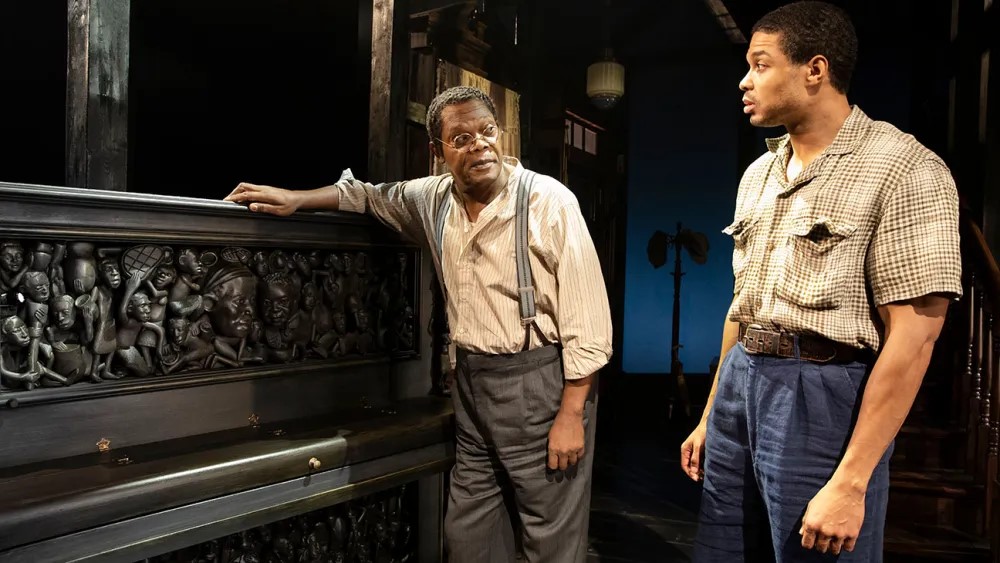
In the Doaker Charles household, Lymon notices that piano that was saved. It’s not just any piano but engraved on it are the images of Willie’s and Berneice’s ancestors. Ancestors who were enslaved and carved in so they’re never forgotten. On a piano Willie wants to sell to buy Sutter’s land. Land where his ancestors toiled as those slaves engraved on that piano. Doaker Charles insists Berneice won’t comply and Berneice is infuriated with the plan as well as Willie’s prospective buyers list. Despite the fallout, Willie believes he will convince her but as Maretha comes to Willie at the piano, he teaches her a few things. Including the boogie-woogie.
As Wining Boy visits with Doaker, Boy Willie and Lymon return to announce they found a buyer. Not only is Boy Willie told Sutter will cheat him, but pasts and future desires come to light. It’s revealed the story of Lymon and Boy Willie’s terms in prison are exposed. Although they want to buy Sutter’s land, Lymon wants to be up North because of better treatment, but Willie reminds him that despite the North is not as racist, it still exists. As Wining Boy, who made a career as an entertainer, is asked to play the piano, Wining Boy declines feeling being solely as a piano player is nothing but a burden.
The story of the piano is finally told by Doaker. The piano was an anniversary present from Sutter to his wife. The piano was bought in a slave trade and a mother and child were the currency. Over time, Mrs. Sutter missed the slaves and Mr. Sutter had the sold slaves’ husband/father carve their likeness in the piano as he was a carpenter. On that Fourth of July 1911, it was Boy Willie’s father who stole the piano and he was killed by the whites in retaliation. Willie brushes the stories aside as something from the past but as Willie and Lymon try to move the piano to weigh it, Sutter’s ghost is heard. Berneice tries to stop Willie from ‘selling his soul’ but as the two argue, Mareitha is exposed to the ghosts and screams in terror.
The next day, Doaker tells Wining Boy that he saw the ghost of Sutter playing the piano and feels Berneice should discard the ‘cursed’ piano before it can traumatize more of the family. Wining Boy doesn’t agree. After a successful watermelon sale by Willie and Lymon, Wining Boy tries to distract them of their opportunism by selling them is suit and shoes, claiming it attracts women. That same day, Reverend Avery Brown meets with Berneice. He’s been hoping to win her love and tells her she needs to stop hurting over the past, especially her husband’s death. Berenice changes the subject by trying to get Brown to be a reverend and try to get the ghosts out of the house. Instead, Avery tells her by the piano not to be afraid of her family’s spirits. Berneice then tells Rev. Brown the story of the piano. It’s a story that involves her father’s blood and her mother’s tears and she refuses to expose her hurt to all.
Boy Willie returns to the house with Grace: a woman he just hooked up with. An infuriated Berneice demands them out. Just as they leave, Lymon enters. Lymon is disheartened over his feeling he’s not that good at attracting women and confesses his feeling to women to Berneice. Berneice kissed Lymon and is finally comfortable with letting go of her late husband.
The following morning Boy Willie and Lymon are ready to take the piano for selling but Uncle Doaker stops him. Boy Willie confronts Doaker and tells him how he’s determined to sell it. The day of the selling of the piano is inching closer and closer and Willie is excited without caring what Berneice things. That is, until Berneice enters with her late husband’s gun. As Doaker and Rev. Brown see the confrontation, they urge the two to talk it out. Right there, the ghost of Sutter is revealed to all in the house. Rev. Brown tries to pray the ghost out of the house but doesn’t succeed. As Berenice sees this, she then knows she needs to play the piano again as a plea to her ancestors. As she finally play it, the ghost of Sutton disappears and the calm returns to the house. Willie then decides to move back to Mississippi but tells Berenice to keep playing or else he and Sutter will return. Before leaving, Mareitha is given a lesson.
There’s no question the story is about racism. It’s a unique story as it is about one set of family members who are originally from Mississippi, which was a slave state and still faces harsh hostile racism, and another set of family who live in Pittsburgh, which never was a slave state but had its own racism. The story is also about a piano. Carved on the piano are the ancestors of the family. Ancestors who were slaves. One set of the family wants the piano kept because the images of the ancestors maintain a link to the family blood. Others of the family want it sold because it’s an ugly reminder of the slavery their ancestors have endured. Past memories even come to the point images of ghosts of the family are involved. They don’t know how to deal with this. In the meantime, it’s in the middle of the Great Depression where buying the recently-deceased slave owner’s land depends on the sale of the piano.
August Wilson did an excellent job when he wrote this play. The piano lesson isn’t just about a young girl being taught how to play the piano on a family piano. It’s an excellent story about how an African-American family, and their struggle to deal with racism and their family’s horrific past are all encompassed in a single piano. We have Berneice who values the piano. She knows her grandfather carved the family in it, her father died so it can be theirs, but she’s reluctant to play it. There’s Boy Willie who wants to sell the piano so he can buy Sutter’s land. Already there’s a case of the difficulty of dealing with a past of slavery. Berneice considers the piano sacred and a symbol of her family. Boy Willie sees it as a bad memory of slavery and he feels selling it to buy the land his ancestors were enslaved on will be revenge. A case of a brother and sister who don’t know how to deal with the past. Berneice being widowed and having to deal with the ghost of Sutter adds to its theme. It’s right in the moment of the ghost’s presence that both Berneice and Boy Willie have to make resolve both with their family’s past of slavery and the past as a whole.
Those that have seen the play before will be able to understand the film well. The scenes that were added in the film adds to the story and helps those that have never seen the stage play before get a better sense of all that happened in the past. Those that have never seen the play before and may not attend theatre as of may find the story a bit confusing. They may not understand about the piano or the presence of ghosts and even get confused of what genre the film is.
This is the third of three plays of August Wilson Denzel Washington has helped bring to screen. The thing is of the three, this is the film that’s the least fluid and the least together. This is also the first feature length film done by his son Malcolm. Malcolm has mostly directed short films in the past. His lack of experience shows in directing an unsteady adaptation of the play. The adaptation he co-wrote with Virgil Williams who is more experienced at writing is a good adaptation to the screen but its imperfections are noticeable.
One thing that shines biggest in the film is the acting. The best coming from Danielle Deadwyler. She did an excellent job of playing the troubled Berneice who first can’t seem to let go or make resolve with tragedies of the past, but finds it in herself at the end. Her performance was the strongest quality. Also excellent is the performance of John David Washington. He does a great job of playing the character most confused with the situation and what to do with it, and the need to stop having a hard heart. Also excellent is Samuel L. Jackson as the uncle trying to settle the score and try to get Boy Willie to leave his stubbornness behind.. His role as a man caught in the middle of a difficult problem helped add to the film as well. The production design by David Bomba, the costuming from Francine Jamison-Tanchuk and the music from Alexandre Desplat also add to the story and the times.
The Piano Lesson is another ambitious effort to bring August Wilson’s greatest plays to the screen. The film is adapted well but the errors are noticeable. The best thing is the acting is top calibre. Those who watch it will be impressed.

 Jon The Blogcentric