This year’s Golden Globes will be hosted by Andy Samberg and Sandra Oh. I’ll admit it’s awfully late for me to post my Golden Globe predictions, but I have been lacking the drive this holiday season. A late-minute alerting made me get myself into action. To start things off, here are my predictions for both the winners and their respective most likely upsetters in the film categories:
FILM:
Best Motion Picture, Drama
Winner: A Star Is Born Most Likely Upsetter: BlacKkKlansman
Best Motion Picture, Musical or Comedy
Winner: The Favourite Most Likely Upsetter: Green Book
Best Actor in a Motion Picture, Drama
Winner: Bradley Cooper, A Star Is Born Most Likely Upsetter: Rami Malek, Bohemian Rhapsody
Best Actor in a Motion Picture, Musical or Comedy
Winner: Christian Bale, Vice Most Likely Upsetter: Viggo Mortenson, Green Book
Best Actress in a Motion Picture, Drama
Winner: Lady Gaga, A Star Is Born Most Likely Upsetter: Glenn Close, The Wife
Best Actress in a Motion Picture, Musical or Comedy
Winner: Olivia Colman, The Favourite Most Likely Upsetter: Emily Blunt, Mary Poppins Returns
Best Supporting Actor in a Motion Picture
Winner: Mahershala Ali, Green Book Most Likely Upsetter: Richard E. Grant, Can You Ever Forgive Me?
Best Supporting Actress in a Motion Picture
Winner: Amy Adams, Vice Most Likely Upsetter: Regina King, If Beale Street Could Talk
Best Director
Winner: Alfonso Cuaron, Roma Most Likely Upsetter: Peter Farrelly, Green Book
Best Screenplay, Motion Picture
Winner: Alfonso Cuaron, Roma Most Likely Upsetter: Nick Vallelonga, Brian Currie & Peter Farrelly & Vanessa Taylor, Green Book
Best Foreign-Language Film
Winner:Roma (Mexico) Most Likely Upsetter:Shoplifters (Japan)
Best Animated Feature Film
Winner:SpiderMan: Into The Spiderverse Most Likely Upsetter: The Incredibles 2
Best Original Song, Motion Picture
Winner: “Shallow”, A Star Is Born Most Likely Upsetter: “All The Stars”, Black Panther
Best Original Score, Motion Picture
Winner: Marc Shaiman, Mary Poppins Returns Most Likely Upsetter: Marco Beltrami, A Quiet Place
Those who know me well enough know I will predict the winners for the television categories but not predict the most likely upsetters. Especially since this year’s crop of nominees come mostly from new shows for this season. So my predictions for the winners:
TELEVISION:
Best TV Movie or Miniseries: American Crime Story: The Assassination Of Versace
Best TV Series, Drama: The Americans
Best TV Series, Comedy: The Marvelous Mrs. Maisel
Best Actor in a TV Series, Drama: Matthew Rhys, The Americans
Best Actor in a TV Series, Comedy: Bill Hader, Barry
Best Actress in a TV Series, Drama: Sandra Oh, Killing Eve
Best Actress in a TV Series, Comedy: Rachel Brosnahan, The Marvelous Mrs. Maisel
Best Actor in a Miniseries or TV Movie: Darren Criss, American Crime Story: The Assassination Of Versace
Best Actress in a Miniseries or TV Movie: Regina King, Seven Seconds
Best Supporting Actor in a Series, Mini-Series or TV Movie: Henry Winkler, Barry
Best Supporting Actress in a Series, Miniseries, or TV Movie: Thandie Newton, Westworld
And there you go. Those are my predictions for tonight’s Golden Globe awards. Winners to be revealed starting 8pm EST. That’s less than an hour!
It’s the football event that defines us Canadians. Grey Cup Sunday is back. This year marks the 106th contesting of the Cup. Again it’s East vs. West. Like 2016, it’s Calgary vs. Ottawa.
FIFTH TIME FOR EDMONTON
This marks the fifth time the Grey Cup will be contested in Edmonton’s Commonwealth Stadium. The Stadium, which was built in 1978 to host the Commonwealth Games, is one of the biggest in Canada. It features a basic capacity of 56,302 and can be expanded to just over 63,000. Since 2016, the Stadium has been named ‘The Brick Field At Commonwealth Stadium.’
One thing about Edmonton is that they really love their football. It was announced back in February that they’d make Grey Cup festivities twice as big as they were in 2010: the last time Edmonton hosted. The five-day festival which started on Wednesday is to include things like a ZipLine, an artificial hill and a multitude of musical acts and theme parties. Since the Grey Cup would be taking place around the annual Santa’s Parade Of Lights, the event would be combined into one parade. For entertainment, The Reklaws will perform prior to the game as part of the Sirius XM Canada KickOff Show. The half-time show will be performed by Alessia Cara.
And Now The Game
As I mentioned earlier, this is going to be a 2016 rematch of the Calgary Stampeders vs. the Ottawa RedBlacks. The Stampeders are the heavy favorites again, but there are no guarantees in sports. The RedBlacks could win their second Grey Cup in only their fifth year of existence.
WEST: CALGARY STAMPEDERS
The Calgary Stampeders not only lead the Western division but the whole CFL too. They come as the heavy favorites for this year. But this is a constant repeat. This is the third year in a row the Stampeders have topped the CFL in Regular play and won the West Final. The thing is they lost the Grey Cup both times as the heavy favorite. In no way will they want this to be their third loss of the Cup in a row.
Going over their regular season, Calgary has had thirteen wins and five losses. All of their losses were from teams in the West. In the West Final, they won beating Winnipeg 22-14. They had just lost to Winnipeg three weeks earlier in regular season. That alone can send the message that Calgary can overcome a lot. Calgary has the best defense in the league and they will present a challenge when put to the test. However Ottawa does have a tough offence, which I will touch on later. That could be the one thing standing in the way of Calgary avoiding a three-peat of Grey Cup losses. Not to mention weather could be a factor. I still remember last year’s Grey Cup and how it snowed heavily. The snowy slippery field was too much for Calgary that day.
EAST: OTTAWA REDBLACKS
The East teams don’t have as jam-packed the combined talent the West does. However the Ottawa RedBlacks turned out to be the only team from the East this year to have more wins than losses in regular season. Their record of 11 wins and 7 losses would have them ranking third in the West. However don’t let sabermetrics fool you. They did beat the Eskimoes, the RoughRiders, the Lions and the Bombers in at least one game. The only loss to an East team was to a game against the Argonauts back in August.
The RedBlacks lost both their games against the Stampeders in the regular season, but both games were in June and July. The RedBlacks are a different team now. Calgary may have the best defense in the CFL, but Ottawa has a tough offense to match. On top of it, Ottawa has a star quarterback in Trevor Harris. In fact Harris scored a playoff-record six passes during Ottawa’s 46-27 win in the East Final. They could just pull another upset.
FINAL PREDICTION
I know it’s tough to pick. Sure, it’s easy to think Calgary’s going to win it, but I thought that in the last two Grey Cups. I think Calgary will do it this time 30-25. Plus the weather will look good for tomorrow.
So there you have it. That’s my prediction for tomorrow’s Grey Cup. I knew I had to complete my VIFF Wrap-Up before I gave my Grey Cup prediction. Glad I had the energy to do both. We’ll see who wins tomorrow!
I know I’m late in doing my VIFF Wrap-Up blog. It’s been a crazy time. It’s not just seeing a total of twenty-one films but craziness involving work, a computer with faults, illnesses and injury, and post-secondary classes. Nevertheless I finally have the ambition to complete it today.
The 2018 Vancouver Film Fest ended on Friday, October 12th. There were big crowds throughout the festival. There was a lot to see with over 300 films from almost 70 countries and territories.
How about that? I got 21 out of 24 at VanCity’s Oscar Bingo…
The VIFF again offered Hub events and special lectures on film making topics from various professionals in its many fields. There was the VIFF Immersed virtual reality exhibit in which I will reflect on later in this blog. The Director’s Guild of Canada held Creator Talks. The first Saturday was Totally Indie Day with focuses on independent film from project to creation to promotion. There was the VIFF AMP conference which was a series of talks about musical promotion, primarily in film. There was even a Sustainable Production Forum on topics of how to makes films through environmentally-friendly means to promoting environmentalism in films.
The award winners were announced at the closing gala on Friday:
BC Spotlight Awards
Sea To Sky Award
Presented by Telus
WINNER: Broken Bunny (dir. Meredith Hama-Brown)
Special Mention: Anthem Of A Teenage Prophet (dir. Robin Hays)
Best BC Film Award
Presented by the Harold Greenberg Fund, Encore by Deluxe
WINNER: Edge Of The Knife (dirs. Gwaii Edenshaw & Helen Haig-Brown)
BC Emerging Filmmaker Award
Presented by UBCP/ACTRA & William F. White
WINNER: Freaks (dirs. Zac Lipovsky & Adam Stein)
Canadian Film Awards
Narrative Features
Best Canadian Film
Presented by Directors’ Guild of Canada
WINNER: Edge Of The Knife (dirs. Gwaii Edenshaw & Helen Haig-Brown)
Special Mentions: Genesis (dir. Philippe Lesage) & the Grizzlies (dir. Miranda de Pencier)
Emerging Canadian Director
Presented by Directors’ Guild of Canada
WINNER: When The Storm Fades (dir. Sean Devlin)
Special Mention: M/M (dir. Drew Lint)
Documentary Features
Best Canadian Documentary
Presented by the Rogers Documentary Fund
WINNER: The Museum Of Forgotten Triumphs (dir. Bojan Bodruzic)
Special Mention: A Sister’s Song (dir. Danae Elon)
Short Film Awards Best BC Short Film
Presented by CreativeBC
WINNER: Biidaaban (The Dawn Comes) (dir. Amanda Strong)
Best Canadian Short Film
Presented by Lexus
WINNER: Fauve (dir. Jeremy Comte)
Most Promising Director of a Canadian Short Film
Presented by Delta Air Lines
WINNER: EXIT (dir. Claire Edmonson)
VIFF Impact Award
Presented by The Lochmaddy Foundation
WINNER: The Devil We Know (dir. Stephanie Soechtig)
Special Mentions: The Silence Of Others (dirs. Almudena Carraceco & Robert Bahar) & Samouni Road (dir. Stefano Savona)
Vancouver Women In Film And Television Artistic Merit Awards:
Award For Drama:
WINNER: Mouthpiece (dir. Patricia Rozema)
Award For Documentary:
WINNER: What Walaa Wants (dir. Christy Garland)
Audience Awards
Super Channel People’s Choice Award
WINNER: Finding Big Country (dir. Kathleen Jayne)
VIFF Most Popular International Feature
WINNER: Shoplifters– Japan (dir. Kore-eda Hirokazu)
VIFF Most Popular International Documentary
WINNER: Bathtubs Over Broadway (dir. Dava Whisenant)
VIFF Most Popular Canadian Feature
WINNER: Edge Of The Knife (dirs. Gwaii Edenshaw & Helen Haig-Brown)
#mustseebc Presented by Storyhive
WINNER: Finding Big Country (dir. Kat Jayme)
As for my volunteer experience, this was a different time. I was originally given office work to do over at the head office. One of the more difficult things was that the office positions were only announced just two days or even a single day before the shift. That didn’t fit very well with me as I work a job from 830 to 430 and if I were to take one of those positions, I would have to let my place know a good three working days in advance, especially this time of year. I did however do a variety of volunteering. I did some ushering over at the SFU and International Village cinemas as well as the Centre For Performing Arts. I did some work over at the virtual reality exhibit, which I will focus on a bit later. I helped serve one morning at the VIFF AMP conference over at The Annex which I will also touch on a bit later. I ended my volunteering with the takedown at the International Village. Their takedown was Thursday the 11th: the day before the VIFF concluded. It was late at night and we finished at midnight. We were rewarded with free passes to VanCity Theatre films. The rewards of being a volunteer.
There was a volunteer party at the VanCity the following Friday. It was great. We had catered food with a Southern USA atmosphere. It consisted of a mix of vegetables and meats like pulled pork and roast chicken. There was also the VIFF bank playing bluegrass.
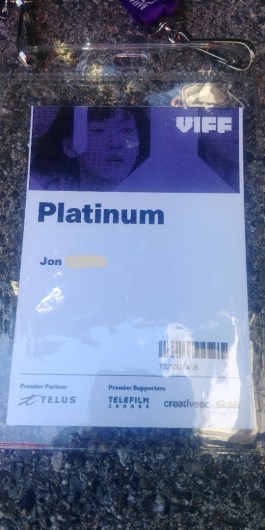
…and I won a VIFF Platinum Pass!
For those who didn’t know, I won a Platinum Pass on the day of the Oscars. How did it happen? The VanCity Theatre, the main venue for the VIFF, had their annual Oscar party and their Oscar Bingo Contest. How Oscar Bingo works is you fill out your predictions for all 24 categories on the bingo squares. Here’s how good my predictions were. I was the first to get a row. I soon got a second row, but that was it for minor prizes for me. At the end of the night, I got 21 out of 24 right. The Oscars were that predictable. Plus I took a gamble on guessing The Shape Of Water to win Best Picture, and it paid off! As the night ended, I found out one other person had 21 out of 24 right. We both won Platinum Passes! It was exciting as I would experience having a Platinum Pass for the first time.
As for the films I saw, here’s a list of them. I have the country of origin in brackets and an asterisk marking those that are their country’s official Best Foreign Language Film entry:
I’m happy with the choices I saw. Some I was able to choose well in advance while some I chose because of the time. Some I wanted to see I did. Some I wasn’t so lucky. Like Can You Ever Forgive Me? showed at the same time as Boy Erased. I can only choose one! However I did achieve my usual VIFF goals of seeing one shorts segment, one Canadian feature and one nation’s entry for the Best Foreign language Film Oscar. It was crazy juggling having my volunteer pass and my Platinum pass on the same chain. Often if I wanted to see a film, I’d use my Platinum Pass and I’d get any seat I wanted! That was the best thing about having a Platinum Pass.
The biggest thing I learned about having a Platinum Pass this year is that they’re best for people who have all sixteen days of the festival available. I see a lot of seniors with the Platinum Passes and they make good use out of it. They are the ones that can see five films in one day, if they have the tenacity to do so. I still had my jobs to attend to during the time so that really kept me from seeing a lot. Also volunteering kept me from seeing a lot too. I remember I told one of the VIFF supervisors during Oscar night “Even though I won, I still plan to volunteer.” It was a double-edged sword to do both volunteering and own a platinum pass as most of the time, you’re outside the action. If I ever pay $900 for a Platinum Pass in the future, it will be after I retire.
The VIFF isn’t all about big screen films. It also includes virtual reality films.
There were two things I attended as a volunteer that I could not attend for free via my Platinum Pass. That was the VIFF Immersed virtual reality exhibit and the VIFF AMP conference. If I wanted to attend it, I would have to pay full admission. Being a volunteer was a good experience in both cases. For virtual reality, I learned quite a lot about a new means of film making and animation. I’ll admit I haven’t caught onto the VR craze. I had my first experience with VR at the exhibit as volunteers were allow to try things out. It was nice to try two of the VR films; both films were made in BC. I also assisted in showing a VR exhibit to students from a Vancouver high school who were on a field trip. My shift was ending just as they were about to set the place up for ticketholders. As my shift ended, I tried a state-of-the-art animated VR show called Fire Escape. It was too technical for me to handle. It’s good that the VIFF have a virtual reality exhibit. One thing we shouldn’t forget is that VIFF focuses on all formats of film: not just feature-length. They also focus on writing in film and even music in film. It was a good experience to attend the VIFF AMP conference for the morning. I was given the duty to have musicians onstage sign waivers for VIFF promotional videos. I learned a lot from some of the musicians and producers and agents about the challenges of getting music promoted in your film as well as the worldwide promotion of music in general.
So overall I’d say it was an excellent VIFF and a unique experience this year. This was the first year I saw over twenty films! Next year’s VIFF is anticipated to be from September 26th to October 11th, 2019 and should also be a unique experience. No doubt I will be back to volunteer!
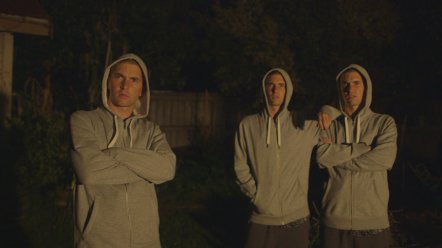
Anton Tennet plays a young man who uses multiplicity to form his own gang in Mega Time Squad.
Every year I do the Vancouver Film Festival, I make the effort to end my VIFF with the very last show. Once again, it was at 11:15pm at the Rio Theatre on Friday, October 12th. This year, it was the New Zealand thriller-comedy Mega Time Squad. It wasn’t the best film to end it with, but it wasn’t one of the worst.
John has a life that’s going nowhere. His parents are deceased. He lives in a garage in a town full of aged people. The only way he can make any kind of money is for working with a crime boss named Shelton who’s hired him with a lot of other dim bulbs.
Shelton gives John and another dim bulb named Gaz a mission. He wasn’t them to intercept a money drop at a Chinese antique store being dropped off by a rival Chinese gang led by a man named Wen. This turns out to be a bad idea as Gaz says he’s tired of being Shelton’s bitch. The heist is successful as they grab the money, but John gets a lot more. From the antique store, he grabs a Chinese bracelet. The store-owner tells him not to take the bracelet, claiming it has a mysticism that could be harmful. John ignores and takes it.
The crazy thing about the heist is that it has the Chinese gang and his own gang after John. John doesn’t know what to do until he discovers a time machine that can transport him back into time and avoid whatever trouble they’re facing. The machine also duplicates the user, so John uses it to get more than one John around. Eventually all the Johns meet up. The lead John declares his group of selves the ‘Mega Time Squad.’
The good thing is that John can accomplish what he misses the first time with his duplicate selves. The bad news is none are brighter than the original John. Plus with the charm bracelet, it could mean all the Johns would die off soon, including him. The various Johns are able to accomplish the heist, win a fight win over Wen, and fool people while the real John has won over the affection of Shelton’s younger sister Kelly. Eventually the actions of the various Johns catch up to the real one as Wen’s gang is after him and Shelton has a mission involving a bomb for him to do, which he eventually fails. Kelly learns of this and is turned off John.
However John has to do right. John is able to fix the curse so that all the other Johns are in a room. He reverses the curse of the bracelet and all the other Johns die with Kelly witnessing. Also Wen is able to get the bag of money John stole. Meanwhile an infuriated Shelton wants to see him. Shelton is about to shoot him for not doing his part right, but John confronts him and tells him he gives everyone the risky business while Shelton sits back and calls orders. Shelton tries to shoot john, but the bullet is shot in the reverse direction. RIP Shelton! All the gang members are free and John is free to love Kelly. As for Wen and the bag of money, that’s for you to see.
Here we go again where we see a New Zealand film that tries to be a thriller-comedy. I’ve seen it before many times at the VIFF with Housebound and Deathgasm. Housebound was the best-done of the three I’ve seen. Deathgasm was more focused on the humor and the gore than it was on the story, but still delivered on entertainment. Mega Time Squad gave me the feeling like I was watching the same thing over again. Also it didn’t compare to the other two as a story or in humor. There were a lot of times in which I felt the story was dumb or lacking in thrills. There was a lot missing.
One thing I will not do is declare this movie to be a disappointment. This film wasn’t the disappointment Housewife was. The acting was still good, if not great. The story was consistent and made sense. Even the foolishness or ridiculousness of the story or the idiocy of the characters didn’t come across as stupid or confusing. I will admit that this is the type of film that could simply be a made-for-TV film on a sci-fi network. However the film does deliver on a consistent story line that is fun, entertaining and humorous. It may be boring or lackluster in comparison, but it still entertains and will make you laugh.
I wouldn’t say this is an accomplishment for writer/director Tim Van Dammen, who ironically was an actor in Deathgasm. However I will say that it delivers in entertainment. Sure, some of it was idiotic, but it was able to pull itself together at the end and even deliver a humorous ending. Anton Tennet was funny as the loser-turned-winner John. Even some of his acting looked idiotic, but it was on for the most part. Hetty Gaskell-Hahn was the scene-stealer as Shayna. She was solid in her character and she helped make the film too. Yoson An was also good as a humorous villain who meets a surprise at the end.
Mega Time Squad offers nothing new for the thriller genre. I’ve seen it done before and done better. Nevertheless it will entertain you and get you laughing. It is a welcome relief after watching a lot of heavy, intense fare at the VIFF. And a good way to end the VIFF, if not end it with a bang.
And there you go! That sums it up for all the films I saw at the Vancouver Film Festival. I know it took longer than I should, but I saw a lot of movies and had little time to write. But I’m finally done now. My review of the Fest will be coming very shortly within a day or two.
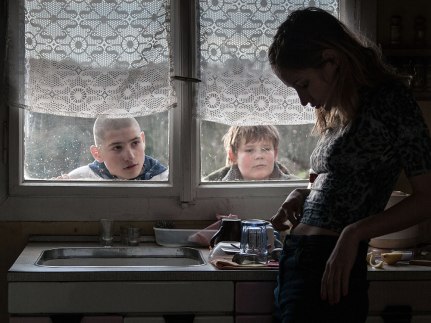
Winter Flies is the story of two Czech boys having fun braking the law.
“You’ve only got this time in your life to be young and stupid, so go for it!”
-my advise to young people
Winter Flies is the third of three entries in the Best Foreign Language Film category at the Oscars I saw at the VIFF. This Czech film is one that will surprise you.
The film starts on a winter’s day with a young boy carrying what appears to be a gun and wearing an outfit that makes him look like a bear. Turns out it’s a pellet gun. The boy’s name is Hedus. Soon an Audi arrives. It’s driven by a teenage boy with a shaved head named Mara. Despite the meeting together starting on a bad note, Mara decides to invite Hedus along.
The film then flashes to a police office. Mara has just been arrested for grand theft auto of that Audi. The female police officer, Officer Freiwaldova, is not impressed with Mara. He’s 15 and has a pregnant girlfriend back home, or at least he claims so. The film goes frequently from their ‘road trip’ to Mara being interrogated. They interrogate him about the trip and as well about the pink female sweater they found in the car.
Flashing back to the trip, Hedus drams of joining the French legion and asks Mara advise over girls. Mara acts like he knows it all, but soon they spot a girl on the road. She’s an older girl named Bara and looks like she’s abused. However she accepts a ride from the two as they don’t appear too threatening. During the trip, they stop at a park near a small lake. Hedus is having fun being up a tree and talking to Mara. Meanwhile a man is trying to sell them a dog. The boy laugh it off, only for the laughter to end when it appears the man is trying to drown the dog. They go to the rescue of the dog and Hedus even fires his pellet gun at the man. The dog is now theirs.
Back at the police office, Freiwaldova tries to get Mara to map out the trip, but he refuses and even hits on the Officer. Freiwaldova is frustrated with dealing with Mara. This is a long process as the Officer keeps on asking questions as she’s smoking cigarettes she puts in an ashtray with a fly in it. Continuing on the trip, the three come to a man who’s willing to give the three shelter for the night. They think it’s okay, and Bara sees no problem as long as she can protect herself. However things go wrong when they notice the man is about to rape her. That’s when Hedus and Mara act in and start acting violently to the man. They then take off again. However it’s soon where Hedus tries coming onto Bara. It’s there where she demands to be let out. So that’s all that’s left in the trip. The two boys, the dog and Bara’s pink perfume-scented sweater for them to masturbate over.
Overnight doesn’t seem to stop them. They learn they’re in a self-driving Audi as it can drive itself even while Mara is asleep at the wheel! In the morning, Mara learns they’re close to the town where his grandfather lives. However when they get to his house, Mara find his grandfather on the floor suffering from a heart attack. Mara, more concerned for anyone, gets his grandfather to a nearby hospital. Flashing back to the interrogation scenes, Freiwaldova is hoping to use this incident to find out more information about Mara. She calls the hospital to find out the name and tells Mara one of the men died last night. That makes Mara cry and confess information. It’s right after that where she admits she lied and says she did it to get any info out of him. No doubt Mara is pissed off.
Reflecting back to the trip, the Audi does eventually find itself caught by police in a small Czech town. It’s only a matter of time that the car is stopped and Mara is arrested. Hedus was nowhere to be seen. It’s the end of the road for Mara with him being at the police office, or is it? Hedus is outside the police office and the Audi is close outside. Hedus also found a ladder that reaches up to the office Mara is interrogated in. Hedus is sly enough to fire his pellet gun on all the police vehicles. That’s enough to distract all the officers and leave Mara alone in the office. Alone except for the fly in the ashtray coming back to life. Then Hedus climbs up the ladder and tries to get Hedus to escape. They’re back on the road again!
We should really hate those two jerks. One is stupid with an overactive imagination. The other is an irresponsible rebel with complete disrespect to just about everyone, including the police. We should also hate the two at the very end. However one critic made a point that I agreed with. They said the two make the rebellion and the irresponsibilities of adolescence look charming and even funny. I have to agree because that is the magic of art. It can take characters that we would look down on in the real world and make them look likable and even charming. We see that here as Mara does bring out the charm of the anti-authority jerk we really should hate. Hedus also brings out the charm of the weird boy with an over-the-top wild imagination. That was what the story is about in a nutshell: two adolescent misfits on a wild ride.
The film not only brings out the characters’ charms but may also remind us of our own adolescent ‘glory days.’ There are many scenes that were funny and hilarious, but would look terrible or disgusting in real life. Like when Mara is being a jerk to the officer, or when the two start hitting on Bara right after she was about to be raped the night before, or even when the two masturbate over Bara’s perfume-scented sweater. It’s a guilty pleasure to laugh at moments of stupidity like that because they will remind us of us and our own stupidities. I’m sure you remember the days you used to flip the tweeter to whoever you wanted! The film has other humorous moments as well like when the fly in the cigarette ashes appears to come back to life or when the two boys are able to sleep in the self-driving Audi with no problem. The latter should also be symbolic as it appears the two boys appear to be on a trip to nowhere. Maybe they don’t really care if they don’t have a destination, as long as they’re away. That’s another joy of being young: venturing into the unknown.
One thing to take note is that even though the two are characters of teens we should hate, Mara does show some vulnerability. One case is when a man is about to drown a dog. Mara gets Hedus to fire his pellet gun at the man while Mara goes to rescue the dog. Also that scene where Mara and Hedus are seen helping their grandfather who is having a heart attack. It sends you the message that Mara does have a heart, despite his rebellion and carelessness. Also that scene where Mara is crying when he thinks his grandfather has died shows he still has a child-like innocence in him that comes out when you least expect it. Those are scenes that bring out Mara’s redeeming qualities and make you actually like him and feel for him. He’s not the heartless jerk we’re first led to believe he is.
We should give a lot of respect to Slovenian-born director Olmo Omerzu and Petr Pycha. Who would’ve thought this was Pycha’s first ever feature-length script? Pycha’s story and Omerzu’s direction help make this film and its characters entertaining and charming in ways you least expect it. Tomas Mrvik was very good at the young protagonist Mara. This is Mrvik’s first film but he succeeds in making Mara hatable, but charming at the same time. Also acting for the first time is Jan Frantisek Uher. He did the idiocy of Hedus very well and surprised us all in showing Hedus is trickier than we thought. Lenka Vlasakova was excellent as Officer Freiwaldova. She did an excellent job in delivering the more dramatic parts and made them work for the film.
Winter Flies is the Czech Republic’s entry for this year’s Academy Awards for the Best Foreign Language Film category. The film was nominated for the Crystal Globe for Best Film at the Karlovy Vary Film Festival where Omerzu won Best Director. The film is also quite remarkable for including a lot of elements in a story of teenagers most teen films, especially those made by the Hollywood system, wouldn’t include. Stealing an Audi, allowing it to self-drive while asleep at the wheel, teen boys talking about getting ‘pussy,’ the two masturbating and climaxing in their pants, I doubt Hollywood would dare to make a teen-themed film with scenes like those!
Winter Flies is a humorous story. However the funniest thing about the film is that it makes likable characters out of two we should really hate!
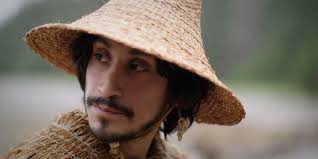
Tyler York plays a Haida man who’s inner monster overtakes him in Edge Of The Knife.
One of my goals each VIFF is to see a Canadian feature-length film. I had the good fortune when I went to see Edge Of The Knife. Not only is it a Canadian feature, but possibly the only feature-length film ever completely in the Haida language!
The film begins with the carving of a wooden mask and then burning it in a fire. The story begins with a meeting of two Haida families over at the Haida Gwaii in Northwestern BC in the 19th Century. It’s an annual fishing camp the families have together. Adiits’ii is the oldest son of and close to the family of Kwa and his son Gaas, who sees Adiits’ii as his mentor. Kwa’s wife Hlaaya finds his appetite for challenges to be too reckless for her son. However Adiits’ii often feels belittled by his own family. Sometimes Kwa makes him feel inferior.
In the evening, Adiits’ii decides to take Gaas onto the waters on boat. Overnight a storm hits the coast. The families fear the worst for Adiits’ii and Gaas. The next morning, the bad news. Gaas is found dead on the coast. Adiits’ii is missing and presumed dead. However Adiits’ii is still alive. He’s in a remote forested location and feels he can’t return because of the reactions from others he fears. Secluded, he becomes overtaken by a huge spirit. He transforms into a Gaagiid/Gaagiixiid — the legendary Haida Wildman — and his behaviors become feral and even demonic. The whole family searches for Adiits’ii. Kwa and his wife are first to discover Adiits’ii, but lashes out at him wanting to kill him. The wife tries to stop him, but that leads Kwa to speak out his belief of who he thinks Gaas’ true father is. The families work to get Adiits’ii captured before they can free him from his possession. They set up a trap and they succeed. It’s at a ritualistic ceremony that involves prayer and piercing of the chest that they have to free Adiits’ii from the possession of the Gaagiixiid. The film ends with Adiits’ii carving out a mask out of wood, the very mask seen at the beginning, and burning it. At the end, we notice it’s in the image of how Adiits’ii was when possessed by the Gaagiixiid.
As far as film quality goes, this is a film I’d call great, but not excellent. The story is very good as it focuses on physical actions and unspoken feelings. However I have seen Canadian films with better dialogue and better story lines. Culturally, this is an excellent film as it captures the Haida culture and the Haida language without any interruption of the English language. Also it captures Haida mythology with excellence. It introduces us to the Gaagiixid. I am not familiar with Haida culture at all, but the film gives me a good understanding about the mythological belief of other beings. We should remember that Adiits’ii is a person with personal demons. He feels like the misfit and he feels like he’s belittled. Although he doesn’t say it, it’s obvious. After the accidental death of Gaas, it’s his guilt that gets the best of him and runs away. It’s there when he turns into the Gaagiixid. I believe the Gaagiixid is all about his personal demons and bad self-image. He had to conquer the Gaagiixid inside of him to truly come to peace with who he is and what he did.
SPOILER WARNING – Ending Revealed In This Paragraph: The film begins with the scene of a mask being carved of wood and then burned in a fire. At first one would wonder why would a person burn a mask that was just carved? Then it’s repeated at the end. At the end, you see that the mask is the image Adiits’ii had as he was fighting his inner demon. Then as you see it burn again, you see why. It’s like the final step in ending the demon inside. That scene is a good interpretation of Haida culture and Haida mythology.
This is an accomplishment of a film as far as culture goes. First off, this is a film done by not one, but two First Nations directors: Gwaii Edenshaw and Helen Haig-Brown. Secondly, this is a film done completely in the Haida language. This is a film that is essential for the language. At first, Haida was the only language the people spoke. However with the happenings of past history and with modernization, there are only twenty fluent Haida-speakers left. Even though there is educating young people inn the Haida language or even a resurgence of bringing back the language, the struggle is still there. This film does an excellent job in displaying the language and the culture of the Haida people. The idea of the film came back in 2011 by University professor Leonie Sandercock. In making the film, those involved received a Partnership Development Grant of $200,000 from the Social Sciences and Humanities Research Council, so even arts funds knew of the importance of this film to be made. Also to create a time before European settlers arrived really involved a lot of effort.
Also the film has been widely welcomed and celebrated by the Haida peoples and other First Nations peoples of BC. I remember a couple of times during the VIFF, I was waiting to see a film after Edge Of The Knife over at the theatre I was to attend. Each time I was in line, I was given the news that there would be a 30-40 minute delay of the start of my film. As Edge Of The Knife finished, I saw more than just people exiting. I saw some dressed in traditional First Nations costume. Some even brought drums and performed a song of celebration. When I saw that, I felt I had to see Edge Of The Knife when I had the chance. This was more than just something. I’m glad I did.
Gwaii Edenshaw and Helen Haig-Brown did an excellent job in directing and creating a world far back in the past and appear authentic. The script by Gwaai and Jaalen Edenshaw, Graham Richard and Sandercock was not too intense in terms of dialogue, but it does present a very good story that’s more about emotions and image-based. Tyler York did a very good job as Adiits’ii. His acting was more about what was inside of him rather than what he said. Willy Russ almost stole the show as Kwa. The actors involved are more of a Haida community rather than actors by profession. All did a very good job. The film was light on special effects, but the effects fit the film and the scenes right. It didn’t need more effects than necessary.
Edge Of The Knife may not be the best Canadian film I’ve seen or even the best of subject of First Nations peoples. However this is a very culturally-important film that deserves to be shown. It also tells its story in both an entertaining and mesmerizing way. Definitely worth seeing.
Some of you are wondering when will I finish with my blogs about the VIFF? This is my fourth-last review. The end is coming very soon.
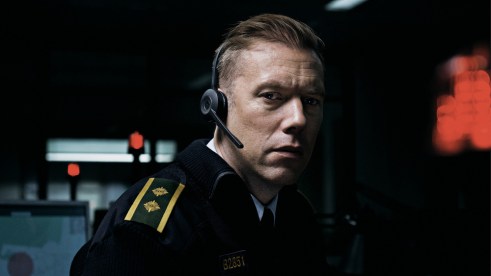
The Guilty is a unique drama which centres on the officer (played by Jakob Cedergren) and the voices he hears through his headset.
I usually like film that delivers the unexpected. That’s the best thing about the VIFF. The Guilty is a Danish film that delivers on surprises in the best way.
The film begins with Asger Holm operating the emergency call system at the Copenhagen police department. He has his call technology with him which includes the computerized phone system and a monitor consisting of a map mapping out the geographical range of the cellphone calls he receives. His calls are mostly mundane as it’s an evening and of situations that aren’t so violent and more cases of stupidity. Asger also receives the occasional phone calls from his lawyer. Cellphone calls on his personal line are not allowed during his job.
Soon there’s a call he receives that causes him concerned. It’s of a woman named Iben. She first tries to hit on Asger, but we soon learn she’s in the back of an SUV driven by Michael, her ex-husband. The monitor shows her travelling close to the Sjaeland area but there’s no knowledge what the car looks like or the license place. Asger tells police along the route to look out for a white van, which no one finds. Asger researches her ex-husband’s name and finds out he’s a convicted felon. On top of that, Iben has two small children she misses a lot.
We should keep in mind Asger is nearing the end of his shift, and must transfer whatever feedback to the next person who will be working the shifts. Nevertheless Asger sticks to it. Asger sends police to the house to tend to the small children while he tries to get police to chase the van. Asger receives a phone call from the police who visited the house. The police found the daughter with blood all over her but no wound. However they found the infant son dead with stab wounds all over him. Asger is convinced that Michael committed the murder. Asger learns the van has stopped and tells Iben to get something where she can hit Michael on the head as part of an escape. She does so. When Michael calls in about being hit on the head, Asger lashes out at him and hangs up.
Now that Iben has escaped, it’s a matter of keeping her in a single location until the police arrive. Meanwhile Asger receives distracting phone calls from his lawyer about his trial for tomorrow. Asger will go on trial for the wrongful shooting death of a 19 year-old. Right while Asger is keeping Iben on the line, he learns a shocking result. Iben thought there were snakes inside her infant son. So she took a knife and stabbed him to cut them loose. Asger now has more to deal with. He first has to let his fellow police know of the shocking turn of events. He also has to deal with Michael and reassure him that he now accuses him of nothing and to stay calm. Also Iben now wants to jump into the coast water, now realizing the terrible thing she did. Asger reassures him and keeps her calm. Asger even tells her about the wrong he is about to face the music about. It works as Asger is able to keep Iben on the line and for police to come to her. The ordeal finally ended on the right note as Asger walks off.
This is more than just a detective story. This is a film that allows us to be the judge and jury of the whole action too. All we have is Asger on the phone, the police computer screens and those on the phone Asger converses with. The story is successful in giving us a scenario where we all think a common thing and make common assumptions: that Iben is abducted by her ex-husband, that Michael murdered his infant son, that Michael will murder Iben next. However it’s right in the middle that we are reminded that what we think we know is not the true story. I even remember hear gasps or reactions of shock in the audience when it was made clear that Iben killed her infant son. That is the top quality of the story. With it being in one location and consisting of telephone conversations adding to the story, it allows us to confront what we thought we knew and shock us with the truth that we don’t see, but hear. Also the cellphone conversations to Asger along the side appear to be distractions to the story at first, but later prove vital in telling the story about Asger. It too gives us our own thoughts at the beginning, but later reveals a truth we didn’t know.
I have seen a lot of single-location films before. However I thought for the longest time that it would be next to impossible to do a single-location feature-length film. This film proved me wrong. It may have switched rooms on occasion, but it kept the story within the same building and was able to use it with the use of cellphones or computer terminals. The phone conversations that deliver the unseen drama work to the quality of the film and help make the story. I know I said the film’s gift is working with what we don’t know or what we assume at first. Everything in which the film did helped make the story work for us and kept us glued to our seat.
The story is not only about what happens through the phone conversations. The story is also about Asger Holm. When the film begins, we first think it’s about an officer assisting on an emergency line at the police station and that the story is mostly about Iben. Later on we learn the story is also about Asger. We are led to believe that emergency operator is his assigned job. We often wonder why Asger won’t leave the crime situation to others, even after he’s told his shift is over. We wonder if he cares about being fired. It’s later we learn that Asger has a blemish too. The following day, Asger will need to go on trial for the shooting death of a 19 year-old. We soon understand his phone operations are not his job. It’s because he has been demoted since the shooting incident. As for continuing with dealing with Iben, it appears more than just sticking to it and doing the right thing despite the risks to his job. I think he knows this day will be his last day of any kind of police work and that may be the additional reason why he’s doing it. He know that his career will end with a blemish and I believe he wants his last act of police work to be a job of dignity. At the end of the film, he is not acknowledged at all by his co-workers and walks off. Nevertheless we in the audience know the excellent work he did. It is quite something how a policeman about to face trial becomes the one who prevents Iben from committing suicide and puts her in the right hands.
This film is an excellent work by Gustav Moller. This is actually Moller’s first-ever feature length film with only brief experience doing a short and two television episodes. This film he directs and co-writes with Emil Nygaard Albertsen who’s also mostly known for work in TV and shorts really delivers on the story and is excellent pieced together. The story becomes like a puzzle that needs to be pieced together piece-by-piece and it succeeds greatly in piecing it all together. Also excellent is the acting from Jakob Cedergren. The story is him, the computers and the phone calls he receives. Being the one who centres on the crime story as well as other stories that surround him through outside cellphone calls, he makes the story work and makes it interesting. He helps us focus on the situation and makes what could be a boring story interesting, thrilling and even thought-provoking. Also excellent was the acting of Jessica Dinnage. There’s no physical acting here. The only acting we have of Jessica is her voice through her cellphone calls. Nevertheless her voice-acting was perfect in both telling the story and in embodying the character. Her voice over the phone and the things Iben said really made the unexpected drama happen.
The Guilty is Denmark’s entry in the Academy Awards for Best Foreign-Language Film. The film won the Audience Awards at Sundance as well as a nominee for the Grand Jury Prize. The film has also won a wide variety of awards at other film festivals such as the Critics Choice Award at the Zurich Film Fest, the Special Circle Jury award at the Washington DC Film Fest, the IFFR Audience Award at the Rotterdam Film Fest and the World Cinema Winner at the Montclair Film Fest.
The Guilty is a remarkable film. Not just because of how it’s filmed on a single location, but also because of how it reminds us what we think is not what’s fact. Definitely an unforgettable eighty-five minutes.
One of my goals at the VIFF is to see at least one film which is a nation’s entry into the Academy Awards for the Best Foreign Language Film category. The first of three I saw during the VIFF was Burning from South Korea.
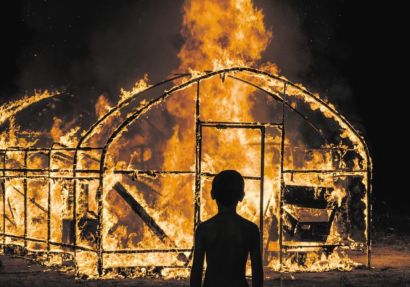
The film begins with Lee Jong-su performing odd jobs in Paju. One day he runs into a former neighbor and classmate from his childhood. Her name is Shin Mae-hi. Mae-hi confesses to Jong-su that she always liked him but he always ignored her. Could it be because he was a farmer’s son and she was more urban? At the date later on, Mae-hi tells Jong-su that she has pursued an acting career. She’s disappointed to see that Jong-su hasn’t pursued a career in writing as he wanted to do in college.
The romance sparks up so high, they have sex in her apartment. She lets Jong-su know she will have an acting gig in Nairobi very soon and she wants him to feed her cat. He agrees. Jong-su never sees the cat, but always sees the food gone and the litterbox used. Also when he’s at her place, he masturbates in her bedroom. Mae-hi returns, but three days later than expected because of a terror warning. Mae-hi also returns with a Korean man named Ben: a man she bonded with during the crisis. The three have dinner together. Mae-hi recalls a sunset she saw during the trip. She cries, confessing she wanted to disappear. Ben doesn’t understand why people cry and admits he never cried himself.
Jong-su has things to take care of back home. He has to look after the family house and farm as his father is awaiting trial. Jong-su often watches the relationship with Mae-hi and Ben from afar with envy. However he’s suspicious of Ben. Ben is confident, but doesn’t mention what he does for a living. Jong-su pays a visit to Ben’s place and notices an area where there is a lot of women’s jewelry and decorations in the bathroom. Jong-su later joins the couple in a restaurant. There Mae-hi shows them the dance she learned in Nairobi. Jong-su likes what he sees, but he notices Ben is unamused.
The trio then go to Jong-su’s farm where they find themselves getting high and Hae-mi dancing topless. Hae-mi recalls a memory where Jong-su rescues her from a well. After Hae-mi falls asleep on a sofa, Ben makes a confession to Jong-su that he like to burn an abandoned greenhouse every two months. He notes his area is full of greenhouses. Ben claims the next burning will be close to Jong-su’s house. Ben also tells Jong-su that Hae-mi considers him her best friend. But as she awakens from her drunkenness, Jong-su calls her a whore as they leave.
Jong-su takes this to heart as he is careful over the neighborhood to spot out of any gas houses are burned down. None are, but he receives something even more disturbing. He received a phone call from Hae-mi one night that cut out after that cut off after a few seconds of ambiguous noises. The concern grows as Jong-su makes call after call to Hae-mi with no response. He goes to her apartment which is surprisingly clean and shows no sign of the cat. Jong-su contact’s Hae-mi’s family, but they say they haven’t heard from her in some time and she owes them a lot of money. Even Ben makes claim of Hae-mi not returning calls as Jong-su approaches him.
Suspicious of it all, Jong-su starts stalking Ben. Ben is unaware that Jong-su is stalking him, but treats Jong-su with friendliness. Ben even introduces Jung-su to his new girlfriend and even says they have a new cat. As Jong-su makes his way to the bathroom, he sees the watch he gave Hae-mi. Looks like the truth about Ben and what happened to Hae-mi came out. It’s just after Jong-su’s father has been sentenced that we get the final act of the drama.
The film is a quiet mystery. I call it quiet because there is little if any score. The film quietly lets the events unravel as they happen. It lets the facts quietly but surely become clearer over time. We learn more about what happened to Mae-hi. Mae-hi may be very free as is expected of an artistic person, but no sign of her for a long time does rise to suspicion. We soon learn more about Ben. He comes across cool and confident and the type of person who wouldn’t hurt anyone, but it’s Jong-su who sees Ben’s true colors. We also learn more about Jong-su. Jong-su comes off as an awkward son of a temperamental farmer undecided about his dreams. Jong-su comes as the type of person too awkward to do anything seriously violent, but as truths unfold, the monster inside him comes out. The story comes just as his father is sentenced for his violent actions, Jong-su becomes judge, jury, and executioner on Ben. Having all this happen in a film with no score or any other cinematic gimmicks works well for the film. I think something like a musical score may have hurt the drama.
In addition, the film answers more with what we don’t see than what we see. The value of the unseen is first given credit involving the scenes of tending to Hae-mi’s unseen cat. We never see the cat and neither does Jong-su, but the food is eaten and the litterbox is used. The unseen is key for resolving the mystery of Ben. The unseen is where Ben acquired all the female jewelry and decorations. He talks of his ‘hobby’ of burning gashouses down. However it becomes more obvious about what these burning are. And it took the piece of Hae-mi’s jewelry just after Hae-mi goes missing to get the sense that Ben is a killer, and the burnings is a secret word for murder. It’s at the end that the burnt gashouse ends up being Ben’s car with a fatally-wounded Ben inside.
Top credits go to Lee Chang-dong. Lee has had an impressive film making career in South Korea. However it was 2003’s Oasis where he won the Best Director award at the Venice Film festival that he first caught international notice as well as the Chief Dan George Humanitarian Award at VIFF 2003. Poetry took his career to a new height after he won the Best Director Award at the Cannes Film Festival in 2010. This film in which he directs and co-wrote the script with Oh Jung-mi is an excellent work of its own. It won the FIPRESCI Prize at this year’s Cannes Film Fest. Awards aside, the film does keep one intrigued. The story doesn’t make a lot of sense at first, but the drama slowly builds over time. Yoo Ah-In does a very good job as Jong-su. He does a great job of playing a character who first seems harmless, but has a monster inside of him. Steven Yeun, a Korean émigré to the United States, does a good job as playing a character cool and calm, but has a dark secret. Jeon Jong-seo is also very good as the free-spirited Hae-mi.
Burning is a suspense that starts quiet but slowly builds over time. Its quiet drama is its best asset and adds to the film.
A young Indonesian girl uses myth and spirituality to deal with her dying twin brother in The Seen And The Unseen.
At film festivals, you often see a lot of cutting edge film. Very rarely do you see a film that’s family-friendly. The Seen And The Unseen is a film that should rightfully called family-friendly.
The film begins with a young Indonesian boy named Tantra being brought into a hospital bed. The mother is hurt. However the twin sister Tantri is naive and doesn’t know what’s really happening. You can tell by how she breaks the egg in her hand that it’s very serious. A flashback shows how the two were in more playful times.
The family live on a farm and the hospital Tantra is staying at is in the city. Unknown to her mother, Tantri takes trips to visit Tantra. She brings puppets, eggs, plants and a musical instrument. One day Tantra does a shadow-puppet show for Tantri where he tells of his illness. She returns to the hospital to play games, sing, dance and dress up in traditional costume. They even share time where they dress up as birds.
However the mother notices it and she’s not happy. Even though she understands, she advises Tantri not to do it anymore. Nevertheless Tantri feels the spirits of her brother in the farm fields. She even feels her own spirits in the animals and in the sky. Then the news comes. Tantra’s cancer is getting worse. She spends as much time as she can with him whether it’s in the hospital or in the dream world. In the dream world, he’s alive and well and active. Even as she goes with her parents with a temple crowded by monkeys, she can feel his spirit. Even as his death eventually comes.
The thing of the film is that it takes a stressful situation like a child sick and dying and it incorporates Balinese culture as a way to escape. Tantri is the twin of Tantra so of course she has a strong with him. The culture incorporated in the film is very much rooted in images of monkeys and birds. When he’s sick with a potentially fatal illness, she goes to elements of the Balinese culture to play with him and communicate with him. She even uses the elements to get into her own spirits. However for Tantra, the more serious and debilitating his illness gets, the more his imagination flies. It becomes evident that there’ something in the unseen. The mother doesn’t see it. I guess that was the point; a world seen only by the two children.
The culture in the film is also central in the relationship between two twins. It is there where in Tantri’s dreams, the two can act out their stories, or where they can become the spirits of animals. They share songs, dances, dress in animal costumes and play games. The two have a balance together. When Tantra is nearing death, Tantri senses something in his spirit. It’s this world of culture and animal imagery that help Tantri in dealing with her brother’s looming death.
If I have one complaint, it’s the ending. I felt like the ending was too brief. All the events led from his admission to the hospital up to his death. I was anticipating something post mortem whether it be Tantra’s spirit in the form of animals or imagery. It was not to be. I assume it was the director’s choice for the ending to be that way. However I felt it did take away from the film.
Top credits go to writer/director Kamila Andini. Childhood is an essential part of her filmmaking as she also wrote and directed The Mirror Never Lies. I know the subject of a child dying makes for something that would be tricky to make watchable, but Andini creates something beautiful. Through the imagery, the looming death of Tantra doesn’t look so harsh. The film even has spiritual elements and the focus of the soul living on. I admire Andini for having those elements in the film. In terms of acting, top credits go to Thaly Titi Kasih. She was the protagonist in the film and she did a very good job without getting manipulative or overbearing in emotions. Even though she’s the sister in between this, she’s not trying to be manipulative. Also goo din the film is Ida Mahijasena as the brother whose spirit comes alive at night when the body is fastly dying.
The film has won the Best Feature Award at the Adelaide Film Festival and won the Generation KPlus Award at the Berlin Festival. It was also a nominee for the Platform Prize at the Toronto Film Festival. The VIFF doesn’t have any special awards for family-related films. Here’s hoping in the future.
The Seen And The Unseen is a film that wouldn’t normally get children too interested, but it’s a beautiful film. One could even describe it as ‘spiritual.’ However it’s definitely cultural.
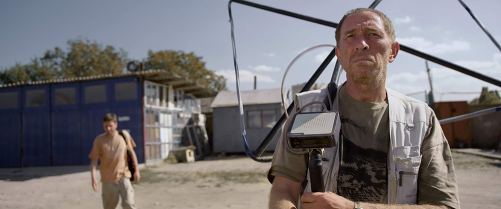
I took an interest in seeing Volcano knowing that it was to be the one feature-length film at the VIFF from Ukraine. I was left with a big surprise with what I saw.
The story begins in Southern Ukraine as Lukas is hired by the OSCE to be an interpreter during the Crimean conflict. Instead of soldiers or diplomats to transport, he has three people in the fashion business. As he tries to fill up with gas, he is out of coverage. He tries to get a cab for the three, only to find them gone. Lukas boards a bus, but it breaks down in a remote area. He stays over at a youth home and is beset by teens who only care about drinking and partying. He just leaves for a moment, but he left his wallet, passport and jacket inside the place. They won’t allow him in.
He finds help in a place he least expects. A failed inventor named Vovo who lives with his mother and daughter Marushka. It’s good for one night, but he feels one night is enough. After that, he wants to move onto his mission. Besides Vovo is too eccentric. The next day, he finds himself in a violent conflict with local militia men, a mass brawl culminating in a fireworks display, and being attacked by men for no reason with him ending up in a dug-out pit in a dead sunflower field.
The only person to discover him is Vovo. Vovo gives him some good advice “It is total anarchy. If you get used to it, you will survive.” During the time, he learns Vovo’s way of doing things, even if it seems off. Lukas even helps with some of the metal scavenging that Vovo seeks out in both land and sea. Occasionally Lukas gets reminders from the news of the conflict and that there’s a nationwide search for him. To take a break from it all, Vovo, Mama, Lukas and Marushka go to a one-man circus show, but it does include flashes of reality. The show includes saluting the new young soldiers in the war and a performance by a choir of woman from a village that was flooded to make way for a hydro-electric dam.
It’s not to say that it has its own difficulties. Vovo gets in conflict with his mother about his ambitions. Also Marushka flirts with Lukas, unknowing that he’s married. However Lukas confesses about the crossroads he’s going through in his life and questions his life, love and ambitions.
Without a doubt, the film is very bizarre. This is something I was not expecting to see at first. It does seem odd for a film of a man who gets separated from OSCE bureaucrats in the middle of southern Ukraine, loses the car with people he was to taxi, goes from place to place and every wrong thing happens, only have the one place he can call a shelter being the home of an eccentric metal scavenger. The story is very entertaining and even humorous. It becomes ironic how an eccentric man becomes the best person for Lukas to be with in this hard time. It does however touch on some serious elements, like when Lukas is dealing with the life he’s supposed to be leading and even dealing with whether he truly loves his wife. Being completely away from it all does get one thinking deeply about the things in one’s life. Here it made Lukas think. It’s an intriguing story of how a young man becomes found while lost, and in the most unlikely place.
Throughout the film, there are a lot a scenes related to the Crimea conflict. First off, there’s Lukas acting as an interpreter for the OSCE. The television at Vovo’s household constantly gives stories of the ongoing conflict. There’s also the television showing Putin talking of how Ukraine is a part of Russia (of which I gave the finger to). There’s also the event of the one-man circus where they later hold an event saluting the latest young soldiers for Ukraine. I think the message Roman Bondarchuk is trying to say in the film is that even though Ukraine has a lot of areas that are unruly and anarchic, it is still worth defending.
This is a unique film for Roman Bondarchuk. This film he directs and co-writes with Darya Averchenko and Alla Tyutyunnik is a bit of a drama and a comedy into one. A bizarre situation of how one becomes found when lost. This is his first feature-length film that isn’t a documentary. It’s not that huge on actions or thick on dialogue, but the scenes he has tells a lot about the story and about Ukraine. This is also a debut for actor Serhiy Stepansky. Stepansky has actually had more experience as a sound mixer. Here he gives a good performance of a person who’s quiet, thinks a lot, but colorful in character. Viktor Zhdanov was a good show-stealer as the eccentric inventor Vovo. Khrystyna Deilyk was also a good attention-stealer as the flirtatious Marushka.
Volcano has already won top film awards like the Golden Apricot at the Yerevan Film Festival and the Grand Prix at the Split Film Festival. It has also been nominated for Best Film at festivals of Sao Paulo, Karlovy Vary and Athens.
Volcano may seem like a slow film that doesn’t seem like it makes a lot of sense, but you’ll come to understand it later after you leave the theatre.


 WEST: CALGARY STAMPEDERS
 EAST: OTTAWA REDBLACKS



 I took an interest in seeing Volcano knowing that it was to be the one feature-length film at the VIFF from Ukraine. I was left with a big surprise with what I saw.
 Jon The Blogcentric