It’s something how after eight years, the Women’s World Cup goes from a tournament of 24 teams to a tournament of 32 teams! So how exactly do they split the 32 berths among the continents? Here’s a breakdown:
- AFC (Asia and Australia): 5 + host Australia
- CAF (Africa): 4
- CONCACAF (North America): 4
- CONMEBOL (South America): 3
- OFC (Oceania): 0+ host New Zealand
- UEFA (Europe): 11
- Inter-confederation playoff berths: 3
Now the inter-confederation play-offs are interesting. Most men’s inter-confederation playoffs consist of a single game between two teams. For the women, the three berths were to be decided between groups of three or four! it was a mix of teams from all six confederations. Teams were usually those who missed the direct qualifying berths but were given chances by their placing in tournaments or through a repechage tournament or in the OFC’s case, the tournament winners. Teams were divided into three groups and all played matches in February for the last team standing in each group. Here are the groups with qualifiers bolded:
- Cameroon, Thailand, Portugal
- Senegal, Haiti, Chile
- Chinese Taipei, Paraguay, Papua New Guinea, Panama
What can I say? Deciding the other 30 qualifiers wasn’t easy. And now it’s leading up to World Cup play which is already known to be crazy enough. My next Group of focus is Group C. Four nations from four continents:

-Spain (6): The men of Spain have often been referred to as “Football’s Greatest Underachievers.” Spain’s women have shown their prowess in recent years, even been in the World Top 10 for the first time ever in 2021, but they are looking for their first tournament performance to show the world what they’re capable of. This Women’s World Cup will actually only be the third-ever for La Roja. First in Canada 2015 and the second in France 2019 where they made the Round of 16. They’ve competed in the last three Women’s Euros but have only made it as far as the quarterfinals all three times. 2022 was a case where two of their best players were injured and out. They did finish second in this year’s Cup Of Nations.
In recent years, as Spain has improved, there have been troubles with the team. The most notable has been a labor dispute within the past twelve months. The last while has seen a lot of labor disputes involving Women’s football team which I will focus on in a later blog. In terms of Spain, the team wanted improvements after their disappointment at Euro 2022. The women brought up they wanted a higher level of training, less authoritarian manner from the head coach and took their concerns to the head of the President of the Royal Spanish Football Federation (RFEF). In September 2022, fifteen players who would come to be known as “Las 15” sent and email to the RFEF speaking their concerns and their withdrawal from the national team. The RFEF leaked the letters hoping the women would cave in and return, but all hell broke loose, including Coach Vilda playing innocent and English player Lucy Bronze showing support for Las 15 in a social media picture. The months continued with disputes but there would be talks with the team member by April 2023. As of now, not all of Las 15 have returned to the national team. It’s unclear how many exactly have returned.
Since 2022 Spain have won all but four of their games, drawing once and losing three times. Notable wins include China, Denmark, United States and Japan. Their one draw was 1-1 against Sweden and their losses came to England, Germany and Australia. This Women’s World Cup is a new chance for Spain to prove itself and the team’s ability to play well.

-Costa Rica (36): This is only the second time Las Ticas will perform at the Women’s World Cup. Nevertheless their previous appearance at Canada 2015 showed them delivering a brave performance of drawing against Spain and South Korea before losing to Brazil. The women’s team have delivered impressive results in the past such as twice bronze medalists at the Pan American Games, five-time semifinalists at the CONCACAF Women’s Championship and even runners-up in 2014, and twice medalists at the Central American and Caribbean Games.
The team is coached by Costa Rican Amelia Valverde. Most of the players play for teams in the Costa Rica Women’s Premier Division and three who play for the US’s NWSL. Since 2022, the team has more losses than wins and draws combined. They’ve won against the Philippines, Trinidad and Panama, drawn against Colombia and Mexico, and their losses have included USA, Canada, Netherland, Portugal and Nigeria. The Women’s World Cup is another chance for the team to prove how good they are. They could just surprise again.
-Zambia (77): Zambia comes as the low expectations team. Of all the 32 teams here in Australia/New Zealand 2023, they have the lowest FIFA ranking of all with 77th. This is the Copper Queens’ first-ever Women’s World Cup, but their talent has been starting to catch notice in the football world in the last four years with playing in the 2020 Summer Olympics and finishing third in last year’s Africa Cup. Their finish in the Cup is what made them qualify.
Most of the players play for teams in the division of the Zambia Premier League and most are under 25 years of age. Since 2022, Zambia has had notable losses to Colombia, South Korea and Ireland and draws to Senegal and Switzerland. Most of their wins have been to African teams, but they’ve also achieved wins against Uzbekistan and North Macedonia. Most recently, they achieved a surprise 3-2 victory over Germany, who are ranked second in the World! Pele always said football is a box of surprises. The 270 minutes of group play can be a chance for Zambia to deliver more big surprises. Especially for the world!

-Japan (11): Japan have been part of the Women’s World Cup since it all started in 1991. The Nadeshiko peaked in 2011 when they won the Cup against the US in a penalty shootout. They had continued success shortly after winning the 2012 Olympic silver medal and WWC finalists again in 2015. Since then, the team has had a bit of a struggle. They didn’t qualify for the 2016 Olympics, finished in the Round of 16 in France 2019 and only got as far as the quarterfinals during the 2020 Olympics. They even lost out in the 2022 semifinals of the Women’s Asian Cup after winning it the two previous times. They have shown improvement as they finished second in this year’s SheBelieves Cup.
The team is coached by Futoshi Ikeda who has coached two Japanese age-group national teams and named senior team coach in 2021. Most of the team plays for teams with Japan’s WE League. Since 2022, they’ve had wins against Serbia, South Korea, New Zealand, Canada and Portugal. They also had a draw against China and losses to the US, Brazil, England and Spain. The 2023 Women’s World Cup is an opportunity for Japan to make a comeback among the best in the World.
My Prediction: Here it comes again. Just when you think you know the two will qualify, there’s always the chance for surprises. I predict the two qualifiers to be Spain and Japan.
And there you go. That takes care of my review of Group C for Australia/New Zealand 2023. At first I didn’t think I’d find the time to do these blogs, but I’m getting more confident now!

 -Poland (10)- Poland has a football success that usually is strong one quadrennial, weak another. This time around, it looks like Poland has its strongest team in decades. They topped their World Cup qualification en route to Russia. They’ve even produced a superstar in Bayern Munich striker Robert Lewandowski.
 -Senegal (28)- 2002 seems like a memory. It was Senegal’s first World Cup and they surprised defending champions France in the opening game of that World Cup and en route to going to the quarterfinals. They’ve failed to return to the World Cup scene until now. They hope to show the world they still have what it takes.
 -Colombia (16)- This appears to be a new era in Colombian football. They first had a chance in the 90’s to make a name for themselves at the World Cup, but poor performances marred by political strife in their country prevented that from happening. Then they made a return to the World Cup scene in 2014. There they made it to the quarterfinals for the first time ever. On top of that, striker James Rodriguez won the Golden Boot for scoring six goals.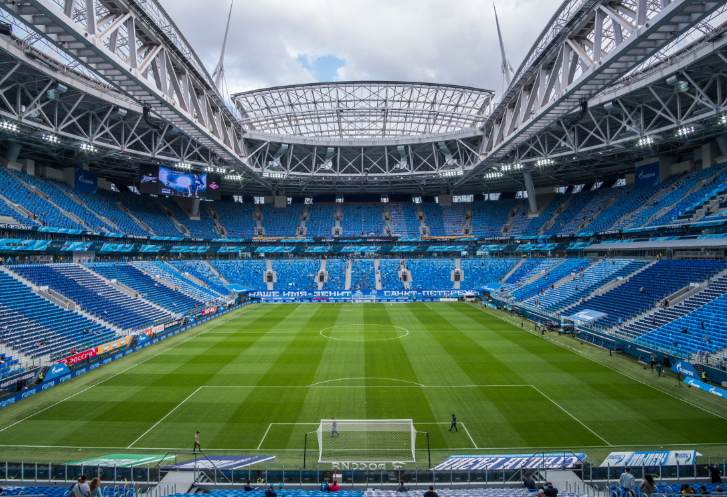

 The stadium has had three renovations in the past. The most recent being before the Confederations Cup in preparation for the World Cup. World Cup renovations include a demolishing of the old stadium to have a new stadium with enclosure. The self-supported wall and facade of Lenin Stadium was maintained. New construction allowed the stadium to be connected to a main building. After the World Cup, the stadium will be the host venue for the Russian national team.
 Jon The Blogcentric