World Cup 2014 Preview: Group E

Group E consists of four teams that have a lot of strengths but also have weak sides that are very noticeable. But even though Group E isn’t a ‘Group Of Death,’ don’t count them out completely. Here’s my rundown of the Group E teams:

Switzerland-Switzerland (8)- It’s a surprise to see Switzerland among the seeded teams during FIFA’s World Cup draw back in December. Sure Switzerland was in FIFA’s Top 8 but traditionally Switzerland was never a football powerhouse. Switzerland has been to the World Cup nine times and have gone past the First Round five of those times. However they’ve never gone any further, not even when they hosted back in 1954. Nevertheless Switzerland has been playing very impressively lately. They especially did well in World Cup qualifying, taking their qualifying group in seven wins and three draws. Of the eighteen games they’ve played in the last year, they only lost one game and that was to South Korea. They’ve also proven themselves further by winning against Brazil in a game and tying Croatia. Chances are Brazil could be the stage for Switzerland’s best World Cup performance ever.

Ecuador-Ecuador (28)- Ecuador isn’t one of the more celebrated South American countries in football but it does have the ability to surprise many. Ecuador was able to finish second in the Group Stage back in 2006 and advance to the Round of 16 for the first time ever in only their second World Cup. Ecuador however has struggled at the Copa America and has not gone past Round 1 ever in this century. Ecuador did however have a setback last year when one of their best players Christian ‘Chucho’ Benitez died of a heart attack last year at 27. It was a struggle for the team as they saw him not only as a key player but as a friend. Ecuador did qualify for the World Cup finishing fourth in the South American qualifying pool. Ecuador’s play records include recent wins against Chile, Colombia, Uruguay and a tie against the Netherlands. This World Cup will define Ecuador even further.

France fixed-France (16)- If anyone were to answer who the seeded team of this group was in the draw, I’m sure they’d most likely pick France. With good reason: winners in 1998 and finalists in 2006. However France has a reputation of being an ‘all or nothing’ team as of late. In fact if you remember the 2010 World Cup, you may remember France had a terribly disappointing time that even cause the president of the French Football Federation to resign even before their last game in Group Stage. Since then, France has worked on rebuilding itself. They’ve done better but it didn’t come without difficulties. France lost to eventual winners Spain in the quarterfinals of Euro 2012. That led to the new coach being fired after just two years and being replaced by Didier Deschamps, captain of the World Cup-winning 1998 squad. France has had an up-and-down time in terms of play. For World Cup qualifying, the team finished second to defending World Cup holders Spain in their group and were delegated to a repechage round in which they were paired up against Ukraine. They first thought it would be easy since Ukraine has never won against France in their seven matches. This would be a surprise to France as Ukraine won their first repechage match 2-0 and would be Ukraine’s first win over France. France knew they would have to give Ukraine a hell of a game in the second match to qualify and a hell of a game is what they delivered, winning 3-0 and qualifying. Recent friendly play has been less stressful on France as they’ve beaten Netherlands 2-0 and Norway 4-0. However they’ve also lost to Uruguay 1-0 and Brazil 3-0. The latter is odd because France has a reputation of being Brazil’s ‘achilles heel’ especially at the World Cup. Whatever the scenario, France will have to prove their comeback in Brazil whether they’re ready or not.

Honduras-Honduras (30)- Honduras should be seen as a ‘little giant’ in football. This is their third World Cup and second in a row. However even though they are a rising team that has included making the CONCACAF Gold Cup semifinals the past three times, they’re still looking for that breakthrough moment at the World Cup. Being in this group makes their chances look next to impossible but you shouldn’t immediately dismiss them or their talent. They have a reputable coach in Colombian Luis Fernando Suarez who coached Ecuador to a Round of 16 finish in 2006. Although most of the lineup including top scorer Carlo Costly play for Honduran teams, They have Emilio Izaguirre who plays for Chelsea and four players who play for MLS teams. They’ve also given Mexico and the U.S.A. defeats in recent play and even tied Ecuador 2-2. So don’t count Honduras out. They may have their best World Cup ever in Brazil.

Okay, my prediction for the two advancers: France and Switzerland. However a surprise from Ecuador is possible.

STADIUM SPOTLIGHT

I like reviewing stadiums but I admit it does get kind of tiring. Fortunately I only have one to review and it’s a good one.

-PORTO ALEGRE : Estadio Beira-RioBeira
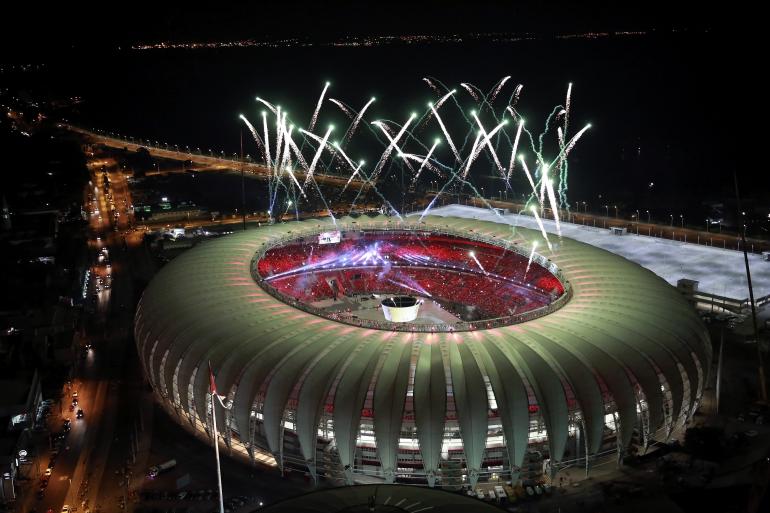
Year Opened: 1969

World Cup Capacity: 48, 849

World Cup Groups Hosting: B, E, F, H

Additional World Cup Matches Contested: Round of 16 (G1 vs. H2)

This stadium has long been home to Porto Alegre’s team Sport Club Internacional. The stadium in recent years has undergone through restoration and developments for the World Cup. For one thing, the stadium received a metal  roof with appropriate drainage. Timeliness was a problem as the first FIFA test match had to be scrapped because of construction delays. Yes, even stadiums that already were in existence had problems with renovations. It was however ready for the second test event in February and should go off without a glitch during the World Cup.

And there you go. My take on Group E and another stadium. Hard to believe nine days to go. Hang tight.

World Cup 2014 Preview: Group D

It’s questionable which of the eight World Cup groups of this year should be called the ‘Group Of Death.’ Most people are saying it should be Group D, and with good reason. It consists of three countries that have won at least one World Cup and all three are still strong today. It’s a shame there will be at least one of those World Cup winners packing once all the Group Stage matches are done.

So here’s my rundown of the Group D teams:

Uruguay-Uruguay (6)- If any country has to be the comeback story of football, it’s Uruguay. Uruguay dominated football in the 1920’s and won the first ever World Cup in 1930. Uruguay also shocked home country Brazil in 1950 by beating them 2-1 in the Maracanazo, which I will write about in a later blog. Since then, Uruguay’s prowess withered over time. It was like their fourth-place finish in 1970 was the end of it all. It would take four more World Cup appearances where the highest they got was the Round of 16 before there was a turnabout in the last few years. And it was over at the 2010 World Cup where Uruguay sent the message they’re back with their fourth-place finish. Further success continued with a win at the 2011 Copa America, qualifying their under-23 team for the Olympic Games, and finishing fourth at last year’s Confederations Cup. They’ve also had good play in friendlies with wins against, Italy, France and Japan. Nevertheless they did struggle during World Cup qualifying during the first half. They just have to be together in Brazil if they want to write another chapter to their new legacy.

Costa Rica-Costa Rica (34)- Costa Rica seems like the odd one out in this group. The other three have won World Cups in the past and the furthest they ever made it was the Round of 16 back in 1990. Maybe so but Costa Rica can deliver. They have had wins against Mexico and the U.S. last year. They’ve had their notable losses too. Whatever the situation, this can be a good learning experience for Costa Rica. They’ve never won against any of their Group D rivals but win, lose or draw, this can provide excellent growth for the team. They have good guidance through Colombian coach Jorge Luis Pinto and have talented players like Fulham’s Bryan Ruiz, Costa Rica’s top goalscorer Alvaro Saborio and rising newcomer Joel Campbell who plays for Arsenal. Don’t underestimate Costa Rica.

England fixed-England (11)- It’s always the same old story for the Three Lions. England often has the finest combined talent assembled for a football team no matter what tournament they enter. However they don’t always play like a functioning team and they often come up shorter than expected. And don’t get me started on penalty kicks. 2014 will define the TriLi’s even further. They have the goods to do well. They have an excellent coach in Roy Hodgson who took on England just two months before Euro 2012. They have top players like captain Steven Gerrard, vice-captain Frank Lampard, phenom Wayne Rooney and rising young star Jack Wilshere. Since Hodgson took over as coach, England has been impressive despite being ousted in the quarterfinals of Euro 2012 thanks to, you guessed it, penalty kicks. They’ve won or drew most of their matches. Even their losses– to Sweden, Chile and Germany–were not that big. So will England arrive here in Brazil? It will all be decided with the whole world in their wake.

Italy ficed-Italy (9)- The Azzuri are traditionally a stellar team. Only Brazil and Germany have finer World Cup legacies. However things really took a stump at World Cup 2010. They entered the tournament as the reigning Cup holders and left at the end of the Group Stage. The irony being they had the same coach that led them to win the 2006 World Cup. Italy has since hired Cesare Prandelli as their new coach and he has given them an excellent turn-around. The tournament where Cesare proved himself and the new Azzuri was Euro 2012. The Euro was won by Spain but Italy did make it to the finals. That was enough to send the  message that Italy was back and playing with the winning style the Azzuri has the reputation for. Italy also finished third at last year’s Confederations Cup and qualified for the World Cup easily. However Italy has shown some glitches in recent play. They beat Mexico and tied Germany but have lost to Argentina, Brazil and Spain. Italy is seeking redemption in 2014. No doubt they have the ability. It’s just a matter of them delivering.

And now my prediction. I predict the two advancers from this group will be Uruguay and Italy.

STADIUM SPOTLIGHT

After doing three spotlights where I’ve spotlighted two stadiums, I can finally spotlight only one here. However it’s one of the biggest and will be a major stage here at the World Cup.

-BELO HORIZONTE : Estadio MineiraoBelo Horizonte

Year Opened: 1965

World Cup Capacity: 62,547

World Cup Groups Hosting: C, D, F, H

Additional World Cup Matches Contested: Round of 16 (A1 vs. B2) & a semi-final

This is another of Brazil’s classic football stadiums. It was 25 years in the making and opened up in 1965. The stadium is considered one of the best football stadiums in the world. The stadium once held over 132,000 people for a soccer match back in 1997. Many other big soccer matches and big concerts have been held in the stadium. There was some redevelopment to the stadium in the years leading to the World Cup. Now fans can enjoy better access to the arena. The stadium was also one of the venues for the Confederations Cup. After the World Cup the stadium will return to being homes to Atletico Mineiro and Cruzeiro.

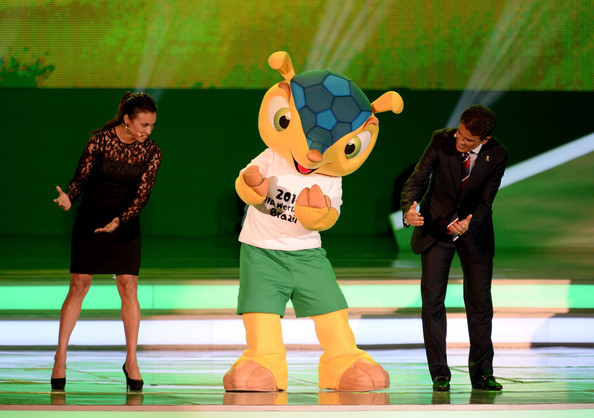
MEET THE MASCOT FULECO

Fuleco dancing with hosts at the World Cup Draw in December 2013.
Fuleco dancing at the World Cup Draw in December.

Since I only have one stadium to focus on, I thought I’d give a focus to the mascot. Normally choosing a mascot for a major sporting event is not an easy thing and it wouldn’t be an easy thing for the World Cup. Some like Striker in 1994 and Zakumi in 2010 were well-received. Some like Goleo in 2006 were questionable since the lion is representative not of Germany but more England and the Netherlands. And then there are even food-based mascots like Naranjito the Spanish orange from 1982 and Pique the jalapeno pepper from 1986.

Brazil went with a three-banded armadillo who camouflages himself as a soccer ball. Brazil held a vote on the mascot’s name and the most votes went for Fuleco: a mix of the words Ful–from Futebol (football)– and eco from Ecologia (ecology). The name should suit as Fuleco is representative of football spirit and is of an endangered species. Fuleco has a cheerful and appealing personality. He’s a proud, confident Brazilian armadillo. He does not talk but he’s very curious and extroverted, adventurous and loves to explore wherever he goes. Like all Brazilians, he has a big heart and is hospitable. Unlike his other armadillo friends, he’s very sociable. He loves to dance to music, especially Brazilian samba music, and likes keeping up to date with his family.

Brazil has given Fuleco a positive response. Within two days after Fuleco’s announcement, 89% of Brazil knew who Fuleco was. A recent survey of appeal revealed that Brazilians gave him average appeal score of 7.3 out of 10. Already he’s destined to be one of the best World Cup mascots ever.

And there you go. That’s my take on group D, another World Cup venue and the mascot Fuleco. More World Cup stuff to come.

World Cup 2014 Preview: Group C

Group C may look like a more relaxed group as compared to groups like Group B, Group D or Group G, but don’t be so quick to dismiss. There have been teams from nowhere that would come to surprise and finish high, if not win. Group C may come with one of those surprisers and it could be any of the four teams. All four have reputations of being ‘sleeping giants’ and it could be right here in Brazil where they finally arrive. Here’s my rundown:

Colombia-Colombia (5)- Colombia is one of many great teams who never had the change to deliver well at the World Cup. There was a period in the 90’s when they were one of the best teams in the world but during those three World Cups, they only made it past the Group Stage once and even then only got as far as the Round of 16. It’s a question of what it was: not all being together, political tension at the time, best players sidelined. We’ll never know. But now there’s a new Colombian team picking up where the previous one left off. They’re currently ranked in FIFA’s Top 5 and they’re hoping to deliver this time around. They have the players and the clout. They also have a good coach in Jose Pekerman who often selects players for a specific role rather than their profile. He was successful in coaching Argentina to the quarterfinals in 2006. They’ve even played well in recent games, tying Netherlands 0-0 and beating Belgium 2-0. Colombia can finally arrive on the World Cup scene here in Brazil.

Greece ficed-Greece (10)- This is one team whose prowess over the years has grown considerably. Their first World Cup was in 1994 and they were uninspiring: losing all three of their matches and scoring no goals while conceding ten. Things have really picked up for Greek football since. They were the surprise winners of Euro 2004. They returned to the World Cup and even though they didn’t advance past the Group Stage, they still had the benefit of winning a game: 2-1 against Nigeria. For 2014, they’re a top-ranked team in good hands with Portuguese coach Fernando Santos who has been very successful coaching in both Portugal and Greece. He guided Greece to the quarterfinals of Euro 2012 and to a consistent track record since, losing only to Bosnia-Hercegovina and South Korea. This is possibly Greece’s best team ever and there’s no better time than now for them to prove themselves.

Ivory Coast-Ivory Coast (21)- At every World Cup since 1986, there’s been at least one African country that advances past the Group Stage. Some have made it as far as the quarterfinals. Many have expected the Ivory Coast–or Cote d’Ivoire– to be that team but ‘The Elephants’ have played below expectations in their two World Cup appearances in 2006 and 2010. Even though they have Didier Drogba, one of the greatest African football players ever, he can’t be a one-man team. Nevertheless the team has been very consistent in recent years. Much from the help of French coach Sabri Lamouchi who has guided the team these past couple of years. They finished second in the African Cup of Nations in 2012 and even tied Belgium 2-2 in a friendly this year. Even at 36, Drogba still looks and plays strong and the team consists of other good talents like Manchester City star Yaya Toure and promising young gun Serge Aurier. This could finally be The Elephants’ year.

Japan-Japan (47)- No other nation has experienced increased growth of football in the last 20 years the way Japan has. It all started with the creation of the J League in 1993 when football really took off and helped Japan qualify for their first World Cup in 1998. They’ve qualified for every World Cup since even co-hosting in 2002 where they made it to the Round of 16 for the first time. Success continues for the Blue Samurais. They’re coached by Italian Alberto Zaccheroni They feature star players in the top European leagues including Keisuke Honda with AC Milan and Shinji Kagawa with Manchester United. From the first year Zaccheroni assumed the role of Japan’s coach, they won the 2011 Asian Cup. They’ve has mixed results in international play these past two years but have shown their strength trough ties against the Netherlands 2-2 and wins against France 1-0, Belgium 3-2, Ghana 3-1 and South Korea 2-1. They may rank low on FIFA’s chart but they could perform above expectations here.

Now my prediction for the two that will advance. It’s a toughie but I believe it will be Colombia and Greece that will advance.

STADIUM SPOTLIGHT

Now that I’m done all the stadiums that will just hold Group Stage, I’ll now be focusing on stadiums that will host matches in the knockout rounds. One is brand new while one is older and has a reputation. Both will be known for their capacity and features and are both expected to have sufficient post-World Cup use.

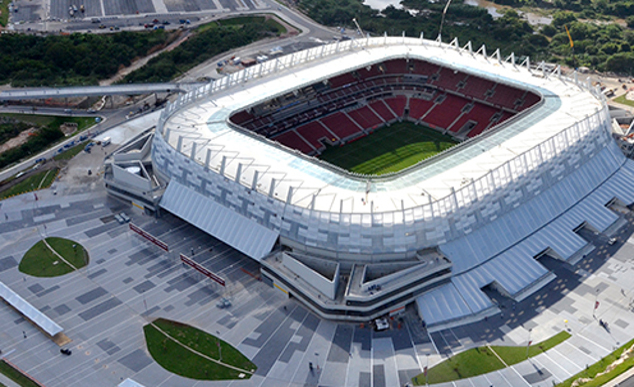
-RECIFE : Arena PernambucoPernambuco

Year Opened: 2013

World Cup Capacity: 46,154

World Cup Groups Hosting: A, C, D, G

Additional World Cup Matches Contested: Round of 16 (D1 vs. C2)

Pernambuco is a new stadium that was built not just for the World Cup but for last year’s Confederations Cup too. Pernambuco is a new stadium not just built for the World Cup and for Recife to have a new football stadium but also to give a financial boost to a deprived area of the city. Plans for the surrounding area include a university campus, indoor arena, hotel and convention centre, plus commercial, business and residential units and a large entertainment complex with shopping centres, cinemas, bars and restaurants. The biggest feature of the stadium is its intent to be a ‘Green Arena’ relying on solar power and even serving the purpose of being a solar power plant to power 6,000 people when not used for game play and be part of the research and development of solar power in Brazil. Football club Nautico Capibaribe is expected to make this stadium home after the World Cup.

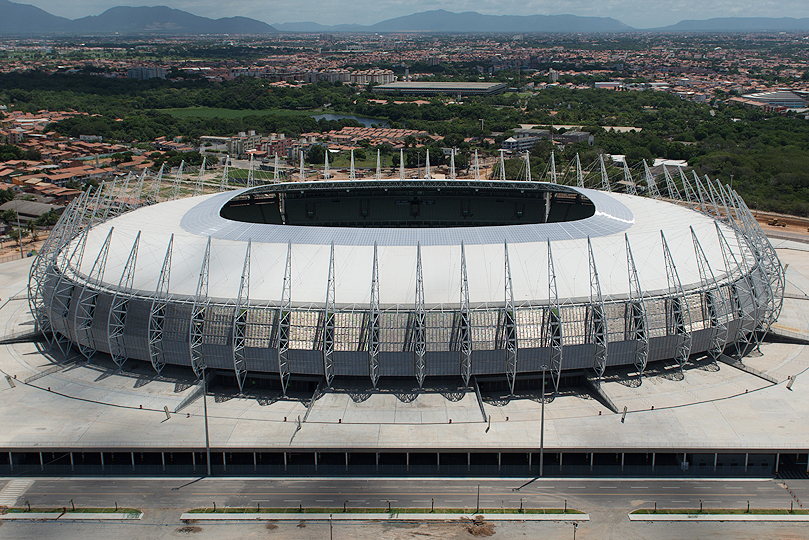
-FORTALEZA: Estadio CastelaoFBL-BRAZIL-WC2014-FORTALEZA-CASTELAO ARENA

Year Opened: 1973

World Cup Capacity: 67,037

World Cup Groups Hosting: A, C, D, G

Additional World Cup Matches Contested: Round of 16 (B1 vs. A2) & one quarter-final

Castelao is one of the few stadiums at this year’s World Cup to go through two major renovation projects. The first came in 2000 and it was a three-stage project that lasted a year. Then once it was assigned as a hosting venue for the World Cup, it was given a twenty-month reconstruction project starting in March2011: a mere ten years after the first set of renovations were completed. Whatever the situation, Castelao was the first World Cup venue to be completed, back in December 2011. Castelao was one of the venues for last year’s Confederations Cup. Castelao Stadium has always been a venue that has hosted big events in the past. Castelao plans to continue to host major concerts and serve as host venue for Ceara and Fortaleza Sporting Clubs.

And there you have it. My take on Group C and two more stadiums reviewed. Five more groups and six more stadiums to go.

World Cup 2014 Preview: Group B

The funny thing about the World Cup group draws is its unpredictability. They try to make things easier by designating seeded teams from all the others to give better parity only to end up with a crazy combination. Group B has a combination crazy enough to have the very first match a rematch of the exact World Cup final from 2010! Also just as surprising is that Group B has four teams that are very talented but it’s not enough to call it the ‘Group Of Death.’ I think there was more than one ‘Group Of Death’ for this World Cup. It’s a wonder why Group B didn’t get that label.

Despite these oddities, Group B is loaded with talented teams and should make some exciting play. Here’s my rundown of the Group B teams:

Spain Fixed-Spain (1)- Now seems to be ‘The Reign of Spain.’ Spain has always been known to be full of football talent but the team hardly ever came together at World Cup tournaments of the past, often performing below people’s expectations. This would cause Spain to be known as ‘football’s greatest underachievers’ for a long period of time. This all changed when Vicente del Bosque was appointed coach of Spain’s national team in 2008. Since then, Spain’s magic came about. It all started with winning Euro 2008, then surprising everybody including their compatriots with a win of the 2010 World Cup. Spain’s long-awaited legacy continued with a win at Euro 2012 and becoming the first team ever to successfully defend their European Championship. Spain’s success continued as they played without a loss until the finals of the Confederations Cup where they lost to Brazil 3-0. Spain continues to be brilliant only losing one game since, 1-0 to South Africa. Spain just recently beat Italy 1-0 in a friendly. They appear poised to repeat in Brazil. It’s the next month that will define things.

Netherlands Fixed-Netherlands (15)- While Spain is no longer ‘football’s greatest underachievers,’ the Netherlands have the misfortune of being seen as the greatest team in the world to never have won a World Cup. Three times a finalist, never a winner. Oranje is waiting for that day to prove themselves the best in the world. However it will come a t a challenge. Back during Euro 2012, the Netherlands performed one of the biggest chokes in their history by losing all three of their Group Stage matches. 2013 was a year they really wanted to make up for things and they did well by not losing a game. However failing to win all four of their friendlies since World Cup qualifying including a 2-0 loss to France shows that they might not be ready for this World Cup. This is unfortunate for head coach Louis van Gaal as he would like to leave team Netherlands on a positive note. Nevertheless it could be that Oranje is just ‘playing possum’ and may come alive in Brazil.

Chile-Chile (13)- Chile is another team full of talent that has yet to prove itself in a big way. The team that is affectionately called ‘La Roja’ by its compatriots and supporters have only gone as far as 3rd at the World Cup, and that was back in 1962 when they hosted it. In recent years, Chile has been better at its consistency. They’ve qualified for the 1998 and 2010 World Cups and finished in the Round of 16, the only other two times they’ve made it past the Group Stage. Chile has had a great play record since 2013 in both friendlies and World Cup qualifiers. They’ve shown they can challenge some the best teams in the world, if not defeat them. They beat Uruguay 2-0 in a World Cup qualifier last March, tied Spain 2-2 in a September friendly and even beat England 2-0 in a friendly in November. However they have lost to Brazil 2-1 back in November and lost to Germany 1-0 this March. Most people are predicting Spain and Netherlands to be the two advancers from Group B. There could be a Chilean surprise.

Australia-Australia (59)- The Socceroos were the surprise of the 2006 World Cup. Their 2006 advance to the Round of 16 led them to be transferred from Oceania’s continental federation to Asia’s. However their prowess has taken a bit of a dip. They didn’t advance past the Group stage in 2010 and have struggled in play for the Asian Cup. The 2013 and 2014 play seasons have been unimpressive including 6-0 losses in friendlies against both Brazil and France. In 2014, they’ve had a 4-3 loss to Ecuador and a 1-1 draw to South Africa. 2014 could be a further learning experience for Australia.

So now my prediction for the two advancers from Group B: Spain will definitely advance but it will be tight between Netherlands and Chile in which I feel Chile will be the one moving on.

STADIUM SPOTLIGHT

More stadiums in focus. Like the stadiums focused in my Group A review, these two will also host four matches, all in the Group Stage. And both with host a Group Stage match for Group B. I also want to remind you that in my Stadium Spotlight, I won’t completely compliment the stadiums. In fact I will make aware of some of the glitches, especially since glitches in the construction and/or upgrades of stadiums have made big news leading up to the World Cup. And these two have been two of the ‘bad news bears.’ So without further ado:

-CUIABA: Arena PantanalPantanal

Year Opened: 2014

World Cup Capacity: 42,968

World Cup Groups Hosting: B, C, F, H

There’s been a lot of concern of the readiness of many of the stadia set to stage the World Cup. Cuiaba is one stadium that’s been causing some of the headaches. One of the headaches happened back in October when a fire caused structural damage, which has since been repaired. In fact Cuiaba needed a second World Cup warm-up match on April 28th to prove its readiness. FIFA was pleased this time around. Nevertheless it didn’t guarantee the stadium was 100% ready. Work returned to the stadium shortly after and on May 9th, a worker was killed when he was electrocuted while working on the installation of a telecommunications network. Work was halted temporarily after his death.

Ready or not, Arena Pantanal will be the stage for four Group Stage games. After the World Cup, the Arena is to be reduced in capacity and to be the home venue for both Cuiaba and Mixto Esporte Club.

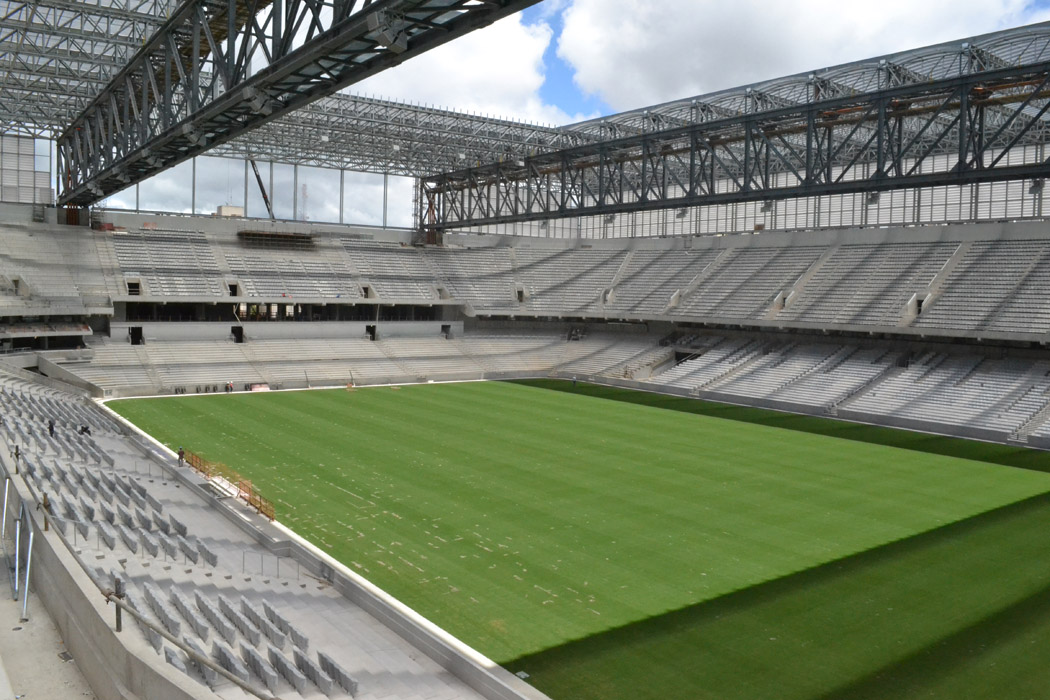
-CURITIBA: Arena da BaixabaCuritiba

Year Opened: 1999

World Cup Capacity: 41,456

World Cup Groups Hosting: B, E, F, H

Not all World Cup stadium problems are about the new stadiums. Existing stadiums have had their own problems too in terms of renovations or upgrades. Curitiba’s Arena da Baixaba is one stadium that had its issues. The stadium had plans for upgrades like extra seats and a retractable roof. The stadium suffered a setback in October 2013 as work was suspended  on the orders of a Brazilian labor tribunal due to numerous and serious safety breaches. An extra headache came in January 22 of this year when FIFA’s General Secretary visited the Arena and said Curitiba could be dropped if significant improvements in the renovations didn’t take place within a month. FIFA decided to keep Curitiba the following month. Recently there was some good news about the Arena. Valcke visited the Arena again on May 22nd and this time he praised it for being a ‘top-class’ venue.

The venue is expected to have its seating reduced once again to its usual 30,000 and return to being the host venue for Atletico Paranaense.

So there you have it. Another Group Stage group summary and two more stadiums in the spotlight. More World Cup reviews coming.

World Cup 2014 Preview: Group A

Those of you that have known my writing over the years have  known that when I do soccer blogging of major events, I do a rundown of the teams that will be competing. Some of you may have guessed I’d be doing it again for the World Cup, and you are right. However I’m doing a separate blog for each of the eight Group Stage groups. So much to preview, so little space. With this being my first blog of the upcoming World Cup, then it’s no question the first blog will be done on Group A. For the record, my summary of  the teams will be done in their drawn World Cup order rather than their FIFA ranking of May 2014. FIFA ranking of that month will appear in brackets.

GROUP A:

Brazil-Brazil (4)-No other country has as much of a football legacy as Brazil. Brazil is the only country that can boast competing at all nineteen past World Cups and the only country to have won the World Cup five. The World Cup arena has been an excellent showcase of Brazilian football at its best and it has inspired the world around. However we’ve also seen Brazil choke at times, especially in recent competitions. Just ask France. They’re known as Brazil’s ‘achilles heel’ and have handed Brazil some surprising defeats including the 1998 world Cup final and the 2006 World Cup quarterfinal. In both cases, Brazil was the defending World Cup holder. Brazil’s recent chokes were more humbling as they choked to the Netherlands in the 2010 World Cup quarterfinal and at the 2011 Copa America, they lost their quarterfinal in what was Brazil’s worst-ever Copa America performance.

Brazil can’t take any chances at this World Cup more than any World Cup. They’re the host country and all the world expects them to win. They especially want to rid their compatriots of the 1950 ‘Maracanazo,’ which I will talk about in another blog. Yes, Brazil may have won the World Cup more than any other country but of the eight countries that have won the World Cup, Brazil and Spain are the only ones to fail to do so as host country. Brazil hopes to end this ignominy this time around. After their Copa America debacle, they sacked their coach in favor of Luiz Felipe Scolari who helped coach Brazil to its last World Cup in 2002. The return to Scolari has paid off as Brazil won last year’s Confederation Cup defeating reigning World Cup holders Spain 3-0. Since the return of Scolari, Brazil’s overall record has been excellent losing only twice: to England and Switzerland. No doubt they’ll face huge pressure but the Confederations Cup proved that Brazil is back in action and ready to deliver.

Croatia ficed-Croatia (20)- If you were to do a pound-for-pound rational of football teams, Croatia should rank amongst the top. Croatia is one of only two countries in FIFA’s current Top 20 with a population of less than 5 million . Uruguay being the only other country. Ever since their independence in 1991, Croatia has proved itself a formidable force in football, especially at the 1998 World Cup where they finished third. However that was the last World Cup where they even advanced past the Group Stage. 2002 and 2006 appearances didn’t pan out and a failure to qualify in 2010 almost made the Vatreni’s glory a thing of the past. However Croatia is looking to mount a comeback. In 2012, they signed on a new president in Davor Suker, himself a former great as the top goalscorer at the 1998 World Cup. The role of manager was replaced by former team captain Niko Kovac. The team successfully qualified for the World Cup. They also have a good mix of talent from veterans like Darijo Srna and Luka Modric and fresh young talents like Dejan Lovren and Mateo Kovacic. Croatia is one country that’s very capable of causing a surprise.

Mexico-Mexico (19)- Mexico is without a doubt the best team in the CONCACAF as far as legacy goes. No other North American team has qualified for the World Cup as often. However its greatness has appeared to have alluded them in the past couple of years. They failed to advance past the Group Stage of last year’s Confederations Cup, they lost to Panama in the semifinals of the CONCACAF Gold Cup and almost missed  qualifying for the World Cup in a qualifier against Costa Rica where they trailed 1-0 after 80 minutes. Two goals in the last 10 minutes kept them alive where they’d go on to beat New Zealand for the wildcard berth. Mexico has made efforts to make their near-loss to Costa Rica a thing of the past. They have not lost a game since but they have come across some tight ties like a scoreless draw against Nigeria and even a 2-2 tie against the US last month. Mexico hopes to be ready for Brazil. Miguel Herrera is one tough coach who favors home grown talent over talent from European leagues. That could be the factor that could either spell success or failure. Only the World Cup stage will decide that.

Cameroon-Cameroon (50)- Older people may remember Cameroon as the team that came from nowhere in 1990 to win 1-0 against defending champions Argentina. Cameroon charmed the world that year by reaching the quarterfinals and becoming the first African team to do so. However their glory appears to be a thing of the past. Cameroon has not advanced past the Group Stage since. This time around doesn’t show too much promise. They do have a German coach, Volker Finke, and have good talent in Samuel Eto’o and Alex Song but they do face a heavy battle in group play. Already this year, they’ve had mixed results with a 5-1 loss to Portugal and a 2-0 win against Macedonia. Nevertheless it’s too soon to judge. I’ve seen teams where nothing was expected of them and they’d advance far.

STADIUM SPOTLIGHT

This is a new feature. This is where I get to focus on the various stadia that are hosting the World Cup. I figure the arenas are worth talking about. Brazil has twelve stadia that will facilitate for the World Cup: seven just opened within the past year. The crazy thing is how the Group Stage play is organized. Usually in most cases at a World Cup, the country would have organized certain Group Stage groups playing at a set stage of stadiums. In Brazil’s case, a country with twelve stadiums may have three stadiums in cities close to each other to host the Group Stage games of two groups. Division that simple. Brazil has done it weird. All twelve of the stadiums will hold four Group Stage matches but they will be matches for four different groups. Additionally, all six of the Group Stage games for each individual group will be played in six different stadiums, and not all will be that close by. That will mean a lot of traveling around for the 32 teams, especially in a country of over 3 million square miles.

It’s confusing but hopefully it won’t interfere with the play as badly as the vuvuzelas did at the last World Cup. As for stadiums, Brazil has twelve good stadiums. Five are old and traditional but renovated in time. Seven are new built especially for the sake of hosting the World Cup. Here I’ll give you my first taste of my Stadium Spotlight. Note that each stadium I show in my Stadium Spotlight feature will be a stadium that will contest Group Stage matches for each respective group. These two I will focus on will host Group Stage matches in Group A. So without further ado, here are the two stadiums in focus:

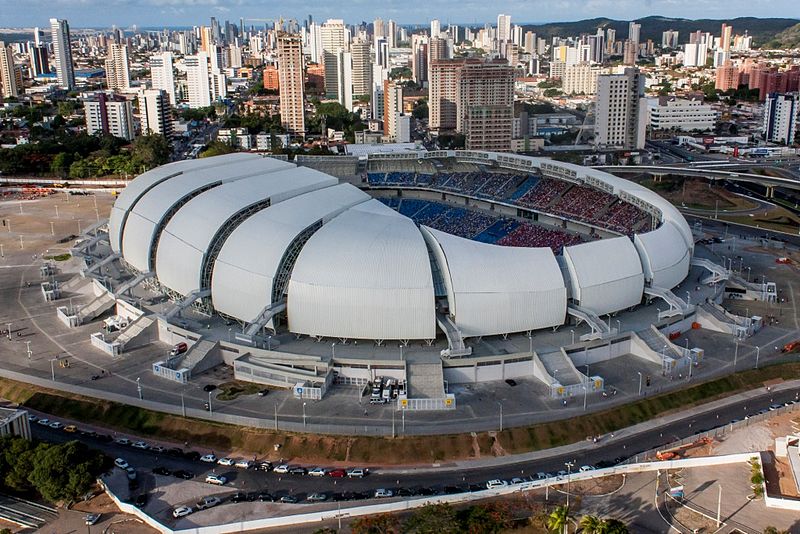
-NATAL: Estadio das DunasDunas

Year Opened: 2014

World Cup Capacity: 42,086

World Cup Groups Hosting: A, C, D, G

One of seven new stadiums built especially for this World Cup, the most unique thing of the stadium is definitely the roof. While Brazil had made headlines with difficulties of building and completing stadiums in time for the World Cup, this stadium however earned praises from FIFA not just for the stadium itself but for development of areas surrounding the stadium which I will talk about later. This stadium finished in good time and officially opened this January. After the World Cup, the stadium capacity is to be extended to 45,000 seats and to be the stage of home games for both the America Futebol Clube and ABC Futebol Clube. The area surrounding the stadium has planned a shopping centre, commercial buildings, hotels of international standard and an artificial lake.

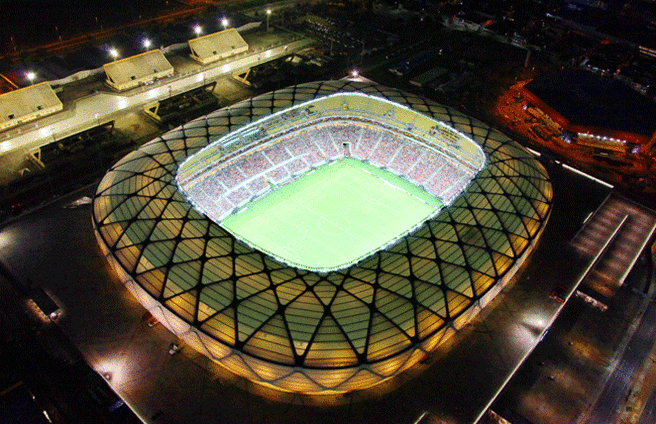
-MANAUS: Arena AmazoniaAmazonia

Year Opened: 2014

World Cup Capacity: 42,374

World Cup Groups Hosting: A, D, E, G

There was some criticism from England’s manager Roy Hodgson about Manaus hosting World Cup matches. He should watch his tongue as England will be playing the very first World Cup match of his group there, against Italy. This was one new stadium that actually was under question whether it would be ready for the World Cup. The stadium has been completed and was officially opened in March. The stadium has a full capacity of 46,000 and is to be the host stadium of Nacional FC after the World Cup, replacing the now-demolished Vivaldao Stadium.

And there you go. My first preview of the World Cup teams and stadiums. As for predictions, I’ll just settle for predicting the two countries that will advance past the Group Stage right now, and I predict it will be Brazil and Croatia.

Seven more groups and ten more stadiums to review before World Cup 2014 starts. Stay tuned for more.

Super Bowl XLVIII Preview

Super Bowl
Super Bowl XLVIII is happening on Sunday the 2nd. It’s provided for some interesting humor but it will make for some serious play between two teams that night.
It’s a funny irony that this year’s Super Bowl is happening all the way on the East Coast but the two teams are way far west. It’s also a funny irony as posted out on some of my friend’s Facebook posts that both team come from states that legalized marijuana. Hence names like the Weed Bowl, the Bud Bowl and the Super Bong have come about.
THE EVENT
Without a doubt the Super Bowl is the biggest one-day hype-fest in the USA. This will be the first Super Bowl since Super Bowl X to be played outdoors on artificial turf. MetLife stadium in East Rutherford has a capacity of 82,500: the biggest in the NFL. A 30-second commercial costs $4 million and all ad spots were sold out two months ago. Fox will broadcast to the United States with CTV airing Fox’s broadcast to Canada. 45 countries will also have their own broadcast. Marching bands from Rutgers and Syracuse University are expected to open the pregame show. Queen Latifah is to follow singing ‘America The Beautiful’ with the New Jersey Youth Chorus. Renee Fleming will become the first opera singer ever to sing the ‘Star-Spangled Banner’ at the Super Bowl.
There almost wasn’t half-time show since this is to be a Super Bowl held in cold weather and there was fear of blizzard conditions. Nevertheless Fox and the NFL said there will be a halftime show and they’re confident it will go well. Actually they shouldn’t worry since the hourly weather forecast for the game hours predict calm and partly cloudy skies with temperatures starting at 7 Celsius (45 Fahrenheit) and dropping to 4 (39). Bruno Mars and the Red Hot Chili Peppers are scheduled performers.
THE TWO CONTENDERS:
AFC: DENVER BRONCOS
Denver have won the Super Bowl twice back in 1997 & 1998 during their ‘Elway Era.’ The Broncos ended the last season losing the Super Bowl to the Baltimore Ravens. They hoped to win the Super Bowl this year but had a whack of obstacles to overcome. Firstly during the offseason, All-Line probacker Von Miller was suspended six games for violating the NFL’s drug policy. Several offensive linemen also sat out the beginning of the season with injuries. There were four departures and four new additions. Head Coach John Fox had a health scare and had heart surgery which caused him to miss four games and Jack Del Rio taking over in his absence.
The Broncos actually started slowly in exhibition play as they only won two of their four exhibition games. When the regular season officially began, it was another story. The team did excellently as they won thirteen of their sixteen regular season games to come out on top of the AFC. Along the way the team set new NFL records for most total points (606) and total touchdowns in a single season. And Peyton Manning set new records for passing touchdowns and passing yardage. Can you blame Sports Illustrated for naming him 2013’s Sportsman Of The Year?
The playoffs were also smooth sailing as they won the Divisional Championship against the San Diego chargers 24-17 and the Conference Championship against the New England Patriot 26-16. It’s good to see after all those obstacles, they finally made it to East Rutherford with the Super Bowl game against the Seahawks being their last hurdle remaining.
NFC: SEATTLE SEAHAWKS
This is their second time ever to the Super Bowl. Their first time ever was eight years ago where they faced the Pittsburgh Steelers and lost 21-10. Even before the season began, one NFL.com expert ranked the Seahawks as the most powerful team in the NFL. Nevertheless it was up to them to prove it.
Unlike the Broncos, the Seahawks didn’t have the discomfort of shockers, frequent trades and suspensions. Seattle did acquire ten new players: five through trades. Seattle won all four of their exhibition games including one against the Broncos. The regular season was excellent for them as they won thirteen of their sixteen games. The playoffs were also great for the Seahawks as they won their Divisional Championship against the New Orleans Saints 23-15 and the Conference Championship against the San Francisco 49ers 23-17. This is especially great for them because many at the beginning of the season gave San Fran better odds than Seattle to win the Super Bowl.
MY PREDICTION
Normally I’m better at making predictions for the CFL Grey Cup than I am for the Super Bowl. The reason is all CFL teams play against all the other teams at least twice in the regular season and it’s easier to make a prediction with the head-to-head data. It’s not the case in the NFL as if each team were to have at least one game against every other NFL team, all teams would have to play a total of 31 games. Wow, could they handle it?
This is not an easy prediction for anyone. Even Wikipedia states the favorite for this match to the Broncos by 2: the tightest favoring in 32 years.The two Super Bowl teams don’t always meet during the regular season each year. The Seahawks did play the Broncos and won 40-10 but it was an exhibition game back in August where Seattle was hosting. A lot can change in those five months since.
Both teams finished on top of their Conference with 13 wins and three losses. Both teams played the 49ers at least once in the season and had a loss to them. Denver may have set a scoring record this season but Seattle had the better defense allowing only 231 points scored on them.
Okay, enough of the saber metrics. I predict that the winner will be the Denver Broncos. I won’t hazard a guess on the final score but I believe it will be a close game with Denver’s win being by five points. This would make it the third win for the Broncos and the second Super Bowl win for Payton Manning.
So there you go. My preview and my prediction for Super Bowl XLVIII. Show begins tonight at 6:30 EST in MetLife Stadium. May the best team win!

2014 World Cup Group Stage: Luck Of The Draw

The stage was set Friday to decide the eight First Round groups for next year's FIFA World Cup in Brazil.
The stage was set Friday to decide the eight First Round groups for next year’s FIFA World Cup in Brazil.

You could say it took a lot to determine the 32 countries that qualified for the 2014 FIFA World Cup: thirty months, six confederations, 204 countries or teams, 820 matches, and a total of 2303 goals to decide the 31 berths up for grabs. Finally on November 20th, all thirty-one berths up for contention were all decided. However deciding the eight groups of four for the Group Stage was also another tricky matter. Yeah, just when you thought it would get easier.

Yesterday, the eight First Round groups were decided at the Costa de Sauipe resort in Bahia. It was broadcast live around the world. I myself saw the live telecast at 9am my time. The draw to form the eight groups for each World Cup involves a process with a lot of thought: four countries per group with continental separation. That would mean each continent other than Europe would have only one of their countries in a First Round group. Europe by means of fielding thirteen berths this World Cup would have a maximum of two countries per group. That’s always been the case since the World Cup expanded to 32 countries back in 1998.

The respective continent’s confederations contested their matches conducted their own qualifying format for deciding their qualifiers for the World Cup. There were even two countries that qualified via a ‘wildcard’ berth where they’d have to play a team from another continent twice. The thirty-two qualifying countries were all decided more than two weeks ago. Seeded teams which I will talk about later are in italics:

  • Host Nation: Brazil
  • South America: Argentina, Chile, Colombia, Ecuador, Uruguay
  • Europe: Belgium, Bosnia-Hercegovina, Croatia, England, France, Germany, Greece, Italy, Netherlands, Portugal, Russia, Spain, Switzerland
  • Africa: Algeria, Cameroon, Ghana, Ivory Coast, Nigeria
  • The CONCACAF (North and Central America, Caribbean): Costa Rica, Honduras, Mexico, U.S.A.
  • Asia: Australia, Iran, Japan, South Korea

That list of qualifiers does provide for some interesting notes. Australia has played for the Asian confederation (AFC) since 2006 because of its superiority in Oceania’s confederation (OFC). Also Spain, the defending World Cup nation, still had to play qualifying matches as the defending World Cup team no longer qualifies its own automatic berth: a FIFA rule in effect starting with the 2006 World Cup.

Dividing the groups into four teams of appropriate continental separation would include something else involved: a seeded pot. Host Brazil was already allocated to Group A: a FIFA regulation in effect starting with the 2006 World Cup. Each of the other seven groups would have to have one of the teams amongst the Top 7 of FIFA’s World rankings from October 2013. In order from 1st to 7th, they were:

  • Spain
  • Germany
  • Argentina
  • Colombia
  • Belgium
  • Uruguay
  • Switzerland

There always was a seeded pot for drawing groups for the World Cup that would involve a complicated system involving a multitude of ranks, previous World Cup places and other factors. This time around the seeding was just on that one FIFA ranking list. Sure, it was odd to see countries normally not amongst the top seeds like Belgium and Switzerland in the mix but finally creating a seeded pot was that simple.

The pots meant for continental separation amongst the groups were not that easy. One easy element was that Pot 3 consisted of teams from Asia and the CONCACAF: continents that both fielded four berths. As you could tell, the seeded pot consisted of three South American teams and four European teams. That’s where complications and confusions would arise as Pot 2 would consist of Africa and South America. Pot 2 ended up with seven countries since three of South America’s five berths were seeded teams. Pot 4 consisted of the nine non-seeded European teams. So how do you solve this problem of those pots with the continental maximums?

Yeah, explaining continental limits and parities is easy. Making it happen in the groups this year is the hard part. So FIFA under Sepp Blatter decided to make the following procedures to even it up:

  • Draw one European team from Pot 4 and place into Pot 2 for four even pots of eight with the teams assuming the first position of their group.
  • Draw from Pot 1 to decide the first teams for Groups B to H.
  • Draw amongst the four seeded South American teams and place the drawn out team in auxiliary pot  ‘Pot X’ for the sake of continental separation.
  • Place the European team drawn out of Pot 3 with the South American team from Pot X.
  • Draw from the remaining pots to determine the other qualifying teams.
  • After the Pot 1 teams were drawn, draw the positions of the teams of the other three groups as the draw goes group by group.

Yes, it’s hard to make sense. It’s hard to explain. And it’s hard to make it all work out. It’s not like the last World Cup where there were five seeded European teams and you’d easily have a European pot of eight. Nevertheless it was accomplished. The European team from Pot 3 that was drawn out first was Italy. The seeded South American team that was put into Pot X was Uruguay which was already drawn to Group D. That would mean Uruguay and Italy would both be in the same group. The remaining teams would also be drawn out evenly.

So after all that confusion and fretting, all the First Round groups were drawn out. The parity and continental separations took place as FIFA wanted it: maximum two European teams and maximum one team from the other continents in each group. So here are the eight First Round groups for the 2014 FIFA World Cup:

Group A

  • Brazil
  • Croatia
  • Mexico
  • Cameroon

Group B

  • Spain
  • Netherlands
  • Chile
  • Australia

Group C

  • Colombia
  • Greece
  • Ivory Coast
  • Japan

Group D

  • Uruguay
  • Costa Rica
  • England
  • Italy

Group E

  • Switzerland
  • Ecuador
  • France
  • Honduras

Group F

  • Argentina
  • Bosnia-Hercegovina
  • Iran
  • Nigeria

Group G

  • Germany
  • Ghana
  • Portugal
  • U.S.A.

Group H

  • Belgium
  • Algeria
  • Russia
  • South Korea

The group set-ups sure have gotten a lot of people talking. Some people have noticed that some groups are so tightly put together, it’s hard to declare the one group to call the ‘Group Of Death.’ Some are stating it’s Group D with Uruguay, England and Italy. Some are saying it’s Group G with all four of its teams being top contenders. Some are even saying it’s Group B with their very first match—Spain vs. Netherlands—a re-contest of the 2010 World Cup finalists.

Whatever the situation, all 32 teams have to be ready to face their Group Stage opponents and put their best foot forward if they want to advance and be the last team standing that wins the 2014 World Cup. The world will be watching from June 12th to July 13th. I myself will be doing group-by-group reviews on my blog in the weeks leading up to the start. Stay tuned for more action.

2013 Confederations Cup: More Than A Soccer Tournament

The FIFA Confederations Cup is as much of a pre-World Cup test event as it is a major international soccer tournament.
The Confederations Cup is as much a pre-World Cup test event as it is a major soccer tournament.

So 2014 has the World Cup and 2012 had the Euro. I guess that means 2013 will be devoid of big-time international soccer excitement, right? Wrong! 2013 is the year of the Confederations Cup, an eight-team competition held in Brazil. It’s good and important for a lot of reasons.

A TOURNAMENT GROWS IN SIGNIFICANCE:

The Confederations Cup is more of an intercontinental competition than international. Six of the eight teams that are competing here have earned their berth by winning their respective continent’s confederation championship. The only exceptions being the World Cup winner and the host country. That’s how the Confederations Cup is contested.

The idea of having a soccer competition of the best of the continents was an idea that evolved over 21 years. Actually the first attempt at such a competition came not with the participation of FIFA. It came through the royal family of Saudi Arabia through a competition called the King Fahd Cup. The first King Fahd Cup was contested in Riyadh, Saudi Arabia over five days in October 1992 and consisted of Saudi Arabia, which was the Asian Cup holder at the time, CONCACAF Gold Cup winner USA, African Cup Of Nations holder Ivory Coast and South America’s Cop America holder Argentina who won the Cup. The King Fahd cup was contested once more in 1995 and expanded to six teams: five continental cup winners and host Saudi Arabia.

By 1997, FIFA became involved and the King Fahd Cup had been renamed the Confederations Cup. This is the turning point with the Cup being contested the year before the World Cup and with the competition consisting of the eight teams through the qualifying format that still exists today. There were however two exceptions as two second-place teams from their continent’s championships competed: Czech Republic because Euro winners Germany declined to participate and United Arab Emirates because the hosting Saudis had already qualified as hosts. This would also be a new standard for the Cup  that if one of the continental cup holders already earned their berth as either host nation or World Cup holder, the runner-up team would be given the continent’s berth.

After the 1997 tournament, the Confederations Cup would be contested bi-annually and in a different country every year. The 2001 tournament featured a unique twist as the host countries were Japan and South Korea, the host of the following year’s World Cup. That would be the norm from now on in which the Cup held the year before the World Cup would be hosted by the World Cup host nation(s). Six of the stadiums that were to be for the World Cup the following year were the sites for the Confederations Cup.

The Confederations Cup would continue being a bi-annual competition. Germany, the host nation of the 2006 world Cup, would continue the tradition by hosting the 2005 Confederations Cup with five of the venues for the following year’s World Cup used for this event. Since 2005 in Germany, the Confederations Cup has become a quadrennial event and seen as a warm-up event for the following year’s World Cup. South Africa used it to prepare for their hosting of the World Cup and you can be sure Brazil will do the same here. Six venues that will participate in next year’s World Cup including the legendary Maracana stadium will stage this competition. You could say the Confederations Cup has really grown a lot in the last decade.

WITH THE WORLD CUP A YEAR AWAY…:

You can be sure with the Cup being contested, the media will be paying close attention to how prepared Brazil is for this event and how ready they will appear to look with the World Cup just a year away. Already the media has paid high attention to Brazil’s troubled preparations for the World Cup. FIFA and even local critics have complained of construction delays and cost overruns. Few infrastructure projects were completed and even the 3G network couldn’t work properly. Even the official musical instrument of the World Cup was a failure as fans of losing teams would throw it on the field. Only two of the six stadiums participating in the Confederations Cup were completed by December and two cities were almost axed from hosting. In fact delays have caused FIFA to make an exception in their pre-World Cup demand that the host country hold three major competitions.

It’s not to say it’s all bad. Tickets for the World Cup and the Confederations Cup were a success. Also a record number of volunteers for both the Confederations Cup and World Cup signed up. Even exports from Brazil look optimistic as Brazil anticipates to export $1 billion from this Cup. Brazil has openly vowed it will be ready for the World Cup and even FIFA believes they’re confident Brazil will be ready. There’s only one year to go.

TEAM BY TEAM ANALYSIS:

Now enough talk about hosting the tournament. Let’s move onto the teams and see how well they stack up for this. All but two teams are winners of their respective country’s continental championship. The two exceptions are Brazil who qualifies as hosts and Italy which was runner-up at Euro but qualified since the winner Spain already qualified as World Cup winner. Here’s how they pare up group by group with their current FIFA ranking in brackets:

GROUP A:

-Brazil (22)- You’d think a country like Brazil with a legacy and depth of talent would enter the competition as the favorites but it’s actually not the case. Brazil first surprised everybody at the 2010 World Cup with a quarterfinal loss to the Netherlands. They surprised soccer fans even more by being ousted in the quarterfinals of the 2011 Copa America. Brazil just wasn’t Brazil. Lately Brazil has been making some changes like bringing back coach Luis Felipe Scolari who helped coach Brazil to the 2002 World Cup. Their play has gotten better in a slowly but surely pace. They may have tied Italy 3-3 three months ago but just last week they won a friendly against France who has been traditionally considered Brazil’s ‘Achilles Heel.’ The Confederations Cup could be a turning point for Brazil and send a message how much their team has improved and how far they would have to go to win the World Cup. I’m sure the world will be watching.

-Italy (8)- If you remember last year’s Euro, you’d remember it for Italy’s comeback as much as for Spain’s win. Italy was a team that was direly in need of improving after the 2010 World Cup and their qualification for the finals shows how far they came. Their play in World Cup qualifying matches have also been excellent. However they’re not immune to choking as noticed in a 2-2 friendly against Haiti. Nevertheless this tournament can also send a strong message to Italy how their team looks en route to the World Cup.

-Mexico (17)- Mexico has always been considered the ‘sleeping giant’ of soccer. The team has always been loaded with talent and skill but they have yet to prove themselves in a big way at a major tournament. They may be the current CONCACAF Gold Cup holders but even now with World Cup qualifying for the CONCACAF they still find themselves third in the standings with the USA leading. This group being the ‘group of death’ in the Cup could also pose a challenge. Nevertheless Mexico could pull one of the big upsets of the tournament. We also shouldn’t forget Mexico won the gold medal in London. It’s a given in any tournament to never count Mexico out.

-Japan (32)- If there’s one continent that has grown the most in terms of soccer play in the last two decades, it has to be Asia. And Japan has to be one of its strongest examples of accelerated success. Nevertheless Japan finds itself in a tight situation here in the Cup against three teams known for their legacies and their consistency of play. But don’t count Japan out. They’re the first team to earn a World Cup 2014 berth on play by already leading their AFC qualifying group by a huge margin. Plus they’ve won three of their six matches in 2013. So if any team can most give the biggest surprise at the Cup, it’s Japan.

GROUP B:

-Spain (1)- How about that? Spain has gone in five years from being ‘soccer’s greatest underachievers’ into the top team in the world. Two straight Euros and a World Cup. They sure have come out of their shell and they come to the Cup as the favorites to win. Heck they haven’t had a single loss not just in 2013 but 2012 too. They look to have an easy Group Stage play but play in the semis and possible finals could make things more challenging for Spain. Just because a team is #1 and undefeated for two years doesn’t mean their infallible. We shouldn’t forget they lost to the USA in the semis at 2009’s Confederations Cup. Here could be yet another achievement in Spain’s recent legacy or a sudden reminder of their own weaknesses. Only the next two weeks will tell.

-Uruguay (19)- Uruguay has to be the comeback story right now. It seemed as though Uruguay’s soccer legacy was a thing of the past. Their prowess from the 30’s to the 50’s captured the imagination of the world. However it was their fourth place finish at the 1970 World Cup that appeared to mark the end of Uruguay’s greatness. However recent years has seen Uruguay make a comeback with a fourth-place finish at the 2010 World Cup and the win of the 2011 Copa America. But before you can shout out that Uruguay was back in a big way, it hasn’t been completely easy. They currently stand fifth in the standings of World Cup qualifying play for the CONMEBOL. Nevertheless while their play against South American teams have been a bit of a struggle, their play against other international teams have been quite impressive. This tournament can also send a message to the Uruguayan team in terms of what they need to do to qualify for the World Cup.

-Nigeria (31)- Nigeria has always been one of the top African teams. They look impressive in world Cup qualifying right now. The big question is their international play. Not much is known and past international and World Cup play has not given to impressive results. One result that did send a strong message was a 2-2 tie against Mexico two weeks ago. Nigeria could prove to be a stronger team here than most experts think.

-Tahiti (138)- Usually the OFC Nations Cup goes to either Australia or New Zealand. Last year it went to little Tahiti! Tahiti has become the least populous nation ever to win a continental championship. Here at the Cup, Tahiti’s biggest victory is just simply qualifying. Not much is expected since all the other teams have stronger depth in talent and international experience. In fact Tahiti is the only team at the Cup that doesn’t have a chance in even qualifying for the World Cup as the Oceania contestant for a berth against a CONCACAF team is New Zealand. Nevertheless the Cup can be a valuable learning experience for Tahiti. They’ve had hardly any international experience outside of Oceania. Now’s their chance to experience play against some of the best teams in the World. Despite their meager chances of qualifying for further play, Tahiti is probably the only team at the Cup with nothing really to lose and everything else to gain.

So there’s my rundown of the eight teams for the Confederations Cup. I’m not going to hazard predictions until the Group play is done and the semifinal berths have been decided. In the meantime stay tuned to see who will win the 2013 Confederations Cup. And stay tuned to see how ready Brazil appears to be for hosting next year’s World Cup. Both should be interesting to see.

The Grey Cup Plays Its 100th Game

This Sunday will have the 100th contesting of the Grey Cup, the most prestigious prize of Canadian football. It will be an exciting time not just for fans of Canadian football but fans of the Cup itself.

A CUP FULL OF HISTORY

I’ve already talked about the Grey Cup partially back in a post from last year but I’ll elaborate more here. The Grey Cup has more history than the Super Bowl: 58 more years to be exact. Before there was a CFL, the Grey Cup was open to Canadian football teams from all sorts of leagues. The very first Grey Cup was played in 1909 by the University of Toronto Varsity Blues and the Toronto Parkdale Canoe Club at Toronto’s Rosedale Field to a crowd of just over 3,800. Yeah, that small. The winner was the Blues 26-6. From 1909 to 1915 the Grey Cup was often a contest between Toronto and Hamilton teams. World War I led to the postponement of four straight Grey Cups until it was revised back in 1920. Those would be the only years the Grey Cup was not contested.

It wasn’t until 1921 that the Grey Cup stopped being a contest strictly of Ontario teams when the Edmonton Eskimos qualified for the final. It would pave the way for teams from Regina and Winnipeg to qualify for the final. 1931 was a history-maker for the Grey Cup as it was contested in Montreal’s Molson Stadium: the first time ever the Grey Cup was contested outside of Ontario. Just as historic was the match as it featured two teams outside of Ontario: the Regina Roughriders and the Montreal AAA Winged Wheelers. Montreal won 22-0, making them the first team outside of Ontario to win the Grey Cup. The first team from Western Canada to win the Grey Cup was the Winnipeg ‘Pegs back in 1935. While the Grey Cup was cancelled during World War I, it was not cancelled during World War II where teams from branches of Canada’s armed forces qualified for the finals.

The Grey Cup’s popularity grew after World War II as 1948 saw the first Grey Cup with a crowd of 20,000 in attendance for the first time. Then the Canadian Football Council (CFC) became the Canadian Football League (CFL) in 1958 which would propel the Grey Cup to further popularity. Since then, Grey Cup Sunday has become a permanent fixture in Canadiana with the top team from the East competing against the top team from the West. An average crowd of over 50,000 gather to watch the big final in the stadium and millions more watch from their house.

A MILESTONE WORTH CELEBRATING

This year marks the 100th contesting of the Grey Cup. To celebrate, there has been a Grey Cup 100 Train Tour with the Cup touring various cities of Canada with three CFL themed railway coaches: a museum car, a railcar with contemporary memorabilia, and a car containing the Grey Cup itself. It started September 9th in an official ceremony in Vancouver, traveled across Canada for ten weeks visiting various Canadian cities including all cities with CFL teams, and ended in Toronto on November 17th. The 100th Grey Cup has also been celebrated through Canada Post. Canada Post has issued commemorative stamps of all the teams and the Cup itself. It has also issued 8*10 pictures of the various Grey Cup stamps and many other gift sets. Rosedale Field–which has had its spectator seats removed years ago and now functions as a field for festivals and community events as part of Rosedale Park– was commemorated during the celebrations in Toronto with a commemorative plaque from Heritage Toronto for its role as host field for the first-ever Grey Cup.

THIS YEAR’S CUP

As for this year’s Cup, the event will be held at the Rogers Centre, formerly SkyDome, tomorrow night. This is the 46th time Toronto will host it. There will be a fan parade from Varsity Stadium to Rogers Centre. The coin toss of the game will consist of the first 100th commemorative Grey Cup coin struck by the Royal Canadian Mint executed by Governor General David Johnston. There will be various musical acts for both the pre-game show and the halftime show. Pre-game show acts include the Guess Who’s Burton Cummings and country singer Johnny Reid. Halftime show performers include Justin Bieber, Carly Rae Jepsen, Marianas Trench and Gordon Lightfoot.

As for game itself, it will be a face-off between the Toronto Argonauts representing the East and the Calgary Stampeders representing the West. So who will win? Here’s the breakdown:

EAST – Toronto Argonauts: The Argonauts have not looked like the team most likely to win the berth for the East. They have both won and lost nine games during regular season play and it was looked to be Montreal that would represent the East. Nevertheless Toronto has played brilliantly in their Division playoff games firstly against the Eskimos 42-26 and recently against the Allouettes 27-20. Toronto has an advantage leading into the Cup having won both its regular season games against Calgary. Their veteran quarterback Ricky Ray has been consistently strong and looks strong leading into tomorrow’s game. Nevertheless Toronto knows Calgary has a strong defense and they won’t overlook it for tomorrow’s game. Kevin Huntley even admitted their game against Saskatchewan, which I will talk about later, sent them the message. Nevertheless they have been taking note on Calgary’s strengths and weaknesses. They know that Kevin Glenn and Jon Cornish are the ones they have to maintain if they want to win tomorrow. Will they win it again or will it be a change in the game plan?

WEST – Calgary Stampeders: Like Toronto, Calgary was second in their division leading up to the playoffs. The Stampeders have has a better season with twelve wins and six losses. They too have been brilliant in the playoff games winning against Saskatchewan 36-30 and BC 34-29. Their consistency has been their biggest strength. They’re not flashy showmen, just a strong team. One important statistic to remember is that Calgary lost both of its regular season games against Toronto. Nevertheless they showed they can come from behind by winning a game against Saskatchewan where they were originally trailing by 17 points with six minutes to go. Quarterback Kevin Glenn has been getting better and stronger as of recent. Their other strong players have played well. Nevertheless they know the Argo’s star quarterback Ricky Ray has returned from surgery back in October and is playing strong. Also the Stamps know the Argos have been good at holding Cornish back. Tomorrow could go either way for the Stamps.

MY PREDICTION:

So what’s my say? This is a hard one to call. both have their strengths and weaknesses. Both have shown they know how to perform when it matters. I have to give the win to Toronto. It’s not just about their play against Calgary this year but also balancing things out. Kevin Glenn has become a stronger quarterback but Ricky Ray has returned in a strong way. Also Toronto knows how to hold down Cornish and they have a special edge with Chad Owens winning the CFL award for Most Outstanding Player. So I have to hand it to Toronto. They have the edge but it’s going to be a tight game.

Anyways everything will be decided tomorrow in Rogers Centre and it promises to be a great game and a great show. In the end, one city will be left smiling. So may the best team win!

WORK CITED:

WIKIPEDIA: List Of Grey Cup Champions. Wikipedia.com. 2012. Wikimedia Foundation Inc. <http://en.wikipedia.org/wiki/List_of_Grey_Cup_champions>

London 2012: Just Ten More

Okay I know I already wrote articles about athletes at the London Olympics from around the world and Canada that are worth watching. The thing is when it gets closer and closer to the Olympic Games, there become more and more that are worth keeping an eye on. Here in this article are another ten that I feel are worth keeping an eye on. So without further ado:

-Ryan Lochte/USA – Swimming: A lot of attention is focused on Michael Phelps ending his legendary Olympic career with a bang. However Ryan Lochte is one swimmer that could steal the show from Phelps. Like Phelps, he also qualified for four individual events. Unlink Phelps, he’s the one this time around with his face on more magazine covers than any Olympic athlete. Here in London, he will attempt to defend his 200m backstroke title and rival Phelps in both individual medley events. Actually Lochte has an advantage over Phelps as he holds the world record in the 200 and finished ahead of Phelps in the 400 at the Olympic Trials. Looks as though London may not only be the last hurrah for Phelps but also a possible changing of the guard with Lochte. It will all be decided in the London Aquatics Centre.

-Kosuke Kitajima/Japan – Swimming: There’s a lot of talk of Michael Phelps threepeating in four events. The thing is he may not become the first male swimmer to do so. That could be Japan’s breaststroker Kosuke Kitajima. Kitajima has already won both the 100m and 200m breaststroke events in both 2004 and 2008, making him one of only six swimmers to achieve a ‘double-double’ in swimming. 2011 was a difficult year for Kitajima as he only won a single bronze medal at last year’s Worlds. Nevertheless this year has seen him return to his winning form as he has the world’s fastest time in both the 100 and 200. But don’t think another double here is going to be easy for him. The 200 will be his toughest challenge as he will face the rivalry of Hungary’s Daniel Gyurta and his teammate Ryo Tateishi who’s best time of the year is just .17 seconds behind Kitajima’s. Nevertheless Kitajima trying to be the first to achieve a ‘triple-double’ in swimming should prove to be exciting.

-Kenenisa Bekele/Ethiopia – Track and Field: This Olympics seems like to be one where a lot of events have a chance of a threepeat happening. Track and field also has the potential of some threepeats: Jamaica’s Veronica Campbell in the women’s 200m, Isinbaeva in women’s pole vault, Norway’s Andreas Thorkildsen in men’s javelin and Ethiopia’s Kenenisa Bekele in the men’s 10000m. Bekele has had a stellar running career ever since he burst on the scene back in 2003. He holds the world records in both the 5000m and 10000m, has won a total of five World Championships and has won three Olympic gold and one silver. Beijing was especially stellar as he performed the 5000-10000 double. However 2011 was not a kind year for Bekele as he sat the year out with injuries. He has since regained his old form and has posted the third-fastest 10000 time in the world this year only less than a second behind the fastest. Will a threepeat happen here? Mark your calendars August 4th and tune in.

-Allyson Felix/USA – Track and Field: Allyson Felix is one of the best 200m runners ever but she’s still missing that Olympic gold in that event. She first burst onto the scene back at the 2004 when she won a silver medal in the 200 at the age of 18. She also set a world junior record upon winning that medal. The following year she won the 200m at the World Championships becoming the youngest sprinter ever to do so. She repeated as World Champion in the 200 in 2007. However she again won Olympic silver in 2008 finishing second again to Jamaica’s Veronica Campbell-Brown. She did however win a gold as part of the USA’s 4*400m relay. Nevertheless she’s still chasing down that elusive 200m gold here in London. Last year was a bit of a shock for her as it was the first World Championships since 2003 where she didn’t win the 200m, finishing 3rd. However she’s run the world’s fastest 200m time this year–4/10 of a second faster than the second-fastest–and she’s the heavy favorite to win that event. She also will compete in the 100m here in London where she actually finished in a tie for third at the Olympic trials with Jeneba Tarmoh. Although Felix was the one who got the birth, both will compete in the 4*100 relay. Nevertheless it’s the 200m that will be the big focus for her. Will her time finally have come? Her fate will be decided August 8th.

-Kerri Walsh and Misty May-Treanor/USA – Beach Volleyball: It’s not just individual events where threepeats could happen here in London. There are some team events too. The beach volleyball duo of Walsh and May-Treanor could do just that. Both women started as indoor volleyball players. May-Treanor switched to beach volleyball in 1999 she teamed up with Holly McPeak and finished 5th at the 2000 Olympics. At those same games Walsh was part of the USA’s indoor volleyball team where the US finished 4th. Soon after Walsh switched to beach volleyball, was paired to May-Treanor, and the rest is history. Actually it started slow with a 9th place finish at the 2001 World Championships. Since then it was a legendary pair in the making with three world Championships and Olympic victories in 2004 and 2008. Since Beijing they’ve had their difficulties. They lost their competitive edge in 2009 losing early in tournaments and May-Treanor badly injured her Achilles tendon not by playing or training but as a contestant on Dancing With The Stars. 2011 saw the two return to competition where they finished second at the World Championships to Brazilian pair Larissa and Julianna. They’re confident they can win in London. Will they do it or will it be a changing of the guard? It will all be decided at the Horse Guards Palace.

TWO MORE CANADIANS:

-Karen Cockburn – Trampolining: The trampolining event for both men and women have only been contested at the past three Olympics and Karen Cockburn has won a medal in all three: bonze in 2000, silver in 2004 and silver again in 2008. In 2011 she had to deal with both injury and illness which left her out of major competitions. She would finish fourth at the Worlds that year. Nevertheless she looks strong for London and is a medal favorite once again. Also keep an eye on another Canadian, Rosie MacLennan, as she won a silver at last year’s Worlds. London could be another triumph for Karen or a passing of the torch to Rosie. August 4th’s the date to decide it.

-Clara Hughes – Cycling: There are two Canadians that will have two of the most illustrious sports careers of the whole team. One is equestrian rider Ian Millar competing in his record-setting tenth Olympics. The other is Clara Hughes, competing in her sixth Olympic Games. She has won a Canadian record total of six medals in both cycling and speed skating. Her Olympic success in cycling came at the 1996 Atlanta games winning two bronzes. Her last Olympic appearance in cycling was in 2000 as she retired years later to focus on speed skating where she has won four Olympic medals including a gold in the 5000m in 2006. She was also selected to be Canada’s flag bearer at the opening ceremonies of the Vancouver 2010 Winter Olympics where she won her last speed skating medal, a bronze in the 5000m. Shortly after retiring from speed skating she made a return to cycling in November 2010. She will compete in the road race and the time trial. She is not favored in either event but both are events where even a non-favorite can be a winner. Whatever the results, it will make for another exciting moment for the 39 year-old’s exciting career.

TWO MORE FROM THE HOST COUNTRY:

-Paula Radcliffe – Marathon: Paula is one of the most respected British women in track and field competing here in London. However she is still searching for her first Olympic medal. Her first Olympic appearance was at the Atlanta Games in 1996 where she finished 5th in the 5000. She won her first World Championships medal in 1999 with a silver in the 10000. She would finish 4th in that event at the Sydney Games in 2000. After the 2000 Olympics she would have an incredible career in Marathon running winning both the London Marathon and the New York Marathon three times, winning the Chicago Marathon in 2002 and the World Championships Marathon in 2005. She also holds the world record in the marathon with her winning time at the 2003 London Marathon of 2:15:25. Olympic marathons have been bad luck for her as she competed in 2004 as the heavy favorite but dropped out because of injury. The injury also caused her to drop out of the 10000m. She competed in Beijing finishing 23rd in the marathon. Now 38, she has qualified for the Olympic marathon with a qualifying time at last year’s Berlin Marathon where she finished 3rd. This may be her last Olympics in an illustrious career. She has made mention that she’s trying to heal a foot injury. Win or lose, the whole nation will be behind her.

-Bradley Wiggins – Cycling: British cyclists have some of the biggest Olympic feats ever. Chris Hoy, who will be the flagbearer for Britain at the Opening Ceremonies, is one of two cyclists to win four golds. The other being Dutchwoman Leontien van Moorsel. Bradley Wiggins is the only other cyclist besides van Moorsel to win six Olympic medals. He’s also the second British athlete besides rower Steven Redgrave to win six Olympic medals. All of Wiggins’ previous medals have been in track cycling. Here in London he will compete in the two road events: the road race and the time trial. He has a lot of potential to set new medal-winning records there especially after he just won the Tour de France last week. A lot of excitement awaits. Oh, as for Hoy, he will be competing in one event: the team sprint.

AND ONE MORE TEAM:

-Great Britain Men’s Soccer Team: Interesting to know that FIFA recognizes England, Scotland, Wales and Northern Ireland as their own nations and can field their own ‘national’ team for events like the World Cup. The International Olympic Committee thinks otherwise and will only recognize Great Britain as a nation. Great Britain has qualified a soccer team in eight previous Olympic Games, winning gold in 1908 and 1912. The last time the British soccer team appeared at the Olympics was in 1960. With Great Britain hosting the 2012 Olympics, there was to be a British team in the soccer tournament as host nation. Even Prime Minister Gordon Brown suggested in 2008 that a Great Britain team was ‘vital’. However the Scottish, Welsh and Northern Irish football associations first refused feeling it might affect their status with FIFA. FIFA gave a May 2009 deadline to settle the row. The three dissenting associations said they would not participate in a unified UK team but would not prevent England form fielding a team under that banner. Jim Boyce, vice-president of FIFA and Englishman, steeped in and said non-English players have the legal right to be considered for Team GB. Anyways after years of association politicking, public opinion polls and words from politicians from all four countries, there is a Team GB in Olympic football. All but five of the players are English–the five that aren’t are Welsh– and they come from some of the UK’s best clubs like two from Manchester United, two from Tottenham Hotspur, two from Chelsea, one each from Arsenal and Liverpool, and three from Swansea City. Sports Illustrated predict them to win bronze. After all that politics, it’s time for them to play.

And there you have it. One last set of Olympians to watch in London. I wish I could tell you more how like Zara Phillips is following in the footsteps of her mother, Princess Anne, by competing in equestrian or Canadian canoer Mark Oldershaw who’s the fifth Oldershaw in three generations to paddle at the Olympics. However I better call it quits before I get the urge to write about any more Olympians to watch. In the meantime, let the seventeen days of drama, excitement and glory begin!