VIFF 2023 Review: When Adam Changes (Adam Change Lentement)

The teen years are never easy. And overweight Quebec teenager Adam proves it in the animated film When Adam Changes.

The animated film When Adam Changes fulfilled the third of my annual VIFF goals of seeing at least one feature-length Canadian film. It’s an animated film that tells a common story of growing up the oddball, but done in a unique and entertaining way.

It’s a summer in the 1990’s. A grandmother is dying in the hospital. All the family members surround her. Then the grandmother utters her last words. It’s an insult of the size of the torso of Adam, her 15 year-old grandson. Adam has endured a whole lifetime of insults from her because he’s overweight. Crazy thing about it is her insult makes Adam’s torso grow bigger! After she dies, everyone is in tears, except Adam.

With the grandmother dying, Adam’s family will be having family over to make funerary plans, host gatherings and also have Uncle Mario living with him, his older sister and his parents. With Adam being 15, the father wants him to learn responsibility. He gets him to do things like mow a neighbor’s lawn, take care of the house of his cousin’s, and walk a neighbor’s dog. The latter is a bizarre case as the previous walker takes the bags of droppings and hangs them from a neighbor’s tree. Adam’s not too happy about that. He just wants to hang out with his equally awkward best friend, play video games or watch action movies.

As the family and other relatives make funeral plans and arrangements, Adam goes about his duties the best he can. He even disposes of the dog dropping properly. However problems arise. In the area of his dog walking is a boy named Pierrot. Adam knows Pierrot. Years ago, he was encouraged to befriend him on the playground. It went well until an accident Adam caused led to a big gash on Pierrot’s face. The scar from the accident is still very noticeable on Pierrot’s face and Adam is afraid to make eye contact with him To add to his problems, he learns a bully from his school lives close by. He’s going to take pleasure in being mean to Adam. Adam does see a possible ray of hope in his girlfriend, who’s also a classmate of his. He notices she takes a liking to him. Can he win her?

As the days pass, the funeral happens. Adam does his best to speak about his grandmother, as all her grandchildren were to say something about her. It’s not easy since she was so mean to him, but he pulls it off. After that difficult task, Adam goes about doing his duties. It’s not always easy as the school bullies are harassing him and seeing him being left out of parties makes him feel like a misfit. To add to his personal insecurities, his sister has a boyfriend who doesn’t look like the type to trust. On top of it, he keeps seeing Pierrot walking down the sidewalk with a long metal rod. Why? Is it personal? Does Pierrot hate him from that incident from long ago?

One day, Adam has a ray of hope. The bully’s girlfriend invites him to Marianne’s party. His best friend encourages him. Things do not go all that well. It’s crazy but Adam wants to do something to be popular and win her love. He fantasizes being the hero as he watches the action movies. Then he tells her a party at his place. Hopefully this will make things work out.

Adam’s been waiting for this moment. He’s even watched some of his action movies to make him feel big. Then the doorbell rings. She came! But shoe brought friends along, including her boyfriend. This is going to be a long night for Adam. The party doesn’t go well and his sister caught her boyfriend cheating. Suddenly Adam sees an opportunity with his classmate. She gets into a scuffle with her boyfriend, but he turns abusive to her. That’s it. Even though he may have bullied Adam in high school, Adam’s not taking it and he gives him a piece of him with moves he learned from the movies. The bully’s down on the ground. Adam things he won her, but i9t’s not the case. Dejected, Adam leaves the house. He notices Pierrot and that the reason for the metal rod was to take the dog dropping out of the tree and sending them to the original walker. Adam helps and it turns out a friendship between the two was there after all. The film ends with Adam at the couch with family.

Let’s face it. The teenage years are the years you both love and hate. You love it for the best music and best movies of your life. You hate it because of all the jerks and mean peers you have to deal with. I’ve even said that high school is a total social “torture chamber.” I think everyone can remember the false sense of superiority some students had or the many times peers made one feel inferior. We see that in Adam as he’s often fat-shamed. He wants to fit in, but he also has his hopes on a bigger prize: that girl. Can he win her? He looks like he can win her and he has a chance.

Watching the film will remind us of our teenage years. They’re some of the best moments of our lives and some of the worst moments of our lives. The film does a good job in displaying that in a humorous form that can make us laugh off even some of our worst high school memories. It also doesn’t miss in showing some of the ugly cases of teenage life such as use of substances, bullying, infidelity and abuse. Even that thing where someone hurls an insult at an aspect of Adam’s body and that aspect grows, wasn’t it just like us back in our teen years? Didn’t we also feel that same way the instant somebody taunted us about a physical flaw of ours, whether it be minor or major? I guess that’s what the film is intended to do. Remind us of our teen years as the most frustrating years of our lives, but in a humorous way.

The film ends with a touching moment where the protagonist gets the message that despite the garbage and pressures around you, it’s important to surround yourself with people who care about you. There’s Adam with his teenage sister, Uncle Mario, his parents and his best friend watching a movie. Leaving the peers who used him and crashed his party somewhere else. With the frustrations that come with being a teenager, I guess that’s what you need to have. Have a time to be around the people who make you feel good about yourself. That scene is a good “To hell with it,” to the garbage of teenage peer pressure.

This is a unique story and film by Joel Vaudreuil. Up until now, Joel has had experience in creating animated shorts and even directing music videos. This is his first attempt at making an animated feature and it’s impressive. Its 2D animation is unique in its style and fits the story well. Vaudreuil also gives a story that does hit close to home but in a humorous way. Yes, the teen years were a hurtful time for all of us, but it’s able to make light of it well. Even some of the nastier moments of our lives. Very impressive first feature-length film.

This film has already won an award in animated film. The Ottawa Animated Film Festival made it the Grand Prize winner.  The Annecy International Animated Film Festival made it a nominee for the Contrechamp Award for Best Film.

When Adam Changes is an enjoyable animated movie. It’s another example of how Canada keeps on sending out winning animation time after time. It’s also a good reminder of why you’re glad your teenage years are long over!
Movie Review: Still Alice

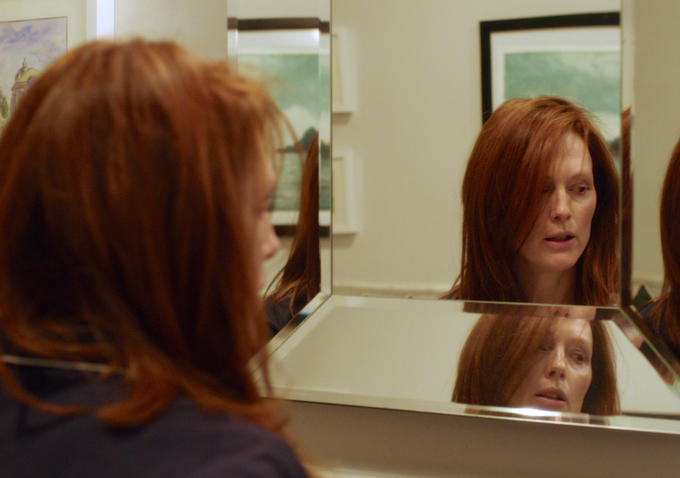
Julianne Moore plays Alice Howland, a 50 year-old woman fighting early Alzheimer's in Still Alice.
Julianne Moore plays Alice Howland, a 50 year-old woman coping with Alzheimer’s in Still Alice.

“I wish I had cancer. At least then people wear pink ribbons for you, and they go on long walks.”

It’s always a question whether it’s possible to have a film about Alzheimer’s Disease that’s watchable. The latest film making that attempt is Still Alice. I believe it does so.

Alice Howland is a 50 year-old woman who appears to have it made: a college professor who just published a book on linguistics, an active person recreationally, a wife to a loving and supportive husband and a mother to three adult children. One of which is married and about to be a mother to twins. However something goes noticeably wrong during a lecture about her book. She has a mental lapse she mistakes for an effect of alcohol. Soon there are more mental lapses, especially while jogging around campus and while giving lectures. Even reintroducing herself to Tom’s girlfriend causes people to wonder. Alice seeks a doctor’s attention immediately. She’s given the news: Alzheimer’s. She’s victim to a gene that brings on Alzheimer’s at an early age.

The family is devastated to hear the news. The children even have to get tested to see if they carry the gene. Anna bares the gene but her yet-to-be-born twins are immune. Nevertheless the family tries to go about the best they can while trying to be a help to Alice. However the changes are as hard for them as it is for Alice herself. Firstly Alice will have to give up her professor job. Going to an Alzheimer’s ward in a nursing and witnessing the patients leaves her upset about her future to the point she plans her own suicide using a marked bottle full of pills and a video file on her computer named ‘Butterfly’ of herself instructing her to take all the pills in the bottle. Family friction happens over time as her husband John notices changes in her thinking and Lydia overreacts after she learns Alice went through her theatre notes.

However things get better over time. John learns how to work with her fading abilities and become patient with her even in the case of her cellphone she misplaced a month earlier. Anna gives birth to the twins and she’s able to hold one of them. Her relationship with Lydia grows as Lydia shares her plays with her and gets Alice to see her perform in Angels In America where Alice feels the play. Even Alice is able to give a lecture to the local Alzheimer’s association where she delivers a speech she wrote herself and uses a highlighter to mark the notes she read as John and her son Tom watch. The speech is near perfect.

Over time she continues to acquire inner strength just as the disease is continuing to impair her brain even further to the point she needs a caretaker while John is gone. However it’s by chance that while her caretaker is away, she comes across the ‘Butterfly’ video on her laptop. She obeys the video and even takes the laptop with her as she searches for the bottle. However the suicide attempt fails as the pills still all over the bathroom floor. The film ends with her still alive but will get you questioning if it ended right.

The film is more than just about Alzheimer’s. It’s about having it at a very young age and trying to be able to deal with it and its debilitating effects. You can’t blame Alice for being distraught on hearing the news, especially when she has so much going for her. Just a bit of trivia here: even though 50 seems awfully young to have Alzheimer’s, we should remember the first subject Dr. Alois Alzheimer studied in the disease that bears his name was a 51 year-old German woman. It almost seems understandable to some that Alice sets her own suicide up to happen when the time appears right. However it’s about acquiring inner strength over time. Yes, Alice’s years are numbered and the disease is taking a toll on her mind and her body but she becomes a stronger person over time. It makes like the suicide attempt look like the wrong thing to do after what she’s fought out.

The movie is also about family relations during Alzheimer’s. For those who have a loved one with this disease, you would know how much it affects the whole family and even hurts deeply. It’s even harder to bear when the gene that causes early Alzheimer’s is present in other family members, just like how it’s also present in Alice’s oldest daughter Anna. The frustrations are there in the Howlands as Lydia doesn’t know what to make when she learns Alice went through her script notes. Even John feels the frustration as being the husband. Nevertheless the family unit becomes stronger over time and they continue to function the best ways that they can. Lydia’s connection with Alice through her theatre work helps Alice still keep in touch with the world even as the disease continues to take its toll. Anna even tries to let the fact she bares the gene not bother her and continue to live her life as a wife and mother of newborn twins. That scene where Alice is holding her grandchild is one of the more poignant moments of the film.

Without a question, the film belongs to Julianne Moore. Her ability to give an Alzheimer’s victim a personality and a will of her own while fighting the destructive nature of the disease has to be the actress performance of the year without an equal. She did a top notch job and deserves the Oscar. None of the supporting performances can pare up to the caliber of Julianne’s performance but Kristen Stewart’s performance of the actress daughter with extreme emotions who connects with her mother through the art of theatre has to be the best of the supporting performances and has more range than even the character of John, despite how good of a job Alec Baldwin does. Kate Bosworth was good as the daughter with the same gene trying to live her life normally but it could have been developed more. Hunter Parrish’s role as Tom the son was the most underdeveloped role in the film but he does a very good job with what little he has. Richard Glatzer and Wash Westmoreland do a good job of directing and writing despite making this film appear to be a film of a single acting role dominating for the most part. I’ll admit I haven’t read the novel by Lisa Genova so I can’t say if they adapted it right or not.

SPOILER ALERT: They say the ending is one of the trickiest things to do in a film. I will have to say the scene of the suicide attempt ended rather flat and led into scenes that will leave one wondering if the film makes it look like a good thing the attempt failed or a bad thing. That scene where Alice is with John having ice cream dwelling on how she used to be very smart will have you wondering as will the end scene where she’s with Lydia and she can hardly talk. It also makes you wonder if it ended right. But I think that may have been the point. I think Richard and Wash ended the film that way so we can make our own judgment whether Alice continuing to live is the right thing or the wrong thing.

Still Alice makes for a very watchable movie about Alzheimer’s even if it does appear at times to be dominated by Julianne Moore’s acting. Nevertheless her role is one that leads to a performance meant to shine and she does just that.