VIFF 2015 Review: In Your Arms (I Dine Hænder)

In Your Arms is a Danish film that's about more than granting someone their wish to die.
In Your Arms is a Danish film that’s about more than granting someone their wish to die.

Let’s face it, films about euthanasia are rarely watchable. However Danish film In Your Arms (I Dine Hænder) succeeds in making a film that’s watchable and even entertaining and touching.

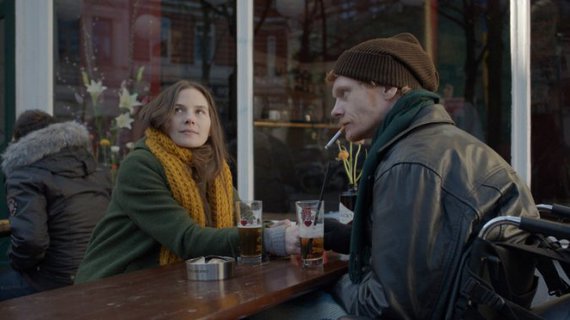
Niels is  a man with a debilitating illness. First it left his legs useless, then its making his arms more useless day by day, and Niels wants to die. Maria is a nurse at Niels’ hospital who longs for freedom, especially after the end of a troubling romance. Maria finds it very hard to be a nurse to Niels, one of her many patients. She finds him very stubborn and selfish, especially after he recently tried to slit his wrists.

Niels has a wish to die. He wants to be taken to a euthanasia clinic in Switzerland. His mother and brother don’t want it, feeling it’s just Niels being selfish again. Maria is reluctant at first but agrees to comply. She has decided to be the one to accompany Niels on his trip from Copenhagen to Switzerland which also consists of a stop in Hamburg, Germany.

After his family bids Niels good-bye, Niels and Maria board the train and it’s there that the two get to know more about each other, such as their likes and their personal lives. In Hamburg, Niels wants to be taken to places where he spent his younger years, especially the restaurants and bars.

During the time, he’s able to meet again with people from the past. Maria meets two key people. One is Niels ex-girlfriend from his ‘Hamburg Days.’ She learns he has a four year-old son. The other is the pub manager. He invites Maria to visit during the night. Maria agrees and it’s over at the pub that night it appears that Maria is able to live again. Unfortunately it comes at a price to Niels as she’s not there to help him first thing in the morning. Niels does not want his son to see him dying so she is able to make Niels watch his ex-girlfriend pick up his son so he can see him for the first and only time in his life.

During the trip, it appears as though the relation of Maria and Niels is growing. Often making one question it’s a friendship or even more. As Maria drives down the wide roads of Germany to the Swiss border, the two decide to take in the nature that they view. Maria even swims in the lake despite how snowy cold the day is. Then they finally reach Switzerland and visit the clinic where Niels wants to end his life. After receiving details of what the following day will entail, Maria spends one last night with Niels. The ending is somewhat predictable and melodramatic but done right.

I don’t think this film is trying to peddle the message of euthanasia, although it’s obvious the film maker has no qualms about it. As for me, I’ll save my view. However it appears the film is not about euthanasia. This looks like many film before it of a dying person spending their last days. Even still I believe it is to do about the relation between the two. At first, both Maria and Niels were polar opposites. He was an ailing patient in the care facility. She was a nurse who just happened to take care of him along with the others. The chances of the two being friends were slim to none but it was that trip that changed it. The film does question whether Niels did love Maria all along or if Maria did love Niels in any which way. The bond of friendship was obvious but was it more than that? I think the film maker wants to keep us guessing. Even despite whatever friendship occurred, Maria knew she still had to honor Niels’ wish even though it would hurt her dearly.

It’s not just about the two together but the two as individuals. Niels has had it with life. The disease has taken away all that he has to live for. Maria longs to live but her job and failures at relationships prevent her. It’s when the two join together on the trip that things become better for them. Niels is able to die content and Maria is able to discover her freedom within herself.

I will admit that this is a rather short film. Nevertheless this is a good melodrama that presents itself well. Samanou Acheche Sahlstrom has written and directed a good drama that centres on the characters both as individuals and as a pair. It’s the bond that occurs during the time of the trip that helps make the story. The acting from both Lisa Carlehed and Peter Palugborg made the story work as well as develop the necessary chemistry for the film. In Your Arms has won two awards at the Gothenburg Film Festival and was nominated for a producers award at the Hamburg Film Festival. Here at the VIFF, it made its North American debut.

In Your Arms may be short and may lack the qualities to make it a film of renown. What it achieves is honest sensitivity and a connection to the story and its main characters.
Movie Review: Still Alice

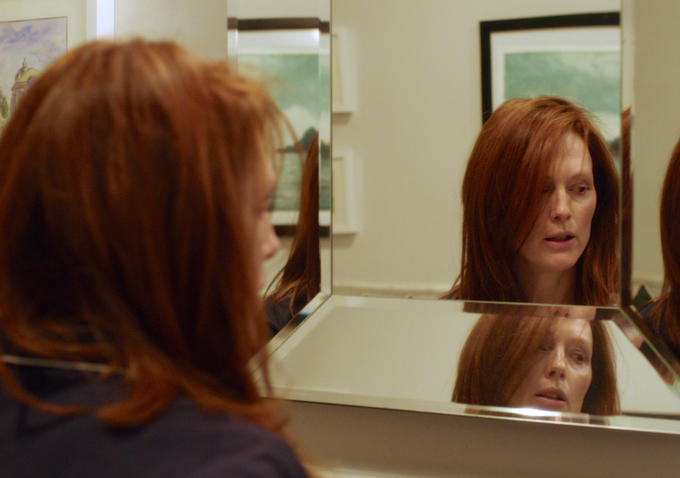
Julianne Moore plays Alice Howland, a 50 year-old woman fighting early Alzheimer's in Still Alice.
Julianne Moore plays Alice Howland, a 50 year-old woman coping with Alzheimer’s in Still Alice.

“I wish I had cancer. At least then people wear pink ribbons for you, and they go on long walks.”

It’s always a question whether it’s possible to have a film about Alzheimer’s Disease that’s watchable. The latest film making that attempt is Still Alice. I believe it does so.

Alice Howland is a 50 year-old woman who appears to have it made: a college professor who just published a book on linguistics, an active person recreationally, a wife to a loving and supportive husband and a mother to three adult children. One of which is married and about to be a mother to twins. However something goes noticeably wrong during a lecture about her book. She has a mental lapse she mistakes for an effect of alcohol. Soon there are more mental lapses, especially while jogging around campus and while giving lectures. Even reintroducing herself to Tom’s girlfriend causes people to wonder. Alice seeks a doctor’s attention immediately. She’s given the news: Alzheimer’s. She’s victim to a gene that brings on Alzheimer’s at an early age.

The family is devastated to hear the news. The children even have to get tested to see if they carry the gene. Anna bares the gene but her yet-to-be-born twins are immune. Nevertheless the family tries to go about the best they can while trying to be a help to Alice. However the changes are as hard for them as it is for Alice herself. Firstly Alice will have to give up her professor job. Going to an Alzheimer’s ward in a nursing and witnessing the patients leaves her upset about her future to the point she plans her own suicide using a marked bottle full of pills and a video file on her computer named ‘Butterfly’ of herself instructing her to take all the pills in the bottle. Family friction happens over time as her husband John notices changes in her thinking and Lydia overreacts after she learns Alice went through her theatre notes.

However things get better over time. John learns how to work with her fading abilities and become patient with her even in the case of her cellphone she misplaced a month earlier. Anna gives birth to the twins and she’s able to hold one of them. Her relationship with Lydia grows as Lydia shares her plays with her and gets Alice to see her perform in Angels In America where Alice feels the play. Even Alice is able to give a lecture to the local Alzheimer’s association where she delivers a speech she wrote herself and uses a highlighter to mark the notes she read as John and her son Tom watch. The speech is near perfect.

Over time she continues to acquire inner strength just as the disease is continuing to impair her brain even further to the point she needs a caretaker while John is gone. However it’s by chance that while her caretaker is away, she comes across the ‘Butterfly’ video on her laptop. She obeys the video and even takes the laptop with her as she searches for the bottle. However the suicide attempt fails as the pills still all over the bathroom floor. The film ends with her still alive but will get you questioning if it ended right.

The film is more than just about Alzheimer’s. It’s about having it at a very young age and trying to be able to deal with it and its debilitating effects. You can’t blame Alice for being distraught on hearing the news, especially when she has so much going for her. Just a bit of trivia here: even though 50 seems awfully young to have Alzheimer’s, we should remember the first subject Dr. Alois Alzheimer studied in the disease that bears his name was a 51 year-old German woman. It almost seems understandable to some that Alice sets her own suicide up to happen when the time appears right. However it’s about acquiring inner strength over time. Yes, Alice’s years are numbered and the disease is taking a toll on her mind and her body but she becomes a stronger person over time. It makes like the suicide attempt look like the wrong thing to do after what she’s fought out.

The movie is also about family relations during Alzheimer’s. For those who have a loved one with this disease, you would know how much it affects the whole family and even hurts deeply. It’s even harder to bear when the gene that causes early Alzheimer’s is present in other family members, just like how it’s also present in Alice’s oldest daughter Anna. The frustrations are there in the Howlands as Lydia doesn’t know what to make when she learns Alice went through her script notes. Even John feels the frustration as being the husband. Nevertheless the family unit becomes stronger over time and they continue to function the best ways that they can. Lydia’s connection with Alice through her theatre work helps Alice still keep in touch with the world even as the disease continues to take its toll. Anna even tries to let the fact she bares the gene not bother her and continue to live her life as a wife and mother of newborn twins. That scene where Alice is holding her grandchild is one of the more poignant moments of the film.

Without a question, the film belongs to Julianne Moore. Her ability to give an Alzheimer’s victim a personality and a will of her own while fighting the destructive nature of the disease has to be the actress performance of the year without an equal. She did a top notch job and deserves the Oscar. None of the supporting performances can pare up to the caliber of Julianne’s performance but Kristen Stewart’s performance of the actress daughter with extreme emotions who connects with her mother through the art of theatre has to be the best of the supporting performances and has more range than even the character of John, despite how good of a job Alec Baldwin does. Kate Bosworth was good as the daughter with the same gene trying to live her life normally but it could have been developed more. Hunter Parrish’s role as Tom the son was the most underdeveloped role in the film but he does a very good job with what little he has. Richard Glatzer and Wash Westmoreland do a good job of directing and writing despite making this film appear to be a film of a single acting role dominating for the most part. I’ll admit I haven’t read the novel by Lisa Genova so I can’t say if they adapted it right or not.

SPOILER ALERT: They say the ending is one of the trickiest things to do in a film. I will have to say the scene of the suicide attempt ended rather flat and led into scenes that will leave one wondering if the film makes it look like a good thing the attempt failed or a bad thing. That scene where Alice is with John having ice cream dwelling on how she used to be very smart will have you wondering as will the end scene where she’s with Lydia and she can hardly talk. It also makes you wonder if it ended right. But I think that may have been the point. I think Richard and Wash ended the film that way so we can make our own judgment whether Alice continuing to live is the right thing or the wrong thing.

Still Alice makes for a very watchable movie about Alzheimer’s even if it does appear at times to be dominated by Julianne Moore’s acting. Nevertheless her role is one that leads to a performance meant to shine and she does just that.

Movie Review: The Room (2003)

There’s one thing about really bad movies. Most of which get lost into oblivion. Many bad Hollywood movies get to be laughing stocks forever. And then there are some that develop a cult following often as audience participation movies. The most legendary is the Rocky Horror Picture Show: the raunchy musical that made no sense and lives on as an audience participation free-for-all. There hasn’t been a movie that could replace the Rocky Horror Picture Show or even rank well with it. There was an attempt from 1995’s Showgirls many years earlier but it didn’t pan out. The latest one to enter the flock is 2003’s The Room. It has developed a huge cult following too. But will it replace the Rocky Horror Picture Show in terms of being an audience participation phenom?

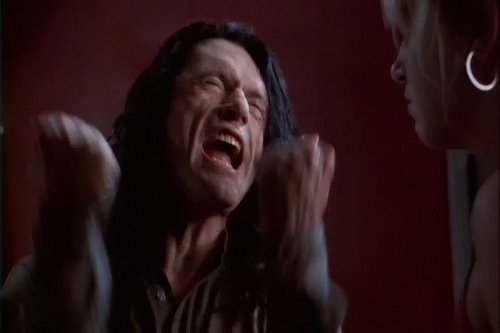
The film was written, directed and produced by Tommy Wiseau who also plays the lead character Johnny. The film stars as Johnny comes home to his fiancee Lisa. He’s a successful banker with a loving relationship with Lisa who’s a successful real estate agent. His young friend Denny, an orphaned kid with a troubled upbringing, comes to visit but has to leave because of… you get the idea. After Johnny leaves, we learn Lisa is bored with Johnny and is more interested in Mark, his best friend. Lisa and Mark end up making more than love, so to speak. Lisa’s mother insists that she marries Johnny because of his stability. Later Johnny doesn’t get the promotion promised to him. Johnny later learns of talk from Lisa’s best friend that things aren’t going right and start suspecting things. Johnny soon finds out that Denny has been getting into drugs. Not even Johnny’s friend Peter, a psychologist, can help him with his issues. Finally Johnny’s surprise birthday party happens and the truth comes out. At the end Johnny commits suicide and Mark tells Lisa how selfish she is over Johnny’s dead bloody body.

Okay you can draw out your own conclusion through my description of the movie. But the key ingredient towards its awfulness has to be the lines. Laughing moments happen more often than they should. Playing football happens at the most awkward times. ‘Future wife’ is said instead of ‘fiancee.’ “Everything’s going to to be fine” is uttered more often than it should. But the real creme de la creme of lousiness comes with the lines uttered only once: “You’re tearing me apart, Lisa!” “I feel like I’m sitting on an atomic bomb waiting for it to go off.” “Everybody betrayed me! I fed up with the world.” “You betrayed me… you that good… you, you’re just a chicken, chirp-chirp-chirp-chirp, cheep, cheep.” “Why Lisa, why? Please talk to me! Please!” Yeah, that bad. If the bad lines weren’t enough, there were also fight scenes that looked like they weren’t coordinated at all, cinematography that was bad, story lines that made no sense at all, and love-making scenes set to R&B music that came across as cheesy as hell. Even the end scene as people cry over Johnny’s dead body leaves the audience laughing. All this made over a budget of $6,000,000? And to think Tommy first tried to market it as a drama but then marketed it as a black comedy. That adds to its weirdness it’s already garnered.

You’d think a movie like that would be too insufferable to watch, right? Well some people somewhere sometime ago turned this into an audience participation movie and that’s where its success came. People dress up as their favorite characters. People throw things around like spoons, food and footballs during certain scenes.  People say “Hi…” and “Bye…” whenever a character enters or exits. People hurl insults and lewd comments during the scenes. People shout “Go, go, go!” during the landscape shots. People also reenact the cheesy lines as they come during the movie. It’s a lot like Rocky Horror. Over at the screening I saw at Vancouver’s Rio Theatre, there was one host dressed up as Tommy Wiseau reenacting his voice and holding an impression contest before the movie was aired. The theatre was filled with mostly twentysomethings; some dressed up as the characters. In the end, the movie is not the same without the audience participation. Sure you could watch it alone on your DVD and laugh but it’s not as fun without the crowd.

It’s already garnered a cult following in the last few years. Will The Room ever achieve the same cult status as Rocky Horror? I doubt it. It hasn’t stood the test of time that Rocky Horror has. The Room’s test of time is something only the future will tell. Also while I’ve never heard of any cast or crew from Rocky Horror often showing up at screenings, occasionallyTommy Wiseau will make a guest appearance at certain screenings of The Room. He wasn’t here in Vancouver, at least this time.

In conclusion, it’s no wonder that The Room is labeled the Citizen Kane of bad movies. The cult following of audience participation is a celebration of its lousiness and makes for a fun night out at the movies. Prepare to laugh like you never laughed before.