VIFF 2025 Shorts Segment Review: Forum 3 – The peripheral core

One thing about being into cinema is that it will give you a liking for short films. I saw a second segment or forum of shorts at the VIFF entitled The peripheral core. This segment, the third Forum segment, consisted of eight films that are very similar, very different, but tell a lot.

-Resistance Meditation (dir. Sara Wylie): In this documentary, we see a woman (possibly director Wylie) sleeping in bed. As she sleeps, Wylie talks about sleeping and how the time on the clock we follow is ‘corporate time.’ As she lays in bad, we learn she has a disability and she calls her sleep here ‘crip time.’ It’s not just for her sleep, but to rebel against the demands of the capitalist world.

Simply put, this is a five-minute documentary where the filmmaker has something to say. Although I don’t completely agree with her opinion about ‘corporate time,’ I like how she makes her statement in a creative way. It makes sense to present filming of sleeping and her speaking her belief about time, disability and rebelling against it.

-A Very Straight Neck (Japan – dir. Neo Sora): A woman wakes up from her sleep and has terrible neck pain. The dream she has haunts her. Her dream was she was lying face-down on the sidewalk of a busy street and the world passes around her. Even crumbling out of its existence in her mind.

This is a picturesque short film which the focus is on unspoken images and the main character narrating in the background. The biggest quality is the visuals as it adds to the story and creates the mood of what she’s trying to say. Sometimes we can understand the pain she’s going through. Very well done.

-Not Enough for the Love Inside (Brazil – dirs. Marcelo Matos de Oliveira and Wallace Nogueira): Cassio and Otto are both gay couple in Bahia, Brazil and both became blind recently. Cassio is unemployed while Otto is able to participate with a theatre group. Through all that happens in the story and Cassio’s body language, one can’t help but notice the relationship appears doomed to end.

The biggest quality of the film is the body language. I don’t know if both became blind from the same incident or from separate incidents, but you can understand how sudden changes can affect a relationship. The body language in the film is as valuable to the story as the dialogue itself. It creates the negative vibe of a relationship that is starting to fall apart.

-The Sphinx (USA – dir. Jesse Pavdeen): Harold is a young adult locksmith by profession, but he has a problem. He was born without a nose and he needs to wear a prosthetic. His nose falls off during a date, but his date doesn’t mind. She encourages him to come to a party. Things get worse when the people at the party want him to show ‘his true self.’ He takes his nose off and they all laugh. He runs to his estranged mother’s house, but she has the door locked with seven locks. Meeting with his father exposes the secret.

When you have short films, you should expect a bizarre comedy or two. Harold is seen as The Sphinx as The Sphinx itself has its nose missing. I’ve seen stories of missing body parts or weird body parts before, but this comedy does a unique job in showing one young man’s flaw and how the world treats him. Even his mother who has cut herself off from everyone. It’s a bizarre story that’s humorous too.

-Confluence (Canada – dirs. Charlene Moore and Oliver Darrius Merrick King): This is a documentary made by Indigenous members of the Winnipeg Film Group for their 50th anniversary. As images of parts of Winnipeg are shown on screen, the Indigenous members of the Group talk about various topics like their land and colonizing, being an Indigenous person, filmmaking as an Indigenous person and even envisioning the future and pondering ideas of what to film next.

I’m from Winnipeg and I remember the Winnipeg Film Group and how it took a modest area in an office building back in the 1990’s. The Group has grown a lot. This documentary is important because in recent decades, the Indigenous peoples are getting more into the arts and holding their own. Film has a bright future in Winnipeg, but the Indigenous filmmakers show the most promise and most envisioning. It’s good to hear them speak their minds about the topics as we view images of Winnipeg.

-In My Hand (Norway – dirs. Marja Helander and Liselotte Wajstedt): The film begins with a re-enactment of Norwegian Sami activist Niillas Somby waking up in prison with his amputated arm bandaged. Niillas narrated how he spent 21 years in prison and was involved greatly with Sami activism. He also talks of the accidental battery explosion from 1981 that led to the loss of his arm. He also talks of the time he went to Canada cleverly disguised as a white man and with a fake passport. The film ends in the present with present-day Niillas and today’s Sami activists.

This is another film that showcases the racism felt by a nation’s first peoples. In this case, it’s the Sami peoples of the Nordic nations. Niillas Somby tells his story about what it was like to be a Sami activist and of some of the illegal things he did in his life. We hear Somby narrate as the moments are re-enacted in front of us. This is a valuable story in learning about their struggle and has a message worth hearing.

-Cocotte Coulombe, Filmmaker (Canada – dir. Charles-Francois Asselin): Charles-Francois has always known his unmarried deaf aunt Cocotte. He does remember her bringing a film camera to family events. It’s after her death that he discovered she had taken lots of family films. As he watches the family films of hers, he discovers this was they way she communicated her love to them.

This documentary is great at telling its story. Cocotte’s family films play in the background as Charles-Francois tells his story of Cocotte and his recent discovery of the films. It’s an intimate story of how a film maker himself learns how home videos were not just a hobby for Cocotte, but also the means for a deaf family member to show her love to them. It was nice to watch.

-We Were The Scenery (USA – dir. Christopher Radcliff): In 1978, Hoa Thi Le and Hue Nguyen Che were Vietnamese refugees in a refugee camp in the Philippines. During that time in that same place, Francis Ford Coppola was filming Apocalypse Now and wanted to use the refugees as extras for the film. Le and Che rewatch Apocalypse Now and during the scenes, they point themselves out and mention of other people they knew personally as their appearances come on screen.

This is one documentary one would not expect. Most of us who saw Apocalypse Now probably never bothered to notice the extras were from a Vietnamese refugee camp. It was great to hear the story of how a couple who are married were those very extras and they saw it as just a way to make some extra money. It’s also a smart choice the director had them tell their story in Vietnamese. Although they are now American citizens, telling their story in Vietnamese only adds to this documentary.

And that was my experience with the short films from Forum 3: The peripheral core. Interesting how with this forum, five of the eight films were documentaries. Although I prefer watching live-action, I still found the documentaries intriguing to watch. Whatever the documentaries had to say, they said it well in their own way. For the live-action, they were unique to watch as well.

VIFF 2019 Review: Spider (Araña)

Spider
Spider is the Chilean drama of a neo-Fascist group in pre-1973 Chile whose memories haunt its former members 45 years later.

Spider is Chile’s official submission for this year’s Academy Award for Best International Feature Film. The film will touch a raw nerve with Chileans due to its set in history.

The film begins in modern-day Chile. Out of nowhere, a purse-snatching happens. A man in a vehicle notices and tries to chase down the snatcher. The snatcher tries to avoid him, but Gerardo makes a turn into a concrete wall and crushes the snatcher to death. When the police arrive, they find a lot of guns and ammunition in the car. They also learn of his identity and arrest him.

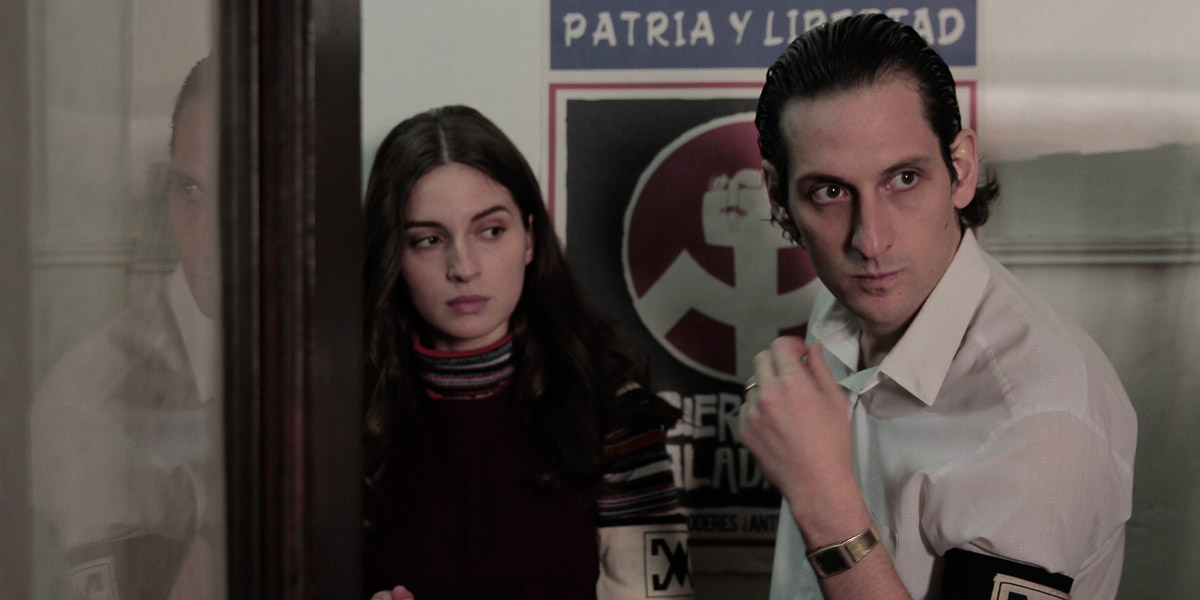
That same day, Ines, a powerful businesswoman, arrives home tired after a long day. She learns from her husband Justo about the arrest. Both of them know the man. His name is Gerardo, and they’re surprised he’s still alive. Gerardo is known as a member of the former group Fatherland And Liberty. This is a group Ines and Justo belonged to back in the 1970’s along with Gerardo. While incarcerated, Gerardo is given a psychiatric evaluation. Ines arrives at the department of justice and is unhappy about just a simple psychiatric evaluation. The man in charge is asking what Gerardo did to her.

The film flashes back to 1969 in Santiago. Salvador Allende, a Socialist, became the democratically-elected president of Chile. At that time, Ines, Justo and Gerardo were all young adults. Ines was a beauty pageant contestant. Justo was her boyfriend at the time. Gerardo was a judge for the pageant. At the pre-contest interview, she charms Gerardo. As the two appear to drive home, they see Gerardo on the sidewalk and ask about him. They learn of his involvement with the Chilean air force and invite him to join their political group.

The group they are a part of is the group Fatherland And Liberty: a far-right fascist group which bears a spider-like figure as their symbol. They’re against traditional politicians and they’re especially opposed to the Allende government, fearing that Chile will become Communist like Cuba.

Returning back to the present, Gerardo is under psychiatric evaluation. Every time he is questioned by the attractive nurse, he appears to be making passes at her. Meanwhile Ines is trying to negotiate with the government agency against having the past involvement of her and her husband with the group. The man she’s dealing with wonders how big of a problem can this be for her? She tells the facts.

Flashing back to the past, the group did a lot of violent acts. They painted over images that appeared pro-Socialist like those of Che Guevara. They disrupted any pro-Allende events and start riots with Marxist supporters. They started their own military group with their own manifesto. They also caused destruction and explosions through their political motives. Gerardo even commits to shootings. They had a goal of overthrowing the Allende government. They all believed they were doing the right thing and believe they will be seen as heroes of Chile. During the time, the romance between Ines, Justo and Gerardo get in a heated love triangle. Then one day in the summer, Gerardo decides to fake his disappearance and make it appear like he crashed his plane. The group receives the ‘news’ and he’s seen as a martyr.

Back to the present, Ines is hugely concerned about what news Gerardo will bring about. Justo is so upset over the news, he starts to suspect if Ines still has romantic feelings towards Gerardo. Gerardo appears in his psychiatric interviews to show no remorse of his killings. He feels he did the right thing each and every time. Gerardo is still incarcerated, but notices how the other native Chileans are assaulting a Haitian emigre.  Word is out how Gerardo has become a hero in Chile thanks to social media. Gerardo then breaks out. The first place he goes is to the house of Ines and Justo. Only Ines is there to confront him. The film ends appearing like the past returned for Gerardo and appearing the past is buried for Ines and Justo.

The film touches on a moment of Chile’s history. Allende was democratically elected in the late 1960’s, but there was nervousness with him being a Socialist both in the USA and abroad. For those that don’t know, Allende was assassinated in a CIA-led coup in 1973 and replaced by Pinochet who ruled like a ruthless dictator until he voluntarily stepped down in 1990. The fear of Allende being Socialist did touch at home in Chile too. Even though Allende was democratically-elected, there was fear Chile would be a Communist country just like Cuba.

The Fatherland And Liberty (Patria y Libertad) group did exist in real life. They are the radical right-wing activist group that emerged after Allende’s election. They attempted to overthrow the Allende government in June of 1973, but failed. They had collaboration from Chilean Armed Forces to sabotage infrastructure. The two banded together to assassinate Allende’s naval aide and cause a power outage as Allende broadcast a speech. The group disbanded on September 12, 1973: the day after Pinochet’s coup assassinated Allende.

Right now, Chile should be a free democracy. If they are not 100%, they should have way more freedoms since Pinochet was deposed in 1989. However the film gives an impression that Chile still feels a lot of the scars of the past 50 years. Chile may be a democracy and may have done a lot since the fall of Pinochet to become more democratic and give the people more freedoms and a better quality of life, but there’s still the feel there’s a lack of freedom. That’s evident by the violent protests that have made news in recent weeks.

Sometimes I feel like the film is saying the ghosts of Chile’s past have come to haunt them. Even how three people from a neo-Marxist group of the past would reunite involuntarily. The ending of the film does get one thinking. Especially as the past appears to be over for one while coming back for another. The film is, in a sense, a fictional story within a real-life moment of history. The Fatherland And Liberty group did exist from the start of Allende to his end. The film has three different people. There’s Gerardo who appears silent and harmless on the outside, but a nasty killer deep inside. There’s Ines, who was young and full of strong beliefs as she was young, but grew up and moved on. There’s Justo who appears to have moved just like Ines, but appears like he can’t once he receives the news of Gerardo’s return. The ending is a shock, but it seems to suit the personalities of all three. Gerardo appears he will only appear to be known for his killings. While Justo and Ines appear to put the past behind them and become two of love and for a better Chile. Note I say ‘appear.’

This film is another good film by director Andres Wood. Chile’s political past is a common theme in a lot of Andres’ works. This story, which is scripted by Guillermo Calderon, is a good story that sends a message of modern-day Chile still being haunted by its turbulent past. The story does often seem more story-driven than character-driven at times. The actors, both the older and the younger actors, do a good job in playing their parts well. Mercedes Moran is best as the older Ines who has a past to hide and is determined to hide it. She’s also good as the woman best at settling the score between Gerardo and Justo. She knows Gerardo will never be good at loving and only good at killing. Marcelo Alonso is also good as the older Gerardo who hasn’t lost his sense to kill and to think that he is right in doing so.

Spider is a fictional telling of a real neo-Fascist group in Chile of the 1970’s. However the film appears it’s trying to send a bigger message of a moment in Chile’s history that has left scars in the nation not even its current democratic system can heal.

WORKS CITED:

WIKIPEDIA: Fatherland And Liberty. Wikipedia.com. Wikimedia Foundation Inc. 2019.<Fatherland And Liberty>

VIFF 2018 Review: Theatre Of War (Teatro de Guerra)

Theatre of War
Theatre Of War features six soldiers from the Falklands Islands War telling their stories of battle and aftermath.

Many people will consider the Falkland Islands War of 1982 a ‘forgotten war.’ Theatre Of War will show you six men who can’t forget it: the soldiers.

First off, I’ll answer what most of you are already asking; What are the Falkland Islands and why was a war fought over them in 1982? The Falkland Islands are a set of islands 300 miles east of the coast of Argentina. They’re 4,700 square miles wide and the population is almost 3,400. The islands were discovered by Europeans starting in the 16th century and were thought to be uninhabited. It was in the 18th century when Europeans started making the islands inhabitable with the French inhabiting the east island and the British inhabiting the west island. France eventually surrendered its ownership to Spain years later. The British captured the east island a year later, but a war was never started. Over time, the Spanish took over and the Argentineans, who refer to the islands as the Malvinas, attempted a garrison in the 19th century. Over time, the British asserted their rule over the land in 1832.

It would continue to be under British rule even though the Germans sought to own it in 1912. Naval conflict abounded with the British winning. However the Argentineans started another garrison in 1982: 150 years after British rule was declared. It was then Prime Minister Margaret Thatcher started what would be remembered as the Falkland Island War. The war lasted 10 1/2 weeks and left over 900 dead. The UK won the war and British rule was reasserted.

In this documentary, we are introduced to six men: three British, three Argentinian. On the British side is Lou Armour: marine corporal, David Jackson: a young soldier at the time, and Sukrim Rai: a Nepalese immigrant who fought for the UK. On the Argentinean side is Gabriel Sagastume, Marcello, Marcelo Vallejo and Ruben Otero. Throughout the film, they tell of their experiences of what it was like to go to war at such a young age. Lou Armour actually led the British Marines. They also talk of the struggles they’ve had with their lives in the years that followed. A lot of them tell of their stories of dealing with post-traumatic stress disorder, especially when it came into their lives quite late.

The unique thing about this documentary is that they don’t just talk about their stories. Very often, they act out their stories. We see all six at the pool and one talks of an incident in 2004 when he nearly drowned himself. We see two at an empty discotheque as one tells of his story of loneliness in a bar. We see one British and one Argentinean soldier showing copies of magazines published around the time of the war. It’s interesting what each magazine had to say. We see one Argentinean use tiny plastic army men to tell the story of how Argentinean soldiers first claimed the Falkland Islands and the battle that started the war. We see the six in a rock band as one ‘singer’ shouts out “Have you ever…” and tells of instances only a soldier can ever experience both in battle and in post-battle life.

However this wasn’t just simply a vanity effort what they were doing. The six also visited Argentina to tell their stories. There were times the six went to schools together telling children their stories of the war. There were times they even had to answer questions from the children. However the most interesting moment came near the end. The soldiers had six 18 year-old Argentinean men dress up like them to re-enact a moment from the war. As the soldiers were dressing them up in their war uniforms or applying scar make-up, they were telling their stories. One even showed another what it was like to wield a knife in battle. It’s interesting as they told their stories to the boys, it showed the luxury these 18 year-old boys of today have. They don’t have to be called up for battle. They can live their care free life. That was made evident just as it led to the end scene where the young men re-enacted the battle at the former soldiers’ directions.

The unique thing about this documentary is that it shows the foolish side of war. We have six men from both sides and they tell their stories. They made to be made to look like heroes in their own country but they don’t feel like heroes. They even made spoof of the political situation behind it. One scene includes soldiers in face masks of Margaret Thatcher and the Argentinean president locking lips. The film even showed that this is of a war in which the opposite sides can have a peaceful disagreement. We see that in one scene where an Argentinean and a Brit talk of the history of the Falklands/Malvinas. Both feel strongly that those islands belong to their country, but they’re able to disagree peacefully without enmity or even a fistfight.

The interesting thing is that these six soldiers did this documentary just as they were about to perform in an onstage docudrama called ‘Minefield.’ Before they performed in the play, they had the opportunity to do all this. The soldiers reunited and sorted out their differences. They went to places where they experienced these traumatic events in their lives to recreate the moment. They went to schools to educate the young children of Argentina. They even met with six young Argentinean men to give them the experience of what it is to fight in a war about a set of islands none of them really knew. This is an important docudrama worth seeing because it does tell you a lot of how a simple war that lasted three months can change lives forever, most for the worse. The film doesn’t simply show how foolish fighting over a small set of islands are, but makes other wars of past look foolish too.

Lola Arias did a very good job in creating a meaningfully documentary of what many consider a meaningless battle. Lola takes a lot of incidents from the school visits, the meeting with the young actors, the on-stage work, and various scenes solely for the documentary and brings it all together. It’s pieced together in a mixed way that may seem like it doesn’t go in a straight pattern. Maybe Arias had her reasons for doing so. She does however include a lot of important scenes and a lot of poignant moments throughout the documentary. It may not appear to have ended in a solid manner but the whole documentary tells a lot.

Theatre Of War isn’t just about six soldiers coming together, settling their differences and making peace. It’s an important reminder of that war and it shows how war is something you can’t leave behind. Even long after you’ve dropped your guns.