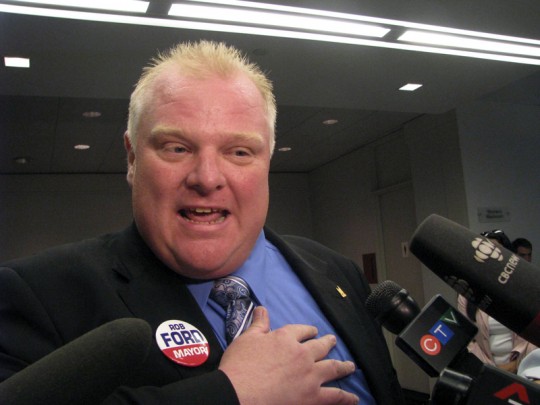
The Rob Ford Fiasco

Rob Ford, always a controversial figure, faces his biggest controversy thanks to Gawker.

Most of you outside of Canada or even Ontario have a bit of an idea about the Rob Ford fiasco happening there but aren’t too clear who Rob Ford is. Us Canadians on the other hand can’t walk away from it. It’s here, it’s there, it’s everywhere. But what is it and why should it matter for all of Canada? Even for a Vancouverite like myself?

NOTE: I’m sure there are many Torontonians and Ontarians that will find my article too simple. Fact is I have many followers from around the world. The point is to explain the situation to those who don’t know who Rob Ford is and what the fiasco is about. Besides I’m from Vancouver so I’m not all too familiar with Rob Ford myself.

Rob Ford was elected mayor of Toronto back in 2010 and assumed office in December of that year. He was a Toronto City Councilor for Etobicoke North the previous ten years. Rob comes from a political family with his father owning the business DECO Labels And Tags (which Rob, his mother, and his other three brothers direct) and a former Member of Provincial Parliament and his brother Doug Jr. has assumed the role of Etobicoke North City Councilor upon Rob’s election of Mayor of Toronto. He’s a huge favorite of popular hockey voice Don Cherry who was at his mayoral inauguration in a pink suit.

Ask any Torontonian and they will tell of Ford’s controversial politics as mayor. At his best, he’s against excessive government spending and calls for the ‘end of the gravy train’. At his worst, he will make opposition to policies leaning more to the left much to the chagrin of many Torontonians. He’s been long known for voicing his opinions leaning towards the right, much to the annoyance of a highly liberal city like Toronto. However it’s been his attitude and his outspoken comments and actions that had already made Ford notorious even before the whole recent Crack-smoking scandal. Having his own talk radio show on Toronto air waves may have something to do with it. As for his political verbal outbursts and such, hmmm, where do I start:

  • In 2002 he got into a fight with fellow councilor Giorgio Mammoliti and called him a “Gino-boy”, leading him to charges of racism.
  • In June 2006, he spoke out against a city donation of $1.5 million to prevent AIDS by responding: “If you’re not doing needles and you’re not gay, you wouldn’t get AIDS probably.”
  • In March 2007, Ford made comments about cyclists use of roads saying: “Roads are built for buses, cars and trucks, not for people on bikes. My heart bleeds for them when I hear someone gets killed, but it’s their own fault at the end of the day.”
  • In March 2008 he said at a council meeting: “Those Oriental people, they work like dogs. They work their hearts out. They are workers non-stop. They sleep beside their machines. That’s why they’re successful in life. I’m telling you, the Oriental people, they’re slowly taking over.”
  • He’s been involved in many publicized incidents while driving including reading and talking on his cellphone.
  • He asked city officials to approve drainage and road repairs outside the DECO Labels And Tags headquarters before it’s 50th anniversary party in August 2012.
  • He was accused by CBC political comedian Mary Walsh for saying the F-word during one of her impromptu interviews with him.
  • In May 2012, he was accused by news reporter Daniel Dale of cornering him and threatening to punch him. He’s frequently referred to journalists as ‘scumbags.’
  • Even a month ago, he blurted out the F-word after accidentally being hit in the face by a camera. It was caught on camera and was shown on The Jimmy Kimmel Show.

Okay now you know what he’s like as a reckless politician. Now to see where all this crack-smoking fits in. Ford has had his brush with substances. He was arrested in 1999 in Miami for DUI and marijuana possession during his mayoral campaign. In 2006, Ford was accused of getting drunk at a Toronto Maple Leafs game and verbally assaulting the couple in front of him. In March 2013, former mayoral candidate Sarah Thomson accused Ford of touching her inappropriately and even suggested in a radio interview he was on cocaine. Even a Toronto City Councilor ask Ford to leave a function two weeks later because he appeared intoxicated.

Hard to believe all this that happened was just a forerunner to the ultimate, thanks to the website Gawker. Gawker claimed they had a video of Ford smoking crack cocaine from a Toronto Star reporter taken from a smartphone. Gawker said it appeared to show Ford in a clearly lit room although they also claim they can’t verify the authenticity of the video. Gawker even claimed the reporter asked for $200,000 for release of the video. Fact or fiction, the news sparked a heatwave of debate and talk all over Toronto. The heat could have come either because there’s so much opposition towards Rob Ford in Toronto or since it comes on the tails of another Canadian political scandal: senator Mike Duffy’s resignation after an expense controversy. Even Ford got into the act by claiming that the video is not true. Nevertheless this is rare for a scandal in Toronto politics to have all of Canada watching.

UPDATE: The last 48 hours have consisted of even juicier news on this. The man who reportedly showed Gawker the alleged video was recently murdered. Many councilors have since resigned over the controversy yesterday in which Ford called: ‘business as usual.’ This could lead to a bigger scandal than one thinks and could lead to Ford’s resignation in the future.

What will happen to Rob Ford after this incident and the aftermath remains unclear. He is still mayor of Toronto and shows no signs of resigning. The video is still unseen and still continues to make news. More news is expected to continue to unravel over the next days or weeks.

However the next election could tell the results. Ford might even resign before the election. I’m sure with Toronto having 2 1/2 years of experience with him, many thousands have already made up their minds should ford run for re-election. Also this incident shouldn’t really matter for all of Canada but it does show we can have some crazy politicians of our own.

WORK CITED:

WIKIPEDIA:Rob Ford. Wikipedia.com. 2013. Wikimedia Foundation Inc.  <http://en.wikipedia.org/wiki/Rob_Ford>

Britsh Columbia Civic Elections: Not Much Change Noticed

If you live in one of the cities of British Columbia, you may have had to place your vote in this year’s civic election. It’s that time every three years where the B.C. Cities head out to decide their mayor, their school trustees, and their city councilors. Nevertheless it’s always the mayoral election that catches the most attention, especially for the mayor of the City of Vancouver. Whatever the situation, most major cities had very little change in terms of the mayor elected. The biggest changes happened in the smaller cities on the outskirts of Greater Vancouver or in the smaller towns. Here’s a brief wrap-up of which mayors are staying and which are leaving:

RE-ELECTED

VANCOUVER – Gregor Robertson

HIs three-year term of mayor has received huge publicity. It came as he was mayor while Vancouver was the Olympic City and mayor during the time of the Stanley Cup finals. His three-year term as mayor has come with many ups and downs. He sponsored HEAT (Homeless Emergency Action Team) to aid the homeless problem and provide shelters. It has helped the problem to an extent but has faced its own funding issues. He praised the opening of the Canada Line but criticized the construction process. He has mandated for Vancouver to become the “Greenest City on Earth’ but has been criticized for approving the construction of bike lanes down Dunsmuir from Beatty to Hornby. He has headed an amendment for borrowing almost half a billion to fund the 2010 Olympic Village without taxpayers input. He has also made some unguarded comments about Premier Gordon Campbell at a public introduction and profanity-laden comments about the rival civic party NPA which were broadcast on Youtube. He has even admitted partial responsibility for the 2011 Vancouver Riots.

In the 2011, he and his Vision Vancouver party faced stiff rivalry from councilor Suzanne Anton and rival party NPA and Ellen Woodworth and COPE. On election night, Robertson was re-elected mayor with all but two of the council seats won by Vision. The other two seats were won by the NPA party. Vision also kept the control of the Park Board and the School Board. Robertson promises in his term an aggressive agenda to try to end homelessness, raise the profile of green issues and tackle housing affordability.

BURNABY – Derek Corrigan

The election was known more for the forming of a new civic party than of the party that was expected to win. When Burnaby school board passed an anti-homophobia policy, many Burnaby parents were unhappy and formed the Burnaby Parents Voice party with five school board candidates in an attempt to strike down the policy. In the end, it was the left-leaning Burnaby Citizens Association headed by Mayor Derek Corrigan that swept everything, and for the second election in a row. Despite the lack of opposition, Corrigan says he and his Citizens Association will be open, transparent and anything but complacent about ideas and issues.

NEW WESTMINSTER – Wayne Wright

Being a resident of New Westminster, this was one election that was able to distract me from that of the City of Vancouver. Wayne Wright won for the fourth straight time and his win was double the number of votes of his closest rival James Crosty. The downside of the election was that there was only 24% voter turnout. Shame. Wright has been known to push for development in the city, especially after the loss of three pulp mills and the Labatt’s Brewery in the past decade. The last three years have seen a lot of development completed or taking shape like the completed shopping area and the business sector under construction at the Brewery District, the New Westminster Station shopping center which is to be opened next month, the New Westminster Civic Centre which has just started construction and a Pier Park project in the works.

SURREY – Dianne Watts

Her re-election to the mayor’s office was not a surprise. She had already won twice before. What was a surprise was that her Surrey First party swept all the councilor seats and won 81% of the vote. She plans to develop its City Centre into a ‘Second Downtown’ for Greater Vancouver with a new library and City Hall. She also plans to add more police presence and firefighter presence in the city and well as services for at-risk youth and a child advocacy center. She also plans for more seniors services and for more transit access in the city.

RICHMOND – Malcolm Brodie

It was Brodie again for the fourth straight election. His win may not have been the most decisive of the night but it was the quickest of the night. The biggest civic issue he plans to tackle is growth, especially around the Canada Line. He plans on working out an aggressive affordable housing strategy along with ensuring the number of green spaces and recreational facilities.

COQUITLAM – Richard Stewart

Richard Stewart’s biggest pre-election headlines weren’t about the campaign or his issues but about being hit by a car a week ago while campaigning. Despite an aggressive rivalry from Barrie Lynch, Stewart won the election.

NANAIMO – John Ruttan was re-elected mayor of Nanaimo with a convincing win. The council has a mix of some familiar faces and some new faces. This was another city with another low voter percentage: 26%.

VICTORIA – Dean Fortin

Fortin was re-elected for a second term. The capital region saw very little change in the leadership. There were some changes of councilors but most of the original councilors as well as the city’s mayors remained the same.

NEWLY ELECTED

WHISTLER – Nancy Wilhelm-Morden

Wilhelm-Morden won the mayor’s seat beating out incumbent mayor Ken Melamed: 2636 votes to 610. The city’s biggest issues were the transit problems, assisting business, trust between the community and city hall and the unpopular implementation of pay parking.

SQUAMISH – Rob Kirkham

Kirkham was elected Squamish’s new mayor in a close race: 2283 votes to 2104 to incumbent mayor Auli Parvainen. His biggest goal is the town’s oceanfront plan which he sees it key to the town’s prosperity.

LANGLEY – Jack Froese

Mayor Rick Green was often criticized for leading a dysfunctional council. In the end, he lost to newcomer Jack Froese. Froese plans to bring a better future to the community and tackle the town’s urbanization whom many residents feel is growing too fast.

PITT MEADOWS – Deb Walters

Don MacLean was stepping down as mayor of the town. That led to three rivals for the mayor’s seat. In the end, the winner was Deb Walters with 55% of the votes. In the process, she became Pitt Meadows’ first femal mayor.

KELOWNA – Walter Gray

Possible the biggest city to have a change of mayor. Walter Gray has been mayor before but lost to Sharon Shepherd back in 2005. After a six-year absence, Gray was elected back in to the mayor’s seat by a close margin: 47.1% compared to Shepherd’s 45.7%. His goals are to attract investors to Kelowna and create more jobs for the city.

There are more elections that happened in BC but those were the one that received the biggest notice for which seats changed and which remained the same. For most BC residents, there were two elections to pay close attention to: the City of Vancouver and their own city. Every city’s residents have a lot of expectations from their mayor and the councilors over the next three years. Whether they carry them out, and if the outcome is good or bad, is something only the next three years can tell.

WORK CITED:

VANCOUVER SUN: Vancouver Sun, 2011. Canada.com. Postmedia Network Inc. <http://www.vancouversun.com&gt;