At this year’s Festival, you will see a lot of films that deal with the harsh realities of the filmmaker’s home nation. Bidad is a film that deals with the issue of simple human rights.
Seti is a young Iranian woman who dreams of a singing career. In Iran, only men can be lead singers and female singers are relegated to the background. Seti did sing at a park sing-along but was stopped by the Guidance Patrols, or ‘morality police’ of Iran. Since she can’t perform on a public stage, the most she can do is post videos of her singing on social media. Seti also has a major problem in her life. Her mother Homeyra, whom she lives with, is an alcoholic who can’t seem to recover from her addiction. To make matters worse, Homeyra often has an alcohol-fueled explosive temper. Seti often stumbles into her with a bottle in her hand, and it infuriates her.
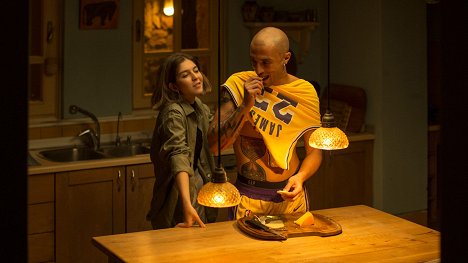
Seti is a bit of a rebel. She dares to walk the streets of Tehran without a veil or a hijab, despite the chance of the Guidance Patrols arresting her even for that. She even cuts her hair in anger. One day after rehearsing with others in her underground college, she comes across a man who hoots at her from her car. At first, she thinks it’s just another young jerk male. She reluctantly decides to spend the night at his place. She learns this man named Bebin is a lot more. He has shown a liking to Seti and her music. Overnight she learns more about Bebin and he’s a man who really cares about her. Bebin also has a secret of his own. He has a bottle of specialty alcohol that he has to keep hidden from the Guidance Patrols. He gives her a drink and he talks about hope of seeking refuge in another country.
Seti has a public performance set up for her at a club. The advertising had to be kept to a minimum for the sake of Seti’s safety. Homeyra is scared to see her there but Bebin will see her perform. Before she is even able to perform, the Guidance Patrols bust the place up. They boot everyone out of the club. Infuriated, Seti attacks the Patrol and runs off with Bebin helping her escape. The Patrols did track her identity down and later arrest her at home. She is taken into custody for a week’s period of time. The cell she’s kept in feels like a prison. The inspections she is forced to endure from both male and female patrols are humiliating. She is released on bail awaiting trial.
After her release, she returns home. Homeyra tries to show Seti that she has stopped drinking for nine days. Seti learns some unhappy news. Her social media account is restricted and Homeyra posted a message that Seti will never perform or post videos again. Seti is infuriated and lets out her anger to Homeyra. She leaves for the streets and soon learns the club she performed at is closed off by a concrete barrier. Soon, she learns of an underground public music rally. Many other women will be performing. On her way, she’s fortunate to bump into Bebin again.
Seti and Bebin find a group of ‘underground’ performers. It looks ideal for Seti to sing as many women are singing and are without veils. Just as Seti finds a female guitarist to sing along with, the Guidance Patrols bust the location up and are ready to make arrests. Bidad knows if Seti is caught, she would be arrested and could be executed. Bidad is willing to take her to safety, but Seti insists on singing with the guitarist. The ending doesn’t give full details of the aftermath but the images during the credits are telling.
Seti’s story is a common story for many women in Iran. Men have more freedoms and the women are frequently targets of the Guidance Patrols if they don’t obey. It’s been that way since 1978 when the Islamic Revolution happened in Iran. Even seeing how there are a lot of women that are part of the Guidance Patrols speaks a message how there are many women in Iran who agree with this restrictiveness. Seti is a woman of rebellion. Her only weapon is her singing voice, but the powers that be in Iran consider it a threat. No veil and a woman singing in public. You can understand the reason for rebellion with the Iranian women revolting in 2022. In fact, the word Bidad is Farsi for ‘outcry.’ You can see that this film is also outcry about this problem. That scene where Seti cuts her hair will remind you of how Iranian women cut their hair during the revolt that year.
It should also be reminded it’s not just women doing what women are not allowed to do that are under scrutiny from the Guidance Patrols. Drinking alcohol is a crime for any Iranian. That explains why Bebin has a hidden bottle of whiskey and that’s why Homeyra can’t get proper treatment for alcoholism. Because she’ll be arrested.
The film isn’t just a reminder of what women in countries like Iran are going through. The film is about Seti herself. Seti loves to sing. It’s her expression. She does not understand why only men get the lead and only men can perform in public. It’s because of her passion for singing that she dares to perform in the club and dares to attack the Guidance Patrol when she’s about to be arrested. It’s because she’s furious with her mother when she learns she posted a fake video that she’ll never sing again. How dare she say a lie like that on social media about her passion. You can understand why Seti dared to perform at that underground performance. She won’t even let the threat of death stop her from doing what she loves.
This film is a great work from Iranian director Soheil Beiraghi. Iranian women and their fight for their rights and autonomy are a common theme in his films like 2016’s I (Me), 2018’s Cold Sweat (Permission), and 2020’s Popular. This fourth feature he directed and wrote is another story of Iranian women and their struggle. This is something how Iran and their Guidance Patrols consider something as simple as a woman singing in public is seen as a threat to order. He has a statement to make and he does an excellent job of making it as a dramatic story rather than something preachy. It’s tricky to do something like that but he succeeds very well. This film was a nominee for the Best Film award at the Karlovy Vary Film Festival and won the Crystal Globe at that Festival for Special Mention.
The performance of Sarvin Zabetian is excellent. She not only delivers a good performance but she makes Seti and her dream of public singing a relatable story. One can’t help but feel a connection to her dream and disgust to why she’s forbidden, and she succeeds in making us feel that way. Leili Rashidi is another actor who delivers a great performance. Her performance of Homeyra is one where you don’t know whether to despise her or feel sympathy for her. I know Seti makes it appear living with her is like a prison of its own but sometimes, you sense Homeyra is also a prisoner of her own situation. Amir Jedidi delivers a great character in his role of Bebin. He makes Bebin to be a likeable person, especially as he’s the one person Seti feels completely secure around, but I feel his role could have been developed more.
Bidad is both a tragedy and a story of hope. You can see an incident like this happening in Iran. You can also sense the film telling you despite these dark times, there is hope for the future of women in Iran.
 Jon The Blogcentric