Disaster Close To Home

The tourism activities in English Bay were suspended by the spill for at least eleven days.

All too often whenever we hear of a disaster, it’s miles away. All too often it seems it’s at the other end of the world. However something happened just two months ago that hit close to home.

Wednesday April 8, 2015 was supposed to be like any other day including around English Bay: a beach located close to downtown Vancouver. Unfortunately bad news struck. A freighter called the Marathassa accidentally spilled 2700 litres of bunker oil into the waters of the Georgia Strait near the English Bay beaches. The biggest shock is that the federal government authorities did not alert the public about this for 12 hours.

Those enjoying leisure activity around the waters could have been affected. This oil is harmful if inhaled, can cause fertility or organ damage and could cause cancer. The oil would wash up on surrounding beaches creating a slick six to eight inches thick. At least twenty seabirds were affected by the spill. When news hit that day, the whole city was in shock. Especially since English Bay has been very popular with tourists and residents for leisure.  For at least, ten days, the beach was closed off to the public warning them not to engage in any activities in the water.

No doubt that this was huge news that week. Even bigger was the shock that this incident wasn’t alerted to the public by the federal government until 12 hours after it happened. Already people were outraged. Even the decision to close the Kitsilano Coast Guard base two years ago was to blame. Both the municipal and provincial governments through Gregor Robertson and Christy Clark, environmental scientists and an international shipping expert criticized the federal government’s lack of immediate response. However Roger Girouard, Assistant Commissioner of the Canadian Coast Guard, defended it and said: “You don’t contain 80 per cent of a spill inside 36 hours and call that inadequate. I will not accept that definition of my team in the ops centre or on the water. Look at the normal standards throughout the world and what we achieved over the last couple of days, it was exceptional.” Okay, it’s exceptional in terms of containment but notifying the city 12 hours later exceptional? Even our national Coast Guard leaders as Coast Guard Commisioner Jody Thomas described the response as ‘exceptional.’ Makes you question our current Coast Guard heads.

Most of the oil washed up on other shores but the dirty foam was enough of a reminder of what occurred three days earlier.

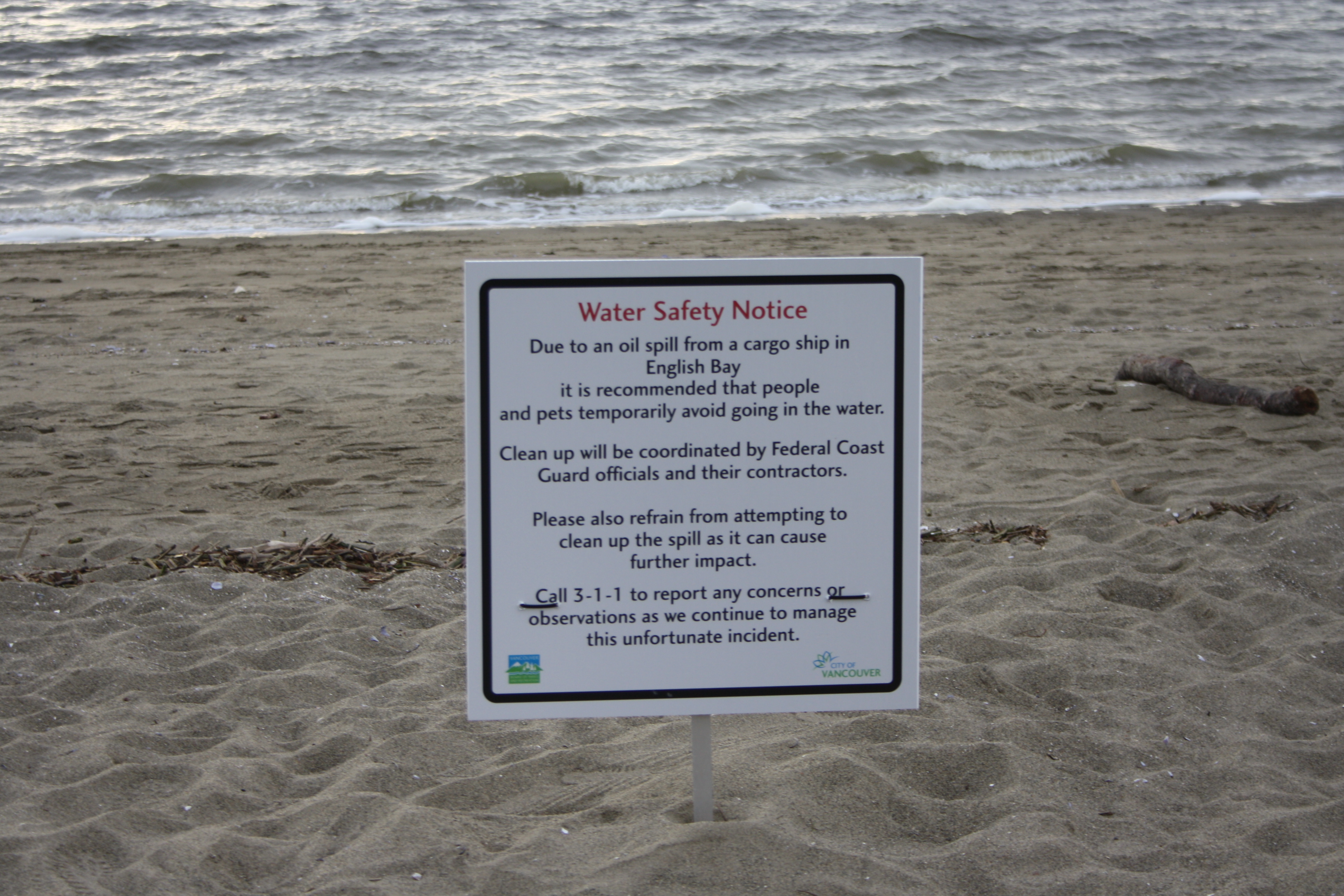
On Saturday the 11th just three days after the incident happened, I walked English Bay to see for myself any noticeable aftermath. I didn’t get anything too tragic or too graphic-looking. What I did get was enough to give me quite a picture. Freighters were all along the bay. Business as usual in Canada’s busiest ports. Recreation as usual but only as far as people sailing recreational ships. People wanting to do recreation on the beach were warned not to do so by signs. The beaches of English Bay were lifeless except for a few people that just want to visit. I didn’t notice any blotches of oil or sludge washing up on the ricks at the beach. News reports at the time said that they’ve cleaned up over 95% of the spill. However I did notice something unpleasant: foam. Foam had just washed up and right on top you can see dirt of a black or grey dinge. An ugly reminder of what happened. I was looking around to see any birds or other animals around the beach. I didn’t find any. Actually a map of the spill would show that more areas around the coasts of West Vancouver or Stanley Park would be hit bigger.

It’s going to be hard to try and calculate the whole damage of what happened. There were no fatalities and no record of illnesses caused by the spill. As for environmental damage and its effect on wildlife, that also remains unanswered. Even though there hasn’t been too much reported two weeks after the spill, two months is still not enough time to tell the whole story. In fact it was later reported on April 29th that a slick 80 metres long and six to eight inches thick made its way the Sandy Cove in West Vancouver: the other side of the shore. English Bay was not the only area hit. New Brighton Park, ten miles away from the spill, was even hit.This will really affect the Burrard Inlet.

I don’t even know if the crew of the MV Marathassa have been arrested. They should be and they should go on trial for this, more than anyone else. Canada’s laws ensure that polluters are held financially liable, and the operators of the MV Marathassa have agreed to pay for clean up and to appear in future legal proceedings that could lead to fines. Further news revealed this was actually the Marathassa’s maiden voyage.
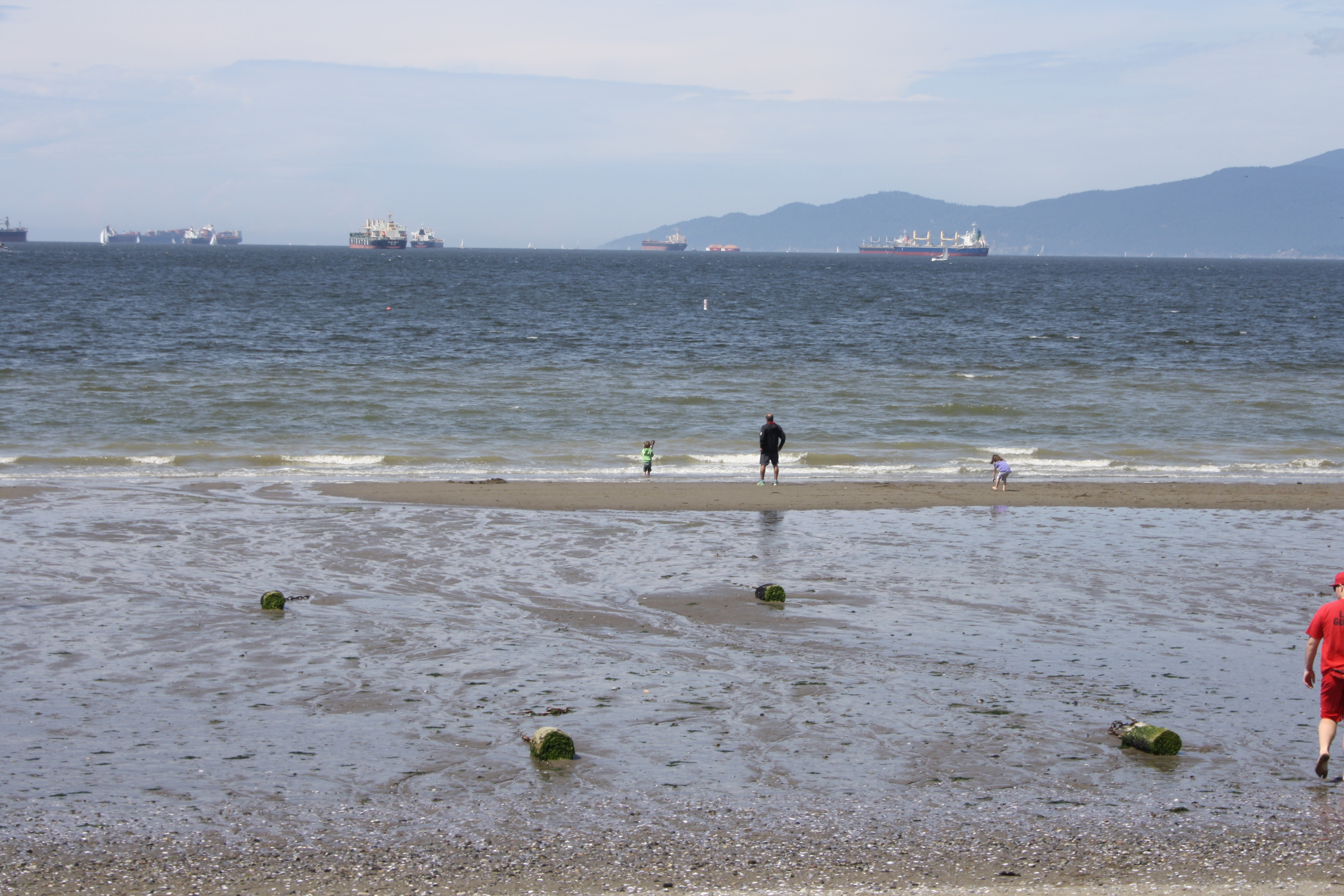
Leisure activity did eventually return to English Bay. This photo taken on Victoria Day (May 18th).

I did return to English Bay just two weeks ago. The signs are no longer there. They were taken down after April 19th. The shores no longer have that dirty foam. There wasn’t too huge of a turnout at the coast that sunny Monday which happened to be a national holiday: Victoria Day. There was a mother who took her toddler child to the coast. That was something you couldn’t do over a month earlier. I saw a bird flying over the coast and even walking close to the shoreline. Seeing that made me hope the water’s safe. I don’t know how long it will be until English Bay will become swimmable again.

The oil spill isn’t that colossal of a disaster as say recent disasters like the earthquakes in Nepal or even the train crash in Philadelphia. It was chicken feed compared to legendary spills like the 210 million liters from BP off the Gulf of Mexico in 2010 or even all that spilled from the Exxon Valdez disaster. Nevertheless it did hit close to home and it’s going to affect a lot of attitudes in the city towards oil.

WORKS CITED:

Mackin, Bob. “Feds On The Offensive Over English Bay Fuel Spill” Vancouver Courier. 10 April 2015<http://www.vancourier.com/news/feds-on-the-offensive-over-english-bay-fuel-spill-1.1820657>

WIKIPEDIA: 2015 English Bay. Wikipedia.com. 2015. Wikimedia Foundation Inc.<http://en.wikipedia.org/wiki/English_Bay_%28Vancouver%29>

Canadian Press. “The MV Marathassa given the all clear to return to normal operations” News 1130. 25 April 2015<http://www.news1130.com/2015/04/25/the-mv-marathassa-given-the-all-clear-to-return-to-normal-operations/>

2015 FIFA Women’s World Cup: Group F Focus

Okay. I just have one last group to go. But before I head into it, I’ll give you the links to my other Group reviews for those that missed:

And now here is my last group review for the 2015 FIFA Women’s World Cup:

GROUP F:

France fixed-France (3): France is one team loaded with talent and prowess but still looking for their first big break in a major international competition. The highest ‘Les Bleues’ have ever finished at a World Cup or an Olympics is fourth and they’ve never made it past the quarterfinal of a Women’s Euro.

No doubt they come to this World Cup with something to prove and the hopes of finally proving it here and now. France has been very impressive in their play these past two months. They’ve only lost to the United States. This could be their year.

England fixed-England (6): England is one of those countries that has constantly seen football as a man’s game leaving the women getting the short end of the stick. That was made evident in the 2003 movie Bend It Like Beckham. Things have gotten better as many Premier League teams have their own women’s teams like Everton, Aston Villa, Arsenal, Chelsea and Liverpool to name a few. They even have their own league, the WSL. Heck, even Prince William gave the national team a royal send-off before they left for Canada. However as they improve, so does women’s football as a whole and they struggle to show their greatness. They’ve only gotten as far as the quarterfinals in the World Cup. The ‘Three Lionesses’ did however make the finals of the 2009 Women’s Euro.

Play for the national team has been a struggle in recent years. They failed to advance past the group stage of the 2013 Women’s Euro. They also suffered a blow knowing that there won’t be a Great Britain team for the 2016 Olympics remembering the difficulties getting Great Britain teams were for London 2012. So it’s no wonder they’ll be looking for Canada for glory. They did however win the Cyprus Cup back in March where they beat Canada in the final as well as Finland and Australia. The last eighteen months have also been consistent for England as they’ve won most of their matches, losing only to France, Germany and the U.S. Their reputation can increase after this World Cup which will be a plus because at last year’s World Cup, the men failed to advance past the group stage for the first time since 1958. Trust the girls to give England that well-needed upper.

Colombia

-Colombia (28): Colombia is an emerging nation in women’s football. They competed in their first World Cup in 2011 and they’ve finished second in the last two Copa America Femininas. They even have a berth in the 2016 Olympics upon their second-place finish at last year’s Copa and with winners Brazil automatically competing as host nation.

However ‘Las Cafetaras’ are still relatively inexperienced in terms of international play. The only UEFA team they’ve ever won against is Wales and they’ve never won against Mexico. They have some good talent that even plays in American and European leagues but they still have along ways to go to contend for bigger things. Nevertheless it’s all uphill from here. It would be interesting to see how far they go over time.

Mexico-Mexico (25): Mexico is one team on the move in women’s football. They’ve competed in two previous World Cups and one Olympics. They’ve been runner-up at the CONCACAF Cup twice and medalists at the Pan Am Games three out of four times.

‘El Tricolor’ have a talented line-up with no less than twelve players playing for American or European leagues. This is the team that is most likely to pull an upset as they have drawn against England in their last meeting. Their qualifying chances are very good. They could also progress well but they have a mixed record from the past twelve months. They’ve won against Italy, Czech Republic and Colombia but lost to Canada, U.S., Costa Rica and South Korea. Nevertheless whatever happens in Canada, El Tricolor have a bright future.

MY PREDICTION:

I feel France will take the top spot in this group. I feel England will most likely be second but Mexico could surprise. Mexico will definitely be third at the least.

STADIUM SPOTLIGHT

-VANCOUVER: BC Place StadiumBC Place

Year Opened: 1983

World Cup Capacity: 54,500

World Cup Groups Hosting: C,D,

Additional World Cup Matches Contested: Round of 16, Quarterfinals, Final

The stadium was built with the intention of being a highlight during Expo 86.It consisted of a unique air-supported dome until 2010. Highlights of its use have primarily been CFL games and concerts. Noteworthy use in the past include Vancouver Canadians baseball games, the Pope’s visit in 1984, and ceremonies venue for the 2010 Winter Olympics and Winter Paralympics.

Vancouver however has a special liking to the sport of football. BC Place’s first ever event in June of 1983 was actually a soccer match starring the Vancouver Whitecaps who were then part of the NASL. The Whitecaps have had a loyal following over four decades and whatever name changes over the years and their transfer to the MLS five years ago were met with open arms. The Whitecaps have since gone on to be the fifth-most attended team of the MLS. It’s no wonder with this kind of football support Vancouver was easily chosen as a venue for the 2015 Women’s World Cup. One noteworthy item: all the tickets for the final at BC Place are sold out.

And there you have it. My last Women’s World Cup group review. More WWC blogs to come like my experience at the Trophy Tour, tournament analyses and my own experience at a Round of 16 game (Yes, I have a ticket!). The Cup all beings in Edmonton on Saturday the 6th!

2014 Grey Cup Preview

Grey Cup

This weekend will mark the 102nd Grey Cup. Yes, even though us Canadians like celebrating Super Bowl Sunday, we also celebrate Grey Cup Sunday where we salute our own football league and we crown our own champions. Plus an extra excuse to pig out on munchies. Yes, one of the best things about being Canadian is we can hold two football parties in the year.

The 102nd Grey Cup is especially exciting because Vancouver is hosting! Interesting how we only get a three-year wait for hosting the Cup. Well it’s interesting to know the last time we hosted, we started a streak. The streak being consecutive Grey Cups won by the host city. Crazy thing is that we will mark the end of that streak this year because the Lions lost in the playoffs! Yes, a bit of a downer. Besides how did we end up playing for the East division semis anyways?

This year’s Grey Cup is called the ‘Roar On The Shore.’ Lots of festivities are planned to happen even as soon as Thursday. A parade of course will happen Saturday morning. The Cup has Dallas Smith and Nikki Yanofsky planned to sing the national anthem. This is a welcome back for Nikki as she is famous for singing I Believe: the official song of the Vancouver Olympics. The big surprise is that an American band, the Imagine Dragons, are halftime show performers. This is the first Grey Cup in seven years where a non-Canadian act provides the halftime show entertainment. I don’t know about you but I don’t think it’s right having a non-Canadian performer for the halftime show.

This has been a unique year for the CFL. For one thing, the league returned to nine teams as Ottawa came back with a new team, the RedBlacks, and Winnipeg returned to the Western division like they should. Also unique is how many miles ahead the West is over the East. Just look at the regular season stats yourself.

Grey CupAs for the actual game, the West will be represented by the Calgary Stampeders. The East will be represented by the Hamilton TigerCats. One’s a finalist from last year, one’s a finalist from two years ago. One won their last Grey Cup six years ago. The other won their last one fifteen years ago. Both finished their regular season top of their division but one was the top of the league. And both teams’ head coaches have won at least one Grey Cup in the past.

CALGARY STAMPEDERS

Already it’s fair to say that the Calgary Stampeders are the CFL team of the year. The Stampeders finished the regular season with the best record of all CFL teams with 15 wins and only three losses. Also this looks to be Jon Cornish’s year as he has become one of the biggest standouts of the CFL this year.

Right now it’s hard to find a flaw in them that could cause me to think they’d lose the Grey Cup. Especially since they won their division finals game against the Edmonton Eskimos by a huge margin: 43-18. Particularily remarkable since the Stampeders won both their regular season games against them but by 28-13 and 41-34.

However we should also know there are no guarantees in sport. We should also keep in mind that yes, the Stampeders beat the TiCats in both their regular season games but both wins were close ones: 10-7 and 30-20. We should also keep in mind is that the TiCats’ last loss to the Stampeders would be their turning point to becoming better and more victorious over the remainder of the season. The Stampeders know how to win against the TiCats, no doubt about that. The question is can they deliver on Sunday?

HAMILTON TIGER-CATS

The Tiger-Cats had the misfortune of a tough season opening: they lost six of their first seven games. However they had a big turnaround that started on Labor Day with a win against the Toronto Argonauts and things got better and better for them by winning eight of their last eleven regular season games. They finished the season with nine wins and nine losses like the Montreal Allouetes but they finished at the top of the Western division because of point differentials.

The TiCats showed they can really deliver now as they were able to win the Eastern final against the Allouetes 40-24. And the Allouetes were one of the teams they lost to during their ‘losing streak’ early this season.

No doubt the TiCats are the most improved team of the CFL but the question his have they improved enough to rival the Stampeders? We should keep in mind that Calgary was not only team of the year during regular season but regular season also showed a near-dominance of the West in overall league stats. In face Hamilton may have finished top of the East with nine wins and nine losses but nine wins and losses is also the same stat of the BC Lions: the team that finished fourth in the West. In fact Hamilton has lost at least one game to all five West teams. This lagging behind of the East could become prevalent on Sunday.

THE BIG GAME AND MY PREDICTION

This is going to be a toughie. Sure Calgary beat Hamilton in both regular season games. But Hamilton improved greatly after their second loss to Calgary. However I’m not going to make the same mistake I made with the World Cup semi-final where I predicted Brazil would beat Germany 1-0. I couldn’t have been wronger. So I will trust my instinct and predict the Calgary Stampeders to win 38-20. This will make it the fourth Grey Cup for coach John Hufnagel.

And there you go. That’s my Grey Cup prediction. Funny how Grey Cup is second to Canada Day in terms of Canadian patriotism. Kickoff is 3pm Vancouver time Sunday. Stay toond!

A VIFF 2014 Wrap-Up: A Record Year

CinemaDISCLAIMER: Okay, I know this is a month late but I’ve had some computer problems plus I was waiting for some certain facts that still have not yet come. Nevertheless I decided to publish this VIFF wrap-up as is today. Especially since I want to get my review of Mommy out soon.

The Vancouver International Film Festival wrapped itself up the night of Friday, October 10th. It was quite the sixteen days of films, discussions, films, events, films. You get the point. Nevertheless the end gave lots for people at the VIFF to smile about.

You may remember last year was about getting used to a new system of theatres with the closure of both the Granville 7 and the Ridge. This led to two new smaller theatres, a back-theatre to a mainstage and temporary use of three theatres in a downtown megaplex. It worked out well in the end in more ways than one.  Firstly it helped the VIFF have a very good per-screen average of attended. Secondly it was an opportunity to learn and make improvements for the following year. This year was really excellent both in terms of attendance and festivities. I’ll get to the numbers later in my blog. One thing is that the film festival heads were now more familiar with the new format and could make it work better this time.

It seems like each year is a new adventure both in watching films and volunteering. Volunteering was a unique thing this year as people could now schedule their shifts electronically via an online booking system. Nevertheless things were the same that we all still had to sign in and sign out via a paper sheet. Yep, they still keep a total of hours through that method. One of the good things about the electronic system is that it expected people to trade shifts if they couldn’t make it or call in to cancel. A confirmation e-mail would be sent to them with a number for them to call and cancel if they couldn’t make it. If they didn’t, they risked being dropped and having their volunteer card cancelled if they had free movies in mind.

Another unique thing this year was we were not all confined to a single theatre. We could book shifts to as many theatres as we wanted. The commitment level was still expected as we were still expected to meet up with the theatre manager at all our shifts. I was able to book for SFU Woodwards, Cinematheque, The Rio, International Village (Tinseltown) and the Centre for Performing Arts. I think the only ones I didn’t do were the VanCity and the Queen Elizabeth Playhouse. Nevertheless it made for some good times. It made for some frustrations too in the case of scanners that delayed their use at times or didn’t scan passes or iPhones well.

One unique duty as far as volunteering was surveying. This was something new as I’ve never seen surveying done before. It wasn’t an easy thing to do as there wasn’t that huge of a number of people willing to do it at first. When incentives for entry into a contest came up, I made myself willing. There were three times I did it: a Saturday and a Sunday at Tinseltown and closing day at the Centre for Performing Arts including the gala. It was a good focus on attendees with the prime focus on people from out of town.

Filmwatching opportunities were good for me as you can tell by my reviews. However this year was not the year I gave the most reviews. Last year was with 16. This year I was able to review 14 even though I saw 15 in their entirety or close enough. The only one I chose not to review was In Search Of Chopin because it was more a DVD biography of Chopin simply played in front of a big screen. I saw films from France, Canada, the UK, the US, New Zealand, Mexico, the Netherlands and South Korea. I saw comedies, dramas, documentaries, shorts, feature-length films, television shows brought to the screen, independent films and big production company films. It was a good mix though I wish I could see more variety but I’m not complaining. They were all unique and had their own styles. I don’t think I saw anything really bad this year. Also I don’t think any of the movies I saw pushed the envelope in a big way unlike in the past. I think El Incidente was probably the edgiest because it told a unique story of the supernatural.

The most interesting thing that happened on screen was the unexpected airing of a short before some films showed. The short was called Echoes and I saw it three times: only once in its entirety. The first time I saw it, it was as it was ending and I thought I walked into the theatre just as a film was finishing. I tried looking in my VIFF guide for it but couldn’t find it. All I knew was that it was produced by the Weinstein brothers. Then I saw it again just before I saw Haemoo. Once again I walked in long after the short started and it didn’t make much sense at first. Also this time it was at the Centre and they had a tent from Lexus where they were signing people up for a Lexus contest, in which I entered. Later on I learned of the title and researched it online. I saw some Youtube videos and write ups about it and how both Lexus and the Weinstein Group are involved in its promotion. It caught my interest but still left me confused what the short was all about. I finally did have a chance to see it in its entirety when I was in my seat long before I saw El Incidente. I finally got what it was all about and the point of airing it before the show. Funny how it wasn’t until the very last show when it all made sense.

The number of films I saw could have been higher especially with the Rio having their 11:30 at night screenings for seven of those days. However I would only be willing to see such a late-night film if it was worth it and I was guaranteed to return home in decent time that night. I only saw two 11:30 shows. There were some I passed up: the one the first Friday because of its late start time, the one the second Friday because I was ticket scanning and only finished scanning long after the film started, two because I already saw one film while ushering and that was enough, and the one on the Thursday before closing because I fell ill. Weird how I was still ill but saw the 11:30 Rio show on the last night of the VIFF. Hey, it’s a personal tradition of mine I either see the last VIFF movie or volunteer on closing day.

As for the festival itself, the Festival had its third-highest number in terms of flat ticket entries: 144,000. 2011 and 2010 had higher numbers but this year’s VIFF of 144,000 entries over 349 films exceeded 2011’s record for per-screen attendance of 150,000 over 386 films. The results are especially impressive when you compare it 2012 which had more films and with last year under the new format. Last year’s total entries were 130,000: an increase this year by more than 10%. Great job, VIFF!

Anyways here is the 2014 Vancouver International Film Festival by the numbers:


144,000: estimated gated attendance

1000+: Film and Television forum delegates

700+: volunteers

549: public screenings

349: films shown

  • 219: feature length (60+ minutes)
  • 130: short or mid-length films (less than 60 minutes)

76: Canadian Films shown

68: countries entering films

83: Canadian premieres

  • 45: North American premieres
  • 24: International premieres (first screening outside home country)
  • 11: World Premieres

24: Media Screenings

19: entries in the Best Foreign Language Film category for this year’s Oscars shown

18: percentage increase of visitors from the US

17: panels featuring 73 speakers

16: days of showing films

9: screens showing films

7: theatres participating in the VIFF


Now I know some of you want to know the award winners. Here they are:

ROGERS PEOPLE’S CHOICE AWARD

-THE VANCOUVER ASAHI (Canada), dir. Ishii Yuya

VIFF MOST POPULAR INTERNATIONAL DOCUMENTARY FILM AWARD

-GLEN CAMPBELL: I’LL BE ME (USA), dir. James Keach

BEST NEW DIRECTOR AWARD (tie)

-MISS AND THE DOCTORS, dir. Axelle Ropert

-REKORDER, dir. Mikhail Red

VIFF MOST POPULAR CANADIAN DOCUMENTARY AWARD

-ALL THE TIME IN THE WORLD, dir. Suzanne Crocker

Runners-Up: MARINONI, dir. Tony Girardin

-JUST EAT IT: A FOOD WASTE STORY, dir. Grant Baldwin

VIFF IMPACT AWARD

-JUST EAT IT: A FOOD WASTE STORY, dir. Grant Baldwin

VIFF MOST POPULAR CANADIAN FILM AWARD

-PREGGOLAND, dir. Jacob Tierney

WOMEN IN FILM AND TELEVISION ARTISTIC MERIT AWARD

-SITTING ON THE EDGE OF MARLENE, dir. Ana Valine

BEST CANADIAN FEATURE FILM AWARD

-VIOLENT, dir. Andrew Huculak

MOST PROMISING DIRECTOR OF A CANADIAN SHORT FILM

-THE CUT, dir. Geneviève Dulude-Decelles

Honorable Mention:

BEST BC FILM:

-VIOLENT, dir. Andrew Huculak

MUST SEE BC AWARD:

-JUST EAT IT: A FOOD WASTE STORY, dir. Grant Baldwin

BC EMERGING FILMMAKER AWARD:

-SITTING ON THE EDGE OF MARLENE, dir. Ana Valine

Those were awarded at Friday’s closing gala. After the VIFF closed, VIFF repeats happened at select theatres for three more days. I helped volunteer two of those days at the SFU. Then it was the volunteer party on Sunday. I was able to get there right after seeing Still Life. The party was at the Rickshaw Theatre and it started with a showing of the 1972 film The Poseidon Adventure which not only consisted of the movie being shown but a cast re-enacting and spoofing the movie. There were even times they had people from the audience including myself participate. After the showing, it was a feast on appetizers, drinks and dancing to two of the VIFF’s favorite bands. Of course there were prizes given away and this year’s posters being given out. Great to see this year’s VIFF end on an exciting note.

So there you go. The 2014 Vancouver International Film Festival ended with record success and fun for all volunteers. Next year’s VIFF is anticipated to be from September 24th to October 9th, 2015 and should be bigger and better. I know last year I said I hoped the VIFF would be one Film Festival added to the FIAPF: the International Federation of Film Producers Associations. However some people prefer that it’s not as they feel VIFF not being part of the FIAPF-associated film fests would add to the VIFF’s reputation being an unspoiled celebration of film. We’ll see in the future. Anyways things look optimistic already and the VIFF’s reputation improves over time. See you next year!

VIFF 2014 Review: Reel Youth Film Festival

Movie (640x306)

You may remember at last year’s VIFF, I saw the Reel Youth Film Festival. The Reel Youth Fest was back again at this year’s VIFF. Again it was entertaining and creative.

Last year the main focus was to get the works of a lot of young filmmakers on screen. It didn’t matter if the quality was amateurish or professional. Its focus was to get the filmmaking images of the youth–whether it was making a point or just having fun– and get them on the big screen. This year did feature a lot of films done by the young. However it also featured a lot of productions by professional companies with a message to give to the young.

One of the top themes of the short films was bullying. This was especially the case as the United Way showcased the top three anti-bullying films by students. It was also focused on in a short film by a young Scottish director. Environmentalism was also a top theme of focus. With the controversial subject of shipping LNG’s, that was reflected in a BC film of three girls who have what starts as an innocent water balloon fight. There was the theme of youth representation which was focused on in a film done by five Hamilton teens. There was also the theme of digital media overkill that was shown in one young man’s film. There was also the theme of pressures young people face today–both socially and academically–as seen through the eyes of a young teen girl. Even teen love triangles were also focused. The theme of sexuality was included in a few films too including one on the topic of transgenderism from Portugal of a girl who always felt she was a boy.

The standout theme amongst the short films was to do about the promise and hope of a better tomorrow. That was reflected in one short film from Mexico about a boy who has to vacate his home to a new home. Another film showing the daily life of a Mexican-American girl’s mother while the  daughter narrates in the background shows hope for her family. It was also reflected in an Iranian film of a young boy who sees hope in a piece of trash. It was even focused creatively in one film of a Bengali boy doing pretend filming. There was even one film from ex-street youth from Sierra Leone who showed what happens when they get $2000 handed to them immediately. The outcome isn’t what they expected but they all learned from it. I felt the message of hope for the future was best reflected in a film about a Peruvian youth orchestra where the orchestra is their escape from the poverty and harsh lives.

Sometimes the films weren’t always thematic. Sometimes they were reflections of people. There were two films which were of two different elderly people living in Greater Vancouver. One was the first black quarterback in professional football. Another was of a woman who just turned 91. Both were nice stories to hear. There was even a film about children in a small town in the Northwest Territories. It was just them playing in the background as the stories they tell of themselves and their family are told. It was a simple film that’s a nice eye opener.

Then there were films that try to get creative. This is where the young directors started to have fun. One was a story of a hitman’s murder attempt with poisonous muffins gone wrong. Another of a toy car getting lost and going on an adventurous trip. Another an animated adventure of a polar bear. Even an animated story of a fish dinner gone awry. No major point to it. Just a chance to have some fun and even possibly make a future out of it.

The films either came from all over the world or were shot in many places around the world. It made for an eclectic look at the lives of young people from a global perspective. Needs and concerns differ from one place to the next but they all share that common desire for hope for the future. There were at least eight films from Canadian filmmakers. There were six of which that were done locally. There was even one that was done by New Westminster youth and shot in areas I frequently visit. That was the film where it appears they’re giving adults a glove. Then they show they’re spreading the love. It left me wondering when it was filmed and how I wasn’t there at the time. I’m sure if they gave me the glove at first, I too would think: “What on earth is this?”

Just like last year, they gave all the attendees a ballot to fill out of their Top 3 films and favorite local. It’s hard to play favorites but here’s what I voted for:

  1. Orchestra For A Dream – I rated it first because it had the best message of hope by showing a way out for disadvantaged youth.
  2. Sin Madre – The film of the young girls’ mother and the daughter’s admiration for her really made me like this a lot.
  3. What If There Was A Place? – Five Hamilton youth make their message heard that they demand to be taken seriously. Excellent two-minute film.
  • Best Local: And That’s Remarkable – A creative film that sends the message that you can either let bullying comments hurt you or you can defy them.

And there you go. That was the Reel Youth Film festival for this year. If you want to learn more about the Reel Youth Fest coming to your town or if you want to book a showing of your own, just go to the Reel Youth website.

← Back

Thank you for your response. ✨

Warning
Warning
Warning
Warning

Warning.

It’s VIFF Time Again

CinemaYes, it’s that time of year again. The Vancouver International Film Festival will be back up and running. It will open Thursday September 25th and run until Friday October 10th.

This year’s festival looks to be optimistic. As you may remember, last year’s festival could be considered a test pilot for the new way of doing the VIFF. They had no choice. The Granville 7–our main venue for years–closed in 2012 and a whole new system had to be created. It took finding new venues like the Vancouver Playhouse, the SFU Arts Centre, three cinemas of the International Village and the Rio Theatre and relocate their gala shows from the Vogue Theatre to the Centre for the Performing Arts. The end result was a success as it had one of the best per-screening averages. Sure there was a slight decrease in the number of films shown and the number of screenings but it payed off and kept the VIFF in a very healthy state.

There are not too many changes as far as screenings of films. One cool thing is that there will again be 11:30 showings at the Rio Theatre during certain nights. The festival promises to show 365 films from 70 countries during its duration. Some of the hot ticket films include:

  • Mommy– The latest film from 25 year-old Quebec directing phenom Xavier Dolan
  • Wild- A film starring Reese Witherspoon from Dallas Buyers Club director Jean-Marc Vallee
  • Maps To The Stars – A film by David Cronenberg with an excellent performance from Julianne Moore
  • Whiplash– a musical drama featuring drumming phenom Miles Teller
  • Welcome To Me– A dramedy starring Kristen Wiig that’s surprisingly very personal
  • Clouds of Sils Maria– A humorous but personal story starring Juliette Binoche and Kristen Stewart
  • Foxcatcher– An Olympic story directed by Bennett Miller that ends up being far from the Olympic dream
  • Men, Women and Children– The latest Jason Reitman film that shows relationships of teenagers and their parents’ relationships and the complications coming with it
  • The Riot Club– An intriguing look at special clubs and establishments in England in the 1800’s
  • Winter Sleep– Cannes’ Palme d’Or winner this year from Turkish director Nuri Bilge Ceylan
  • Goodbye To Language 3D– The latest from Jean-Luc Godard that caught the attention of crowds at Cannes.

The biggest change would be in the case of volunteering. In the past, volunteers would be kept strictly to a single theatre throughout the running of the festival. This time they can volunteer at any theatre or theatres they want. I myself have chosen to volunteer at three theatres so far. Yesterday at the volunteer orientation, all volunteers had to learn the five different duties which they will be assigned. This was the first time ever that the VIFF has given us instruction during the volunteer orientation. Nevertheless it’s a good thing for when they have to do their duty.

Anyways the festival begins tomorrow. Expect a lot of excitement. And expect to see a good number of reviews from me. For more information or to purchase your own tickets, go to the VIFF website.

The Times They Are A Changing

Change is good. So they say. Change is sometimes good, sometimes bad, but it’s unavoidable. There will be two notable changes–one in Greater Vancouver and the other all across Canada–that are products of the signs of the times.

CANADA POST’S FIVE-YEAR PLAN

Mailing a letter in Canada became a lot more expensive as of March 31st.

It’s been official since March 31st to be exact. However it was in November when the news hit the fan. Then Canada Post announced major changes that would take place: some that would take place within months and some within years. One was the reduction, if not the complete elimination, of mail home delivery and designating it to neighborhood post office boxes. This was something to affect 80% of Canadian households over a five year time. Another was a do-away with thousands of postal jobs. Canada Post plans to ‘retire’ jobs just as many of its employees are reaching retirement age rather than have huge layoffs. However the biggest news had to be huge increases to the price of postage–the biggest ever in Canada Post’s history– for the average customer. One example is the price of single Canadian stamp for a simple basic letter anywhere in Canada to be $1 each or $8.50 for a book of ten. That’s up from $.63 each the year before.

No kidding it was a shock to all those that heard it. But in all fairness, it’s pretty much a sign of the times, albeit a rude sign. When you look at it, less people–especially the young– send out lettermail. They send it via email, whether it be in the form or regular mail-style communication or greeting cards. Even payments are sent by cheque less often and have mostly been replaced by wired payments. In fact Canada Post announced the billions of dollars in total it has lost over the last few years. If you saw things through Canada Post’s point of view, you could understand why these shocking changes. One increase in postal use has occurred in recent years has been the increase in parcels and packages. You can thank modern technology for that too. More specifically online shopping that has resulted in the increased packages. that’s one thing that’s keeping the postal workers in business and working.

Before Canada Post would make changes they’ve been intending to do for a long time, they consulted the public. They had group meetings with people from all around the country. They even invited feedback via email. So this isn’t something that they did as run-of-the-mill. They actually paid attention to what was out there and took note. However it’s not to say they may have missed some details. The biggest flack came in concern of elderly people who can’t make it to those anticipated boxes, or not without huge effort.

If there’s one saving grace about this, it’s that businesses get a bigger break from this. Businesses also have their own dealings with the new postal rate increases. Fortunately Canada Post is very understanding how businesses rely on paper mail. I myself work for a business that sends out a lot of paper mail and I know of the graces given to businesses. One is postal rates given to businesses using indicia print mail. Businesses can pay anywhere between five to twenty percent less than what the average customer pays at the counter. One example is while the average person pays $.85 per stamp for a book of ten, businesses can pay $.75 per piece even if it’s just one to go. The savings get even better in terms of bulk mailing on the Electronic Shipping Tools (EST). Sending bulk mail via EST was already a good savings before as businesses could save two cents per piece as long as the batch was a minimum of 5000: a savings of at least $100 per batch. Now the price is $.70 per piece–a savings of five cents each– and the batch minimum for this savings has been reduced to 1000. It looks as though Canada Post was most prepared for businesses and did what it could so they wouldn’t take as huge a blow as the customer.

No doubt there have been complaints about this all. I cannot blame the people for complaining. In fact I don’t like paying $1 for a single stamp, and this is as a basic customer. Nevertheless I think of all the changes that have occurred on how people deal with mail, especially in terms of technology, and I sometimes feel like saying to them: “If you decrease the postal system’s usefulness to yourself and others, you have this coming.” Sometimes I really feel like saying just that. One more thing. American conservatives have liked the new system and some are considering it as a template for changes in the American postal system.

Oh, a footnote. You know how I mentioned Canada Post’s plans to ‘retire’ certain positions than lay off. Well there were was an announcement of a certain number of carriers in three major Canadian cities being laid off. I guess they didn’t want to wait.

TRANSLINK GOES ELECTRONIC

The Compass card from TransLink. The program was expected to start January 1st but still lacks a definite start date.

Okay, I’ve already talked about one change that’s already happened. Now I’ll talk about a change that was supposed to have happened fully already but is only happening partially. For those who don’t know Greater Vancouver transit system, people simply buy their tickets and board the trains. Sounds like a good opportunity for freeloading but Transit Police frequently board the trains to inspect. Those caught without proof of appropriate fare get fined $160. Buses are pretty regular where customers pay up front, allowing little opportunity for fare evasion.

Just two years ago, Greater Vancouver’s transit authority TransLink started set up of new turnstiles for the Skytrains. It’s not just for the sake of restricting access to people who have paid their fare but also to equip for for the new electronic way of boarding transit. TransLink announced plans to start the new Compass program where people use a computer sensor card to tap in and tap out of buses and trains. Compass cards and their value are paid for at special fare booths at Skytrain stations. The cards are a lot like how some use a chip credit card to tap in their charge at some terminals.

TransLink had plans for the program to start on January 1, 2014. However they invited people from the general public to become testers of the Compass card system during a three-week period starting in September 2013 and ending October 1st. I was one of the people who signed up to volunteer and I was selected to participate in the testing period. I received my card in the mail and used it tapping in and out of buses and SkyTrains. Tapping in wasn’t the hard part. Tapping out was as I forgot at least five times completely. There were a few times I’d forget to tap out of the SkyTrain and then head back to the turnstile to register.

One purpose was for TransLink to get an understanding of people’s transportation patterns. Another was to get a sense of how transit passengers dealt with and felt about the upcoming system. they even invited emails under usernames to get the feedback they wanted. It was a mixed bag of what to expect. Even before the testing period, I remember one bus driver saying that the Compass system is going to create mayhem. I take that with a grain of salt because I’ve lived in Vancouver long enough to know there are lots of Vancouverites that mourn “Doomsday!” over everything.Actually I’ve seen people in Quebec City use a fob-style method of payment on buses as far back as 2009. I’m sure there are many more cities in Canada and around the world that have adopted their own electronic fare system. So this Compass thing is actually something Vancouver and TransLink should have caught onto a long time ago. However I don’t feel Compass should replace fare payments as some people may not need the card due to infrequent TransLink travel. Compass is more for people like me who bus day in-day out.

One drawback about this is that TransLink users that were part of an employee pass program–where employees received passes for a monthly fee that was a 15% discount from monthly bus pass rates– were told the employee pass program would expire December 31st of the year. Many people, including myself, were disappointed but TransLink made it clear that this was a sale and sales do end. The public were told people would pay a monthly rate via Compass that’s less than that of the current regular bus passes.

Anyways it’s May, more than four months after the original planned date of the Compass changeover, and I’m still waiting. I’m also back to paying the regular monthly bus pass rate.  Compass may not be available to the general public as of yet but it is open to certain people. Some people who are part of disability programs or assistance programs already have access to Compass as the general public are still waiting. TransLink even admits on their website that they’re ‘rolling out Compass one group at a time.’ Now that we’re talking about TransLink’s website, TransLink also has a section on their website devoted to Compass and their answers to FAQs like security and privacy concerns. One thing that’s still unanswered is the start date for the general public. They say the start will be spring/summer 2014. It’s already May and there’s no official start date yet. Guess it’s just the waiting game right now.

So there you have it. Changed happening in 2014. One nationwide, one strictly in Greater Vancouver. One partially for the better, one for the worse. One happened on their projected start date, one is still four months past it’s official start. Both however are signs of the changing times and changing needs of the public.

A VIFF 2013 Wrap-Up: Better Year Than Expected

Cinema

The 2013 Vancouver International Film Festival wrapped up show on Friday, October 11th. Almost 350 films were shown on nine different screens in seven movie venues over the sixteen days. This year was expected to be a nervous one as it was trying to fit a new venue format but it worked out well in the end.

Getting used to new venues was part of this year’s VIFF. It was with that with us volunteers, the supervisors and the VIFF heads. The theater I volunteered at, the SFU Woodwards, was unique that it was located in the Woodwards Square of Gastown. It’s also a campus for film and theatre students of Simon Fraser University. The theatre itself was very good. It’s both a screen and a classroom with a seating capacity of 350. Also the theatre didn’t have concessions but the shopping square had no shortage of eating facilities.

One of the challenges of this year was separating moviegoers from students. Another was knowing how to set up lines. The venue consisted of the main floor, second floor and theatre on the third floor. On the first day we had the box office on the main floor and throughout the VIFF. Thus we’d have the ticketholders on that floor. We’d organize passholders in a line in the outdoor area of the second floor. On the third day we’d have ticketholder and passholder lines all outside. That became a concern because of the rain. After that we returned to having ticketholders indoors on the first and passholders indoors on the second. A bit of getting used to.

I was able to take advantage of my film viewing opportunities as often as I could. One highlight was the Rio Theatre showing films at 11:30 in the evening. That was actually one of my best chances to see films. Yes, I’d be very tired the following morning but it was worth it for my VIFF fix.  This year featured an additional treat for volunteers however it would have to wait until after the Festival was officially finished. The treat was free films for the repeat screenings in the week that followed the Festival. Volunteers were allowed only 5% of the seats during the actual Festival but repeats allowed for 20% of the seats up for volunteers. That explains why you see so many of my reviews coming late. It was great for me because it allowed me to see three more films and do some more volunteering at the SFU Woodwards Theatre. Oh yeah, that’s another thing. VIFF repeats were not strictly limited to the Vancity theatre this year. They also added in repeat screenings at both the Rio and the SFU Theatre on Saturday and Sunday. I volunteered at SFU that Sunday and finished the night taking stuff from both SFU and the Rio back to the storage of the main VIFF office downtown.

Those who’ve followed my blog may have noticed I saw sixteen films in total both at this year’s VIFF and the week of repeats. They came from many countries around the world like the US, Australia, South Africa, Israel, Iceland, Mexico, Poland, Croatia, I could go on. The list could even be extended if I add in filming locations like Laos, Cambodia, Cuba or India. The films ranged from dramas, to comedies to thrillers to documentaries to horror films. The quality ranged anywhere from film for art’s sake to moviemaking to getting their message across. The material ranged from entertainment-driven to message-driven to envelope-pushing to family friendly. I also saw two nation’s official entries for Best Foreign Language Film category at this year’s Oscars: Heli and The Rocket. One thing I felt I missed out on this year was my fix of short films. I did get a fix of it over at the reel Youth Film Festival but I would have liked to have seen more shorts shows. Also I only saw two Canadian films. Hopefully I’ll see more next year. If you want to see all my reviews of VIFF films, just click here.

The Festival also ended on a positive note for us volunteers. We were all given a volunteer screening at the Vancity Theatre to attend. Actually the VIFF organizers had to do two volunteer screenings of the film in order to accommodate the 700 volunteers for this year. I went to the one that was held late Friday evening. It was a good occasion. Out in the lobby there was your typical party food and we were all treated to at least one free drink. I was able to meet with people I volunteered with. There were door prizes given to people before the movie was shown. Then we were treated to The Fantastic Mr. Fox. I actually saw it four years ago but I was cool with seeing it again. Also have you ever noticed the things you see in a movie the second time you forgot you saw the first time?

As for the Festival itself, the Festival films attracted a total of 130,000 in gated admission. As a flat number, that’s 7% lower than last year  and 20,000 shy of 2011’s record but that’s actually a very optimistic number to the VIFF staff. The reason being the new theatre facilities had less total capacity than those of last year and the VIFF staff were anticipating a smaller number. Don’t forget there were some facilities that took some time off from showing VIFF films. Like the SFU theatre had all of Monday the 6th off and the evening off on the 7th. Also the three screens at the International Village stopped showing movies on Sunday the 6th. Media coverage was extensive and mostly positive. Audience and filmmaker feedback was also very good regarding the films shown and the facilities. The VIFF wrap-up report called the ticket numbers ‘a record year.’ I assume that ‘record’ would be based on a per-screening analysis which is a good estimate of over 250 per screening.

Here is this year’s VIFF by the numbers:

-130,000+: gated attendance
-1000+: Film and Television forum delegates
-700+: volunteers
-515: public screenings
-341: films shown

  • 212: feature length (60+ minutes)

-92: Canadian Films shown

  • 31: feature length
  • 55: shorts
  • 6: mid-length

-85: non-fiction films shown

  • 73: feature length
  • 17: Canadian

-75: countries entering films
-64: Canadian premieres
-41: North American premieres
-27: International premieres (first screening outside home country)
-26: World Premieres
-16: days of showing films
-15: entries in the Best Foreign Language Film category for this year’s Oscars shown
-9: screens showing films
-7: theatres participating in the VIFF

Bonus Stats:

-27: media screenings

-26: VIFF repeats

Another year of good numbers. Now I know some of you want to know what were the award winners, right? Here they are:

ROGERS PEOPLE’S CHOICE AWARD

-LIKE FATHER, LIKE SON  (Japan) dir. Koreeda Hirokazu,

VIFF MOST POPULAR INTERNATIONAL DOCUMENTARY FILM AWARD

-DESERT RUNNERS (USA) dir. Jenifer Steinman

VIFF MOST POPULAR CANADIAN DOCUMENTARY AWARD

WHEN I WALK, dir. Jason da Silva

VIFF MOST POPULAR ENVIRONMENTAL FILM AWARD

-SALMON CONFIDENTIAL(Canada) dir. Twyla Roscovich

VIFF MOST POPULAR INTERNATIONAL FIRST FEATURE

-WADJDA (Saudi Arabia/Germany), dir. Haifaa Al Mansour

VIFF MOST POPULAR CANADIAN FILM AWARD

-DOWN RIVER, dir. Ben Ratner

WOMEN IN FILM AND TELEVISION ARTISTIC MERIT AWARD

-SARAH PREFERS TO RUN (Canada) dir. Chloe Robichaud

DRAGONS & TIGERS AWARD for YOUNG CINEMA

-ANATOMY OF A PAPERCLIP (Japan) dir. Ikeda Akira

Runner-Up: TRAP STREET (China), dir. Vivian Qu

Special Mention: FOUR WAYS TO DIE IN MY HOMETOWN (China), dir. Chai Chunya

BEST CANADIAN FEATURE FILM AWARD

– (tie)RHYMES WITH YOUNG GHOULS, dir. Jeff Barnaby

THAT BURNING FEELING, dir. Jason James

MOST PROMISING DIRECTOR OF A CANADIAN SHORT FILM

-Matthieu Arsenault for NATHAN

Honorable Mention: Timothy Yeung for 90 DAYS

BEST BC FILM:

-THE DICK KNOST SHOW, dir. Bruce Sweeney

MUST SEE BC AWARD:

-LEAP 4 OUR LIFE, dir. Gary Hawes

BC EMERGING FILMMAKER AWARD:

-Matthew Kowalchuk for LAWRENCE & HOLLOMAN

So there you go. Those are the winners of the 2013 Vancouver International Film Festival. A good end to a great VIFF. I know this year was a nervous year as we didn’t know what to expect with a new set of theatres to work with. Nevertheless it turned out great and we had our best per-screening rate ever. Next year’s VIFF is scheduled from September 25th to October 10th, 2014 and should be bigger and better. Also I hope one year the VIFF grows to achieve accreditation from the FIAPF: the International Federation of Film Producers Associations. Most of the big Film Festivals are accredited and the VIFF being accredited should definitely add to its attraction. Anyways see you next VIFF!

VIFF 2013 Review: When I Walk

Filmmaker Jason DaSilva won't let MS stop him from living his life or even making films in When I Walk.
Filmmaker Jason DaSilva makes his MS and his life the focus in When I Walk.

When I Walk is a unique documentary where the documentarian is the complete subject of the film. It’s a very personal documentary. Possibly because this may be the last film he ever makes.

We meet Jason da Silva, a promising young documentarian of Indian heritage living in Vancouver. He lived the life of a budding 25 year-old filmmaker and had a promising future ahead. That all changed in 2006 during a family vacation in St. Maartens. His legs weakened and he was diagnosed with multiple sclerosis. His condition wasn’t fatal but it would lead to weakening of his body and other deteriorations. Jason was encouraged by his mother not to allow his disease to limit what he can do. So Jason decided to make his battle with MS his subject of his next film.

Jason is determined to fight it or deal with it the best way he can. He tries his hands as many different types of medicines and healings. He first travels to his parents’ hometown of Goa, India where he agrees to Ayurveda medicine. He then goes to Lourdes, France on the advice of his very religious Catholic grandmother and receives healing water. He also arranges an appointment for a wonder-surgery that’s a breakthrough in fighting MS and is highly advertised on Youtube by people cured through this surgery. The Ayurveda medicine procedures didn’t work. Lourdes didn’t heal. And this ‘wonder surgery’ only gave limited improvements that didn’t last.

Family unity is another theme in the film as Jason comes from a close family with relatives in Canada, New York and back home in India. His mother is the one who’s trying to encourage him to stay positive and hold his head up high. Though she cries near the end of the film and admits she didn’t know how bad it was and how limiting it would be. There’s another time when he visits a relative in India and tries to find out if his MS is inherited.

Despite his illness and its dehabilitation over time, Jason continues to be strong. He talks of difficulties going to restaurants and various other places in New York. He meet up with another person in a wheelchair and they decide to organize a blog of wheelchair accessible locations in New York. It’s not just simply taking restaurants that advertise themselves as ‘wheelchair accessible’ at face value. Both Jason and his colleague go to the various locations and test out how ‘wheelchair accessible’ the places are in both the facilities and the washrooms. Jason also purchases various filmmaking software and various computer accessories to assist him with his filmmaking as his body functioning lessens over time. They show one gadget which assists in functions as Jason makes commands in a microphone. Some days it’s so hard to talk, Alice–who I will talk about shortly– has to learn filmmaking and its functions in order to complete certain jobs for Jason.

Possibly the biggest plot of the documentary is not just simply overcoming his condition of MS in daily life but his relationship with Alice Cook. Before Alice, Jason was a frequent dater in the film making scene. He first thought MS would be the end of the dating road. Then he went to a support group for people with MS offered by his mother. He met a woman named Alice who was around the same age as him. Alice is a fully able person who attended the sessions in support of her stepfather who has MS. Alice took an interest in Jason. They started dating. Alice started helping and assisting Jason in his daily life. Then in 2009 they married. They even show Jason using his scooter with Alice on the back and a Just Married sign on the seat.

However right after the marriage came some new hurdles. First was the stress of being married to a physically limited person. Alice is a very cooperative and a very supportive wife but the stress does take its toll and Alice needs a vacation for a week to give herself relief. One of the things she sacrificed in her relationship with Jason was her love of hiking. She would have the chance to hike again after so many years. There’s also the effort of the two to have children. The film takes us to the doctor’s office where Jason learns he’s fertile and conception is possible. The first conception works but Alice miscarries.  SPOILER ALERT: However the film ends with Alice showing Jason the result of her home pregnancy test: a positive. The film’s last scene shows the two in the ultrasound lab and the screen showing a healthy fetus.

One thing about this documentary that stands out is how personal this is for the filmmaker. Before MS, Jason was no simple documentarian. He was already showing promise at a young age with short documentaries like Olivia’s Puzzle, Twins Of Mankala and a Song For Daniel. He also had two feature-length documentaries to his credit: Lest We Forget and From The Mouthpiece On Back. One would figure MS would be an end to a filmmaking career at such a young age but Jason’s determined not to let it stop him. The film is very personal as it not only hides nothing of Jason but also of Alice. We see an image of blood in the bathtub when Alice miscarries. We also hear Alice tell her side of the story at times and she holds nothing back. In fact there are times when she’s in tears when she talks of the stress of managing a physically challenged husband and her fears for the future as his condition deteriorates over time. This film is as much about the struggle of the two as it is the triumph. Even Jason admits there are times when he can’t handle it or wants to give up.

Another addition to the documentary is the animation. Often the documentary will go to animated images of Jason in his life, MS eating away at him showing the MS as ‘bugs,’ and various other images. That is another added bonus to the documentary that keeps it from getting mundane. Although the animation is not the most professional, it still adds to the documentary.

As a documentary, it’s questionable whether this is worthy of box office release. It has already made appearances at the Sundance Film Fest and the Hot Docs Film Festival where it even won an award. It’s still possible. One thing I know is that it is definitely eligible for broadcast on a documentary television channel.

When I Walk is a film worth seeing. It’s as truthful about the struggles and the setbacks as it is about the triumphs. Definitely worth seeing for all types of people.

BONUS: If you want to learn more about Jason and When I Walk just go to: http://wheniwalk.com/ There’s even a mailing list to subscribe to.

VIFF 2013 Review: Reel Youth Film Festival

Movie (640x306)

One thing about the Vancouver Film Fest is that they show a lot of films and shorts from upcoming filmmakers. They also show films made by youth or young filmmakers too. The Reel Youth Film Festival–which is a festival all it own and had its premiere at the VIFF on Sunday–showcases films from young filmmakers.

Most of the time whenever there’s a shorts segment show I see, I review all the shorts one by one. Now rather than review the shorts, I will just describe what I saw. Besides I wouldn’t consider it to be fair to critique student films.

The twenty-five films were chosen out of three-hundred entries. The films are from Canada and seven other countries and range from one minute to nine minutes. They consist of animation or live-action. They are filmed on typical motion picture format or typical run-of-the-mill video camera. They range from a played-out stories to music videos to animation exhibits to social messages. Some of the films appeared amateurish in quality, some appeared quite professional in quality. Most can be classified as G-rated works but two films in the festival were rated PG with one even including nudity and masturbation (non-explicit, of course). Three videos included were also part of the United Way’s contest to create a one-minute anti-bullying film. Two videos were from the UNIS student program including one of two girls growing up in a rural area of Vietnam.

The films show a lot through their eyes. A lot of it is often about school life, home life and even the work life they anticipate to have in the coming years. Sometimes they focus on other people such as gypsies, two sisters in Vietnam, a graffiti artist or an elderly man in the town. Sometimes they focus on social issues like bullying, corporate greed, homelessness or drugs. Sometimes they focus on fun aspects like dating, school irritations, social media and even the city they’re proud to call home. Sometimes they even focus on nonsense subjects like the death of a sandwich, being scared by a ghost, an office dork or a certain secret about Barbie we never knew.

The thing is that most of the students doing the filming may or may not want to take filmmaking to further directions in their life. Some–like the directors of Crack, Hank and Light Switch–appear to want to take filmmaking seriously in the future. Many others look like they prefer the direction of animation. Some are just amateurs doing it for fun. I guess that’s what the focus of the Reel Youth Film Festival is: more concerned about getting out their voice or creativity rather than the seriousness or professionalism of the craft.

The screening I saw Sunday evening was actually the World Premiere of the annual Reel Youth Film Festival. There will be one more showing at the VIFF on a Wednesday morning open for student groups. It will be showing at more locations to come and the Festival can act as a fundraiser for your community centre. If you’re interested in screenings or interested in showing it at a place you know, or even if you know a young filmmaker with dreams, just go to: http://www.reelyouth.ca/

One last thing. That evening I went had a ballot for all to fill out. The ballot was asking the voter of their three favorite films and their favorite local film. I don’t know if they will be doing it again in their next showings but I had a chance to pick my favorites:

  1. More
  2. Crack
  3. Being Ernest
  • Fav Local: Too Old For Fairy Tales

The Reel Youth Film Festival is a good attraction at the VIFF. Who knows? Maybe one of the directors can make it big one day.