Some of you may remember a while back I did my own personal rundown and observation of the HST referendum in British Columbia. It was done just a few days after the last mail-in day. However the wait to find out the final result seemed to take forever. Nevertheless the result was made public since Thursday. The citizens of British Columbia voted ‘Yes!’ to extinguishing the HST. The decision was 55%. However there are many economists that believe that reverting from the HST back to the GST/PST system will have both positive and negative impacts.
On the positive side, many businesses will like the reversion back to the GSTR/PST system. I myself have heard of many business owners talk of how unhappy they are with the HST system and how it cost their business. In fact a recent article in the Vancouver Sun written by Don Cayo said that restaurants and the builders of high-end homes should the most notable businesses to win big with the reversion. The total tax customers pay retailers will definitely boost sales businesses. Customers themselves will now have to pay less like they did in the days of the PST/GST.
Even though it was noted a while back that businesses should will big on the customer end of things, they will face higher costs as the PST they pay on the items they buy to run their business will either be swallowed or more likely passed to customers. Even back in the original days of the PST, there were some mind-boggling complexities like in the case of tax exempt items like children’s clothes or for women’s dress fabric. Also one economist pointed out it will cost $30 million to reinstate an infrastructure that was split. Also under the HST, businesses could report and remit taxes twice a year instead of multiple times with the split tax system. There’s even the case liars may take advantage of the old system again. Even in the case of manufacturers, costs they used on materials are rebated with the HST but weren’t in the PST days.
As a BC citizen, I too know about experiencing the HST. As annoying as it is to pay 12% on things that used to be only 7% or 5%, I am open to insights on both sides of things. I’m glad Cayo repeated those points that were commonly spoken by economists and business people. Whatever happens in the future, it will be a gradual process. BC Premier Christy Clark promised that the HST will be extinguished by March 31, 2013. What it paves for the future of British Columbia, only time will tell.
The news just broke days ago. After months of fighting, warfare and rebellion, the rebels deposed Libyan dictator Muammar Gadhafi and have just raided his compound as of now. Gadhafi is currently in hiding but refuses to believe he has been removed from power. The news of Gadhafi’s overthrow was expected over time. After 42 years, many feel this will be a new change for Libya but the question is will it be positive or negative?
Before 1969, Libya was a kingdom with increasing oil wealth. It adopted a constitution to model the freedoms and liberties similar to that of European and North American states. It also received huge foreign influence from countries like the United States, Italy and Great Britain in aiding increased levels of wealth and tourism. While most welcomed these contributions, there were many who saw it as a threat.
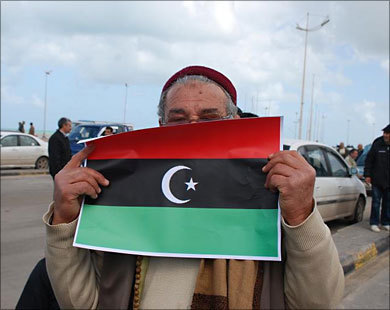
On September 1, 1969, a group of young soldiers led by 27 year-old Muammar Gadhafi staged a coup d’etat on King Idris and launched the Libyan revolution. In 1973 Gadhafi imposed Sharia law on all of Libya, purged of the ‘politically sick’ and a ‘people’s militia would ‘protect the revolution.’ The revolution was both in culture and administration. 20% of workers in Libya were under heavy surveillance by Gadhafi. Executions of dissidents were made public and broadcast on state television. In 1977 Gadhafi officially declared Libya the Great Socialist People’s Libyan Arab Jamahirya and adopted a national flag that was completely green. Gadhafi opposed any Arab country that sided with Israel and even declared a four day war on Egypt. He also supplied arms to any of its allies, both nations and terrorist groups.
Another key note is that Gadhafi was heavily influential in terrorism during the first two decades of his reign. Some believe he was the tour de force of terrorism at the time that would pave the way for groups like Al Qaeda. He formed the Black September movement which caused many attack in the 1970’s including the Olympic Attack in Munich where 11 Israeli athletes were killed. His terrorists were also instrumental in hijacking airplanes which led to the tight security on airplanes that still continue and become stricter to this day. In 1985, it was discovered by the United States that Gadhafi harbored a camp for training terrorists. This led to President Ronald Reagan to declare an airstrike on Libya in 1986. The strike failed to kill or depose Gadhafi but killed his daughter. His terrorist activities died down soon after but not without one last infamous attack of a bomb on a flying plane exploding over Scotland in 1988, killing hundreds. Even despite his terrorist activities dying down, he still talked tough and sided with Arab leaders who were anti-Israel.
In 2011, people’s movements in Tunisia and Egypt led to the overthrow of their heads of state. The revolutionary spirit spread to other Arab countries including Libya starting in the month of February. Gadhafi quickly condemned the uprising and claimed it was being engineered by Western elements and Israel. By March, much of Libya had tipped out of Gadhafi’s control where even members of the Libyan army were joining the revolt. Gadhafi loyalists were encouraged to kill the protesters. Soon international forces from the United States, the United Kingdom and France had joined forces to declare a military operation to remove Gadhafi. In June, the International Criminal Court issued an arrest warrant for systematically planning and implementing attacks on civilians. By August 22, 2011, rebel fighters had gained influence and control of Tripoli’s Martyr’s Square. Meanwhile Gadhafi asserts he’s still in Libya and will not concede power to the rebels.
Now the overthrow of Gadhafi is definite or eventual, if not official. There comes the big question. What will come of Libya in the future? Will it become a better stronger country? Or will it face its own problems?
The country is now mostly controlled by Mustafa Abdul Jalil, Gadhafi’s former justice minister who established the National Transitional Council shortly after the Libyan revolt began. The Declaration of the council includes many key aims like: ensuring safety of its citizens and liberating the rest of Libya, restoring normal civilian life, have the military council achieve a doctrine protecting Libyan citizens and defending the borders, draft a new constitution, pave the way for free elections and guide the conduct of foreign policy and international relations.
The policies appear promising but the big question is can it be attained over time? Many Arab countries that have established new freedoms and new liberties have faced the threat from dissidents, terrorists and loyalists of the former dictators. Afghanistan and Iraq have held elections and drafted new constitutions after their revolutions but have constantly faced attacks from many dissident factions that still happen to this day. Also it is possible of another coup d’etat in the future from a new dissident or Gadhafi loyalist with military power. The future of Libya has yet to be determined in the wake of the deposition of Gadhafi that continues as we speak.
Libya also has the 10th largest oil reserves in the world and the 17th highest petroleum production. It’s high petroleum production and low population has given it the fourth-highest GDP in Africa. During Gadhafi’s reign, the money was used to buy arms which led to many of the terrorist attacks. The wealth was not evenly spread out amongst the people. Under a new government in Libya, will the wealth be used more generously for the sake of developing the nation and the quality of life for its citizens? Or will it be a heated political debate in the future?
Since Gadhafi’s official overthrow is eventual, the future of Libya is a big question. The future of the country and the leadership that follows will be a new chapter in the country’s history but which direction it goes, and whether the new intended freedoms and liberties will be successfully carried out, still remains a question that only time can answer.
Hi. This is an article that I have delayed posting here for the longest time. Hope you like it.
It was declared on July 9, 2011. South Sudan was now an official independent nation of its own. Its population is an estimated 8,000,000. The capital city is Juba, a city of an estimated 400,000 people. Hearing about what the people of South Sudan went through, you’d feel their independence from the main Sudan was hard-earned.
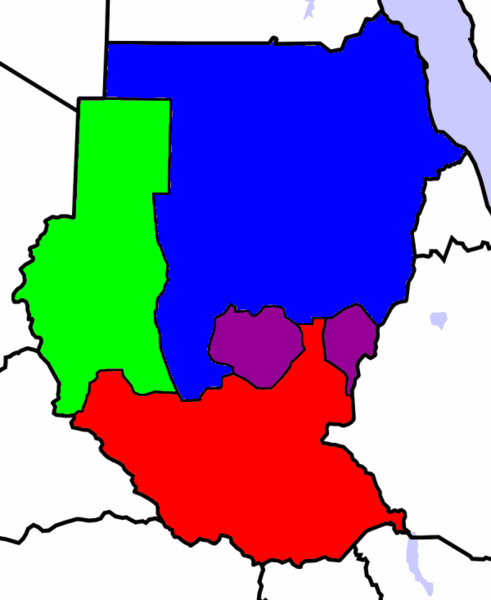
Map of Sudan and regions. Area declared South Sudan is in red.
Firstly Sudan was originally a joint condominium between Britain and Egypt until they declared independence in 1956 as the Republic of Sudan. Despite Sudan being independent, it was not unified. The northern and southern parts of Sudan were sharply divided. The main divide between the two was based on ethnicity but also about religion; the northern part of Sudan was predominantly Muslim while the southern part of Sudan had a Christian majority. Conflict between Northern Sudan and Southern Sudan had already existed for a year and would continue until 1972. That war would be known as the First Sudanese Civil War. Half a million people were killed. It would take an agreement in Ethiopia in March 1972, known as the Addis Ababa Agreement, that would end that civil war. The goal of the Agreement was to address and appease concerns of the southern Sudan liberation and succession movement. This would help to give some autonomy to the Southern Sudanese region and would give peace to Sudan for almost a decade.
The one thing the Agreement failed to do is dispel the tensions that caused the first Sudanese Civil War. Then in 1983, Sudan’s President Gafar Nimeiry declared all Sudan an Islamic state, The Southern Sudan Autonomous Region was abolished on June 5, 1983 and the Addis Ababa Agreement was ended. This would lead to the Second Sudanese Civil War. This war would last from 1983 to 2005 and would have one of the highest civilian death tolls since World War II. Two million people were killed as a result of the warfare, famine and disease caused by the conflict. Four million people from Southern Sudan have been displaced during the times of the war. At the start of that war, the Sudanese People’s Liberation Movement was formed as both a rebel group and a political party in response to the crises.
The war finally ended in January 2005 after a comprehensive Peace Agreement was signed. The purpose of the agreement, known as the Naivasha Agreement, was to develop democratic governance countrywide and share oil revenues. It further set a timetable by which Southern Sudan would have a referendum on its independence. The referendum happened during the week of January 9-15, 2011. Almost 99% of South Sudanese voted for independence. Independence was declared on July 9, 2011 and the United Nations recognized South Sudan’s independence on July 14th.
Despite being the world’s newest nation, South Sudan still faces problems and challenges in the time ahead. One problem is that the famine that is occurring mostly in Somalia also includes South Sudan and other nations. Another problem is that conflict between Sudan arose again a month ago with the South Kordofan conflict that still exists today. Another problem is of possible intertribal enmity within the country. One challenge South Sudan will have to face in the future is organizing the nation and its rights amongst the people. It is currently on a human rights watch by the UN, and rightly so. The SPLA may have been able to get South Sudan its independence but is also known for human rights atrocities of their own. Even the CIA has suspected of genocide in southern Sudan last year. One thing the elected President of South Sudan, Salva Kiir Mayardit, has promised is respect to freedom of religion. Kiir himself is Catholic with a Muslim son.
South Sudan: the world’s newest nation. Will it be a better, wealthier, more developed, more just country that Sudan was and still is? Or will it have its own problems or atrocities? Only time will tell.
Hi. I know it’s been a while since I wrote something, especially of substance. So here I am getting back into the swing of things with my latest article. Hope you like it.
If you’ve lived in BC this past year and a half, you may have known for a long time about the most heated three letters in the province: HST. The tax came from nowhere, became part of BC faster than you think and is now up for public vote after a year of existence. The tax and the craziness surrounding it is both frustrating for the citizen and cartoonish in the media’s eye. Even more surprising is that the referendum involving the HST isn’t your typical ballot-and-booth referendum but a mail-in referendum lasting a full month. Most BC residents may not know a whole lot about this Harmonized Sales Tax but it sure has been far from harmonious in BC.
What few people know is that British Columbia is currently one of five provinces with an HST. The others being New Brunswick, Newfoundland and Labrador, Nova Scotia and Ontario. Actually it was the Atlantic Provinces who worked back in 1996 in having a Harmonized Sales Tax implemented in order to lower the amount of tax a citizen would have to pay. This resulted in a 15% HST that came into existence on April 1, 1997. When the GST lowered to 6%, the HST went down 1% to 14% and would go down to 13% when the GST was reduced to 5%. It was noticed that the price of goods fell when the HST came in. In fact one of the things in changing from a cascading tax to a value-add tax was to reduce income taxes, and instituted direct transfer payments (refundable tax credits) to lower-income groups, resulting in lower tax burdens on the poor.
The benefits of the HST were appealing. Even Prime Minister Stephen Harper government said of tax harmonization: the single most important step provinces with retail sales taxes could take to improve the competitiveness of Canadian businesses.” However it was in 2010 when the HST was implemented in BC and Ontario that the drawbacks came to light. It made businesses hard to manage and property values hard to maintain. Many food expenses which had either to the one tax or neither tax became more expensive. The price of gas increased. Services like haircutting and dry cleaning which had only one tax saw the raised price. Some items in BC, like public transportation, ferry costs and toll-bridge tolls. Children’s clothing, child-care items and feminine hygiene items were also exempt. Nevertheless the expenses that were already added were noticed soon enough.
In BC, the brouhaha about this tax is not just simply its existence but its introduction and implementation. It was first reported back in June 23, 2009 that the BC government under the leadership of Gordon Campbell intended to harmonize the two taxes. Full attention to this tax didn’t come until after the 2010 Winter Olympics in Vancouver had ended. Before it was to be implemented on July 1, 2010, the raucous was not only raised by BC citizens but former premier Bill Vanderzalm in campaigning to get the HST abolished. After the HST was made official in BC, Vanderzalm still continued on his campaign while Gordon Campbell’s popularity soon dipped to single-digit percentages, leading him to retire.
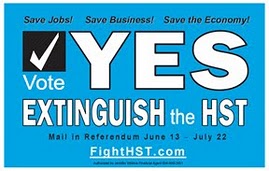
Now the fate of the HST lies in the hands of the citizen of British Columbia. All registered BC voters including myself were sent a mail-in yes/no ballot in which one is to vote not on keeping the HST but on abolishing the HST. The deadline for mailing in the vote was Friday July 22nd. During that time, there has been many pro-HST and anti-HST rhetoric. Those against the HST would speak of their drawbacks, most notably the increase in expenses for BC citizens and the businesses that have either faced huge economic difficulties or closed. The common citizen should also have its own experience with the HST in the past.
Those for the HST have come from economics or other sources that have studied the HST in the past. On May 4, 2011, an independent panel commissioned by the BC government released a report on the impact of the HST in BC. The report concluded that “Unless you are among the 15 per cent of families with an income under $10,000 a year, you’re paying more sales tax under the HST than you would under the PST/GST: On average about $350 per family.” The report also predicted that by 2020, the HST is anticipated to result in a BC economy that will “Be $2.5 billion larger than it would be under the PST. That’s about $480 per person or $830 per family.” There was even a prediction from the University of Calgary that the HST will lead to 600,000 more jobs in the next ten years. Economists have even spoken of the potential damages and drawbacks that could happen if the HST is abolished.
Anyways the referendum is over. If you didn’t mail your ballot in by now, tough cookies. Time will tell what the result of referendum will determine. Time will also tell which tax system was supported by the people and whether it will pay off in the long run. Stay tuned. The future of BC and its economy will be decided.
I don’t have to explain Game 7 for you; most of you know Boston won 4-0 and took the Stanley Cup with it. I don’t even have to explain the aftermath that happened immediately after. It’s worldwide news now. However I would like to tell what I experienced, why I’m not surprised and what has happened since.
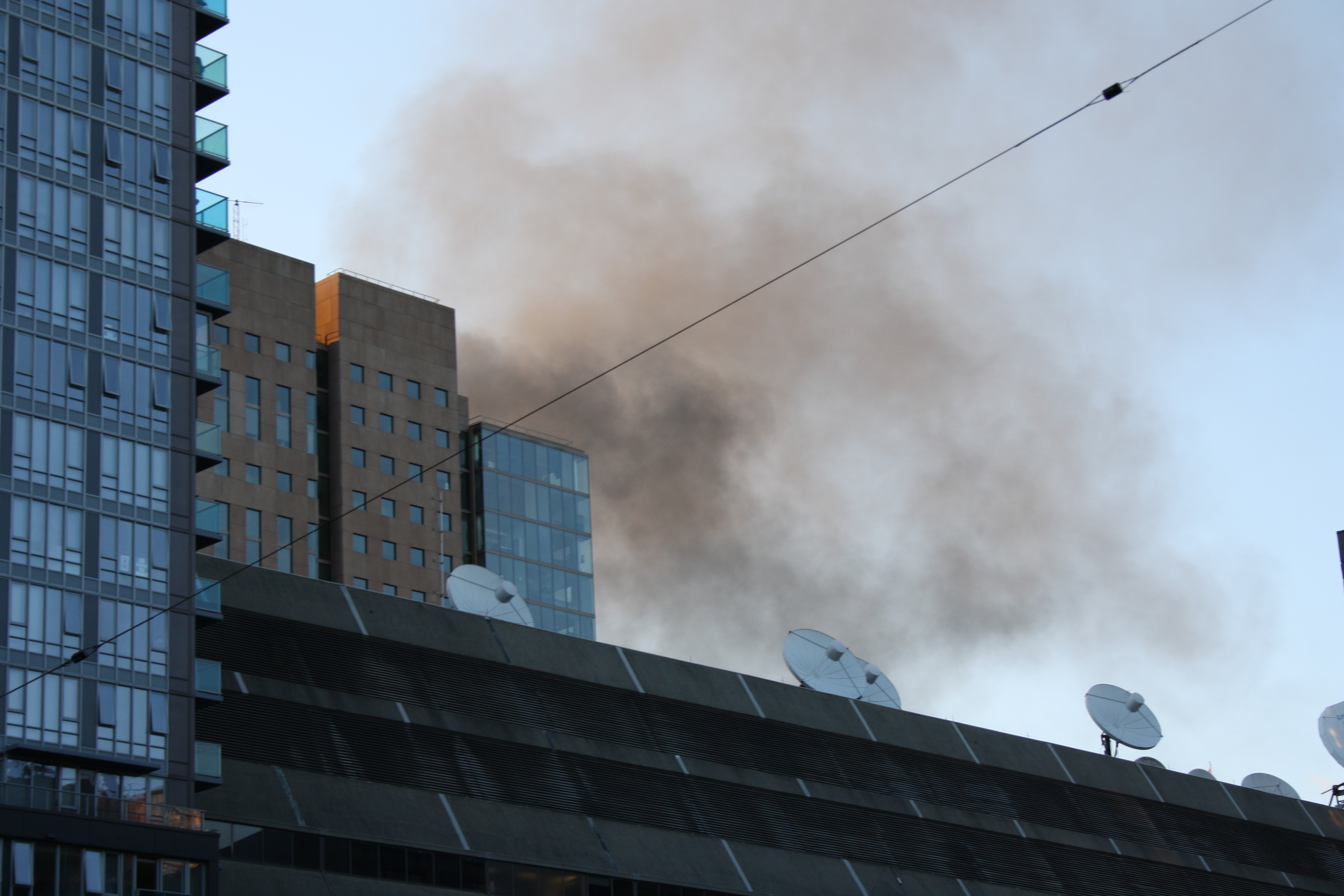
I saw the event over around Robson and Beatty. It was in a building with 70 others. It was a fun time, even though we weren’t happy with the final score. We sat through watching the Stanley Cup being given out, despite our obvious disappointment. Afterwards many of us stuck around to help set the place up for tomorrow’s work day. As we were looking out the window, all we saw were people walking down the street. Within a matter of minutes, I heard someone say that two cars were being burned. Another short while later, I heard another say that a police car was set ablaze on Granville. Once we had the room completed, I talked with four others I would be leaving the building with that I felt it was best to go to the Yaletown SkyTrain. Just as we were leaving, we went outside and saw rising smoke from above a skyscraper. The skyscraper was blocking the view of where the smoke was coming from. Then we heard two explosions that sounded like gunshots only to see more smoke. It was after ten minutes of looking out to the rising smoke that we decided to walk the long route to Yaletown SkyTrain. While walking, we saw one cafe had a TV screen on and live coverage of a car burning outside the Post Office building; that area where we saw smoke rise. We were all shocked. Soon we boarded the Canada Line Skytrain, got off at the Langara station and took a bus to a Metrotown Restaurant to toast the Canucks.
At home hours later, I didn’t know if I would be going to work the next morning. The next morning I was able to go to work but not without seeing some of the damage, destruction or repairs happening. It was all over the news. Reactions not just in Vancouver’s news but all across Canada and around the world poured in. The riot led to 150 injuries, 15 burned cars and millions in damages and stolen goods. Even a story of a Boston Bruins fan stabbed in the neck. Vancouver was officially defamed.
The craziest thing about these riots is that they were not completely unexpected. Some may remember that seventeen years ago, in 1994 when the Canucks lost the Stanley Cup to the New York Rangers in Game 7, there was rioting happening then too. Businesses were damaged, there were at least 100 injuries. Police had to rush in to stop the action. Remembering that, I was originally planning to title my article Vancouver Riots: The Next Generation. Recently I heard a story from my uncle that there was a riot in Vancouver back in the 60’s when they won the Grey Cup. Whatever the situation, it was the riot of 1994 that would make Vancouver the unofficial ‘riot capital of North America’. There would be further riots: 1997 at the time of the G8 summit, a multitude of pre-Olympic protests and clashes, and Olympic raids during 2010. Vancouver has also been known as a central meeting spot for anarchists from all over BC and even the Northwestern United States. Even many people knew that there would be a riot after Game 7, win or lose. Some made mention that there were people in the crowd of Georgia street dressed as fans but carrying pepper spray and goggles for the sake of wreaking havoc at the end. Mayor Gregor Robertson and the Chief Of Police even made mention in a news story that they learned from 1994 and would be prepared for a possible riot this time around. They couldn’t have been wronger.
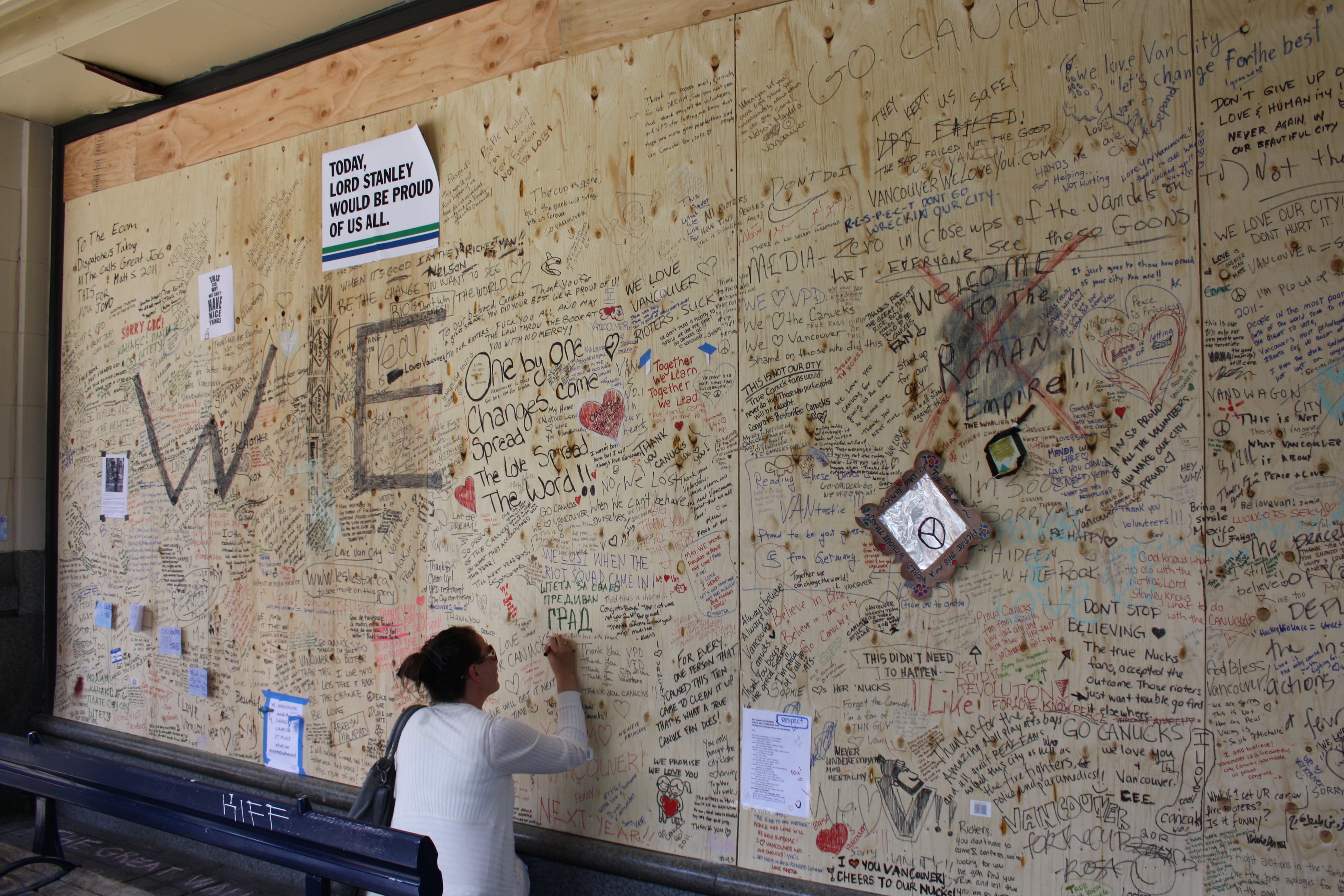
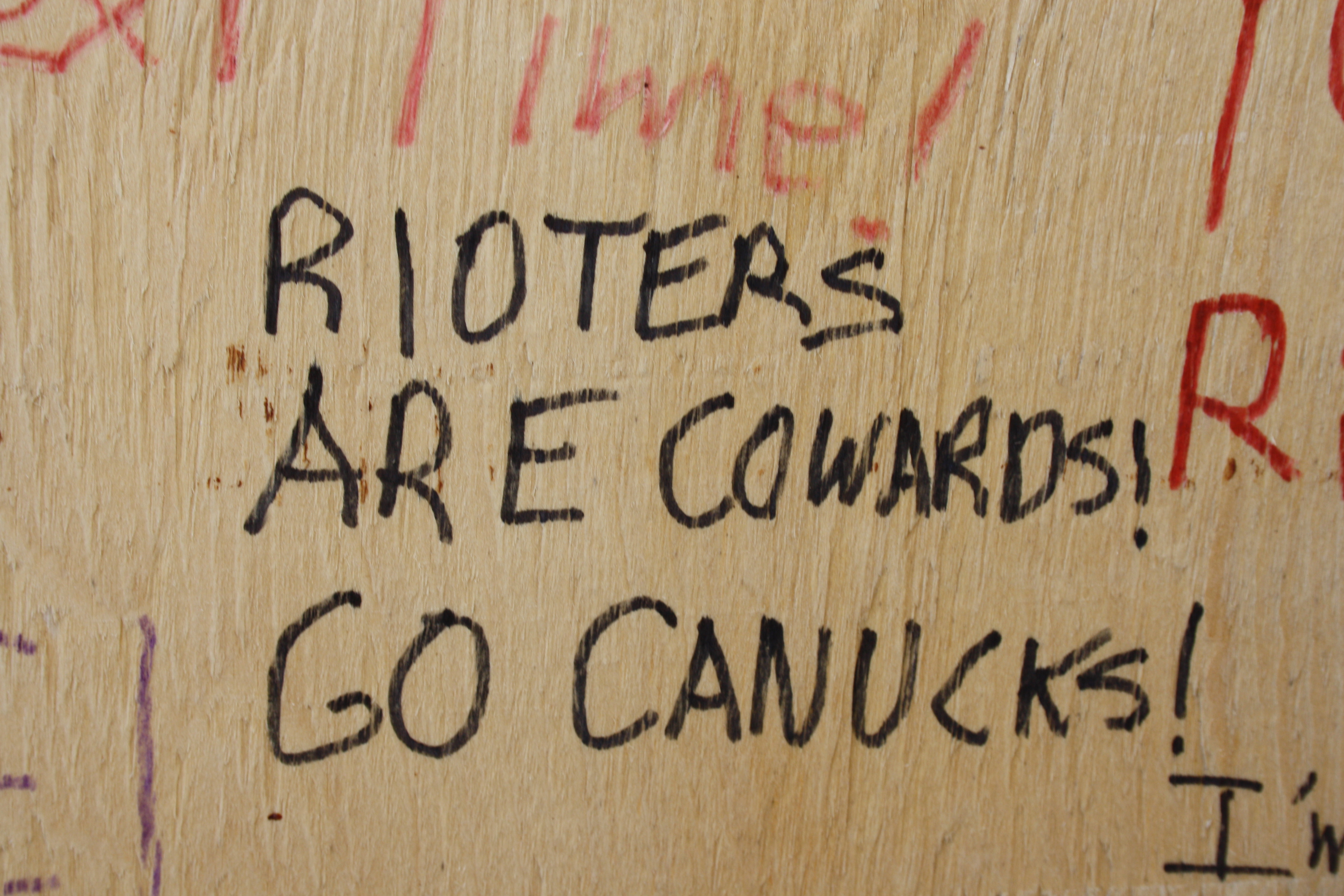
Despite all the nasty things that happened, there was a ray of hope. As workers started cleaning up the glass from smashed-in windows, volunteers came in and helped with the clean-up. I saw many along the streets and even around the Post Office building cleaning where cars burned the night before. Groups on Facebook started support groups like: ‘Vancouver Spirit Rally,’ ‘Real Canucks Fans Don’t Riot!’ and ‘Canucks Fans Against the 2011 Riots.’ One Facebook page even encouraged volunteers to clean up from the night before. That may have to do with why there were volunteers cleaning the next day. There were even pages devoted to posting photos of people causing criminal activity like ‘Vancouver Riot Pics: Let’s Get These People Locked Up,’ and ‘Report Canucks Riot Morons.’ Pages like those has led to many arrests since. On the plywood held in place of the various business’ broken windows, people wrote messages of apology or messages condemning the rioting or support to Canucks and the city of Vancouver. It’s a given that when cowardice like the riot arises, humanity responds.
It has been eleven days since the riots. A lot of rebuilding and replacing have happened since. A lot of support has happened since too. The reputation of Vancouver since the riots still has yet to be determined. Will new laws be passed to prevent further riots from happening? If Vancouver qualifies for another Stanley Cup finals, will there be another telecast on a big screen on Georgia Street? Win or lose, will things be better this next time? Or will we have another riot? And will the authorities be prepared this time around? Only time will tell.
This is it. On Wednesday June 15th at Rogers Arena, the Stanley Cup will be decided in a single game. The two finalists–the Vancouver Canucks and the Boston Bruins–both have won three games apiece. Both have shown their strengths and both have shown their weaknesses. Both have some key players out, either by penalty or injury. Both have also been the subject of negative opinion and positive opinion. Whatever the situation, tomorrow decides it all. But who will win? Instead of predicting the winner for tomorrow, I decided to sum the two all up and break them all down:
VANCOUVER-Three wins on home ice. All of their wins have been very close: 1-0, 3-2 overtime and 1-0. One thing about the wins is that they may not have been big or spectacular but the Canucks knew how to play smart at home in order to make the wins happen. Yes, the wins were mostly conservative but their conservative play would pay off at home. Their losses to Boston have been a lot bigger: 8-1, 4-0 and 5-2. Part of the reason for their losses in Boston have to be with the lack of confidence many would display. It would be noticeable as they would miss many important plays. Also during the Boston games, there was a noticeable weakness in Roberto Luongo as he let in a total of fifteen goals. Whenever he was replaced by Cory Schneider, the Canucks would soon get their confidence back and start playing better hockey. Already two top players: Aaron Rome and Mason Raymond are out.
BOSTON-Also three wins on home ice. All three of their wins against the Canucks have been decisive: 8-1, 4-0 and 5-2. The Bruins definitely know how to go all out on them while at home but during the away games, they’re lacking. All three of their losses have been tight games. They’re not as good at scoring in Vancouver and despite having a lot of puck control, they don’t materialize it at Rogers Arena as well as they could. One thing about their big wins is that they’re hoping to use it to intimidate the Canucks en route to winning the Stanley Cup. The big wins didn’t intimidate the Canucks enough as they would win 1-0 on Game 5. Tim Thomas has been an excellent goalie conceding only eight goals in the final. However this would prove to be a weakness as there would be two Canuck wins of 1-0. Plus Boston’s big wins in Game 3 and 4 didn’t succeed in intimidating the Canucks as they would win Game 5 1-0, putting the embarrassments of Game 3 and 4 behind them.
Now there’s the overall play. The media are already calling this the ugliest Stanley Cup finals in recent years. It all started in Game 1 with the Burrows Bite. Then in Game 3 came the check from Canuck Aaron Rome to Bruin Nathan Horton. That left Horton hospitalized and out of Finals play. For Rome’s part, he was slapped with a four-game suspension also leaving him out of Finals play. Then came the ‘pumping his tires’ reference from Bruins goalie Tim Thomas to Roberto Luongo that has been well-published. Already the Canucks were labels the most hated team of the Finals by many. Then things took a worse for Boston. Game 6 saw a check to Canuck Mason Raymond which left him hospitalized with a fractured vertebrae. Also many on the web have suspected the Boston ice to be too soft and the Boston referees too ignorant to the Bruins own penalty-worthy misdoings. Already the Finals are memorable for a lot of wrong reasons.
With Game 7 just more than a day away, people are already giving out their predictions. There has even been some numerology and trivia bits floating about to hint who will win. Now I’m not one who completely believes in numerology or trivia odds and ends but I have been hearing some interesting facts that may lead to tomorrow’s fates. I heard that a Canadian host city of an Olympic Games would win the Stanley Cup the following year: Montreal hosted in 1976 and won in 1977; Calgary hosted in 1988 and won in 1989: Vancouver hosted last year and it’s just so close. Also in favor of Vancouver, there’s the fact that of the fifteen previous Game 7’s of the finals, all but two have been one in the Game 7 host city. However there’s also one going against Vancouver which I learned of during Game 5’s telecast. Of the previous fifteen Cup Finals that lead to a Game 7, all but four winners of Game 5 would not win the Cup.
Whatever the odds and ends, whatever play happened in the previous six Finals games, only tomorrow will decide the 2011 Stanley Cup Winner.. Will Vancouver’s conservative style of playing and winning at home pay off? Or will it take its toll in Game 7? Will Boston’s big wins succeed in intimidating the Canucks for Game 7? Or will it be like in Game 5 in which the Canucks were able to bounce back from humiliation and show the Bruins they weren’t so intimidated? It will all be decided when the puck drops in Rogers Arena tomorrow, Wednesday, June 15 at 5pm Pacific time. May the best team win!
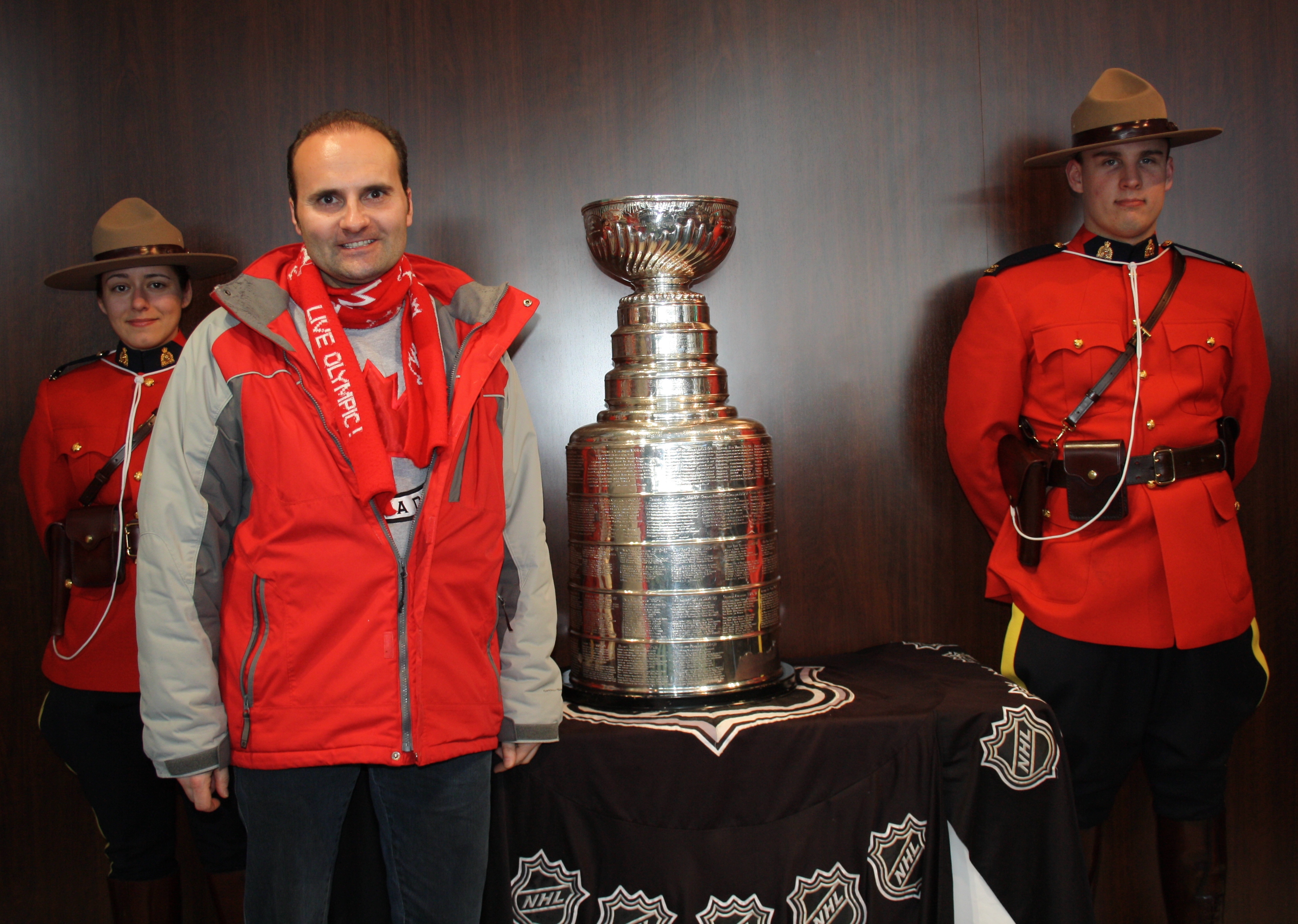
Me with the Stanley Cup. Which team will hoist it tomorrow?
So some of you may have already got my first taste of Canucks talk. Well guess what’s happened since? I was at the very first Stanley Cup Finals Game at Rogers Arena! Don’t ask me how much my tickets were. The most I’ll say was they were over $500. I will say that I was glad to be in the arena for a once-in-a-lifetime event. Looking back, I can say I was there when it all started.
Tickets for the Finals games didn’t go on sale until 10am on Tuesday, May 31st,, only the morning before Game 1. They were originally intended to go on sale Monday at noon but they were delayed 22 hours for inexplicable reasons. I took an early lunch break at that time to buy a fair-priced ticket for Game 1 from Ticketmaster. By the time I got on, they were either impossible to buy or completely sold out. I know that before ticket-buying I promised myself that $500 was the most I’d attempt to spend on a Stanley Cup ticket, but desperate times call for desperate measures. I called ShowTimeTickets to place an order because I had trouble logging in to their website. Luckily, I was able to buy one ticket for Game 1, for up on the balcony. Unluckily, I broke my promise to myself. I mean it is history in the making, right?
Okay, Game Day. On Wednesday June 1st, I was finally done my job at 4:30. I was told by ShowTime to wait until 3 at the latest to get the best seats in the house for my order. Once my work was done, I took my Canon Rebel camera and bag out of my backpack to make my trek to the ShowTime office. Luckily I get my ticket just a minute as soon as I arrive. Amen! My order was for a balcony seat and I ended up with Section 329, Row 13, Seat 107. Original ticket price, $150. Luv-lee! I immediately head to the nearest path to get to Rogers Arena. I get to one entrance and security demands that they check my camera bag and backpack and removed all my empty liquid bottles. Real fun. Then my ticket was taken and scanned. Easiest part of getting in.
First thing’s first, I find my seat. Okay, first thing’s not first. I go to get a medium soda and huge pretzel. Yes, my favorite game snack is the huge pretzel! I get my goodies and then head to my seat. I find there’s no finals towel there. Which means either arena personnel forgot to put one on or the guys in the seats above me stole it as an extra thing to hock on Ebay.
I set my bags underneath my chair and have my camera around my neck. Nice SLR camera I bought for the Olympics for the sake of taking some good action shots. Now ready for another set of action shots. Before the game began, there was a rap from rapper Kyprios—whom I personally don’t care for—who rapped “How The West Was One”. Game begins with the Bruins and the Canucks on the ice. The national anthems are sung. Meanwhile Luongo is warming up the whole time. Anyways the game starts off on an exciting note. During the first two minutes, the Canucks produced four shots on goal. Boston would respond strongly. First penalty of the game would go to Daniel Sedin and that landed him 4 minutes in the box. Despite more shots on goal, Boston failed to score. The second half of the first period saw more Canucks dominance with a powerplay and six shots on goal compared to Boston’s four. After the twenty minutes were up, the period was scoreless. One thing I have to say is that being so far up in my seat made it hard to notice the Burrows Bite at the very end. It looked like a typical hockey squabble from where I was sitting and I wouldn’t know until tomorrow’s news what exactly happened.
During intermission, I left my seat and learned some yahoo spilled beer on my backpack. As annoyed as I was, I should have expected it. Anyways I made a full circle around the lobby to check out the shops, concessions, exhibits and fandemonioum. During the break, I bought another pretzel, this time salted. I took photos of the exhibits and some of the more colorful fans: both Canucks and even a Bruin or two. I hope those Boston fans inside know that Vancouver has a store that sells all sorts of ‘different’ meats, including bear meat! I bought some souvenirs in time for Father’s Day. Oh yeah, Supertramp and Michael J. Fox were spectators that night and Don Cherry was there too.
Before I get into my talk about second period, I have to say that being up there in my seat was not an easy thing. I wanted to watch the game and take pictures at the same time. It was not an easy thing to do being from my seat and sometimes using my camera as binoculars for the game. Sometimes I’d forget to take pictures of some of the highlights. I must admit that watching is easier without the camera.
I arrive back into my seat minutes after second period began. By the time I arrived, Boston had four more shots on goal and the Canucks had a power play. I returned around the time an injured Dan Hamhuis delivered one of the more entertaining tackles by flipping Bruin Milan Lucic. After that, there was some boring play for a while and then came the penalties- three in a minute. Thanks to a Bruin getting a penalty, I get my first look at the green men. Vancouver loves them but I bet every other team hates them! Vancouver soon came on strong and then Boston had more goal attempts. Nevertheless, the period ended with the game still scoreless. I didn’t want to deal with a soaked bag again so I remained in my seat during intermission.
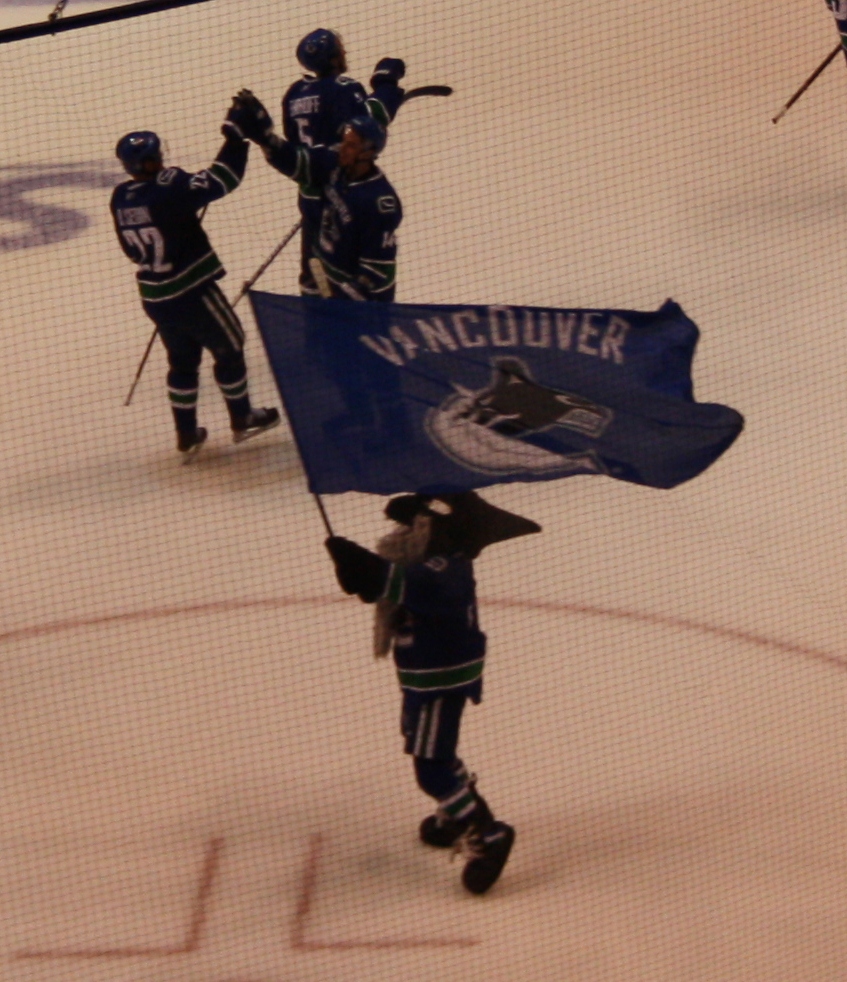
Third period came with the Canucks coming on stronger but Boston continuing to challenge. There was music mixing from DJs Marlon J English and Jay Swing and the Canucks band played in our area. The last half of the third period saw the Canucks come out of their shell and start making more of a serious attempt to score. However in the final minute, most of us were groaning about a possible overtime after a scoreless game. Then the miracle happened. With 18.5 seconds to go, Raffi Torres delivered the goal, much to the euphoria of the full venue. It was there and then we knew the Canucks did it! Even though Boston called a time-out, we knew there was no hope for them. The game was ours and the Canucks began their quest for the Cup with a Win and Torres was the savior of the night. The final mark of the win was Fin waving the Canucks flag on top of his hockey stick.
After the win, it was a party as people were leaving the Rogers Arena and into the streets of Vancouver. As I exited arena with my backpack soaked in beer, the streets were loaded with fans. I met one guy who came from Winnipeg to see this. For three blocks until I hit the Central Library, it was like a complete parade of fans. Even after I left the library ½ hour later, it was still active with fans. Already the quest for the Cup began with a good start.
Hard to believe it was five days ago. Hard to believe Game 3, Boston’s first Finals game as host happened tonight. We had a second game on Saturday where the Canucks started good but Boston pulled a second period surprise. I was with friends in a church hall at the time. I kept on telling them ‘It’s not over.’ In the third period was the game-tyer. However with an event taking place upstairs, the church was under a strict regulation to end telecast of the game at regulation, overtime or no overtime. When we made it to the chapel, we were reassured that the Canucks won: 11 seconds into overtime by Burrows.
All I can say this last while is fan euphoria like no other. There have even been fan videos from Youtube. My favorite is of a Victoria comedian imitating a Bruins fan with Boston accent, attitude, foul mouth and all. I think he could rival the green men.
Just now, Vancouverites are recovering from an 8-1 loss to Boston. I was working when it all happened but I heard a lot and saw enough from replays on Youtube. Canuck Aaron Rome has gotten the biggest heck for that check to Nathan Horton that left Horton carried off on a stretcher. Boston sure came back with a vengeance, although many Canuck fans are complaining about bad reffing. Bad reffing or not, the Bruins won the game. Personally I had a bad feeling that Boston would win today but not by that much. I knew that both Canucks wins came from very tight games. Game One was won by a goal in the last minute. Game 2 was won by an overtime goal after just eleven seconds. Before Game 3, Boston was able to show the Canucks that they can be a formidable rival, even though they lost both games. Boston knows the Canucks are a tough team but they also have a vulnerable side and they really exploited that tonight. Many Canuck fans are claiming they appeared tired after the second and that’s where it all went Boston’s way. Now the Canucks know they will have to play harder smarter games if they don’t want to give anything else up. I believe the next Boston game will be another nail biter for both teams. Nevertheless Vancouver can take comfort that they still lead the finals two games to one. It ain’t over yet.
I don’t think I’ll ever see another Stanley Cup Finals game ever again. Not that I doubt the Canucks in the future but I believe the next Stanley Cup Finals tickets will be way more expensive the next time. It’s even possible that in the near future, $1000 won’t even be enough. All I can say is I was glad to be there when it all started. Now I have something to tell my grandkids!
Me With The Stanley Cup During The 2010 Paralympics
On the evening of May 29, 2011, I was at the Hollywood Theatre for their last double-bill showing. It was a bittersweet night with a huge attendance. The night not only marked the end of a Vancouver landmark as we know it but a family business too.
The Hollywood Theatre was opened in the West Broadway area of Vancouver back on Thanksgiving weekend of October 24, 1935. Reginald Fairleigh, a Vancouver cinema mogul, and his wife Margaret had the theatre built in the Great Depression so that her children could have jobs. At the time, there were already 26 other movie theatres in Vancouver. The theatre opened with the double-bill of Will Rogers in Life Begins At 40 and Thelma Todd in Lightning Strikes Twice. Tickets for the double-bills were a dime or 15 cents for a balcony seat. Men had to wear a tie and women had to wear a dress. A man tempted to make out with his lady was given a small sheet of paper saying, “Treat your date as if she were your mother.” Over time, many famous faces and many great movies graced the screen. Its tagline which existed until its last days was: “Pick O’ The Best Plays.”
Styles of movies changed and the theatre would face rivalries from television, pay-pre-view and VCR but the Hollywood continued success. Also in place even in present day were many things done back when it first started, like double-bills, taking straight cash at the ticket booth, and most importantly the Fairleigh family owning and operating the theatre. The closest thing to a big change was the start of the ‘odd double-bill’ back in 1990. This phenomenon started when My Left Foot and Rambo were aired one weekend. Some first thought it was a bad mix. It actually was a success because they attracted two completely different movie crowds that were both big in size. The ‘odd double-bill’ was kept up in many different versions in the years since.
Over the years, I’ve taken a liking to the Hollywood Theatre. Just a fact about myself: when I first moved to Vancouver from Winnipeg in February 2000, I was just a casual moviegoer with a general interest in movies for someone at my age. Nothing big. But after I saw American Beauty just days after I arrived in Vancouver, that movie and that year’s Oscar race to go with it changed my life.
Okay, going back to the Hollywood Theatre, I first saw a movie at the Theatre in 2001, shortly after moving to Vancouver from Winnipeg for the second time, and this time for good. I saw them as a second run movie theatre that played not just any movies for a second run but good ones too. I am unsure exactly what the first movie I saw there was. I’ve been asking myself ever since I learned of the closure what the first movie I saw there was; I believe it was Almost Famous. A few weeks later, I saw Gladiator. I came to like the theatre for its double-bills and for the best price of movie popcorn in town. Another thing I liked was their photocopied program of scheduled movies over a six-week period. I’d frequently pass by to pick one up. One noteworthy thing about the program is that in its brief review of the movie, they always had the director’s name and in bold. I consider that something. A couple of years ago, I came across the newspaper article hanging in a frame. I saw it was from 1935 and talked of the opening of the theatre. When I saw that I thought “Wow, 1935! This is definitely a piece of Vancouver history!”
Here’s some other excellent movies I saw over there: Mulholland Drive, City Of God, Downfall, Vera Drake, Lemony Snicket, Transamerica, American Gangster, Changeling, Tropic Thunder, Another Year, it’s just too hard to remember them all . Yeah, I saw a couple of bad ones and the odd guilty pleasure now and then too, but the Hollywood never let me down. The most unique ‘odd double-bill’ I went to had to be the pairing of Bridget Jones: The Age of Reason and Vera Drake. Two movies with a British female lead character: two completely different films of quality. The Hollywood was really convenient when it would show certain popcorn movies and ‘Oscar buzzers’ I always wanted to see but missed during its main theatre run. I’d always check the newspaper to see what the Hollywood was showing. I also remember leaving my second job, which ends at 9pm, to rush out and take buses to the Hollywood. Even if the movie ended before midnight or past midnight, I didn’t mind bussing back home that late.
Hollywood also consists of a few movie-going milestones of mine which I’m quite proud of. The first is seeing City Of God in the spring of 2003 before most would later discover this gem on DVD. The second is A Serious Man the night before the 2009 Oscar nominations were announced. It’s an Oscar-time tradition of mine to see all five, or now ten, Best Picture nominees and seeing A Serious Man the night before the nominations were announced completed it for me right there and then!
On Monday May 23rd, which is Victoria Day, I went to the Hollywood with my cousin to see Another Year. It had been months since I had been there. As much as I like the Hollywood, I like going when there’s a movie I like or a movie I want to see but haven’t. Such was the case that day. Before I entered the theatre, I learned from the ticket taker that they would be closing and that there would be a farewell party over the weekend. That was a shock to me as well as to her.
One of the reasons for the demise is because of the current difficulties of the single-screen neighborhood theatre. Nowadays if a movie theatre is to do well, it either has to be a multiscreen cinemaplex or connected to a shopping mall. In the past ten years, Vancouver has seen a lot of single screen theatres go and end up crushed for developers to construct something new. There’s the Varsity Theatre near the University of British Columbia that ended years ago and is now developed into condo land. There was recently the Van East which ended in January and has had its inside worked in for new development. Even triple theatres like the New West Theatre and multiplexes Langley’s Willowbrook cinema closed and were developed into something new. Some multiplexes like the Granville 7 constantly face threats of closure. Currently there are only six single screen theatres in Vancouver; the independently owned Rio Theatre and Dunbar Cinema; the Festival Cinemas-owned Ridge and Park Theatres; and the organization-oriented Pacific Cinematheque and Vancity Theatre.
Another reason for its demise over the years is now of the many ways one could see film and its current ability to be accessed at no cost on the internet. I don’t want to get into a tirade about how Napster and Netflix get people with a selfish sense they have a ‘right’ to free entertainment, but I will say that movie websites like Netflix has made it so easy and affordable for one to have all the online movies they want at a monthly rate, it’s not only hit theatres hard but video stores hard too. Plus so many ways to watch movies, especially those that happened in the last 10 years like Youtube, in your airline seat, on your smartphone and even on your wristwatch. Makes the original ‘other’ ways like television, pay TV and VCR seem old and tame.
In the days before its closing weekend, I contemplated when to go to the farewell weekend. I was first thinking of Sunday only, then both Friday and Sunday. Also I was confused of what exactly was happening. What I heard at first, I interpreted that there would be a party going on in the theatre and that there would be a piano playing with all the movies silent. My mind does play tricks on me. When I returned on Thursday to take some pictures of the outside, I talked with the ticket-taker: Vince Fairleigh, the fourth generation Fairleigh to work at the Hollywood wo had been taking my tckets all these years. I told him I would miss it. Also in terms of the weekend festivities, I was left thinking of the same ‘party’ that I heard about on Monday.
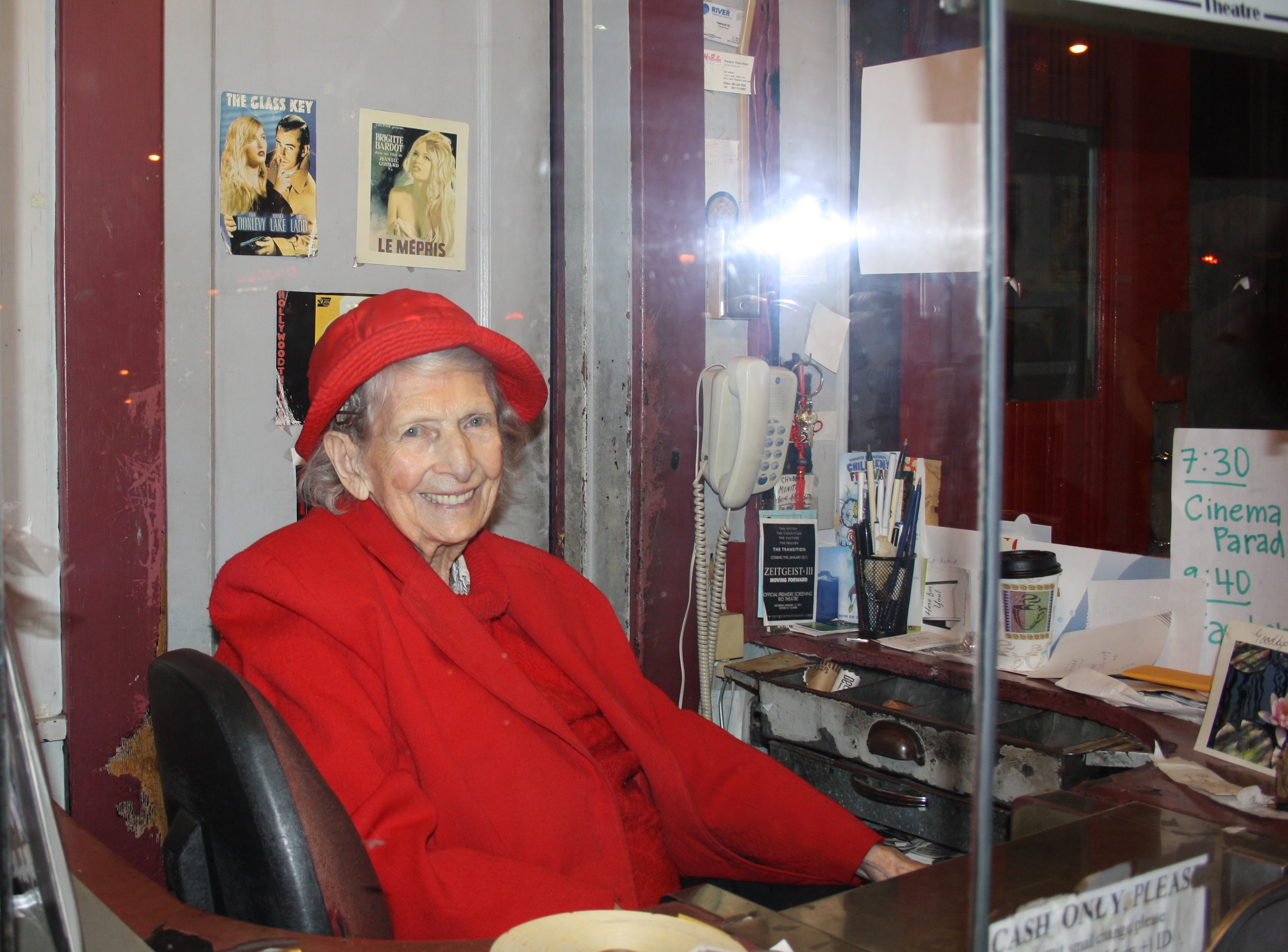
Alice giving tickets one last time.
Friday the 27th came and I was to go with my friend to that ‘party’. The ticket taker at the door was an elderly lady: grandmother Alice Fairleigh well into her nineties! By the time I got in, I saw the ending of Cinema Paradiso. It wasn’t exactly a party but a showing of movies with speeches. After Cinema Paradiso ended, there were some speeches from professional actor and family friend Mackenzie Gray and from David Fairleigh Jr., the last Fairleigh to run the Hollywood. He gave some words about what the theatre was like in the past, including the ‘treat your date’ etiquette. He also talked of the experience of watching the movie in a theatre and how the new modern ways like cellphone and wristwatch can’t compare. Then began the final feature of the ‘closing double-bill’ which I will refer to later in this article. As it began, I left to check out the balcony. As I was taking some pictures, I noticed the door to the projectionist room was open and with a guest. I went into the room as well. I met David Jr. and we talked more. I learned a lot about the theatre and of the projector they had. He said “I’m going to miss the place,” not looking for sympathy. Then I returned to my friend in the theatre, after being away for almost half an hour. When the movie ended, the curtain closed. I thought I’d probably see in close on Sunday for the last time. As I was leaving, I saw Alice in the ticket booth and took some photos of her. I left wondering how Sunday will be like.
Sunday May 29th was a night of goodbyes but no one was going to shed a tear. All the family was here: grandmother Alice, David Jr. and wife, and all the Fairleigh sons with their families. The theatre was near-packed for this night, the final night. The night began with some applause to individuals. Then there was something unique that hasn’t happened in many decades but happened all weekend: a silent movie accompanied by a pianist. The pianist was Johnathan Benny, award winning director and cinematographer and good friend of Vince’s. The silent movie was The Goat which Buster Keaton directed and starred in. Many would forget that’s what the Hollywood did back when it first started. Even though it opened while ‘talkies’ were just starting, there were silent movies showed then too. It was fun to see the old film again and hear the piano played at the time in the way it was done: playing accompanying the many humorous, bizarre, dramatic and romantic moments of the film.
After The Goat ended, there were some speeches from family members like Alice, Vince and David Jr. David’s was notable because again he made the mention of the experience of watching a movie on a theatre. Despite that day being a bittersweet day, he sang the Charlie Chaplin song ‘Smile’. Then began the first of the final weekend’s double-bill Cinema Paradiso: a 1989 Italian film about Salvatore, a successful director, reminiscing about growing up in a smalltown’s theatre and learning projection running and filmmaking from the projectionist who just died. He returns to his hometown for the funeral and witnesses the Cinema Paradiso blown up. Vince picked the movie because the movie practically is what his life was all about: growing up in a movie theatre. The scene of when the grown Salvatore enters the dead Cinema Paradiso before it was blown up seemed almost synonymous with the Hollywood that weekend. At the end, the audience gave a huge applause. Mackenzie gave more thank yous but asked us to return to see the final movie of the night: Faster.
I left for a break in the lobby, taking more pictures and talking to people, especially many of the Fairleigh family including Vince’s brothers. Then I returned to the theatre to see what would be the last movie shown at the Hollywood: Faster– an action movie about a revenge mission starring The Rock. It seems odd for the Hollywood Theatre to show Faster after Cinema Paradiso but the mix of two was ironically appropriate for the closing weekend because it was part of the ‘odd double-bill’ tradition. And a double-bill of Cinema Paradiso and Faster doesn’t get any odder than that. I didn’t care too much about Faster. In fact I found it like your typical action movie with heavy emphasis on the shootings and car chases and featuring wooden overdramatic acting. Nevertheless I wanted to be there for the Hollywood’s last minutes. As The Rock left the screen, he had the honor of being the last face to grace the Hollywood’s screen. After the credits finished rolling, the curtains didn’t close. Instead some people walked around the screen area and checked some of the rooms around the screen. I then went upstairs to the balcony and said goodbye to the Fairleighs and wished them the best of luck in the future and best of luck for the theatre.
On the evening of Monday the 29th, the day after, I returned to the Hollywood. To my surprise, the neon lights were on. I saw the inside from the windows. Empty concessions, tables and chairs from the night, mop left out. Closings are never pretty. The future of the Theatre is a big question mark. I’ve been hearing a lot of tales about what will happen. Some say the developers want to either crush it or change it into something. I heard from others that Vince has partial ownership and that it will stay a theatre for at least five years. Despite all the talk of the possibilities for the Theatre, nothing was certain and closing weekend had to be treated like it was a goodbye. Since nothing’s really definite despite the fact I’m hoping for it to reopen, I took the closing weekend as that goodbye and I’ll let time decide what happens. I plan on bussing by at least once a week to see if there will be any changes and exactly what. I hope whatever they do, if the Theatre runs again, they keep the inside exactly as is. Many people on review websites have said that entering the theatre is like stepping back in time. How many present movie theatres do you know of that do that?
I do hope for the best for the Fairleighs. I do hope for the best for the Hollywood Theatre. I do hope the new owners take good care of the Theatre. I do hope the younger generation learns to appreciate watching movies in a theatre. In fact I’m glad they aired Cinema Paradiso for the final weekend because it’s considered by many to be a ‘love letter’ to movies and movie lovers. Until then, thank you Hollywood Theatre for the memories and the experience.
Okay. Now’s when I take a break from my journalistic ambitions and I write about something on my mind.
Normally during most of the year, I don’t pay attention to hockey that often until playoff time. Then, like most Vancouverites, it’s my focus on how far they make it through the playoffs to the Cup. This year was a landmark year for the Vancouver Canucks. For years, Vancouverites have been hoping they’d win the Stanley Cup and this looks like the first year they might do it. They’ve made it to the Stanley Cup finals before–in 1982 and 1994–but they’d lose both times. The latter was especially famous for the rioting that happened for days. Since then, Vancouver has had a reputation of being the unofficial riot capital of North America.
Since the 1994 Stanley Cup, Vancouverites have been hoping their Canucks would have another shot at the Cup. The time since the 1994 Stanley Cup to the 2004 NHL Lockout were not the best of times for the Canucks. Despite a new arena with the GM Place, now called Rogers Arena, it had some difficulties including four years in a row failing to make the playoffs. Whenever it did qualify, they would only get as far as a Conference Quarterfinals of Semifinals. After the 2004 Lockout, the Canucks have had a change for the better. Upon returning to NHL play, they didn’t qualify for the 2006 or 2008 playoffs. 2007, 2009 and 2010 would see them win the Northwest Division but only make it as far as the Conference Semifinals. one bright note was that Roberto Luongo was named Goalie Of The Year by the NHL for two years straight.
The 2010-2011 was a different year for the Canucks. After the usual trades and free agent deals, the Canucks were ready to start their new year, which was also their 40th Annivarsary, with a bang. After losing their first game against the Los Angeles Kings 2-1, the rest of the season was complete magic.With 54 wins and 19 losses, including scoring 262 total goals and conceding only 185, the Canucks were the top team of the NHL in regular season. Upon having the top standings in regular season, they were awarded the President’s Trophy.
When the playoffs began, their first round pairing was against none other than the defending Stanley Cup champions the Chicago Black Hawks. The first three games were wins against the Hawks and appeared to have a comfortable lead over them. Things sure changed once the fourth game began. The Hawks showed that even though they entered the playoffs the last of the Western Conference teams to qualify, they were not going to give up their Stanley Cup chances easily, and boy did they pour it on once the fourth game started. The Hawks came back with 7-2, 5-0 and 4-3 overtime wins. That left the seventh and last game a nailbiter. Played at Rogers Arena on Tuesday April 26, the Canucks appeared poised to win with 1-0 until Hawk Jonathan Toews scored the game-tier with 2 minutes to go. This left fans nervous as the game went into overtime. It took a goal from Alexandre Burrows at 5:22 to win it for the Canucks and move them to the next round. It’s a good thing too because the previous two Presidents Trophy winners lost in the Conference quarterfinals. If the Canucks did the same, three-in-a-row would make the Presidents Trophy a curse!
After the Conference quarterfinals, things were easier for the Canucks although they still had to put in a good fight. The conference semis against the Nashville Predators was also a tight competition but the Canucks prevailed four games to two. The Conference Finals against the San Jose Sharks were possibly the easiest of the bunch. The Canucks won four games to one and the Canucks wins were in spectacular fashion. They’re the first Canadian NHL team in four years to qualify for the Stanley Cup finals. For the record, the last Canadian team to win the Stanley Cup was Montreal in 1993. Will the Canucks break Canada’s 18-year drought?
Now the Finals. The Western Conference winning Canucks will be up against the Eastern Conference winning Boston Bruins. How well do they stack up?:
CANUCKS-What haven’t I talked about already. A team loaded with talent, but all coming down to how they play as a team unit, and under the pressure of the Stanley Cup. They showed they could lead well but almost give it up, as they did against Chicago. They also showed they can come on strong as they did against the Sharks. It all depends how they play against the Bruins. One thing about the Presidents Trophy winner is that those winners that qualify for the Stanley Cup final have the odds with them. Of the nine previous Presidents Trophy winners that made it to the Cup Finals, seven won. Will the Canucks be the eighth to do so or the third to lose?
BRUINS-They finished third in the Eastern Conference and won the Northeast Division. Like the Canucks, they had a tough fight in their Conference Quarterfinals against the Montreal Canadiens and qualified for the semis on a seventh game overtime goal. Their Semis against the Philadelphia Flyers were magic as they won four straight games en route to their Conference Finals against the Tampa Bay Lightning. Their Conference Finals against the Lightning was a tougher affair as Tampa Bay proved to be a tough opponent. In the end, the Bruins won their seventh and final game with a single goal by Nathan Horton with 7 1/2 minutes to go in the third period. That’s all it takes! One important fact: In their one regular season game against the Canucks, they won 3-1. Even the Canucks will admit that they are a good rival. The Bruins had one of the highest goals-per-game averages in regular season this year. The defence of the Bruins is so good, even Luongo will admit it’s their strongest asset. However in playoffs, their scoring magic has taken a backseat. They’ll have to pour it on against the Canucks featuring Luongo if they want to win their sixth Stanley Cup.
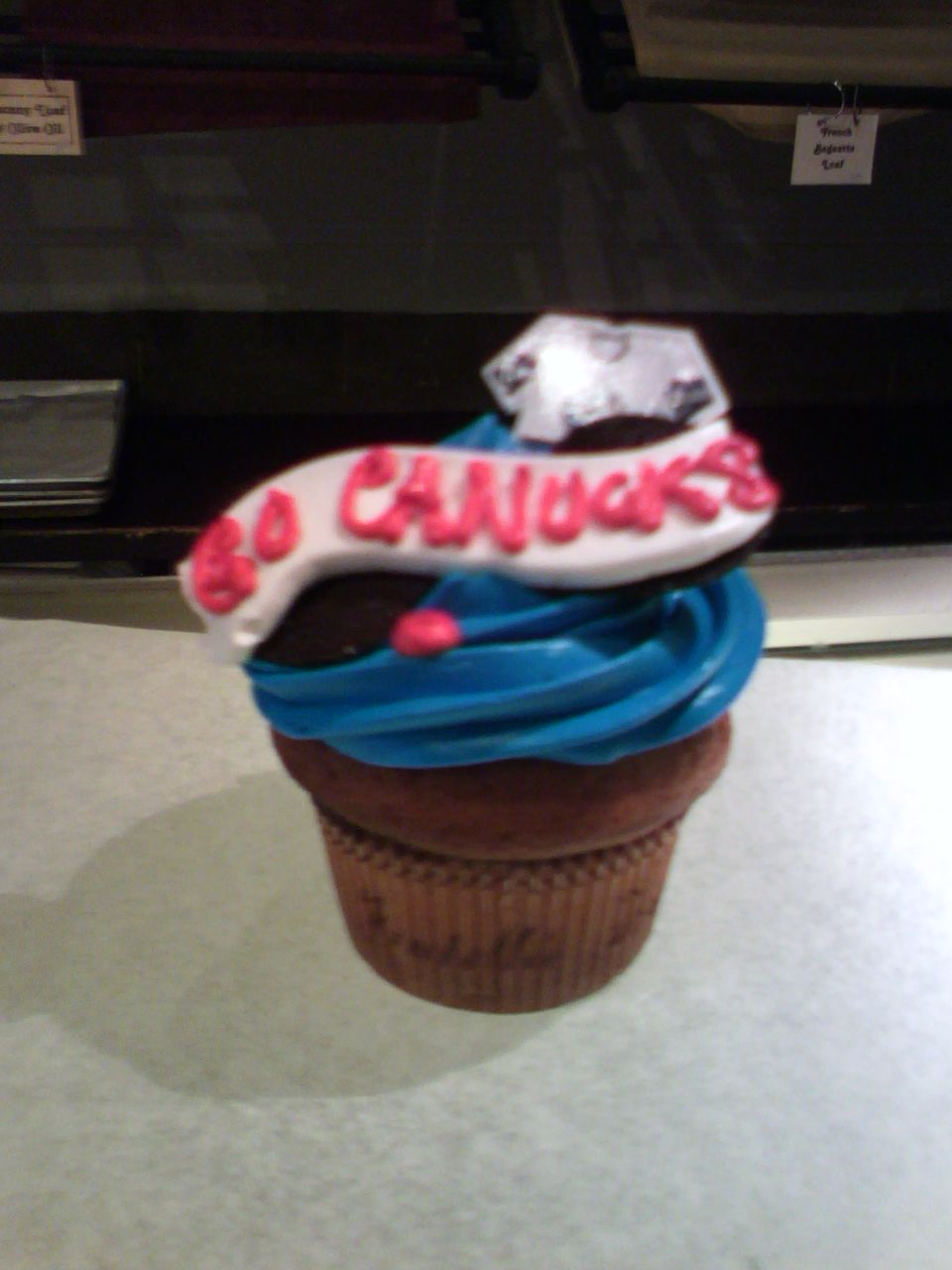
Anyways on with the show. Hopefully the Canucks will win their first ever Stanley Cup. What’s especially noteworthy is that I promised my Admin team at work that if we win the Cup, I will buy them all a cake! I’ve already bought cupcakes for them when we won the Conference quarterfinals. Make it a yummy win guys!
The news came unexpectedly on May 1, 2011. Osama Bin Laden, the Saudi hermit and terrorist leader of Al-Qaeda who was the master mind of the attacks on US soil on September 11,2001, was finally found and killed. He had been on the run from the law and taunting the US by videotape for 9 1/2 years until he was finally caught and killed. Reactions have been numerous and varied. One thing is for sure, that his death leaves an uncertain question about the safety of the world, particularly the United States.
Before September 11, 2001, the world was not a safe happy place. The World was a place that was already as precautionary as it felt to be. Airline terrorism had been a reality for almost 40 years and prevention procedures were already in place and carried out as best as they did. Terrorism from Muslim extremists, especially against the US, had been known for years. Until then the biggest terrorist attack on US soil from foreigners was the 1993 bombing of the World Trade Center which left six dead but failed to bring the two towers down. Osama bin Laden was actually already on the FBI’s Ten Most Wanted list. His connection to money and his ability to access arms was already legendary. He formed and headed the terrorist group Al-Qaeda, which means ‘the foundation’. He helped to empower the Taliban in Afghanistan and they would become his biggest ally. He was the admitted mastermind of the 1998 US Embassy bombings: the August 7, 1998 bombings of the American embassies in Dar Es Salaam, Tanzania and Nairobi, Kenya that left hundreds dead. He had already been known for making a ‘death wish’ against the United States for his wish to see every American dead. In 1999, just two years before 9/11, Bill Clinton had already encouraged sanctions against Afghanistan in an attempt to extradite him. Weeks before 9/11, bin Laden promised in a videotape a ‘great day of terror’ to the United States.
Then 9/11 happened. Terrorists with flight training knowledge committed possibly the most shocking terrorist attack ever. The Two Towers destroyed by terrorists in a Kamikaze-style attack. Part of the Pentagon was also destroyed by a plane attack. A fourth plane meant for the Camp David site crashed outside it thanks to the vigilantism of American passengers. In the aftermath, thousands of Americans were dead. The world’s airline system was shut down for days. Memorial services were conducted all around the world. Some Arab countries and Arab peoples considered it a great victory for them and punishment from Allah to the US. Bin Laden himself acknowledged the attacks and praised the ‘martyrs’ in the attacks. He promised more in the future and promised never to get caught. Soon President George W. Bush declared war in Afghanistan against al-Qaeda and the Taliban. Bin Laden was now the World’s Most Wanted man.
Even while at large for years, Osama still had access to money and had a huge worldwide group of allies with the ability to carry out a terrorist attack anywhere in the World at any given time. The war in Afghanistan and the subsequent war in Iraq have fueled further attacks since. Osama’s Al-Qaeda have carried many terrorist acts out since that have left a total of hundreds dead: the 2004 Madrid Train bombings; the 2005 attacks in London; two bombings in Algiers in 2007; the 2008 bombing of the Danish embassy in Pakistan; a 2009 shooting in Little Rock; and two failed bombing attempts.
You could say the world has changed a lot since 9/11. Arabic words we never knew before are now part of our everyday language. Airline security has become more advanced and becomes increasingly stricter after additional foiled terrorist attempts. We have no-fly lists. We have a colored alert system whenever a terrorist threat appears coming. Right-wing and left-wing politics in the United States have increased in their division. We have a ‘Patriot Act’ which claims to be a prevention to terrorism. We had a terrorist list introduced in attempts to catch those connected to the bombings or terrorist associations. There have even been conspiracy theories surrounding the 9/11 attacks with protesters seeking attention for their cause. A lot has changed in the past ten years. The one thing that remained unchanged during that time was Osama bin Laden was alive and still at large. His lack of access to any means of modern technology besides a personal courier helped keep him from being found for years. He was capable of orchestrating terrorist attacks and shelling out videos to Al Jazeera television while remaining at large from authorities. Billions of dollars and cooperation from many nations failed to capture bin Laden. But on May 2, 2011, that all changed.
On May 2, 2011 in Pakistan (still May 1 back in the US), Osama had been killed by shots to the head and chest by an operation ordered by Barack Obama on his compuond some 40 miles from Islamabad, Pakistan. This operation was conducted by Navy SEALs under the command by the Joint Special Operations Command in cooperation with the CIA. It will forever be remembered at Operation Neptune Spear. Many other associates of Bin Laden, including his courier, one son and two others, were also killed. Soon after the killing, his body was taken to Afghanistan for identification and confirmation, then buried him at sea within 24 hours.
Reaction around the world was almost immediate. US President Barack Obama made the address on US television with the phrase “Justice has been done.” There was cheering in the streets, especially in New York around the area where the Twin Towers stood. Many Americans, especially those who lost loved ones on 9/11, were met with relieve that the killer had finally been brought to justice. There’s also cynicism too. Some conspiracy theorists are adding to the claim it’s a conspiracy. Many are demanding that the ‘death photo’ be shown. In the Arab World, reactions were mixed. Pakistan is denying ‘hiding’ bin Laden since his compound was so close to the capital of Islamabad. Some were happy of his death. Others were hurt and angry that their hero had been killed by the Americans.
It is because of the latter reactions that it’s too soon to believe that the world is a safer place now that Osama is gone. Both Obama and Bush have stated that. We should not forget that Al-Qaeda was a group built on revenge. That is why they carried out their terrorist attacks. Osama even stated that the 9/11 attacks were for revenge of all the Arab blood. Osama has also stated in previous tapes that he had people to carry on his mission even after his death. Even Al-Qaeda promised revenge shortly after acknowledging Osama’s death. That is the top reason why the US won’t release the death photo of Osama. Plus with Al-Qaeda spread so far out around the world, including countries like the US and Canada, there’s no telling when and where the next terrorist attack will happen. Also there’s no telling who from Al-Qaeda would be the new mastermind and there will be no telling what new security precautions will result because of this. So the terrorism precautions used shortly after 9/11 still have to be in effect. Also airlines have to maintain top professionalism and security competence to keep any further security risks. we should not forget that part of the 9/11 attacks’ success was taking advantage of the security ‘weak spots’ at airports.
While millions of people are probably still celebrating Osama’s death, the celebrations can’t last for long. The next ten, possibly twenty, years will tell whether this was a smart movie for the US to carry out. I personally wanted to see Osama arrested, tried by a World tribunal court, and executed. Also the next years will tell whether Al-Qaeda was in fact weakened by Osama’s death or only grew stronger and wider. Only time will tell.





 Jon The Blogcentric
