Move Review: Super 8

DISCLAIMER: Okay, I know I’m behind in my writing and my movie reviewing. This has been a summer where I’ve tried to relax as possible so please excuse while I play catch-up here.

It’s the summer: the time when Hollywood producers, directors and film companies compete for the #1 grossing movie and the top moneymaking film company. It’s always at the box office where they decide the tried-and-true from the tried-and-tired. Despite the intense competition, there’s always a movie that comes with modest expectations that surprises everyone and steals their attention in the end. Super 8 is a movie that came with no top billed cast, Steven Spielberg acting only as a producer, and directed by little-known J.J. Abrams. Nevertheless it surprised everyone who saw it and gave them more than their money’s worth.

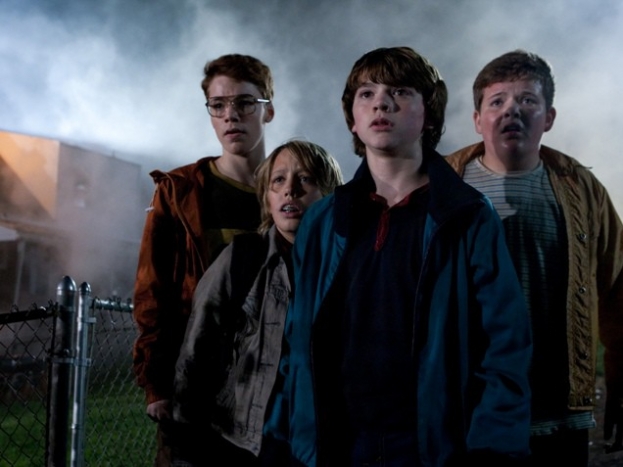
The movie starts as Joe Lamb’s mother had died on the job at the steel mill in an Ohio town. His father, the town deputy, is not taking it that well and even arrests Louis Dainard, the town bad apple. Four months later, school’s out. Joe’s father wants to send him off to a baseball camp in Pennsylvania but Joe’s more interested in making a zombie movie with his friends. This is a film director Charles Kaznyk wants to make to win a Super 8 film competition. He convinces Alice Dainard, Louis’ daughter, to play the protagonist’s wife in the movie. Alice steals her father’s car and takes the group to a train station to film the scene. During the shoot, a train passes by which the crew hopes will add more to the story. During the passing, Joe notices a truck driving towards the train, colliding, and derailing the whole train. In the aftermath, the kids come across a lot of explosions from the train cars and unique white cubes amongst the debris. They also find out the man who hit the train was their biology teacher Mr. Woodward who instructs them never to talk of what they saw or they and their parents will be killed. Just before the children flee, they learn that the Super 8 camera was untouched during the crash. Later the U.S. Air Force arrives to take over the crash scene.

Over the next two days, strange paranormal phenomena occur like people and dogs disappearing, power lines vanishing, missing electronics and even a gas station destroyed by something unknown. Woodward, recovering from the accident, refuses to answer the Air Force any questions and he is poisoned by a soldier. The Air Force has complete control of the town and its people, even deliberately starting a wildfire to evacuate the whole town. The town relies on Joe’s father to assure them of their security and answer their questions.

In the meantime the kids try to use some of the events as catharsis for Charles’ film, including using one evacuation scene for shooting. They also try to look for clues to this whole mystery. The first clue comes in the developed film used at the train station shoot. They notice something bizarre, like bugs. Later after Alice is amongst the missing, they break into their school and search for any of Mr. Woodward’s items that may have clues to this creature. What they find is a film and audio recordings about a creature that crashed to Earth in 1958. The alien only wanted to rebuild its ship but the Force tortured and imprisoned it to take its technology. One film even showed Woodward attacked by the alien only to form a bond. Woodward crashed into the train to free the alien.

The Air Force capture the boys and place them on an Air Force bus heading back to the base only to be attacked by the alien. The alien kills the men from the Air Force bus with allows Joe and the boys to escape and return back to the town. The boys return to town which is under heavy fire from the malfunctioning military equipment. They find a subterranean lair near the cemetery where Joe’s mother is buried. They come across many missing people still alive, including Alice, in which the alien was planning to have for food. They also learn the town’s electronics are underneath the base of the water tower formed together in which the alien is hoping to build a machine to return him back to his planet. Joe rescues Alice but in the escape, Joe is caught by the alien. Joe tells the alien that he can still live on after the painful events. The alien understands him telepathically and allows Joe and his friends to escape.

Soon after, all the loose metal, including the cubes that break free from the Air Force transport truck, are attracted to the town’s water tower. The cubes align and a ship forms allowing the alien to enter and finally leave earth. During the end credits, we see the film in which Charles, Joe and his friends created. A fun zombie movie filled with simple effects and gory make-up.

The movie is not just about an alien breaking free from the Air Force captivity. It also has a lot of human elements and themes. One theme featured is about parent-child relations. The town sees Deputy Lamb as a hero but Joe sees him as someone who has alienated him ever since his mother’s death. Alice Dainard thinks her father’s a monster. Things turn for the worse as she befriends Joe and her father forbids him. Another theme is about trying to heal from the past. Deputy Lamb blames Louis Dainard for his wife’s death since he didn’t show up for his shift that day. Joe also keeps the locket of him as a baby in which his mother wore until her death. Another theme is about the growing pains of adolescence. Charles hoped using Alice in his film would attract her to him. Instead she develops a bond with Joe. That puts a hot spot in the friendship between Joe and Charles with Charles feeling like the misfit again because he’s overweight. This was one sci-fi film that had a lot of depth in its script that worked well with the movie.

One of the best things about this movie is that it will remind many people of Steven Spielberg’s thrillers of the past. I’m sure most of you have a favorite one: Jaws, Close Encounters of The Third Kind, Poltergeist, E.T.: The Extraterrestrial, Gremlins, The Goonies. They captured people’s imaginations and dazzled viewers looking for an escapist thrill. Here in Super 8, we can see a lot of the Spielberg magic captured with the storyline, the special effects and the thrilling sequence of events. That’s what makes for a winning story. Many people can already see many hints of Spielberg’s past movie’s in Super 8. I’m sure if you see it or have seen it, you might too.

The best thing about the movie has to be the lack of star-billing in this movie. Here the main characters are the children. The adults are in minor roles. They are all great individually but its their unselfish performances together where the acting shines best as a whole. J.J. Abrams’ direction is also excellent. He was very good at taking the story he wrote and turning it into a thrilling movie that is as generous with its storyline as it is with its thrilling effects. With Spielberg acting as producer, I’m sure that J.J. Abrams could rightfully label himself the heir apparent to Spielberg. The visual effects definitely could pass as some of the best of the year. The mix of music with 70’s hits and the original score of Michael Giacchino was also excellent. Overall this was an excellent movie.

In terms of its business, Super 8 cost surprisingly over $50 million to make and even had a video game released with it. As of now, the film has grossed $125 million in North America and just over $200 million worldwide; not enough to rank it even in the annual Top 10 list of highest grossing movies. I really enjoyed it. I feel sorry for those who missed out on it. It’s also surprising to see that something like this about an alien invasion of such would draw and captivate moviegoers in the late 70’s but doesn’t seem to do so now.

Super 8 is an excellent summer movie that the viewer would expect little of but would leave the theatre amazed. This definitely has to be one of the best summer movies you could see. It may not look like your type of movie but if you give it a chance, you might be surprised.

Movie Review: Midnight In Paris

Midnight In Paris turned out to be one of the most unlikely sleeper hits of the summer. Little was expected of it: Owen Wilson being the biggest name, a romance featuring characters older than the 20’s, a Paris setting and a trip back to the past. Somehow it was able to capture people’s imaginations and make moviegoers want to see it.

The story is about Gil: a Hollywood screenwriter who’s successful but easily distracted. He’s engaged to Inez, a daughter of wealthy conservative parents. While the four are vacationing in Paris, Gil is struggling to finish his first novel about a man working in a nostalgia shop; a novel for which he plans to give up his scriptwriting career and move to Paris for inspiration. This does not sit very well with Inez’s parents as they don’t favor the arts or Paris nor does it sit well with Inez herself as she intends to live in Malibu. Meanwhile Inez’s friend Paul who appears to know a lot of the artistic greats makes things more complicated as Gil finds him insufferable and even phony.

 After a wine tasking one night, Gil is drunk and alone outside the hotel. At midnight, Gil comes across a coach leading a group to a secret place. Gil joins the group and the people appear to be celebrating 1920’s couture. Later we see that the coach leads to a place where the 1920’s come alive with the Cole Porter, Josephine Baker, Ernest Hemingway, F. Scott Fitzgerald and wife Zelda. He even meets Gertrude Stein and offers her to look over his novel. One catch we learn as he returns to the hotel, he’s back in the present.

Gil goes to return the next night novel in hand and offers to bring Inez with him but she’s annoyed with what he says and returns to the hotel. The coach returns at midnight and this time Ernest Hemingway is inside. He gives Gertrude his novel and she introduces him to Picasso. Gil encounters Picasso’s mistress Adrianna whom he has become attracted to. The following day Paul  shows Gil and Inez Picasso’s painting of Adrianna at a museum and tells his story about it. Gil contradicts with the truth he just saw the other night, only to annoy both Paul and Inez.

Gil visits the past more often for inspiration for his novel which annoys Inez. Her father even hires a private investigator on him, only to be lead to the Versailles during the era of Louis XIV and never to be found again. Gil spends more time with Adrianna, who leaves Picasso for Hemingway. This confuses Gil as he feels he’s falling in love with her. Meanwhile he meets with surrealists like Salvador Dali, Man Ray and Luis Bunuel who see nothing strange about him coming from the future. Gil goes furniture shopping with Inez but comes across and an antiques dealer who’s selling Adrianna’s diary. He also learns from a conversation with the antiques dealer herself that she also has the same fondness for the 20’s Gil has. Later a guide from the Rodin Museum translates Adrianna’s diary and he learns she’s in love with him. Gil returns to the past and confesses his love to Adrianna. A coach leading them to the days of the Belle Epoque drives up and Adrianna opts to go in, talking of how she longs of the days of the Belle Epoque and how the 1920’s are so imaginative. It there that Gil learns about the illusionate lure of nostalgia and learns to accept the present for what it is. In the end, the romantic triangles between all involved take a surprising turn and Gil makes some surprising decisions.

I don’t think the movie is stressing too many points but rather telling an amusing love story where artistic inspiration and one’s passion are the top themes. It does pay an admiration for the writers and thinkers in the past but it reminds us to admire their influences rather than dwell back to their time.

Another theme that’s common in Woody Allen’s movies is about artists and their inspirations. It shows how a top Hollywood writer feels that burning desire to create a novel that no Hollywood millions can take the place of. Allen puts in many legendary artists, writers and filmmakers—including some from an American expatriate group in Paris at that time–who received their inspiration in Paris to make his point. It also reflects on Allen’s feelings of conservatism being stuffy, especially with the Tea Partiers. Interesting how Gil is an artist mesmerized by legends of the past while Inez’ father admires a political party known for its past thinking.

In terms of the movie’s acting, this is the best acting I’ve seen from Owen Wilson. He seems in these past few years to be leaving his past Slacker Pack schtick behind and is now doing more sensible roles. This is an excellent move for Wilson. Here he plays a man who’s smart but easily distracted. Very good job. The supporting roles were also excellent, especially the character acting. Most of the characters of people from the past are so well-acted, you easily forget who the actor is. It took me a while to recognize Adrien Brody as Salvador Dali, Marion Cotillard as Adrianna and Tom Hiddleston as F. Scott Fitzgerald. The most recognizable was Kathy Bates as Gertrude Stein. Nevertheless her acting was still top quality.

The best effort has to come from the directing and writing from Woody Allen. I will admit that Woody Allen’s humor and comedies are not as fresh as it was during the 70’s and Midnight isn’t that different. If there’s one thing I like, it’s that Woody Allen is able to keep quality and good effort in comedy. While most comedic writers rely on cheap shots, one-liners and slapstick to make hit comedies, Allen keeps the intelligence in his storylines and presents comedies with amusing situations, full characters and an ending that differs from your typical Hollywood endings. Here we have characters that make you laugh and think at the same time. Here we have a return back to the past that fits the story well. Here we have a romantic comedy that doesn’t end the way your typical Hollywood romantic comedy ends. in terms of box office, Midnight is Woody’s highest-grossing film in North America ever. Impressive.

Midnight In Paris is not a comedy for everyone. I don’t think a trip into the past in Paris at the stroke of midnight will draw everyone. Nevertheless it is a refreshing break from your typical predictable, formulaic Hollywood fare and will impress whoever is willing to view it.

Movie Review: In A Better World

In A Better World is the winner for this year’s Oscar for Best Foreign Language Film. It is only the third of the five nominees I’ve seen: the others being Canada’s Incendies and Spain’s Biutiful. I finally had the chance to see In A Better World a while back. This film has a story line that really gets one thinking.

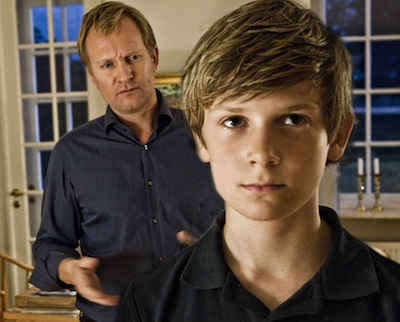
The film begins as a Danish boy named Christian reads a eulogy at his mother’s funeral. He appears calm and composed but his mother’s death troubles him. He and his father move from London to Denmark where he spends his spare time on the roof of his grandfather’s silo looking out. We then meet Anton, a Swedish doctor who lives in Denmark but spends most of his time working in a refugee camp in Sudan. The villagers, especially the children, regard him as a hero but home life is difficult as he is on the verge of a divorce and he doesn’t see his sons as often as he’d like.

Their paths cross as Anton drops his son Elias off to school. A group of bullies taunt Elias because of his awkward looks. As Christian interferes, he too is assaulted. As Elias is bullied again the next day, Christian assaults the bully with his bike pump and threatens him with a knife at his throat never to hurt him again. Anton hopes to teach the two boys about the wrongs of violence as he himself witnesses it in the refugee camp each day. He gets a chance as his son is fighting with another boy in a playground and the father of the other son hits Anton. From atop the silo, Christian is able to spot where the man who hit Anton works by his car. Anton takes the boys again to see him confront the man where he gets hit again. Anton wants the boys to see how violence fails but they don’t get his intended message.

Later Anton is called back to work in the refugee camp. He soon has to deal with tending to the wounded warlord despite villagers pleading for him not to help. It’s later after a female patient dies that the warlord coming asking for her body that Anton leads him out where he is met by villagers ready to lynch him. After coming across fireworks in the silo, Christian gets an idea to create a bomb to blow up Anton’s attacker’s van. Meanwhile Christian’s relationship with his father takes a turn for the worse as Christian lets out his frustrations about his mother’s death, including his father’s failed promise that his mother would get better. Elias tries to talk to his father via Skype about Christian’s plan but Anton is exhausted after a stressful day. Elias then agrees to Christian’s plan. They go out one Sunday when no one is to be around and set the bomb off under the van. As Elias notices joggers, he wards them off but the bomb explodes knocking him unconscious.

Anton comes rushing back to Denmark after learning Anton is unconscious and hospitalized. When Christian tries to visit Elias in the hospital, Elias’ mother tells him to leave and calls him a ‘brat’ and a ‘psychopathic killer.’ Christian runs off and goes to the top of the silo contemplating to jump, only to be stopped by Anton. He reconciles with his father and goes to visit Elias, relieved knowing that Elias is alive and recovering well. The movie ends as Anton returns back to Sudan and is greeted by the adoring children.

There are a lot of subjects in this film. One of which is about communication barriers between people. There’s the main protagonist Anton struggling with communicating to his wife while they’re on the verge of splitting up. Anton again struggling to be there for Elias while he’s thousands of miles away in Sudan. Anton struggling to be an idealist to the boys and show how weak violence is when the boys expect Anton to be a hero. Christian struggles to relate with his father just after his mother’s death. He also struggles with the personal troubles of himself. There’s also the subject of making hard decisions. Anton has a duty of being a doctor to the refugees while Elias faces problems of his own. Anton is faced with a hard decision of being a doctor to the wounded landlord while the people insist that he doesn’t help him. Overall Anton is trying to be the man of reason and he has his share of successes and failures. Elias makes a tough decision whether to rejects Christian’s plan to blow up his father’s enemy’s van or not. All of which deliver in the results in the choices they make, or fail to make.

This is another impressive script from Susanne Bier. Although I have not seen her past works, I know she has developed a reputation. She has produced many works in Sweden and Denmark and even has one American release: 2007’s Things We Lost in The Fire. This is her latest work. The script she co-wrote with Anders Thomas Jensen also touches base on another subject of the film. Before they wrote the script for the film, Bier and Jensen had a discussion about how Denmark is perceived as having a harmonious society. They then wanted to write a story where dramatic turns of events would disrupt the image of a place perceived as blissful. The film’s original title is Hævnen, which is Danish for ‘revenge’. This film is a stark reminder that it’s quite possible in countries like Denmark that appear to be harmonious and peaceful, violence can happen through the actions of a single instigator. The film does a good job of setting situations of violence, both in Denmark and Sudan, while capturing the perceived peacefulness of Denmark at the same time.

The acting in the film was also excellent. The lead actor, Mikael Persbrandt, was excellent in portraying a man trying to maintain peace and show rational thought in hugely stressful situations both on the job and at home. Young actor William Johnk Neilsen was excellent as the troubled Christian. Also excellent were the performances of Trine Dyrholm and Markus Rygaard. The film did a good job of not overdramatizing events and maintaining its themes along with the storytelling. The cinematography added to the storytelling of how acts of violence can happen in such a peaceful place like Denmark.

It’s hard to say if In A Better World deserved the Oscar for Best Foreign Language Film. I’d hate to compare it against its rivals. Nevertheless it was a very good film in its own right. It keeps one thinking as they leave the theatre.

Movie Review: Paul

Okay, you’re probably wondering why on earth am I just posting this review now when Paul has been out for at least a month? Here’s the thing. I don’t immediately rush out to the theatres whenever a movie comes out. I see them when I see them. Often when there’s a big hit movie, I wait weeks until the crowds die down to go see it. So that explains why you get my review of Paul later than most. So after explaining all that…

Who is Paul? He’s a fugitive. He’s a celebrity. He’s a slacker. He’s a joker…He’s an alien. Paul is all those things, and the subject of a recent comedy movie. The latest concoction of the British writing/acting collaboration of Simon Pegg and Nick Frost. So how does this close encounter of the funny kind end up?

Graeme Willy and Clive Gollings are two British comic book dweebs with a passion for sci-fi and alien encounters. The love it so much, they rent an RV and take it from San Diego’s Comic-Con all across the US for their own alien encounter tour. Little do they know they’d find themselves in trouble. First they come across some homophobic hunters who suspect them to be a couple. They head off, accidentally denting their truck. On the run, they get hit by a car driven by, among other things, an alien named Paul. The two bring Paul along in the RV. Little do they know that Paul is actually in pursuit by a shady government agent named Zoil who even recruits two inept FBI agents in the capture.

Later during a campfire over at a campground run by Moses, a strict Christian and his daughter Ruth, Paul tells the twosome that while captured by the government, he helped with Spielberg’s E.T. and the X-Files’ Mulder. Ever since he learned the government planned to dissect his brain, he’s been on the run since. Ruth is then kidnapped by the two. Once in the RV, she learns of Paul and refuses to trust him as it contradicts her devout beliefs. Once Paul heals her blind eye, blind since she was four, she trusts him to the point she becomes eager to sin.

Meanwhile Zoil and the two agents question Moses who says she was abducted by demons. Graeme, Ruth and Willy once again meet up with the homophobic hunters, but Paul comes to the rescue. Upon pursuit of Paul, Zoil and the agents come across him. Once Paul makes his escape, all three are after him but for their own separate pursuits each. Meanwhile Moses is chasing for Ruth.

Paul finds refuge in an old house which is owned by Tara, a young girl who saved his live back in 1947 and is all grown up, reclusive because of the ostracism she received throughout her life. Tara is relieved to find that Paul is real. After turning on the stove, a shootout ensues at her house, causing it to explode with Paul, Graeme, Clive, Ruth and Tara on the run. The three agents go on their pursuits again but only Zoil survives in meeting up with Paul, who is in a field waiting for his UFO to take him home. Instead, it’s a helicopter with ‘The Big Guy’, Zoil’s superior. Zoil reveals he was the one who helped Paul get away. Zoil disarms the men but is shot in the shoulder. Tara punches out ‘The Big Guy’. Moses shoots Clive dead. Paul heals him but his healing powers come at the risk of his own life. After Clive is revived, it appears Paul is dead but he’s just exhausted. Paul’s ship arrives, crushing ‘The Big Guy’. Heading for home, he invites Tara to come with him and finally live a life. Two years later, Clive, Graeme and Ruth return to Comic-Con. This time, they are on stage as successful comic book writers thanks to their comic book Paul.

I have to say the biggest overall glitch with this movie is that it often appears to rely on the crude and rude one-liners in many parts. It has enough humorous subject matter and comedic characters without having to resort too often to such lines. First off,  the incorporation of the subject lines of many alien shows of past, like Star Wars, Close Encounters, E.T. and the X-Files. Second off, there are already a lot of talented actors that have been able to prove of recent that they can do comedy well. Kristin Wiig and Bill Hader have proved their humor in Saturday Night Live and other movies they’ve acted in. Blythe Danner, Sigourney Weaver and Jason Bateman were also able to make their roles work in the movie. Seth Rogen, already a reputed funny man himself, did a good job in the voice over as Paul. Pegg and Frost are already known for their comedic acting as well as their writing for Shaun Of The Dead and Hot Fuzz. They don’t have to resort too often to such low brow material.

Outside of that, the movie was a good job of meshing 3D animation with live-action, an alien encounter story with comedy, and even romance with sci-fi dweebs. Pegg and Frost once again show that they’re at their best when they’re together. They also showed they can do a good job with an American story line for the first time. Also it was unique to see a comedy not just revolve around an alien encounter but also with San Diego’s Comic-Con, which has grown in popularity in recent years to the point even A-listers make appearances.

Simon Pegg and Nick Frost, who both wrote and star in Paul, describe it as a ‘love letter to Steven Spielberg’. You could describe their two previous big-screen comedies, Shaun OIf The Dead and Hot Fuzz, as ‘love letters’ too. If you saw Shaun Of The Dead, you’d tell it was a love letter to all those zombie movies. If you saw Hot Fuzz, you’d definitely know it was a love letter to all those gunslinger action movies of the 80’s and 90’s. I don’t think Paul is so much a love letter to Spielberg as much as it is a love letter to sci-fi as a whole. Good mesh of stories but I feel this movie is more of a salute to sci-fi dweebs and comic books geeks the world over.

Paul is an enjoyable movie. Even though I felt it could be better with the humor in the script, it is a delight to watch. Pegg and Forst know how to do enjoyable movies and they do it again here.

Movie Review: Of Gods And Men

The French/Arabic-language film Of Gods And Men doesn’t have the type of subject matter that would normally bring in a large crowd. The film is about Cicstercian Monks living in a small village in Algeria facing threats from fundamentalist terrorist groups. Nevertheless those lucky enough to see it will love it for what it is.

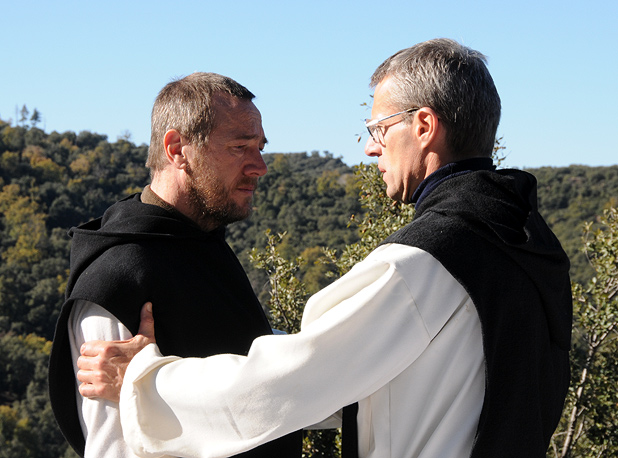
This film is based on an incident that happened in 1996. Seven French monks from the Algerian village of Tibhirine were found decapitated. The film focuses on the days just before they were killed. They were a group of eight monks who lived in a monastery in Tibhirine. They devoted their lives to monk rituals of gardening, distributing medical help to locals and religious devotions. They were present at the village during times of celebration and they conversed with the villagers regularly. They all did this during a time of the Algerian Civil War. Religious extremists were committing acts of brutality amongst foreigners and their own people. The pressure was felt by the monks. Christian, the leader and resident religious scholar, tells authorities they will not go. However this is hotly debated with the other monks as some fear for their own safety. Christian then gives the men time to decide whether to leave or not. News gets grimmer by the moment. They even face potential threats of their own. Authorities of the Algerian government request they leave for their lives. The villagers however convince them of how vital they are to the community. In the end, as one brother pays a visit to the monastery, they all vote to stay. Late in the night, seven of the nine are found, captured and taken away. Those would be their last minutes known to be alive.

The film has many great qualities. Its best technical quality was the cinematography as it added to the film in showcasing the landscape in its best splendor. The film was well-directed and well-written by French director Xavier Beauvois. The script he co-wrote with Etienne Comar was excellent and very no-nonsense as it cut at the heart of the monks and the village they served. As important as it was to show the events that happened leading up to the times, the script’s biggest focus was on the monks and their lives. It was more about people than events. Even the scene of the last dinner with the music of Swan Lake in the background was done with the focus on the men. 

 The biggest strength of the movie is definitely the acting. Of all performances, the two that stood out were that of Christian the leader and Luc the doctor. Lambert Wilson’s performance of Christian was excellent and the most intense. Often he said more in his scenes of silence than he did with his spoken parts. Michael Lonsdale’s performance of Luc the Doctor was the best supporting performance. There wasn’t a hint of phoniness in it.

As for the monks as a whole, the most remarkable thing about the film is its ability to give three-dimensional portrayal of monk characters. The film not only showed them in their prayer life but also showed the devotion during their prayers. The film showed them in their occupations and how important they were to the village. The film showed their convictions and their beliefs. The film showed the bond between the men. Above all, it was alll done in a three-dimensional manner. This is very rare for a film to accomplish that feat. Even back during the days of the Hays Code–where one of the rules was that religious figures were to be depicted in a positive manner–religious figures were still two-dimensional at the most. Even the negative depictions of religious figures that came once the Hays Code was dropped in the 60’s as ‘censorship’ or ‘restrictive of creativity’–were also two dimensional and often too stockish. This film has to be the most realistic and inside-out portrayal of religious characters, in both character and their vocation, that I’ve ever seen on the big screen. Even 1997’s The Apostle doesn’t compare as Robert Duvall’s portrayal of a minister had more focus on his passion and personal demons than on his vocation.

Also vital is the ending of the film. It is not known who exactly killed the monks. An Islamic extremist group has claimed responsibility but recent documents from the French secret service claim that the Algerian army carried it out as a mistake during the rescue attempt. The film doesn’t pick one group at fault as the monks are captured in the dead of night with the darkness hiding their identity.

There may be some nervous in seeing this film, feeling it might try to ‘convert’ them to Catholicism. For the record, director Xavier Beauvois has not directed a religious film in the past. One thing we should note is that while the monks lived at the monastery, there’s no scene of them trying to convert any of the villagers from Islam. In fact Brother Christian was as knowledgeable about the Koran as he was about the Bible. When religion extremists threatened to shoot the brothers in one instance, Brother Christian quoted a passage from the Koran which caused the leader to drop his gun and order his followers to leave. I believe Beauvois wanted to show that for the monks, the faith was mightier than the sword. Also in the script was a scene where the monks talk about the difference between the Islamics and ‘Islamists’. This is good for a time when religion faces a lot of flack from religious dissenters. I believe that may have been another point from Beauvois that it’s important for one to recognize the believers from the ‘beliefists’.

This film has won a lot of accolades. It won the Grand Prix and the Prize of the Ecumenical Jury at the 2010 Cannes Film Festival. The Grand Prix is second to the Palme d’Or as the most prestigious award at the Festival. Other nominations and awards have followed such as wins at France’s Cesar Awards, nominations at the European Film Awards, nominated for Best Film Not In The English Language at Britain’s BAFTA awards and was France’s official entry for the 2010 Academy Award for the Best Foreign Language Film category. The film was well received by critics here in North America and has a 91% approval rating at Rotten Tomatoes.

Although this is a movie that makes for excellent viewing for Catholic communities, it’s not completely 100% ‘safe’ for everyone. There is a few profanities utters, including one by a monk. There are also some scenes of violence. The most violence is the scene of soldiers being cut at the throat by the extremists. Most of the violence is only seen through news footage.

For writers and directors with religious values, this film offers a ray of hope for those who want to break into film making. It shows that a film showcasing religious values can not only be shown on the big screen but also be written and produced well. That has long been the dilemma ever since the Hays Code has been lifted. This was best summed up in a quote by Catholic scriptwriter/acting school director Barbara Nicolosi-Harrington: 

I realized coming (to Hollywood) that it’s not so much Hollywood is persecuting the Church as much as it was the Church was committing suicide in Hollywood. Big difference. So I basically wrote an article about it saying that Hollywood isn’t anti-Christian as so much as it’s anti-bad art, and we’re just giving it schlock.

She states a major hurdle here as all too often a lot of Christian writers have written a lot of scrpits viewed by Hollywood as sub-standard in skill while the more liberal writers seem to know how to write for the screen. It’s a hugely difficult task to write a film of positive values or strong faith for the general audience without crossing the line of being schmaltzy or manipulative. Of Gods And Men shows that it can be done and it’s just a matter of learning how to do things right.

If you’re fortunate enough to have it come to your city, I highly recommend you see Of Gods And Men. Even if you don’t buy the Catholic faith or want a movie with preachy religious themes, it’s a film worth watching. It’s as much about people and their devotion to their beliefs as it is about an incident that happened. Even with the tragic ending, it tells a lot about the human spirit that will stay with the viewer once they leave the theatre.