Movie Review – Sherlock Holmes: A Game Of Shadows

Okay, this is one of my delayed movie reviews. There will be three more to come. I saw it weeks before but I’m sure many of you could now see it in a second-run theatre before you can get the DVD or Netflix file.

Those of you who have seen the first Sherlock Holmes starring Robert Downey Jr. only received one part of the story. Sherlock Holmes: A Game Of Shadows picks up where it left off. It’s not an adaptation of the Sherlock Holmes novel but an independent story of Sherlock Holmes that is able to entertain.

The movie is full of tricks, foiled killings and even successful incidents that lead Holmes to solve his next mystery. A bomb meant for Dr. Hoffmanstahl from Professor Moriarty is detonated. Adler is murdered by Moriarty who thinks she did it out of a love for Holmes. The murders and bombings surrounding Moriarty is part of Holmes’ next case.

Even Watson and his wife become part of this when Moriarty tells Holmes he killed Adler and the couple will be next if Holmes doesn’t stop. The couple is even attacked on a train by Moriarty’s men but Holmes, who followed them for protection, is able to foil the attackers and successfully protect the two. The two head to Paris to contact a gypsy who was to receive a letter from Adler. She becomes part of the detective team and leads them to an anarchist group she once belonged to only to learn of a plan to assassinate Moriarty via explosion. One search for a bomb lead to the wrong place. The bomb kills one of Moriarty’s business associates, allowing ownership to Moriarty of the businessman’s weapons factory in Germany.

Each clue leads the three-Sherlock, Watson and the gypsy- to the factory. There they are tortured by Moriarty and his men and learn of his plan to own weapons factories to profit out of a World War he plans to start. They’re able to break free thanks to Watson and flee onto a moving train. However Holmes senses that Moriarty may be planning an incident at a peace summit in Switzerland to cause an international uproar. At the summit, Holmes learns of the true assassin who is disguised as an ambassador. Both Holmes and Moriarty go outside to discuss to their associates their plans. Both Watson and the gypsy are able to stop one of Moriarty’s men from assassinating. Holmes later revealed he replaced Moriarty’s diary with the plans and able to get Watson’s wife to decrypt the code of Moriarty’s. Mary forwards the information to an Inspector who’s able to claim the bulk of Moriarty’s assets. This would lead to a physical confrontation between Holmes and Moriarty over a waterfall, which leads to a surprise ending.

A Game Of Shadows is partially influenced by A Final Problem, which is part of Arthur Conan Doyle’s series The Memoirs Of Sherlock Holmes but has been tailor made for the movie with a lot of twists and turns. It’s not necessary part of a chronological series but another story based on the characters. In fact the filmmakers intended for A Game Of Shadows to be a stand-alone film that did not require knowledge of the previous movie. The movie retains a lot of the charms of the first one but doesn’t seem to deliver the same thrills as the first. It does however maintain the same energy of humor as the first. Robert Downey Jr. is again able to keep the humor moviegoers will remember from the first. Jude Law, Rachel McAdams and Eddie Marsan also reprise their respective roles well too albeit for their brief time. The biggest new edition was Noomi Rapace as Simza the gypsy and she does a good job of her own at stealing scenes. The Mulroneys, Kieran and Michelle, did a good job in creating a humorous adventure with a lot of familiar thrills as the first but often felt like a maze that was confusing at times. Guy Ritchie did a good job in directing, if not the directing that stands out. Technically the sets and costumes were excellent in fitting the times. Even the guises worked well. And Hans Zimmer returned with a score that included parts of the original as well as some new material that fit the movie’s adventurous and humorous tone.

Sherlock Holmes: A Game Of Shadows faced the same pressures as any sequel. In the end, the movie lacked the same level as the first in terms of its best qualities. One thing is while most sequels or follow up movies often lose the first movie’s best qualities A Game Of Shadows was still able to keep the original’s best qualities, if not match the original’s same level. Fans of the first will appreciate A Game Of Shadows and movie goers in general will find it a good relaxing time at the movies.

2011 Oscars Best Picture Nominee: War Horse

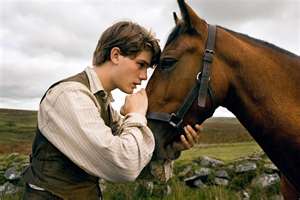
War Horse is the latest live-action drama by Steven Spielberg. It was originally a children’s story written in 1982 and later adapted into a stage play which debuted on Broadway in 2011 and even won a lot of Tonys. Now War Horse comes to the big screen and it’s only right that Steven Spielberg be the one to create it into an epic movie.

The film opens as young Devon boy Albert Naracott watches the birth of thoroughbred colt and watches him grow up. The colt would become his, but at a cost to the family. The father Ted wins him at an auction at an enormously high 40 guineas, thanks to his intent to spite his landlord. The high price would cause him to miss his rent and he would have to pay by autumn. That’s not an easy thing for Ted as he has an injured leg from the Boer War for which he’s not proud of and drinks to hide his guilt. He even hides his medals away.

Meanwhile Albert grows a friendship out of the horse whom he names ‘Joey’. Each time Ted threatens to shoot the horse, Albert tries to prove Joey is worthy of staying. Albert trains Joey into plowing the farm and succeeds in having it all plowed in a single day. However the farm fails because of heavy rain and Ted sells Joey to an Army Captain as World War I has just started. This breaks Albert’s heart and he even tries to enlist, even though he’s underage. However Captain Nicholls ensures Albert Joey will be fine and will make it home. Albert even ties his father’s war pennant to Joey’s bridle.

Joey is trained for battle and faces his first battle with Nicholls on top against the Germans. The Germans however have the latest artillery which are capable not only of killing horses from far away but making horses now useless in war battle. Nicholls is killed in battle but Joey is one of few horses to survive, only to be captured by the Germans and used as an ambulance horse along with Topthorn, a black horse whom was trained by the British. Joey and Topthorn become friends. The two horses then become owned by two young German brothers who plan to desert the army and flee to Italy. Even though they hide themselves and the horses in a French windmill, the brothers are discovered by the German soldiers and executed by firing squad.

The two horses are discovered by a French farm girl named Emilie, an orphaned girl who has brittle bones and lives with her grandfather. They soon become hers and she’s able to hide them successfully after German soldiers raid their house and take their food. She finally rides Joey on her birthday only to have the horse stolen by German soldiers. The horses are then put to the task of pulling heavy artillery. Joey and Topthorn are the only two pulling horses to survive this.

Meanwhile it’s 1918 and Albert is now a soldier for Britain. He and his allies are wounded by a mustard gas explosion in German trenches. Joey and Topthorn are still alive after years of brutal labor by the Germans but Topthorn can’t take it anymore and dies. Soon after, Joey tries to flee and advancing tank only to end up tangled in barbed wire and fall down in the mud. A British and German soldier clip off the wires together and the British soldier wins possession of Joey in a coin-toss. While Albert is recovering from his gas attack, he learns the story of the miracle horse. Meanwhile Joey is to be put down because he is too injured. Just before he’s to be shot, Joey responds to an ‘owl call’ from Albert. Albert and Joey are back together again but it doesn’t end there as there is still the auctioning of the war horses. What happens after is something for you to see for yourself.

One thing about the movie is that this, like a lot of epic films, does not have that stellar of a script or of acting. The script is good in how it takes one through the adventure from one place to the next with its various twists and turns, but nothing really deep. There are even times in which it comes off as fluffy as a movie-of-the-week script. The acting is flawless but nothing of any real challenge either. There was no real actor that stood out with Emily Watson being the top billed actor of the film and newcomer Jeremy Irvine being the lead human protagonist. The acting roles are well-played but often end up as cardboard as your typical acting in an epic movie.

The lead role and the protagonist in the movie is actually Joey the Horse. The story may mainly be about Albert trying to get Joey back to Devon but it’s Joey’s adventure and trials of it all which is what the story is all about. He goes from being born to Albert’s best friend to a horse in battle for Britain to befriending another war horse named Topthorn to a horse on the German side to being a horse of a French farm family to being back with the German side to being found stuck in barbed wire to being reunited with Albert. I may have knocked the script a while back in my review but I have to say one of the best attributes of the script is that it was able to make Joey into a horse with feelings without coming across as cheesy. That scene where Joey says his last goodbye to the deceased Topthorn didn’t come across as cheesy or manipulative. Also the movie ends with some unexpected twists and turns. Just when you think Albert and Joey are finally reunited, it doesn’t guarantee Albert will be taking him back to Devon. Interesting note is that the scriptwriters worked with Michael Morpurgo, author of the novel, to get the right adaptation of the movie.

Although the script and the acting are not the best attributes of the movie, the cinematography, set design and the accompanying score are the best technical qualities. Spielberg picked out some of the best and most appropriate areas of England for filming this movie, including Devon for the countryside and town scenes, Hampshire for cavalry scenes and an airfield in Surrey for the battle scenes. Janusz Kaminski did an excellent job of cinematography. His cinematography duties for this movie were complex as he had to both capture the grittiness of war for the battle scenes and capture the glamor and beauty of the countryside for the various country scenes. Plus you can’t go wrong when you have John Williams to compose your movie’s score.

However the best overall attribute is its ability to capture battles of World War I. Steven Spielberg is already known for his movies that depict wars and it only seemed right that he should be the one to recreate World War I in this movie. Here, he doesn’t disappoint. He’s able to recreate everything from the horse battles to the ground artillery to the trenches of the World War I battles to the first tanks. He also shows the grittiness of war too with the laying of the dead horses in battle to the execution of boys not yet adults to the rats in the trenches to the explosion of mustard gas bombs. Grittiness of war is something Spielberg doesn’t avoid and he doesn’t avoid it here. It’s also interesting noting the horse statistics of World War I that Morpurgo researched to create the War Horse novel. It is believed that there were 10 million horse deaths during the whole war. Of the one million horses sent from the UK to battle, only slightly more than 60,000 returned alive. The rest were killed in battle or slaughtered in France for meat. So War Horse is quite a story of survival.

War Horse may not deserve to win Best Picture as its acting performances, direction and script lack the winning edge but it’s a very good movie on its own. It’s a good family drama for families with older children. I commend Steven Spielberg for making the adaptation of this children’s novel possible on the big screen.

Oscars 2011 Best Picture Nominee: The Tree Of Life

The Tree Of Life won the Palme d’Or at the 2011 Cannes Film Festival. The film isn’t the typical drama you’d come to expect. Instead it’s more introspective and delivers a message of a common theme of the human existence.

The movie’s story starts upon Mrs. O’Brien receiving the news of her son’s death. Mrs. O’Brien had always been taught everyone must choose between the path of grace or the path of nature. The son’s death would throw the family in turmoil. The movie then focuses on present-day Jack O’Brien, now an architect. When a tree is planted in front of his building, he reminisces about his life as a young boy during the 1950’s.

A pre-teen Jack is living with his family in suburban Waco, Texas and is now forced to choose the path for himself. His parents have equal bout opposite influences on him. His mother represents grace as she is gentle and nurturing but authoritative, presenting the world as a place of wonder. His father represents nature as he is loving but strict and authoritarian as he tries to make his boys tough for a world here perceives as corrupt and exploitative. He often questions giving up his passion of becoming a musician and instead became an engineer and hopes to achieve wealth through filing patents of his inventions.

Before Mr. O’Brien goes on a trip to market his inventions, a drowning death of a child at the town pool happens. Mr. O’Brien suddenly turns violent and unleashes an abusive rage on his boys and Mrs. O’Brien. While he’s away, Jack and the boys are raised exclusively by their mother and his feelings of rebelliousness start happening. Jack follows along with the other boys in his town and commits acts of vandalism and animal abuse, even theft of women’s underclothing from a neighbor’s house. It’s after that where Jack gets the first natural sense of his consequences and throws the stolen underwear in the river. Mr. O’Brien returns home having failed to sell his inventions. His plant closes and is given the option of staying with the company with an unpromising job or be terminated. He chooses the unpromising job which means the O’Brien family would have to move away from Waco. Upon leaving he asks Jack to forgive him for the harsh treatment of him.

What I just stated in the above synopsis was of the events that happened in the drama. That’s only half of it. The other half is what happens in the more sublime parts. The opening image of the movie is the mysterious flame that flickers in the darkness. We see it at the beginning of the film as it leads to the opening scene of Mrs. O’Brien receiving the news of her son’s death. Just as soon as an older Jack O’Brien reminisces of his childhood in the 50’s, the movie doesn’t shift back to Jack in the 50’s but of the very beginning of the universe. Galaxies are formed, planets are formed, volcanic activity and the existence of life begin on Earth, dinosaurs fight to survive and fight to conquer, an asteroid hits the Earth, and then the O’Briens marry and have Jack and his two brothers. This leads into the main drama of the story.

After Jack reconciles with his father the sublime returns as it fast forwards to an Earth five billion years later incinerated and shrunken by the sun and left completely devoid of any life. The movie returns to the present as Jack leaves work and encounters a vision of walking on rocks. As he walks through a lone wooden door frame, which is probably the door from the house in Waco which doesn’t exist, and is reunited with his family and all those who were in his life. Even those that died including his brother have been resurrected. The movie ends with the mysterious flame seen at the beginning continuing to flicker in the darkness.

For those who’ve seen the movie, there’s no question that the movie is very much thematic and gets you thinking. The biggest theme of the movie has to be the constant dilemma of the way of grace vs. the way of nature. It’s a constant choice everyone has to face in their life. It’s also made present in the movie that this dilemma has existed ever since there was life on Earth even before the human race. It’s a dilemma Jack is forced to confront as a child and witness his parents representing the two opposites. The way of grace is given additional support by the messages given by the priest. The way of nature is given additional support by all the rough, even destructive games the boys play. That theme and the various part of the film, both in terms of the plot and the sublime, focus on the theme of grace vs. nature being the universal pulse.

If there’s one weakness of the film that stands out, it’s that it tries too hard to be artistic and creative. I actually admire films that try to be original and take artistry to new levels. The only problem is all too often, many artistically inclined films look like they forget they are to be shown in front of an audience. When I critique movies, my attitude towards the more artsy films is: “Okay, I know you are trying to be artistic and creative but don’t forget you’ll be seen in front of an audience.” I also have a tough attitude towards commercial movies: “Okay, I know you want to make big money but give the audience their money’s worth.” Overall I feel a film doesn’t have to be entertainment but it should do something with the audience, like connect with them or get them thinking.

Enough about my critiquing guidelines. The problem with the Tree Of Life is that firstly it takes a subject matter that is common. It also tries to connect the dealings of loss and lost innocence with the existence of earth and the universe itself and even the spiritual world. Yes, it makes for some creative film crafting and original themes but it doesn’t succeed in grabbing the crowd or make them involved in the story line. Often the story tries too hard to let its sublime side get inside the audience that the story comes across as humorless and even unwatchable or confusing at times. That has to be the biggest glitch and that’s why I feel it doesn’t deserve to win Best Picture. Terrence Malick does his best to write and direct a watchable movie about lost innocence and reconciling with the past that tries to get inside the audience, but it misses in a lot of ways.

The best acting performance overall had to come from then-newcomer Jessica Chastain. It was her performance as Mrs. O’Brien, the struggling housewife, that was the most complex as she plays a character who struggles to keep the calm of the family despite the many fierce adversaries that come their way. Even though Chastain earned an Oscar nomination in The Help, I felt her supporting performance here was much scronger and deeper. Brad Pitt also did well but it was not his best acting performance. Actually his performance was more of a supporting performance as was that of Sean Penn. The leading performance of the movie actually comes from young Hunter McCracken. As young Jack O’Brien, he embodies the loss of innocence unraveling through its joy, anger and its heartbreak. Through young Jack, we see the embodiment of what being a young boy is all about in both a boy’s toughness and tenderness. Young Jack sees all that is happening and what would lead to the decline in relationship with his father that would pave the way for the reconciliation. The film’s best qualities are the cinematography by Emmanuel Lubezki and the musical score by Alexandre Desplat.

The Tree of Life tackles familiar themes of coming of age, loss of innocence and reconciling with the past. The problem with it is it tries too hard to connect it with the existence of the universe, all life on earth, the end times and even the spiritual world. Although it didn’t really appeal to me, I’ll just sum it up by saying it’s a love-it-or-hate-it film.

Brief Blog: Super Bowl Prediction

I’ll admit I’m not an expert at American Football, but the Super Bowl XLVI is coming up. Sunday the 5th to be exact. The stage is in Indianapolis. The commercials costed the companies $3.5 million each time they will air them. The halftime show will be Madonna but the game is strictly an East Coast affair with the New England Patriots facing the New York Giants. Which team will take home the trophy? Let’s break them down:

NEW YORK GIANTS

Of all of the six NFC teams to qualify for the playoffs, the Giants had the weakest record and was the only qualifying team not to win at least ten games: nine wins and seven losses to be exact. Nevertheless each playoff game they’ve played, they’ve gotten stronger. First was winning their wildcard game against the Atlanta Falcons 24-2, then came their Divisional Playoff win against the Green Bay Packers 37-20, and then their overtime win of the NFC Championship against the 49ers 20-17. Will their rapid improvement reach its peak on Sunday or will the Super Bowl be where their luck finally runs out?

NEW ENGLAND PATRIOTS

While the Giants had the worst regular season results of the NFC’s playoff qualifiers, the Patriots had the best of the AFC’s with thirteen wins and only three losses. They didn’t need to play a wildcard match and won their Divisional match against Denver easily 45-10. Their AFC Championship victory against the Baltimore Ravens was tighter: 23-20. So far they have predominantly been the strongest team overall this year. However there was one important regular season statistic: of the Patriots’ three losses, one was against the Giants 24-20. That would be the last game the Patriots would lose all season. Will they get revenge at the Super Bowl or will they succumb again?

MY PICK: Now for my prediction. I know I’ve based a lot of opinion here on statistics. One thing I learned from Moneyball is that sabermetrics aren’t always right in the end. For the game however, I strongly feel the Patriots will win. It will be a tight game during the first three quarters with the lead alternating at least three times but the Patriots will grab tight hold in the fourth and go on to win it. As for the score, I won’t hazard a guess on that. I’ll just stick to predicting the winner.

Anyways go out and buy your munchies this weekend. Super Bowl XLVI promises to be exciting: both the game and surrounding events. So may the best team win on Sunday.

Oscars 2011 Best Picture Nominee: The Artist

Georges and Peppy's fates are sealed with a kiss in 'The Artist'.

Miss silent movies? Some of you are too young to know what silent movies are, never mind appreciate them. Anyways The Artist is a throwback to the days of the silent movie and it does a top notch job of it.

It’s 1927 and the era of silent films. Georges Valentin is the king of the big screen. The premiere of his latest release A Russian Affair is applauded greatly. He is quite the charmer with his debonair looks and his mall dog Jack by his side. Zimmer, his boss at the Kinograph Studios, loves him. Clifton, his valet, considers him his best friend. Outside he’s signing autographs when a young wannabe named Peppy Miller accidentally falls into him after dropping her purse. The incident is an event for photographers and even leads her to the cover of Variety magazine with the title ‘Who’s That Girl?”

Peppy and Georges meet again as she auditions as a dancer for his latest movie. He insists on giving her a role and even gives her a fake beauty mark for a competitive edge in Hollywood. It works as her fame is soon rising. Meanwhile Georges has a nightmare one night where he’s in a world of sound and he’s the only one who can’t talk.

It’s 1929 and Zimmer announces that Kinograph will now be doing movies with sound, or ‘talkies’ from now on. Valentin is unhappy feeling talkies are a passing fad. He stubbornly makes and directs his own silent film with his own finances. Unfortunately it opens on the same day as Peppy’s latest talkie release. Before the release, she’s being interviewed in a restaurant where she proudly talks of herself as ‘fresh meat’ and ‘out with the old, in with the new’ until she comes face to face with Valentin. Peppy’s movie is a hit while Georges’ silent movie is a flop. Georges’ wife kicks him out of the house and he takes up an apartment with Clifton. Meanwhile Peppy is a major Hollywood star. Despite her stardom, she never loses her thoughts and concerns for Georges. She even attends the premiere of his silent film.

Things turn for the worse for Georges especially after the stock market crash where it gets to the point he auctions everything off and fires Clifton who he hasn’t paid for a year. One day in a drunken rage, he burns all the copies of his movies save one. He’s trapped in the fire and can’t get out until Jack the Dog is able to attract a policeman’s attention. He’s rescued and taken to a hospital where Peppy soon takes him to her house to recuperate.

Georges awakes not only to find himself in Peppy’s house but to learn Clifton now works for her. Peppy then pleads to Zimmer to get Valentin to star in her next film, even going as far as threatening to quit Kinograph  if he doesn’t agree. Meanwhile Georges discovers all his auctioned-off items at Peppy’s house and then returns to his burned-out apartment. Peppy arrives at George’s apartment just as he’s about to commit suicide. It’s then when they reconcile and she persuades Georges let go of whatever pride is eating him and star in her next film. I won’t tell you how it ends exactly but it does end happily and on a surprise note.

It’s unique that it shows the swing from the silent world to the sound world as a personal trial of Georges Valentin. The world of silence made him a star, made him beloved and helped define him. When talkies came into play, silent movies went out of fashion and Valentin faded with them. Even despite his insistence of them being an art form, silent movies were not liked anymore. Valentin’s devotion to silence and his anger to his lost fame almost becomes like a source of pride for him as he even goes as far as neglecting the help given from those who act like ‘guardian angels’ to him: Jack, Clifton and Peppy. It’s only in the world of sound, a world Georges feared, that he’s able to recover.

Another thing this movie reminds us is that this world of disposable stars in Hollywood is nothing new. The movie does show a truth that a lot of stars popular during the era of silent films would lose their stardom during the start of talkies to a new era of stars. Does John Gilbert come to mind? And that line from Zimmer that: “The public wants fresh meat and the public is never wrong.” gives us a reminder of what Hollywood is about and always was about. Those who complain that Hollywood is not about the art of filmmaking and ‘all about the money’ are reminded in this film that it always was that way. Even while it has churned out some of the most classic and most beloved movies of all-time, it was still a profits-first system even during its Golden Age. The battle between ‘film as art’ and ‘film as entertainment’ still continues now.

Overall this was an excellent movie that is the brainchild of French director Michel Hazanavicius. He directs, writes and even edits the film. He also includes Jean DuJardin and Berenice Bejo who have worked with him in two of his past productions. Their performances on their own stand out as two of this year’s finest. Often one thinks that a lot of acting involves annunciation of words but a lot of acting is also done in silence too. In fact there’s even one completely mute performance–Holly Hunter in The Piano–that even won an Oscar. And we see the quality of the silent performances in this movie. Supporting performances from James Cromwell and John Goodman also add to the movie and stand well on their own. Also we have the dog Uggie as Jack the Dog who’s as much of a charmer as he is a scene stealer. The accompanying score from Ludovic Bource is also another top quality of the movie that adds to its highlights. The set design and costuming also work perfectly to set the time period. You’d hardly know this was made in 2011. Overall this is a well-organized film that’s as entertaining as it is artistically merited.

The Artist is a very charming throwback to the silent movie age. It retains the charm of silent movies and the era while maintaining an intriguing story and top notch acting. The big question is will its silence be golden on Oscar night? It’s heavily favored. We’ll just wait and see.

2011 Oscars Best Picture Nominee: Hugo

Hugo is a delightful movie based on the book The Invention of Hugo Cabret by Brian Selznick. It’s a unique story about how a chance stealing by a young boy changed everything forever.

It all starts in a train station in Paris in 1930. Hugo Cabret has a life no child would want. He lives in the train station completely orphaned and with nothing but a bed and an automaton from his late father whom he hopes to repair. He ended up there after his widowed father was killed in a fire and taken by his alcoholic uncle who would look after the station clock. After his uncle died, Hugo steals food and runs the clock himself from revealing the death of his uncle. If the truth is found out, he will be sent to an orphanage.

One steal by Hugo of a toy part from the station’s toy store owner would change everything. Hugo was able to escape the station policeman thanks to his leg brace being caught in a train. Hugo however loses a book of animated drawings to the toy store owner. For Hugo to get it back, the toy store owner punishes Hugo by making fix his broken toys. The toy store owner is surprised to see that Hugo is very skilled at fixing toys thanks to his father’s teachings.

Soon Hugo catches the attention of Isabelle, the girl who frequently visits the train station. She is an orphan too who is being looked after by the toy store owner, whom she refers to as Papa Jacques. He notices the key she wears: it is heart-shaped. His automaton has a heart-shaped lock. Another link to the mystery. The two spend time together. She sees the clock area Hugo lives and the view of Paris. The two sneak into a movie theatre and see a movie, something Papa Jacques forbids her to see. Later Hugo uses Isabelle’s heart-shaped key on the automaton. The automaton draws a picture of the moon with a spaceship in his eye and the name Jacques Melies.

The two try and search further to see if Papa Jacques really is Jacques Melies. Upon a return visit to the house, they try to uncover the top drawer in his bedroom. Out comes a wide variety of imaginative artist images. Nevertheless Jacques is distraught to learn the children have learned of his secret. It’s only until the children bring a young film student to Jacques that Jacques finally reveals that he really is Jacques Melies, director extraordinaire of the early 20th Century. He explains to all why he became a recluse, because of his films failing as the First World War was taking place. He even burned most of the master copies of his films in a fit of rage during his downtime.  It is through Hugo and the film student that he’s able to receive an acclaim from a new generation of film enthusiasts. It is also where Hugo finally finds a family.

The movie is more than just a salute to Jacques Melies and his contribution to film in general. This movie is also a salute to moviemaking and movie watching. Movies achieved their greatness by making people’s fantasies come to life. They took them to worlds never before imagined. They took them to adventures and thrills they wouldn’t experience in their own lives. And to think it all started when a film of a train approaching the station made the audience duck for their lives. Nowadays movies face a lot of rivalry from many entertainment sources. Its biggest rival is now video games which allow the viewer to live the fantasy via an avatar, but movies still capture people’s attention and take them to worlds they never dreamed of.

Even though the movie is very much a salute to movies, it’s also a reminder that even then, great directors like Melies faced downtimes too. Jacques created hundreds of movies in his lifetime but as soon as most of the French public lost their liking for movies his fortune disappeared, his studio became useless, burned his films in anger and lived in obscurity for years. Nowadays we hear countless stories of people, especially greats, who had their moment but fade fast and die in obscurity without a penny. It happens to greats as often as it happens to ‘one-hit wonders’. Showbiz is cruel. Fortunately there does come a time long after their downfall when their achievements are recognized once again. It may be while they’re still alive or it may be post mortem but their greatness does become remembered and honored again.

Overall the movie was top-notch quality. That’s something you rarely see in most live-action family movies. There was no one acting performance that stood out or was spectacular but the performances of all worked excellently with the movie. Ben Kingsley was very good as Jacques. Sacha Baron Cohen who’s known for his comedic characters was great as the comic relief of the movie. The child actors of Asa Butterfield and Chloe Moretz did an excellent job in their lead roles. The story was very well-adapted and well-edited as it’s able to keep the audience excited, thrilled and interested from start to finish. Martin Scorsese did another excellent directing job. He’s tackled a lot of genres of film excellently and now he achieves another triumph in directing family movies. The score by Howard Shore fit the movie perfectly. The visual effects were also amongst the best of the year. The movie being shown in 3D worked. This was one of the rare times in which the 3D viewing appeared to be less in vain or for extra money and more for the delight of the crowd. It looked like Scorsese knew that if he was to have a movie in 3D, he should have the effects that make it work.

One thing that’s been unique in the film world of recent years is that a lot of well-renowned directors have started to make family movies. Seven years ago, Danny Boyle (Trainspotting, 28 Days Later, Slumdog Millionaire) released Millions: a story about a boy who encounters a bag of stolen money and consults patron saints for advice. Many years ago, Roman Polanski did his version of Oliver Twist to make a movie for his children who were twelve and under at the time. Two years ago, Spike Jonze directed the film adaptation of Where The Wild Things Are. Even Quentin Tarantino says he’s interested in doing a family film if the right idea comes around.

Now we have Martin Scorsese with a family movie out. It may come as a surprise since he has been renowned for his filmmaking of some of the grittiest legendary dramas. Nevertheless if Martin was to make a family movie, Hugo would be the perfect fit. The celebration of film in Hugo is something Martin would do well because Martin is known to have a love for film itself. Martin even did a documentary series for the BBC years ago where he narrated the history of film and its genres. In Hugo we see Martin’s love for film as much as we see the reasons why movies have become so beloved. Even Roger Ebert described the move as “in some ways, a mirror of his own life.” And the love of film started with Jacques Melies. Martin Scorsese does more than just make a family movie. He also makes a masterpiece that even adults can appreciate, especially those who love film. The film has been nominated for Best Picture and ten other categories at this year’s Oscars. It is the first live-action family movie since Babe to be nominated for Best Picture.

Hugo is a pleasant film not just in terms of family movies but all films. Very rarely is a family movie able to be referred to as a masterpiece. Very rarely does a family movie deserve to be referred to as a masterpiece. Hugo is that rare.

NOTE:  Usually around this time, I start my reviews of the Best Picture nominees. I have five more reviews coming. Best Picture nominees already reviewed are: Midnight In Paris, The Help and Moneyball.

2011 Movie Year In Review: Another Downhill Year

It seems with every movie year, it tells a lot of its overall successes and failures. However its overall total would be the big determiner if it was a success of a year or not. 2011’s movie year not only showed one year’s lack of success but Hollywood’s continually declining success.

2011 started carrying the burden of the not-so-good news of 2010. 2010’s total box office finished at $10.565 billion: $30 million less than 2009’s record-breaking year. At first $30 million doesn’t seem that that big of a loss but there was one additional sobering fact. 2010 sold almost 1.34 billion tickets: the lowest since 1996. Even Entertainment Weekly made note of that during January of 2011 and offered some tips in increasing movie turnout.

2011 had even more sobering statistics to tell. The year’s total gross was almost $400 million less than 2010’s: a dip of 3.8%. These two years in a row failing to outgross each other was the first such pair of years since 1990 and 1991. Ticket sales were also lower: 1.276 billion to be exact and the lowest since 1993. Not pleasant at all.

2011 was not completely bad news. The year still grossed over $10 million and became only the third year ever to do so. The months of January to March failed to outgross 2010. Mind you it was hard to do considered January and March 2010 had mammoth hits like Avatar and Alice in Wonderland. That downtime ended in April as it managed to become the highest-grossing April ever at $948 million. Successes like the action movie Fast Five and animated family movies like Rio and Hop had a lot to do with it. May also managed to be bigger than 2010’s thanks to Thor and Pirates of the Carribean 4 but June was a setback of a quarter-billion. Movies with big buzz like X-Men: First Class, Super 8 and Cars 2 didn’t pan out as big as they hoped. July and August offered bigger grosses than 2010 thanks to Transformers 3, the last Harry Potter movie, Captain America, the Rise Of the Planets of the Apes and the sleeper hit The Help. Thanks to July and August’s success, the whole summer’s total just managed to squeak over the previous year’s total. September became the highest-grossing September ever, thanks in part to a 3D release of the Lion King but the last three months had lackluster box office results. Not even the latest Twilight movie, the second Sherlock Holmes movie or the latest Mission Impossible could help the last three months of 2011 outgross the previous year, nor lead 2011 to a higher box office total.

So who or what’s to blame for this? You could blame the theatres for giving such irritating increases in ticket prices. You could blame the lack of box office star power of today’s A-list stars. You have to admit the star power of Julia Roberts, Tom Cruise, Tom Hanks and Will Smith isn’t as big as it used to be and there haven’t been any new ones to achieve the star power they once had. You could blame it on the lack of attractions at the theatres itself. That explains why a few theatres, including the Coquitlam SilverCity, have included an adults-only VIP lounge that includes alcoholic drinks. You could blame the lack of new winning ideas coming from Hollywood.

You could also blame it on a lot of external factors as well. First the economy. You have to admit that tough times don’t make for being able to afford a night out at the movies that often. You could also blame it on a lot of the new media functions and new ways to see movies. In the last five years, Youtube and Netflix have come about and it has changed a lot with people seeing movies. Even cellphone companies have movies in which one can download and watch on their cellphone, much to the displeasure of the likes of David Lynch. In fact that has led to a lot of changes in businesses such as video chains like Blockbuster and Rogers either going bankrupt or reducing its stores. Even local stores like Vancouver’s Videomatica–which specializes in hard-to-find DVDs like cult movies, indie flicks and a multitute of classic movies–had to close their main shop and relocate to a record store to keep business happening, especially for their most loyal patrons. It also explains why it’s next-to-impossible to have a single-screen theatre as I stated in my article about the closure of the Hollywood Theatre. In fact in my city of New Westminster, there will be a cinemaplex opening up with ten screens and a total seating of 1800: an average of 180 per screen. That’s the realities of running a movie theatre nowadays. Also we should remember that we’re now at a time when video games make higher annual grosses than movies. So people are finding other alternative ways to entertain themselves.

Despite all that’s happened last year and even happening now, 2012 has a lot of movies to show. Hollywood knows its demands and film festivals have their line ups planned. So hopefully 2012 should give you plenty of reasons to go see a movie this year.

Okay. Now I’m done the one and only ‘2011 in Review’ article I feel I need to right. Now I can go back to what I do best, which is review movies and the awards season. Golden Globes predictions tomorrow.

WORK CITED:

“Yearly Box Office Chart” BoxOfficeMojo.com. 2011. Box Office Mojo. Owned by  IMDB.com. <http://www.boxofficemojo.com/yearly/>

Kim Jong-il’s Death Leaves An Uncertain North Korea

The news was revealed on December 17th. Kim Jong Il was dead. At first, people thought it was a hoax. Later it became official news. Even images of his body lying in state while North Koreans mourn him have made it official. His successor is his third and youngest son, 28 year-old Kim Jong Un. He has officially assumed the office on December 24th just days before his father’s funeral. The big question is will Kim Jong Un be able to rule the tiny, private, separatist country the way his father has or will North Korea find its grip succumbing to the times?

The nation of North Korea has existed since 1948. Korea was under Japanese occupation for decades before World War II and existed as a nation after World War II ended. However it was divided at the 38th parallel under a United Nations agreement with the Soviet Union occupying the north part and the democratized world occupying the south part. It was the communist North’s refusal to participate in a 1948 UN-supervised election that led to the two Koreas being separate and Kim Il Sung being the leader of what established as the Democratic People’s Republic.

North Korea is not only unique for having only three heads of state in its existence but also from the same family: first Kim Il Sung, then Kim Jong Il and now Kim Jong Un. During Kim Il Sung’s reign, he wreaked havoc of his own. The two Koreas tried to control each other during the first few years of existence. Its escalating border conflicts led the North to invade the South which kicked off the Korean War: a civil war that lasted three years, included support for the south from UN-backed countries like the US, the UK and Canada, and left a total of over 2,000,000 soldiers and civilians dead and the borders restructured as originally planned with a heavily-armed Korean Demilitarized Zone protecting the borders. Despite the peace, relations between the North and South have been tense as was common during the Cold War times and still remain tense to this day. The North has attempted many times to assassinate leaders of the South, North Korea boycotted the 1988 Summer Olympics as Seoul was the host city, and has even attempted to develop its own nuclear weaponry. Even as the South adopted a Sunshine Policy in 1998 to moderate for peace, that hasn’t stopped the North from uttering threats and causing international tension.

During the time of Kim Il Sung, he developed a ‘cult of personality’ status that would even make some of the heads of state of most other Communist countries envious. He adopted the title of the ‘Great Leader’: a title repeated constantly amongst the citizens of North Korea of all three Kims. Glorification of him replaced all religion in North  Korea. Even after his death in 1994, he’s still referred to as the ‘Eternal President’ and his birthday is a national holiday in North Korea. As a ruler, he came across as the familiar tyrant we know Kim Jong Il to have been through his own methods. During the first years of his reign, he issued a command economy with all industry owned by the state and all agriculture collectivized. His economy was focused on peasants and workers and was aimed at eliminating class differences. Heavy industry and arms production were also predominant as was a large army. While the USSR and China were moving away from de-Stalinization, Kim was infuriated and began distancing North Korea from the two countries, even denouncing any reconciliation or peace attempts with the United States. The times from 1979 onward were very hard for North Korea as China moved towards economic reform and the European Communist countries including the USSR were exercising political reforms that led to the eventual overthrow of Communism. This led Kim Il Sung to make North Korea even more isolated: an isolation that still exists to this day. Its economy was soon hurting and Kim Il Sung was investing in nuclear arms production: a process Kim was fiercely protective of up until a month before his sudden death in July of 1994.

Kim Jong Il was named by Kim Il Sung back in 1980 to be his successor and eventually succeeded his father after his death. Kim Jong Il would wreak the havoc most people are currently familiar with during his reign from his father’s death up until his own death on the 17th. He would keep the heated ‘cold war’ between South Korea alive and well with constant condemnation and threats of war. He too was heavy on developing nuclear military prowess, resisting UN demands to inspect facilities and even threatening a war if North Korea was imposed sanctions. His military prowess kept on growing by number of soldiers and weaponry the Military First policy he adopted. The policy would continue in existence even as the people in North Korea had to deal with flooding in the 1990’s which lead to a huge reduction in arable land and eventually a famine that left anywhere from 1 million to 3 1/2 million North Koreans dead. Relationships with the United States weren’t any nicer either as Kim would still portray the US as the bad guy and George W. Bush referring to North Korea as part of the ‘axis of evil’. Even as relationships appeared to be improving one moment, things appeared to go wrong the next.

Now Kim Jong Un assumes the role as the ‘great leader’ of North Korea. Over the past two weeks, we’ve learned more about him. He attended school in Switzerland as a child, has a degree in computer science and has a military rank as general. He has two older half-brothers but it was believed by many through his personal character that he was most likely to be Kim Jong Il’s successor. In 2009, it was made official by Kim Jong Il. Since Kim Jong Il’s death, it has become a reality as title after title from North Korea’s government is now being bestowed on the younger Kim. Since the funeral and transition, the media has kept a watchful eye on North Korea and Kim Jong Un. There have been countless headlines leaving one to question the state where North Korea is going:

  • 24th – North Korea To Be Center Of Japan – China Talks
  • 26th – Kim Jong Un Meets With South Korean Delegation
  • 27th – North Asks South Korea For Money At Kim Jong Il’s Funeral
  • 27th – North Calls For Enactment of Investment Pact
  • 30th – Military Says South Korea Will ‘Pay For Hideous Crimes’

Once again, headline after headline that differ, confuse and even make people question about what the North will do next. Also in question is Kim Jong Un’s reign as the new leader. Does a dictator that’s not even 30 have what it takes to run a nation with a Stalinist style governing? Will North Korea still be a fierce hermit to the rest of the world? Will North Korea’s relations continue to be fiery and even lead to the ‘war’ North Korea keeps on talking about? Or will things open up and lead to progress and improvements in North Korea, especially its citizens’ way of life? Those are answers that can only be made as time moves on. Nevertheless it’s important for all to keep a watchful eye on events that unfold.

WORKS CITED:

WIKIPEDIA: North Korea. Wikipedia.com. 2011. Wikimedia Foundation Inc. <http://en.wikipedia.org/wiki/North_Korea>

WIKIPEDIA: Kim Il Sung. Wikipedia.com. 2011. Wikimedia Foundation Inc. <http://en.wikipedia.org/wiki/Kim_Il-sung>

WIKIPEDIA: Kim Jong Il. Wikipedia.com. 2011. Wikimedia Foundation Inc. <http://en.wikipedia.org/wiki/Kim_Jong-il>

2011 Corruption Perceptions Index Shows Many Surprises – Including For Canada

The annual Corruption Percentage Index has been released which ranks the most corrupt countries to the least corrupt. If there are two points one would most get from this list, it would be that Canada is slipping and that this is a very corrupt world.

Since three years ago, I’ve taken an interest in a certain annual chart. It’s called the Corruption Perceptions Index and it’s released by Transparency International. Transparency International is an international watchdog association headquartered in Berlin with 70 international chapters that monitors the corruption levels in countries around the world. Every year since 2002, they publish what they call a Corruption Perception Index which shows the annual corruption ranking of each country. They rank the countries based on a scale they give from 0 to 10. 0 is completely corrupt while 10 is not corrupt at all.

Many welcome their results while others question the validity and accuracy of the results. Some question whether Transparency International really has all their facts together when they make their list. The thing we shouldn’t forget about the list is that it’s about perceived corruption: the people’s ability to sense or notice corruption in their own country. This is based on poll questions ranging from “Do you trust the government?” to “Is corruption a big problem in your country?” Without a doubt, the results are rather surprising. Plus we shouldn’t forget that most governments do a good job of hiding their corruption so it’s hard to sense.

In the past, Canada has done very well ever since the Index has been published. Canada ranked an impressive 10th-least corrupt in 2011 with a score of 8.7. However the rank becomes less impressive knowing that last year, Canada ranked 6th with a score of 8.9. Also making it less impressive is the fact that it’s Canada’s lowest ranking on the list since 2006. The lowest Canada ever ranked on that list was 14th back in 2006 and 2005, and what was around the time the Gomery Scandal was fresh in the mind of most Canadians. The most recent government scandal–the Harper government’s contempt of parliament which led to a national election–had a lot to do with Canada’s slip of four spots.

For the record, here are the Top 10 least corrupt countries, according to this year’s Corruption Perceptions Index with score in brackets:

1)New Zealand (9.5)

2)Denmark (9.4)

2)Finland (9.4)

4)Sweden (9.3)

5)Singapore (9.2)

6)Norway (9.0)

7)Netherlands (8.9)

8)Australia (8.8)

8)Switzerland (8.8)

10)Canada (8.7)

Viewing the overall results can give some interesting facts and figures. Interesting how the Scandinavian countries and the major countries of Oceania had the highest rankings. The only Scandinavian country not to make the Top 10 was Iceland at 13th with 8.3. It’s a shame because they used to rank #1 in 2005 and 2006 with as high as a 9.7. Hong Kong ranked 12th. Many countries which has some of the most established democracies ranked lower than most people would expect like Germany and Japan ties for 14th, United Kingdom in 16th, the United States in 24th and France in 25th and Italy in 69th. The highest ranking country under a dictatorship was Qatar in 22nd. The highest ranking African country was Botswana in 32nd.

An interesting find is that 49 of the 183 countries ranked received a 5.0 or higher, sending a message about how this is quite a corrupt world. The country at #49 is Rwanda with a 5.0. That’s especially surprising since many people could remember the bloody civil war they went through back in 1994. The list is as good at monitoring improvements as it is in monitoring weakenings. Rwanda had the highest jump up from 4.0 from last year. For the record, the biggest drop in pointage came from Slovenia which went from 6.4 last year to 5.8 this year. The dictatorship of Cuba ranked a surprisingly high 62nd, outranking such democracies like Italy, South Africa and Greece. Syria and Yemen, which made bad news this year for its constant clashes with people marching for freedom, ranked 129th and 164th respectively. Also Venezuela, which continuously makes bad news with its dictator Hugo Chavez, ranked 172th. Since we’re on the topic of Venezuela, here’s the ten most corrupt countries on the list, the ‘Bottom 10’:

182)Somalia (1.0)

182)North Korea (1.0)

180)Myanmar (1.5)

180)Afghanistan (1.5)

177)Uzbekistan (1.6)

177)Turkmenistan (1.6)

177)Sudan (1.6)

175)Iraq (1.8)

175)Haiti (1.8)

172)Venezuela (1.9)

172)Equatorial Guinea (1.9)

172)Burundi (1.9)

Most of the bottom countries are already well-known for their governments continuously making bad news. They remind us that when things seem to be going wrong in our country, there are countries where corruption is not only very present but sometimes part of daily life.

So there you have it: a brief summary of the 2011 Corruption Perception Index and its interesting finds. With the politics of the world changing frequently and varying from country to country, there should be many interesting finds for 2012. The politics in Canada will determine if we can improve on our 10th-place ranking. The nation of South Sudan should make its debut next year. Also Arabic countries which had successful fights for freedom this year could see interesting results for next year. If you want to keep track, Libya ranked 168th, Tunisia ranked 73rd and Egypt ranked 112th for 2011. Stay tuned for next year’s rakings.

If you want to learn more about Transparency International and the Corruption Perceptions Index, which I have used in my article here, here are the links to go to:

Transparency International: http://www.transparency.org/

2011 Corruption Perceptions Index (with link to list): http://cpi.transparency.org/cpi2011/

Grey Cup 2011

On Sunday November 27th, fans of Canadian Football will have all their attention fixed on the newly renovated BC Place Stadium for the 99th Annual Grey Cup. For those unfamiliar with Canadian Football or even the Canadian Football League (CFL), the Grey Cup is to Canadian Football what the Super Bowl is to American Football. This year, the rivalry between East and West over the Cup will be the BC Lions against the Winnipeg Blue Bombers.

For those non-Canadians unfamiliar with the CFL, the CFL is as much a part of Canadiana as the NFL is to Americana. The Grey Cup has been part of league football in Canada since 1909 but it wasn’t until the CFL formed in1958 that the Grey Cup was a permanent fixture in Canadiana. For the most part, the CFL consists of nine teams except when something goes wrong with one of them. Usually there is at least one city that has problems with their CFL team. In the 80’s and 90’s, it was Montreal. Now it’s Ottawa. But don’t worry. Ottawa will be returning in 2013. Plus there’s talk of possible franchises in the future from Quebec City or Halifax.

For the most part, the CFL has been happy to be Canada’s own football league. For many decades, it didn’t worry about competing with the NFL because it knew it had a very solid dedicated base in Canada. Things became uncomfortable in the late 80’s when the CFL tried attracting new players to the league but couldn’t compete with the big salaries of the NFL teams. In the 90’s, the CFL tried things like offer a $5 million annual salary to Raghib ‘Rocket’ Ismael to join the Toronto Argonauts in 1991. It turned out to a success for that one year. Sure the Rocket and the Argos won the Grey Cup that year but the Rocket’s career went downhill after that. The success of the Rocket led to the CFL to form franchises in cities like Sacramento, Baltimore, Las Vegas and Shreveport. In 1995 Birmingham and Memphis entered the league. The 1995 Grey Cup came as a shocker as the Baltimore Stallions won; the only time an American team won the Grey Cup. After a lot of business issues and bad management from some American teams, the CFL returned to being based completely in Canada since 1996 and we’re happy to keep it that way.

Nowadays, the CFL does not need to seek out ways to try to reach the popularity level or moneymaking level of the NFL. Ever since the CFL stopped its expansion into the US, they were reminded again that they can hold their own with loyal Canadian fans. The CFL has the seventh-highest per-game attendance average of 27,000. Its average may be less than that of Major League Baseball and not even half that of the NFL but it has a higher average than the top soccer leagues of Mexico, Italy, Argentina, France and even Brazil. Yeah, that well-attended.

BC Place and its new roof on its opening night.

This year’s Grey Cup will prove to be an exciting match. Firstly because it is held in BC Place with the new roof. Before the 2010 Winter Olympics, there was a demand for a new roof for the stadium as the air-supported ETFE roof had a tear in 2007. The construction of the new roof began after the 2010 Paralympics and was completed on September 30 of this year. During that time, the Lions returned to the dismantled Empire Field and played in a stadium consisting completely of 25,000 temporary seats. This was quite an experience for me as I saw the Lions’ fourth game of theis season in that temporary stadium. A lot of banging, that’s for sure. As for BC Place’s new roof, it’s more high-tech and doesn’t require so much air pressure to keep it up. The scoreboard is supported by 36 cables connected to its own mast. The top of the Stadium consists of lighted glass. Looks great from the outside, but now that people couldn’t call BC Place ‘The Marshmallow’ anymore, what could they call it? My pick for the name would be ‘The Crown’. Anyways in the very first year of BC Place being ‘The Crown’, it appropriately hosts the Grey Cup this year. This year the race for the Grey Cup has narrowed the field down to its East and West contenders: the Winnipeg Blue Bombers and the home team BC Lions. Here’s a wrap-up on how the two stack up:

BC LIONS

Another pic of the newly renovated BC Place at night.

If one would say at the beginning of the CFL season that the Lions would be in the Grey Cup, most would be laughing. The start of the regular season for the Lions was depressing and even frustrating for fans. The first five games were straight losses. Even I attended the fourth game, against Hamilton, and witnessed the loss. Their sixth game was a win against Saskatchewan only to follow it us with a loss against Edmonton. After that, it was like a miracle turnaround. Eight straight wins propelling themselves to the top of the CFL. There was only one loss after the sixth game, and that was against Hamilton in their 16th game in the regular season. By finishing atop the West Division, they only had to wait until the Division Finals to play their first and only playoff game against Edmonton, in which they won 40-23.

Overall, the 2011 Lions have had an excellent season with 11 wins and 7 losses. They became the first team in CFL history to lose their first five games only to end regular season on top of the CFL. Many teams they lost to at the start of the season they were able to beat in matches later in the season. The only two teams the Lions did not win against this season were the Hamilton TiCats and the Winnipeg Blue Bombers. This may come as an Achilles heel for the Lions as they will face Winnipeg for the Cup, and Winnipeg beat Hamilton en route to their East division berth for the Cup. However it may not be a glitch as we should remember that the two losses to Winnipeg came in its first seven games of the season. The Lions have sure changes since then and they could be ready for Winnipeg this time.

Also a bit of Grey Cup trivia. This year’s Grey Cup may come in the first year of BC Place’s new roof but BC Place hosted the Grey Cup in its opening year: 1983. Like this year, the Lions played in the Cup. Unfortunately they lost. Actually of the three times BC both played in and hosted the Grey Cup, only once were they the Cup winners. Something to think about for Sunday.

WINNIPEG BLUE BOMBERS

The Bombers finished atop the East Division with 10 wins and eight losses. Sounds impressive at first but while the Lions started their regular season weak and ended strong, the Bombers started strong and ended weak. They started off impressively winning all but one of their first eight games of regular season. However there was a surprise turnabout as the Bombers would only win three of the last ten games of regular season. They were known for their strong defence but many of their top defencemen were injured later on in the season. By finishing atop the East division, their only playoff game was the division Final against Hamilton which they won 19-3. If their strength from the beginning of the season has returned to form, then they should be able to beat the Lions for the Cup. It may not be 100% as some of their top defencemen are too injured to play in the Grey Cup. If Winnipeg’s defence is still strong, it will be decided in the play for the Cup.

One additional note. While Winnipeg had its own challenges on the playing field, its biggest news this season was of the loss of their Assistant Coach Richard Harris. Harris collapsed at the CanadInns Stadium on Tuesday, July 26 and died that afternoon. He was 63. He was promoted to Assistant Coach this season after being their Defensive Line Coach since 2006. This also came as a loss for the Lions too as he was their Defensive Line Coach from 2011 to 2004. Surely Coach Harris will be on the minds of the Bombers when they play the Grey Cup on Sunday.

For me, it’s hard for me to pick who will win or who I should cheer for. I was born in Winnipeg and lived there most of my life. However I’ve made a home for myself in Vancouver these past ten years. BC has only won the Cup five times compared to ten for Winnipeg, but Winnipeg hasn’t won the Cup since 1990 while BC’s last won the Cup five years ago. Anyways I decided not to cheer for either team and let the game decide the better team. Anyways, Go Bombers! Go Lions! May the best team win!