Is The End Of Gadhafi A New Beginning For Libya?

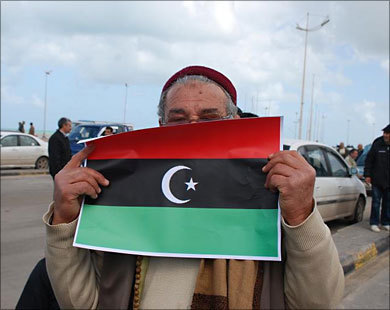
The news just broke days ago. After months of fighting, warfare and rebellion, the rebels deposed Libyan dictator Muammar Gadhafi and have just raided his compound as of now. Gadhafi is currently in hiding but refuses to believe he has been removed from power. The news of Gadhafi’s overthrow was expected over time. After 42 years, many feel this will be a new change for Libya but the question is will it be positive or negative?

Before 1969, Libya was a kingdom with increasing oil wealth. It adopted a constitution to model the freedoms and liberties similar to that of European and North American states. It also received huge foreign influence from countries like the United States, Italy and Great Britain in aiding increased levels of wealth and tourism. While most welcomed these contributions, there were many who saw it as a threat.

On September 1, 1969, a group of young soldiers led by 27 year-old Muammar Gadhafi staged a coup d’etat on King Idris and launched the Libyan revolution. In 1973 Gadhafi imposed Sharia law on all of Libya, purged of the ‘politically sick’ and a ‘people’s militia would ‘protect the revolution.’ The revolution was both in culture and administration. 20% of workers in Libya were under heavy surveillance by Gadhafi. Executions of dissidents were made public and broadcast on state television. In 1977 Gadhafi officially declared Libya the Great Socialist People’s Libyan Arab Jamahirya and adopted a national flag that was completely green. Gadhafi opposed any Arab country that sided with Israel and even declared a four day war on Egypt. He also supplied arms to any of its allies, both nations and terrorist groups.

Another key note is that Gadhafi was heavily influential in terrorism during the first two decades of his reign.  Some believe he was the tour de force of terrorism at the time that would pave the way for groups like Al Qaeda. He formed the Black September movement which caused many attack in the 1970’s including the Olympic Attack in Munich where 11 Israeli athletes were killed. His terrorists were also instrumental in hijacking airplanes which led to the tight security on airplanes that still continue and become stricter to this day. In 1985, it was discovered by the United States that Gadhafi harbored a camp for training terrorists. This led to President Ronald Reagan to declare an airstrike on Libya in 1986. The strike failed to kill or depose Gadhafi but killed his daughter. His terrorist activities died down soon after but not without one last infamous attack of a bomb on a flying plane exploding over Scotland in 1988, killing hundreds. Even despite his terrorist activities dying down, he still talked tough and sided with Arab leaders who were anti-Israel.

In 2011, people’s movements in Tunisia and Egypt led to the overthrow of their heads of state. The revolutionary spirit spread to other Arab countries including Libya starting in the month of February. Gadhafi quickly condemned the uprising and claimed it was being engineered by Western elements and Israel.  By March, much of Libya had tipped out of Gadhafi’s control where even members of the Libyan army were joining the revolt. Gadhafi loyalists were encouraged to kill the protesters. Soon international forces from the United States, the United Kingdom and France had joined forces to declare a military operation to remove Gadhafi. In June, the International Criminal Court issued an arrest warrant for systematically planning and implementing attacks on civilians. By August 22, 2011, rebel fighters had gained influence and control of Tripoli’s Martyr’s Square. Meanwhile Gadhafi asserts he’s still in Libya and will not concede power to the rebels.

Now the overthrow of Gadhafi is definite or eventual, if not official. There comes the big question. What will come of Libya in the future? Will it become a better stronger country? Or will it face its own problems?

The country is now mostly controlled by Mustafa Abdul Jalil, Gadhafi’s former justice minister who established the National Transitional Council shortly after the Libyan revolt began. The Declaration of the council includes many key aims like: ensuring safety of its citizens and liberating the rest of Libya, restoring normal civilian life, have the military council achieve a doctrine protecting Libyan citizens and defending the borders, draft a new constitution, pave the way for free elections and guide the conduct of foreign policy and international relations.

The policies appear promising but the big question is can it be attained over time? Many Arab countries that have established new freedoms and new liberties have faced the threat from dissidents, terrorists and loyalists of the former dictators. Afghanistan and Iraq have held elections and drafted new constitutions after their revolutions but have constantly faced attacks from many dissident factions that still happen to this day. Also it is possible of another coup d’etat in the future from a new dissident or Gadhafi loyalist with military power. The future of Libya has yet to be determined in the wake of the deposition of Gadhafi that continues as we speak.

Libya also has the 10th largest oil reserves in the world and the 17th highest petroleum production. It’s high petroleum production and low population has given it the fourth-highest GDP in Africa. During Gadhafi’s reign, the money was used to buy arms which led to many of the terrorist attacks. The wealth was not evenly spread out amongst the people. Under a new government in Libya, will the wealth be used more generously for the sake of developing the nation and the quality of life for its citizens? Or will it be a heated political debate in the future?

Since Gadhafi’s official overthrow is eventual, the future of Libya is a big question. The future of the country and the leadership that follows will be a new chapter in the country’s history but which direction it goes, and whether the new intended freedoms and liberties will be successfully carried out, still remains a question that only time can answer.

WORKS CITED:

WIKIPEDIA: Libya. Wikipedia.com. 2011. Wikimedia Foundation Inc. <http://en.wikipedia.org/wiki/Libya>

WIKIPEDIA: National Transitional Council. Wikipedia.com. 2011. Wikimedia Foundation Inc. <http://en.wikipedia.org/wiki/National_Transitional_Council>
Movie Review: Kung Fu Panda 2

Yes, I’m playing catch-up with my movie reviews of the summer. Hope you like this late review.

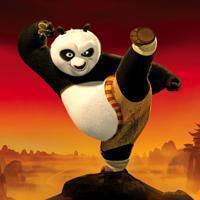
I’m sure you remember the first Kung Fu Panda. Po was the lumpy clumsy Panda who came from nowhere to become the Dragon Warrior. It charmed audiences, made people laugh and even rivaled Disney/Pixar in making 3D animated movies. Now Po’s back in Kung Fu Panda 2. But does this new version of Kung Fu Panda still have its kick?

We begin the movie learning of the clash between the peacock clan and their son Lord Shen stealing the power of the fireworks and using them as weapons. When Shen learned from a soothsayer that a warrior in black and white would defeat him, Shen exiled the pandas from the village. Shen’s parents exiled him soon after to which Shen swore revenge.

Flash forward 20 years, we see Po as the Dragon Warrior protecting the Valley Of Peace with the Furious Five who are now his friends and allies. Master Shifu senses Po lacks inner peace. At first Po doesn’t know what he meant until the five attack a band of wolf bandits. During the fight, Po is distracted by a symbol on the head wolf’s armor which causes a flashback to memories of his birthmother. He then learns from his father, the goose Mr. Ping, that he found him as a baby in a radish basket and adopted him since. Learning that truth leaves Po frustrated and upset.

Later Master Shifu learns that Master Thundering Rhino has been killed by Lord Shen with a cannon he build and plans to use to destroy kung fu tradition and conquer China. Po and the five go to Gongmen City to end Shen’s control. They come across two imprisoned council members and try to chase down Shen’s wofl pack, only to be captured. Upon being brought before Shen, Po and the Five break free and destroy Shen’s cannon. However Po is again distracted by the symbol that caused flashbacks of his mother which allows Shen to escape and destroy the tower with an arsenal of cannons. After escaping, a concerned Tigress confronts Po of his distraction. Po knows of Shen’s presence on the day he was separated from his parents and has to ask him about his past

Despite Tigress fearing for him, Po breaks into Shen’s cannon factory and confronts him. Shen tells Po his parents abandoned him before blasting him out of the factory and capturing the Five. Po finds himself rescued by an exiled Soothsayer in the city he was born in. The Soothsayer guides him to embrace his past where Po learns his village was raided at the time he was born as Shen’s forces killed every panda and burned the village. Po’s father was fighting the war and told Po’s mother to run and escape with their baby. Po’s mother ran throughout the snow and left him in a radish box at a place she knew he’d be safe, Mr. Ping’s place. It’s upon returning to his old home and finding his childhood toy that he learns he was given up out of love and raised out of love. Finally he attains inner peace.

Po then returns to Gongmen City to save the Five and stop Shen from conquering China. Po and the Five along with Ox and Croc block the gates to shop Shen but Shen’s cannon clears the way and lands them all in the ocean. While Shen attacks Po with his cannon, Po is able to use his inner peace to redirect Shen’s cannon fires to Shen’s cannon, destroying it. He then urges Shen to let go of his past, but Shen refuses and attacks Po. In the fight, Shen accidentally cuts the ropes to his own cannon and is crushed to death. Po achieves victory and freedom for Gongmen City. He returns to Mr. Ping and lovingly declares him as his father. The very end may hint to many that there may be a Kung Fu Panda 3.

While I’m not a big fan of most Holywood sequels, I have to say that I was impressed with Kung Fu Panda 2. It managed to have a story different from the first movie. Its fights and special effects were just as dazzling as the first. The characters still had their charm from the original and especially kept the appeal of Po. The movie had an excellent range of voice-over talent with renowned actors like Jack Black, Angelina Jolie, Dustin Hoffman, Jackie Chan, Michelle Yeoh and many others. The animation graphics were excellent and top notch to the slightest detail.

For the most part, I believe the movie would be fine for parents of children but not for most adults. It is a movie that doesn’t have the same level of adult appeal as a Disney/Pixar animated movie would. Some things that may appeal to parents is the actors doing the voiceovers. Overall, the movie, storyline and humor are more tailor made for families of young children.

 Overall Kung Fu Panda 2 makes for an enjoyable night out at the movies for families of young children. Even some older children or teenage fans of the first movie will enjoy it.

2010 Oscars Best Picture Nominee: Black Swan

I don’t know all that goes on in ballet. I’m sure some dancers can have a better knowledge of all that happens, like rehearsals and backstage secrets. Black Swan is the story of an insecure dancer who receives the role of a lifetime in Swan Lake and works to achieve it, despite what possible tragedies lay ahead.

We first meet Nina Sayers: a young insecure aspiring dancer of a New York ballet company. Her mother, who’s a failed dancer and now an amateur artist, loves Nina and supports her but is very controlling of her. One important note: Nina has many psychotic symptoms like delusions and colorful hallucinations. She also purges herself at times. The director Thomas Leroy announces he’s putting a new twist on the production of Swan Lake. In this production, a virginal pure girl is trapped in the body of a swan only love can free. She falls for a prince but her evil twin, the Black Swan, tricks him and seduces him. Devastated, the white swan jumps off a cliff and find freedom in death. In this production, they’re looking for a new dancer that can play both swans.

There are auditions for this and there is a lot of rivalry between the girls.  For so long, they all aspired to replace Beth McIntyre who has been the ensemble’s top dancer for so many years. Beth herself is devastated by the news and wrecks her dressing room in the process. During practice Thomas points to Nina that she’s perfect in the technical aspect in her dancing but lacks grace, and points to a dancer named Lily as an example of grace. The results are then announced that Nina is cast as the swan.

This should make Nina happy but is given harsh words from a drunken Beth at a benefit gala where Thomas promotes Nina. Days later, Beth attempts suicide by throwing herself into a car. Thomas tries to get Nina to loosen up for her role as the Black Swan. He even kisses her with power and recommends masturbating. Nina sees a suspicious rash coming on her shoulders. She even suspects Lily, who’s cast as her understudy, is trying to take her role away from her.

One night Lily arrives at Nina’s door and takes her for a night on the town. She meets Lily’s gay friends and takes drugs Lily offers her. The two then have sex at Nina’s house after an enraged argument with her mother. Waking up alone, she arrives at the rehearsals with Lily standing in as the Swan Queen. Furious with Lily not waking her upon, Nina argues only to learn sleeping with Lily was just a drug-induced illusion.

 The night before opening, Nina rehearses late and experiences more delusions like lily and Thomas having sex. She visits Beth in the hospital only to see Beth stab her face with a nail file. Upon returning home, she sees her mother’s paintings mocking her, pulls a black feather from the rash on her back, her eyes turn into swan eyes and her legs contort into swan legs. Upon steadying herself, she falls and knocks herself unconscious.

The morning of the opening performance, she wakes up to find out her mother locked her in her room and let the company know she can’t make it because she’s not well. Nina forces her way out violently and arrives at the company to prepare for the White Swan. The first act goes well until Nina is distracted by another image and a lights glare; the Prince drops her during an overhead lift. Nina returns to the dressing room to see Lily dressing as the Black Swan. Lily then turns into Nina whom Nina fights and even stabs with a broken mirror. Nina then hides Lily’s bloody body in the closet. Nina returns to the stage as the Black Swan. It is during her performance that the rash on her back sprouts black swan feathers and becomes wings as she dances flawlessly and gracefully. The audience gives her a standing ovation and she kisses Thomas with power.

Back in her dressing room, Lily comes in to congratulate her. She then learns she never fought Lily but the stabbing from the mirror glass was not only real, but she stabbed herself as the White Swan. For the final act, Nina dances gracefully as the White Swan. At the end where the Swan is to jump to her death off the cliff, Nina sees her mother in the audience crying. Nina jumps and the audience erupts in applause. The cast, especially Lily, is horrified to see blood from Nina’s stab wound but Nina lays dying and happy that she everything she could to achieve the perfect performance.

 Despite it showing some truths about the ballet world, ballet is not what Black Swan is mostly about. Nor is it about the dark truths of the ballet world. It’s mostly about life imitating art as the director gives a new twist to Swan Lake and it imitates Nina’s own life from her trying to impress Thomas to loosening herself with Lily to dying in order to free herself from her mother. It’s about delusions and it either interfering with reality or sending a message. It’s about whether it’s better to fade down or end on top. It’s about people in the arts world that have either this freeness or extremeness about them. It’s also about dying for one’s art. All these themes are present in Black Swan which is what makes it unique, frightening and even beautiful.

The biggest highlight of the movie was the acting and the dancing of Natalie Portman. This was a role of a lifetime and Natalie mastered it. Also excellent was Mila Kunis as the loose, confident Lily. Barbara Hershey, who played the mother, did a lot with what little screen time she had. Darren Aronofsky did an excellent job in directing this in what is only his fifth feature. His previous work The Wrestler showed that bigger things was going to come from him and they have.  The trio of scriptwriters also did an excellent job in writing a clever but haunting script. This has to be one of the best films about dance ever made.

Black Swan has been a darling of film critics and awards juries. Black Swan has also done well at the box office so it’s nice to see it’s also succeeding commercially. Black Swan may confuse some at first but one would understand it more as the film progresses. I don’t know if it will win Best Picture but it is surely deserving of the Oscar and all of its nominations. Definitely worth seeing.