VIFF 2012 Review: Stories We Tell

Stories We Tell was one film that was added to the VIFF at the last minute. I was expecting this to be more of a live-action film but it turned out to be a documentary to my surprise. And quite an intriguing one.

The documentary is directed by famed Canadian actor/director Sarah Polley. The documentary first appears to be her father, siblings and other friends and loved ones talking about her mother Diane Polley, from her career as an actor and a singer to her work in a Montreal play around the time her pregnancy with Sarah was starting (April 1978) to the abortion that wasn’t to the birth of Sarah to Diane’s death. All of those involved tell their story with reenacted images appearing in the style of Super-8 home movies. Some even receive direction from Sarah in telling their story and Rebecca Jenkins is cast to play Diane in the Super-8 re-enactments and fake television footage.

After more than half an hour, you think it’s a chronology of the Polley family, or at least the mother. It turns out to be a lot more: a ‘family secret.’ After the death of her mother, Sarah began to question her birth father. Could it really be Diane’s husband Michael Polley or was it another man? It even became a bit of a family joke at the dinner table when Sarah was a young teenager. Eventually the jokes died down and Sarah did some serious business about it. She learned about the actors her mother was acting within that play. She tried to look up one whom many in her family joke as the father but it’s not. Later she learns through conversations of those with the play and through a paternity test her father was Harry Gulkin, Canadian actor and film producer.

The story about searching for the truth of her birth father is seen and heard from the various angles interviewed for the movie: Sarah, her four siblings, Michael Polley, Harry, Harry’s daughter from a previous marriage, and castmates of that fateful Montreal show. The interviews are real in their retelling of the story but some interview dialogue is dramatized for the sake of the film. Possibly to show how a story that happens turns into a story told. I think that was the point Sarah was trying to get across in this is how people take the experiences of their lives and turning them into stories. That explains why we see Sarah giving those she interviews direction at times.

One thing about this documentary is that despite the re-enactment of events on Super-8 film (which had me fooled into thinking they were actually home movies) and the facts being told dramatically by some of the interviewees is that the drama does stop. There is a point where Michael does admit that there was a time in the late 70’s when the marriage seemed to be going dry: he had ambitions of being a playwright but settled on becoming an insurance salesman. He even confesses he told Diane during that time it’s okay for her to romance another man. Another point near the end, Michael cuts away from his cheery personality and his ability to laugh off the situation into showing the hurt he feels knowing he’s not Sarah’s biological father. It’s like that for all the others interviewed too where they all have a calm face or are smiling when they tell the story throughout but it’s near the end when they’re deep in thought that the hurt comes to them. You can see it in their faces.

This is not just a documentary that exposes a family secret of a popular Canadian celebrity. It’s also about Sarah’s relation to the people around her, both family and friends. New people came into her life after learning the truth. Most of her personal relations with others remained unchanged. She still has a healthy relationship with her siblings from her mother’s side as well as the father she always knew. She also has developed a healthy relationship with her biological father and her daughter: people that just came into her life years ago. Another angle of the documentary is it shows how despite laughing off the story, there are still some that feel hurt knowing the truth about the story. Siblings she always knew as full-siblings are now half-siblings. Even the half-siblings from her mother’s first marriage are hurt knowing the truth. The father has hurt behind the laughter. Harry occasionally thinks of the years he missed seeing Sarah grow up.

The thing that surprises me most about this is how successfully the family and others involved were in their ability to keep it secret and away from the media. We shouldn’t forget that this was all happening when Sarah was a public figure. The first secrets were unraveling during her days as Sarah Stanley in Road To Avonlea. It accelerated just as she was becoming the it-girl of Sundance in the late 90’s. The truth was finally revealed just as she was making a name for herself as a director in Away From Her. If this secret had been let out earlier, this could have put a big dent in her career and her image as ‘Canada’s Sweetheart’ during her child actor days could have been tarnished. It’s good to see the family and those who knew the truth kept quiet about this and that only Sarah herself could allow this to be exposed through this film only now. In a world that’s tabloid-obsessed and loves celebrity scandal, it’s good to see this was kept quiet enough to give Sarah the privacy she wanted.

THREE BITS OF TRIVIA: First, Diane Polley was a casting director for two made-for-TV movies of Anne Of Green Gables: the Canadian novel series the family drama Road To Avonlea was spun off of. Second, Diane died only three days after the pilot episode of Road To Avonlea was aired across Canada. Third, Sarah notes on the National Film Board of Canada (NFB) website that at least two journalists knew of the story for years but respected her wishes to keep it private and for her to be the first to let the truth out.

Once again, Sarah can add another accomplishment to her resume. She has already accomplished television acting as a child, movie acting as a teenage adult, directing and scriptwriting just years ago and now documentary director. It’s interesting how back during the late 90’s, Sarah turned her back on Hollywood in an attempt to be taken more seriously despite being referred to as the Sundance it-girl. It was a risky move that has paid off over the years. That’s something to admire especially since we’re in a time when people are mostly willing to become famous however they can, even if it doesn’t involve talent at all.

This is one documentary I saw at the VIFF that works well as a big-screen film. I myself saw it at the 1100-seat Vogue stage theatre in Vancouver. However this is one documentary that would best draw a crowd with Canadians or those into arthouse films. Those are the filmgoers who recognize Sarah best.  Outside of that, it’s still a documentary that can touch one who may have a similar story like this in their own family. For the record, American film company Roadside Attractions has purchased the film and plans to release it in the US in early 2013. No word yet on Canadian theatrical release. It’s all in the hands of the NFB.

Stories We Tell is an amusing and touching documentary about the retelling of a family secret within Sarah Polley’s family. It’s as charming and witty as it is intimate, touching and even heartbreaking. Definitely worth seeing.

VIFF 2012 Review – High Five: An Adoption Saga

The Wards and their five adopted children are the focus in the documentary High Five.

High Five is a documentary filmed over a five-year period. It’s a story about international adoption and about a couple’s iron will to let their heart win out over politics, finances, and inter-family strife in their attempt to adopt and parent five Ukrainian siblings. We don’t get what we expect to have but we do get an eye opener on the subject of international adoption and the lives of all seven.

We first meet Cathy and Martin Ward, a couple from Surrey, BC who’ve always wanted children. A car accident to Cathy ten years earlier to which she constantly needs operations for even now makes pregnancy very risky. They first decided to play host to a 7 year-old Ukrainian orphan named Alyona in 2006. During the visit, they learn that Alyona have additional siblings. They bring Alyona with her next oldest sibling Snezana the next year. The following year they visit all five at the orphanage in Gorodnya, Ukraine. They decide to adopt all five but laws allow them to only adopt two at the time. They first adopt Alyona and Snezana but promise the other three–Older siblings Yulia and Sergey and youngest sibling brother Sascha–that they will adopt them the following year. Politics delay the adoption of the other two siblings for years. After much struggle–political, financial and emotional–the three other siblings are finally adopted. Problem solved, right?

Not completely. Even before the full adoption process we learn of potential problems that could arise. The five come from an abusive household in Ukraine where their mother died and their stepfather was an abusive alcoholic. It took the courts to remove the children from the stepfather and put them in the orphanage. All five remember the abuse very well. The gap between the two adoption periods also has an effect on the siblings too as there’s a sense Yulia has lost some feelings to the two others. One thing to keep in mind is that Yulia, the oldest daughter of the five, acted as the mother figure to her four younger siblings in the orphanage. There are also the health problems of the two. Martin is a nurse at the BC Children’s Hospital but Cathy needs frequent surgery from her car accident and Martin has a bout of the flesh-eating virus. Sergey himself has a growth stunt that has slowed his growing down to which he’s only 4’6″ at the age of 17. The adoption process is also a financial risk. The process was very costly and Martin would have to take a nursing job in the territories to help make finances more manageable. Then there’s the fact that the siblings are growing up. There’s always growing pains and approaching adulthood for some. Even Sergey returns to Ukraine temporarily for better job opportunities.

The biggest difficulty appears to be the relationship of the family with Yulia. Yulia has always been a sensitive and emotional girl. Since the adoption, Yulia would now have to go from the mother-figure to the parented. This does not fit well with her as she’s so used to being the mother figure. Her relationship with Martin is mostly unaffected but it’s sour with Cathy. The bad vibe also doesn’t go well with the other siblings as they find her hard to stand, even Sergey whom she’s always been the closest with. On top of it, she’s a growing girl who’s graduating from high school, working a job, has a boyfriend and is entering adulthood. She had made two trips to Ukraine both for employment purposes and to meet with another sibling of theirs who was adopted by a Ukrainian family.

The documentary ends with Yulia still in Ukraine. She still has a negative attitude: “I have no mother.” The other four are still seen being parented by Martin and Cathy. The documentary ends with the six on a local snowboarding trip. As Martin looks out to them as they’re having fun, we’re left wondering what he’s thinking about as he watches them. As for the documentary’s ending, it ends with a ‘to be continued’ ending. It leaves off in the present as the continuing story that it is and leaves one asking questions. Will Yulia return to the family? Will the five be one again? Will any of the other sibling try to pursue opportunities in Ukraine? Those are questions only time has the answers for.

This documentary is a good example of international adoption and how it doesn’t always worked out as wished. It didn’t have a completely happy ending nor did it have a tragic ending. It just presents the story as is and is able to balance the positive aspects with the negative aspects. As I just said, this documentary ends without a real ending. It’s a story that continues to this day with the cameras no longer rolling and will have changes to the lives of all seven over the years. Nevertheless I wish the Wards and the five all the best in the future.

Directors Yulia Ivanova and Boris Ivanov did a very good job of filming this story which appears to be like a daily or yearly chronology of the adoption story over the five-year period. Even though most of the documentary is narrated by Martin, the story is seen through a wide variety of angles: both the parents and the siblings themselves. There are moments when it’s about the family and moments when it’s about one individual. They give the right focus for each situation. Sometimes they try to be mediators in this situation by attempting to help the interviewed subjects by giving advice behind the camera. That doesn’t become a weakness for the documentary. This documentary does give a feel of being like a reality show but this is not a ‘reality show’ as one would commonly associate with popular reality TV. There’s no sensationalism or explosive brattitudes. This is a real situation with real human emotions present and real problems and crises arising in the adoption process.

This is another documentary that’s meant more for the television than for the big screen. The fact that it’s produced in association with the Knowledge Network is the best example of why. From what I heard at the screening, it will be shown on The Knowledge Network in British Columbia in December. I have no information about whether there will be a DVD release for it. I feel it’s worth a DVD release since this is good teaching material. Those interested in international adoption will get a good experience to what it’s like and the potential risks that lay ahead.

High Five is as much a documentary that tells a story as it teaches. It presents a common story of international adoption that presents the viewer with the stories of the individuals as much as it does with the family. It’s worth watching.

London 2012: A Games To Remember

So the seventeen days of Olympic action has ended. History was written in London. Some of these athletes’ dreams came true, some dreams had to be put on hold for another four years, and some died right there. Nevertheless they were a seventeen days that gave the world lots to cheer about.

MEMORABLE MOMENTS AND NAMES IN HISTORY

One of the unique things of these Olympic Games were that two of the biggest stars from the Beijing Games were back to thrill the world again. An aging Michael Phelps was back in London proving to the world he still has it. He left London with four gold and two silver, successfully defended his gold medal for the third straight time in two different events, set a career Olympic medals record with 22 over three Olympic Games, and ended his Olympic year as arguably the greatest Olympian of all time. Another great from Beijing, Jamaican sprinter Usain Bolt, won the 100m, 200m and anchored Jamaica’s 4*100m relay to gold as he did back in 2008. He too solidified himself as one of the greatest Olympians of all time. It wasn’t just Bolt and Phelps who added more glory to their Olympic careers in London. There was the American beach volleyball team of Kerri Walsh and Misty May-Treanor who won gold for the third straight time. There was British cyclist Chris Hoy whose two gold medals at the Velodrome gave him a career total of six gold medals. No other cyclist has won more. Also British yachtsmen Ben Ainslie won gold for the fourth straight Olympics. Only one other sailor, Denmark’s Paul Elvstrom, has won as many yachting golds.

Even with greats adding to their legacy here in London, this was also the arena where great were born. American swimmer Missy Franklin won five medals, four of the m gold. American sprinter Allyson Felix won three gold medals. British distance runner Mo Farah dazzled the home crowd by achieving the 5000m-10000m double. American decathlete Ashton Eaton and British heptathlete Jessica Ennis gave brilliant wins. Right after the US won the women’s team event in gymnastics, it was American Gabby Douglas who won hearts and the all-around gold. Swimming wasn’t only Michael Phelps and Missy Franklin. American Ryan Lochte also provided some great rivalry for Phelps in the pool. The women’s swimming also saw double golds from China’s Ye Shiwen and the Netherlands’ Ranomi Kromowidjojo. Tennis made a double-winner out Serena Williams in both individual and doubles with her sister Venus. There were also brilliant team efforts in London too. China dominated badminton and table tennis while the Americans dominated basketball. China also won six out of the eight diving events. While the American women’s gymnasts were the clear winners, it was China again who was the class of the men’s field. And the football contest showcased the gold medal-winning brilliance of the Mexican men and the American women.

Despite all the sports action, one of the biggest attractions of these Games were the attendance of members of the royal family at events. The most notable were Prince William, Prince Harry and Kate Middleton. They were seen taking in the athletic action and cheering for Britain. Some of the most notable appearances of them were at the men’s team gymnastics tournament, the swimming finals where they saw Michael Phelps and Missy Franklin in action, the track cycling events where the British women’s pursuit team set a world record in front of them, and the equestrian competition where they cheered Duchess Zara Phillips to a team silver in the eventing competition. Her medal was placed around her neck by her mother Princess Anne: a former Olympic equestrian rider and a member of the International Olympic Committee.

As for medal totals, the most medaled male athlete of these games was once again Michael Phelps with six: four gold and two silver. The most medaled women were three swimmers–Austrailian Alicia Coutts and Americans Missy Frankin and Allison Schmitt– who won five medals each. The American team won the most medals with 104 as well as the most golds with 46. Next in line was China with a total of 88 medals, 38 of them gold. Russia was third in total medals with 82. However it was the host country of Great Britain with the third-most gold medals with 29 which I will elaborate on later in this article.

As for Canada, Canadian athletes won eighteen medals over eleven sports. The eighteen medals was the same medal total as in Beijing but Canada only won a single gold. Canada’s only gold medalist was trampolinist Rosie MacLennan. Canada’s other medals were also worthy of respect too. Both of Canada’s rowing eights teams took silver. Wrestler Tonya Verbeek regained her past winning form to take silver in her category. Canada’s female synchro diving pairs both won bronze. Christine Girard became Canada’s first female weightlifter to win a medal, a bronze. Swimmer Brent Hayden won bronze in the 100m freestyle in his third Olympics. Derek Drouin was a surprise bronze medalist in the men’s high jump. And it was Canada’s women’s football team that won the hearts of the country after their controversial semifinal loss against the Americans and their win in the bronze-medal game. There were even non-medallists like Jessica Zelinka, Damian Warner, Mary Spencer and Canada’s women’s gymnastics team who won the respect of the nation.

The Olympic Games here showed that inspiring a generation doesn’t strictly mean winning a gold medal. For the first time in London,  all Olympic sports had events for women or were mixed. Also every competing country sent female athletes with their delegation. This was especially victorious for women of Muslim nations as they could finally compete for their country. There was also individual achievements here in London too.  There was marathon  runner Guor Mariol from South Sudan. South Sudan was just formed as a nation one year ago and has not yet formed its own national Olympic Committee. Guor was given the option to compete for Sudan but refused. Because Sudan it is the country responsible for the genocide of two million of his people, including eight of Guor’s own brothers and sisters, he believed competing for Sudan would be a betrayal to his people.  The IOC agreed to have him compete as an Independent Olympic Athlete, one of four at these Games. His appearance could lead to a South Sudan team for the 2016 Olympics. There was South African double-leg amputee runner Oscar Pistorius who had only run in the Paralympics previously and won a long battle with the IAAF to run as an Olympic runner. He ran as part of South Africa’s relay team and in the men’s 400m event. He only made it to the semifinals in the individual 400m but the highlight was at the end as eventual Olympic champion Kirani James did a name tag exchange with him as a sign of respect. There was the American men’s 4*400m relay where the first runner Manteo Mitchell broke his fibula halfway through his run but still ran to the exchange to help the US qualify for the finals. In the finals, Bryshon Nellum who was shot in the leg three years earlier and was told he would never run again ran as part of the silver-medal winning team. He would be chosen as the American flag bearer at the closing ceremonies. And there was delight in the home crowd as British diving prodigy Tom Daley wanted to win a medal for his father who died one year earlier. Those in Britain and the diving world were well aware of the close relationship he had with his father whom wholeheartedly supported Tom during his lifetime. He faced a tightly competitive field in the men’s platform diving but won the bronze. You don’t have to win a gold to be a hero.

THE NEW POSSIBLE: NEW RECORDS SET

Have you been seeing all those ads from AT&T where they show a winning moment and a young athlete writes it as their goal followed by the tagline: “Here’s to the new possible?” The new possibles have been celebrated as new World Records and new Olympic Records countless times here in London.  Archery saw the world records fall in the ranking rounds of both the men’s individual and team tournaments.  Athletics saw the Olympic record broken in twelve events: four of them new world records. The most amazing had to be the American women’s 4*100 relay team breaking a 27 year-old world record held by East Germany by more than half a second. Cycling saw ten world records broken in four events. All but two were set by British cyclists. Shooting saw seventeen Olympic records and seven world records broken or equaled. Both Modern Pentathlon events saw new Olympic record totals set. Swimming saw the Olympic record fall in twenty events and the world record fall in eight events. The women’s events were the ones with the most change as only two events saw the old Olympic record still standing. Weightlifting saw nineteen Olympic records set, eight of them world records. They say records were made to be broken. Makes you wonder how many of those new records will be broken in 2016?

THE FIRST OF THEIR COUNTRY

Remember how I made mention in my segment of Botswanian sprinter Amantle Montsho that one of my favorite Olympic moments is when a country wins their first ever Olympic medal? Here in London, seven nations won their first ever Olympic medals here in London.  Botswana was one of them but it wasn’t Montsho; it was Nijel Amos who won silver in the men’s 800m run. Bahrain’s first ever medal was a bronze in the women’s 1500m run won by Maryam Yusuf Jamal. Montenegro’s women’s handball team won their country’s first medal, a silver. Guatemalan race walker Erick Barrondo brought his country on the medals table for the first time ever with a silver in the 20km walk.  The victory ceremony of the men’s heavyweight category in taekwondo saw Gabon’s flag raised for the first time ever at the Olympics for silver medalist Anthony Obame. Cyprus arrived on the medals podium for the first time ever thanks to sailor Pavlos Kontides winning silver in the Laser event. And finally the tiny Caribbean island of Grenada with a population of only 110,000 had an Olympic champion in 19 year-old sprinter Kirani James in the men’s 400m run. With that Grenada set a unique Summer Olympic record for most gold medals per population, beating The Bahamas in 1964 when they had a population of 130,000. The Winter Olympic record is another story. Anyways back to the focus of this segment, one of the reasons why I like seeing a country win their country’s first Olympic medals is because you know they will come home to their country a national hero. That’s the biggest example of the London Games motto “Inspire a generation” happening here. No doubt they’ll inspire their country’s children to excel like them.

HOST NATION PRIDE

The British Olympic Committee has existed possibly ever since there was an Olympic Games. However things changed in the late 90’s after the Atlanta Games of 1996 where Britain won a total of 15 medals and only one was gold. The Olympic Committee revamped itself as Team GB in 1999 and meant to unify the team as one body, irrespective of one athlete’s particular sport. It’s formula appeared to pay off as Team GB, had set targets of medal achievements in each sport at the London Olympics and a total medal target of at least 48 medals; one more than the total won in Beijing. That seemed a pretty high target considering Beijing had one of Britain’s biggest medal hauls ever. It actually turned out to be a very realistic target as Great Britain won a total of 65 medals including 29 golds in a total of 17 sports. It all started with a silver medal won by cyclist Lizzie Armistead in the Women’s Road Race and ended on closing day with pentathlete Samantha Murray winning silver in the women’s modern pentathlone event.  In between were loads of reasons for the host country to cheer, especially on Saturday the 4th when Britain won six golds on what will be known as ‘Super Saturday’.

One of the benefits of Team GB’s sport unity was the ability for Brits to excel better than ever in sports Britain was never much of a power in. Taekwondo had only one British medal in the past and here in London they had their first Olympic champion. Previously underrated tennis player Andy Murray won the men’s singles tournament and later won silver in the mixed doubles tournament. Britain won its very first triathlon medals here through the Brownlee brothers: Alastair taking gold and Jonathan taking bronze. British canoeists won more gold medals than ever. And the British gymnastics team here in London won a silver and three bronze; the same total of medals British gymnasts have won in all past Olympic Games combined. There were also some sports where Britain used to dominate in the past that saw a return to the dominance here in London. British boxers won medals in five of the thirteen categories including three wins. Britain’s equestrian riders won gold in three of the six events. And British sailors won medals in five categories including a gold medal for Ben Ainslie in the Finn class: his fourth consecutive.

However it was in the sports that Britain has consistently done best in over the years that saw their biggest successes. It was the sports of cycling, rowing and athletics that most gave the home country something to cheer about.  The GB cycling team that included greats like Chris Hoy and Bradley Wiggins always got the crowd cheering especially in the velodrome as they won twelve medals, eight of them gold. No other country did better in cycling. British rowers won the most medals winning in nine of the fourteen categories including four gold. Athletics saw huge success with four gold and six total medals but it was on ‘Super Saturday’ August 4th that Britain had three Olympic champions: Mo Farah in the men’s 10000m; Greg Rutherford in the long jump; and Jessica Ennis in the heptathlon. There hasn’t been that many athletics wins by a host country in a single day since the Los Angeles games of 1984. The only sport Britain fell short in was swimming where they targeted five medals at the least but wound up with only three. A far cry from the six medals won in Beijing. There were other sports where Britain made no target and no medals resulted. Even in soccer Britain’s teams lost their quarterfinals: the women to Canada and the men to South Korea via (what else?) penalty kicks. Nevertheless it was their biggest Olympics since 1908 and it gave the whole of Great Britain something to cheer about and a Games to be proud of.

OLYMPIC LOWLIGHTS

Even though these were an excellent Olympic Games, it’s not to say they weren’t without their problems. First was to do about their security. In the days leading up to the Games, the media made highlights of the security inadequacies. This lead the London Organizing Committee of the Olympic Games (LOCOG)  to bring in British troops from even as far away as Afghanistan to help. Another was to do about the use of Twitter by some athletes. The bad tweets got most of the attention but two athletes–a Greek triple-jumper and a Swiss soccer player–wrote tweets bigoted enough to get them taken off their team.

There were lowlights during the events. First was news about all the empty seats at some events. despite ensuring fans that tickets were all sold out. Even the non-ticketed qualifying rounds of archery held just before the opening ceremonies raised eyebrows. Another controversy was a man from the stands threw a bottle at the track just before the start of the men’s 100m final and was subsequently arrested. One boxing referee was dismissed from the Olympic for awarding a win to an Azerbaijani fighter who was knocked to the canvas six times by his Japanese rival. A women’s fencing semifinal was given extra time because of a clock malfunction. That allowed German fencer Britta Heidemann to win the match against South Korea’s Shin A-Lam. A-Lam protested with a one-hour sit-in to no avail. One scoreless judo quarterfinal led to the judges unanimously deciding the win on the Korean fighter at first then changing it to the Japanese fighter with no explanation.

However of all the lowlights outside of actual cheating, the two most notable came in the gymnastics events and women’s soccer. Gymnastics first  saw scoring problems first in the case of two scores–one by a Japanese gymnast in the team competition and another by American Aly Raisman in the balance beam final–leaving the individual and team out of the medals. Their country’s respective official immediately appealed the score in both cases and both were changed to a score that allowed the gymnasts to win their medals. Another case came when British gymnast Louis Smith and Hungarian Krisztian Berki were both given the same score in the pommel horse final. However Berki won the gold because of a higher execution score. This broke the hearts of both Smith and the British people especially since had Smith won the gold, he would have become Britain’s first-ever Olympic champion in gymnastics. No doubt gymnastics scoring will be debated and reassessed by the FIG in the years before the 2016 Olympics. And a woman’s soccer semifinal received a rare delay-of-game call against the Canadian goalkeeper which allowed an American player to get a penalty kick to tie the game. The American team won the semifinal and went on to win the gold medal. The Canadians were disheartened but not enough to win their bronze-medal match three days later.

CHEATER CHEATER

The biggest Olympic  lowlights are always the cheaters. Usually the Olympic cheaters that make the biggest news are often those that test positive for drugs. Here at these Olympics the cheaters that made the biggest news were the ones that cheated through different means. The biggest news came in the women’s doubles badminton tournament. Four teams deliberately lost in their preliminary bouts so they can get a more favorable position in the elimination round. When it was revealed, all four teams were disqualified. Also newsworthy was the stricter rules in sports such as the no-false-start rule which means even a single false start in swimming and athletics would get one disqualified. It almost happened in two swimming finals but both false-starters were allowed to compete as the starts were on technical malfunctions. Another case of stricter rules came when Canada’s men’s 4*100 relay team was third across the finish line but was disqualified of the race as one of their runners stepped on the lane’s line only once. In the past runners were allowed a maximum of three steps.

There were even some cases of cheating later admitted and cheating being questioned now. First was the swimming feat of China’s double-gold medalist Ye Shiwen. Her 400m Individual Medley win was set in world record time with her final 50m swum comparable to the time of the men’s winner Ryan Lochte. Despite the controversy, she tested negative in all of her drug tests. Another swimming shocker came in the men’s 100m breaststroke when South Africa’s Cameron van der Burgh won in world record time. He later admitted to using more than one allowable dolphin kick during the race. He was not disqualified. Britain may have provided some of the biggest highlights of the cycling competition but the Men’s sprint team provided a lowlight as member Philip Hindes crashed and the team was given a restart. Hindes claimed in an interview that he crashed deliberately after a slow start to get the restart for his team. He later retracted his statement and so far no action has been taken against him. And then there’s men’s 1500m run champion Taoufik Makhloufi of Algeria. On the day before his gold-medal run, he withdrew himself from the 800m heats after 200m. The IAAF disqualified him feeling he didn’t give an honest effort. He was later reinstated after providing a medical certificate showing that an ailment hampered his efforts. Whatever the truth is, Makhloufi will continue to be under suspicion. One thing about these incidents of potential disqualification is that it shows the sports feds need to get their acts together.

And then there are the positive drug tests. The IOC and the WADA (World Anti-Doping Agency) have developed tougher doping rules over the last few years such as having half the competitors of the London Games, 6000 in total, being tested between the start of the Olympics and the end of the Paralympics. All medalists and fourth-place finishers will be tested. The Olympic anti-doping agency will test up to 400 samples a day for more than 240 banned substances. Samples will also be stored and tested over a time period of four year for in the case of additional substances added to the banned list. Even WADA set an ‘in-competition’ time starting July 16th and declared that any athlete can be tested during the in-competition time without notice. During the in-competition period, thirteen athletes from thirteen countries tested positive for banned substances and sent home with suspensions. The only Olympic medalist to test positive was women’s shot put champion Nazdeya Ostapchuk of Belarus. She tested positive for Methenolone and was stripped of her gold medal. New Zealand’s Valerie Adams, second-place finisher behind Ostapchuk, now has the gold medal. One thing about all this cheating is Canadian magazine Maclean’s wrote an article about it asking: “Whatever happened to sportsmanship?”

RIO 2016: A LOOK AHEAD

The next Summer Olympic Games will be held in Rio De Janeiro in 2016. This marks the first time ever a South American city will host an Olympic Games. There’s no doubt Brazil is hoping to use these Games to showcase themselves to the world. This comes at a busy time as Rio will also be facilitating to two more major events within the next four years: World Youth Day in 2013 and the World Cup in 2014.  These Olympics already have their own official motto: “Live your passion.” They will begin on August 5 and end on August 21. There are expected to be 304 events in 28 sports. There will be no new sports introduced to the Olympic program in Rio but there will be one making a comeback. Rugby will be making its Olympic return since it was last contested in 1924 although the Olympics will stage Rugby sevens instead of the Rugby union conducted in the past.

The city of Rio is planning on hosting most of the events within the greater city. There are four districts of Rio where the majority of facilities are planned: Deodoro, Maracana, Copacabana and Barra. Deodoro is planned to host most of the modern pentathlon events as well as whitewater canoeing and mountain biking. Copacabana is the perfect place planned to host events in rowing, canoeing, yachting, marathon swimming and beach volleyball. Barra will be a hub for contesting sports such as swimming, gymnastics, hockey, tennins, boxing and wrestling. Maracana will have the biggest hosting of events with the legendary Maracana stadium for football events and the ceremonies, Joao Havelange stadium for athletics, the Maracanazinho arena for volleyball and the Sambadrome which normally host Carnival will host the archery and marathon events.

Most of the events will be held in facilities that already exist like the Maracana, the Joao Havelange Stadium, the HSBC Arena, Pio Olympic Velodrome, the Maria Lenk Aquatics Centre and the multipavilion Riocentro. There are some temporary facilities planned strictly for the Olympic Games like the Copacabana stadium for beach volleyball, the Deodor Modern Pentathlon Park, an Olympic Hockey Center, an Olympic Hockey Park and a temporary pavillion at the Riocentro. There are only six new venues planned for these Games like the Olympic Aquatics Stadium, the Olympic BMX Centre, an Olympic Tennis Centre and an Olympic Training Centre consisting of four halls and a total seating capacity of 50,000. The only competition venues held outside Rio will be soccer stadiums in four different Brazilian cities.

As for the Brazilian team, Brazil’s team here in London won a total of seventeen medals including three golds in eight sports. That’s their biggest medal haul ever although the most golds they won were five back in 2004. Brazil is one country whose Olympic prowess has really grown in the last twenty years. The first Olympics where Brazil ever won ten or more medals was back in 1996 and the Brazilian team has left every Summer Olympics since with ten medals at the very least. There’s no doubt Brazil wants these Games to have their biggest medal haul ever. What they will have planned in preparation for their Olympic team for these Games will be decided and carried out gradually in the next four years.

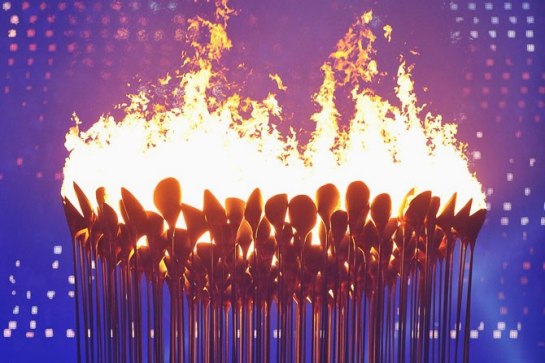
The Olympic flame won’t be lit again until the Winter Games in Sochi in 2014. By now all the Olympians are either home or heading home. Each nation’s Olympic Committee will be taking home the one of the 204 pedals of the cauldron that has their country’s name on it. One has to agree the London Games gave a lot of great memories and once again brought the world together. The Olympic flame may be extinguished in London but the flame still burns in the hearts of the athletes. That’s what continues to make the Olympic Games so great. Its ability to unite the world, put on a show and inspire the young. The motto of the Games was “Inspire a generation” and you can be sure there were many children watching that were inspired here. Thank you London for a job well-done.

WORKS CITED:

WIKIPEDIA: 2012 Summer Olympics. Wikipedia.com. 2012. Wikimedia Foundation Inc. <http://en.wikipedia.org/wiki/2012_Summer_Olympics>

WIKIPEDIA: 2016 Summer Olympics. Wikipedia.com. 2012. Wikimedia Foundation Inc. <http://en.wikipedia.org/wiki/2016_Summer_Olympics>

WIKIPEDIA: Controversies at the 2012 Summer Olympics. Wikipedia.com. 2012. Wikimedia Foundation Inc. <http://en.wikipedia.org/wiki/Controversies_at_the_2012_Summer_Olympics>

WIKIPEDIA: Controversies at the 2012 Summer Olympics. Wikipedia.com. 2012. Wikimedia Foundation Inc. <http://en.wikipedia.org/wiki/Team_GB>


London 1908: The First Time Around

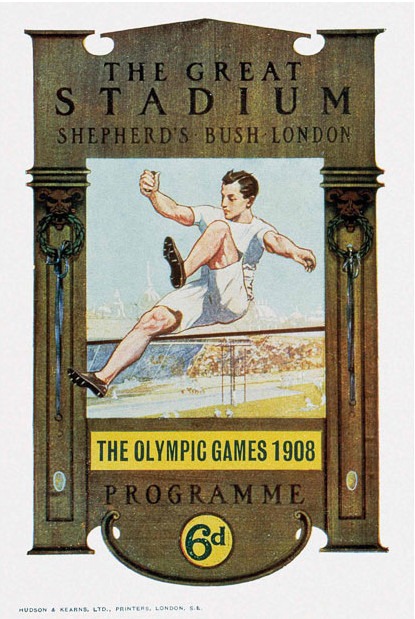
I made mention back in my post of Olympians to watch that this is the third time that London has hosted the Olympic Games. The first time was back in 1908. This was only the fourth time an Olympic Games was held. Boy have a lot of changes happened since. Also it had its share of memorable moments.

LONDON TO THE RESCUE

One thing few know is that London was not meant to host the Games of the IV Olympiad, Rome was. However Mount Vesuvius erupted in 1906 devastating much of central Italy, especially Naples. The Italian government then devoted its funds to recovery from the disaster. London was then selected to host. For the record, Rome would have to wait until 1960 to host the Olympic Games.

As for the Games, they were six-months long: beginning April 27th and ending October 31st. Twelve of the 24 sports at these Games were held in the White City Stadium which was constructed in a short time for only £60,000 and built to hold 68,000. The running track was three laps to the mile, contained a 100-metre pool for swimming and diving, a 660-yard cycling track, and platforms for wrestling and gymnastics in the middle. After the Olympics it would host the 1934 Empire Games, greyhound racing, speedway and a World Cup match in 1966. It was eventually demolished in 1985. White City now consists of buildings for the BBC including a media village. The BBC now plans to either demolish some of the buildings or convert it into a University campus. There is one reminder of these London Olympics that still exists there: a marker commemorating the finish line.

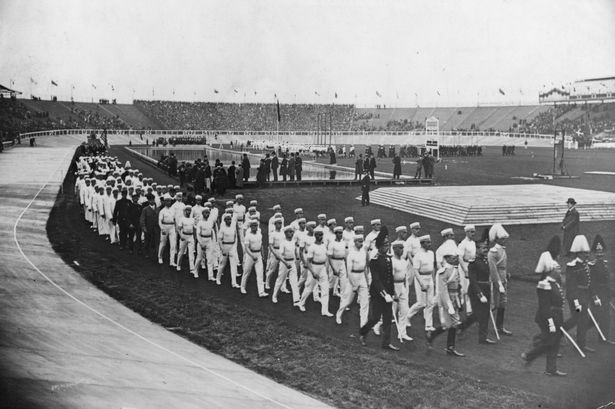
Opening Ceremonies of the Games of the IV Olympiad in London’s White City Stadium.

NATIONAL TEAMS

Athletes from many nations have competed in Olympic Games since it started but it would be these Olympic Games that there would be national teams fully recognized at these Games: 22 in total. It would even be signified by the parade of nations at the Opening Ceremonies. Each nation marched behind their national flag. First was Finland marching behind the Russian flag since Finland was under the Russian Empire. Many chose not to march over a flag at all. The Swedish flag was not displayed over the stadium so members of the Swedish team decided not to march in the ceremony. Finally the USA raised eyebrows highest of all when they were only nation not to dip their flag to King Edward VII. Popular belief is because flag bearer Ralph Rose said: “The flag dips to no earthly king.” To this day the American flag is the one flag that has never dipped to a head-of-state’s presence at any opening ceremonies. One interesting fact is that Australia and New Zealand competed together as Australasia. One more note is that Irish athletes competed for Great Britain. That left many Irish unhappy as they wanted to compete for their own team. Even though the Olympics were meant to bring nations together in brotherhood of sport, we shouldn’t forget there were still national tensions at the time and they were not left on the sidelines during the Olympics.

As for Canadian athletes, they have been competing at the Olympic Games since 1900. Here in 1908 they were able to march under their own flag. They sent 87 athletes in eleven sports. Flag bearer was Edward Archibald who would win a bronze in the pole vault.

FIRST AND ONLY

The London Olympic Games would feature a lot of sports and events that would be held at these games only. One is jeu de paume: a form of tennis that the Brits refer to as ‘real tennis’. In fact the Olympic Report of those games refer to this as “tennis (jeu de paume)” while the more familiar tennis was referred to as ‘lawn tennis’. There were eleven competitors: nine British and two American. American Jay Gould II won. It was contested at the Queens Club, as was Rackets. Rackets would also make a one-time only appearance at these Games with all entries being British. Also contested as an Olympic sport for the first and only time were Water Motorsports. They were a demonstration sport in 1900 but a full-medal sport here. They were dropped as Baron Pierre de Coubertin, president of the International Olympic Committee, insisted that the Olympics not consist of motorized sports.

NO LONGER HERE

The unique thing is that there were not only sports and events at these London Games that were there for these Games only but also sports and events that would eventually be eliminated from the Olympic Program and are no longer part of the Program to this day. Sports at London that are no longer contested at the Olympics are lacrosse, polo and tug-of-war. That’s right! Tug-of-war was an Olympic sport from 1900 to 1920. Here in London all teams that won were British. The Americans withdrew after their protest against the footwear worn by the team of the footwear of the Liverpool Police was dismissed. Lacrosse was conducted as a medal sport for the first time in 1904 and for the last time here. Canada won both times. Here in London it was a single game between Canada and Great Britain which Canada won 14-10. Polo would be contested for the second Olympics of five Olympic Games it would be contested in. All competing teams were British.

As for events no longer contested, there were separate indoor and outdoor tennis competitions. Shooting events had events at distances of 300m and 1000 yards and there were even individual and team events for many events. Yachting events were classified by boat length instead of style. Cycling had events in 20 km and 100 km and even a tandem event. Archery events had two different styles of archery. Figure skating, which I will touch on later, had both as singles and s special figures event for men. Track and field has the most discontinued events: 5 miles, race walking events of 3500m and 10 miles, a medley relay of various distances, a three-mile team event, standing long jump and high jump, a Greek-style discus throw and a freestyle javelin throw where one could hold anywhere.

Interesting that there is one sport contested at the London Games which will make a return at the Rio Games of 2016. Rugby Union debuted at the Paris Games in 1900 and London would be the second Games of four to contest Rugby. It consisted of a single match between Britain and Australasia with Australasia winning 32-3. Ironically it would be the Paris Games of 1924 where Rugby would make its finale. The professionalism, popularity and globalization of Rugby in recent decades has allowed for its reacceptance into the Olympic Program in time for the next Olympics.

FIGURE SKATING AT A SUMMER GAMES?

Sounds weird but it’s true. Figure skating made its debut at these games and was contested at the Prince’s Skating Club on October 28th and 29th. There were two men’s categories: singles and special figures. There was also a woman’s singles and pairs. The two singles winners were two names that would be legends in their sport: Ulrich Salchow of Sweden and Madge Syers of Britain. Contesting figure skating at a Summer Olympics seems odd but it would not be the last time. The Antwerp Games of 1920 would bring figure skating back and would also have ice hockey. It’s because of those two times those winter sports were contested at a Summer Olympics that would lead to a push for a Winter Olympic games that would first be contested in 1924. As odd as it was here in London, it would have its significance later on.

SPORTING SURPRISES

One thing we should remember is that sports weren’t as organized as they are now. Because of it, there were many surprises, shockers and controversies in the various sports competitions. First off was the overwhelming number of British entries in many events including the team events. Not surprisingly Britain won 146 medals including 56 golds in the 100 events. No surprise was that the famed Henley Regatta was used for rowing. A wrestling final between Finns Verner Weckman and Yrjo Saarela took 11 hours to decide. The water motorsports all resulted in a single boat making it to the finish line in each race contested. Gymnastic teams were unlimited in the number of athletes they could field. Platform and springboard diving events included 5m and 10m platforms as well as 1m and 3m springboards. The sprint event in cycling was declared void as the time limit was exceeded in the final. The athletics events were guided under the Amateur Athletics Association of England. The limit of competitors per nation was twelve. Race walking made its debut. Athletics events consisted of a medley relay of 200-200-400-800m.

I’ve already mentioned some of the controversies. I’ll bring up the two biggest later. One thing about the lack of organization of the sports was that it became apparent that international sporting federations had to be formed to have set rules guidelining the sports in the years to come. FINA–the federation in charge of aquatic sports–would be formed immediately after the Olympic aquatic sports competitions here in London. The IAAF for track and field, FILA for wrestling, and the FIE for Fencing would follow years later.

Off topic, Canada would win sixteen medals including three gold. Its gold medals came in lacrosse, Walter Ewing in trap shooting and Bobby Kerr in the men’s 200m. The most medals came in track and field. Medals also came in cycling, rowing and wresting.

Also of interest, there were only twenty-two women competing in London in tennis, archery, figure skating and yachting. Yachting was the only mixed sport at the time.

A RACE TO REMEMBER FOR THE WRONG REASONS

Of all the controversies of these London Olympics, the biggest would be in the men’s 400m. There were sixteen heats with only the winner qualifying for the semifinals. There would be four semifinals the following day where only the winner would move on to the finals. The final was held the following day. the finalists were Americans John Carpenter, William Robbins and John Taylor with Brit Wyndham Halswelle completing the field. The final ended with Carpenter first, Halswelle second, Robbins third and Taylor fourth. One of the British umpires of the event, Roscoe Badger, noticed Carpenter maneuvering as to prevent Halswelle from passing which was forbidden under British rules but legal under American rules. Badger signaled to the judges to declare the race void. This led to a 30-minute argument between British and American officials. There was an official inquiry the following day where the judges disqualified Carpenter and ordered the final to be rerun the next day without Carpenter. The following day only Halswelle showed up. The two other Americans Robbins and Taylor refused to participate in protest of Carpenter’s disqualification. Halswelle simply jogged his way to the gold. This still remains the one and only walkover win in Olympic track and field. This would also be the biggest argument for an international athletics federation. The IAAF would be formed in 1912.

MARATHON: A FINISH TO REMEMBER

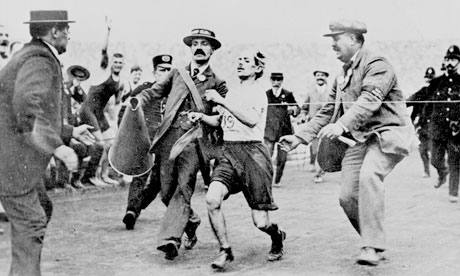
The most memorable image of the 1908 London Games. Dorando assisted to the marathon finish.

The marathon run of these Olympics were remembered for two main reasons. The first is the distance. Although the marathon run was originally 25 miles, it was changed to 26 miles for the sake of having the start at Windsor Castle. It would be changed again at the request of Princess Mary so that the start would be beneath the windows of the Royal Nursery. New distance was 26 miles, 385 yards. That would return as the marathon distance at the 1924 Paris Olympics and would be the standard distance for the marathon run from then on.

The second was the final lap which will go down as arguably the most memorable moment of the London Games of 1908. The first runner in the stadium was Dorando Pietri of Italy. He appeared exhausted and he ran into the stadium in the wrong direction. Officials directed him in the right direction. then he collapsed and picked himself up. He would collapse and get back up many times. Then an American runner Johnny Hayes came into the stadium heading to the finish line. Dorando had just collapsed yards from the finish line as Hayes was nearing the finish. Two officials then assisted Dorando to his feet and led him to the finish line. Hayes crossed the line 32 seconds later and launched a protest. This led to Dorando being disqualified and Hayes winning the gold medal. Dorando was however rewarded the next day by a sympathetic Queen Alexandra a gold or silver-gilt cup in recognition of his courage.

So there you have it. A trip back in time with the first London Games. Interesting that 104 years have passed and they’re still memorable for both the bad and the good. One thing we should remember is that the Olympic Games were still young and these were the first successful Olympic Games since the very first Games back in Athens in 1896. That was an accomplishment in itself.

WORKS CITED:

WIKIPEDIA: 1908 Summer Olympics. Wikipedia.com. 2012. Wikimedia Foundation Inc. <http://en.wikipedia.org/wiki/1908_Summer_Olympics>

WIKIPEDIA: White City Stadium. Wikipedia.com. 2012. Wikimedia Foundation Inc. <http://en.wikipedia.org/wiki/White_City_Stadium>

WIKIPEDIA: Athletics at the 1908 Summer Olympics – Men’s 400 metres. Wikipedia.com. 2012. Wikimedia Foundation Inc. <http://en.wikipedia.org/wiki/Athletics_at_the_1908_Summer_Olympics_%E2%80%93_Men%27s_400_metres>

WIKIPEDIA: Athletics at the 1908 Summer Olympics – Men’s marathon. Wikipedia.com. 2012. Wikimedia Foundation Inc. <http://en.wikipedia.org/wiki/Athletics_at_the_1908_Summer_Olympics_%E2%80%93_Men%27s_marathon>

London 2012: Seven Canadians To Watch

 
Yesterday I gave a look at some Olympians to watch from around the world. Today I focus on Canadians. Canada ranks seventeenth on the all-time list of total Summer Olympic Medals with a total of 260 including 58 gold. Our most medaled Summer Olympics, both in golds and total, is the 1984 Los Angeles Games which was boosted by the boycott of Soviet-allied nations and allowed the team to take home 44 medals including 10 gold. In terms of fully-contested Olympics, our most medaled are the 1996 Atlanta Games with 22 and our most golden are the 1992 Barcelona Games with 7. Here in London, Canada has sent a team of 277 athletes in 24 sports. Canada has strong expectations for the team in London and the athletes have their own personal expectations. Sports Illustrated even predicted for Canada to win seventeen medals including two golds. Here are six Canadian athletes and one team to keep an eye on in London:
 
 -Adam van Koeverden – Canoeing: Kayakers are not necessarily Canada’s most celebrated athletes. Adam van Koeverden is one of the few. Interestingly enough he trains at a retreat with no plumbing or electricity. It must be doing something right. Back at the 2004 Olympics nothing was expected of him but he came away with a gold and a bronze. His medal wins were an upper for the Canadian team as they experienced a lot of disappointment in Athens. By 2008 he was the reigning 500m World Championships and was heavily favored to win both solo kayaking events for men. He was even Canada’s flag bearer for the opening ceremonies. The pressure must have got to him because he finished 8th in the 1000m and won silver in the 500m. 2011 saw him return to the title of World Champion, in the 1000m. Will he be all there at Dorney Lake? It will all be decided August 8th.
-Alexandre Despatie – Diving: Seems like just yesterday he was the 13 year-old prodigy that won the tower event at the 1998 Commonwealth Games or the 15 year-old from Sydney 2000 who finished fourth. Twelve years later he’s now a three-time World Champion, a two-time Olympic silver medalist and nearing the twilight of his career. However things took a turn for the scarier in June as he hit his head on the springboard while practicing an inward 3 1/2. He has since healed up and even reattempted that dive in practice two weeks ago with success. Already Sports Illustrated has him as diving’s underdog story. Does he have one last hurrah for us in London? Stay tuned.
-Jennifer Abel – Diving: As one Canadian diver’s legacy appears to be coming to an end, another appears to be starting. Jennifer Abel actually made her Olympic debut in Beijing just before her 17th birthday but her diving career has taken off greatly. She won two golds and a silver in the springboard events at the 2010 Commonwealth Games. She also won silver in 3m synchro teamed up with Canadian vet Emilie Heymans and bronze in 3m solo at the 2011 World Championships. Come London she will face challenges from China’s diver He Zi and Wu Minxia who both finished ahead of her in both events. But no matter where she finishes in London, it will all be to her advantage as the best of her is still yet to come.
-Mary Spencer – Boxing: Women’s boxing has gone from the sleazy novelty of ‘foxy boxing’ to a serious sport in the last decade. Here in London will be the first time women boxers will compete for Olympic medals. Canada’s best hopes rest on former World Champion Mary Spencer. The 27 year-old southpaw who’s of Ojibway heritage won her first World Middleweight Championship in 2005 at the age of 20. She has since won the World Champion title twice again in 2008 and 2010. However she lost in the Round of 32 at this year’s Worlds. London is the best place for her to regain her supremacy. Will she do it? Only time will tell.
-Catharine Pendrel – Mountain Biking: It seems like ever since Mountain Biking has been added to the Olympic program back in 1996, there’s always been one Canadian woman after another amongst the best in the world. It all started with Allison Sydor winning silver in 1996, then Marie-Helene Premont winning silver in 2004. Now the torch has been passed to Catharine Pendrel and she has quite a resume. She finished 4th back in Beijing but her career has taken off ever since with winning the 2010 World Cup series and last year’s World Championships. She recently won the Olympic test event at Essex’s Hadleigh Farm. Sports Illustrated even predicted her as the one to win the Olympic Mountain Biking event. Will she do it? August 11th is the day for her to deliver.
-Carol Huynh – Wrestling: Carol was the first Canadian to win gold at the Beijing Olympics and she could do it again here. She has won World Championship medals since 2000 and she has won gold at the Commonwealth and Pan Am Games. However she missed out on the medals at last year’s Worlds. Nevertheless she has been preparing well and is confident her knee injury has healed. Sports Illustrated preditcted three Canadian women to win medals in wrestling and she’s one of them. Mark your calendar August 8th.
-Canada’s Track and Field team: Canada is not known as a track and field country. In fact it was even pointed in a recent news article that there are many third world countries that have bigger fanfare and a bigger investment in the sport than Canada and even better overall showings at World Championships. Nevertheless Canada has consistently produced Olympic medalists, Olympic champions and even greats like sprinters Percy Williams and Donovan Bailey. Who does Canada have for this year? Canada’s best chances for the men come from shot putter Dylan Armstrong who won the silver at last year’s Worlds. However his best put this season has been surpassed by seven other putters. He will have to throw a seasonal best if he wants to win a medal. Canada’s best chances for the women come from heptathlete Jessica Zelinka. She has also qualified for the 100m hurdles event but it’s the heptathlon that she specializes in. She finished 5thback in Beijing and at this year’s Olympic trials she delivered a personal best total that’s currently the 4th best in the World. If she’s on the ball in London, she could win a medal. And don’t count out any of the lesser-favored Canadians. Anything can happen in the heat of Olympic competition.
 
And there you have it. Six athletes and one team from Canada to look out for in London. When the Games begin the night of Friday July 27th, there will be seventeen days of thrilling moments, national pride and history in the making. An event like this that only comes around every four years is definitely worth being a part of.
 

Jack Layton: 1950 – 2011

It’s extremely rare when a major politician dies in the middle of his term. It’s also unfortunate that Jack Layton dies soon after the biggest success for himself and his political party. Nevertheless his influence in Canadian politics will always be remembered.

John Gilbert Layton was born in Montreal on July 18, 1950 to a family with a huge political background. His mother Doris Steeves was a grand-niece to a Father of Confederation. His father Robert Layton was a Progressive Conservative MP who served as a Cabinet Minster during the Mulroney administration. His grandfather was a cabinet minister in Quebec parliament. His great-grandfather was an activist for the blind. Naturally he would follow in his family’s footsteps. He was elected student council of his high school and studied Political Science at McGill University. In 1969-1970 he was a member of the Quebec Youth Parliament. In 1970, the family moved to Toronto where he attended York University and received his PhD in Political Science. He became a professor at Ryerson University, was a prominent activist and wrote many books on political issues and his beliefs.

He first entered politics on a civic level. He was elected to Toronto City Council in 1982 and soon became one of the most outspoken members of the council and a leader of the left wing. He was one of the first advocates for rights for AIDS patients and spoke his opposition to the building of the Skydome and Toronto’s bid for the 1996 Summer Olympics. In 1985 he moved on to the Metropolitan Toronto council. In 1988 he became returned for the election to Toronto City Council. He not only won but his reformist coalition for which he headed gained control of City Council. In 1991, he made the move to run for mayor of Toronto. His opposition to the Olympic bid and the low popularity of the NDP party at the time caused him to lose the election. Layton would return to teaching and later founded an environmental consulting business, the Green Catalyst Group. He ran for the House of Commons twice in the 90’s and lost both times.

Then in January 2003 came the biggest breakthrough of his political career. He was elected leader of the federal NDP party. Before the 2004 election, Layton was already known for making some eyebrow-raising statements about the Liberal party led by Paul Martin shifting to being too right-wing. During the 2004 National Election, Layton accused the Liberal Party for the increase in homelessness and homeless deaths in Canada. Many people complained that it was negative campaigning. Layton caused another controversy during that election when he suggested the removal of the Clarity Act and allowing Quebec to declare independence upon a referendum vote. In that election the Layton-led NDP party had 15% of the popular vote, the highest in 15 years, and 19 seats in the House of Commons.

In the next federal election, in January 2006, Layton attempted to cast himself as the sole remaining champion of universal health care. Layton constantly repeated during the campaign to Canadian that they have a ‘third choice.’ Some conservative pundits mocked Layton and his stances. Some would paste Layton-styles moustaches on them and say things like ‘raise my taxes’ or ‘I’d like to pay higher gas prices.’ Layton also went all out in attacking the scandal-ridden Liberals at the time and pledged to use his minority clout to keep the Conservatives in check. The election resulted in 29 seats in the House of Commons for the NDP: 11 more than the previous election. Layton’s wife Olivia Chow was also elected to the House of Commons making them the first couple to be elected to the House.

During the 2008 Federal election, many were comparing Layton as trying to pass himself off as Canada’s Barack Obama. He shunned the comparisons and reminded people that he only simply shared the same views as him like the working class and the middle class. Layton also mentioned he told Obama and Hillary Clinton the North American Free Trade Agreement was hurting people on both sides of the border. Layton also spoke out about internet freedoms and his stance in favor of net neutrality, torrent sites, video-sharing sites and social networking sites. The NDP would go on to win a total of 37 seats in the House but would only be the fourth-most populous behind the Conservatives, Liberals and Bloc Quebecois. Shortly after the election in November 2008, Layton negotiated with Liberal leader Stephan Dion and Bloc leader Gilles Duceppe on forming a coalition to replace the Conservatives as the government. Prime Minister Stephen Harper responded by suspending parliament until January 2009. After Liberal leader Michael Ignatieff signed a budgetary agreement that would end the coalition, Layton declared: “If you oppose Mr. Harper and you want a new government, I urge you to support the NDP.”

In 2011, a new national election was called as the Conservative party was defeated in a Vote of Non-Confidence for contempt; the first time in the history of the Commonwealth for a government to receive a Vote on Non-Confidence. That resulted in Prime Minister Harper dissolving parliament for a new national election. During the election, appeal for the NDP started slow but Layton’s NDP party soon increased greatly in popularity after the leadership debates. The NDP moved past the Liberals into second place in the polls behind the Conservatives and first in Quebec. Soon after his popularity rose, a smear campaign came about as a retired police officer stated he saw Layton naked in a massage parlor back in 1996 but didn’t charge him. Layton responded that he was just simply getting a massage. In the end, no charges were laid against Layton. In the election, held May 2, 2011, the NDP won 103 Seats. That was the highest-ever total of seats for the NDP party and made the NDP the Official Opposition party to the Commons for the first time ever with Layton as the official opposition leader.

One thing known to few was of Jack Layton’s illness and the severity of it. In February 2010, he announced he had prostate cancer and vowed to beat it and continue to pursue his duties as the leader of the NDP. On July 25, almost three months since the national election, he announced he would take a temporary leave to fight an unspecified newly diagnosed cancer. He announced he planned to return as leader of the NDP once the House of Commons was to be resumed September 19, 2011 and recommended NDP caucus chair Nycole Turmel serve as interim leader. On the morning on August 22, 2011, Jack Layton died at his Toronto home. He was 61.

Jack Layton was a unique politician. He came from a family who had a lot of political experience. He rallied and campaigned for causes that were popular with the left and he strongly believed in as well. As a leader of a national party, he brought ideas and spoke of issues in ways unheard of before by leading Canadian politicians. He brought ideas unheard of before in Canadian parliament. Overall he was one p[politician who believed in a better Canada and wasn’t afraid to speak out about it. After his death, Prime Minister Stephen Harper said:  “On behalf of all Canadians, I salute Jack’s contribution to public life, a contribution that will be sorely missed. I know one thing: Jack gave his fight against cancer everything he had. Indeed, Jack never backed down from any fight.”

As a fitting final tribute, Jack wrote a letter two days before his death. His family released the letter the day of his death that ended with these final words:

“My friends, love is better than anger. Hope is better than fear. Optimism is better than despair. So let us be loving, hopeful and optimistic. And we’ll change the world.”

WORKS CITED:

WIKIPEDIA: Jack Layton. Wikipedia.com. 2011. Wikimedia Foundation Inc. < http://en.wikipedia.org/wiki/Jack_Layton&gt;

Election 2011: Canada Votes

Okay, some of you who don’t live in Canada have heard that we have a National Election—the 41st Canadian General Election– in which we will be voting on May 2nd, but don’t know all the details of what’s going on. Here are the details about what’s been happening and what to anticipate.

For those unfamiliar with how Canadian elections work compared to American elections, Canadian elections are held on any given date instead of the first Tuesday of November. A Prime Minister’s term can be any length of time instead of the solid four years of an American President’s term, even though most Prime Minister terms are between three to five years. While Presidential Elections are decided by electoral votes based on which Party wins the most votes per state, Canadian Prime Ministers are decided by the most won seats with each voting district or region deciding its own winning Member of Parliament per Seat. In other words, while citizens vote for electors in the Presidential election and the winning Party in the state wins all the state’s electors, Canadians vote for MP seats in the Prime Minister election. While an American President is decided by the most electoral votes, even if he doesn’t have the highest total of votes, A Canadian Prime Minister can be declared upon winning the most seats even if they don’t have the highest total of votes. So there are some similarities between Canadian elections and American elections but a lot of differences.

Now for the current political scenario in Canada. Politics in Canada has gone through a lot of chaos over the past few years; so chaotic this is the FOURTH National Election in seven years. The most recent National Election was declared in the aftermath of a political scandal. Stephen Harper’s Conservative party was long considered to be in contempt of parliament at the beginning of March upon refusing to meet Opposition requests for details of proposed bills and their cost estimates. The Liberal Party responded by declaring a motion of non-confidence against the Government and on March 25, 2011, the House voted agreeing 156-145 to the motion. This marked the first time in the history of Canada or any nation in the Commonwealth of Nations that a cabinet has been found in contempt of Parliament. Following a meeting with Stephen Harper, Governor-General David Johnston agrees to dissolve the 40th Canadian Parliament and a Federal Election was declared.

Even before the most recent election was declared, Canadian politics has already been known for its chaos in the last seven years. Back in 2005, the Liberal Party under then-Prime Minister Paul Martin faced a sponsorship scandal of what would be documented in the Gomery Report. Even though Paul Martin had been Prime Minister for less than a year, an election was declared and in January 2006 Conservative Party Leader Stephen Harper won the election with a minority of seats. The Conservative Party victory was considered an arrival for political conservatives in Canada who struggled during the 90’s after the eventual decline of the Progressive Conservative party upon the resignation of Brian Mulroney.

 Another national election was held less than three years later in October 2008 and Harper’s Conservatives again won the election with a minority with Liberals, Bloc Quebecois and NDP making up most of the remaining seats. Shortly after the 2008 Federal Election, the Liberals and NDPs banded together for an overthrow of the Conservative government through a unified vote of non-confidence. Some may call it the right thing, others political mutiny. Whatever the situation, the coalition didn’t succeed and the Harper-led Conservatives remained the leading party of Canada. Since then, many Liberals have tried to distance themselves from the coalition.

Now it’s Stephen Harper’s try for a third term as Prime Minister. He comes in the election with the scandal creating baggage for him, but not a lot. Before the scandal, the Conservatives were tops in the polls and they still remain on top. One thing Stephen Harper is hoping for is a Conservative majority, especially with the 2008 attempted coalition still in his Party’s memory. The most surprising fact of the polls is that the Liberal Party is not the party with the second-highest ratings but the NDP. The Jack Layton-led NDP surpassed the Liberals in the April 20th poll and the most recent polls have the NDPs at an average of 31.4% in comparison with 3% for the Conservatives and the Liberals at 20%. This has many believing that the NDP could be setting up for a possible upset for Monday’s election; maybe even a Prime Minister Layton. Mind you the polls only represent popular voting patterns. It will all be decided when the ridings vote for the MP’s and their parties.

Win or lose, Jack Layton appears poised to have the biggest National Election result for the NDP party ever. The biggest ever result for the NDP Party is 43 seats in the 1988 election while the Party was led by Ed Broadbent. Even its founder, Tommy Douglas, never experienced the success Ed received. One difficulty of Layton’s, especially after the coalition, is for the NDP to distinguish its political platform from that of the Liberal Party. Too many voters label the NDP to be like the Liberals since they are on the same left stance. This may be seen good for liberal-siding voters but not so good for the NDP’s own identity. Whether Jack Layton wins or loses, he will have to prove the NDP’s distinction from the Liberals politically. Otherwise voters will continue to believe the NDP and Liberals are two choices of the same stance.

Then there’s the Bloc Quebecois. The Bloc was started in response to a resurgence of Quebec nationalism felt after the decline of the Parti Quebecois and after the Meech Lake Accord, which was intended to grant Quebec distinct constitutional status, was overturned in 1990. The party has attracted Quebec nationalists and even prompted a second referendum in 1995 in which Quebec nationalism lost again. Despite Quebec nationalism being voted down, the party has always won at least 50% of the Seats open to Quebec. The Bloc had 49 Seats in the last election–47 are still current– with 10% of the popular vote in Canada and 38.1% of the vote in Quebec. However recent polls have them at 7%. Could this mark a decline of the Bloc?

Party aspects aside, One thing about the election is that the parties are hoping for a better voter turnout than what happened during the 2008 election. Then, the voter turnout was 58.8%, the lowest turnout percentage ever for a National Election. Parties have been making the effort to urge voters out. Even campuses have had young people out to drum out support. Interesting how around the time I first became an adult, MTV started a ‘Rock The Vote’ campaign around the time of the 1992 Presidential election and MuchMusic started ‘Vote With A Vengeance’ for the 1993 Federal Election. This election, there’s no ‘Vote With A Vengeance’ campaign. Funny. Doesn’t Much care anymore?

The big day is May 2nd, tomorrow to be exact. Canadian history will be decided by the people. The election results and its aftermath will further shape Canadian democracy in the years to come. Stay tuned. As for Canadians, get out and vote!

WORKS CITED:

WIKIPEDIA: Canadian Federal Election, 2011.Wikipedia.com. 2011. Wikimedia Foundation Inc. <http://en.wikipedia.org/wiki/Canadian_federal_election_2011>

WIKIPEDIA: New Democratic Party.Wikipedia.com. 2011. Wikimedia Foundation Inc. <http://en.wikipedia.org/wiki/New_Democratic_Party>

 WIKIPEDIA:Opinion Polling in the Canadian Federal Election, 2011.Wikipedia.com. 2011. Wikimedia Foundation Inc. <http://en.wikipedia.org/wiki/Opinion_polling_in_the_Canadian_federal_election,_2011>

WIKIPEDIA: Bloc Quebecois. Wikipedia.com. 2011. Wikimedia Foundation Inc. <http://en.wikipedia.org/wiki/Bloc_Qu%C3%A9b%C3%A9cois>

In The Wake Of The Japanese Tsunami, Are You Prepared?

Ever since the late evening of Thursday March 10th leading into Friday the 11th, the story of the Japanese tsunami and aftermath has dominated our headlines. We constantly see images, both professional and amateur, as well as the latest news updates. It’s both alarming and upsetting. It’s also a sobering reminder that something like this can strike close to home, especially if you live on either the east coast or west coast.

The news first broke this past Thursday night or very early Friday morning. A powerful earthquake in the Pacific Ocean just 100 miles east of Japan’s northern coast caused a tsunami that hit the coast of Japan, especially the city of Sendai, really hard. The quake measured 9.0 on the Richter scale and is the seventh-highest ever recorded. Replays of the wave’s crashing caught on amateur video has left many shocked. Some who were up during the early morning hours were able to see live footage of the wave as it was travelling towards the west coasts of the Americas.  The destruction to the Japanese coast and surrounding areas has been in the news daily. The statistics of destruction and human loss are growing. Many anticipate the final death toll to reach around 20,000.

Another shocking thing about this disaster is that it comes more than six years after the 2004 tsunami in the Indian Ocean which claimed a total of almost a quarter-million lives in many countries. That ranks as the deadliest tsunami in history. I’m sure many of us still have images of the disaster fresh in our minds.

Those living near the west coasts of the Americas had the least damage to deal with. Hawaii was hardest hit but there was no loss of life and damage was minimal. Even the west coasts of the Americas had their own damage to deal with but the most damage individual areas faced was one or two million dollars. We were pretty lucky. Nevertheless one thing citizens living  on or near coastal land need to remember is that a tsunami can strike at anytime. Where there’s a coast by an ocean, sea or lake, there’s a tsunami danger. The big question is do we know how to take action?

For one thing, warning systems are an excellent start for prevention. First part involves network sensors to detect threatening waves. Second part involves  a communications infrastructure to issue timely alarms to permit evacuation of coastal areas. This can beneficial since the tsunami from days ago was distant enough from the Americas to allow ample time for warning. Although beneficial, they are imperfect as in the case for Japan in this instance. Tsunamis can come as fast as 600 miles/hour and the earthquake epicenter for this tsunami was 100 miles east of the coast. This wouldn’t allow for ample time to save enough property or enough lives. Nevertheless new advances in warning are still yet to come. After the 2004 Indian Ocean tsunami, an Internation Early Warning Programme was proposed immediately after and it resulted in the Indian Ocean Tsunami Warning System. I’m sure after the Japanese tsunami, there will me more pressure to follow through on the Internation Early Warning Programme and propose for more technological advancements.

Technological devices are also helpful. One such is the DART buoy: DART standing for Deep-ocean Assessment and Reporting of Tsunamis. These buoys are held in place off coast to detect possible tsunami threats along with a Bottom Pressure Recording package to detect pressure changes of the tsunamis. The United States has 39 DART buoys in the Pacific and Atlantic Oceans and The Caribbean Sea. Since 2009, other countries have started to use DART buoys for tsunami detection. Another such is a tsunami warning system like the Pacific Tsunami Warning System based in Honolulu which records seismic activity in the Pacific Ocean. Although not every Ocean earthquake causes a tsunami, the computers assist in analyzing the tsunami risk of every earthquake that occurs in the Pacific Ocean and the adjoining land masses.

Then there’s also local preventative measures. Some are natural, like mangroves, coastal vegetation and coral reefs which helped to cause the least damage during the 2004 Indian Ocean tsunami. Others are constructed like seawalls and floodgates. Japan has constructed some seawalls that are as tall as 15 feet to protect populated areas. Seawalls may have to be expanded in the wake of the most recent tsunami. All Pacific Rim countries have organized evacuation routes and practice evacuation procedures.  In Japan, such preparation is mandatory for government, local authorities, emergency services and the population. Vancouver even has some disaster relief routes. There’s even preparation information and a program from BC’s Ministry of Safety and Solicitor General. It’s up to the governments to inform the public at risk to be informed how to take action.

The tsunami in northern Japan is a chilling and sobering wake up call to those who live on or near coastal areas. This will undoubtedly leave many questioning if such a disaster can happen to them and how would they respond. This will also leave government agencies time to question whether they have the right technological means to detect warnings necessary for alerts and possible evacuations. Hopefully none of us will have to experience what those in northern Japan are dealing with right now.

WORKS CITED:

WIKIPEDIA: Tsunami.Wikipedia.com. 2011. Wikimedia Foundation Inc. <http://en.wikipedia.org/wiki/Tsunami>

WIKIPEDIA: Tsunami Warning System.Wikipedia.com. 2011. Wikimedia Foundation Inc. <http://en.wikipedia.org/wiki/Tsunami_warning_system>

WIKIPEDIA: International Early Warning Programme.Wikipedia.com. 2011. Wikimedia Foundation Inc. <http://en.wikipedia.org/wiki/International_Early_Warning_Programme>

WIKIPEDIA: Deep-ocean Assessment and Reporting of Tsunamis (DART).Wikipedia.com. 2011. Wikimedia Foundation Inc. <http://en.wikipedia.org/wiki/Deep-ocean_Assessment_and_Reporting_of_Tsunamis>

Christy Clark’s Pre-Election Baggage

Hi. This is my first non-movie article. Hope you like it.

The BC Liberal Party announced a new leader on Saturday, February 26th. Her name is Christy Clark. She is to replace Gordon Campbell who has served as Premier since 2001 but recently resigned due to low ratings. Being Premier of BC is a big job for the 45 year-old, especially after Campbell’s recent resignation. The big question is how will she and the BC Liberal Party hold in the next provincial election?

Currently Premier-Designate Christy Clark is no stranger to politics. If you saw her resume, you’d see she has quite a list of accomplishments. Her first political victory came at the age of 30 when she was elected MLA for the Port-Moody-Westwood riding in 1996. At the start, while the Liberals were the official opposition party in BC, she served as the Official Opposition critic for the environment, children and families and for the public service. As the Liberal Party headed by Gordon Campbell prepared for the provincial election of 2001, she served as the campaign co-chair in which the Party won 77 of the 79 seats. Once Gordon Campbell was sworn in as Premier, she was appointed Deputy Premier and the Minister of Education.  She would be appointed Minister of Children and Family Development in January 2004. In September of that same year, she quit provincial politics and did not seek re-election of her MLA position in 2005. She would later seek leadership of the Non-Partisan Association for the Vancouver mayor election that same year, but lost to eventual mayor Sam Sullivan.

She’s also a popular media figure too. She was a weekly columnist for the Vancouver Sun and Vancouver Province during the 2005 provincial election and was a television election analyst during the 2006 federal election. She also hosted a Vancouver radio show: The Christy Clark Show from 2007 until she decided to enter the premier leadership back in December.

Even though no provincial election has been called yet, she faces a bumpy road for the BC Liberal Party firstly based on past election results. On the provincial side of things, leading  provincial parties face a huge electoral loss after their leader resigns as premier. Past history in the last 30 years have proven so. In Manitoba, NDP Howard Pawley, who was elected premier in 1981, resigned. The leadership then went to Gary Doer. The NDP finished the election with the third-most ridings. Doer would have to wait until three more provincial elections before being elected premier of Manitoba. BC premier Glenn Clark, who headed the NDP Party, resigned in 1999 and would be replaced by Dan Miller and Ujjal Dosanjh the following year. The BC NDP, headed by Dosanjh would face a humiliating loss of winning 2 of 79 seats, paving the way for Gordon Campbell and the BC Liberals. Carole James, the NDP leader since, has headed the party in two provincial elections, regaining many seats for the NDP but losing to Campbell both times.

Nationally, political parties have had its own dark days when their leader resigns as Prime Minister. In 1984, Pierre Trudeau resigned as Prime Minister and John Turner would be voted head the Liberal Party. In the national election, his Liberal party would lose to the PC Party headed by Brian Mulroney. Turner remains the Prime Minister with the second-shortest leadership. He would head the federal Liberal party in the following federal election in 1988 and would lose to the Mulroney PC’s again. The PC Party would soon face its own party troubles after Mulroney resigned in 1993. Kim Campbell succeeded him. However Campbell and the PC’s would face a crushing defeat in the federal election that same year by winning only two seats. The Liberal’s headed by Jean Chretien would win the federal election. Chretien would be re-elected twice more while Canadian Conservatives would struggle with political parties for many years. The PC Party ran again in 1997, would reconstruct themselves at the Canadian Alliance Party for the 2000 federal election, and would them become the Conservative Party in time for the 2004 election.

If past elections aren’t enough for Christy to cause concern, it would be the Campbell leadership, especially in the last year. Campbell’s leadership has always been through a rocky road ever since he was elected but he would be hit hardest in 2010 upon introducing the HST. The introduction of the tax, and the rapid implementation if it, proved to be very unpopular amongst British Columbians. Soon after, the polls had him at an approval rating of just 9%, the lowest of any provincial premier. This was cause for him to resign in November of 2010.

Now despite party problems, Christy Clark has had some political problems of her own once she’s sworn in on March 14th. As Minister of Education, she introduced changes like stronger parental power, increased accountability and provided greater parental choice in the flexibility in the school system. This proved unpopular with teachers, school board members and union officials as they believed it resulted in funding gaps. She also sought to increase the independence of the BC College of Teachers against strong opposition from the BC Teachers Federation. She also has allegations against her regarding a BC Rail scandal when she was deputy premier, although nothing has been proven against her. Those could hurt her come election time.

Currently no provincial election date has been set, and there may not even be one for a full year. Dawn Black is currently interim leader of the BC NDP Party, succeeding Carole James. Jane Sterk leads the Green Party. The BC Conservative Party is not associated with the national Conservative Party and may have a slim chance in the election. Nevertheless all opposition parties have a good chance at rivaling Clark and the Liberals in the eventual provincial election. In this period of time, Sterk and Black have to prove themselves worthy of the office of provincial Premier. Black already has a lengthy resume of her own political accomplishments while Sterk has yet to prove herself. In the meantime, Clark can use the time to her advantage to improve her political image and the image of the Liberal Party in this post-Campbell era as an effort to win the next election. She would also have to use the time to prove she is worthy of being Premier of British Columbia.

With the next provincial election happening anytime, Christy Clark arrives at the Premier’s desk with a lot of baggage of the Campbell Administration and of her own doing. Despite it all, only time will tell whether she has what it takes to be Premier of British Columbia and whether she and the BC Liberals deserve to win the election.

WORK CITED:

WIKIPEDIA: Christy Clark.Wikipedia.com. 2011. Wikimedia Foundation Inc. <http://en.wikipedia.org/wiki/Christy_Clark>