Grey Cup 2011

On Sunday November 27th, fans of Canadian Football will have all their attention fixed on the newly renovated BC Place Stadium for the 99th Annual Grey Cup. For those unfamiliar with Canadian Football or even the Canadian Football League (CFL), the Grey Cup is to Canadian Football what the Super Bowl is to American Football. This year, the rivalry between East and West over the Cup will be the BC Lions against the Winnipeg Blue Bombers.

For those non-Canadians unfamiliar with the CFL, the CFL is as much a part of Canadiana as the NFL is to Americana. The Grey Cup has been part of league football in Canada since 1909 but it wasn’t until the CFL formed in1958 that the Grey Cup was a permanent fixture in Canadiana. For the most part, the CFL consists of nine teams except when something goes wrong with one of them. Usually there is at least one city that has problems with their CFL team. In the 80’s and 90’s, it was Montreal. Now it’s Ottawa. But don’t worry. Ottawa will be returning in 2013. Plus there’s talk of possible franchises in the future from Quebec City or Halifax.

For the most part, the CFL has been happy to be Canada’s own football league. For many decades, it didn’t worry about competing with the NFL because it knew it had a very solid dedicated base in Canada. Things became uncomfortable in the late 80’s when the CFL tried attracting new players to the league but couldn’t compete with the big salaries of the NFL teams. In the 90’s, the CFL tried things like offer a $5 million annual salary to Raghib ‘Rocket’ Ismael to join the Toronto Argonauts in 1991. It turned out to a success for that one year. Sure the Rocket and the Argos won the Grey Cup that year but the Rocket’s career went downhill after that. The success of the Rocket led to the CFL to form franchises in cities like Sacramento, Baltimore, Las Vegas and Shreveport. In 1995 Birmingham and Memphis entered the league. The 1995 Grey Cup came as a shocker as the Baltimore Stallions won; the only time an American team won the Grey Cup. After a lot of business issues and bad management from some American teams, the CFL returned to being based completely in Canada since 1996 and we’re happy to keep it that way.

Nowadays, the CFL does not need to seek out ways to try to reach the popularity level or moneymaking level of the NFL. Ever since the CFL stopped its expansion into the US, they were reminded again that they can hold their own with loyal Canadian fans. The CFL has the seventh-highest per-game attendance average of 27,000. Its average may be less than that of Major League Baseball and not even half that of the NFL but it has a higher average than the top soccer leagues of Mexico, Italy, Argentina, France and even Brazil. Yeah, that well-attended.
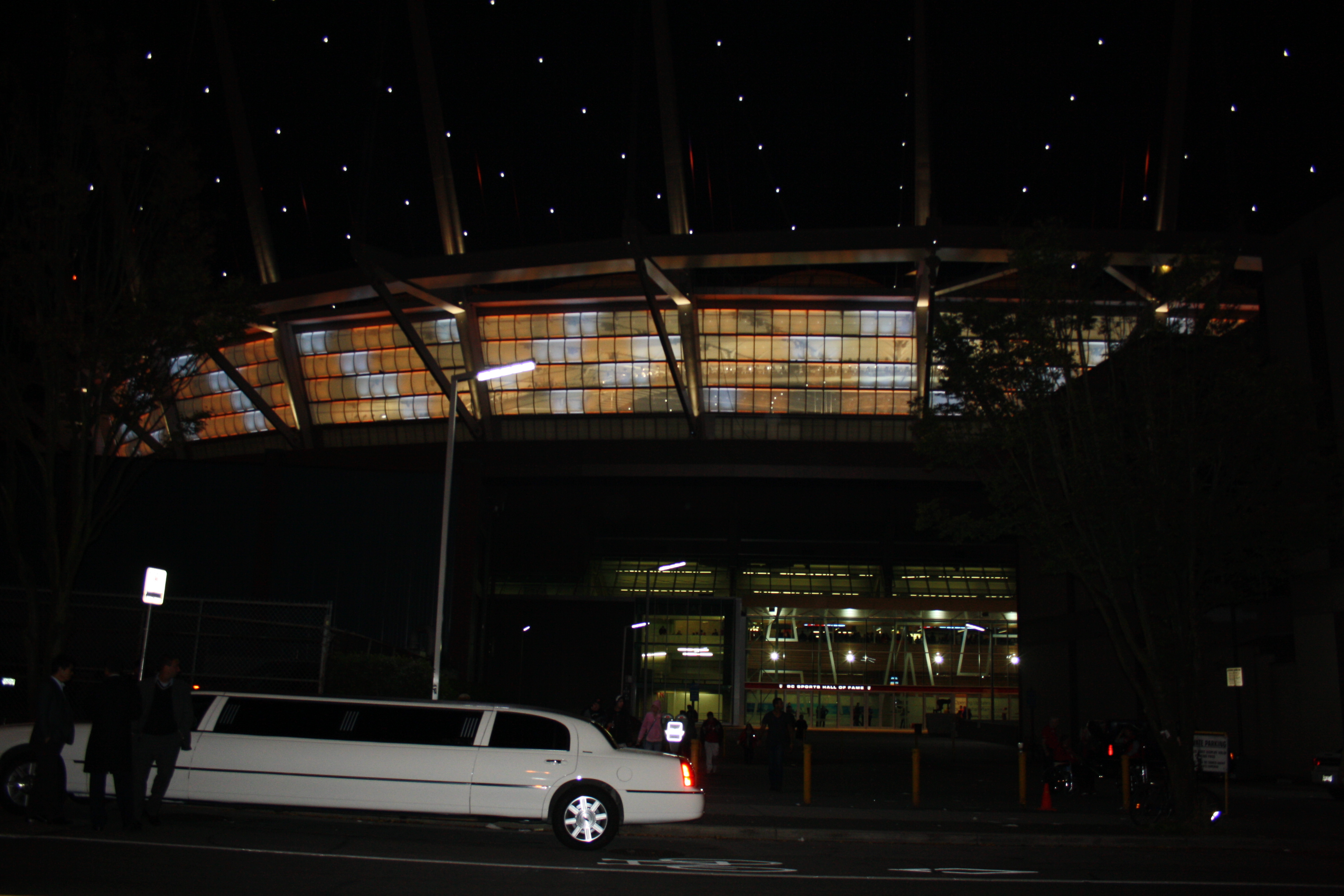
BC Place and its new roof on its opening night.

This year’s Grey Cup will prove to be an exciting match. Firstly because it is held in BC Place with the new roof. Before the 2010 Winter Olympics, there was a demand for a new roof for the stadium as the air-supported ETFE roof had a tear in 2007. The construction of the new roof began after the 2010 Paralympics and was completed on September 30 of this year. During that time, the Lions returned to the dismantled Empire Field and played in a stadium consisting completely of 25,000 temporary seats. This was quite an experience for me as I saw the Lions’ fourth game of theis season in that temporary stadium. A lot of banging, that’s for sure. As for BC Place’s new roof, it’s more high-tech and doesn’t require so much air pressure to keep it up. The scoreboard is supported by 36 cables connected to its own mast. The top of the Stadium consists of lighted glass. Looks great from the outside, but now that people couldn’t call BC Place ‘The Marshmallow’ anymore, what could they call it? My pick for the name would be ‘The Crown’. Anyways in the very first year of BC Place being ‘The Crown’, it appropriately hosts the Grey Cup this year. This year the race for the Grey Cup has narrowed the field down to its East and West contenders: the Winnipeg Blue Bombers and the home team BC Lions. Here’s a wrap-up on how the two stack up:

BC LIONS
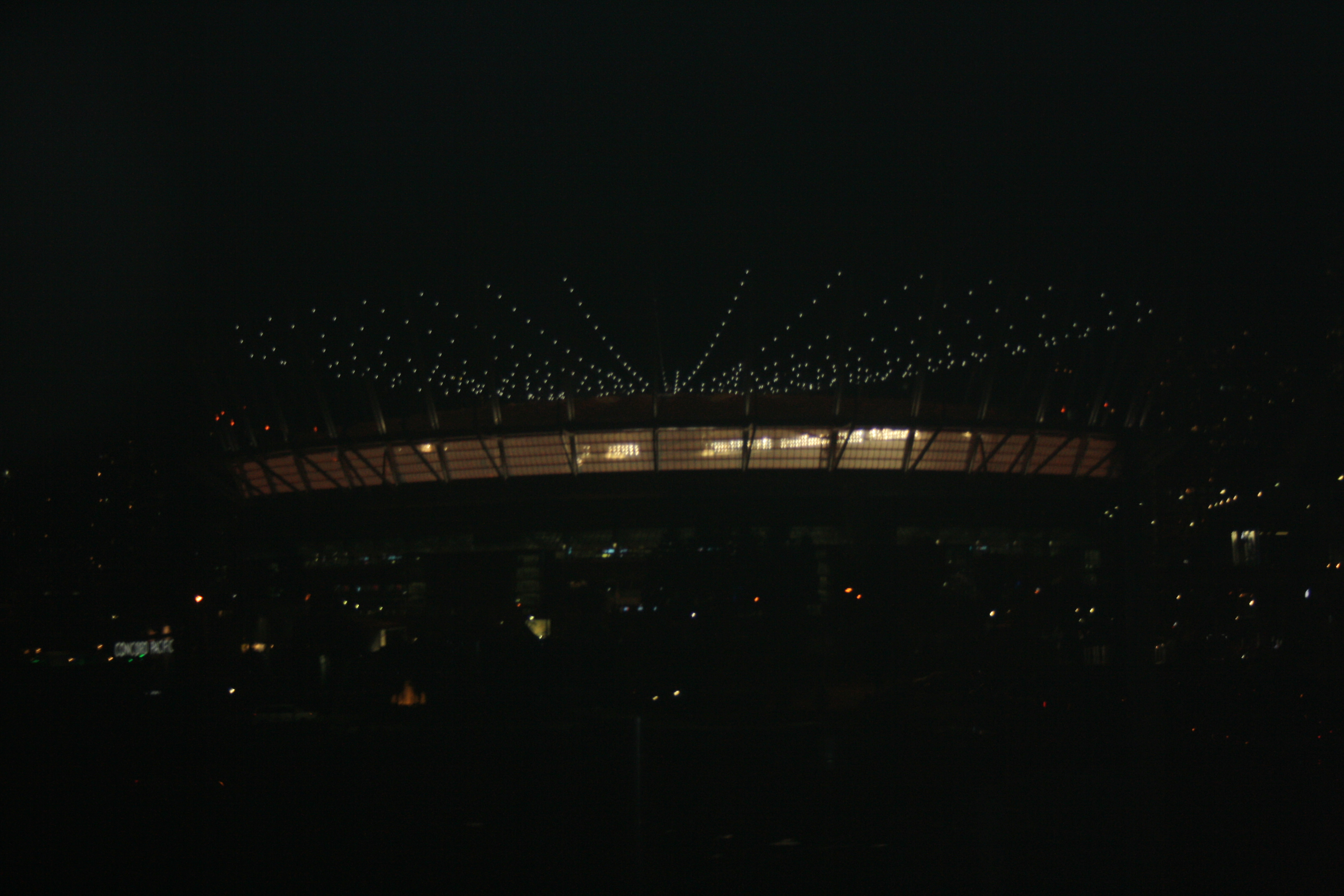
Another pic of the newly renovated BC Place at night.

If one would say at the beginning of the CFL season that the Lions would be in the Grey Cup, most would be laughing. The start of the regular season for the Lions was depressing and even frustrating for fans. The first five games were straight losses. Even I attended the fourth game, against Hamilton, and witnessed the loss. Their sixth game was a win against Saskatchewan only to follow it us with a loss against Edmonton. After that, it was like a miracle turnaround. Eight straight wins propelling themselves to the top of the CFL. There was only one loss after the sixth game, and that was against Hamilton in their 16th game in the regular season. By finishing atop the West Division, they only had to wait until the Division Finals to play their first and only playoff game against Edmonton, in which they won 40-23.

Overall, the 2011 Lions have had an excellent season with 11 wins and 7 losses. They became the first team in CFL history to lose their first five games only to end regular season on top of the CFL. Many teams they lost to at the start of the season they were able to beat in matches later in the season. The only two teams the Lions did not win against this season were the Hamilton TiCats and the Winnipeg Blue Bombers. This may come as an Achilles heel for the Lions as they will face Winnipeg for the Cup, and Winnipeg beat Hamilton en route to their East division berth for the Cup. However it may not be a glitch as we should remember that the two losses to Winnipeg came in its first seven games of the season. The Lions have sure changes since then and they could be ready for Winnipeg this time.

Also a bit of Grey Cup trivia. This year’s Grey Cup may come in the first year of BC Place’s new roof but BC Place hosted the Grey Cup in its opening year: 1983. Like this year, the Lions played in the Cup. Unfortunately they lost. Actually of the three times BC both played in and hosted the Grey Cup, only once were they the Cup winners. Something to think about for Sunday.

WINNIPEG BLUE BOMBERS

The Bombers finished atop the East Division with 10 wins and eight losses. Sounds impressive at first but while the Lions started their regular season weak and ended strong, the Bombers started strong and ended weak. They started off impressively winning all but one of their first eight games of regular season. However there was a surprise turnabout as the Bombers would only win three of the last ten games of regular season. They were known for their strong defence but many of their top defencemen were injured later on in the season. By finishing atop the East division, their only playoff game was the division Final against Hamilton which they won 19-3. If their strength from the beginning of the season has returned to form, then they should be able to beat the Lions for the Cup. It may not be 100% as some of their top defencemen are too injured to play in the Grey Cup. If Winnipeg’s defence is still strong, it will be decided in the play for the Cup.

One additional note. While Winnipeg had its own challenges on the playing field, its biggest news this season was of the loss of their Assistant Coach Richard Harris. Harris collapsed at the CanadInns Stadium on Tuesday, July 26 and died that afternoon. He was 63. He was promoted to Assistant Coach this season after being their Defensive Line Coach since 2006. This also came as a loss for the Lions too as he was their Defensive Line Coach from 2011 to 2004. Surely Coach Harris will be on the minds of the Bombers when they play the Grey Cup on Sunday.

For me, it’s hard for me to pick who will win or who I should cheer for. I was born in Winnipeg and lived there most of my life. However I’ve made a home for myself in Vancouver these past ten years. BC has only won the Cup five times compared to ten for Winnipeg, but Winnipeg hasn’t won the Cup since 1990 while BC’s last won the Cup five years ago. Anyways I decided not to cheer for either team and let the game decide the better team. Anyways, Go Bombers! Go Lions! May the best team win!

VIFF 2011 Review: i am a good person/i am a bad person

The Vancouver International Film Festival is very good at showcasing Canadian films. Some from directors who have establised themselves and some who are trying to make a name for themselves. The film i am a good person/i am a bad person is a film directed by Ingrid Veninger. Ingrid has already established herself first as an actress, then as a director in films like Gambling, Gods and LSD, Nurse. Fighter.Boy and MODRA. Her latest film i am a good person/i am a bad person is the latest film she directs and plays lead.

In this film, Ruby White is a married director who’s taking her daughter Sara to two film festivals with her as she showcases her latest release, leaving her husband and son at home.

Both are having problems. Sara’s dilemma is obvious as she is testing herself for a pregnancy. Ruby’s dilemma is less obvious emotionally but more physically as the strains of her marriage appear to be affecting her. Ruby is the more bohemian type as she enjoys partying and meeting new people at clubs and is unafraid of trying eccentric things for inspiration and solving problems. Sara is more reserved and often keeps to herself about her problems. Nevertheless their problems cause obvious friction in their relationship and their own lives during their first stop in Brighton. Ruby’s film is showed to a small audience unimpressed enough for one to ask her during a Q&A why she made the film. That leaves Ruby at a loss for words. Meanwhile Sara doesn’t know if she’s pregnant or not and it’s bothering her to the point she wants to leave her mother to visit cousins in Paris. Ruby agrees.

During their three days away, Ruby tries to assess herself as a person, as a wife and as a filmmaker in Berlin before her film opens. Sara meets up with the cousin in Paris and her beau and is able to take her mind off her troubles. Each try their own method in sorting out their problems. Sara is able to enjoy Paris and find it as a source of enjoyment and inspiration in her drawings and her photography. Ruby relies on a poster board sign she wears with “i am a good person” on the back and “i am a bad person” on the front. It is the input she receives from others that draws her insight. In the end, both make crucial decisions for themselves: Ruby for her filmmaking and marriage and Sara for her pregnancy. They meet up again back in Brighton and are able to return as mother and daughter with the satisfaction of their decisions made.

One unique thing about the film is how the alone time of three days helps to develop both Ruby and Sara. While in Berlin, Ruby contemplates herself and her relationship. While in Paris, Sara’s imagination and artistic dreams come alive. While both spend time with themselves and with others, they come to terms with making the huge decisions with their lives in the end.

Another unique thing about the film is that it is very woman-centered, unlike most movies out there right now. Ingrid Veninger directs, writes and plays the protagonist in the film and her daughter Hallee Switzer plays Sara, the main supporting role. The whole story revolves around these two women. It’s here in film festivals where female directors get their works best showcased. In an industry that is very much bottom line and almost completely run by men, it is through female filmmakers through independent companies being exhibited at film festivals where they have their best opportunities to showcase their works. This could lead to more female-based film works in the future. It’s film festivals like these that serve as a reminder that a lot of bottom line-oriented entertainment is missing something valuable.

 Of all the unique things about the film, the most unique thing about it is Ingrid’s shoot-as-you-go approach. For those who don’t know, this film was shot within a period of 19 days. Ingrid shot her scenes in Brighton and Berlin while she herself was out promoting her latest production at film festivals. During the time, she would use some of the film festival audience as part of the audience for this film, for what would be her follow-up. She would also use her interactions with other people as additional footage for the film. This capturing is very unique especially since filmmaking is frequently seen as something carefully directed and edited. I admire Ingrid for her courage to try something new and unique. Basically the only thing about the film that wasn’t that unique was that this is Ingrid plays the lead, as she does in most of her works, and includes her children–Hallie and Jacob–in the works. Here Hallie and Jacob play her character’s children.

This film I believe is meant more to be a personal film than it is to be a crowd-grabber. It is a very though provoking work that will cause some viewers to think as it does reflect on a lot of themes like a failing marriage, one’s career, sudden changes in life, and how to deal with what’s coming. I believe Ingrid did a very good job with her work. Some are calling it her best and most chance-taking work to date.

If you’re looking for a film out of your usual movie-going and are more interested in a thought-provoking film that your typical heavily marketed escapist fluff, i am a good person/i am a bad person is a good choice. At first you think the film makes no real sense but it comes together in the end.

VIFF 2011 Review: BumRush

The gangsta film BumRush played at the Vancouver Film Festival. I know what you’re going to say: “I’ve seen gangsta movies before.” BumRush is different. Firstly, it’s Canadian and set in Montreal. Secondly, it’s based off a sting and of events that really happened. Whether it can compare to other hood movies or gangsta movies of the past is one big question mark.

The film is set in Montreal in a strip club. In the past, the neighborhood of the club has had its dealings with rivalry from biker gangs and the Montreal mafia. Now comes a new messy chapter for the club as the neighborhood sees a crossfire between two rivaling street gangs. Soon they want to seize power over the club. This leads to a huge mess on all sides and the condition of the club in jeopardy. Soon the IB11 gang declares the club their property.

To end it all, the leader of the sting, Le Kid, finds an opportunity in five tough men who have had a brotherhood for many years. They also see it in Catherine, a girl who was imprisoned for her activity in relation for one of the gangs. She wants out of gang life but is having trouble with her criminal record being checked. Le Kid sees her and the brotherhood as an opportunity to get the gangs out of the club. It starts with a sting where Catherine gives the leader and his girlfriend spiked shooters. Later one of the gang members takes the drugged up girlfriend out to make out, only to have a cop videotape it with a phone and send it to the gang members. The video leads to more heated friction between the gangs. Then the brotherhood kidnap the two leading gang members to a mortuary to force them to tell the whereabouts of two men they’re after. This leads to an ending that has a small amount of action and some amount of cheeseball moments.

If there’s one strength about the movie, it’s that it shows a lot of forgotten truths that most gangsta movies or hood movies leave out or neglect. One often overlooked truth is girls involved with gangs like Catherine. Catherine’s role shows an angle of girls who want out of the gang system and start a better life. It also shows the ill misogynistic treatment girls get from gang members like the vulgar treatment of the strippers and the girl that was ‘gangbanged.’ That’s it with gangs. They think that because they have all the gun power they can treat women as mysogynistically as they want. That part happens to be the movie’s biggest strength.

Another thing is that it doesn’t show a completely happy ending. It shows the ugly reality that gangs have taken their street activities online and expanded their territory greatly. It’s a new truth that gangs have gone from just their own hood to anywhere online. There’s even talk on the news in Vancouver about gangs going online. That’s one thing that we often forget is that even after a sting is made, there’s still a lot of things left behind or things that don’t go away.

Another thing about the movie is that it features the final acting performance of Montreal musician Bad News Brown. He was famous in Quebec for being a harmonica-playing hip hop blues musician and was a opening act for many big name hip hop stars in Montreal, even accompanying some on stage. Brown was murdered in Montreal on February 11th or this year at the age of 33. This movie could possibly be English Canada’s first introduction to him and Quebec’s last time they’d see him on the screen.

Director Michel Jette did an excellent job in researching the story and creating a good script that was as smart as it was thrilling. He doesn’t rely completely on too much action or too much shootouts but rather focuses on the scenes leading up to the big moment and the people surrounding it. Nevertheless for all of the script’s intelligence, there were a few flat points and noticeable glitches. There were also some corny moments with the harmonica playing of Loosecannon. I often wondered if having a harmonica playing gangsta was such a good idea. The acting was imperfect and often overdone from some. Also the timing of this movie being out at a time when the popularity of gangsta movies have faded over time makes me question whether this would make for a good commercial release.

BumRush’s best quality is its truthfulness about gang activity and those around it. Its weakness is its lack of professionalism from many of the actors and a script that gets confusing over time. This one left me questioning its potential in the end, especially for English Canada.

VIFF 2011 Review: Shorts Segment – Air

This is another shorts segment that I saw at the VIFF. It was not the original movie I planned to attend but when someone at the info desk was giving away free tickets, I told them I already had a ticket for a show that was happening. She offered a trade, which I accepted. I’m glad I did. Like Water, the shorts of Air also had styles and varieties of their own:

 Spirit Of The Bluebird – This is mostly animation that’s very colorful and meant to tell a story. A story about a Native woman killed one night by two strangers. The bluebird is to represent her. At the end, we see her relatives standing by the building near where she died painted permanently with a mural in her memory. This was as much of a reminder that no one and nothing is forgotten as it was a picturesque short of animation.

Parkdale – This is a very thought-provoking short to do about two sisters living in a rough area with a father who’s constantly in trouble with the law. As they try and draw up money for a bus trip to Kingston, this paints an unhappy but truthful statement about street youth and their attempts to try and stay afloat.

Hope – As a war general lies on his deathbed, he confronts images of violence. It’s hard to make sense of it all. I’m sure that through some of the bizarre images the director is trying to make some statement. It didn’t come across too clear or maybe he tried too hard to be graphic.

CMYK – This is another animated movie focusing on the primary picture colors: cyan, magenta, yellow and key. The filmmaker tries to be creative but the short ends up coming off as mind dizzying and drawn out.

Oliver Bump’s Birthday – Oliver’ three older siblings died on their 13th birthday, and he’s doomed for the same fate. While all three made achievements during their lives, Oliver dreamed of the stars and space travel. On his birthday, he leaves his family party, which is quite like a pre-funeral, for his homemade space ship. You’ll enjoy seeing him chase his dream and enjoy a surprisingly enlightening and happy ending.

Theatrics – Two flirty thirtysomethings go for a night out in a movie theatre with surprises left, right and center. Starts off with drinking a drink with horse tranquilizers and then leads to one misfortune after another. Humorous and amusing. Just hope I never have to go through what she went through.

The Provider – Just when we see mention of the droppings of the atom bombs on Hiroshima and Nagasaki, we think we would get something serious. However we’d be surprised to get a darkly comical story about coming home. Very bizarre indeed.

Cold Blood – I don’t know if it was because I saw a lot of originality of the previous shorts or because I was expecting something else instead, but this short came up less than what I expected. Perhaps it was just meant to represent an aspect of life. Perhaps it was as much about the mother of the two children as it was of the son giving blood for his sister.

The Balcony Affair – This is one comedic short that is completely unpredictable. A lonely Russian man who’s always out on a balcony falls in love with a woman in the apartment across. Will they meet? Will they fall in love? The ending will surprise you, more than you expected.

So there you have it. The shorts that made up Air. All were Canadian. All were unique. Some I liked, some I didn’t. Some were thought provoking. Some were meant just to entertain. Some may go on to bigger and better things. Some may continue to do just shorts. All were worth seeing. It’s good that a film festival like the VIFF showcases shorts from up-and-coming directors as well as from established film companies. It’s what makes the VIFF different from Toronto.

VIFF 2011 Review: Shorts Segment – Water

The Vancouver Film Festival has been known to show a lot of feature movies during its 16 day run. What they also show is a wide variety of short films, especially those made by Canadian directors. The shorts exhibited range from those with an established reputation to those just starting out. For airings of Canadian shorts, the VIFF had four segments titled off of the earths four natural elements; Air, Earth, Fire and Water. The first shorts segment I saw was the one titled Water. All the shorts in the segments had something to do with water either as a metaphor, part of a scene or as a central theme. Each had their own style and/or their own story to say or play out.
 
For this year’s VIFF, I wanted a good mix of films to see: Canadian, foreign, documentaries and shorts. This was the first segment of shorts I saw. I’m happy. At the beginning of the segment, I was expecting this to be showcasing works of ‘the filmmakers of the future’ as shorts are often known as. What I saw here, I was a bit surprised:
 
Wait For Rain – This is an amusing comedic short. People who work at a sales business waiting for rain for their plant in a world where fresh water is rare. James is always the last to get rain for his plant and thus the least suucessful. One woman is interested in him and his plant while he’s interested in another. Amusing quirky love story that plays out humorously form beginning to end.
 
Steam – This is a more serious short. A middle aged man struggling with something he’s always felt as a burden. Now he learns to accept himself. It seems odd to go from a cute and funny short like Wait For Rain to Steam but Steam is a good short in its own right where one is kept intrigued by the drama.
 
Snowbound – This is the most shocking short of the bunch. A 13 year-old girl learns she’s pregnant. She can’t tell her boyfriend. Her mother finds out accidentally. What does she do? In the end, she makes a decision that will leave all shocked.
 
Swim – It’s four minutes where you see a man swimming in an area of Lake Ontario. But what makes it is the narration form the filmmaker. He tells of a childhood memory that still haunts him. He would later repeat that same dare on his boyfriend years later. More of an introspect or a reflection than a drama played out.
 
Le Rocher – Another short that’s not a piece of drama played out. Instead it’s a showcase of places and spaces from both Canada and Europe. It’s meant to show the relation of both. Mostly a collection of landscape filling. If you like scenic films, you’ll like it. If you came to the shorts segment expecting all shorts to be dramas like I did, you’ll leave confused.
 
Blood/Sweat/Tears – At first the two people in the crashed car all alone on the street  look dead. Then they become conscious and arguing. It all starts out with the two arguing by themselves, then amongst a crowd of onlookers and then the woman is taken away while the man is out shouting. Interesting story about troubled love. Also interesting is that’s it’s of a single-car crash with no other car, no street light, no nothing causing it. I think the crash was meant to be a metaphor of the relationship.
 
Bone Wind Fire – This is another intimate short. This is of the lives of three of the greatest North American painters: Emily Carr, Frieda Kahlo and Georgia O’Keefe. What it’s focus is on the nature of where they lived and how it played out and inspired the paintings they created. Awesome cinematography. You really get a feel for the nature.
 
And there you have it. The seven shorts that comprised Rain. I’m sure anyone that came to saw it might find at least one they liked. One thing is that it taught me a lot about short filmmaking. Not everyone who creates a short puts a story or a drama on film. There’s more creativity to it. Glad to see it shown in this segment. As for the fiilms, some shorts may catapult directors into something bigger in the future. Some may lead to other filmmaking jobs in the future. And some may continue to do shorts. Only time will tell how they do. 
 

Vancouver International Film Festival Turns 30

Back on Saturday, I started my volunteer work for the Vancouver International Film Festival. It is my fourth year volunteering. It’s great being part of an event that gathers a lot of media attention and helps promote filmmaking.

If you look back to the late 1970’s, you might remember there being film festivals like the Toronto Film Festival and the Sundance Film Festival that garnered very little attention but were growing at the time. They were still below the ranks and renown of the more established film festivals in Europe like Cannes, Venice and Berlin. Since then, Sundance and Toronto have made a major impact on the film world with its releases and its promotion of films. The Vancouver International Film Festival started in 1982 and now ranks as one of the top film festivals in North America. It nevertheless does carry a bit of an identity crisis but does have a lot to offer.

Since the Vancouver International Film Festival, the VIFF, opened in 1982, it has grown to an annual attendance of 150,000 every year since 2003. The 2000’s saw the construction of a special theatre, the VanCity Theatre, and an adjacent office for the VIFF organizers. This year it features over 300 films from 59 countries. Quite a lot. Nevertheless many feel that the VIFF is sandwiched in the role of playing second-fiddle to the Toronto Film Fest. In fact one person frequently tells me that we always get the ‘leftovers’ from Toronto. It is true that we get a lot of films that have already had their show at Toronto, especially those that get a special presentation at the Visa screening room. Very rarely, if ever, does a big-name actor show up. At most, a big feature will only have a tech person in the audience at the VIFF. What’s also true is what the VIFF has to offer on its own. Firstly the VIFF has more Asians films than any film festival in North America. This year there are more than 100 from dozens of countries. The VIFF also features more Canadian films and works than any other film festival in Canada. Not even Toronto has as much. They’re too busy hyping up the Oscar contenders. The VIFF also features loads of documentaries. There are dozens this year too from a wide variety of topics. The VIFF also features a lot of short films and films for youth. The film festival is not simply a festival showing straight features but a wide variety of films from across the spectrum from shorts both animated and live action to at least four films longer than 4 hours. There’s also the possibility of Q&A sessions from directors and even actors.

The VIFF also has a lot of dealings going on. Some films will catch the eye of distributors and will work things out to have them shown to the big screen. Others, like documentaries, will be able to be shown on specialty television networks. Some will be promoted as videos or films for special groups or resource centers. Like last year I saw the Canadian film Two Indians Talking and the director said in the Q&A that she hopes for it to be put on DVD and shown in First Nations resource centers. Then there are those where the VIFF will be the furthest their film will get. That’s the nature of the beast in filmmaking and promoting. It’s always a case of chance and luck of how far it will go.

Another thing the VIFF did was that it had a special panel. With this being the 30th Year of the Festival, it had a look back to the early years of the Festival and also hosted a free forum about the future of film. I wasn’t there at the Forum but I’m sure there’s a lot of discussion. I myself believe the world of film faces a lot of challenges in the years and decades ahead. One is the future of creativity and taking film in new directions in what is essentially a bottom-line business. Film can allow for a lot of creative minds to express themselves but there’s this beast called ‘showbiz’ where the subject of movie marketability is inescapable. Whether creativity can be taken in new directions and possibly even change filmmaking, only time will tell. Another factor to take into consideration is the multitude of media sources one now has, including some that didn’t exist ten years ago. When the VIFF opened, film’s top rivals were television, VCR and the newly-created pay TV. Multiplexes were increasing but it was still possible for a single-screen cinema to hold its own. Today, we have digital cable with hundreds of channels at our fingertips. We have websites like Youtube and Netflix. We can watch a movie on our laptop or even on our cellphone. Multiplexes are now the mainstay for big screen cinemas and single screen cinemas nowadays have either succumbed, are now in the fight of their life, or have to have some backing from some film source or company. Some of you may already have read some of the current difficulties of running a cinema as noted in my Hollywood Theatre article. Just to give a heads up, there’s going to be a multiplex opening in the new shopping mall at the New Westtminster station: ten cinemas with a total of 1800 seats. A multiplex with samll per-screen theatres; another example of what’s happening with the movie business.  Don’t get me wrong. There will be a future for film–there’s no doubt in my mind– but it has a bumpy road ahead.

This year, there were some changes in the venues with the Festival. The Granville 7 still remains the biggest venue for showing films but the Visa Screening Room is no longer Cinema 7 on the top floor. Instead it’s the Vogue Theatre. The Park Theatre is not one of the alternative theatres this year. The VanCity and Pacific Cinematheque are still being used for the Festival. Last year, the Festival opened with the screening of a Canadian film–Barney’s Version— with promotion of Telefilm Canada. This year they open with Pedro Almodovar’s The Skin I Live In, a film from Spain. Last year, they closed with the animated movie The Illusionist. This year, they close with the French film The Kid With A Bike.

In its thirtieth year, the Vancouver International Film Festival shows strong signs of growth. It may have a while before it joins the ranks of Sundance and Toronto but I’m sure it will continue to establish its own identity in the future. For more information about the Festival, go to the VIFF website.