Oscars 2015 Best Picture Review: The Revenant

Revenant
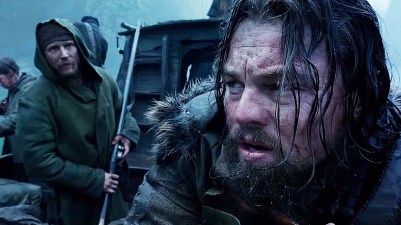
Hugh Glass (played by Leonardo DiCaprio) will soon find himself at odds with his former trapping partner John Fitzgerald (played by Tom Hardy at left) in The Revenant.

If there’s one movie that’s had its box office results significantly after the nominations, It’s The Revenant. If you’ve seen it already, you’ll easily see why it could have done excellently even without the Oscar buzz.

It’s 1823 in an unsettled wilderness part of the northern area of the Louisiana Purchase. A group of trappers under the command of Captain Andrew Henry search for pelts until a surprise attack from Arikara Native Americans kills many from the camp and cause the survivors to flee on a boat. Part of the camp is Hugh Glass who is on friendly terms with the Natives–even being a widow to a Native American woman and fathering their ‘half-breed’ son Hawk who’s part of the camp– and knows the area well. At Glass’ recommendation, they abandon ship and walk on foot to return to their outpost Fort Kiowa. This does not settle well with some of the trappers including John Fitzgerald who has a hostile attitude towards Natives after being scalped years ago. He is noticeably hostile to Hawk.

Glass scouts ahead alone for a while but he is mauled by a mother bear protecting her cubs. The attack is brutal and Glass is severely mauled but he’s able to stab the bear. The other people in the camp find Glass but doubt his chances for survival. Henry commands to three men in the camp–Hawk, Fitzgerald and the young Jim Bridger–to stay with Glass until he dies and give him a proper burial. Fitzgerald tries to smother Glass when alone but Hawk stops him. Unfortunately stabbed is killed by Fitzgerald as Glass can only lie and watch. Fitzgerald attempts to bury Glass prematurely but stops when he sees Bridger flee and follows.

Abandoned with only a canteen, Glass is somehow able to survive and slowly heal. Days later, he’s able to heal to the point he can move, then crawl, then walk. As he heals he’s haunted by visions of his deceased wife. He even sees visions of her as he comes across an abandoned church. However he also has to deal with the Arikara whose chief is searching for his kidnapped daughter Powaqa and trusts no white man.

Both Fitzgerald and Bridger are heading to Fort Kiowa but Fitzgerald scares Bridger into being fully under his control. One at the Fort, Fitzgerald tells Henry that Glass died and Hawk was attacked by the Arikara. Henry gives both Fitzgerald and Bridger a cash reward. Fitzgerald accepts without guilt but Bridger refuses.

Glass encounters Hicuk, a friendly Pawnee who gives him food and shelter and helps him along the path back to Fort Kiowa. Hikuc has also lost his family. Upon hearing from Glass his intent for revenge, he tells Glass “Revenge is in the Creator’s hands.” The day after the blizzard, Glass wakes to find Hikuc hanged by French pelters. Not only that, he finds Powaqa being raped by leader of the French pelters. He’s able to kill the two leaders and free Powaqa but has to escape with Hikuc’s horse and Bridger’s canteen. An ambush by the Arikara causes Glass to flee on horse only to fall off a cliff. Glass survives but the horse is dead. Glass uses the horse’s carcass as a shelter overnight.

Meanwhile word has gotten around to Fort Kiowa that Glass is in fact alive. This is known as a French hunter brings Bridger’s canteen there. Henry however thinks it’s stolen from Hawk and organizes a search party but Fitzgerald knows the truth and flees. Henry finds Glass alive in the search. Infuriated, he charges Bridger with treason after returning to the Fort but Glass insists it’s all Fitzgerald’s doing.

The operation then goes to find Fitzgerald and bring him to justice. Henry however is caught by Fitzgerald in an ambush and is killed and scalped. It’s now up to Glass who hatches a plan to finally get his revenge. It works in catching Fitzgerald and having him shot but not without Fitzgerald being able to run off. It then comes down to a fight between the two for Glass to get his revenge. It ends with Glass making a decision and an ending we’re all left to decide for ourselves Glass’ fate.

Now just to get things straight, this is not the true story of Hugh Glass getting revenge on John Fitzgerald. In fact historic documentation shows Glass let Fitzgerald live because he knew the heavy penalty of killing a soldier in the U.S. Army. Fitzgerald became a soldier in the U.S. army and was stationed in Fort Atkinson, Nebraska. Fitzgerald did give Glass his rifle back.

This film is actually a revenge story adapted from the 2002 novel The Revenant: A Story Of Revenge by Michael Punke. I think the focus of the film is more about telling the story than it is about retelling history. I have not read Punke’s novel but I’m sure that was how Punke would have wanted Fitzgerald to face the music upon abandoning Glass to die. There is actually very little information about who John Fitzgerald was or even what type of person he was in real life. We have the historical documentation of what happened to Glass and what happened in his pursuit of Fitzgerald but not much else. The novel was not only Punke’s chance of creating his own revenge fantasy in Fitzgerald but giving Fitzgerald a character of his own. The film helps Punke’s story come alive and even paint a picture of Glass, Fitzgerald, the times, the terrain and the domain of all that happened.

This revenge story is not your typical revenge story you’d see in your typical Hollywood movies or even from the likes of Quentin Tarantino. This revenge story is also a story of survival and also shows a human side of the perpetrator Hugh Glass. Yes, he was as tough as a frontiersman and a trapper of the time should be. However he did have a soft side. He still has feelings towards his deceased wife who was a Native American woman and he truly loved his son despite others seeing him as a ‘half-breed.’ He also had to be tough as he needed to survive the brutal bear attack and recover from his wounds in order to pursue Fitzgerald. He also had to develop the will to live knowing that his son was killed by Fitzgerald. He also had to be right in his mind in deciding what he had to do to Fitzgerald in the end.

I will admit there were times when I questioned if this film was becoming too much of a tall tale. One example is when seeing Glass pursue Fitzgerald in what appeared to be just days before his attack. I often asked: “Would someone who suffered such a brutal bear attack recover in that fast of a time?” Even that scene where Glass and his horse fall off a cliff. The snowy tree broke Glass’ fall and helped him live without any severe bodily damage but the horse died. That scene also had me scratching my head. Maybe those scenes and the elapsed time were also part of Punke’s novel. Nevertheless it still had me questioning its believability.

First off I’d like to give respect to Alejandro Gonzalez Inarritu for delivering an excellent movie. He may be renowned for his ‘filmwork’ but here he takes his first steps in directing a movie intended to draw big crowds while still maintaining some top film making qualities. Very little was compromised and the end result was excellent as it both succeeds as a film and as a movie. I’ll admit I was unhappy about Birdman winning Best Picture last year because it didn’t give much for a film audience to either enjoy or appreciate. Yes, it had top-notch acting, directing and scriptwriting but who truly enjoyed it?  This is ten times more enjoyable while still maintaining top acting and directing. Yes, there were some scenes that can scare many. In fact I’ll admit the film made me hope I never walk in the woods again. Nevertheless it was a very good movie full of drama and thrills. As I said, I have never read Punke’s novel but the script Inarritu co-wrote with Mark L. Smith definitely makes the novel come alive. I know the script was not nominated for an Oscar. However the unspoken scenes in the movie told as much as the scripted scenes.

The film would simply be a popcorn movie if it weren’t for the acting. Leonardo DiCaprio did an excellent job of Hugh Glass. He said a lot especially in the scenes where Hugh Glass was unable to speak. His performance was as much about telling a lot through physical actions as it was through dialogue. Hey, it’s been said 80% of communication is non-verbal and Leo was able to say a lot in those scenes. That’s why I’d be shocked if he doesn’t win the Oscar. Also just as excellent is Tom Hardy. He didn’t play your typical rotten-to-the-core villain. He gave John Fitzgerald some fears and insecurities to the role and conveyed them well. Nevertheless he also made Fitzgerald hateable as a remorseless villain who even calls the dead Hawk a ‘pussy’ in Glass’ face. Additional performances of respect include Bill Poulter as Jim Bridger, the young trapper who possesses the conscience Fitzgerald lacks, and Forrest Goodluck as Hawk.

Additional qualities of acclaim is the cinematography from Emmanuel Lubezki, the costuming by Jacqueline West including its use of furs and hides, the film editing by Stephen Mirrione, the visual effects including that of the bear attack, the excellent use of both natural settings and constructed sets that fit the times and scenes perfectly and the film’s score by Ryuichi Sakamoto, Carsten Nicolai and Bryce Dessner.

An additional note. I also give the film respect for its treatment of Native Americans. I may have been a baby when Sacheen Littlefeather refuted Marlon Brando’s Oscar on his behalf and spoke of his protest to the on-screen depiction of Native Americans or First Nations peoples as Canadians commonly refer to them as. However I already know of Hollywood’s past and how they’re famous for shelling out ‘cowboys and indians’ movies from decades past. I can completely understand why Brando would have been angry with that depiction as Brando has had a history of activism in the 1970’s on behalf of people of various races. I will admit Hollywood has been better at its depiction of indigenous Americans from films like 1990’s Dances With Wolves and even the character of Chief in One Flew Over The Cuckoo’s Nest that was shown in theatres a mere three years after Brando’s Oscar protest. I’m sure there are some people that can spot imperfections in Hollywood’s current treatment of Native Americans including in this film but I found it hard to pinpoint a scene that was insulting to them. Sure there were battles with tribes and there were bigoted attitudes among many white characters but there were many positive Native American characters in this movie. In addition the main protagonist Hugh Glass had positive interaction with the Native people including marrying one and treating his son with love while many despised him as a ‘half-breed.’

The Revenant isn’t just a dazzling movie. It’s one that will keep you intrigued from start to finish and not know what to expect next.

Movie Review: Django Unchained

Django Unchained movie still

If you’ve seen Lincoln already, you’ve already seen one man’s approach to slavery. Now Django Unchained is another man’s approach to slavery that’s more what Quentin Tarantino had in mind and not what you’d expect.

The film starts with the Speck brothers walking a group of male slaves down across Texas in 1858, three years before the Civil War. Their journey is interrupted by Dr. King Schultz who appears to be a traveling dentist. He offers to buy one of the slaves, Django Freemen. Before the Specks can refuse Schultz shoots one of the Speck brothers to death, shoots the other leaving him in pain and frees the other slaves to let them kill the wounded Speck.

Schultz confesses to Django he’s no longer a dentist but a bounty hunter who kills fugitives for reward money whenever the opportunity arises. He especially chose Django because he can help identify his next targets, the three ruthless Brittle brothers. Schultz admits he hates slavery and offers Django to help with freedom, $75 and a horse as a reward. Django assists successfully in helping Schultz shoot down the Brittles.

Not only does Django get his promised rewards but Schultz hires him as his bounty hunting associate. This comes as Schultz learns that Django has a wife: Broomhilda ‘Hildy’ von Shaft who is also a slave now owned by a separate owner. Schultz is hoping making Django his associate will reunite him with Hildy. Schultz does a good job in training him and Django is fully ready with the shooting skills and the desire for blood. His first operation on Smitty Bacall is a success from hundreds of feet above off a cliff. Django and Schultz are successful in other bounty shootings too and soon learn Hildy is owned by plantation owner Calvin Candie. Once arriving as his plantation, Candyland, we learn Calvin is a charming but brutal man who has his male ‘mandingo’ slaves fight to the death for his entertainment pleasure.

The two try to pose as ‘mandingo’ purchasers to Candie however the purchase turns real when they witness a slave mauled to death by angry dogs. They then ask for Hildy as an addition. Candie agrees to the sale but it raises the suspicion of Candie’s staunch slave Stephen who suspects Django knows Hildy and is up to something with this sale. Upon the advise of Stephen, a drunken ruthless Candie gives Schultz a deal: Hildy for $12,000 or death. Schultz agrees and shoots Candie after the offer. A shootout occurs with Schultz shot and Django shooting many of and many of Candie’s men dead only to end when Stephen threatens to kill Hildy is he doesn’t surrender.

Django is sent to punishment by Stephen and Candie’s sister working as a coal miner worked to his death. That’s what Stephen thinks as Django is able to outsmart the slave drivers, kill them and take their dynamite. This comes for the set up at the end for Django’s revenge on Stephen and all those at the plantation. Even though most people know what the ending will be, it’s the style that it’s done in that’s the treat of the movie.

One thing about this movie is that it’s not supposed to be the answer to slavery. It’s not supposed to be even a version of how slavery should have been solved all along. What this movie is basically is Quentin doing what he does best: a revenge movie done in his style. I’ve been an admirer of him since Pulp Fiction. I remember when I first saw it near the end of 1994. I was a college student of the time and Pulp Fiction was a movie that impressed people of my generation. I came from a generation that was strongly anti-censorship and looked at commercialism in movies as a downgrade in creativity and an attempt to soften the authentic. When Pulp Fiction came out, we were impressed. Finally a movie where the director/writer has complete creative control and it excels. Finally a movie that takes filmmaking to new levels as filmmaking should. Finally a film that pushes envelopes as us Generation Xers in college felt all art should. Finally a movie that makes original pay off at the box office. Finally an independent movie that could make the Hollywood fare at the time look like a laughing stock. Finally a film that doesn’t censor itself and doesn’t bow down to pressures of ratings boards or family values groups and it excels. In the end, Pulp Fiction has been hailed by most as the best film of the 1990’s.

Eighteen years have passed since Pulp Fiction has been released. While most directors have had a flare last for a number of years only to flare out over time, Tarantino never did. He still delivers movies that know how to charm and even enchant. Also while it appears that there’s a lack of taking film in new directions right now and more interest in creating a box office winner, Tarantino is still one who dares to stand out, take risks and do things his way. One thing I’ve come to know of Quentin Tarantino’s movies over the years is that he aims to deliver a film in style. It’s seen very clear in the films he shows that he attempts to tell a story via film noir or blaxploitation or spaghetti western style. He wants to deliver a stylized story as he’s done in his past movies and he does it again here.

Another thing Quentin does in his films that he does again here is deliver a movie with stylized characters with eerily charming personalities and deliver their acting with style. We see it with the characters of Django Freeman, Dr. Schultz, Calvin Candie, Hildy and Stephen. All of them have their personalities in their likeable traits and their hateable traits. All also deliver in their stylized acting without coming off as ridiculous. Few times can an actor get away with doing such a showy stylized character in movie performances without looking ridiculous or over-the-top. It’s here in Quentin Tarantino movies where it works the best. It’s funny because when I learned Django was about a slave getting revenge, I was expecting the actors to play characters with mannerisms from the 1850’s. Not in a Tarantino movie.

Also noticeable is how Quentin works to avoid the sentimental and touching in his films and it’s seen again here. The two where I got the biggest sense of this was firstly the scene where Django shot Smitty Bacall from a cliff and we see Smitty’s son coming to him on the ground. There’s no scene of the son’s reaction. The second was the scene where Hildy saw Django after being away from him for so long. I was expecting Hildy to be in tears and embrace him. Instead she faints at the sight of him. Not what I expected but should’ve in a Tarantino movie.

If there’s one glitch to comment about the movie, it’s that it’s yet another revenge flick from Tarantino. Back in the 90’s his films had the focus of the criminal mind. I was good with that. In the 21st Century, his movies have been focused on the theme of revenge, from the Kill Bill series to the Death Proof part of the Grindhouse movie to Inglourious Basterds. I didn’t have a problem with that because it was done entertainingly and even enchantingly at times in some scenes. Here it was a case where I went with the feel “Not another revenge story from Quentin Tarantino.” I’ll admit that it was a very stylishly done movie that delivers in entertainment value but seeing Tarantino toy around with the theme of revenge once again gives me the impression he’s masturbating to that theme a little too gratuitously.

Don’t get me wrong. I’m not trying to say in my review that this is the movie that is the turning point for my respect for Tarantino. In fact I still consider him one of the best filmmakers out right now. I would however like to see him work with other themes too. Like many people, I feel one trait that makes for a great director is one that can do many genres well. Steven Spielberg is an example of a director that can do a multitude of film genres. Martin Scorsese may be famous for gangster films but he showed he can do other styles of film well too, even family movies. Ang Lee is another filmmaker that has demonstrated versatility. I would like to see Tarantino become more versatile in the films he delivers. This may sound odd coming from a fan of his movies but I’d like to see him try it.

Okay, enough of me both praising and sacking Quentin. The film’s acting consists of character acting that knows how to be stylish without coming across as ridiculously showy. Jamie Foxx was impressive as Django Freeman. The only problem is that he was constantly upstaged by the supporting players. Christoph Waltz delivered excellently as King Schultz with all of his charming arrogance who somehow had a heart. Leonardo DiCaprio also was phenomenal as the charmingly hateable Calvin Candie. Samuel L. Jackson was excellent as the hateable Stephen: the former slave who now owns and beats his own. He makes you want his payback in the end. Kerry Washington was also good as Hildy but her character lacked the depth and style the leading male characters had. The sets were perfect in fitting the time. Even the springy tooth on Dr. Schultz’s coach looked less ridiculous over time. The music mix was also excellent. Another trait of Tarantino’s movies is the inclusion of music that enhances, stylizes and even enchants in the movie’s story and Quentin delivered again. It was a mix of original music and of songs from decades past that blend like magic into the film.

One would assume a movie like this would be one to cause controversy. And they’re right. This movie has had people speaking out against it on the subject of either the violence or the subject of slavery or the use of racial slurs. The most outspoken critic has been director Spike Lee. Spike has been critical of Quentin Tarantino in the past for the use of a certain racial slur in Pulp Fiction. Spike hasn’t really spoken about the use of that slur in Django but he has spoken about the movie itself and has declared it: “an insult to my ancestors.” This is particularly questionable since there are African American actors in leading roles. If they felt it was an insult to their ancestors, they would have refused to be in the movie. Besides I’ve always gotten the impression Spike Lee wants the world to think he’s the voice of all of black America simply because of Do The Right Thing. Fortunately the controversy hasn’t generated too much news overload.

It’s interesting while Lincoln showcased justice given to slavery, Django Unchained is about one slave’s revenge. Ironic how both are released in the same year and both have expectations to win the Best Picture Oscar. As for Django, it’s starting to feel redundant to see another Tarantino revenge flick but his stylized filmmaking compensates for that and delivers a winner of a movie for the most part. Not for all to see but it will entertain those that do see it.

Movie Review: Titanic 3D

Who here hasn’t seen Titanic? When it opened near the end of 1997, it broke practically every movie record in the book, became a huge pop culture phenomenon and remained that highest grossing movie ever until James Cameron’s follow-up Avatar was released. Now it’s out in 3D. The big question is how does Titanic fare as a 3D movie?

NOTE: Just to let you know, this is not a basic movie review. This is a review of the movie’s addition of 3D. I’ll give you a brief summary of the movie itself by saying it was an excellent movie but it was more about being an epic than about having excellent acting and scriptwriting. Sure, Gloria Stuart had the best performance of the movie and Kate Winslet was excellent, but most of the acting was the best the actors could do with cardboard characters. The script had a few cheesy lines too–“This is bad.” and “I’ll be down here waiting for you.”–but we should forget that the script isn’t the whole point of an epic movie. As for the Oscars, I feel Best Picture should’ve gone to L.A. Confidential that year. Titanic had some good moments too. The best qualities were the cinematography, the score from James Horner and especially the visual effects. James Cameron created an epic masterpiece. It’s no wonder this movie smashed every box office record in the book and remained unbroken until Avatar broke them all.

So there you have my brief review of Titanic. Now for my review of Titanic 3D. Often I consider 3D releases of movies more of a case of a cash grab than in terms of quality. Most of the time when I go to a 3D release of a movie, I expect the 3D to justify itself. Some of them like Coraline, Avatar, Toy Story 3 and Hugo worked. Some of them like Up, Iron Man 2 and John Carter didn’t. I will have to say that there were many parts in Titanic where the 3D did not work, like the drama and the dialogue. Even the parts of the ship’s sinking didn’t have anything added with the 3D effect. One thing I will note is that Titanic was not designed to be a 3D movie. 3D movies weren’t taken into as serious consideration as they have been in the last four years. I’m sure if Titanic was meant to be seen in 3D, James Cameron would do a lot of direction changes and ordered different cinematography angles.

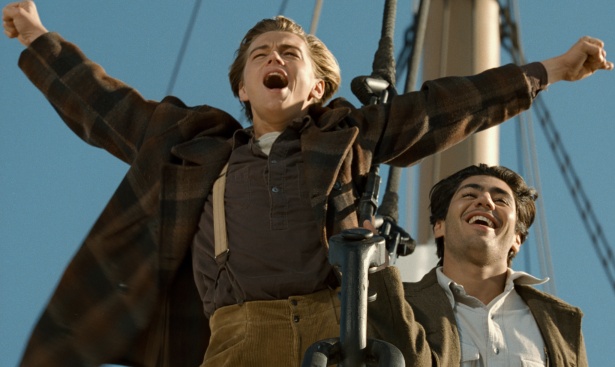
The 3D worked best during scenes which put the audience in the character’s place. Some of the best scenes included where Jack is welcomed to the first-class dinner, or when the two are dancing in the third-class section. The best I felt was the scene where Rose and Jack are at the stern of the boat getting the feel of flying. That scene of riding the waves was one of the best 3D parts of the movie. The other area where 3D worked best was the disaster scenes from within the ship. Scenes of sudden bursts of water in the engine chamber and throughout the third class deck were other areas where the 3D worked best.

One thing about the re-release of Titanic in 3D is that it reminds you just how right it is to do a re-release of Titanic anytime. 3D or no 3D, Titanic is a movie meant to be seen on the big screen. Seeing it on your television via DVD or Netflix and especially seeing it on your cellphone doesn’t do it justice. If you’ve seen Titanic in the past, you would know for yourself that Titanic is a movie meant for the big screen. Not just visual but the addition of the surround sound adds to it too. The big screen is the best way, if not really the only way, to experience it. I’m glad they re-released it. If you loved Titanic when you first saw it and saw it again, the re-release will remind you why you fell in love with it. There were even times when I left the theatre thinking that if Titanic were to be made today, who would play Jack and Rose? Ah, Leo and Kate can’t be replaced but if it was done today, my best bets would be Jamie Bell and Keira Knightley. Gloria Stuart couldn’t be replaced either but I’d assume elder Rose would be played by Lauren Bacall. Okay, I’ll save it!

It’s a wonder why they picked April 4th for the 3D re-release since April has so many 100th anniversary commemorations that month. They could have released it on April 10th–the 100th anniversary of the Titanic’s ill-fated departure– or April 15th: the 100th Anniversary of the RMS Titanic’s doomsday. The only 100 Anniversary April 4th commemorates is the completion of the Titanic’s trial run. Not much to commemorate, eh? As for me, I find it ironic I saw it on Sunday April 15th: the exact 100th anniversary of the sinking.

There’s no question that Titanic’s re-release in 3D is another cash grab as is any other big movie in the past that’s been re-released in 3D. Nevertheless it is worth seeing as it reminds you why it’s so right to see it on the big screen, 3D or no 3D. The addition of 3D doesn’t add much but it’s still worth seeing again even to re-live the experience.