2026 FIFA World Cup: My Prediction For The Final

Before I get into my blog, I would like to thank those who sent messages of support and condolences. The death of a parent is never easy and can be a shock. It will take some time to overcome. Actually there was a period of time when her health was in critical condition that I felt lost and neglected a lot of things that gave me vitality. It was during those days that I learned that writing is one thing that helped bring my vitality back. Back in June, it helped me get a lot of energy back. In talking with my father yesterday, he said it’s not too soon after my mother’s passing to publish a blog. She would want us to live life again. He’s right. Loss is hard but you have to live again.

Can you believe it? We had 102 matches this World Cup so far contested over these past 38 days! It’s crazy that the last World Cup, there were a total of 64 matches. Here, the end of the 64th match still had more Group Stage games to go! The Group Stage was loaded with craziness. First was the invincible play of Mexico, the shocking 6-0 win form Canada against Qatar, small nations like Cabo Verde and Curacao performing better than expected while nations like Turkey, Uruguay, Scotland, Tunisia and South Korea performing below their normal standard and paying the price. There was also the unfairness to Iran where they could play in the United States but had to train in Mexico. Their missed qualification is hugely disputed. There were a lot of calls made during the games that were widely disputed, but that’s common in every World Cup.

Then the Round Of 32: all three host nations won their matches, shocker penalty kick upsets with Paraguay over Germany, Egypt over Australia and Morocco over the Netherlands, and a tight match involving the two highly ranked teams of Portugal vs. Croatia which Portugal won. The Round Of 16 saw all three host nations fall. The fall to the United States was satisfying to their rival Belgium after the intervention of Donald Trump to get the red card of US player Folarin Balogun. In the Round Of 16, there was also the surprise win of Norway over Brazil, Switzerland’s penalty kick win over Colombia, another clash of two Top 10 teams with Spain vs. Portugal which Spain won, and Argentina’s come from behind over Egypt which many have found suspicious (more on that later). The quarterfinals had their own drama with many a tight game and close matches to be decided in added extra time like England’s win over Norway and Argentina’s win over Switzerland which was also controversial. The drama continued in the semifinals as Spain delivered a shocker winner over the more-favored French squad and the always-heated rivalry of England vs. Argentina where Argentina again came from behind. To say these World Cup matches have been packed with drama is an understatement.

THE FINAL: Spain vs Argentina

So here we are. Up until now, the biggest talk of the World Cup Final was to do about a Halftime Show. That would give a 30-minute halftime break which most football fans do not like the idea of all. If you thought the hydration breaks in the middle of each half got on tour nerves, wait until the Halftime Show! Nevertheless the biggest focus should be the play of the game and the contenders. On the subject of the contenders, it’s been 102 matches so far and it was what we needed at this Cup to determine which of the 48 teams are to be the final two to play for the Cup! Interesting note is this will be the first World Cup final since the very first final in 1930 that both teams come from Spanish-language nations! To sum up the two teams briefly, the Final is against reigning World Cup champions and current Copa America champions Argentina and the current European champions Spain. La Roja has only won the World Cup once before and this will only be their second World Cup final ever. La Albiceleste have won the World Cup three times and this will be their seventh World Cup final ever. Only Germany has been in more finals with eight finals each. So what do this year’s two finalists have in store? And who will win it?

SPAIN

Traditionally, Spain has been commonly known as ‘football’s greatest underachievers.’ They would always arrive at the World Cup with a squad full of talent and ability to win due to the players’ combined skill level, but they would frequently fall short as a team. Most of the time, they would find themselves out in the quarterfinals or sooner. The turning point came in 2010. They were the reigning European Champions. Their play was conservative but consistent and they won their first-ever World Cup.

They would repeat as European Champions in 2012 and would win the Confederations Cup in 2013, but it would all fall apart after that. At the 2014 World Cup, they were out in the Group Stage after losing their first two games badly. At both the 2016 Euro and the 2018 World Cup, they were out in the Round Of 16 of both tournaments. They finished in the semifinals of Euro 2020 but would later see World Cup disappointment again with another Round Of 16 finish. After that World Cup, Luis de la Fuente became the new head coach of the team. Before the World Cup, Spain under de la Fuente’s leadership won the 2023 UEFA Nations League Finals and the 2024 Euro.

Here at this World Cup, Spain again showed success. They opened on a lackluster note with a scoreless draw to Cabo Verde, but would rally up in the group play by winning 4-0 to Saudi Arabia and 1-0 to Uruguay. The knockout round was where Spain really shined. They won their Round Of 32 match against Austria 3-0, their tight Round Of 16 match to Portugal with a last-minute goal from Merino, their quarterfinal against Belgium 2-1 and would win their semifinal against France 2-0.

Spain’s play has been very impressive at this World Cup as a result of the teamwork from goalkeeper Unai Simon, strikers Mikel Oyarzabal and Mikel Merino, midfielders Fabian Ruiz and 18 year-old prodigy Lamine Yamal, and defenders like Pedro Porro and Marc Cucurella. Their play has been mostly consistent. However Spain has had a habit in the past of choking at major moments. This team has appeared to be on in terms of performing but they have made mistakes in play and it is possible they can commit an error they won’t be able to rally back on. If they want to win, they need to be dead-on.
ARGENTINA

Argentina and the World Cup almost seems synonymous. It is a bit misleading as they may have won three times but they’re more known for the times they fall short. That was especially exposed when Lionel Messi burst onto the scene. He made his World Cup debut in 2006 at the age of 19 and was nicknamed ‘Messidona.’ A third World Cup was anticipated with the growth of Messi’s career but it became a case where Argentina was putting all the pressure on Messi. Sure they had other competent players but Messi couldn’t be the only one holding the team together. That became evident after they lost the World Cup final in 2014. It was even more evident after their Round Of 16 exit in 2018 and past retirements of Messi from the national team, albeit short-lived retirements.

It was evident Argentina wanted to win the World Cup for the nation and for Messi. After the 2018 World Cup, Lionel Scaloni was hired as head coach. Scaloni and the AFA knew they needed other players that were also at the top of their game. In the years leading up to the 2022 World Cup, they got them. There’s goalkeeper Emi ‘Dibu’ Martinez, defenders Nicolas Tagliafico, Cristian Romero and Lisandro Martinez, midfielders like Leandro Paredes, Alexis Mac Allister and Rodrigo de Paul, and forwards like Julian Alvarez and Lautaro Martinez joining Messi. The combination proved to be a winning success as they first won the 2021 Copa America. At the 2022 World Cup, they lost their opener to Saudi Arabia but made up for it by winning every match after. Even on penalty kicks in their quarterfinal against the Netherlands and the final for the Cup against France! Messi finally got his World Cup.

After Qatar 2022, there was a big question of how the team would be and if Messi would soon retire. As time went on, Messi continued with the team and the team had continued success with winning the Copa America in 2024 and success in qualifying for the World Cup. Along the years, they’ve added new stars to the team like forwards Nicolas Gonzales and Giuliano Simeone, and defender Facundo Medina. Here at the World Cup, they went through the Group Stage effortlessly with wins against Algeria 3-0, Austria 2-0 and Jordan 3-1. In the knockout phase, there was win after win by defeating Cabo Verde 3-2 in added extra time, Egypt 3-2, Switzerland 3-1 in added extra time and England 2-1. Argentina proved themselves ready to become the first team since Brazil in 1962 to successfully defend their Cup.

Their wins may have dazzled crowds here at United 2026 but they’ve also garnered suspicion. Even before this World Cup, there has been suspicion that there would be a lot of corruption with FIFA President Giovanni Infantino having ties to Trump. One of the elements of corruption people have sensed is that Argentina has had the officiating in their favor so they can win matches. Many teams have sensed that they received more fouls than average but many teams have also sensed that Argentina is one of the least fouled teams at this Cup, if not the least fouled. The first suspicion started in the Round Of 16 match against Egypt where five of the players received cardings including one red carded while Argentina didn’t get any. Even how the win went from Egypt leading 2-0 after 80 minutes to Argentina scoring three in the remaining time did not sit well. This infuriated the Egyptian coach so much, he delivered an outburst that even got him a yellow card. Further suspicion came after their quarterfinal against Switzerland. Their win was another come-from-behind victory, Lautaro Martinez jumped into the stands and not getting his second yellow card of the match, and Swiss player Embolo got a double-yellow red card. Further investigation noticed the lack of fouls and carding on Argentina. The sense of match fixing from viewers has gotten so tense, some people have even stated on social media FIFA now stands for “Fixing It For Argentina.”

The sense of match fixing is enough to raise my eyebrows and question the legitimacy of the matches. I have seen many a match that looked too staged to be real. The arguments against Argentina seem very convincing. Meanwhile right after the England game, Messi has insisted that no play is scripted and none of the play is fixed. As for how it will affect play in the World Cup final, that is to question. Fixed or not, there’s no question Argentina wants the world to think it’s not fixed. If they win, people will think it was fixed by Infantino. If they lose, people may think they fixed it to make it look like it’s not fixed. The shoutings of such suspicions may or may not affect Argentina’s play but it is possible as the news of the overturned red card definitely affected the American team and may be why they lost to Belgium. Either which way, Argentina will have to play their best in the final and call their shots if they want to settle the score either by victory or defeat.

My Final Prediction: Finals are never easy to predict. Even the surest of the sure can be beat in the end. That’s sport. There’s no such thing as ‘rightfully yours.’ It’s all won. My prediction is I expect Spain to win and the score to be 2-1 in Added Extra Time.

And there you have it! That’s my prediction for the 2026 World Cup Final. It’s thirty-nine eyebrow-raising days in the making in what has become the biggest World Cup ever. But that’s what it all boils down to.

One Final Note: With the recent passing of my mother, I have something to show you. My mother was very creative. Her creativity ranged in making crafts for sale like baker’s clay, sewn kitchenware, fabric jewellery and would also go into quilting. Many years ago, she made me a quilt I still keep on top of my bed. The quilt she made for me were of my favorite things and hobbies at the time which are things I still like. She had the computer for my writing, masks for my love of drama, a camera for my hobby of photography, and play of the World Cup as you can see at the bottom. Thanks Mom for reminding me to let my own creativity come out!

Oscars 2018 Shorts Review: Animation and Live-Action

Cinema

I’m good at keeping count of all the years I’m able to see all the Best Picture nominees, but I don’t know how many consecutive years I’ve seen the shorts. However I did it again this year. I lucked out and saw all the shorts for this year’s Best Live-Action Short Film and Best Animated Short Film categories. There were a lot of differences of the films, but a lot of similarities too. Here’s my review of the films:

LIVE-ACTION SHORT FILMS:

The col thing about this year is that two films — Fauve and Marguerite — come from Canada. More specifically, Quebec. The five films nominated are very different in genre and story, but all are deserving of their nominations:

Detainment: dir. Vincent Lambe – This is the most controversial of the five films. February 12, 1993 started off as a day in which two 10 year-old boys named Jon Venables and Robert Thompson simply played truant from school and stole items from nearby stores. That all changed when they saw 2 year-old James Bulger standing outside the butcher shop unattended. The film focuses intensely on the police interrogations. Both Thompson and Venables are interrogated separately. Both boys’ parents are in the room listening in, and in complete paralyzing shock.

The film is based off of some of the recorded interrogations of the two boys. The film appears to be a character study of the two individual boys. Thompson appears defiant and remorseless while Venables is constantly lying and frequently cries, even hysterically. The film also relives the moments such as when adults butt in and how they walked Bulger the long distance to the track where he died. It becomes gripping without getting too disturbing.

NOTE: The film has attracted a lot of controversy because of its subject matter. The James Bulger murder is a murder that still upsets the UK, especially Liverpool, to this day. The mother has gone on BBC speaking her anger and demanded the film be removed from the list of nominees. That’s why even though I think it’s the best film of all five, I feel it should not win the Oscar. I don’t see it trying to bring any sympathy to the two boys, but it still upsets many from the UK to this day.

Fauve: dir. Jeremy Comte – Two boys, Tyler and Benjamin, are playing an innocent power game. They first do it around an abandoned train. However they decide to take their game to a surface mine for a concrete factory. Then the game becomes deadly as Benjamin finds himself sinking in the wet cement. Tyler tries to help, but to no avail as it stops him too. Any help from Tyler helps to no avail. Then the aftermath as a woman offers a ride home tells a lot.

The film is a good short story. The story starts off as simple fun and games, but then turns to a dark tragic drama when you least expect it. Even the ending leaves you asking questions at the end. Very good short.

Marguerite: dir. Marianne Farley – Marguerite is an elderly lady nearing the last years of her life at home. She is nursed on a daily basis by a young nurse named Rachel. One day, she overhears a phone conversation between Rachel and another woman. It sounds romantic. Later, Marguerite notices Rachel’s phone in the bathroom and sees romantic photos of Rachel and the other woman. One day, Marguerite unearths a photo album. The photos are back in the 1960’s and are of her and another woman named Cecile. It brings back memories of the two. Cecile would later marry a man. After being put to bed early because of a fall, Marguerite confesses in her bed to Rachel of Cecile and why she never ‘loved’ her.

This is a story that is slow, but it tells a lot. It’s about two women, both lesbians, who are a product of their times. One couldn’t love a woman because it was considered a ‘mortal sin’ and was criminalized. The other is free to love another woman without guilt. It’s there where they share their special bond at the end. That’s why I declare this my Should Win pick.

Mother: dir. Rodrigo Sorogoyen – Marta is relaxing at her place with her mother around. Her son Ivan is on the coast of the French Riviera with his father on vacation. Soon Marta receives a phone call from Ivan. Ivan is alone on a remote area of the coast. The father abandoned him. Nobody except a strange man is around. The battery in Ivan’s phone is dying. Soon Marta calls the police, but the police have no way to locate Ivan as Ivan doesn’t know where he is. Then a second phone call from Ivan happens. That leaves Marta even more frightened and causes Marta to rush out.

The film’s best attribute is that it captures the moment. It’s between cellphones and Marta’s domain. The qualities are what we know and what we don’t know and it builds on the suspense. The weakness is that it appears to be part of a film rather than a full film. It feels like it has a beginning and a middle, but no end. I’m sure the purpose of the director was to give us a film that leaves us in suspense, but it leaves you wondering what was the point of this partial-film? Social message? Suspense story? What?

Skin: dir. Guy Nattiv – Troy is a ten year-old boy growing up in a remote area of the southern USA. The father, Johnny Aldd, is bringing him up to be rough and tough. The father even teaches Troy how to shoot a real gun with the help of his neo-Nazi friends. One day at a supermarket, Troy smiles at an African American man just simply buying groceries. Johnny gets angry and shouts racist slurs, but the black man walks off calm, collect, but angry and lets him know it. Johnny response by getting his friends to rush over and beat the black man up near his van while his family watches in horror, and Troy watches on.

Days later, Troy and Johnny go out somewhere, but the father is captured by a van of African American men. They put a sleeping injection in Johnny and a tattoo artist goes over his racist tattoos, leaving you wondering what will come. After eleven days, Johnny is dropped back at his home. The tattoo artist completely covered him in black, to Johnny’s horror. As Johnny tries to come home, his wife and son react in fear. It ends with a surprise ending.

No question the main theme of the film is about racism. However the film is also about cliques and breeding fear into people. The film can say that the culture of fear can also be why the United States has a gun problem. Seeing how neo-Naziism exposed its face in the Unite-The-Right rally in August 2017, this is a film very relevant to our times. Even with its bizarre story and surprise ending. That’s why I pick it at my Will Win pick.

ANIMATED SHORTS:

This makes for a very eclectic five films chosen for this year. One of the films is from a Canadian animation company. However there are two American films that hint they may have some Canadian ingredients:

Animal Behaviour: dirs. Alison Snowden and David Fine – Various animals walk into a psychology group meeting with a dog doctor leading the meeting. All have a problem to confess. However problems arrive when a gigantic ape with an anger problem comes in. He doesn’t want to be helped. The pig, the leech and the moth are all cooperative, but the ape is disruptive. Then the ape confesses his problem, but also throws a fit in the process and all havoc is wreaked. Right at the end, and with all the damage done, the ape appears helped and will be back next week.

This is some clever 2D animation that may appear simple and crude by most, but fits the story well. Also the whole story of all the animals involved and their problems makes for funny hilarity.

Bao: dirs. Domee Shi and Becky Neiman-Cobb – A Chinese-Canadian woman makes dumplings for her busy husband, but one comes alive. She raises it to be like her own baby. She mothers it with her caring nature, but the son grows up out to be rebellious and even leaves to marry a white woman he loves. She can’t handle it and eats him. Heartbroken after ‘eating’ him, she wakes up to find out it’s just a dream. She’s a mother going through empty-nest syndrome and the child dumpling in her dream was mirroring her own son’s life. It ends on a happy note.

This is the short shown before Incredibles 2. Once again, Pixar adds another excellent writer to its dream team. Director Domee Shi started as a storyboard artist for The Good Dinosaur and Inside Out. Here she has a chance to let her creativity flow with a charming story which transcends race and delights people of all ages and backgrounds.

Late Afternoon: dirs. Louise Bagnall and Nuria Gonzales Blanco – Emily is an elderly woman who is constantly tended to by Kate. Frequently Emily’s memory goes back to her past from moments in her childhood and her carefree nature and then to moments in her young adulthood. Her memory keeps going in and out. Then at the end, she’s reminded Kate is her daughter.

This does seem like a heavy short as the story appears to be either about Dementia or Alzheimers. The use of animation helps with the drifting of Emily’s mind from the present to the past back to the present again. A very good short, but it may be too deep for some.

One Small Step: dirs. Andrew Chesworth and Bobby Pontillas – Luna is a Chinese-American girl with dreams of becoming an astronaut. She lives with her father, a shoe cobbler. He has always let Luna know how much he loves her with the shoes he crafts for her and with his business. He uses his money to promote Luna’s dream. As a young child, Luna cherishes every minute of her father. As she grows up, she becomes more distant from her father and even too busy with her college work. Things take a turn for the worse as she starts failing courses and is denied acceptance into astronaut training. Then one day she comes home and learns that her father has passed. Heartbroken, she then turns her life around and starts a new ambition. This leads to the happy ending we all want.

The story is a very good story as it deals with a common theme of father-daughter relationships. The story may appear heartbreaking, but ends with the positive energy it began with. The animation was excellent and the story, with no dialogue at all, told us a lot. I call this my Should Win and Will Win pick.

Weekends: dir. Trevor Jimenez – A young boy living in downtown Toronto in the mid-1980’s is divided between the time between the homes of his father and his mother. The father is more playful with an imagination into samurai swords. The mother is more serious while she’s dating a man who doesn’t take well to the boy. As the stories shift between the two world, they become intertwined with the boy’s dreams and the dreams tell a lot about the realities of the home lives he’s going through.

Trevor Jimenez has been a storyboard artist for Pixar films and has his chance at doing his own short film. It’s all hand-drawn which adds to the effect of the story. The point of this story was to mix the eerie dreams with the boy’s unfriendly reality. It does a great job in creating the right environment for the film and the drama.

And that’s my look at this year’s Oscar nominated short films. Last year I was better at predicting the shorts winners, but this year looks to be very open. There are some that look like clear winners, but anything can happen in these categories. It will all be decided on Sunday the 24th.

Oscars 2015 Best Picture Review: The Revenant

Revenant
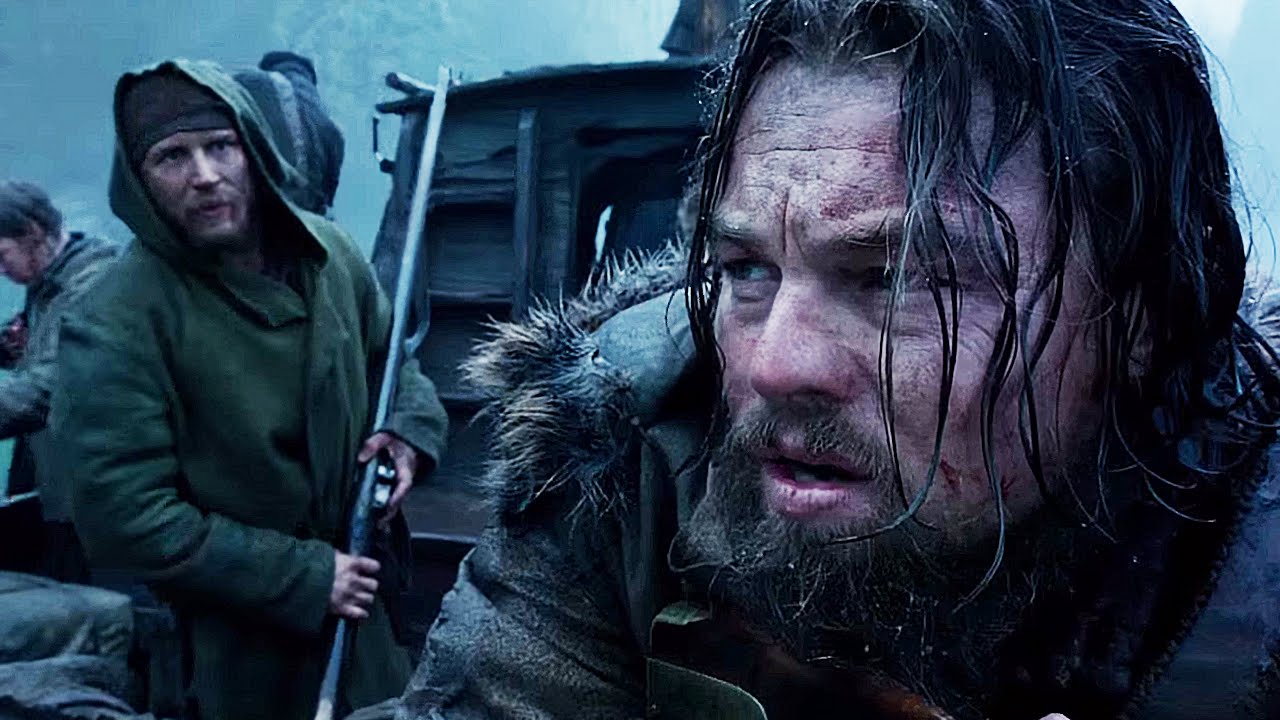
Hugh Glass (played by Leonardo DiCaprio) will soon find himself at odds with his former trapping partner John Fitzgerald (played by Tom Hardy at left) in The Revenant.

If there’s one movie that’s had its box office results significantly after the nominations, It’s The Revenant. If you’ve seen it already, you’ll easily see why it could have done excellently even without the Oscar buzz.

It’s 1823 in an unsettled wilderness part of the northern area of the Louisiana Purchase. A group of trappers under the command of Captain Andrew Henry search for pelts until a surprise attack from Arikara Native Americans kills many from the camp and cause the survivors to flee on a boat. Part of the camp is Hugh Glass who is on friendly terms with the Natives–even being a widow to a Native American woman and fathering their ‘half-breed’ son Hawk who’s part of the camp– and knows the area well. At Glass’ recommendation, they abandon ship and walk on foot to return to their outpost Fort Kiowa. This does not settle well with some of the trappers including John Fitzgerald who has a hostile attitude towards Natives after being scalped years ago. He is noticeably hostile to Hawk.

Glass scouts ahead alone for a while but he is mauled by a mother bear protecting her cubs. The attack is brutal and Glass is severely mauled but he’s able to stab the bear. The other people in the camp find Glass but doubt his chances for survival. Henry commands to three men in the camp–Hawk, Fitzgerald and the young Jim Bridger–to stay with Glass until he dies and give him a proper burial. Fitzgerald tries to smother Glass when alone but Hawk stops him. Unfortunately stabbed is killed by Fitzgerald as Glass can only lie and watch. Fitzgerald attempts to bury Glass prematurely but stops when he sees Bridger flee and follows.

Abandoned with only a canteen, Glass is somehow able to survive and slowly heal. Days later, he’s able to heal to the point he can move, then crawl, then walk. As he heals he’s haunted by visions of his deceased wife. He even sees visions of her as he comes across an abandoned church. However he also has to deal with the Arikara whose chief is searching for his kidnapped daughter Powaqa and trusts no white man.

Both Fitzgerald and Bridger are heading to Fort Kiowa but Fitzgerald scares Bridger into being fully under his control. One at the Fort, Fitzgerald tells Henry that Glass died and Hawk was attacked by the Arikara. Henry gives both Fitzgerald and Bridger a cash reward. Fitzgerald accepts without guilt but Bridger refuses.

Glass encounters Hicuk, a friendly Pawnee who gives him food and shelter and helps him along the path back to Fort Kiowa. Hikuc has also lost his family. Upon hearing from Glass his intent for revenge, he tells Glass “Revenge is in the Creator’s hands.” The day after the blizzard, Glass wakes to find Hikuc hanged by French pelters. Not only that, he finds Powaqa being raped by leader of the French pelters. He’s able to kill the two leaders and free Powaqa but has to escape with Hikuc’s horse and Bridger’s canteen. An ambush by the Arikara causes Glass to flee on horse only to fall off a cliff. Glass survives but the horse is dead. Glass uses the horse’s carcass as a shelter overnight.

Meanwhile word has gotten around to Fort Kiowa that Glass is in fact alive. This is known as a French hunter brings Bridger’s canteen there. Henry however thinks it’s stolen from Hawk and organizes a search party but Fitzgerald knows the truth and flees. Henry finds Glass alive in the search. Infuriated, he charges Bridger with treason after returning to the Fort but Glass insists it’s all Fitzgerald’s doing.

The operation then goes to find Fitzgerald and bring him to justice. Henry however is caught by Fitzgerald in an ambush and is killed and scalped. It’s now up to Glass who hatches a plan to finally get his revenge. It works in catching Fitzgerald and having him shot but not without Fitzgerald being able to run off. It then comes down to a fight between the two for Glass to get his revenge. It ends with Glass making a decision and an ending we’re all left to decide for ourselves Glass’ fate.

Now just to get things straight, this is not the true story of Hugh Glass getting revenge on John Fitzgerald. In fact historic documentation shows Glass let Fitzgerald live because he knew the heavy penalty of killing a soldier in the U.S. Army. Fitzgerald became a soldier in the U.S. army and was stationed in Fort Atkinson, Nebraska. Fitzgerald did give Glass his rifle back.

This film is actually a revenge story adapted from the 2002 novel The Revenant: A Story Of Revenge by Michael Punke. I think the focus of the film is more about telling the story than it is about retelling history. I have not read Punke’s novel but I’m sure that was how Punke would have wanted Fitzgerald to face the music upon abandoning Glass to die. There is actually very little information about who John Fitzgerald was or even what type of person he was in real life. We have the historical documentation of what happened to Glass and what happened in his pursuit of Fitzgerald but not much else. The novel was not only Punke’s chance of creating his own revenge fantasy in Fitzgerald but giving Fitzgerald a character of his own. The film helps Punke’s story come alive and even paint a picture of Glass, Fitzgerald, the times, the terrain and the domain of all that happened.

This revenge story is not your typical revenge story you’d see in your typical Hollywood movies or even from the likes of Quentin Tarantino. This revenge story is also a story of survival and also shows a human side of the perpetrator Hugh Glass. Yes, he was as tough as a frontiersman and a trapper of the time should be. However he did have a soft side. He still has feelings towards his deceased wife who was a Native American woman and he truly loved his son despite others seeing him as a ‘half-breed.’ He also had to be tough as he needed to survive the brutal bear attack and recover from his wounds in order to pursue Fitzgerald. He also had to develop the will to live knowing that his son was killed by Fitzgerald. He also had to be right in his mind in deciding what he had to do to Fitzgerald in the end.

I will admit there were times when I questioned if this film was becoming too much of a tall tale. One example is when seeing Glass pursue Fitzgerald in what appeared to be just days before his attack. I often asked: “Would someone who suffered such a brutal bear attack recover in that fast of a time?” Even that scene where Glass and his horse fall off a cliff. The snowy tree broke Glass’ fall and helped him live without any severe bodily damage but the horse died. That scene also had me scratching my head. Maybe those scenes and the elapsed time were also part of Punke’s novel. Nevertheless it still had me questioning its believability.

First off I’d like to give respect to Alejandro Gonzalez Inarritu for delivering an excellent movie. He may be renowned for his ‘filmwork’ but here he takes his first steps in directing a movie intended to draw big crowds while still maintaining some top film making qualities. Very little was compromised and the end result was excellent as it both succeeds as a film and as a movie. I’ll admit I was unhappy about Birdman winning Best Picture last year because it didn’t give much for a film audience to either enjoy or appreciate. Yes, it had top-notch acting, directing and scriptwriting but who truly enjoyed it?  This is ten times more enjoyable while still maintaining top acting and directing. Yes, there were some scenes that can scare many. In fact I’ll admit the film made me hope I never walk in the woods again. Nevertheless it was a very good movie full of drama and thrills. As I said, I have never read Punke’s novel but the script Inarritu co-wrote with Mark L. Smith definitely makes the novel come alive. I know the script was not nominated for an Oscar. However the unspoken scenes in the movie told as much as the scripted scenes.

The film would simply be a popcorn movie if it weren’t for the acting. Leonardo DiCaprio did an excellent job of Hugh Glass. He said a lot especially in the scenes where Hugh Glass was unable to speak. His performance was as much about telling a lot through physical actions as it was through dialogue. Hey, it’s been said 80% of communication is non-verbal and Leo was able to say a lot in those scenes. That’s why I’d be shocked if he doesn’t win the Oscar. Also just as excellent is Tom Hardy. He didn’t play your typical rotten-to-the-core villain. He gave John Fitzgerald some fears and insecurities to the role and conveyed them well. Nevertheless he also made Fitzgerald hateable as a remorseless villain who even calls the dead Hawk a ‘pussy’ in Glass’ face. Additional performances of respect include Bill Poulter as Jim Bridger, the young trapper who possesses the conscience Fitzgerald lacks, and Forrest Goodluck as Hawk.

Additional qualities of acclaim is the cinematography from Emmanuel Lubezki, the costuming by Jacqueline West including its use of furs and hides, the film editing by Stephen Mirrione, the visual effects including that of the bear attack, the excellent use of both natural settings and constructed sets that fit the times and scenes perfectly and the film’s score by Ryuichi Sakamoto, Carsten Nicolai and Bryce Dessner.

An additional note. I also give the film respect for its treatment of Native Americans. I may have been a baby when Sacheen Littlefeather refuted Marlon Brando’s Oscar on his behalf and spoke of his protest to the on-screen depiction of Native Americans or First Nations peoples as Canadians commonly refer to them as. However I already know of Hollywood’s past and how they’re famous for shelling out ‘cowboys and indians’ movies from decades past. I can completely understand why Brando would have been angry with that depiction as Brando has had a history of activism in the 1970’s on behalf of people of various races. I will admit Hollywood has been better at its depiction of indigenous Americans from films like 1990’s Dances With Wolves and even the character of Chief in One Flew Over The Cuckoo’s Nest that was shown in theatres a mere three years after Brando’s Oscar protest. I’m sure there are some people that can spot imperfections in Hollywood’s current treatment of Native Americans including in this film but I found it hard to pinpoint a scene that was insulting to them. Sure there were battles with tribes and there were bigoted attitudes among many white characters but there were many positive Native American characters in this movie. In addition the main protagonist Hugh Glass had positive interaction with the Native people including marrying one and treating his son with love while many despised him as a ‘half-breed.’

The Revenant isn’t just a dazzling movie. It’s one that will keep you intrigued from start to finish and not know what to expect next.