VIFF 2025 Shorts Segment Review: Forum 6 – City slickin’

What can I say about short films? A lot of them are good and can often promote an emerging director. The latest Shorts forum I saw was Forum 6: City slickin‘.

As you can tell by the title, the series revolves around situations in cities. The cities in the six shorts are in Spain, Belgium, Jordan, France and two in the Unites States. All six make for some great tales:

-Budget Paradise (USA – dir. Latajh Simmons-Weaver): Chester is a non-binary artist looking for an area to paint in peace and inspiration. They are told to leave one public place. They go to an art store and steals $97 worth of paint. They try a café for artists, but the cashier gives them attitude. They try a hotel for a two-hour stay in a suite promising to pay. The model they hire attracts them, but the hotel owner demands they pay.

Trying to get art done wherever and whenever. A common artistic dilemma. This adds humor as Chester finds bad place after bad place, has to steal paint, gets caught up in a street dance and the the one place they can find, it demands pay. A humorous story how one steals paint and coaxes their way into creating their art.

-Our Room (Spain – dir. Jaime Claret Muxart): Gal-la is a disc jockey at a Spanish radio station for its classical music show. She brought along her younger son Marius to watch, but he’s bored. She is also unhappy in her setting. She thinks to how her French-speaking husband Paul is into electronic music. It’s there she decides to quit and the three of them can start their own home radio station that fuses classical music and electronica with Marius’ keyboard!

It’s hard to picture something like this happening in real life where they can make a radio station at home, but it makes for a fun story. I believe the theme of the story is about family relations and family closeness. The beginning seems a bit drawn out or elongated. The ending, however, is happy and you’re left convinced that’s how it should be.

-Father Alphonse and the Fight Between Carnival and Lent (Canada – dir. Diana Thorneycroft): Father Alphone is a new priest and his first mass is to be on Ash Wednesday. As he readies himself, it’s Fat Tuesday and all the people in town are having a blast with all their pre-Lent debauchery. Something his strict father forbade him to do throughout his life. As he walks through town, he’s shocked by all the debauchery but finds himself in an unexpected tangle. That leads to a humorous and unexpected ending.

This short by Winnipeg animator Diana Thorneycroft was inspired by the 16th Century Belgian painting The Fight Between Carnival And Lent. This charming stop-motion short is a case where life imitates art for the new priest and he get tangled in with behaviors his strict father would condemn of! It’s cute and humorous and a delight to watch.

-Ambush (Jordan – dir. Yassmina Karajah): In a conservative area in Jordan’s capital Amman, a hall is turned into a techno club and makes a lot of noise in the normally quiet neighborhood. Hasan, a young man, watches the club from his family rooftop and anticipates an encounter one day. One of the attendees, Jana, is a recovering alcoholic wresting with her own love issues. Can they connect?

The story has two themes in one. One is about people’s desire for love. The other is about how what we see from the outside isn’t completely what we think it is. Hasan watches from afar and thinks they’re all having fun while Jana shows a reality Hasan can’t notice from that far away. As time passes, you think they won’t connect. The ending could get you thinking otherwise.

-There’s A Devil Inside Me (USA – dir. Karina Lomelin-Ripper): Teenage girl Teresa is about to be confirmed at her Catholic church. She struggles in her confirmation class as other girls have attitude. As she struggles with her faith, she dons a nun’s habit as a mass is taking place. An altar boy mistakes her for a real nun and hands her all the collection money. What’s she to do with the money she’s given? Especially after her bratty little sister lost a tooth and swallowed it?

Watching a film like this can cause one to question is this is blasphemy or just simply a film about a mistake that happened. Teresa makes for a believable story of a teenage girl who’s trying to work things out with her life, her faith, her romancing boys and her place in the family. It does make for a bizarrely far-fetched comedy that gives an ending you can laugh at either way you see it.

-No Skate! (France – dir. Guil Sela): Isaac is a student who’s hired to promote swimming in the Seine River. He notices Cleo, his colleague, get into a fight with her skateboarder boyfriend. He sees it as a chance. She’s reluctant, even though they do date and she gets him to spend the night with her. Cleo insists it’s just a friendship, but is it?

New love can come from the unlikeliest of people in the unlikeliest of places. Even the type where one tried to make like it’s not really love. This is a boy-meets-girls story that is slow and leads to an ambiguous ending. Even if you’re left undecided if this is new love or not, the story is funny and charming.

And there they are. Those are the six short films part of the City slickin‘ forum. All of them were unique in their own way and all six had a good story to tell.
VIFF 2018 Review: Petra

Petra film
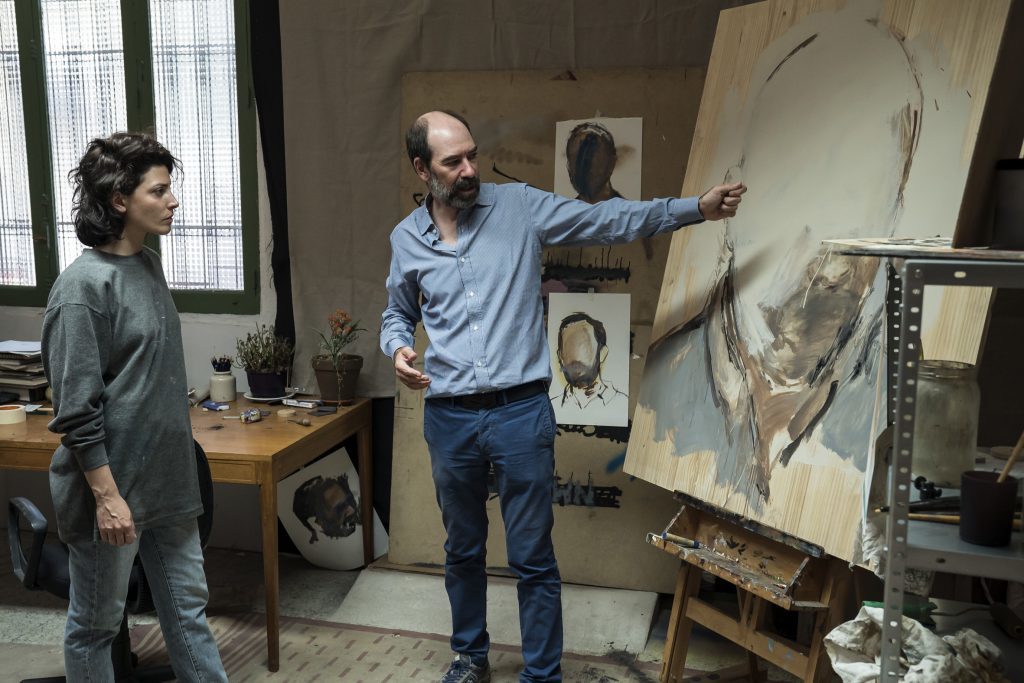
Petra is the film of an artist (played by Barbara Lennie) who seeks tutelage from a legend (played by Joan Botey) but gets more than what she bargained for.

Interesting how a lot of films I’ve seen at the VIFF are to do about deep dark secrets being exposed. Petra is one of those films that exposes some dark secrets.

The film is seven chapters starting with the second chapter. Petra is a young budding artist. She is arriving at the estate of a well-known artist named Jaume. Over at the place, we sense an unhappy vibe. The house consists of wife Marisa, son Lucas, housekeeper Teresa, her husband Juanjo and their son Pau. She is seeking artistic guidance from Jaume, but gets nothing but insults from her. That leads her disheartened with her own work. Jaume is actually a tyrant to everyone he works with. Lucas talks with Petra of a dark ‘confession’ and tries to advance to her, but she rejects.

In the third chapter, Jaume had just finished having sex with Teresa. He criticizes her for not enjoying the non-consentual sex and threatens to tell Pau. Teresa later commits suicide. At the funeral Lucas looks at his father with contempt. Moving to the first chapter, Petra’s mother is dying. She tells of an artist she loved. However she does not reveal it to be Jaume. She doesn’t want Petra to have Jaume in her life. In the fourth chapter, Petra confronts Jaume with reason to believe he is her father. She tells him of a letter her mother wrote years ago. Marisa later admits there has been infidelity in both their lives. Throughout their marriage, they both have had their share of various lovers.

In the sixth chapter, Jaume does admit to Petra that he is her father. Right as Petra is pregnant. He also tells that truth to Lucas. Lucas is infuriated. He tries to shoot Jaume but Jaume reminds him he doesn’t have what it takes. Instead Lucas shoots himself. In the fifth chapter, we learn that Petra and Lucas have become more than just friends. They even get romantic. In the seventh chapter, the people try to deal with their lives after the death of Lucas. Marisa confesses to Petra that Lucas is not Jaume’s son, but the son of an extramarital affair she had. Petra is infuriated and tells Marisa never to see her again. Jaume is seen conversing with Pau. Then as Jaume walks away, Pau shoots him dead. The film ends with Petra looking after her daughter and Marisa showing up as a meeting of goodwill. The film ends with them conversing together in a friendly manner.

The film is definitely one in which goes from something simple to being a film where dark truths are exposed. At first you think Petra is there to see Jaume to learn how to be a better artist. That would appear to be the case. However then it becomes clear that Petra is soon after a truth. A truth that could not just destroy Jaume, but those around him too. In time, a truth about Marisa is also exposed. Dark secrets come to the forefront and a lot of lives are destroyed because of it. You sometimes think there’s no way the film would end with anyone at peace, but somehow it does.

The unique thing about Petra is not just telling the story, but doing it in a non-chronological order . This may be a film of seven acts, but it begins with act two, continues with act three, but then leads into act one. There’s also the shift from act four to act six, and then leading back to act five. That shifting around of the acts works because the film presents itself in situations that has the viewer asking why the situation? Why the friction? It’s when it goes back to the recent past that we get the answers why. This playing around in time, just like it’s done in Pulp Fiction, works for telling the film’s story.

Also it’s unique how this film takes place in the world of art. I know I’ve seen a lot in terms of the freeness or even the foolishness of the way actors live out their love lives. It’s interesting seeing this about an adulterous artist whose wife is just as adulterous. It often leaves you wondering if they lived a strained marriage where they decided to stay together for the sake of Lucas? Or were they an open marriage? There are a lot of open marriages in the world of arts and entertainment. It makes you wonder.

Whatever the situation, the film sometimes seems it’s as much about Jaume as it is about Petra. Petra is a woman searching for the truth and relating to the people she meets along the way. However the film shows just how much of a monster Jaume is. I know that arrogance is common among artists and even berating behavior, but Jaume appears to be a person with no conscience. He berates the artists he works with and Petra’s work, he berates Lucas for being unable to break away from him, he lures his housekeeper in sexual temptation, and even appears at the end as if he doesn’t care about Lucas’ death. It’s no wonder after Jaume is shot to death, Petra and Marisa appear to be at peace as they meet. I think that was it about the film. Jaume was the tyrant in people’s lives and Petra would be that missing link that would free others.

This is the latest film from Spanish arthouse director Jaime Rosales. Rosales has developed a reputation over the years starting with his 2003 short film The Hours Of The Day which won the FIPRESCI Prize at Cannes, his 2007 feature Solitary Fragments which received a lot of critical renown, and 2014’s Beautiful Youth which was nominated for Un Certain Regard at Cannes. Here he directs a story he co-wrote with Michel Gatzambide and Clara Roquet. He places it in an artistic setting with a mostly quiet environment, but that doesn’t take away the intensity of the friction. Instead the quiet slow nature makes you feel the friction. Barbara Lennie does a very good job of playing the lead protagonist, but it’s Joan Botey playing the tyrant Jaume that steals the show. Both do an excellent job of managing their roles well.

Petra is a film that tells a story in a varying chronological order. However it does so to get us to the heart of the story in a surprising way.