VIFF 2014 Review: Queen And Country

All is fair in love and war in Queen And Country.
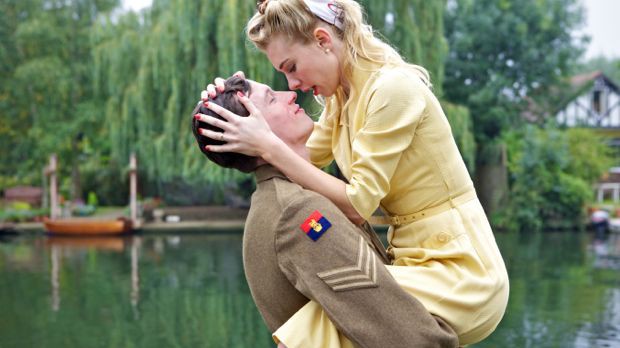
All is fair in love and war for a grown-up Billy Rowan (played by Callum Turner) in John Boorman’s Queen And Country.

Remember Hope And Glory from 1987? The sequel to it, Queen And Country, came out this year and it’s a good film on its own even for those who didn’t see Hope And Glory.

Seven years have passed since the end of World War II. Billy Rowan is now 18 to 20. Since the war he and his family live on an island surrounded by the Thames River which has become a popular spot for filming. Billy however is still a bit of a sissy for his age. However being commissioned for military service may just change that. Before he arrives for training, he meets another young man his age named Percy Hapgood on the train. However he also meets an older woman named Ophelia in the town nearby his training base.

During military service, he goes from simply training to actually having positions of authority, albeit in typewriting class. Both he and Percy do not take well at all to their general Redmond whom they feel to be a hard-heart with no sense of humor at all. Also at their age, they want to have fun with the ladies. A certain girl at the local pub Sophie fancies Billy but he’s off pursuing Ophelia.

Over time Billy gains the respect of the elders and the friendship with Percy grows to the point he helps Percy to steal an office clock Redmond values. Billy even makes returns to the family, one time bringing Percy along whom younger sister Dawn fancies and another time bring Ophelia. Despite all the fun, realities do settle into Billy. The age of Ophelia will prove to be an unavoidable factor. The truth about the prank to steal the clock will come to light for both Billy and Percy as one head officer had already been stripped of his title. And the reality of war becomes more and more eventual for Billy as Britain enters the Korean War. This paves the way for an end that’s both happy, sad and funny for all who are involved.

The best thing about the film is that it is excellently made and it is entertaining. Seeing a young male of 20 being drafted with the British armed forces and all the irresponsibility and shenanigans that come with it does make for an entertaining show. It’s also a treat for those who saw Hope And Glory to see Billy now all grown up and now being placed into the possibility of fighting in a war himself. Whatever happens all turns out for the humorous and things do work out in the end despite paying the consequences.

It also makes one question if this film is autobiographical from Boorman just like Hope And Glory. I will admit it doesn’t have the same special uniqueness Hope And Glory had. For those who remember, Hope And Glory was World War II through a child’s eyes. It was actually one of three films in 1987 that showcased World War II through a child’s eyes. The other two being the French film Au Revoir les Enfants and Spielberg’s Empire Of The Sun which starred a 14 year-old Christian Bale and a not-yet-famous Ben Stiller. Queen And Country was not as unique as there have been other stories before. Nevertheless it’s very entertaining and more comedic than Hope And Glory.

This film is not too heavy of a political statement. However it does have some political messages with the potential of fighting in the Korean War. Another notable underlying message is the change of power after King George dies and the monarchy is transferred to Queen Elizabeth. We forget that Elizabeth was a mere 26 when she came onto the throne and a lot of people were not that confident in her at first. Interesting because she would be the one who turned the British Empire into a Commonwealth. Even British attitudes of what’s ‘manly’ also add to the theme of the film.

My big dilemma is I wonder why Boorman took so long to make a sequel to Hope And Glory. Queen And Country takes place at least seven years after the setting of Hope And Glory. It’s a wonder why such a film was not released back as say 1994. In fact I think that has to be the biggest weakness of the movie, its late release. I’m sure the movie can attract people who saw Hope And Glory back when it was first out but twenty-seven years is a long time to release such a follow-up story. Also I’m sure most of today’s movie crowds may not be familiar with the story of Hope And Glory. If it was released as say 1994 as I suggested, I’m sure there would be more of an audience interest especially since a lot of them can remember the adventures of Billy Rohan and would want to see how Billy grows up.

John Boorman again delivers a film of excellent direction and writing. Calum Turner did a very good job playing the grown-up Bill Rohan both in his character and as a young adult getting in trouble. Caleb Landry Jones was a scene-stealer as Billy’s partner in crime. Tasmin Egerton was very good as the seductive but confused Ophelia. Pat Shortt however did the best character acting as the shrewd Officer Redmond. The supporting actors also added into the film even if their parts were minor.

VIFF Note: The Vancouver International Film Festival is where Queen And Country made its North American debut. Aren’t we lucky?

Queen And Country is an excellent sequel to Hope And Glory, albeit badly timed. Nevertheless it was entertaining and worth watching.
Movie Review: Lincoln

lincoln-2

I’m sure almost all of us are familiar with Abraham Lincoln. Even if you don’t live in the United States, you must have learned about him and his presidency somehow. Steven Spielberg has directed the epic biographic movie of Lincoln. Will it show the Lincoln we know or the Lincoln we don’t know?

It’s January 1865. Lincoln has been re-elected President back in November. However the Civil War is entering its fifth year. It has been the most brutal war on American soil in terms of destruction and fatalities. The Emancipation Proclamation, the law completely abolishing slavery, is being debated in the US House of Representatives. Politicians from both the American states and the Confederate states debate it. Both sided stand firm in their beliefs. Meanwhile Abraham Lincoln and Thaddeus Stevens–a strongly anti-slavery Republican who demanded total war on the Confederate States– are waiting and debating as the Proclamation is nearing its vote into law as the Thirteenth Amendment. However the Republicans want the vote delayed because they fear the outcome and want the War to end. Lincoln doesn’t want to wait. He wants slavery over before the Confederate States can be reintegrated.

This takes an impact on how people view Lincoln. Lincoln is one president who’s willing to meet with Civil war soldiers on the ‘Yankee’ side and hear the stories they have to tell. Many politicians view him as a wise communicator who always has an interesting tale of past history that will make one think about the present. However Lincoln loses some appeal as he’s unable to convince Republican Party founder Francis Blair in his method of dealing with the Confederates instead of peace negotiations. He even senses possible political tension in Stevens desire for racial equality included with ending slavery, fearing the Thirteenth Amendment won’t pass. He a meets up with Secretary of State William Seward with a plan to convince the Democrats to support the amendment with offers of federal jobs.

His family life is also impacted by this all too. Lincoln is adored by his youngest son Tad. His wife Mary is known for her outlandish mouth and is frequently involved with spats with Abraham and even breaks down whenever their late son Willie comes up in conversation, especially since it’s possible their oldest son Robert might have to fight. Meanwhile Robert returns home from his law studies as he had just been named Union Captain to General Ulysses Grant. He’s studying to be a lawyer like his father but is willing to fight in the war if he has to. That leaves Abraham very uncomfortable and even coming to some confrontations with Robert.

Then the day comes for the Emancipation proclamation to be voted upon. Lincoln has gone far to get this voted upon fast to the point of even instructing Confederate envoys to be kept out of Washington. This was a moment of focus for all the nation. In the end, the Emancipation proclamation was voted into law by a margin of just two votes and the abolition of slavery was sealed as the Thirteenth Amendment of the American Constitution. People outside the White House, both black and white, celebrated. Lincoln finally meets with the Confederate envoys after the vote but they were willing to rejoin the Union if they could prevent the amendment from becoming law. Lincoln sent the message: “Slavery’s done.”

It would take time for the Civil War to end: April of 1865 to be exact. Then on April 14, 1865 Lincoln is in a meeting discussing measures to give suffrage to blacks when he is reminded Mary is waiting for him at Ford’s Theatre. That night…the rest is infamy. Nevertheless we’re reminded of the man who is an integral part of history with a flashback to his Second Inaugural Address.

The best thing about the film is that it does not just focus on Lincoln the maverick politician but Abraham Lincoln the person. He was a friendly talker and did his best to be a good father and a loyal husband but he was also stern in what he believed. It was not perfect because he wanted the Emancipation Proclamation to pass but knew that mention of equality for blacks would deter many Representatives from giving it a ‘Yay’ vote.  He was as much a strategist as he was an idealist. He knew any chances of equality would be a step-by-step procedure and emancipation was the first step. He knew of the bloody war happening and of the Confederate’s rebellion but he knew it had to be done.

Another excellent quality of this film is that it shows the political climate of the time. We should remember that the United States of America wasn’t even a century old at the time and slavery had existed in the South long before the United States of America was formed. There were many laws and disputes debating free states and slave states over the years to the point that slavery was going to reach its end but the South refused it to the point they would form their own nation: The Confederate States of America. The North, the United States, wanted to see slavery end throughout the whole United States and were even willing to have this war to make it happen even in the South. The South, the Confederates, knew that they would lose but they valued slavery to the point that they were willing to fight for it in such a brutal war. Even though they knew they were losing, they were willing to fight for it over these four long years and despite the huge losses they suffered.

The debates in the House Of Representative from the various states’ Representatives showcased the ideologies both the United States and the Confederate States felt. Nowadays we all can’t imagine slavery from happening but back then the South valued slavery to the point they would try to start their own independent nation and fight a long bloody war to keep it alive. And even the politicians in the American offices upheld their convictions in debates. The film also reminds us that the Emancipation Proclamation may have been written by Thaddeus Stevens and introduced to the House Of Representatives by Lincoln but it required the House to vote it into law. It almost didn’t happened and if it didn’t, Lincoln may have gone down in history as one of the lesser Presidents of the United States. We’re reminded in the film what kind of gamble Lincoln was making.

Another thing to notice in the film is Spielberg’s infatuation with war. We have seen it before with World War II with Saving Private Ryan and Empire Of The Sun, World War I with War Horse and we see now see Spielberg’s depiction of the Civil War and it has a lot of details. It details the artillery that was used at the time. It details the gruesome destruction and bloodshed that occurred. It even depicted the communication between officers and of relaying news to soldiers via Morse Code. Spielberg does it again.

Spielberg gives another directing effort under his belt. Already we know Spielberg to master sci-fi thrillers, sci-fi family adventures, and war dramas. Now he creates an ideological drama that focuses less on the war and more on the focus of the historic individual and the times he was facing. The film did an excellent job in focusing on the political climate of the times as much as the main politicians involved. The film however couldn’t have been done without the excellent acting. Daniel Day-Lewis gave an excellent performance as Abraham. The may have focused mostly on a single month of Lincoln’s presidency but his performance spoke volumes of the President we thought we knew. The movie however was stolen frequently by Tommy Lee Jones as Thaddeus Stevens. Tommy Lee did a great job in showing Stevens in his mannerisms, beliefs and how fierce of a man of conviction he was. Sally Field was also excellent as the troubled Mary Lincoln. History has documented her as a woman with mental illness. Field’s performances showcase her outlandish personality but also shows her as a woman both troubled by her losses and fearing for her future. Joseph Gordon Levitt was not so good at undoing his body and talking from modern mannerisms but he was better at conveying Robert the person in his ambitions and fears.

The screenplay by Tony Kushner is an excellent adaptation which is able to make that one month in 1865 to be the defining month in the legacy of Abraham Lincoln. It was as much focused on political details as it was on the people involved. John Williams delivers another fitting score to his list of movie scores. Janusz Kaminski gave good cinematography but there were many times I felt the use of zoom-ups were excessive. The depictions of war in the movie were mostly graphic only at the very beginning but were very well-detailed in not just the battles taking place on screen.

Lincoln is a surprising outlook on a president we’ve all come to know and celebrate but didn’t completely know. It’s also an excellent presentation of the political climate of the times. This reminds us of his celebrated greatness and how much of a gamble he made not just with his life but his political status to achieve it. Definitely worth seeing.