NOTE: I may have ‘published’ a previous version of this review. It was accidental as I meant to save instead of publish. Here’s the complete review.
There have been a lot of LGBTQ-themed films done in the past twenty years. Carol is the latest big film to be shown on the big screen. However it’s not your typical gay-themed film.
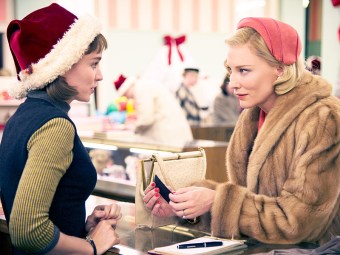
The film begins in a scene set in the future. Then flashes back to Therese, a young 20-something woman working the toy section of a Manhattan department store. A glamorous older woman, Carol Aird, consults her for what to buy her daughter for Christmas. Therese recommends the train set and she buys one. However Carol left her gloves behind in which Therese mails to her from the address on the sales slip.
Both women have difficult lives. Therese is in a relationship with a man and longs to be a photographer. Carol is in a marriage near divorce and in the midst of a tight custody battle with her daughter. However Carol is able to get Therese to meet up for lunch. The friendship starts to grow and Therese is able to take pictures of Carol for her photography habit. On Thanksgiving, Carol invites Therese over to her house but it does not go well with her husband Harge as he knows Carol had a relationship with a woman named Abby last year.
Carol visits Therese on Christmas and gives her a state-of-the art Canon camera. Carol also reveals to Therese the details of her divorce and how Harge plans on having a ‘morality clause’ against her in an attempt to win their daughter Rindy in a custody battle. Carol plans an escape for the two of them around New Year’s Day in a remote Iowa town to get away from the difficulties of their lives and to finally have time for the two of them together. It works on cultivating their relationship but it’s interrupted as it is learned an investigator was hired by her husband to track her lesbian relation. Therese is driven by Abby back to New York.
In the meantime Carol is in a difficult situation as she is to decide whether to love Therese or give it all up for the sake of winning custody of her daughter. Months pass and Therese is now working as a photographer with the New York Times and Carol is seeking psychotherapy for the sake of winning custody of Rindy. Carol attempts to reconnect with Therese at a lunch at The Ritz but is interrupted by a former co-worker of Therese’s. The film ends with the moment many believe was meant to be.
The thing about Carol is that it’s not only about love but about the times too. Cate Blanchett even describes the story as ‘like Romeo and Juliet, only Juliet and Juliet.’ Todd Haynes is a gay director himself and he has delivered films with gay-themed subjects. Here he presents a love story situated back in 1953. The story reminds us of the times of how GLBTQ people were limited in terms of rights if they even had any at all. We shouldn’t forget that homosexual acts were criminalized until the 1970’s and the homosexual attraction was considered a form of mental illness up to 1973. Knowing that would make one understand the situation Carol would have to face: to choose between custody of her daughter or pursue who she loves. Nowadays the courts would be more favoring towards the GLBTQ person but back then homosexuals always lost such a custody battle.
The film isn’t completely about presenting a gay scenario from back in the past. The film is as much about the two main characters Carol and Therese. Carol is of the more upper class but is longing to break free of her loveless marriage to pursue her heart’s desires and live the life she was meant to. Therese is a young 20-something looking for something better but finds it with Carol. It’s as the two find love through each other that they know there are better lives for them. However it’s not to be without obstacles like a boyfriend questioning, a suspicious husband and a judgmental society.
The film is actually based on a novel from Patricia Highsmith entitled The Price of Salt. I’ve never read the novel but I get a good understanding of it from seeing the film. Interestingly is that after reading over Highsmith’s biography, one could sense the film is about some of Highsmith’s own experiences. She herself was a lesbian who had relations with women during that very time set in the film. She even went under psychoanalysis while in her 20’s to marry a man but it didn’t work. Those were the times back then.
The film is excellently written out by Phyllis Nagy and directed very well by Todd Haynes. The only other two films from Haynes I ever saw was 2002’s Far From Heaven which also dealt with homosexuality in the 1950’s and I’m Not There which is something else. Remembering Far From Heaven has me convinced Haynes was the right choice to direct. Phyllis Nagy may only have one other script to her credit–HBO’s Mrs. Harris— but she does an excellent job in writing the story. The slow pace of the story succeeds in getting you to feel the characters and the situation. There have even been a few times I’ve thought that with this movie being released in 2015, the year the US Supreme Court legitimizes same-sex marriages in all 50 states, this film is a reminder of what they had to go through in order to achieve it.
The film also excels because of the acting. Cate Blanchett shines as Carol who possesses a shining confidence but struggles in a world that won’t accept people like her. Rooney Mara is also excellent as the young naive Therese who’s confused about herself but finds herself over time. Despite the two owning the film, there were other good supporting performances from the like of Kyle Chandler as the suspicious Harge and Sarah Paulson as Abby. The set design and costuming did an excellent job of taking the film back to the past. The cinematography added to it as well as the score from Carter Burwell which captures the intensity of the situation.
Carol is a story about a woman of her time who dared to be different and love even if it meant losing it all. It not only does a good job of telling the story but also the time of the story too.

 Jon The Blogcentric