
Oscars 2014 Best Picture Review: The Theory Of Everything

The Theory Of Everything is as much about Jane Hawking (played by Felicity Jones) as it is about Stephen (played by Eddie Redmayne).

When you hear about The Theory of Everything being about Stephen Hawking, you’d probably assume it’s about his scientific conclusions. You will actually be quite surprised.

Stephen Hawking is an astrophysics student at Cambridge in 1963. Stephen is awkward-looking, rather clumsy and already his imaginative thinking is being noticed by students and professors with varying reactions. One night, he meets Jane Wilde, a literature student. They form an unlikely couple with Jane actually taking an interest and liking in Stephen’s imagination.

The following year, there are two incidents that will change Stephen’s life: the first being a lecture on black holes which inspires him to write a thesis about time; the second being when he learns he has ALS–Lou Gehrig’s disease– and is given two years to live. Stephen becomes a recluse upon hearing the news but Jane tells him he loves him and will marry him. The two marry and they have a son Robert.

Stephen continues giving lectures as his condition deteriorates from using crutches to needing a motorized wheelchair and even talking with great difficulty. Jane is always there to help him but it’s becoming very hard on her. Nevertheless he continues to give lectures about black holes, evolution and time to top professors. Some professors find it erroneous while others praise it and give him an honorary doctorate.

Over time Hawking continues to win more acclaim in the science world including becoming a world-renowned physicist. Nevertheless the fame and his physical condition is making it hard for Jane both as a wife and as an educator. Upon her mother’s advice, she joins the church choir where she meets conductor Jonathan Hellyer Jones. Jonathan becomes a friend of the family but the birth of her third child causes suspicion from her mother if Jonathan is simply a friend. Jonathan senses the suspicion and leaves the family for a bit but Stephen tells Jonathan himself she needs him.

While Stephen’s in Bordeaux, Jane has a camping trip with Jonathan and the children and it’s obvious their feeling for each other are shown. The trip ends as Jane learns Stephen contracted pneumonia and needs a tracheotomy in order to fight this. Jane agrees. However Jane finds dealing with Stephen too difficult and hires a helper named Elaine. Elaine works well with him on the letter board. Then computerized technology comes in play and Stephen is able to communicate with a talking machine. He’s able to speak better with the machine than he did when he still had his own voice. It enables him to write a book where he dictates and Jane and Elaine type. The book, A Brief History Of Time, becomes a best-seller and wins Stephen worldwide renown. However it does mark the end of the marriage as he plans to accept an award in the US with Elaine instead of Jane. Nevertheless the film ends on a positive note leaving one to believe Jane and Stephen are still soul mates despite no longer being married.

The remarkable thing about the film is that it shows Stephen Hawking in a light we don’t normally notice. Yes, it shows Stephen and his scientific thoughts. Yes, it shows Stephen in his wild imagination. In fact there are times when it makes Stephen look like the Albert Einstein of our times. However it also shows other aspects of Stephen like how ALS can paralyze his body but not his mind. It’s safe to assume ALS made him a stronger person and the movie shows him acquiring his personal strength over time. He was expected to live only two years when he was first diagnosed and he’s still alive today. It shows how he won’t even let ALS stop him from getting a Penthouse subscription. It also shows him as a father and a husband but also a man with some personal weaknesses such as being sucked into his new-found fame and falling for his assistant Elaine.

But somehow it often appears the movie is not about Stephen. It appears more like it’s about Jane. We shouldn’t forget the film is based off of Jane’s memoirs of being Stephen’s wife. It shows Jane as she’s first attracted to Stephen despite being nerdy and having an eccentric mind. It shows her as the one who got Stephen out and living right after he learns he has ALS and even marries him. It shows her as the one that stood behind Stephen every time he gave a lecture on his Black Holes Theory even when top professors would dismiss it as rubbish. It also shows her as the one who helped Stephen write his legendary book with his talking machine. It almost appears like she was his arms and legs.

The film however does make Jane out to be a saint. It does show Jane’s struggle of being both a wife to a man with a disability. In fact it was the scene when Stephen is playing croquet just after his diagnosis and Jane sees how much it’s deteriorated him that sent me the message this movie could be about Jane. Despite Jane doing her best to be a supporting wife, there are times she can’t hide the frustration and it upsets her. Her frustration is a common frustration people who are spouses with disabilities go through. The film also shows Jane in another flawed light when she falls in love with Jonathan and has a long affair. This film highlights Jane’s own flaws as it highlights Stephen’s.

Without a doubt, the highlight of the film has to be the performances of the two leads. Eddie Redmayne was beyond dead-on as Stephen. In fact it’s the scene of the divorce where Eddie playing Stephen said more with  his face than his talking machine did that caught my attention. There were many times in the film Eddie was able to say more in silence as Stephen than when he was talking. From beginning to end he was excellent and embodied the ALS flawlessly. It wasn’t just the ALS. Eddie also gave us an inside look into Stephen’s imagination which adds to the character. Imaginative minds must be something for a topic for film this year. First Alan Turing and now Stephen Hawking. Felicity Jones was not only excellent but also did a great job of stealing the show. Her embodiment of Jane Hawking helps you get to know Jane better as well as have a new found respect for her. In terms of acting, this is mostly a two-person film. Nevertheless there were some good supporting performances from Charlie Cox as Jonathan and Maxine Peake as Elaine that added color to the story. Even the minor appearances of Stephen’s college mates and Stephen’s family added to the story too.

James Marsh did a very good job in directing, especially since he’s more of a documentarian (Man On Wire). This is his second feature-length film that isn’t a documentary and he does a great job of directing the story and bringing out the characters. Anthony McCarten did a great job of adapting Jane Hawking’s memoirs into a good story with great character depth. However it did often come across as a two-actor screenplay and could have added more depth to the other actors. The film had other great efforts too such as Benoit Delhomme’s cinematography, the score from Johan Johannson and added visual effects that dazzled.

The Theory Of Everything isn’t a perfect depiction of Stephen Hawking and his marriage to Jane but it is entertaining. We get to know the two better and feel for them both.
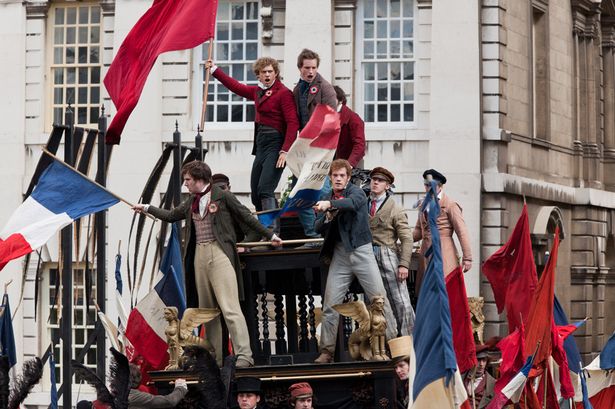
Oscars 2012 Best Picture Nominee: Les Miserables

Les Miserables

How many of you are familiar with the Broadway musical Les Miserables? Lots of you, I’m sure. Yes, Les Miserables was the one Broadway musical phenomenon from the 1980’s that could even have Andrew Lloyd Webber looking over his shoulder. When you heard that the musical finally would have a film adaptation, how many of you looked forward to seeing it? I’m sure a lot of you have including me, but does it deliver to movie crowds and especially to fans of the musical?

One thing I’ve learned about hit musicals being adapted to the big screen is that it’s a very tricky job. The whole filmmaking crew has the job of dealing with the fact the fans of the musicals want something that won’t disappoint them. The scriptwriter has the duty to make a script that includes the musical’s most popular songs mixed with the emotions of the characters in each scene. The director has the duty of making the songs, the emotions, the setting and the theme fit into a 2 1/2 hour long movie. The actors have the duty of delivering a performance that’s both believable and entertaining in both their acting and their singing, especially when a camera is filming them up close and it will be seen by all.

For the record, I saw the stage musical when it came to Canada in 1995. Most of the numbers possessed the same energy, spirit and emotion that was present in the stage musical. The only number I thought was lacking the same spirit was “Master Of The House”. That was the one number that had the least spirit and flavor that was present in the musical. Also Gavroche didn’t make that grand of an introduction. I know he does so in the stage musical but he just didn’t seem to grab you attention at the beginning the way he does on stage.

One thing I have to say about the film version is that it gave me a better understanding of what the musical is all about. Back when I first saw it on stage, I didn’t fully understand it. Now that I’m older and my attention span is better, I can understand it’s about redemption and the triumph and trials of justice in a world devoid of morals and justice. It was entertaining to watch on stage but it was through seeing it on film that it’s like a story from a Dickens novel where a man makes a promise to a dying woman and keeps his promise despite his trials and rivals until the end.

We should remember that there are many loyalists of the musical Les Miserables who hold the stage production dearly to themselves. The musical version of the Victor Hugo novel began in Paris in 1980 by Claude-Michel Schonberg and Alain Boulbil and became a musical on Broadway in 1985 thanks to the translations of Herbert Kretzmer. If you remember Broadway back in 1985 there were two types of musicals: those of Andrew Lloyd Webber that go on to charm the word and every other musical. Ever since it’s been released it’s become a huge Broadway phenomenon that could even rival some of Webber’s most legendary musicals. Every city it touched, it drew huge crowds. So you can imagine that when the film version of the musical came out, there would be a lot of pressure placed by fans of the musicals. It’s like that with any musical where loyal fans expect it done excellently if not perfect. There have been many musical adaptations that have been hits and misses in terms of comparing it with the stage play. Chicago and Hairspray are two examples where the film version hit. Rent and Nine are two examples of the film version missing. I myself have seen the stage production. I personally was impressed by it and I don’t see anything that would let anyone loyal to the stage musical down. I feel Tom Hooper and the producers did a very good job with it. I talked earlier about the energy of most of the songs still there. That had to be the best quality in terms of keeping it true.

There has been some flack from Tweeters and some fans of the musical about the use of actors in the movie. You’ve heard the disses: “Actors trying to sing.” I do give them partial credit because many actors had to learn singing for the sake of getting acting jobs in musicals. In fact John Travolta even made it clear after Saturday Night Fever that if you wanted to get acting work in New York, you had to sing, dance and act. Don’t forget that if there were singers in the film, there would be disses like: ‘singers trying to act.’

Anyways getting to the nitty gritty, one can notice those that are able to sing their roles gracefully from the actors just trying to sing. Russell Crowe gave his best effort as Javert but often came across as too forced and sometimes uncomfortable at what he was doing. Eddie Redmayne also didn’t look too comfortable performing as Marius. That’s the risk when you take when you insist on singing your parts instead of ADR. Hugh Jackman did an excellent job not just in singing and acting as Jean Valjean but also for being consistent in having the biggest role in the musical. Anne Hathaway as Fantine was however the best at combining both singing and acting in their role and coming across the most gracefully. In fact it was her performance of “I Dreamed A Dream” that stood out above all others. It’s no surprise to me if she wins the Oscar. The lead actors were not the only ones who impressed. Helena Bonham Carter and Sacha Baron Cohen did a good job in their supporting roles. Daniel Huttlestone was a good scene stealer as Gavroche is supposed to be. If there’s any fresh face that could rival the veterans, it’s Samantha Barks that was excellent in her supporting performance as Eponine.

Tom Hooper was given the difficult task of taking the musical and putting it on screen and he succeeded very well in doing it. William Nicholson also had the challenge of turning the script and songs of the musical and turning it into something for the big screen. He did a very good job of it retaining the spirit of the musical and of the songs. Also noticeable is that there are some scenes of dialogue. The stage musical doesn’t have that. Good to see he added those small parts of dialogue without dulling or upsetting the musical. As I said before, the music was great with Schonberg, Boulbil and Kretzmer even composing a new song ‘Suddenly’. The technical aspects like the sets, costuming, cinematography and sound mixing were also top notch.

Les Miserables finally has its chance to hit the big screen and faced a huge whack of pressures expected on any adaptation of a legendary Broadway musical before opening. The end result is an accomplishment, if not a triumph.

Movie Review: My Week With Marilyn

My Week With Marilyn is an adventurous comedy of a young man assisting on the set of a Marilyn Monroe movie. What we get is an interestingly adenturous story and a lot more.

Before Colin Clark became a successful British documentarian, he was dazzled by the movies and movie stars, including Marilyn. That didn’t rest well with his upper class family who felt that the movie business wouldn’t get him anywhere. Then in 1956, he hears the news that Marilyn Monroe is coming to England to film The Prince And The Showgirl. How could he turn down an opportunity to work on the set of a film like that?

Once he arrives on the set, Laurence Olivier arrives, Vivien Leigh arrives, Sybil Thorndike arrives and Marilyn arrives with her acting coach Paula Strasberg and husband Arthur Miller. Working with Marilyn is not easy as she often misses her cues and easily loses her confidence in believing she can do a good job. The other actors like Olivier, Leigh and Thorndike find her difficult to work with. The pressure is soon adding up on Marilyn, both physically and emotionally. In the meantime, Colin is winning the attractions of young costume girl Lucy.

Arthur Miller then leaves England for a short while. Marilyn decides to take a break from the pressures of filmmaking and movie stardom and finds her escape through having Colin escort her. Colin takes her around the countryside, around Eton College where he was educated in, just about everywhere every day. During the time, Marilyn develops an attraction to the young Clark and the two have a short affair. During the time, Clark learns that Marilyn is a hurting woman: burdened by a difficult childhood and often feeling like a failure as an actress.  This goes on for the week. During the whole escapade, he forgets about his date with Lucy. The filming end after a week and Marilyn leaves England for Hollywood. Colin is left with an experience he’ll never forget.

The unique thing about this movie is that it’s not just a young man’s adventure with Marilyn Monroe but also an intimate look at a screen legend who epitomizes the beauty and charm of Hollywood but also epitomizes Hollywood tragedy. Marilyn was made into a beauty that excelled in Hollywood. Nevertheless she always wanted to be taken seriously for her talent. She relied on her coaching from Lee and Paula Strasberg and often felt like a failure. Interesting bit of trivia is that Marilyn is the biggest Hollywood star never to be nominated for an Oscar. Never!  As a person, she had problems getting over her difficult past out being raised unloved by her mother. It would be an ordeal she’d go through throughout her whole life. She would eventually take her own life six years later.

The funny thing about the movie is that it wasn’t just about the empty feeling of Marilyn but also the empty feeling of actors in general. During Colin’s time on the set, he also dealt with Sir Laurence Olivier: an actor beloved for his mastery of great roles. He was the accomplished actor while Marilyn was the popular star. Nevertheless he too felt an emptiness of his own. He wanted the movie star acclaim that Marilyn had. That should surprise just about everybody. That’s a very common theme in this movie: an actor’s insecurities, traumas and feelings of emptiness. It hits movie stars like Marilyn and it hit great actors like Sir Laurence.

The most shocking thing is that we would learn from Laurence is that Marilyn’s traumas and insecurities are what make her the actress and legend that she is. It’s not that uncommon that we celebrate entertainers who are troubled and traumatized and all too often, their traumas and troubles make them the greats that they are.

It’s obvious Colin never forgot his experiences of this. He would release his diaries under the title The Prince, The Showgirl and Me and memoirs titled My Week With Marilyn. Both would provide the material for this film. It should be noted that the diaries were made into a television documentary in 2004, one year after Clark’s death.

The biggest strengths of the film have to be the performances of Michelle Williams as Marilyn and Kenneth Branagh as Olivier. They weren’t just performances of the two acting legends but very deep parts. They made the two actors three dimensional and they stand out as two of the best acting performances of the year. The performance of Eddie Redmanye as the young Colin Clark was good but lacked depth. It was a simple role not as Colin Clark but as a twentysomething. Emma Watson’s part as the costume girl Lucy was simple but she is able to make you forget that she is Hermione Granger.

Outside of the acting, nothing much else stood out. The direction of Simon Curtis and the writing of Adrian Hodges were good and flawless but not spectacular. Nevertheless it did make for an enjoyable comedy. In addition, I commend Curtis for directing an excellent first feature. In essence, it was a semibiographical movie whose best assets were the acting performances.

My Week With Marilyn is a surprising look at a screen legend. Make that two screen legends, and the young rising documentarian who witnessed it all. If you like legendary actors, you’ll like this movie and will leave surprised.