2015 FIFA Women’s World Cup: My Prediction For The Final

Womens CupIt took 50 matches to round the 24 contenders to the two finalists for the Women’s World Cup on Sunday. It was decided to be the United States and Japan, same as at the 2011 WWC. It was an interesting match where the game ended 1-1 in regulation and 2-2 after extra time. Penalty kicks gave Japan the win. Anyways Japan have a chance to repeat or the USA can get their revenge and their third Women’s World Cup in the process. However I will make my prediction here for who I feel will win the final.

Third-Place Match: Germany vs. England

Of course I have to make a prediction for who I think will win the bronze medals. We have two teams that are broken-hearted and you can’t blame them. Germany was ranked #1 in the world and sure played like it during the tournament until they got to the semifinals. There the Americans came alive and had their best win over the Germans 2-0. Especially biting for Celia Sasic as she has been the WWC’s top scorer and miss a penalty during that game. The German team was hoping for this World Cup to be the one where they can make a comeback. Even though it’s a big improvement over their quarterfinal exit from four years ago, the loss still bites.

I don’t think I need to explain the frustration England is going through. This World Cup was to be the WWC where the Three Lionesses finally came of age and they did in their quarterfinal win against Canada. Cheers came from all over including the most lauded male players in England. In their semifinal against Japan, they appeared like they had the advantage as they did most of the attacking and shooting. Then just in injury time in the second half came the heartbreaking own-goal from Laura Bassett. That ended it for them as Japan would win 2-1 and become the finalist instead.

Head-to-head play undoubtedly favors Germany as England has never won against Germany in their seven previous matches. Their last duel together was a year ago and Germany won 3-0. However anything can happen and this game could go to whichever team is the least disheartened.

My Verdict:

As heartbroken I am for Bassett, I will have to say that Germany will take it 3-1. The Germans just have that much of an advantage.
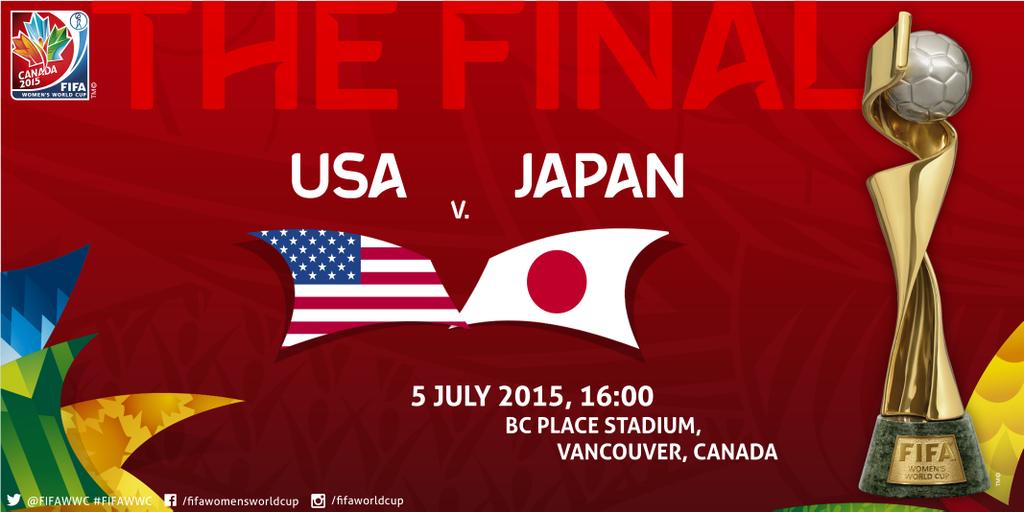
WWC FinalWOMEN’S WORLD CUP FINAL: United States vs. Japan

Team Overview

The United States- What can I say? The Americans have been the best performers of the Cup so far. They may have drawn against Sweden but they’ve had convincing wins elsewhere. Their wins have mostly been conservative but they’ve known how to deliver each time. It was their 2-0 win against Germany however where the Americans were finally starting to show their brilliance.

It’s not to say they’re a 100% bet to win the World Cup. We shouldn’t forget the US lost to Japan at the last World Cup final on penalty kicks. Also the two tied 1-1 in their most recent duel last year. It’s all up to the Americans to deliver.

Japan- Until 2011, the furthest Japan ever got at a WWC was a single quarterfinal. 2011 changed everything as they became Women’s World Cup champions. Nadeshiko has continued their success since with an Olympic silver medal and a Women’s Asian Cup victory. Here they appear on fire as they’ve won every single match they’ve played in Canada.

However there’s one thing about Japan people have noticed. They’ve noticed that they’re not always all together. In fact some even noticed some errors in their game against England. A lot of people are saying Japan’s just lucky. They will have to perform solidly and strongly in the final if they want to repeat as Women’s World Cup holders. Also in terms of head-to-head stats, Japan has lost to the US more often than won.

My Verdict:

Okay this is going to be a tight one but I think the USA will win 2-1 in extra time. Actually it could be possible the US’s winning goal could be during injury time after 90 minutes or even in the last five minutes of regulation. Do you know how many game-winning goals have been scored here in Canada either after the 85th minute or in injury time?

And there you have it. My predictions for who will win the Women’s World Cup and the bronze medals. Now all I have to do is find a place to see the game. Can you believe tickets for the final were sold out months ago?

World Cup 2014 Preview: Group G

Group D has been most lauded as the ‘Group Of Death’ not just because of three country’s current prowess but because of their past World Cup legacy. Group G could rightfully be called the ‘Group Of Death’ because there are four teams that rank amongst the world’s best and it can be any two of the four making it to the Round of 16. Here’ s my rundown:

Germany fixed-Germany (2)- Brazil may be the country with the biggest World Cup legacy but Germany is a close second. They have stats and feats of their own to brag about too: competed in all but two World Cups, has made the Top 8 every year since 1954, qualified for the final seven times like Brazil and won the Cup three times. The Mannschaft know how to make a power of themselves and create a legacy but they also have their own glitches too. Like there have been two Euro tournaments this century when they failed to advance past the Group Stage. Even in World Cup play within the past twenty years they have lost to underdogs like Bulgaria, Croatia and Serbia.

The current German team is in good hands with Joachim Low who has managed Germany since the 2006 World Cup. He has guided Germany to the 2008 Euro finals and to the semifinals in the 2010 World Cup and Euro 2012. Germany also has their stars too like Bastian Schweinsteiger, Philipp Lahm, Mesut Ozil, Lukas Podolski, Thomas Muller and Miroslaw Klose who is just one goal short of tying Ronaldo’s World Cup goal record of 15. Germany already shows solid play as they’ve lost only once since Euro 2012, to the U.S. 4-3 and I’ll get to that later. They’ve also had good wins to England, Sweden, France and Chile. However they did have a 1-1 draw against their traditional ‘achilles heel’ Italy. Low and the boys will have a lot of proving to do in Brazil. No doubt they have the talent and skill to do it. It’s just a matter of them delivering.

Portugal Fixed-Portugal (3)- Before this century, Portugal had only competed in two World Cups: 1966 where they finished third and 1986. Ever since the World Cup has expanded to 32 teams in 1998, Portugal has qualified all but once and they’ve shown their talent off in grand style. Their best World Cup performance this century was a fourth-place finish in 2006. Their biggest moment to shine was in Euro 2004 which they co-hosted with Spain and made it to the final.

Even now they show themselves to be a formidable team full of talent like Cristiano Ronaldo, Simao and Helger Postiga. Right after Portugal lost out in the Round of 16 back at the last World Cup, they appointed Paulo Bento who already had a proven record with coaching Sporting CP. Bento has organized the team well and helped guide them to the semis at Euro 2012. Since then, Portugal has had excellent play with key wins against Croatia and Sweden and a big 5-1 win against Cameroon. They’ve only had three losses in that time to Brazil, Ecuador and Russia. Portugal has the consistency and the ability to go at this World Cup. Possibly even make the finals for the first time. Will they deliver? Brazil’s the stage that will decide.

-GhGhanaana (38)- Ghana has proven themselves to be top African team as of late. They made it to the Round of 16 in 2006 and the quarterfinals in 2010. However while most African teams would consider their quarterfinal performance a feat as Ghana was only the third African team in history to advance that far, it was a disappointment as Ghana almost had a sure semifinal berth in their play against Uruguay. Even though the handball by Uruguay’s Luis Suarez was cheating, Ghana were unable to recover from it. We should remember with the World Cup in 2010 in South Africa, African teams had expectations on them unlike previous World Cups and Ghana was the only one of the six African teams to advance past the Round of 16.

Ghana still continues to perform well including fourth-place finishes at the last two African Cups. James Kwasi Appiah is the head coach after being assistant coach during the last World Cup. Gyan is back as captain and AC Milan’s Michael Essien as vice-captain. However Ghana has a lot of proving. They have not won a game against a non-African team in the past two years and their FIFA ranking has dipped a lot in the past four years. It could be either a case of a team in decline or a team that just hasn’t been proven. This World Cup is their proving point.

-UUSA.S.A. (14)- Before this century, the U.S. men’s team was a joke in the football world. When you think the U.S.A., you don’t think football, or ‘soccer’ as they call it. You think baseball, basketball and American football. A last-place finish at the 1998 World Cup sure didn’t help much. This century, the U.S. have really developed a stronger reputation and are seen as a joke way less tan ever. The existence and success of MLS has helped a lot. Making the quarterfinals in 2002 and even finishing #1 in their Group Stage group in 2010 also made the football world see the U.S. men’s football team as an actual contender in world football superiority.

However the last four years has been a yo-yo. For one thing, they had their lowest FIFA ranking (36th) in August 2012. They’ve also endured losses in the lats two years to Brazil, Jamaica, Belgium, Ukraine and Costa Rica. They’ve also had some great wins like 5-1 to Scotland, 2-1 to Mexico, 2-0 to South Korea and 4-3 to Germany (and I’ll get to the juicy bit soon). Part of their recent success has to do with hiring Jurgen Klinsmann who coached Germany in the 2006 World Cup. In addition is the talent and play of players like Landon Donovan, Clint Dempsey, Jozy Altidore, rising young gun Julian Green and goalie Tim Howard. 2014 looks like to carve another chapter for the U.S.A. and their quest for soccer supremacy that was once considered a long shot.

Note: Spain vs. Netherlands may be the most eagerly anticipated Group Stage match of this World Cup but the second-most should be Germany vs. U.S. A. Why? First because the U.S.A.’s coach Jurgen Klinsmann played for Germany when the last won the world Cup back in 1990. Secondly because while Klinsmann was coach of Germany from 2004 up to the 2006 World Cup, Joachim Low was assistant coach and became head coach after Klinsmann’s departure. Already Germany got a taste of the U.S.A. in a friendly a year ago with the Americans winning 4-3. The rematch in Brazil should be full of intrigue.

And now my prediction for the advancers: I believe it will be Germany and Portugal. The U.S.A. looks like the one most likely to upset.

STADIUM SPOTLIGHT Now that I’m nearing the end of my World Cup preview, my Stadium Spotlights are now moving towards stadiums that are more like Brazil’s prized jewels. And this is definitely a grand one. A brand-spanking new jewel for Brazil, especially for its capital city.

-BRASILIA : Estadio Nacional (Mane Garrincha)Brasilia

Year Opened: 1974 World Cup Capacity: 70,042

World Cup Groups Hosting: A, C, E, G

Additional World Cup Matches Contested: Round of 16 (E1 vs. F2), one quarterfinal & third-place match

The stadium already had a big reputation in Brasilia with it being the stage for home games for Brasilia FC. However the stadium had to be demolished to have a newer bigger stadium in its place in time for the World Cup. Changes involved dismantling the lower tier, retaining the upper tier into the new rectangular bowl, adding a roof and pillars and reducing the size of the field into a football-only field. The changes made the stadium second to the new Wembley Stadium as the most expensive in the world. Nevertheless all the changes were ready by the Confederations Cup and for Beyonce’s concert last September. The venue will continue to be important after the World Cup as they will be home to Brasilia FC and will be a football venue for the 2016 Summer Olympics.

And there you go. Another group review and another stadium spotlight. Last review to come on Sunday.

In The Wake Of The Japanese Tsunami, Are You Prepared?

Ever since the late evening of Thursday March 10th leading into Friday the 11th, the story of the Japanese tsunami and aftermath has dominated our headlines. We constantly see images, both professional and amateur, as well as the latest news updates. It’s both alarming and upsetting. It’s also a sobering reminder that something like this can strike close to home, especially if you live on either the east coast or west coast.

The news first broke this past Thursday night or very early Friday morning. A powerful earthquake in the Pacific Ocean just 100 miles east of Japan’s northern coast caused a tsunami that hit the coast of Japan, especially the city of Sendai, really hard. The quake measured 9.0 on the Richter scale and is the seventh-highest ever recorded. Replays of the wave’s crashing caught on amateur video has left many shocked. Some who were up during the early morning hours were able to see live footage of the wave as it was travelling towards the west coasts of the Americas.  The destruction to the Japanese coast and surrounding areas has been in the news daily. The statistics of destruction and human loss are growing. Many anticipate the final death toll to reach around 20,000.

Another shocking thing about this disaster is that it comes more than six years after the 2004 tsunami in the Indian Ocean which claimed a total of almost a quarter-million lives in many countries. That ranks as the deadliest tsunami in history. I’m sure many of us still have images of the disaster fresh in our minds.

Those living near the west coasts of the Americas had the least damage to deal with. Hawaii was hardest hit but there was no loss of life and damage was minimal. Even the west coasts of the Americas had their own damage to deal with but the most damage individual areas faced was one or two million dollars. We were pretty lucky. Nevertheless one thing citizens living  on or near coastal land need to remember is that a tsunami can strike at anytime. Where there’s a coast by an ocean, sea or lake, there’s a tsunami danger. The big question is do we know how to take action?

For one thing, warning systems are an excellent start for prevention. First part involves network sensors to detect threatening waves. Second part involves  a communications infrastructure to issue timely alarms to permit evacuation of coastal areas. This can beneficial since the tsunami from days ago was distant enough from the Americas to allow ample time for warning. Although beneficial, they are imperfect as in the case for Japan in this instance. Tsunamis can come as fast as 600 miles/hour and the earthquake epicenter for this tsunami was 100 miles east of the coast. This wouldn’t allow for ample time to save enough property or enough lives. Nevertheless new advances in warning are still yet to come. After the 2004 Indian Ocean tsunami, an Internation Early Warning Programme was proposed immediately after and it resulted in the Indian Ocean Tsunami Warning System. I’m sure after the Japanese tsunami, there will me more pressure to follow through on the Internation Early Warning Programme and propose for more technological advancements.

Technological devices are also helpful. One such is the DART buoy: DART standing for Deep-ocean Assessment and Reporting of Tsunamis. These buoys are held in place off coast to detect possible tsunami threats along with a Bottom Pressure Recording package to detect pressure changes of the tsunamis. The United States has 39 DART buoys in the Pacific and Atlantic Oceans and The Caribbean Sea. Since 2009, other countries have started to use DART buoys for tsunami detection. Another such is a tsunami warning system like the Pacific Tsunami Warning System based in Honolulu which records seismic activity in the Pacific Ocean. Although not every Ocean earthquake causes a tsunami, the computers assist in analyzing the tsunami risk of every earthquake that occurs in the Pacific Ocean and the adjoining land masses.

Then there’s also local preventative measures. Some are natural, like mangroves, coastal vegetation and coral reefs which helped to cause the least damage during the 2004 Indian Ocean tsunami. Others are constructed like seawalls and floodgates. Japan has constructed some seawalls that are as tall as 15 feet to protect populated areas. Seawalls may have to be expanded in the wake of the most recent tsunami. All Pacific Rim countries have organized evacuation routes and practice evacuation procedures.  In Japan, such preparation is mandatory for government, local authorities, emergency services and the population. Vancouver even has some disaster relief routes. There’s even preparation information and a program from BC’s Ministry of Safety and Solicitor General. It’s up to the governments to inform the public at risk to be informed how to take action.

The tsunami in northern Japan is a chilling and sobering wake up call to those who live on or near coastal areas. This will undoubtedly leave many questioning if such a disaster can happen to them and how would they respond. This will also leave government agencies time to question whether they have the right technological means to detect warnings necessary for alerts and possible evacuations. Hopefully none of us will have to experience what those in northern Japan are dealing with right now.

WORKS CITED:

WIKIPEDIA: Tsunami.Wikipedia.com. 2011. Wikimedia Foundation Inc. <http://en.wikipedia.org/wiki/Tsunami>

WIKIPEDIA: Tsunami Warning System.Wikipedia.com. 2011. Wikimedia Foundation Inc. <http://en.wikipedia.org/wiki/Tsunami_warning_system>

WIKIPEDIA: International Early Warning Programme.Wikipedia.com. 2011. Wikimedia Foundation Inc. <http://en.wikipedia.org/wiki/International_Early_Warning_Programme>

WIKIPEDIA: Deep-ocean Assessment and Reporting of Tsunamis (DART).Wikipedia.com. 2011. Wikimedia Foundation Inc. <http://en.wikipedia.org/wiki/Deep-ocean_Assessment_and_Reporting_of_Tsunamis>