VIFF 2013: New Year, New Format

Cinema

Yes, it’s leading up to the Vancouver International Film Festival. It’s to start Thursday September 25th and runs until Friday October 11th. There are a lot of similar expectations from last year that carry over to this year, but there’s one big new expectation for this year.

As noted in my summary of last year’s VIFF, 2012 was the last year it was to be held at the Granville 7 Cinema. The Cinema would continue for another three weeks until it was too close for good and be built into a condominium strata. All the volunteers and supporters of VIFF received a summary email where we were told that there would be a new main facility decided by the spring. The months of waiting would keep us guessing and the changes in the Vancouver movie theatre scene would have many of us nervous. First was the closure of the Ridge Theatre at the beginning of February of this year. The second would happen later that month as Festival Cinemas–the independent cinema group that ran The Ridge, The Park and Fifth Avenue cinemas–ceased existence upon the president’s retirement and left the two remaining cinemas in the hands of bigwig Cineplex Odeon. The question of which main theatre would be in charge of the VIFF left followers further in the dark.

Eventually the news came. The Vancouver Film Festival will be shown on nine screens at seven different locations:

  • International Village Cinema (three screens)
  • Vancity Theatre
  • Cinematheque
  • Centre For Performing Arts
  • Vancouver Playhouse
  • Rio Theatre
  • SFU Woodwards Theatre

So there’s no one central location for this year’s VIFF. This will take some getting used to in its post-Granville 7 era. It’s a shame because the Granville 7 was very instrumental in its growth. In fact I was at the volunteer orientation yesterday and the volunteer leaders mentioned that even they are having to try to get used to the new theatres. So this year’s VIFF will be a challenge but it also promises to show a lot. The fact sheet states that 341 films are slated to be screened: over 200 are feature length and 92 are Canadian. Also those of you who attend the festival will notice the Cineplex logo on our volunteer shirts. That’s our new sponsor. So that’s a plus. Hey, having most of the showings at the International Village Cinema helps.

I’m back to volunteering again this year. This makes it my sixth year in volunteering. I’m looking forward to it. I’m able to get four days off from work to be able to volunteer during the daytime. So I hope to have a good time. I also hope for this to be a record-breaking year. I know it may be too much to expect for a film festival getting used to a new theatre system. Nevertheless it’s possible. Remember that 2011 is the record-setting year.

Wow. Sixteen days over three-hundred films from over 75 countries! The Vancouver Film Festival is back. So get ready to VIFF again!

Cory Monteith’s Death All Too Common

Cory Monteith hit the big time with the TV series Glee but his death last week at the age of 31 ended it all.

I’m sure all of you know the news by now, especially Glee fans. Star Cory Monteith was found dead in a Vancouver hotel Saturday night. He was 31. I know because I live in Vancouver so that news hit fast. Toxicology results came immediate: it was an overdose of alcohol and heroin. It was a shock to many. Problem is this tragedy is way too common in the history of entertainment.

The arts and showbiz are known for great lives being cut short due to substances or their own personal demons. They go far back to such greats like composers Mozart and Schubert who never made it to their 40th birthday. They include poets like Edgar Allen Poe, Sylvia Plath, Anne Sexton, Dylan Thomas…the list is lengthy. They include artists like Vincent Van Gogh, Jackson Pollock and Frida Kahlo. Actually it was right after the release of the 2002 film Frida that I made the comment: “A tortured soul makes an artist.” Young showbiz deaths include singers like Sam Cooke, Mario Lanza, Marvin Gaye and Amy Winehouse. They include rappers like Tupac Shakur and The Notorious B.I.G. They also include actors like John Gilbert, Marilyn Monroe and River Phoenix.

Also unique about celebrities and artists is that quite often their young death can add to their mystique as an artist. Many people feel know of Jackson Pollock’s struggle with alcoholism and that it led to him to paint his feelings out. Many people are awestruck by the personal troubles of Kurt Cobain who sang out his troubles: troubles that eventually led to his suicide. Marilyn Monroe’s mystique of being the Hollywood beauty whose fame and fortune couldn’t save her from her personal struggles has added to her legend since her suicide. James Dean epitomized the popular 50’s belief  ‘live fast, die young’ upon his death in a high-speed car crash. Even Tupac Shakur’s knowledge that he would die an early death because of his bad attitude but still went for it anyways also mesmerizes fans to this day. Sometimes an entertainer dying young of natural causes like Bob Marley from cancer can leave us in amazement about what they did in their short life. Early deaths linked to a particular profession create a mystique too. We know of the ’27 Club’ of rock musicians like Jimi Hendrix, Janis Joplin, Jim Morrison and Kurt Cobain who died at the age of 27. We also see how some of the greatest divas in history like Billie Holiday, Edith Piaf, Judy Garland and most recently Whitney Houston failed to reach their 50th birthday. Even early deaths of the biggest of the big like Elvis Presley at 42 and Michael Jackson at 50 capture our intrigue.

The most recent celebrity to be amongst entertainers and celebrities who died a young death was Cory Monteith. Cory was a young actor who had been in the business since he was 22. He was mostly cast in minor roles but received a big break in 2009 when he was cast in the lead role of Finn Hudson in the TV series Glee. The success of the musical TV series took off instantly with huge fanfare and hit records of song they performed on the show. There was even a Glee tour and a 3D concert movie. Things appeared to be going very well for Cory. He appeared to be handling fame well, was in a relationship with fellow cast member Lea Michele and appeared to have overcome a lightly-publicized substance problem within a month earlier this year.

Then the news hit in the evening of July 13, 2013. 31 year-old Cory Monteith was found dead in his room at the Fairmount Pacific Rim Hotel in Vancouver. An autopsy was completed in less than 48 hours. Cause of death was ruled to be a mix of heroin and alcohol. It was ruled to be an accident. Cory became yet another young celebrity who died an early death to drugs and alcohol.

The big question was did celebrity have to do with it? I’ll admit that on the day of his autopsy results released, I posted on my Facebook status:

On the subject of Cory Monteith’s toxicology results, you hear of celebrities past who died early deaths of drugs and various substances and you’d think the next generation will learn the lessons and avoid it, only to see them make the same dumb mistakes!

However if you read stories about him, you will hear that Cory had problems with alcohol and marijuana since he was 13. It should be too surprising knowing he was raised in Victoria when that happened. BC is known for its substance abuse problems. Since then he attended 16 different schools until dropping out at the age of 16. Cory continued to fuel his drug habit by stealing off of family and friends until his family staged an intervention when he was 19 and attended a rehab program that was successful in helping him recover. However his problems would come and go. One news source said his problem would actually disappear when he was in Hollywood but would recur when he was in BC. This may be true or not but one thing’s sure is that his death at the Vancouver Fairmont would make that statement look right.

I’ll admit I was erroneous in my Facebook update but it was nevertheless an easy assumption to make. When I was younger, it appeared that celebrities dying young deaths from drugs and alcohol would serve as a lesson to the younger stars that it’s not worth it. Boy was I naïve. The last ten years has shown us a lot of stories of young celebrities, especially the likes of Paris Hilton, Britney Spears and Lindsay Lohan, who kept on getting themselves into substance problems again and again. I even remember a quote from actress Barbara Eden just after Lindsay Lohan’s DUI arrest in 2007. I don’t remember the exact words but it went something like: “I feel sorry for those young girls in Hollywood. You just can’t simply do some coke. You have to do a whole lot.” It left me with the impression that stardom is still something people feel is worth putting your life at risk for. Even with all these gossip blogs of other celebrities dealing with their substance issues you’re left with that impression. It’s because of all that in which Cory’s death from that lethal mix of heroin and alcohol led me to think it was showbiz again doing its thing. However I’m willing to agree that it has more to do with Vancouver as I’m very familiar with its drug abuse problems. I see it almost every day.

Whatever the situation, or however it happened, Cory was nevertheless a life cut short. Apart from his celebrity, he left behind a mother, father and a brother having to deal with this. His father had an additional dealing as he was not invited to Cory’s viewing. Lea Michele has to deal with her boyfriend gone. The official Twitter accounts of top Glee stars like Lea, Chris Colfer and Kevin McHale have not had a tweet since July 13th: the day of Cory’s death. Lea however has had an official statement wishing for privacy at this time. The future of Glee also remains in question.

Cory Monteith may have shocked all with his death coming at a time of fame and fortune. However a young death is a young death. One can’t help but be left wondering what could’ve been, celebrity or not. I remember a quote from Stevie Nicks when she talked about her cocaine addiction and how she said part of her wanted to die but part of her made her think if she died young, people would say: “That was stupid of her,” and it made her recover. Did that ever cross Cory’s mind?

WORK CITED:

WIKIPEDIA: Cory Monteith. Wikipedia.com. 2013. Wikimedia Foundation Inc. <http://en.wikipedia.org/wiki/Cory_Monteith>

The Ridge Theatre: Gone But Still A Part Of History

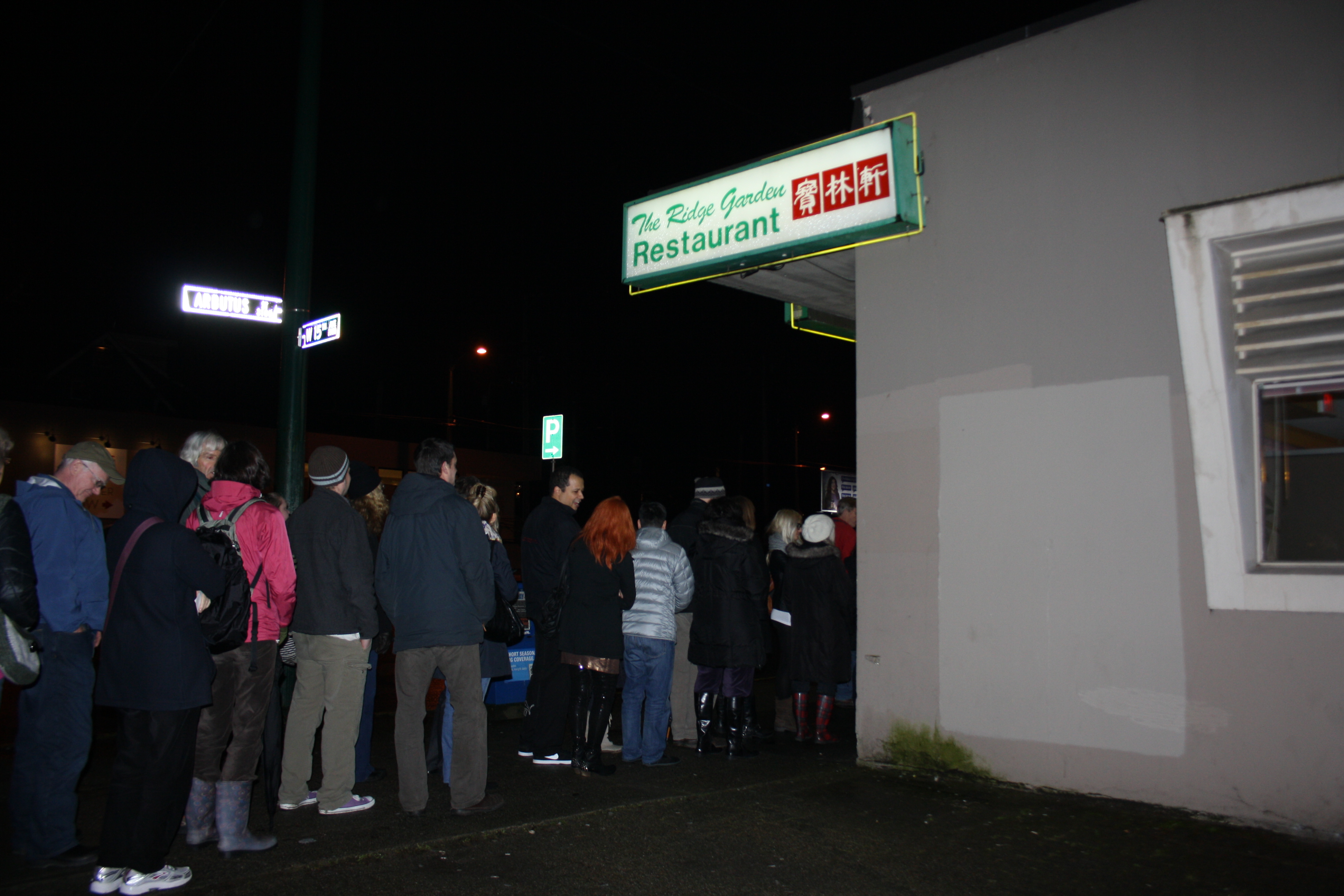
The line-up for The Ridge's very last show went past the whole block of the minimall.
The line-up for The Ridge’s very last show went past the whole block of the minimall.

“Old theatres are irreplaceable. They could never be duplicated at today’s costs – but more importantly, their spirit could not be duplicated because they remind us of a day when going to the show was a more glorious and escapist experience. I think a town’s old theatres are the sanctuary of its dreams.”

– Roger Ebert, 1942-2013

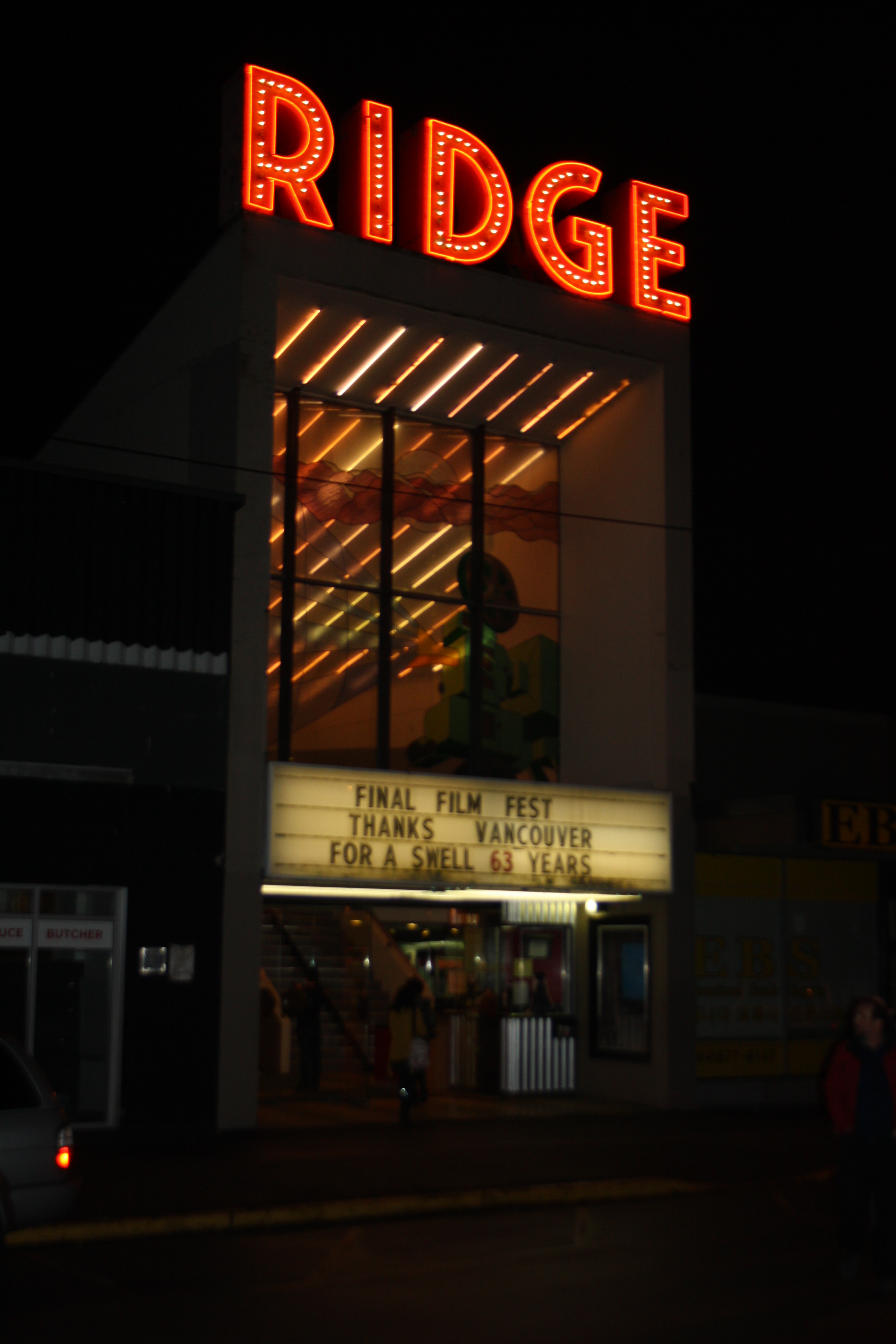
On Sunday February 3, 2013, The Ridge Theatre in Vancouver showed its last movies. It was part of a ten-day film festival put on before its closure. For many, the closing of The Ridge was another downturn in Vancouver’s entertainment business. For others, it was the loss of what was simply a great charming building.

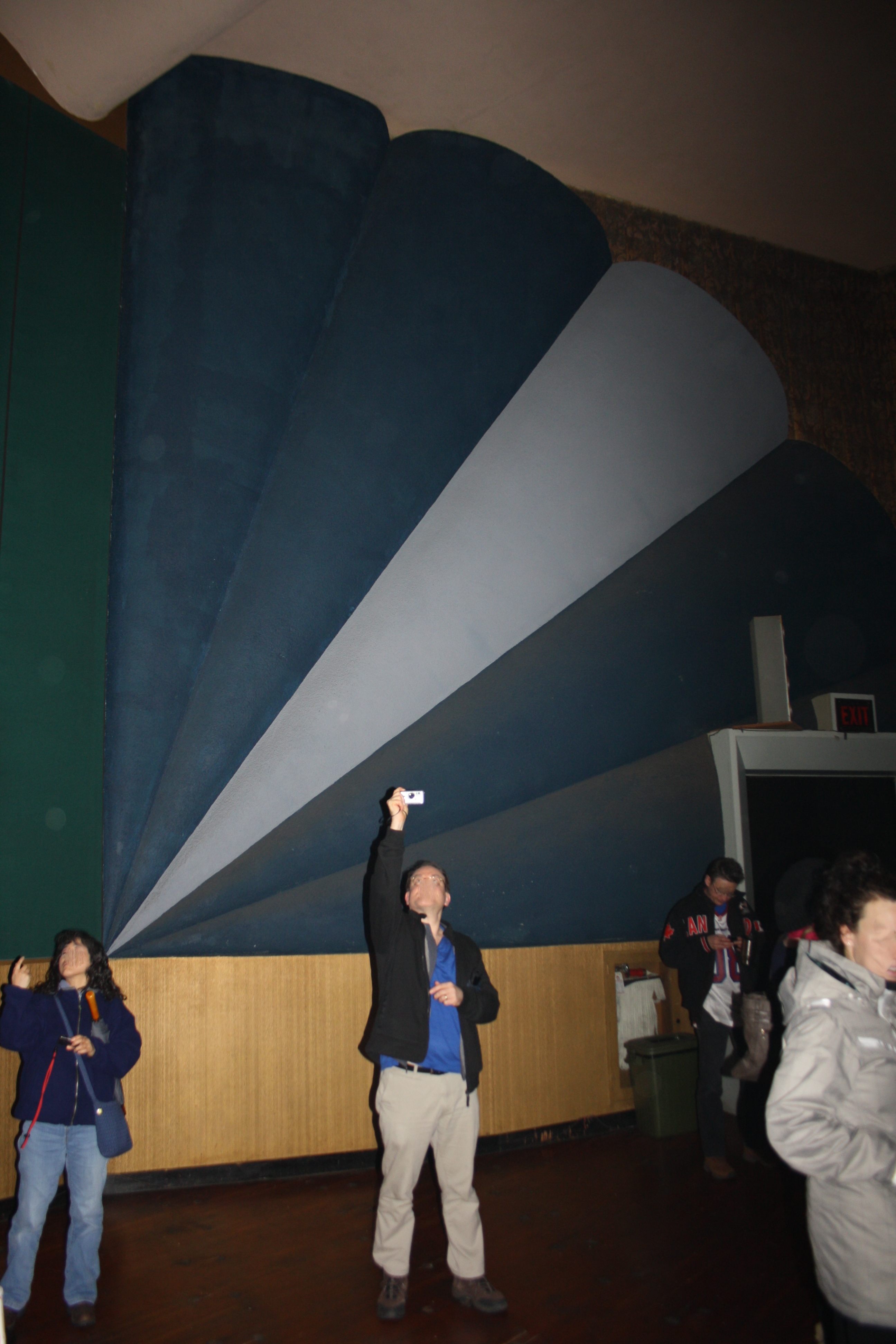
One of its charms was its art deco clamshells that framed the screen.

The Ridge Theatre first opened its doors in the Kitsilano Region of Vancouver on April 13, 1950 screening Henry V starring Sir Laurence Olivier. It was one of many single-screen theatres in Vancouver during a time when single-screen theatres were the norm. Even as the 1980’s approached with the advent of the VCR, video rentals and multiplextheatres, The Ridge still stuck around showing movies in its familiar theatre. It would even continue as an independent reparatory theatre starting in 1978 once bought by Leonard Schein. Schein would show independent and classic films to the public as well as movie fans. Owning and running The Ridge would even help Schein launch the locally-owned Festival Theatres chain which would help bring more independent and foreign cinema to Vancouver’s screens and found the Vancouver International Film Festival in 1982.

I myself saw my first film at The Ridge back in April of 2000. I remember it was Being John Malkovich. I remember seeing it with my cousin, who I’m not speaking with anymore, after eating at the Chinese restaurant in that strip mall. Since then, I would frequently go to The Ridge Theatre. I was always pleased with whatever movie I saw each time I went. It was a good small quaint theater in a nice neighborhood. When I first went, The Ridge Theatre was independently owned and had their movies planned at least two months in advance with a newspaper-like schedule. It was later possible to sign up for e-mail updates. Another thing I liked was the low-cost popcorn and a theatre that served coffee, cookies and brownies.

Another of its charms were the unique doors still stylish and unharmed by time.

Things changed December 24, 2005 when it was no longer under its original ownership. It had been rebought by Schein for Festival Cinemas. It was a hard break for the original owners who wanted to keep it an independent cinema. Nevertheless the new ownership actually did a lot to enhance play as Festival Cinemas had a reputation of promoting some of the more independent films. Even after The Ridge became a full-price theatre with contemporary seating installed, people still enjoyed coming. It’s almost as if it was never hurt in the first place. The Ridge would also become a facility for showing films part of the Vancouver Film Festival and show live soccer games during the World Cup and Euro events.

Then news was heard months ago. Possibly more than a year ago. The area around The Ridge Theatre had been sold to developers. They wanted to turn it into condominiums. A common Vancouver situation where old buildings get sold for the sake of being crushed and turned into condominiums. That just shows how competitive land and its value is here in Vancouver. Many people were unhappy about it. There was even a picket over it months ago. Nevertheless the decision was firm. Sales for the new condos started some time ago. Already other businesses in that minimall had already either closed up or found a new place to do business at. You can read about it more in this Georgia Straight article.

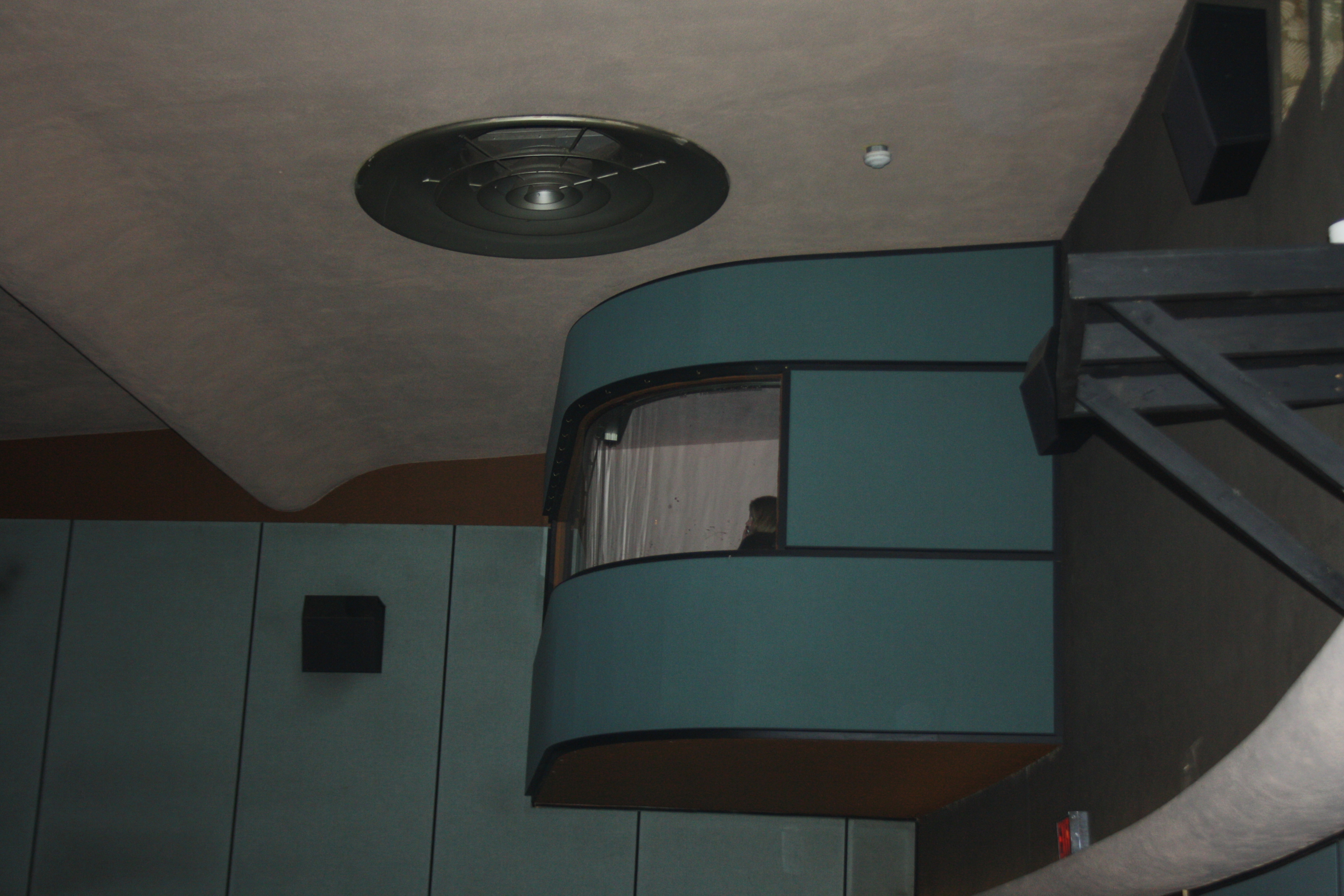
Oh yes. The soundproof crying room. How many other theatres do you know having that?

It was unfortunate for The Ridge to close as it was yet another theatre in Vancouver to close up. Many of you have read my story about the closure of The Hollywood Theatre. The Hollywood still stands but as a church. Other theatres that have closed in the past two years have not even had that minor bit of luck. The VanEast is now closed and is now being turned into business area. The multi-screen Denman Theatre which was great as a second-run theatre has been turned into store area. The three-screen Oakridge theater is now being converted into its new business area. The seven-screen Granville 7 closed in November to make way for a condo development. And another multi-screen venue, the Station Square cinema, has been closed because of a radical redevelopment project in the Station Square area. And now The Ridge. This is hard times for Vancouver’s cinemas right now. I’m sure this is also especially difficult for the Vancouver International Film Festival to find a new venue for 2013 and have it for many years to come.

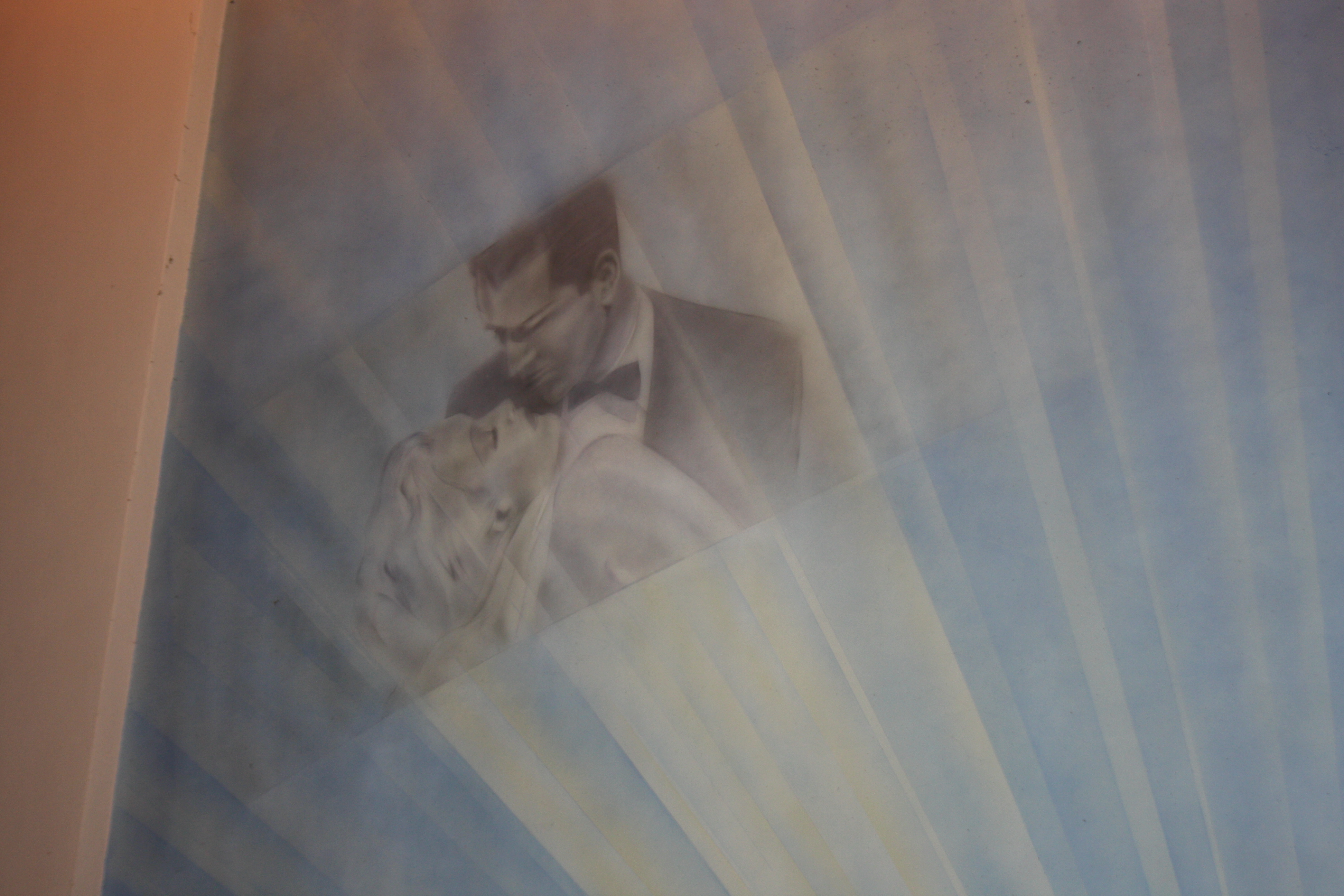
Another charm of The Ridge: the wall painting. It's a shame it will be gone with the theatre.
Another charm of The Ridge: the wall painting. It’s a shame that will be gone with the theatre.

Moving ahead, February 28th would mark the end of Festival Cinemas, the movie company that organizes showings at The Ridge as well as the Park Theatre and the Fifth Avenue. I’m sure it was shocking for many. it was shocking for me too. The owners Schein and Tom Lightburn decided to retire. Fifth Avenue Cinemas and Park Theatre are now owned by Cineplex. Schein and Lightburn reassured people in the Festival Cinema’s last email to patrons that the theatres will still continue to show the films common to what was shown during the Festival Cinema years. As of today, The Fifth Avenue does show some independent films along with a blockbuster or two. It’s great to see since that’s what Fifth Avenue patrons like myself have always come to and want to continue coming to. If they went to doing nothing but blockbusters at those theaters, they could lose a lot of patrons. Good to see them being smart about taking over Fifth Avenue as they were taking over Tinseltown.

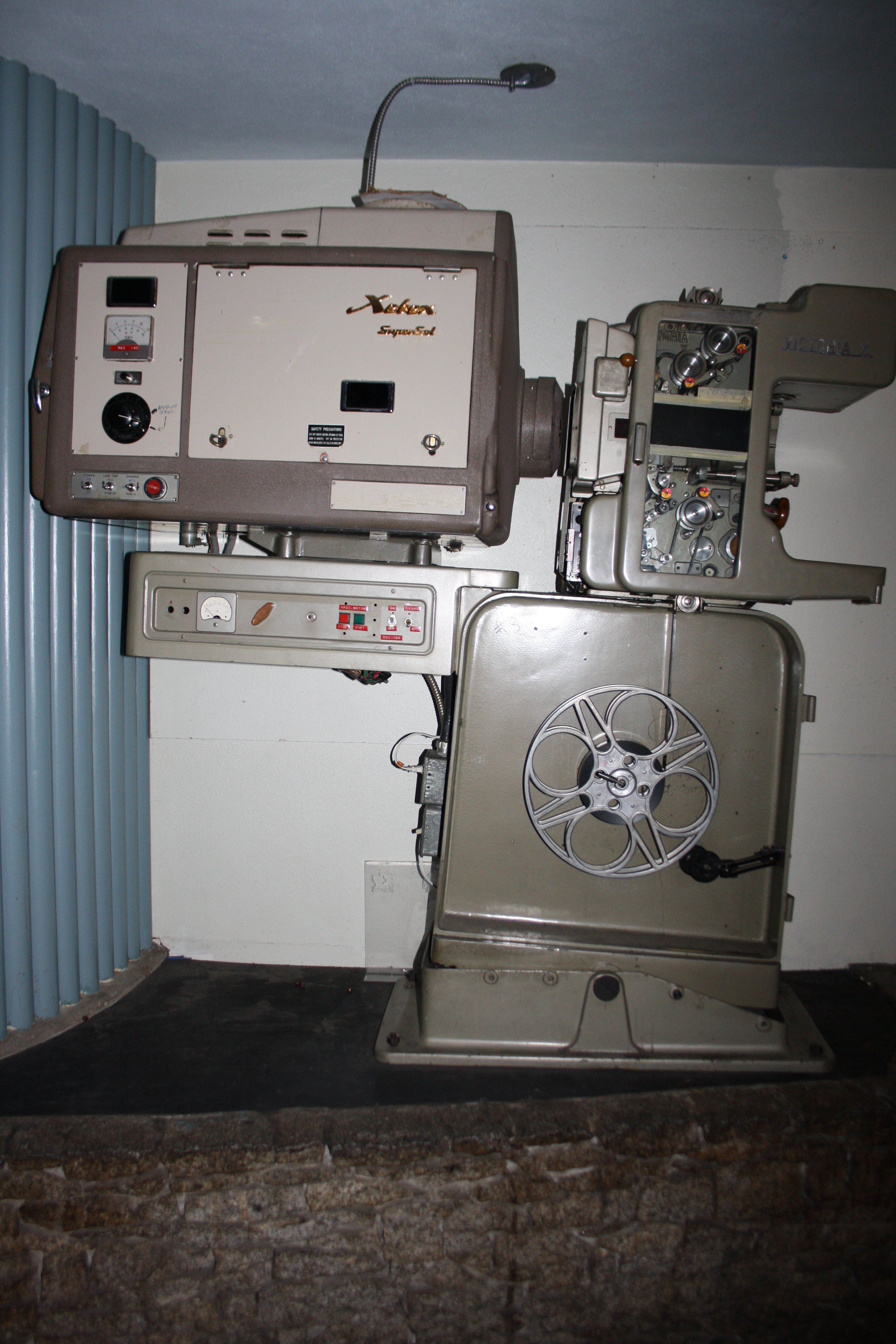
Another priceless gem from The Ridge: the old movie projector on display just outside the theatre.
Another unique gem from The Ridge: the old movie projector displayed in the lobby.

Going back to The Ridge’s closing, The Ridge was to close on Sunday February 3, 2013, but not without a bang. The last ten days consisted of what would be called the Last Film Festival in showing some of the most beloved movies as of recent and some classic gems at $5 admission to salute The Ridge’s last days. Saturday January 26th was a highlight with the last midnight showing of the Rocky Horror Picture Show at the Theatre. I was there and it was a fun night with the Vancouver Rocky Horror fan club in attendance. Virgins were called up to participate in a fake orgasm contest. I believe there was a contest for costumes. The rest of the time was devoted to watching the movie and participating whenever necessary. Unfortunately there were three times when the old celluloid reel broke. Nevertheless it was a fun time.

One problem with the showings was that many were sold out. In fact there was to be a special showing of the 1985 made-in-BC Canadian film My American Cousin on Thursday the 31st in which I was hoping to see with my friend. It was both a screening and a Q&A with a special guest which had a $10 admission. It was sold out before I could get to the box office. It was obvious that if I wanted to see the very last showing at The Ridge–Midnight In Paris at 9:10pm– I would have to buy my ticket well in advance. I bought it that Thursday evening. Smart move.

When I arrived, it was 8:20. Already there was a long line-up. It was halfway down the block and growing quickly before they finally let the people in. I looked around at the buildings in that minimall. The bowling alley is still active but for how long? The Chinese Restaurant will close by the end of the year upon the owner’s retirement. All the other businesses in that mall have either closed or have moved to a new location. The only other businesses still active were the McDonalds and the office buildings on the outside facing 15th Ave. Just outside there were people who were too late to get tickets for the show and waiting to be the last lucky ones. Reminds me of me back on Thursday for wanting to see My American Cousin. I think all the Ridge shows sold out.

After I entered, I wanted to tour and take pictures. I was able to take pictures of the main floor before Midnight In Paris was to be shown. The top floor which had the crying room and the camera room was off-limits for that time. I even remember as I was taking pictures outside the main entrance before the show, a man talked about his first time at The Ridge in which it was a date with the woman who would become his wife. His wife was in attendance with him too that night.

As the show was about to start, the emcee didn’t talk much before Midnight In Paris was shown. It wasn’t like the long goodbye with speeches that happened over at the Hollywood Theatre. He kept it brief and he just simply welcomed us all to the last screening at The Ridge. Actually instead of a long goodbye, we were told of all the theatres that were to get certain ‘pieces’ of The Ridge. One film company was to get its display projector, another was to get the stained glass windows, another was to get the doors. Good to see that certain items of The Ridge will be kept for a long time. Midnight In Paris played after. So the image of Owen Wilson and Lea Seydoux walking off together on a Paris street makes history as the last image to grace the screen at The Ridge.

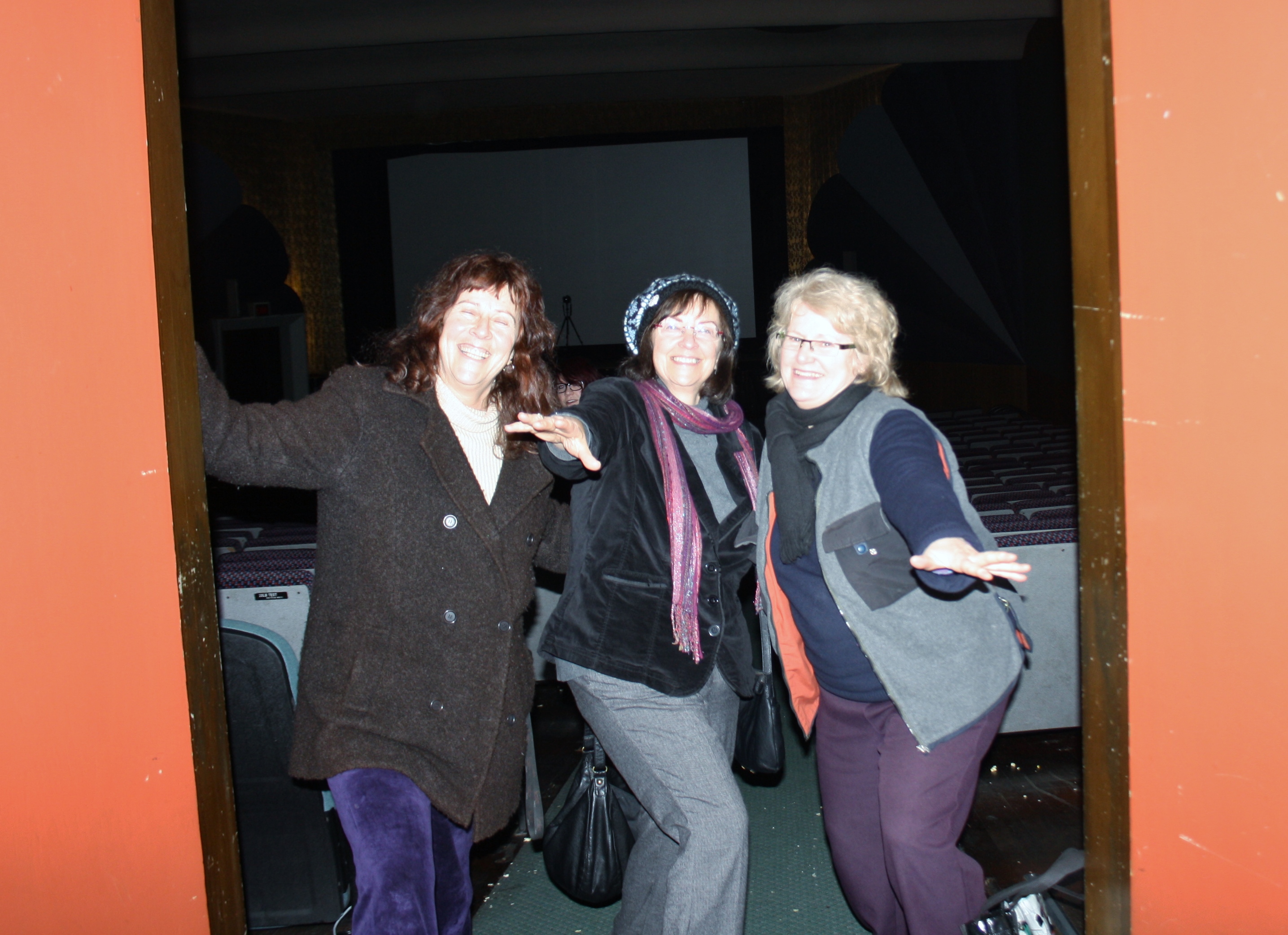
Seeing how 2013 meant the end of The Ridge, these three women wanted to put their foot down in 2012 with The Ridge still alive and thriving. Yeah, I too wished it was still 2012 that night.

As the credits were rolling, some left. More left as the credits finished but at least a hundred people wanted to stick around and get their last looks at The Ridge Theatre. I was taking pictures all over the place: the crumbly snack bar, the movie signs, the ads on the billboard, many things. I also took some photos of the inside of the theatre too and its nice set-up. Something you don’t see much of. Then I finally had my chance to check the top floor. Outside of the women’s restroom, there was a meeting room that had paper of old Ridge letterhead, a sound-proof crying room in the balcony and the projection room. The projection room was a marvel to see. It was nice to see the projector they were using. It was also nice to see the view of the screen from the projection area. I took more photos around the place.

Then finally I returned back to the theatre area. Half an hour and people still wanted to stick around. This was different than the Hollywood closing. The thing I remember most was there were three women from a writing group whom I met. They wanted pictures of them at the theatre. They also got me to take a picture of them showing they don’t want to leave 2012 when the theater was still alive and well. Yeah, I wished it was still 2012 too and The Ridge was still alive, well and thriving. Then after sticking around and taking some last photos, I finally left.

Just when you thought it was all over after I left The Ridge Sunday night, it wasn’t. The following night, I went to the Rio Theatre to see two movies and guess what I saw? Low and behold, I saw the doors of The Ridge theatre. I was happy to see that pieces of The Ridge were already being kept around. Yes, this did mean that the dismantling of The Ridge already started the day after but I was happy to see that the memory of The Ridge will be kept alive.

The closure of The Ridge was not the happiest of occasions. Yes, it was a not-so-pleasant display of the sign of the times. Nevertheless it was happy to see a theatre close surrounded by a lot of people who loved the theatre. For those that attended the last showings at The Ridge, The Ridge was a theatre that meant something to everyone. I know it meant a lot to me and I’m happy I had a chance not just to go to The Ridge Theatre but to experience it during the last thirteen years of its life. Goodbye Ridge Theatre. You’re gone but you still exist in the hearts of many.

The Ridge Theatre: 1950-2013

A VIFF 2012 Wrap-Up

By now you’ve probably read the reviews of all eleven of the films I saw at this years’ Vancouver International Film Festival. The Festival ended its sixteen days of films and festivities on Friday October 12th. I was working at the Granville 7 theatre at the time. The following Sunday all volunteers were treated to a volunteer appreciation luncheon at the Fan Club Cabaret in downtown Vancouver. The luncheon consisted of a live jazzy blues performance and a good lunch buffet. I was able to talk with people I volunteered with during the Festival.

As for the Festival itself, the festival did not succeed in breaking its 2011 record in ticket sales. The number of tickets went down 8% to 140,000. That can be blamed in part due to record-breaking hot Vancouver weather at that time. Yeah, it was a milestone ‘Indian summer’.  Nevertheless there were excellent turnouts and even filled crowds at many shows, even at special showings at the Vogue Theatre. If you want to read up about last-year’s success, which includes details about how film festival income is made, read here.

Here is this year’s VIFF by the numbers:

-140,000 – total admissions

-750 – volunteers

-643 – screenings

-392 – total films shown

  • 235 – feature length (60+ minutes)

-800 – number of Canadian films entered for the VIFF

-108 – Canadian Films shown

  • 37 – feature length
  • 51 – shorts
  • 20 – mid-length
  • 15 – co-productions

-96 – non-fiction films shown

  • 83 – feature length
  • 17 – Canadian

-75 – countries entering films

-64 – Canadian premieres

-51 – North American premieres

-37 – International premieres (first screening outside home country)

-21 – World Premieres

-16 – days of showing films

-12 – entries in the Best Foreign Language Film category for this year’s Oscars shown

-10 – screens showing films

-4 – theatres participating in the VIFF

Very impressive numbers for this year. Anyways I’m sure most of you want to know what film won what award, right? Well let’s say it had to be tough from the multitude of ballots filled out at this year’s Festival. An impressive 87% of the films shown were mostly rated ‘very good’ to ‘excellent’ so you could understand this would be quite the tough call for both the VIFF juries and the ballot tally. Nevertheless winners have been declared and here goes it:

ROGERS PEOPLE’S CHOICE AWARD

-THE HUNT/Jagten (Denmark/Sweden) dir. Thomas Vinterberg,

VIFF MOST POPULAR INTERNATIONAL DOCUMENTARY FILM AWARD

-NUALA (Ireland) dir. Patrick Farrelly, Kate O’Callaghan

VIFF MOST POPULAR CANADIAN DOCUMENTARY AWARD

-BLOOD RELATIVE, dir. Nimisha Mukerji

VIFF MOST POPULAR ENVIRONMENTAL FILM AWARD

-REVOLUTION(Canada) dir. Rob Stewart

VIFF MOST POPULAR INTERNATIONAL FIRST FEATURE

-I, ANNA (UK/Germany/France), dir. Barnaby Southcombe

VIFF MOST POPULAR CANADIAN FILM AWARD

-BECOMING REDWOOD, dir. Jesse James Miller

Women in Film and Television Artistic Merit Award

-LIVERPOOL (Canada) dir. Manon Briand

DRAGONS & TIGERS AWARD for YOUNG CINEMA

-EMPEROR VISITS THE HELL (China) dir. Li Luo

Honorable Mentions:

-A FISH (South Korea), dir. Park Hongmin

-PECULIAR VACATION AND OTHER ILLNESSES(Indonesia), dir. Yosep Anggi Noen

BEST CANADIAN FEATURE FILM AWARD

– BLACKBIRD, dir. Jason Buxton

Honorable Mention: BECOMING REDWOOD, dir. Jesse James Miller

MOST PROMISING DIRECTOR OF A CANADIAN SHORT FILM

– Juan Riedinger for FLOAT

Honorable Mention: PEACH JUICE, dirs. Brian Lye, Callum Paterson and Nathan Gilliss

So there you have it. Those are the winners of this year’s Vancouver international Film Festival. Great to see the Festival end on a great note. I myself had a good time seeing films. I saw eleven, as I reviewed at this site in the last while. I wanted a mix of films and I got a good mix out of it: four documentaries, two shorts programs (all by Canadians), three foreign-language films, one country’s entry in the Oscar category for Best Foreign Language Film and three Canadian features. I feel I had a good mix.

One thing about this year’s festival is it did mark the end of an era for the VIFF. This is the 11th Vancouver Film Festival held at the seven-screen Granville 7 Theatre in Downtown Vancouver. As of November 4th, the Granville 7 will cease to exist as it will be constructed into a condominium building. It was a shock to all of us but for years we kept on hearing “It’s closing within the year” and we’d come back there each and every year. This time it’s for real and even Empire Theatres that owns the Granville 7 made it official in an email to Granville 7 patrons.

The Vancouver Sun and Province didn’t shy away from that fact and even wrote stories that it will mark doomsday for the VIFF in the future. It first seemed believable since the Granville 7 was key to the VIFF’s growth over the years and its location being central to most of the other theatres showing films during the VIFF. The actual fact is most of us won’t believe it to be doomsday. If you know Vancouver media, they love moaning ‘doomsday’ about everything. In fact they kept on shouting ‘doomsday’ in the years leading up to the Vancouver Olympics and they ended up being the best thing that happened to the city. So what does that tell you? Finding a new theatre facility will be a challenge for next year’s film festival. I myself predict it may be either the Tinseltown in downtown Vancouver or the Fifth Avenue Cinema near Kitsilano. Nevertheless I’m confident that a new location for next year’s VIFF will not hurt the festival. In fact those who have VIFF email subscriptions will learn of the new location in the spring of 2013. Also they pointed out in that email that with the healthy attendance at this year’s Festival and 60,000 year–round members, the future of the Festival is bright and secure. Plus the Festival continued its reputation as one of the Top 5 Film Festivals in North America. So no reason to mourn doomsday. Besides if Canadian cities smaller than us in population continue to hold their own International Film Festival, there’s no reason Vancouver can’t.

Here’s to the continued success of the Vancouver International Film Festival and to a new era starting next year. I haven’t been given a start date of VIFF 2013 so I assume it will either be September 26th or October 3rd. I’m looking forward to next year.
VIFF 2012 Review – Side By Side: The Science, Art And Impact Of Digital Cinema

The first documentary I saw at the Vancouver Film Festival was Tribeca Film’s Side By Side. It first caught my interest on opening day as I was assigned to be an usher for the screening. I was lucky to see it as an audient three days later. I’m glad I did because this is of a topic I’ve been interested in over the past ten years.

The documentary is hosted by Keanu Reeves and it is on a hot button in the filmmaking industry. this hot button is the transition from making celluloid motion pictures to digital motion pictures. It attempts to answer the question: “does it mark the death of an art form or does it accelerate it?”

The documentary starts with some opening opinions by some of the biggest names in directing like George Lucas, Martin Scorsese, James Cameron, David Lynch, Christopher Nolan and Danny Boyle. It also features opening comment from independent filmmakers too. The beginning also gives descriptions and computer simulated examples of how images from both celluloid cameras and digital cameras are created. Interesting is the terminology used for filming: film filmed on a reel in a single day and developed the next day would be called ‘dailies’ while digital images would be described as ‘immediates’. Later on the documentary would describe the invention of digital filming dating back to the late 60’s to George Lucas experimenting with it. The progress of digital filming would be described more over the remainder of the documentary, which I will elaborate on more throughout my review.

The documentary also points out that the use of video cameras was not accepted by the film industry at first because video cameras were seen as something for ‘cheap movies’. They showed the first two movies filmed on video camera that made an impact on video cameras’ use in film: Denmark’s The Celebration from 1998 and the US’ Chuck And Buck from 2000. The quality was obviously cheap but the cinematic angles it was taken from caught people’s eyes. Nevertheless many people still felt video cameras were not good enough quality for something like motion pictures. To think back in 1999 when George Lucas announced after The Phantom Menace that he would no longer film on celluloid, most people didn’t take it that seriously.

As I just mentioned, we shouldn’t forget at the time digital film was still lacking in quality. Slowly but surely big name directors would take notice over time and make the switch. That’s another quality of the documentary is hearing of how so many big name directors made the switch to digital. They describe the scene filmed on digital that put the nail in the coffin for their use of celluloid film. The most interesting for me is Danny Boyle’s story about the change. He described one scene in 28 Days Later–the scene of a deserted London–that was able to be done on digital because he could shut down traffic in one area temporarily for a few minutes while he would have to shut the whole of downtown down for hours if he did it on celluloid. Many directors said that filming on celluloid film has gone as far as it can go and none sensed any limit to filming on digital in sight.

Back to the part which give demonstrations of the two filming methods. As the descriptions of are demonstrated, film professionals interviewed would describe their experiences in dealing with both filming forms, both the positive aspects and the negative aspects. One filmmaker talked of the use of dailies of how they’d look at the dailies in the screening room and at how they were taken aback by what they’ve created. It was often the case but not always. There were times when the dailies would be something flimsy. As for digital, the ‘immediates’ were convenient because they were there in an instant and they were cheaper. It’s not to say the ‘immediates’ were a complete solution. One director even said immediates would show the filming well immediately on a computer screen but won’t answer what it will look like on a 50-foot big screen.

Also described in the documentary are the various changes to how one does their job. The director and cinematographer, or director of photography (DP), have always worked as a team during the days of celluloid. The two still work as a pair even during digital filming but there are changes to how they work and communicate to each other during their job. The documentary also describes how actors have had to make adjustments of their own. During filming of celluloid, there was always a period of time when the cameramen had to do technical things that would allow for a break. Now with digital there’s more consecutive shooting less of that break time, if any at all. There’s even mention of a certain ‘protest’ done by Robert Downey Jr. when he did his first digital picture. Another thing involving actors, which would get on the directors’ nerves, is that they’d want to see the ‘immediates’ to see what they looked like all too often. Should we really be surprised? Film editors as well describe how their job has changed from literal cut and paste of reels to the computerized cut and paste. Some say the quality is still there while others say it’s cheapened. And we also see how visual effects personnel work with digital film as they’re able to create greener trees and bluer skies.

Another aspect showcased in the documentary is the changes in technologies over time. I mentioned at the beginning that video camera use for motion pictures were not accepted at first because of the lack of quality. What a difference more than ten years can make. Over time just as computer technology has improved, so has video imagery and designs of cameras. The documentary showcases the pixel quality of pictures over time and also highlights camera companies creating digital motion picture cameras that would be breakthroughs. Interesting how images shot for the big screen are at least ten times better than they were at the start of the century. Video cameras used for filming motion pictures have also become better and even smaller which allows for more unique angles. The simultaneous use of two cameras for filming 3D movies is another example of technological breakthrough. Then the news of the ultimate: the announcement from motion picture camera companies in 2011 that they would no longer manufacture celluloid movie cameras.

Despite the mention of all the technological progresses of digital cameras and its progresses leading to digital practically overtaking celluloid filming, the documentary does remind us there are still Hollywood movies and independent movies shot entirely on film and there are also still ‘celluloid purists’ who won’t hop onto the digital bandwagon for their own personal and professional reasons. Last year’s Oscar winner for Best Picture The Artist was shot entirely on film as were Best Picture nominees Moneyball and War Horse. Even two of the biggest moneymakers of this year, The Hunger Games and The Dark Knight Rises were shot entirely on film. In fact both Christopher Nolan and his personal DP Wally Pfister have even declared that if they’re the last people in Hollywood to shoot movies on celluloid, so be it. There are even some independent filmmakers that talk of the beauty of shooting on celluloid that digital can’t equal.

This documentary may give a lot of examples and opinions about the filming types but it doesn’t give the final word on the future of film. It cuts off to now and will leave the future to define itself. With no more celluloid cameras being made, the ‘celluloid purists’ will face a bumpy ride if they want to stay true to their principles. As for moviemaking, where will an industry full of predominantly-digital movies take this in the future? Will the ‘celluloid purists’ succeed despite the odds? We’ll see. One thing one director said was as long as a director has a vision, they will try to create that vision with whatever means they have.

I admit that this is a topic that caught my attention and it’s one dating back ten years ago. How it caught my attention was when I attended an acting class which a top Hollywood cinematographer Monty Rowan. He talked about celluloid filming and brought up George Lucas’ comments about never filming on film again. Rowan mentioned that digital will never have the same artistic quality as celluloid. Years later I read a magazine–either Time or Newsweek–that talked about filmmaking and once again Lucas’ talk about filming on digital: “You don’t work at the office the same way you used to. So why should I do my filming the same way I used to?” It also mentioned of a younger generation weened on digital this and that and who don’t have the same appreciation for the filmmakers of the past. That had me scratching my head. Even hearing how filming on digital has cut costs on filmmaking has still led me wondering about Rowan’s comments. Yes, filmmaking is an art but there’s this vice called ‘showbiz’ that’s unavoidable. Can celluloid continue one despite the business demands of showbiz? Especially as movie viewing is no longer cinema-only and now flexible to the point one can see movies on their tablet or cellphone?

The best quality of the documentary is the big names and wide array of professionals being interviewed by Keanu for this picture. We not only hear opinions and experiences from some of the top name directors in the business but some of the independent  filmmakers who have their own say, whether positive or negative. We also hear the various cinematography, film editing and visual effects angles from some of the top names in their respective fields. We also hear from the various ‘trailblazers’ of digital filming who did something that would pave the way to the future of film, though they didn’t know it at the time. Hard to believe that Anthony Dod Mantle filmed with video cameras with the thought “I may never win an Oscar but…” and he did for Slumdog Millionaire. It does however limit the number of independent filmmakers in the business. Yes it’s great to hear opinions from the big Hollywood names but the independent directors were limited in numbers and opinions.

Another thing I liked about the documentary is that Keanu did it unegotistically. He wasn’t like Michael Moore or Morgan Spurlock who try to steal every scene and force their personal opinions. Keanu stuck to the topic and put focus and emphasis on the facts, the technologies and the professionals’ opinions. I don’t think I noticed anywhere in the documentary him talking about his own personal experiences.

As far as this documentary goes, I would not consider this to be a documentary meant for a movie cinema. One of the things with the VIFF is that there will be a lot of documentaries shown. Some will be lucky enough for a big screen run. Some will most likely be shown on television through either a documentary channel like Vancouver’s Knowledge Network or a teaching channel. This documentary looks like something that would be best suited for something like a science channel or even an entertainment information channel. I would like to see it again as this this about a topic I’m interested in as I mentioned earlier. I like how thorough this documentary was.

Side By Side is an important documentary for anyone in film, whether a professional or a student at a film school, should see. It doesn’t just present the situation but is very thorough in presenting the examples of filming, history of technological advances, and how some of the biggest names in moviemaking have taken it on. Thank you Keanu for doing a great job of giving us the facts.

VIFF 2012 Review – City Lens: 60s Vancouver by Night & Day

I mentioned that I already saw one shorts program at the VIFF. I was lucky to come across a second one. City Lens wasn’t just any shorts program but one done by Vancouver filmmakers in the late 50’s and early 60’s and all were filmed in black and white. It was an interesting look at Vancouver through those years and what they showcased. Here are the films I saw and what I thought of them:

-City Patterns (1962)-This was a ten-minute short that featured images of Vancouver architecture to band music. It’s not necessarily the quality of the short I paid much attention to but of the places that were filmed. I often thought things like “So that’s what it looked back then” or “Does that place still exist?.” It was just a piece-by-piece film but I was amused with it.

-The Outcast (1963)-This was a biographical film of a former criminal trying reintegrate himself back to society. He’s both the subject being filmed and the narrator. We see him in a hotel on Main Street getting ready for the morning. We see him walk from industrial area to industrial area looking for work. We see him have a nervous look as a flashing police car drives by. During the filming shots he narrates who he is and what crimes he committed. He talks of his struggles to find a job with his criminal record. He also talks about his hopes to leave his bad past behind. The short left me wondering about former criminals and their opportunities to reintegrate into society back then. It left me wondering what was it like then? Is it better or worse now?

-PNE Midway (1960)-Now this is something that would definitely take a Vancouverite back in time. The Pacific National Exhibition fifty years ago. It was nice and fun to see how a day in their life of the PNE was like back in 1960 from workers setting things up to the rides and performances happening all day and night to the closing down for just another night. It was really neat and exciting to see. There was one scene I wasn’t happy to see which was the performance of an African American singing group with ‘Ebony Queen’ on the sign. It was a reminder that entertainment was one of the few big opportunities open to blacks back then and even having ‘ebony’ in the name was unpleasant to see. We should remember this was three years before Martin Luther King’s ‘I Have A Dream’ speech.

-The Seeds(1959)-This was actually a show meant for CBC Vancouver back then but it never was aired due to what claimed to be disturbing content. The movie starts with a gang of guys who like to control a diner. When the owner tries to stop the leader from harassing a girl, he gets beaten up. We later see the gang hang out in their favorite abandoned building playing cards and drinking straight whisky. At night they like to drive around like maniacs anywhere and everywhere. One day a young woman goes shopping with her young daughter when she caught the attention of the gang. She tries to get away only to be found in a shopping area. S tells the daughter to go home, sensing danger. They all try to chase her into a corner of the parking lot and it ends with her unhurt, unrobbed but scared. I didn’t understand what the point of the show was. Violence? Misogyny? I was left confused. I’m sure I would’ve felt uncomfortable watching that on television. I found it disturbing enough watching it in the theatre.

Overall I thought it was a nice break from the usual film fare. It was also nice to see how Vancouver looked those many years ago. I’ve only lived in Vancouver for 11 years but it was still quite an eye-opener to see how the city looked back then. Also it was unique to see four different types of films: documentary, a drama, a visual diary and a parade of images. This program was brought to us by Videomatica’s Graham X Peat along with some assistance from a Vancouver Archival Film company. It’s very rare to have a chance to see something like that.

City Lens was a welcome break for me at the VIFF. I think there should be something like this every year at the VIFF  that shows images of Vancouver past.

VIFF 2012 Review – Shorts Program: Break Even

Once again it was my goal at the VIFF to see at least one program of shorts. I had the good opportunity to see one during my ushering duties. You remember how the four programs of Canadian shorts were given names of the earth’s natural resources: Earth, Air, Fire and Water? This year the theme is about breaks. The program I saw was titled Break Even and featured nine shorts done by Canadian filmmakers. So here’s the rundown:

-Barefoot-In a Cree community, Alyssa is the third girl in her class expecting to be a mother. She has a supportive boyfriend and a supportive family but she has secrets. The story was meant to be a drama but I think this was a statement to do about teen pregnancy in First Nations reserves. An upsetting story but important as it will hit you with some hard truths.

-Peach Juice-An amusing animated movie using dolls and wrapping paper for the animating. Not the most professional but it succeeded in entertaining. This was another teenage story that has a charming outlook on a certain curiosity.

-OMG-A teenage daughter moves in with her grandmother after a spat over her phone use. Grandma handles her granddaughter’s annoying habit well both in her cellphone use and her relationship with her mother. Very clever ability to have a great entertaining story within the same location. Funny and charming.

-Liar-Tara believes her boyfriend Brian lied about being gay when he broke up with her. She and her two girlfriends attempt revenge on Brian but when it goes too far, what will Tara decide? Very good story but it leaves one wondering if it was meant to be a story or a message about violence on gay teens, especially since the bullies were all female?

-First Snow-Siblings and their mother reunite but not in the happiest settings. It’s in a hospital and it’s to decide who will donate their kidney to save their father’s life and it has to be immediate. Who will go forward, especially with all this squabbling? Very comedic with a surprise ending that ends the story well.

-Canoejacked-Two escaped prisoners try to escape across a river with a metal canoe. Only problem is the canoeist is inside with him, and he’s a ‘canudist’. How will they all escape with them in full view of the officer. They find a way. Quite funny, despite the bizarre situation.

-Hollow Bones-Boy bird loses girl bird in this live-action–yes, it’s live-action–short. However he does see hope along the way. Didn’t see the point of showing a break-up scene with the actors having birdheads. Wasn’t that amused.

-With Jeff-Nydia is in love with Jeff but wants to be a strong teenage girl. She receives a lot of advise from friends but loses herself whenever Jeff takes her on his motorcycle. The story appeared to be a good thoughtful story but the ending didn’t make a lot of sense.

-The Worst Day Ever-Bernard is one hard-luck kid. He has one bad incident after one bad incident happen this day. You think things couldn’t get any worse for that tyke until…It was a bit shocking to see all this happen to Bernard but it was funny and easy to find comical.

As for the whole segment, I have to say I first had the sense I was watching a program of shorts about teens after the first four shorts. It wasn’t until First Snow was showed that I got more of a sense of variety. Sure five of the nine shorts had teen subject matter but the mix of more adult shorts evened it out. Many of the shorts either charmed me or made me think. I’d say five of the nine were both entertaining and professional.

Some of the shorts were filmed by BC companies, some by Ontario companies and others by Quebec. I don’t know any of the filmmakers who filmed these shorts but I hope this leads on to bigger projects for them in the future.

The shorts program of Break Even was great to watch. Director wannabes often use short films to try to launch their careers for bigger things in the future. I’d have to say most of them show potential for both the director and even some of the actors involved.

Here I VIFF Again

September 27th to October 12th will be when this year’s Vancouver International Film Festival will occur. Lots to look forward to. Hundreds of films and shorts from 75 countries over these 16 days. Last year’s was a record-setter. This year the Film Festival wants to take things further.

You may remember last year I wrote about that year being the 30th for the VIFF, explaining the history and what to the festival showcases. Also you may remember the Festival records that year achieved. What’s also remarkable about last year is the Oscar success of some of the featured films from last year. The Best Picture winning The Artist was featured last year as was the Best Foreign Language Film winner A Separation.

This year’s VIFF also has goals of achieving a lot. There is estimated to be 380 films from 75 countries this year. Canadian and Asian film as well as documentaries are once again expected to be the highlighted genres of film at the Festival. What’s new this time is having the closing gala at the Centre for Performing Arts. Two live performances at the Centre are also expected to take place this year. Also added is a new real-time electronic ticketing system much like the one used at sporting events. The additions came upon the return of a $250,000 gaming grant the Festival once had until it lost its eligibility in 2009 as the government left adult arts groups behind in giving grants out. The grant returned as a result of the provincial government reassessing gaming grants.

Now that the grant is returned, the festival can continue to grow in both attendance and the number of films exhibited as well as the venues showcasing the films. The Granville 7 and its seven cinemas is once again the theatre with the most action. Pacific Cinematheque and the VanCity Theatre are the two other main theatres showing films throughout the sixteen days of the Festival. Temporary theatres showing films include the Park Theatre which will show a pair of films on two separate days and the Vogue Theatre which is scheduled to be a venue on nine of the sixteen days including the opening gala tomorrow night which will feature the screening of Canadian director Deepa Mehta’s Midnight Children.

As for me, I’m scheduled to do six shifts of five hours each. I actually volunteered this morning. It was good. Good to see a lot of volunteers I know back. Also exciting to see what featured films will be playing. I plan on taking in as many films as I can. Like last year, I’ll be aiming for a mix of Canadian, international, shorts and documentaries. I hope to post as many reviews here about the films I have seen. Anyways here’s to another year of film festing. If you want to check out this year’s fest, just go to the official website.

30th Year Of VIFF A Record Year

After sixteen days of showing films, welcoming crowds, making deals, and allowing directors to give Q&A’s to the audience, the Vancouver Film Festival ended its 30th year on Friday, October 14th. I had my excitement with volunteering and seeing seven different shows of differing variety. Those that volunteered, like myself, were treated to a Mexican style brunch at the Waldorf Hotel which consisted of some prize giveaways and small gifts. Almost a week later, the news hit that this year’s film festival achieved new records.

The 2011 Vancouver International Film Festival was the most attended and highest-grossing VIFF. Admissions totalled over 152,000, up from 148,000 from last year. Ticket revenues also hit a record with $1,178,811, breaking the record of $1,074,025 also set last year. Very impressive.  

One thing we learn about hosting film festivals like these is that the money from ticket sales are not enough. Although we hit a new high in ticket sales, the Festival itself costs $3.5 million to put on. The remainder of the baklance is covered by government support (about 10%), private sector sponsorship, and personal donations. One thing about this year is that there was a bigger expense this year in using the Vogue Theatre for showing movies. Although the VIFF used the Granville 7, Pacific Cinematheque and the VanCity Theatre as it did last year, the Park Theatre wasn’t used this year, opting for bigger crowds with the Vogue Theatre. The Vogue served as the Visa Screening Room for all the big premeieres and Gala events, replacing Theatre 7 at the Granville 7. It did pay off as film crowds were bigger for the Vogue.

The success of this year’s VIFF keeps its reputation as one of the Top Five film festivals in North America in attendance and films screened. Here are some of the numbers behind this year’s Vancouver International Film Festival:

-152,000 – total admissions

-633 – public screenings

-600 – industry guests

-386 – total films shown

  • 240 – feature length (60+ minutes)
  • 126 – shorts
  • 20 – mid-length films (20-59 mins)

-97 – Canadian Films shown

  • 39 – feature length
  • 57 – shorts
  • 1 – mid-length

-80 – countries entering films

-49 – North American premieres

-40 – Canadian premieres

-36 – media screenings

-30 – International premieres (first screeening outside home country)

-20 – World Premieres

-17 – entries in the Best Foreign Language Film category for this year’s Oscars shown

-16 – days of showing films

-10 – theatres showing films

Very imporessive numbers indeed and a hard act for 2012 to follow. Also for those interested in the award winners, here’s which film won what:

DRAGONS & TIGERS AWARD for YOUNG CINEMA

  • The Sun-Beaten Path  (China/Tibet) – dir. Sonthar Gyal

ROGERS PEOPLE’S CHOICE AWARD

  • A Separation (Jodaeiye Nader az Simin)  (Iran) – dir. Asghar Farhadi

VIFF MOST POPULAR DOCUMENTARY FILM AWARD

  • Sing Your Song (USA) – dir. Susanne Rostock

ENVIRONMENTAL FILM AUDIENCE AWARD

  • People of a Feather (BC/Nunavut) – dir. Joel Heath

SHAW MEDIA AWARD for BEST CANADIAN FEATURE FILM

  • Nuit #1 (Québec) – dir. Anne Émond

MOST PROMISING DIRECTOR of a CANADIAN SHORT FILM

  • Andrew Cividino for We Ate the Children Last (Québec)

NFB MOST POPULAR CANADIAN DOCUMENTARY AWARD

  • Peace Out  (BC/Québec) – dir. Charles Wilkinson

VIFF MOST POPULAR CANADIAN FILM AWARD

  • Starbuck  (Québec) – dir. Ken Scott

So there you have it. Those are the winners of this year’s Vancouver international Film Festival. Great to see the Festival end on a great note. I’m happy to have volunteered for the Festival this year. I hope to volunteer for the Festival again next year and I hope to see its records broken again. Will it be a marquee film festival in the future like Cannes, Sundance, Venice or Toronto? Only time will tell. Nevertheless I commend the VIFF for showing its huge variety of films, showing the most Canadian film and for promoting a wide array of films and talents from the up-and-coming to the established. Also I commend the volunteers for doing a good job with the crowds. Last year my uncle visited the Toronto Film Fest and he said the people thee get treated like cattle. So I myself comment the VIFF volunteers for treating the crowds right.

Here’s to the continued success of the Vancouver International Film Festival and to its success in the future years. VIFF 2012: Starting September 27th. Already I can’t wait!

VIFF 2011 Review: Policeman (Ha-Shoter)

Policeman is an Israeli film released this year. What’s unique about this film is not just to tell two different stories about two different characters but also to present a theme and an ending that will provide a lot of heated discussion amongst many Israelis and some thoughtful discussion elsewhere around the world.

 The film is actually two stories in one. The first half of the film is dedicated to following the life of Yaron: a member of an Israeli anti-terrorism unit. Yaron is a likeable character: dedicated serviceman, family man and supportive husband to an expecting wife. However he has to deal with an operation gone wrong whom is group is being investigated for. They’re planning to make a terminally-ill colleague their scapegoat in order to avoid suspension. He’s seen as a tough and rugged man on the job and with his colleague but a tender man outside of his work.

The second half focuses on Shira, a poetic radical. She too leads a group of radicals who want to protest the division of rich and poor in Israel. As noble as her group sounds, sexual tensions between the members including Shira cause friction. Shira and her group want to give their ‘justice’ to the rich, which means killing them. They plan to organize a hostage-taking mission over at a wedding of a rich businessman’s relative. Shira is seen as passionate towards her cause but very snake-like in terms of conducting her methods.

Then the heist. The group come to the wedding posing as guests. Right at the time, the hostage taking happens. The CEO, his father, mother and the married couple are now hostages. Yaron now has to be part of the group to stop the heist. They devise a plan in the back room with careful planning. Before they start, Shira shouts out to them a chant: “Policemen, you are not our enemies. Policemen, you are also oppressed.” Right at the end, the tense standoff brings the two groups together abruptly.

One thing about this film is that it shows a unique twist that would shock a lot of people in Israel. Their country has mostly experienced Israeli vs. Palestinian conflict. This is a case of Israeli vs. Israeli. It would surprise many who would think that all Israelis are allies when one Israeli attempts to attack another. This topic is bound to make a lot of viewers in Israel uncomfortable or even angry. Those that know Israel well would best know about the poverty Shira is speaking of. Even those of us outside of Israel could identify with some of the incidents happening in the film. Here in Vancouver, our city is full of young radicals looking to make their statement, even though they often make ‘attention whores’ of themselves. Despite it, there are a lot of people angry with the city’s divide of rich and poor. Even though Policeman takes place in Israel, I’m sure there are some people that feel the same way Shira does.

This film is actually the debut feature ever directed by Nadav Lapid. This is a very courageous effort for a beginning director to tackle such a hot button in his country. Outside of the topic itself, the film is also good in its way of presenting two different characters and their surrounding lives before the attack. Yaron lives day to day while Shira dreams up to that day. Both outlooks are intimate as they are personal. You learn of both their strengths and their flaws before the attack.

Already this film has received buzz. This film has already received praising reviews at the Locarno Film Festival and even won its Special Jury Prize. It is a multiple award winner at the Jerusalem Film Festival. It would also be shown a week after the VIFF at the New York Film Festival. As of now, it doesn’t have a distributor but I believe this film is loaded with promise.

Policeman is an excellent daring debut from a director who’s not afraid to tackle hot topics. If you’re looking for a film that makes you think or even challenges your thoughts, this is a good one to see. Even if you don’t live in Israel, you will leave the theatre thinking.