VIFF 2025 Shorts Segment Review: Forum 6 – City slickin’

What can I say about short films? A lot of them are good and can often promote an emerging director. The latest Shorts forum I saw was Forum 6: City slickin‘.

As you can tell by the title, the series revolves around situations in cities. The cities in the six shorts are in Spain, Belgium, Jordan, France and two in the Unites States. All six make for some great tales:

-Budget Paradise (USA – dir. Latajh Simmons-Weaver): Chester is a non-binary artist looking for an area to paint in peace and inspiration. They are told to leave one public place. They go to an art store and steals $97 worth of paint. They try a café for artists, but the cashier gives them attitude. They try a hotel for a two-hour stay in a suite promising to pay. The model they hire attracts them, but the hotel owner demands they pay.

Trying to get art done wherever and whenever. A common artistic dilemma. This adds humor as Chester finds bad place after bad place, has to steal paint, gets caught up in a street dance and the the one place they can find, it demands pay. A humorous story how one steals paint and coaxes their way into creating their art.

-Our Room (Spain – dir. Jaime Claret Muxart): Gal-la is a disc jockey at a Spanish radio station for its classical music show. She brought along her younger son Marius to watch, but he’s bored. She is also unhappy in her setting. She thinks to how her French-speaking husband Paul is into electronic music. It’s there she decides to quit and the three of them can start their own home radio station that fuses classical music and electronica with Marius’ keyboard!

It’s hard to picture something like this happening in real life where they can make a radio station at home, but it makes for a fun story. I believe the theme of the story is about family relations and family closeness. The beginning seems a bit drawn out or elongated. The ending, however, is happy and you’re left convinced that’s how it should be.

-Father Alphonse and the Fight Between Carnival and Lent (Canada – dir. Diana Thorneycroft): Father Alphone is a new priest and his first mass is to be on Ash Wednesday. As he readies himself, it’s Fat Tuesday and all the people in town are having a blast with all their pre-Lent debauchery. Something his strict father forbade him to do throughout his life. As he walks through town, he’s shocked by all the debauchery but finds himself in an unexpected tangle. That leads to a humorous and unexpected ending.

This short by Winnipeg animator Diana Thorneycroft was inspired by the 16th Century Belgian painting The Fight Between Carnival And Lent. This charming stop-motion short is a case where life imitates art for the new priest and he get tangled in with behaviors his strict father would condemn of! It’s cute and humorous and a delight to watch.

-Ambush (Jordan – dir. Yassmina Karajah): In a conservative area in Jordan’s capital Amman, a hall is turned into a techno club and makes a lot of noise in the normally quiet neighborhood. Hasan, a young man, watches the club from his family rooftop and anticipates an encounter one day. One of the attendees, Jana, is a recovering alcoholic wresting with her own love issues. Can they connect?

The story has two themes in one. One is about people’s desire for love. The other is about how what we see from the outside isn’t completely what we think it is. Hasan watches from afar and thinks they’re all having fun while Jana shows a reality Hasan can’t notice from that far away. As time passes, you think they won’t connect. The ending could get you thinking otherwise.

-There’s A Devil Inside Me (USA – dir. Karina Lomelin-Ripper): Teenage girl Teresa is about to be confirmed at her Catholic church. She struggles in her confirmation class as other girls have attitude. As she struggles with her faith, she dons a nun’s habit as a mass is taking place. An altar boy mistakes her for a real nun and hands her all the collection money. What’s she to do with the money she’s given? Especially after her bratty little sister lost a tooth and swallowed it?

Watching a film like this can cause one to question is this is blasphemy or just simply a film about a mistake that happened. Teresa makes for a believable story of a teenage girl who’s trying to work things out with her life, her faith, her romancing boys and her place in the family. It does make for a bizarrely far-fetched comedy that gives an ending you can laugh at either way you see it.

-No Skate! (France – dir. Guil Sela): Isaac is a student who’s hired to promote swimming in the Seine River. He notices Cleo, his colleague, get into a fight with her skateboarder boyfriend. He sees it as a chance. She’s reluctant, even though they do date and she gets him to spend the night with her. Cleo insists it’s just a friendship, but is it?

New love can come from the unlikeliest of people in the unlikeliest of places. Even the type where one tried to make like it’s not really love. This is a boy-meets-girls story that is slow and leads to an ambiguous ending. Even if you’re left undecided if this is new love or not, the story is funny and charming.

And there they are. Those are the six short films part of the City slickin‘ forum. All of them were unique in their own way and all six had a good story to tell.


VIFF 2025 Shorts Segment Review: Forum 2 – Memory & Meditation

With the VIFF happening, I have to see at least one segment of short films. Forum 2 – Memory & Meditation was the first one I saw. Some are live- action, some animated, while some are documentary style. All are intriguing in their own way.

One Duck Down (Canada – dir. Lindsay Aksarniq McIntyre): This film is a five-minute documentary. Lindsay Aksarniq McIntyre returns to her home in the Arctic tundra. There she finds the carcass of a duck with the feathers still on. As we see imagery of the duck, various shot ducks, the land and the waters, she tells of the area and of her own personal story.

The documentary is fast, brief and simple, but also intimate. If you look at the imagery, you can understand why Lindsay talks of the area. It’s the area she grew up in and was raised. The imagery means a lot to her. Even that of a dead duck means a lot to her as hunting was most likely part of her family’s livelihood. It was nice to see.

Baadarane (Lebanon – dir. Sarah El Kadi): In a small town in Lebanon, a young boy loses his mother. At her funeral at the mosque, he hears people always talking of God as they pay their last respects to her. Some even saying this is ‘God’s will.’ That causes him to think. Did God punish her with a young death? He himself feels he’s at odds with God for her death.

You can tell the theme of God is omnipresent in the film as God’s name is mentioned throughout. I guess it’s common living in a Muslim society to hear God frequently referenced. The story does capture a young boy’s crisis of faith especially since his mother died and many reference it as God’s will. It makes him question if his mother was a bad person to die so young. The black-and-white filming adds in as at a young age, it does seem like a black-and-white issue and you don’t know what to think.

Water Girl (France/Netherlands/Portugal – dir. Sandra Desmazieres): An elderly woman looks out to the empty seashore as she drinks coffee. As she looks out, she’s reminded of the times she used to doo deep-sea fishing for a living. She also remembers the time at the nearby lounge where she used to drink, be entertained and romance.

Animation usually does a lot with storytelling and imagery that live-action normally can’t. This story of a woman reminiscing on a coastline really creates the environment of her past and uses the imagery of fish and various colors to help add to the storytelling. The story is slow, but creates a mood and is a delight to watch.

-Adieu Ugarit (Canada – dir. Samy Benammar): The film is a documentary where a Syrian refugee named Mohamed tells his story. He tells of growing up in a harsh dictatorship mixed with political turmoil in Syria and knowing as a soldier, his life could be taken any time. Unfortunately, his best friend was murdered by militia men just outside of Damascus in 2012. He recounts these memories as we see imagery of a peaceful land and water.

This documentary is of a story that we rarely hear about, but needs to be heard. Benammar makes a smart move in having the audio of Mohamed telling his story as we see imagery of the land and the water. The land and water is in the Laurentian area of Ontario but it brings back his traumatic memories. Especially that of a lake in Syria filled with the blood of soldiers. As Mohamed tells his story, the images haunt us back.

-A Light That Doesn’t Dim (USA – dir. Colby Barrios): Sister Jones is a Mormon missionary in Mexico. You can tell by the look on her face she’s not happy about something. Could it be homesickness? Could it be a lack of faith? She makes it clear in her diary she wants to go home. Meeting with elders does not help her personal crisis any more. Then one night, she has images that shock her and haunt her.

Of all the characters in the film’s shorts, It’s Sister Jones that will cut the deepest. She faces either a crisis of faith or homesickness, but no one is there to help. Colby’s distortive and hallucinatory imagery in the film adds to the traumatic feel to the story and makes us feel the frustration of Sister Jones’ situation. It makes the story unforgettable.

-Four Walls And A Memory (Poland – dir. Joanna Piatek): A young girl is on the run from a wild creature. She enders into a cabin, but the creature enters. Fortunately in the run, the creature hits his head on the wall and dies. For some reason, the girl doesn’t leave. She stays for days where she even makes food out of the dead creature’s leg, makes the creature like a blanket overnight and dances with the creature as she hears music from the radio of a passer-by.

The film festival is known for showing films with out-of-the-ordinary stories, but the magic of animation is it can take out-of-the-ordinary to even bigger lengths. It does seem odd for the girl to go from running from the creature to eating one of his limbs to making him a blanket to dancing with him. Sometimes you think the story is about her overcoming her fears, but it could end up being more than that. It’s subject to one’s opinions.

-WASSUPKAYLEE (USA – dir. Pepi Ginsberg): Kaylee, a young awkward teenage girl, is a social media influencer in a house popular with TikTok content and with other teen influencers. Despite the other influencers befriending her, Kaylee feels out of place as they all have bigger followings than her. Everything changes as one of the boys tries to do a high dive from the house roof into the pool. He misses and is badly hurt. As all reach out to communicate the emergency, Kaylee does it on social media and that gives her the breakthrough she’s been waiting for. Also the boy will be just fine.

Although this story doesn’t take the same creative chances as the other films in this shorts forum, it does tell a story. It’s a story relatable as we have a lot of young people who want to grow up to be a social media influencer. Kaylee is like a lot of teenagers where her self-esteem is connected to her popularity. She shouldn’t let her lack of a breakthrough get to her, but it does. Fortunately she does get a breakthrough. It may be due to the result of an injured friend, but he’ll be fine.

And there’s my look at the short films of the VIFF segment Forum 2 – Memory & Meditation. Two were documentaries, two were animated and three were dramas. Two were made by Canadians, two by Americans, and the other three from France, Poland and Lebanon. All were intriguing to watch.

VIFF 2016 Review: Harold And Lillian: A Hollywood Love Story

harold-lillian
Film researcher Lillian Michelson and storyboard artist/set designer Harold Michelson are the subject of the documentary Harold And Lillian: A Hollywood Love Story.

Yes, we know too much about Hollywood couples. Harold and Lillian Michelson are a couple that won’t come to most people’s minds. Nevertheless they’re worth knowing in Harold And Lillian: A Hollywood Love Story.

Harold and Lilian Michelson were a power couple in Hollywood, but a couple the masses never knew. Those in Hollywood not only knew them, they wanted them for their movies. Harold was a storyboard artist who drew the images for most of Hollywood’s best movies from the 50’s, 60’s and 70’s continuing into the 80’s.The start of his legend began with The Ten Commandments and led to even bigger films like Ben-Hur, The Apartment, Cleopatra, The Birds, Who’s Afraid Of Virginia Woolf, The Graduate, Catch-22, Fiddler On The Roof, Hair, Spaceballs, and ending with 2003’s Duplex. Harold was also a set designer for Star Trek: The Movie (for which he received his first of two Oscar nominations), Terms Of Endearment, Spaceballs and Dick Tracy.

Lillian Michelson was a film researcher. Her research helped contribute to films like Fiddler On The Roof1941, Reds, Scarface and Rain Man to name a few. Her research was very intense as she would go searching about all information related to the place and time of the story including as far as what people would wear in a certain time. One example of how far she’d go for her research: Lillian even interviewed an actual drug lord from Colombia for Scarface. She was that fearless. She even owned a library full of research materials for films she worked on: a library she would constantly have to fight for a space to have it all kept.

Harold and Lillian were also a dedicated couple who kept a solid marriage for 60 years. Harold was well to do but Lillian was raised an orphan. The age gap of 11 years didn’t stop Harold from taking a liking to her and they married in 1947 when Harold was 28 and Lillian was 17. Harold decided to pursue life as a storyboard artist in Hollywood after returning from the war. An Army Sargent saw the drawings Harold drew of the war and thought he would make an excellent artist. Lillian had nothing really to lose as her first pregnancy cost her a telephone company job; this happened during a time women didn’t have the right to sue for their job back. Lillian would mother three children including an autistic son. Harold was frequently away at work and this caused friction in their marriage. Lillian, bored with motherhood, found an opportunity to become a film researcher and the rest is history. Their marriage was strong and committed and went through the ups and downs until Harold died in 2007. Lillian retired in 2010 and now lives in a Hollywood retirement home.

This documentary is a mix of things. This film mixes the love of Harold and Lillian with their accomplishments in Hollywood. It takes you into what they achieved in film and fits it with the films they were a part of. Sometimes you’re led to think they helped make the film’s greatness. The film tells of the times where they were getting their start in the business: Harold having to spend time as an apprentice in the Hollywood system before his rise and Lillian chasing an opportunity because of the limited chances for women at the time. This film also tells the stories of their own lives where they had to both play spouse and parent, including a parent to an autistic son. We also see how Harold would take his storyboard illustration style he used for his Hollywood books and include it in his own personal diary of his marriage and family life in all its triumphs and struggles.

It’s interesting how when you watch this film, you learn how much these two are responsible for some of the best films to come out of Hollywood. You’d be shocked to see how many films Harold was a storyboard illustrator for: Ben-Hur, The Graduate, The Birds, Cleopatra, Fiddle On The Roof, Who’s Afraid Of Virginia Woolf, etc. You often feel he helped make that era of Hollywood. Learning about all the films Lillian did research for starting with Fiddler On The Roof, and most notably Scarface and Rain Man, you not only develop an appreciation for her too but her profession. The words of gratitude from such big names like Danny De Vito, Mel Brooks and Francis Ford Coppola leave you convinced they may have been the best ever. Even learning about all the research materials she had and continuously fought have a space for, you feel it deserves its own permanent library.

Kudos to Danial Raim for making a very intriguing, very entertaining documentary. This is the third documentary he directed, wrote, edited, produced and cinematographed. This documentary finally exposes Hollywood’s best kept secret in both the films they made and the love they had. However I will admit there are some areas where I felt the editing could have been done better. Most of the time, it goes from the story to the movie they created to the people they worked with in the right order. Nevertheless there are times when the order doesn’t seem to go right. Rare in the film but noticeable. I personally feel this would be a good film to release at the box office. However I’m a person who’s interested in some of the stories of Hollywood movies past. It’s hard to know what exactly makes for a documentary that has what it takes for a box office release. Even those nominated for the Oscars and win don’t exactly explain it all. I think this documentary is best for channels like B.C.’s Knowledge Network or TCM.

Harold And Lillian: A Hollywood Love Story is more than just a story about a Hollywood couple. It’s also a film that gets you understanding their behind-the-scenes jobs and leaves you thinking they were the best ever in their professions.

Movie Review: Some Like It Hot (1959)

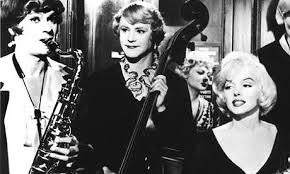
Tony Curtis, Jack Lemmon and Marilyn Monroe put on an unforgettable show in Some Like It Hot.

The AFI (American Film Institute) ranks Some Like It Hot as the best comedy of the 20th Century. No doubt it’s one of the most legendary comedies ever made. The question is does it still have what it takes to entertain people today?

Here’s a brief synopsis for those who’ve never seen it. It’s 1929 in Chicago. Joe and Jerry are musicians by day, bootlegging gangsters by night. They face themselves in a lot of trouble first with a rival mob for being in the crossfire of the St. Valentine’s massacre and secondly for the money Joe owes thanks to losing it on gambling. Their talent agent finds them a job to help them get away from the mob racket and make the money. There’s one catch. It’s with an all-girls band–Sweet Sue and her Society Syncopators—and they’re heading to Miami. They accept and agree to pose as women: Josephine and Daphne.

The beginning is not the best. As they board the train to Miami, they meet Bienstock, their manager who is one to give band members a cheap feel. However they do meet band member Sugar Kane who likes to take a drink every now and then and takes a liking to the two women-in-disguise. They soon start a good friendship after Sugar accidentally drops her liquor flask and the two try to cover it up to bandleader Sweet Sue.

Sugar confesses to the two on the train trip how she’s interested in millionaires. However they can’t make passes at her because they know they have to keep their disguises as women. Once in Miami, Joe disguises himself as a millionaire named Junior to woo Sugar: heir to Shell Oil who has a problem with his ‘disinterest’ in women. However Jerry faces a pursuit of his own as an aging millionaire Osgood Fielding III takes an interest in Daphne.

One night Osgood invites Daphne for dinner on his yacht. Joe convinces Daphne to keep Osgood occupied onshore so that he can take Sugar to the yacht as Junior and pass it off as his. Once on the yacht, Junior tries to convince Sugar that he is impotent because of psychological traumas. He does say he’ll marry anyone who changes that. Sugar tries to arouse him and it’s after some amount of effort that she succeeds. Meanwhile Daphne’s very good at charming Osgood as the two tango all night.

It’s right as Jerry tells the good news to Joe– that Osgood has proposed to him and a divorce upon the truth will result in a huge cash settlement–that they learn the charade has to end. Spats and his gang of mobsters from Chicago are in the hotel for a ‘Friends of The Italian Opera’ conference and they have to quit the band and escape the hotel. This also means that Joe has to disguise himself as Junior again and break off the engagement to Sugar. He succeeds by telling her he has to marry a woman of his father’s choosing but it breaks her heart.

But it doesn’t end there. The two finds themselves in pursuit of the mobsters from the Valentine’s Day killings. It’s right after a revenge shooting at the conference that the two find themselves in pursuit again by Spats and his gang. Even their disguises as dames won’t help them get away for long. They face an additional problem as Joe notices on stage how brokenhearted Sugar is. It’s there that Joe has to tell Sugar the truth and kisses her in his Josephine guise.

Soon Sugar, Joe and Jerry have to leave in a getaway boat for Osgood’s yacht. They all find the boat in time but not before a drunken Osgood runs out. It’s right in the end with all four in the motorboat that all the truths come out, but with unexpected results.

As I pointed out at the beginning, Some Like It Hot has received renown since its release and over the years as both a film and as a comedy. There’s always the question of whether today’s moviegoers will understand the films significance or its comedic value. There’s no question that people of today would still find men dressing as women funny. Heck, the ‘S*** Girls Say’ videos are a hit partially because of it. However we’re at a time where we’re not that unfamiliar with drag queen shows and men dressing up as women. We may not be blasé but we wouldn’t be as shocked as say a crowd from back in 1959 would be upon seeing this. Even the sight of two women kissing would be less shocking to us. Humorous but not so shocking.

We shouldn’t forget that this was released during a different time. A Streetcar Named Desire caused some controversy because of its depiction of promiscuity and a failing marriage. Rebel Without A Cause raised eyebrows with its portrayal of teenage crime. And Blackboard Jungle was being labeled as ‘outrageously violent.’ All these movies would be considered tame by today’s standards. It just goes to show how far we’ve come.

Even Marilyn Monroe’s sex appeal comes into question. By now we’ve had all sorts of screen actresses who have had their own shots at achieving sex appeal with male moviegoers. By now the top screen queens would be Kristen Stewart, Jennifer Lawrence and Megan Fox. Most males who are charmed by them would probably have a look at Marilyn and probably think she’s not as ‘babe-like.’ They may also think she “doesn’t show enough skin.” Heck some might even think she’s ‘fat.’ It wouldn’t surprise me, knowing today’s casting standards in Hollywood. Anyways those who know the screen goddesses of the past would know Marilyn was about more than her looks. She was also about her charm and charisma. That’s something today’s top screen queens lack.

The one thing that surprises me about Some Like It Hot is that it has cross-dressing during a time when Hollywood movies were still subject to the Hays Code. For those of you who don’t know or are too lazy to click on the link, the Hays Code was a rigid code used on movies and television up until 1966. It allowed for certain things to be in the movies but disallowed a lot of things too like an image of a toilet bowl or negative depictions or religious figures or certain things about sexuality. Even while watching it, I was thinking of the Code that was used at the time and wondered about certain scenes—the kiss between Sugar and Josephine and the “Well nobody’s perfect” scene—that left me wondering how they were able to get away with it at the time. Actually back then it did receive some flack from the Catholic Legion Of Decency who gave it a C (Condemnatory) rating. They’d also give Psycho a C rating the following year. Soon after other later films followed with a C-rating, it would lead to an overhaul and eventual end to the Hays Code in the 60’s. You have to give credit to some of these movies of the 50’s for pushing envelopes at the time and eliminating a lot of censorship in Hollywood in future decades. Mind you I don’t see why ‘decency committees’ should have a problem with cross-dressing. Besides we shouldn’t forget that Milton Berle dressed up as a woman on TV frequently during that time.

This is another winning movie for Billy Wilder. Billy is sometimes known for darker movies but rarely for comedies. This is probably his best comedic effort. Not his first but his best. He really took some challenges in making this film but he pulled it off well. This was also very good acting from both Jack Lemmon and Tony Curtis. Their performances were very humorous and it was amazing to see Jack, or should I say Jerry, instantly get into character as Daphne. Marilyn was also good but we shouldn’t forget that in this, like most movies, she was encouraged to play the movie sex goddess we all know her for. She pulled off her part very well. It’s still surprising how Marilyn is the biggest actress never to have even received as much as an Oscar nomination. Character acting from the supporting actors was also very good and added to the movie. The big surprise is that costuming was done by Orry-Kelly. Usually in the movies at the time, especially in Billy Wilder’s movies, it would be Edith Head who would do the costuming back then. Yeah, there were two types of costumers back in Hollywood back then. There was Edith Head and then there was everybody else.

Also interesting to see all the accolades this movie has received over the years. Besides being ranked the #1 Comedy by the AFI, the movie has been ranked #14 on their list of the Top 100 movies of all time back in 1998, then changed to #22 in their 10th Anniversary list in 2007. The line of “Well nobody’s perfect” ranks as the 48th-best movie line in their 100 Years…100 Lines list. In fact “nobody’s perfect” is even on Wilder’s epitaph. However it was not as lucky back at the year-end Oscars. That year the big toast of Hollywood was Ben Hur which would receive 12 nominations and 11 wins including Best Picture. The big surprise is that Some Like It Hot was not even nominated for Best Picture. Nominations did go to Wilder for Best Director and Best Adapted Screenplay and Lemmon was the only nominated actor with his Best Actor nomination. The only Oscar win was for Orry-Kelly for Best Costuming – Black and White who even beat out Edith Head. Some Like It Hot did fare better at the Golden Globes for wins for Lemmon, Monroe and Best Picture – Musical Or Comedy.

Some Like It Hot is a cutting edge comedy of its time in which most of today’s film goers who go to see it might not understand why it’s labeled the “Best Hollywood Comedy Of All Time,” especially since they’ve seen more shocking and more outrageous stuff. People who appreciate old movies and know the history of Hollywood film making will understand why and appreciate for such. For me, it was my first time seeing it and I was entertained.