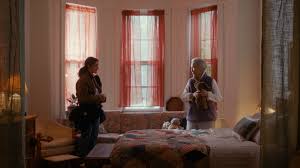
The Scout is about a film location scout names Sofia played by Mimi Davila (left) who discovers more than film locations.
With the Vancouver Film Festival, you can get a wide variety of styles of film showing throughout the Festival. One unique film is the American film The Scout. It’s unique in its own way, even if it is confusing.
Sofia is a location scout in New York City for a film company. Most of the day, she drops flyers into the mailboxes of surrounding houses or apartment suites saying she’s interested in having the inside of their places as set pieces with her phone number listed. After sending out a set of flyers, she makes a trip to an apartment of an older woman as she listens to her voicemail responses. The voicemail range from people interested to those thinking it’s stalking to some unhappy she hasn’t come to her place yet. As she photographs the suite of the older woman, she learns more about her life. She learns the mother has two grown children who have moved out and never returned to see her.
Her second trip is to another apartment. At the house is a man who works from home and often spends time looking after his infant daughter Sophia. Sofia takes a special liking as they’re names are similar. As she photographs the house, she learns more about him and has a sense from the talk that his marriage is falling apart. Her third trip is to another apartment, but that will require crew from the film company to also review. This will be busy for Sofia, the crew and the suite holders. The resident is quite welcoming. The talk from the film crew makes obvious a lot of thought is to go into selecting. Some like it, some are critical of it. Sofia is hoping it will work out.
The day continues as Sofia goes to another apartment of one who accepted. She finds out it’s her friend from her college days. Both of them are shocked. They reminisce about the good times of the past and they talk about what’s happening in the present. Not all of it is pleasant, especially in terms of their relationships. Sofia’s last appointment is to be with a pet store. She’s a half-hour late and the owner is unhappy with it as he’s locking his store. Despite his anger, she’s able to convince him for the appointment. The appointment goes so well, they even have dinner together going into the night. As great as that was, Sofia finds out it took so long, the traffic police clamped her car and she’ll have to pay a fine of more than $400!
The next morning, she attends a meeting at her company’s office. There they talk about certain locations for a scene. Judging by the discussion, it looks like one of Sofia’s discoveries won’t be considered for this scene. After the meeting, she spends the rest of the day over at an urban beach. She just goes there onto the sand holding a coffee and stands there looking out. You can tell on her face something is wrong.
The thing about this film is that it has a good beginning and a good end, but an unsolid middle. In seeing the film, it’s hard to understand what it’s all about. It does show a lot about what it’s like to be a location scout for a New York City film company, but it doesn’t fully make clear what it’s about. You don’t know if it’s intended to be a day-in-the-life film. You don’t know if it’s about the loneliness Sofia’s going through. You also don’t know if it’s to do about the frustration of working a film job in New York. The film could be a case that the director wants us to decide for ourselves what the story is, but I wish it was clearer.
If this film is intended to be one of those day-in-the-life films, it’s not an easy genre to accomplish as the day could present itself as a story to tell or just a portrait of daily life. The film does have a lot to say as Sofia goes from place to place and either meets with her crew or has an ordeal to deal with. It doesn’t make it too clear about what it’s trying to say. One can think of many themes this film could be about like the demandingness of a filming job, life inside different from what we see on the outside, or the story of a successful but lonely young woman. Scenes like when Sofia goes into her parents’ house and call out for her mother make you question if loneliness is the theme. You may have to watch it a second time to make up your own mind what this film is about.
This is the directorial debut of Paula Gonzales-Nasser and the first feature-length script she wrote. Paula has been in the New York film industry for eight years and has made a jack-of-all-trades of herself in doing set design, cinematography, art direction, location managing and producing. The first six years she spent being a location scout so it becomes pretty clear she’s basing this story on her own experiences. The story she writes and directs is a telling story of a location scout trying to make it, but it’s not the clearest in telling its story or making its main point of focus. Despite the lack of overall theme, the performance of Mimi Davila is great. Davila has had an acting career of over 15 years in various roles. In this film, she keeps her performance low-key but she can send a lot of messages even in her moment of silence. She makes for a very believable performance. The supporting performances from the people Sofia visits to the crew she works with also add to the film and make like you’re watching a real situation instead of seeing them act.
The Scout is a unique drama. It could easily be dismissed as a ‘boring movie,’ but you have to look closer. One thing is that the message or theme are not the clearest to understand.
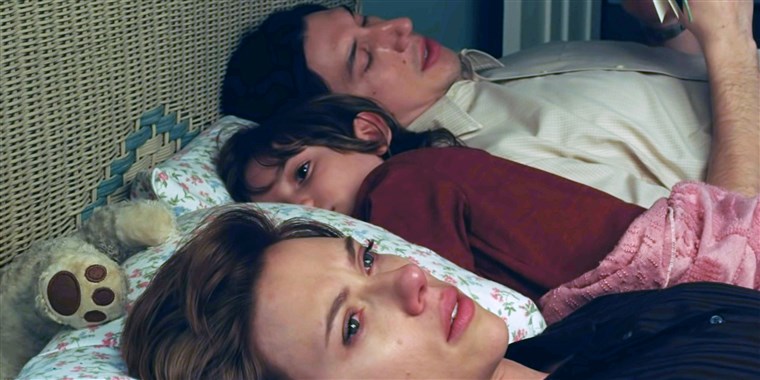
Marriage Story is the story of a marriage between an actress (played by Scarlett Johannson) and a theatre director (played by Adam Driver) that’s falling apart. And the child caught in the middle.
There have been films about marriages falling apart before. You could understand that a film like Marriage Story would be expected to deliver a lot in order to separate itself from the other divorce films. It will surprise you.
The film begins on the two in the marriage: Charlie and Nicole Barber. Charlie is a successful theatre producer in New York and Nicole is a former teen actress originally from California who’s part of his production and has helped her career as an adult actress. We see images of Nicole and we hear Charlie’s voice of what he loves best about Nicole. We see images of Charlie and we hear from Nicole what she loves best about Charlie. We then see Charlie and Nicole sitting in the office of a marriage mediator. What we heard are the written essays both were requested by the mediator to write of each other. The mediator requests Nicole to read first, but she’s too embarrassed and they forego the counselling.
The marriage troubles appear to have happened when Nicole was offered a starring role in a Hollywood television production. After she left the New York production of Charlie’s, Nicole moved back temporarily into her mother’s house taking their 8-year-old son Henry with them. Charlie chose to stay in New York as his play is moving to Broadway. They want the split to be amicable and to forego lawyers. However right after shooting, one of her castmates recommended a family lawyer she had for her ow divorce.
Her name is Nora and she is known to have experience in family situations, especially those in showbiz. Right from the start, Nora appears ready to deal with Nicole’s case, even before she hears it. Nicole does state her case. She tells of how she feels neglected by him and he constantly rejects her ideas and desires. She also suspects him having an affair with the stage manager of the theatre company.
Charlie goes to Los Angeles with the intention of visiting Nicole’s family. Nicole’s family is very affectionate to Charlie, but Nicole wants them kept out of it since this divorce is happening. The family try to make like it’s a normal visit until Charlie is served the divorce papers. Charlie first meets with Jay Marotta in Los Angeles who’s known to be an aggressive lawyer who fights dirty. Charlie declines hiring him, but he receives a phone call from Nora saying he needs to find a lawyer or risk losing custody of Henry. It’s on his return flight he finds a lawyer who’s not one Nicole previously consulted.
His name is Bert Spitz and he’s retired from family law and favors a civil approach to handling divorce. However Bert does make it clear there are some thing Bert will need to do to win custody of Henry such as move to Los Angeles. Charlie finds an apartment and remodels it to look modern. However he still has to fly back to New York frequently to work on his show. Charlie doesn’t want this to be a dirty court show so he gets Bert to arrange a meeting between the two of them, Nicole and Nora. From the start, Nora is the one in control as she brings up Nicole claim of him not being warm to her ambitions and revealing Henry prefers to stay with his mother instead of fly between the two cities. A frustrated Bert recommends Charlie move to Los Angeles completely.
A frustrated Charlie has had it. He fires Bert. During his Broadway run, he wins a lucrative Fellowship Grant. The first payout is enough to buy Jay on retainer. The case then moves to court. A confident Nora reassures Nicole that everything will be for her success, until she sees Jay coming to the court office. She knows it will get ugly. And it does get ugly in the court as Nora tries to portray Charlie as a bad person with past infidelity and emotional distance and Jay tries to portray Nicole as a bad person by making her wine drinking look like alcoholism and a criminal for hacking Charlie’s emails.
This whole lawyer vs. lawyer action frustrates both Nicole and Charlie. They act in a friendly way, especially around Henry. They don’t want this divorce to be a burden to Henry but he makes it obvious the back and forth is an annoyance to him. They hope a private discussion without either lawyer present will lead to a better resolve to the situation. Instead it starts as friendly and then turns into a heated argument. So heated, it a case Nicole claims he has gotten too involved with himself and an angry Charlie wishes she would die. However it’s Charlie realizing what he said that he breaks down, with Nicole comforting him.
The divorce drama isn’t over. Charlie is to have nightly visits with Henry where he is monitored by an expert evaluator. The visit appears to go well until Charlie shows both Henry and evaluator a trick he does with his carpenters knife in front of castmates. The trick failed and it left a long cut on his arm. The court process ends as both agree to relax their demands. At a family party with Nora as guest, Nora reveals the 50/50 agreement is actually 55/45 in her favor with terms Nicole didn’t want. At a party with his Broadway castmates, they console Charlie and he sings a song which seems to reflect his feelings of defeat.
One year passes. Charlie’s play has a successful year-long run and Nicole was nominated for an Emmy for directing. She also has a new boyfriend, possibly the boy she met at a party a year earlier. It’s on the day of Halloween Party. Nicole’s family is excited to see Charlie and Charlie tells them all he accepted residency to spend more time around Henry. Just before Charlie is about to take Henry to the party, he notices Henry trying to read something written on paper. Charlie tries to read it, but realizes it’s what Nicole wrote about Charlie in preparation with meeting with the mediator over a year ago. Charlie reads it as Nicole just enters in, and is in tears. At the end of the party, Nicole notices Henry tired on Charlie’s shoulder. Nicole agrees to let Charlie have him for the night, even though it’s her night with him.
There have been films about marriages falling apart and even films about actual divorce battles. Some will remember 1979’s Kramer vs. Kramer. That film won the Oscar for Best Picture and even highlighted a touchy topic about children caught in the middle of their parents’ divorces. This film is unique as this is about a divorce and it’s a divorce of a showbiz couple with differing career paths whose ambitions can be best met thousands of miles apart. The thing about this film is that anyone who’s been married, been in a long-term relationship, or are even going through divorce themselves can see certain instances in the Barber story that mirror their own. Maybe it’s at the beginning where Charlie’s and Nicole’s essays reflect one’s pre-divorce feelings towards their spouse. Maybe it’s the nasty court battles. Maybe it’s those child custody situations. Maybe it’s even those moments where instead of keeping it all together, they just let it out and just vent out their hostile frustrations towards them. I’m sure one can see their own situation mirrored in this film.
The film does a very good, very thorough, if not completely thorough, look at the divorce of the Barbers. The film starts with the two talking of what wins them to the other. It progresses when we learn of their past career moments, present career situations and obvious future goals. It leads into how the split gets to the point a divorce is necessary and how lawyer involvement is needed. It gets to the legal preparation and even how one tried to prepare himself to win a custody battle. It even gets to moments where both bring out the worst in each other. Then there’s the two aftermaths: the first aftermath being right after the divorce and the second being much later with the calm after the storm. The film is very good at showing how the ambitions of the two, whom both describe the other as ‘a competitive person’ at the beginning, cause the friction. The film is good at showing how one state’s divorce laws conflict with another’s laws. The film is good at showing how divorce battles interfere with their child’s life. The film is also creative as it shows the first part of the aftermath of the court battle with a musical note. Nicole, her mother and sister perform a song from a Stephen Sondheim musical at a post-trial celebration party while Charlie sings a song from a Stephen Sondheim musical at a New York return party about heartbreak. It fits the film and story perfectly.
I feel the biggest focus of the film is not just the marriage falling apart, but of the involvement of lawyers. One of Jay’s assistants said: ‘Criminal lawyers see the good in bad people. Divorce lawyers see the bad in good people.’ That is very true. We see it at the trial as both Nora and Jay try to vilify their client’s spouse and expose the dirt in them. Even after we heard Nicole and Charlie describe each other at the beginning as ‘a competitive person,’ we see in the court battles that their competitiveness is nothing compared to Jay and Nora. Many divorce lawyers like Jay and Nora end up being this kind of ‘cutthroat competitive.’ You can see it puts a strain on Nicole and Charlie. Sometimes you’re left to wonder if their most frustrated by the divorce proceedings or by their lawyers’ involvement. Both lawyers even showed animal-like mannerisms in the way they did their business; Nora appeared to be coming off like a snake while Jay appeared to be coming off like a bull. What can I say? It’s like my father once said “The only people that really win in a divorce are the lawyers.” Very true, Dad!
It would be interesting to compare this to Kramer vs. Kramer. One think that’s noticed is that this film is a lot more intense. One difference is Kramer focuses on a neighbor who’s in support while Nicole has more of a support system of a family. Both films are about a divorce and a custody battle. However the role of Henry in this film is not as dimension as that of the role of Billy in Kramer. Both boys have similar bowl-cuts, but Billy was the bigger role. Actually the bigger roles in this film were the lawyers. There was some ‘lawyer moments’ in Kramer, but not as much. I think that’s the thing with this film is that it’s not just about a divorce but about lawyer interference too.
Interesting note is that Scarlett has been married once and has a daughter from that marriage to Ryan Reynolds. Adam Driver is currently married and has a child. Noah Baumbach is currently married to Greta Gerwig but was married to Jennifer Jason Leigh for some time before and fathered a child through her. Sometimes it’s tempting to think this is about that marriage, especially when Jennifer, like Nicole, was a teen movie star with her breakthrough coming in Fast Times At Ridgemont High. Noah will admit it’s partially about that, but it’s about other divorces too like his own parents and through people he worked with. He even interviewed lawyers, judges and mediators. In case you’re wondering, Jennifer did see it and she’s cool with it. That bit about Nicole having directorial pursuits, I think that’s more like Gerwig than Leigh.
This has to be the best film ever made by Noah Baumbach. Up until now, I felt his best work was The Squid And The Whale which ironically is what it’s like being a teen during a divorce, and was semi-autobiographical. This film he directs and writes really appears to be a mirror on what’s happening in a lot of people’s marriages today. It reminds me of what won people to certain independent films of the late-1980’s and early 1990’s. Those films consisted of actors playing regular people who won audiences over by being reflections of themselves. This film does that. Scarlett Johannson and Adam Driver were also excellent in their parts. There were times when they had to be their own individual character and then times to be a character that was part of a couple. Both did an excellent job of making their characters work. Laura Dern was hateably-excellent as the divorce lawyer that was appeared more interested in winning for her than her client and was going to manipulate her way into getting it. Julie Hagerty was also very good as the mother trying to be supportive for Nicole but still having high regards for Charlie. Azhy Robertson was also very good as Henry, but his role lacked the dimension and the screen time of that of Billy Kramer. I feel the role didn’t touch on the frustrations of the child that well.
Marriage Story is the story of two people in the arts whose marriage falls apart. However what they go through is what one can see mirrored in their own lives or what they see happening to couples close to them or what one experienced in their own divorce. That’s the film’s best quality.
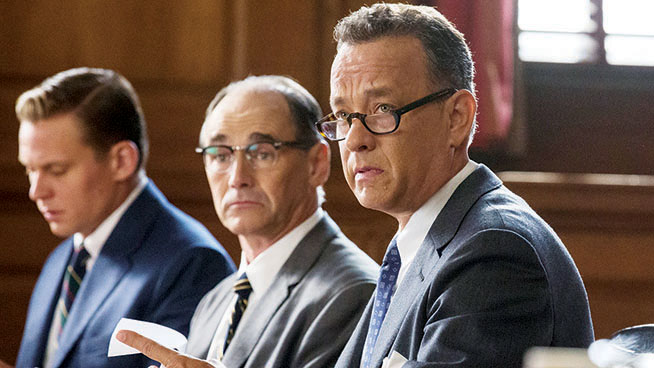
Tom Hanks plays James Donovan, a lawyer in the middle of the height of the Cold War, in Bridge Of Spies. Mark Rylance (centre) steals the show as his subject.
Bridge Of Spies is a Spielberg drama I missed out on seeing during its original theatrical release. I only saw it once it was a choice on a flight I took heading home. It was a good choice.
The film begins in 1957 with Rudolf Abel arrested by CIA agents as he’s trying to read a secret message. He is taken away but is able to keep the message. As Abel awaits trial, American lawyer James Donovan is assigned to defend him. The US government believes him to be a KGB spy but Donovan wants to have a fair trial because an unfair trial may be used as propaganda in the USSR. Donovan meets Abel whom is very welcoming to Donovan but will not cooperate with the US Government for any revelations in the intelligence world.
Donovan knows he has a heavy task in defending Abel. He’s serious about it but no one, not even his closest family, expects him to make a strong defense for Abel. Nevertheless Donovan is persistent and continues to seek acquittal for Abel despite an angry American public, persistent hate mail and threats on the lives of him and his family. Abel is found guilty on all charges. Before sentencing, Donovan asks the judge that Abel receive a prison sentence of 30 years instead of the death penalty because he feels Abel may become a bargaining chip with the Soviet Union. Further difficulties continue as Donovan is unable to win a Supreme Court case where evidence against Abel was tainted by an invalid search warrant.
Meanwhile two innocent Americans find themselves in the hands of Communists. One is US air force pilot Francis Powers whose plane is just shot down between the USSR-Turkish border. He’s able to escape his doomed plane and tries to steer his parachute into Turkey but fails and becomes captive. The other is Frederic Pryor, an American economics student studying in Germany just as the Berlin Wall is being built. He studies in West Berlin but has a girlfriend in East Berlin. He tried to bring her with him to the West but is arrested as a spy.
News gets to Donovan of the two men arrests. He’s even offered a deal from the USSR of the exchange of Abel for Powers. Donovan is insisting in a 2-for-1 deal of exchanging Abel for both Powers and Pryor. However he has the challenge of dealing with Soviet agents and a CIA that’s interested in only getting Powers back. The whole deal puts the governments of three nations– East Germany, the USA and the USSR– in a heated debate with Donovan make the outcome work out right. The end result is historic.
This is yet another film about war Steven Spielberg does focus on. There have been many films of the theme of war he’s done in his career. The wars he have depicted on screen have spanned time from World War II in Empire Of The Sun and Saving Private Ryan to World War I in The War Horse to the Civil War in Lincoln to even revenge missions in Munich.
Here he tackles a war that’s less about brutality but more about ideology and had victims of their own: the Cold War. Although there wasn’t as much blood shed, the Cold War did put a sense of paralyzing fear in the world, especially in the United States, with a possibility of nuclear war and armageddon. Thus the ‘duck and cover’ scene. Ask anyone over the age of 60 about doing all those ‘duck and cover’ practices at school. People were constantly being suspected as spies on both sides and there were reactions of hysteria to those accused of spying or treason. The construction of the Berlin Wall at a time when Germany was divided between the capitalist West and the Communist East is an example of the war.
The story takes us back to the 1950’s at a time when Cold War hysteria was at its highest. Neither side could be trusted if one from the other country came in to visit. That explains why even innocent visitors could be seen with suspicion. People arrested as spies for the other side were huge headline news. Most of the public wanted them dead with Julius and Ethel Rosenberg still fresh in their minds. It’s easy to see why someone like James Donovan would be so easily vilified by the American public and even face a possible shooting. The film shows why James’ efforts in the prisoner trade were necessary in the Cold War. It was something that was able to ease some tension on both sides.
Spielberg does a very good job of showing what the Cold War was like. Instead of showing fighting that’s common in the wars, he focuses on the more tense moments of the Cold War and captures its tense feel most people of that time felt. The screenwriting by Matt Charman and the Coen brothers was very good in providing insight to the moments in history and keeping the key elements of the situation. It didn’t focus too much on Jim’s personal life but it did focus on his efforts and even on the prisoners themselves. It may lack some historical accuracy but it does provide knowledge and keep the audience intrigued. Its one glitch is that it had too sweet of an ending. I don’t think it ended on the right note.
Tom Hanks was very good as Jim Donovan but it’s not at the same level as his most stellar roles. The biggest scene-stealer of the film was Mark Rylance as Rudolf Abel. He not only matched Abel physically but also gave him character with his love for art and his ability to say persuasive things. Other good supporting performances came from Amy Ryan as Jim’s wife and Alan Alda as Thomas Watters. Janusz Kaminski did a very good job of cinematography, the production designers did a very good job of recreating the 1950’s and 1960’s with their sets and Thomas Newman delivered a very good score to the film.
Bridge Of Spies is very much a story about a lawyer and his pursuits but also the times he had to deal with. Reminds you of some of the political tensions and paranoia that’s currently happening now. Spielberg does a good job of capturing the feel of the intensity as well as the political climate of the story.
 Jon The Blogcentric