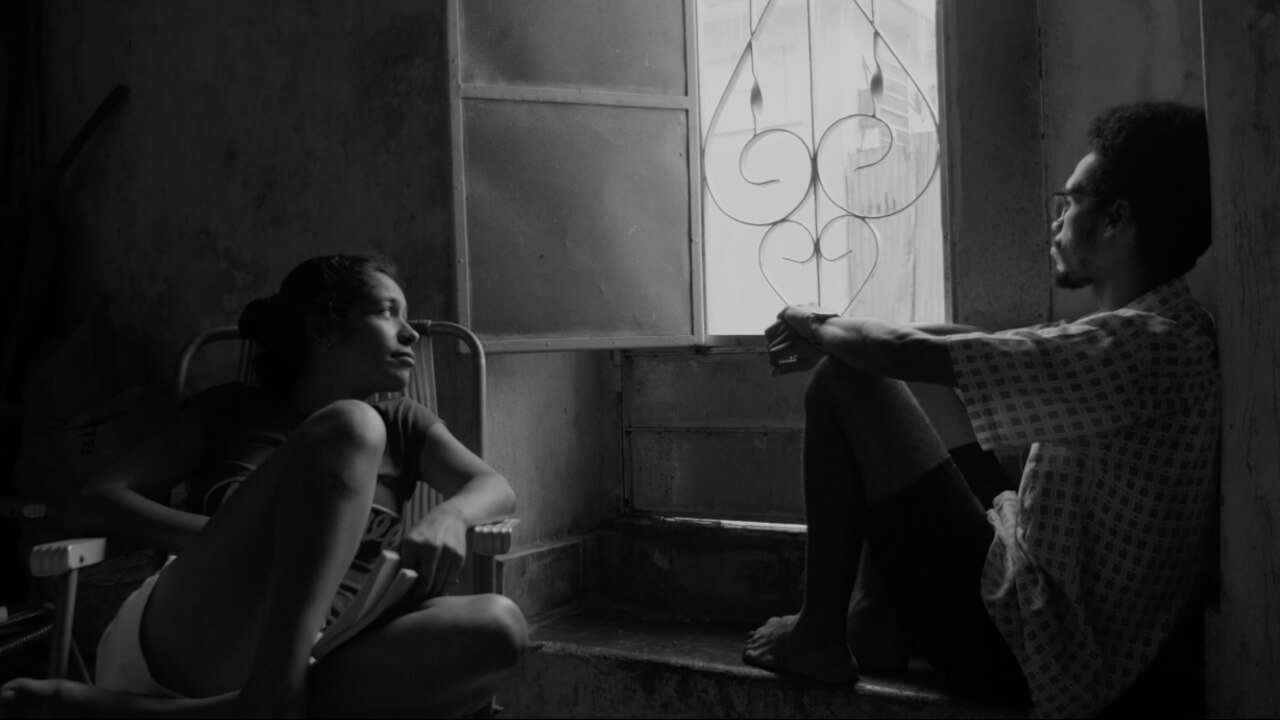
A film like The Oceans Are The Real Continents is a unique portrait of life centred around three different people in a town in Cuba. It paints quite a picture and is full of feeling.
The story begins with a theatrical production live on the lake. Alex is the main actor of the production. He is on a floating island as he floats to the actress, his girlfriend Edith. Alex is an acting instructor in the small Cuban town of San Antonio de los Banos. He has a loving relationship with Edith, a actress and puppeteer. It’s very apparent with the times Alex and Edith spend together, they have a loving relationship and are big artistic dreamers themselves. Recently Edith has applied for a visa to work in Italy. It’s a long process. Especially as news of a record number of evacuees from Cuba is broadcast on the radio.
At the same time is San Antonio de los Banos, there are two boys, around none-years old, named Frank and Alain. Frank and Alain live very close to each other and attend the same school, where they’re taught about glorifying Cuba. They do a lot together, but what they share most is their love for baseball. They play on the same little league team and as expected in Cuba, they are among many boys whom the nation hopes to train up for national glory. Thing is glory for Cuba is not what Frank and Alain are most interested in. They both dream of living in the US and hopefully play in a MLB team like the Yankees.
Also simultaneously in San Antonio de los Banos is an elderly woman named Milagros. MIlagros is retired from her normal work and is now out on the streets selling peanuts. Returning to her place, she dusts off images of past memories, plays music from decades before and reads letters written to her form her husband or boyfriend that he wrote to her as he was among a group of Cuban soldiers who fought in the Angolan Civil War in the late-1980’s. The letters her husband has written sound like poetry. Reading the letters is something she does on a daily basis.
Soon moments of friction happen in the three scenarios. As Alex continues acting and teaching, Edith has a successful puppet show. As news of her visa is getting closer and closer, Alex feels the strain of it. He’s even vocal to her about it, fearing it could hurt the relationship in the future. Especially since Edith desires to move to Italy permanently. For the two boys, Frank overhears a conversation his mother has about heading to Miami to be with family. That could mean leaving Alain behind. He doesn’t want that. For Milagros, a sudden rainstorm causes flooding in her suite and it gets everything wet, including her letters. She hangs them to dry outside after the storm ends. As she hangs them, she comes across what’s possibly the last letter her lover wrote to her and she’s in tears.
SPOILER WARNING: Ending in paragraph. Go to next paragraph if you don’t want to know the ending. The film ends with Frank and Alain walking along the railroad track close to the town’s station. As they arrive at the station, we see both Milagros and Edith waiting at the station as the train going to Havana arrives. In the end, we see and hear the letters Alex writes to Edith. He shares his belief that the distance between the two won’t stop their love for each other.
This film is unique that there are three stories surrounding people in this small town in Cuba. In retrospect, the film seems to be a film with the theme of hope. The case of the actress is a case in hope where it’s actively being pursued through her career and her channels with the Italian Embassy. There’s the case of the boyfriend who hopes to still have her despite the future of being thousands of miles apart. There is Frank and Alain whose hope in their baseball goals is something that will take maybe ten or fifteen years to determine their fates. Finally there’s Milagos who appears to be nearing the end of her life and all hope appears to be gone. She appears to cling to the letters of her late husband possibly as her only chance to get any feeling of hope. One thing the film leaves unanswered is how her husband died. Did he die on the battlefield during the war or MIA? Did he die peacefully in Cuba long after returning home? We don’t know and it’s up to us to decide. It’s possible her appearance at the train station at the end is the hope her husband will return one day.
This is a unique story of three different generations of Cubans who are not related or connected but find themselves linked at the end. The main story is of a couple with artistic dreams. Edith has a chance to go to Italy to further pursue her artistic direction, but Alex is uncomfortable with it. Frank and Alain are two boys with baseball dreams and hope to play for the Yankees one day instead of the glory of Cuba that’s expected of them. Milagros struggles to come to terms with the loss of her husband: a soldier in the Angolan War. It often seems as if reading those letters is the one thing keeping her alive. One story is of a couple and the present, another of a woman and the past, and another of two boys and hope for the future. Shot in black and white and done as a melodrama, it’s as much of a portrait as it is a story. Even without an obvious given time for a setting with the absence of modern technology, it’s a story that looks like it can happen anytime. That’s also part of the story’s magic.
This is an excellent first feature for Italian director/writer Tomasso Santambroggio. Originally from Italy, he has studied in La Havana. It’s apparent his experiences there are input into this film. This film was originally a short film he released four years ago and has only now incorporated into a feature-length film. He creates a story that’s a three stories in one. It’s of a shared theme of for each of the story’s protagonists, hope comes from somewhere else. At the same time, he’s able to show Cuba as a postcard-perfect place despite the crumbly buildings and the lack of promise. He’s able to show the beauty inside the dreariness and have it captured in this three-way melodrama. It’s very easy to be spellbound by the imagery while watching the melodrama. Also it makes sense that the film is marketed as an Italian film. I don’t think the nation of Cuba would want to support a film that depicts the nation negatively.
The unique thing about the film is that it shows actors who have had no known major acting credits before and they pull it off well. Also all five of the main characters in the film use their real first names in the story. For the couple, Alexander Diego and Edith Ibarra make their chemistry very believable. As they central story, they make the love between them and the friction that threatens to separate them often give us the feeling we’re watching a documentary of an actual couple. Frank Ernesto Lam and Alain Alberto Gonzales are both non-actors who come across as typical Cuban boys living the common little boy life, and that works to the film’s advantage as well as the story’s advantage. Milagros Llanes Martinez is also excellent in how she makes us feel her loneliness and her heartache. Of the three stories, hers was the one that most grabbed my attention.
The Oceans Are The Real Continents is a unique film. It is a drama with a central story, but two connected stories. It is both a story and a portrait. It is slow in its storytelling but big in capturing the moments, the land, and the emotions. It’s a rare gem that’s a delight to watch.






 Jon The Blogcentric