
Remember last year I talked about the issue of Oscars and race that took over headlines? Yes, it’s nice to see people pay attention to something about the Oscars besides who wears what? However it did focus on a problem in which many people including myself hoped would only exist last year. Unfortunately it was not the case.
THIS YEAR’S HOPE
Last year was a big focus of the lack of diversity. I even did a focus on it myself and even explained how things worked in all my 15 years of ‘OscarWatching.’ Many including myself were hoping that this year would not have the same mistake this year. And this year had a performance by a black actor eligible for a nomination: Idris Elba in the Supporting Actor category for Beasts Of No Nation. It had all the eligible clout: a Golden Globe nomination, a Screen Actors Guild nomination and a BAFTA nomination. Although nothing is guaranteed or earned in showbiz, it had the right amount of juice to clinch the nomination in that category. Many wanted to see the nomination happen. I also wanted to see it happen. I know that if it didn’t happen, there would be a whole whack of controversy and outrage. I even thought the Academy wouldn’t deny him the nomination, not after the #OscarsSoWhite embarrassment from last year.
The nominations were announced on January 14th. Elba was not among the nominees in that category. There were the nominations of Christian Bale and Mark Rylance which were also nominated for the same awards previously mentioned, the was Golden Globe winner Sylvester Stallone. However there was Mark Ruffalo who had earned a SAG nomination and Critics Choice nomination and Tom Hardy who had amassed only a Critics Choice nomination. All the acting nominees were white. All eight Best Picture nominees consisted of a predominantly white cast and predominantly white crew. As for directing and writing, the only non-white nominee was Mexican Alejandro Gonzalez Inarritu.
The lack of diversity wasn’t just the black-and-white issue. Gay director Todd Haynes was heavily favored to be nominated for Best Director for Carol and even for Carol itself to be nominated for Best Picture but those didn’t happen either. If there’s one positive thing, there were four women who receive scriptwriting nominations: up from zero from last year.
THE BACKLASH
People were already speaking their outrage. A new Twitter hashtag– #OscarsStillSoWhite– came about. Civil Rights leader Al Sharpton, whom last year said he would set up a ‘diversity task force,’ was outspoken in his outrage and urged boycotts. Boycotts did happen from Spike Lee, Will Smith and Jada Pinkett Smith. Some actors who did not intend to boycott like George Clooney, Viola Davis and Lupita Nyong’o spoke their criticism. Host Chris Rock was under pressure to boycott the Oscars. He declined but he will be focusing on it during his opening routine at this year’s ceremony. Even Barack Obama spoke out about the controversy: “I think that when everyone’s story is told then that makes for better art, it makes for better entertainment it makes everybody feel part of one American family, so I think as a whole the industry should do what every other industry should do which is to look for talent, provide opportunity to everybody. And I think the Oscar debate is really just an expression of this broader issue. Are we making sure that everybody is getting a fair shot?”
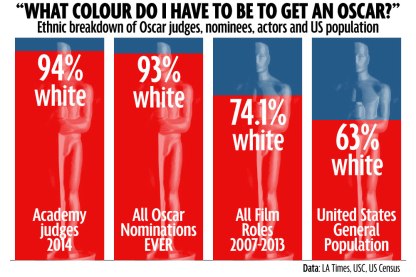 The Academy especially came under fire as they were scrutinized and analyzed and it was revealed that over 90% of the Academy were white in comparison to 65% of the population of the United States being white. In addition three out of every four Academy members were male. Despite the criticism and outrage, there were defenders coming from the likes of actress Penelope Ann Miller: “I voted for a number of black performers, and I was sorry they weren’t nominated. To imply that this is because all of us are racists is extremely offensive. I don’t want to be lumped into a category of being a racist because I’m certainly not and because I support and benefit from the talent of black people in this business. It was just an incredibly competitive year.” Even black actors like Ice Cube and Whoopi Goldberg dismissed the labeling of the Academy as racist. Ice Cube described the labeling of racism as “crying about not having enough icing on your cake.” Whoopi whom herself has won an Oscar and even host the Oscar ceremonies for many years stated: “Even if you fill the Academy with black and Latino and Asian members, if there’s no one on the screen to vote for, you’re not going to get the outcome that you want. I won once, so it can’t be that racist. I’ve been black the whole time.”
THE AMPAS PRESIDENT
With all the criticism the Academy faced this year, the one person who had to do the responding was AMPAS president Cheryl Boone Isaacs. Born in Springfield, Massachusetts in 1949, Boone Isaacs grew up in a middle-class African-American family. She graduated from Springfield Central High School in 1967 and from Whittier College in 1971 with a degree in political science. Her studies in college included a program studying abroad in Denmark.
Her introduction to showbiz came at the age of 25 through her older brother Ashley Boone Jr. who worked as an executive in Hollywood. She started work in Hollywood as a publicist for Columbia Pictures. Her first job was being a publicist for Close Encounters Of The Third Kind. She would work for various film companies as a publicist. Her publicity work on films would eventually lead to higher stature such as Vice President, Worldwide Advertising and Publicity of Melvin Simon Productions and Director of Advertising and Publicity for The Ladd Company. Under Paramount Pictures starting in 1984, she would start as Director, Publicity and Promotion, West Coast and then eventually become the Worldwide Publicity Director. Some of her marketing campaigns included successful Oscar campaigns for Best Picture winners Forrest Gump and Braveheart.
Success continued for Boone Isaacs as she would become President of Theatrical Marketing for New Line Cinema, the first black woman to hold such a position. She even has her own promotion company, CBI Enterprises, Inc., where she has worked on successful promotion of Best Picture winners: The King’s Speech and The Artist.
Boone Isaacs has been a member of the Academy since 1988. In 2013, she was promoted to the position of AMPAS president in 2013and became the first African-American president of the Academy as well as only the third woman, after only Bette Davis and Fay Kanin. Since her inception as president, he achievements have included lifting the cap or restriction on the number of Academy members. she also initiated a drive to invite over 400 new members coming from many ages and backgrounds.
THE PRESIDENT AND THE ISSUE OF DIVERSITY
“It’s easier to be the president of the United States as a black person than to be the head of a studio.”
-Spike Lee
The issue of the Academy and diversity appeared to be making progress since the start of the new millennium. Actors of various races were earning nominations more than ever before as well as non-white directors. Even in the minor categories, minorities were getting an increasing number of nominations. However it’s almost always in the acting categories where the issue of the Academy and racial diversity gets the heaviest scrutiny. That was the case last year when the first hashtag #OscarsSoWhite came out.
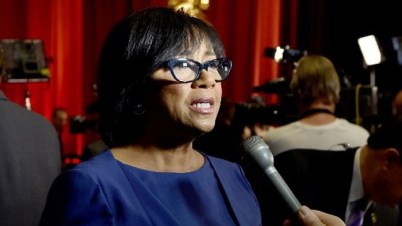
Cheryl Boone Isaacs, an African-American woman herself, knew this was an issue that needed looking into and she made her efforts. This was especially noteworthy at the AMPAS’s annual Governor Awards on Saturday November 14th. One of those awarded was Spike Lee where he was given an honorary Oscar. Before Boone Isaacs announced her plans, Lee talked about the lack of diversity even commenting that when he goes through Hollywood offices, he only sees white faces and the only non-white is the person checking his name at the door.
At those Awards, Boone Isaacs announced her plan which she called A2020: an initiative to age, gender, race, national origin and point-of-view, in Hollywood over the next five years. Her A2020 initiative is a five-year plan to study practices at the Academy with the aim of improving the diversity of its own staff and governance while also bringing new voices into the organization. Outside of the Academy, the plan is also intended to encourage and to push the industry to examine its hiring practices and to begin to make changes. Boone Isaacs stated: “When it comes to fair and equal representation in our industry, words are not enough. We also have a responsibility to take action and we have an unique opportunity to do so now.” At those ceremonies, Lee thanked her and said: “she’s trying to do something that needs to be done.”
THE PRESIDENT RESPONDS TO THE CONTROVERSY
“The Academy is going to lead and not wait for the industry to catch up.”
-Cheryl Boone Isaacs
If there’s one thing most people would feel upon learning of this year’s nominees, it’s that Cheryl’s A2020 plan isn’t happening fast enough. Even though the set of 51 new members of the Academy was more diverse especially with 17 of them being women, the end result on nomination day was one of disappointment. Boone Isaacs herself came under fire by some for not doing enough. Even civil rights leader Al Sharpton ridiculed her by referring to her as a pawn in a predominantly white members-only club.
No doubt Boone Isaacs felt the heat. It was only a matter of a mere eight days after the nominations were announced that Boone Isaacs announced the sweeping changes to the membership rules for Academy members. This was published on the AMPAS website under the title ‘Academy Takes Historic Action To Increase Diversity.’ For those interested in the plans, click here to the official document.
The day before, the Board Of Governors approved through a unanimous vote a set of sweeping changes coming to the Academy’s membership. Its intent was to make the Academy members more diverse and open the door to more women and visible minorities. However one of the things they most wanted to get tough on was the membership of their older members. Examples of the proposed changes starting this year are:
- New members lasting 10 years and renewed if that new member has been active in motion pictures during that decade.
- Lifetime voting rights after three ten-year terms or if they’ve won or have been nominated for an Academy Award. Standards also applied retroactively to current members.
- Current members that have not been active for 10 years can still qualify if they meet the other criteria.
- Members not qualifying for active status will be moved to emeritus status and will be denied voting privileges.
- An ambitious global campaign will be launched to identify and recruit qualified new members who represent greater diversity.
- To increase diversity in its Board Of Governors, the Academy will establish three new governor seats that will be nominated by the president for three year terms and confirmed by the board.
- New members who are not governors will be added to its executive and board committees where key decisions about membership and governance are made. This allows for new members to become more active in the Academy’s decision-making and help the Academy identify and nurture future leaders.
Most of the response has been good. Some of the biggest came from Selma director Ava DuVernay through Twitter: “One good step in a long, complicated journey for people of color + women artists. Shame is one helluva motivator.” Lee stood by his boycott but applauded Boone Isaacs and the Board of Governers for: “trying to do the right thing. It’s a start.” Steven Spielberg also reminded us: “I do think that what the Academy is doing, in a proactive way, to open up the membership to diversity, I think that’s very, very important. But it’s not just the Academy, and I think we have to stop pointing fingers and blaming the Academy. It’s people that hire, it’s people at the main gate of studios and independents. It’s the stories that are being told. It’s who’s writing diversity — it starts on the page. And we all have to be more proactive in getting out there and just seeking talent.”
I admire Cheryl Boone Isaacs for taking the initiative for making these needed changes. The Academy always was aboard with its own membership rules and needed reform back in the 1960’s because of its own issues then. Issues came again now and reform was needed. The changes proposed look great: less members for life.
However I do believe they are not a 100% guarantee of diversity happening on a consistent basis. No kidding diversity will be increasing at double the rate it’s been happening in past years. However it doesn’t mean that every year from next year onward will feature a diverse array of nominees. I’ve seen the various film seasons over the years and see how certain films excel more than others. I’ve seen years that have been very generous towards minority actor and have given them roles that can contend for glory at various awards shows including the Oscars. However I’ve also seen years which have been lackluster for them and they would lack parts that can propel them among the ‘elite of the year.’ I know it’s a start and there will be more to come but I’m still a bit cynical it’s a solve-all.
Also it also depends on the media too. I’ve seen them label some films long before the Oscars full of ‘Oscar buzz.’ And most of them are predominantly white. The media can’t just simply label a film ‘Oscar bait’ because it has characteristics that are common with what wins the Academy over. They should call it ‘Oscar bait’ because of top notch quality, and skin color should not matter.
Nevertheless next year is the first year when these changes are to come into effect. Hopefully over time we will see a more diverse Academy. And not just more blacks; more women, more Hispanics, more Asians, more of all minorities. As for 2016, potential is already showing as this year’s Sundance showed The Birth Of A Nation: a film with a predominantly African-American cast that had rave reviews and huge buzz. The release date to the box office has not been set but Fox Searchlight has bought the film’s rights at $17.5 million, the most ever for a Sundance film.
The outrage over the lack of diversity at this year’s Academy Award nominees was just the catalyst needed for the necessary changes to happen. The future will tell if these changes pay off or not. However the lack of diversity is still an ugly reminder of what happens when you turn art into a competition.
WORKS CITED:
WIKIPEDIA: 88th Academy Awards. Wikipedia.com. 2016. Wikimedia Foundation Inc. <https://en.wikipedia.org/wiki/88th_Academy_Awards>
WIKIPEDIA: Cheryl Boone Isaacs. Wikipedia.com. 2016. Wikimedia Foundation Inc. <https://en.wikipedia.org/wiki/Cheryl_Boone_Isaacs>
Kilday, Gregg. “Spike Lee: Getting a Black President Is Easier Than a Black Studio Head” The Hollywood reporter. 14 November 2015 <http://www.hollywoodreporter.com/news/spike-lee-getting-a-black-840371>
Gray, Tim. “Governors Award Winner Spike Lee to Hollywood: ‘You Better Get Smart’” Variety. 15 November 2015 <http://variety.com/2015/film/news/governors-award-winner-spike-lee-to-hollywood-you-better-get-smart-1201640307/>
“ACADEMY TAKES HISTORIC ACTION TO INCREASE DIVERSITY” Oscars.org 22 January 2016 <http://www.oscars.org/news/academy-takes-historic-action-increase-diversity>

 Jon The Blogcentric