VIFF 2011 Review: Shorts Segment – Water

The Vancouver Film Festival has been known to show a lot of feature movies during its 16 day run. What they also show is a wide variety of short films, especially those made by Canadian directors. The shorts exhibited range from those with an established reputation to those just starting out. For airings of Canadian shorts, the VIFF had four segments titled off of the earths four natural elements; Air, Earth, Fire and Water. The first shorts segment I saw was the one titled Water. All the shorts in the segments had something to do with water either as a metaphor, part of a scene or as a central theme. Each had their own style and/or their own story to say or play out.
 
For this year’s VIFF, I wanted a good mix of films to see: Canadian, foreign, documentaries and shorts. This was the first segment of shorts I saw. I’m happy. At the beginning of the segment, I was expecting this to be showcasing works of ‘the filmmakers of the future’ as shorts are often known as. What I saw here, I was a bit surprised:
 
Wait For Rain – This is an amusing comedic short. People who work at a sales business waiting for rain for their plant in a world where fresh water is rare. James is always the last to get rain for his plant and thus the least suucessful. One woman is interested in him and his plant while he’s interested in another. Amusing quirky love story that plays out humorously form beginning to end.
 
Steam – This is a more serious short. A middle aged man struggling with something he’s always felt as a burden. Now he learns to accept himself. It seems odd to go from a cute and funny short like Wait For Rain to Steam but Steam is a good short in its own right where one is kept intrigued by the drama.
 
Snowbound – This is the most shocking short of the bunch. A 13 year-old girl learns she’s pregnant. She can’t tell her boyfriend. Her mother finds out accidentally. What does she do? In the end, she makes a decision that will leave all shocked.
 
Swim – It’s four minutes where you see a man swimming in an area of Lake Ontario. But what makes it is the narration form the filmmaker. He tells of a childhood memory that still haunts him. He would later repeat that same dare on his boyfriend years later. More of an introspect or a reflection than a drama played out.
 
Le Rocher – Another short that’s not a piece of drama played out. Instead it’s a showcase of places and spaces from both Canada and Europe. It’s meant to show the relation of both. Mostly a collection of landscape filling. If you like scenic films, you’ll like it. If you came to the shorts segment expecting all shorts to be dramas like I did, you’ll leave confused.
 
Blood/Sweat/Tears – At first the two people in the crashed car all alone on the street  look dead. Then they become conscious and arguing. It all starts out with the two arguing by themselves, then amongst a crowd of onlookers and then the woman is taken away while the man is out shouting. Interesting story about troubled love. Also interesting is that’s it’s of a single-car crash with no other car, no street light, no nothing causing it. I think the crash was meant to be a metaphor of the relationship.
 
Bone Wind Fire – This is another intimate short. This is of the lives of three of the greatest North American painters: Emily Carr, Frieda Kahlo and Georgia O’Keefe. What it’s focus is on the nature of where they lived and how it played out and inspired the paintings they created. Awesome cinematography. You really get a feel for the nature.
 
And there you have it. The seven shorts that comprised Rain. I’m sure anyone that came to saw it might find at least one they liked. One thing is that it taught me a lot about short filmmaking. Not everyone who creates a short puts a story or a drama on film. There’s more creativity to it. Glad to see it shown in this segment. As for the fiilms, some shorts may catapult directors into something bigger in the future. Some may lead to other filmmaking jobs in the future. And some may continue to do shorts. Only time will tell how they do. 
 

Vancouver International Film Festival Turns 30

Back on Saturday, I started my volunteer work for the Vancouver International Film Festival. It is my fourth year volunteering. It’s great being part of an event that gathers a lot of media attention and helps promote filmmaking.

If you look back to the late 1970’s, you might remember there being film festivals like the Toronto Film Festival and the Sundance Film Festival that garnered very little attention but were growing at the time. They were still below the ranks and renown of the more established film festivals in Europe like Cannes, Venice and Berlin. Since then, Sundance and Toronto have made a major impact on the film world with its releases and its promotion of films. The Vancouver International Film Festival started in 1982 and now ranks as one of the top film festivals in North America. It nevertheless does carry a bit of an identity crisis but does have a lot to offer.

Since the Vancouver International Film Festival, the VIFF, opened in 1982, it has grown to an annual attendance of 150,000 every year since 2003. The 2000’s saw the construction of a special theatre, the VanCity Theatre, and an adjacent office for the VIFF organizers. This year it features over 300 films from 59 countries. Quite a lot. Nevertheless many feel that the VIFF is sandwiched in the role of playing second-fiddle to the Toronto Film Fest. In fact one person frequently tells me that we always get the ‘leftovers’ from Toronto. It is true that we get a lot of films that have already had their show at Toronto, especially those that get a special presentation at the Visa screening room. Very rarely, if ever, does a big-name actor show up. At most, a big feature will only have a tech person in the audience at the VIFF. What’s also true is what the VIFF has to offer on its own. Firstly the VIFF has more Asians films than any film festival in North America. This year there are more than 100 from dozens of countries. The VIFF also features more Canadian films and works than any other film festival in Canada. Not even Toronto has as much. They’re too busy hyping up the Oscar contenders. The VIFF also features loads of documentaries. There are dozens this year too from a wide variety of topics. The VIFF also features a lot of short films and films for youth. The film festival is not simply a festival showing straight features but a wide variety of films from across the spectrum from shorts both animated and live action to at least four films longer than 4 hours. There’s also the possibility of Q&A sessions from directors and even actors.

The VIFF also has a lot of dealings going on. Some films will catch the eye of distributors and will work things out to have them shown to the big screen. Others, like documentaries, will be able to be shown on specialty television networks. Some will be promoted as videos or films for special groups or resource centers. Like last year I saw the Canadian film Two Indians Talking and the director said in the Q&A that she hopes for it to be put on DVD and shown in First Nations resource centers. Then there are those where the VIFF will be the furthest their film will get. That’s the nature of the beast in filmmaking and promoting. It’s always a case of chance and luck of how far it will go.

Another thing the VIFF did was that it had a special panel. With this being the 30th Year of the Festival, it had a look back to the early years of the Festival and also hosted a free forum about the future of film. I wasn’t there at the Forum but I’m sure there’s a lot of discussion. I myself believe the world of film faces a lot of challenges in the years and decades ahead. One is the future of creativity and taking film in new directions in what is essentially a bottom-line business. Film can allow for a lot of creative minds to express themselves but there’s this beast called ‘showbiz’ where the subject of movie marketability is inescapable. Whether creativity can be taken in new directions and possibly even change filmmaking, only time will tell. Another factor to take into consideration is the multitude of media sources one now has, including some that didn’t exist ten years ago. When the VIFF opened, film’s top rivals were television, VCR and the newly-created pay TV. Multiplexes were increasing but it was still possible for a single-screen cinema to hold its own. Today, we have digital cable with hundreds of channels at our fingertips. We have websites like Youtube and Netflix. We can watch a movie on our laptop or even on our cellphone. Multiplexes are now the mainstay for big screen cinemas and single screen cinemas nowadays have either succumbed, are now in the fight of their life, or have to have some backing from some film source or company. Some of you may already have read some of the current difficulties of running a cinema as noted in my Hollywood Theatre article. Just to give a heads up, there’s going to be a multiplex opening in the new shopping mall at the New Westtminster station: ten cinemas with a total of 1800 seats. A multiplex with samll per-screen theatres; another example of what’s happening with the movie business.  Don’t get me wrong. There will be a future for film–there’s no doubt in my mind– but it has a bumpy road ahead.

This year, there were some changes in the venues with the Festival. The Granville 7 still remains the biggest venue for showing films but the Visa Screening Room is no longer Cinema 7 on the top floor. Instead it’s the Vogue Theatre. The Park Theatre is not one of the alternative theatres this year. The VanCity and Pacific Cinematheque are still being used for the Festival. Last year, the Festival opened with the screening of a Canadian film–Barney’s Version— with promotion of Telefilm Canada. This year they open with Pedro Almodovar’s The Skin I Live In, a film from Spain. Last year, they closed with the animated movie The Illusionist. This year, they close with the French film The Kid With A Bike.

In its thirtieth year, the Vancouver International Film Festival shows strong signs of growth. It may have a while before it joins the ranks of Sundance and Toronto but I’m sure it will continue to establish its own identity in the future. For more information about the Festival, go to the VIFF website.

Move Review: The Help

I know what you’re going to say before I talk about The Help. There have already been a lot of movies about racism and segregation. Yes there have been. Nevertheless The Help is a well-made story about showing a black woman’s point of view on racism from a state most synonymous with segregation: Mississippi.

The movie revolves around three women in particular. The first is Abilene; an African American maid whose latest maid work comes right after the death of her son. The second is Milly; another African American maid who was recently fired from Hilly Hollbrook–Jackson’s white female ringleader–for using a toilet meant only for Hilly’s white family and is only rehired by a white ‘misfit’. The third is Skeeter; a white journalism grad from Ole Miss who is unmarried and wants to make a career for herself in writing but lacks a story.

The setting is Jackson, Mississippi. Segregation is alive and well but is facing abolishment. The black maids have had enough while the white upper class females want to see it kept. Hilly herself wants to enact a passage of a law to make it standard for separate bathrooms for white and colored people. Skeeter is tired of writing a housekeeping column and wants an actual story. She comes across it just after her former maid Constantine, who she always looked up to as a child, is mysteriously gone, Hilly speaks her pro-segregation mind at her ‘clique meetings’ and she encounters Aibilene and Minny. They have quite the story to tell and she learns a lot from what they have to say and what they’ve experienced. Even Milly’s story of her revenge on Hilly with ‘the pie’ makes for some colorful. Nevertheless a book publishing company wants to have the points of view from twelve maids, not two. It’s a struggle for Skeeter as she becomes more of a misfit in Hilly’s clique for being unmarried and being opposed to segregation and because of state law: Mississippi law can imprison writers and interviewees for cross-race writing. It isn’t until the shooting death of Civil Rights leader Medgar Evers that Skeeter finally gets her twelve to interview, however giving them pseudonyms to protect their identity. The result is the novel finally being made and boy does it stir up a lot of debate and reactions.

One thing about the ending is that a lot is accomplished and many good things come out of it. Despite positive changes, some bad things still remain and the movie doesn’t end on a completely positive note. The ending takes a turn for a different more negative ending. Nevertheless it did so on the right note. It reminds us that even after segregation was ended for real in the Southern States, some negative aspects of racism still remained and some changes didn’t go as far as it should have.

There have been movies about racism in the past and conquering racism but hardly has there ever been such where it’s on the basis of the black maids for white families. It touches on a common notion. The white children were raised and cared for by the African American maids and many of the children would look up to them as a mother figure. As most of those white children grew up as adults, they would then go on to the hiring and firing of them. They would adopt the cruelness to the maids their own parents had. The story is set in Jackson, Mississippi around the time of the civil rights movements and around the time Jackson, the capitol of Mississippi, is where segregation is possibly the most alive and well. The story features Skeeter, an aspiring writer who’s looking for a story and sees one. Remembering how Constantine was like a mother to her and wondering whatever happened to her, she hasn’t developed the hardness of heart her girlfriends had developed over the years. It is with her willingness to see the maids’ side and write about it that made her want to set the record straight. That helps to create the intrigue of the story.

One of the interesting themes in the movie is oddly enough its use of toilets. Many people including myself still look at toilets as something taboo but in recent decades, many people and many creative artists have defied this taboo and become more public about it and even incorporated it into art. In this film, it plays a significant role because as we remember, toilets were a part of the days segregation: separate ones for whites and colored. The Help presents toilets in many different references. It is Aibilene’s toilet teaching where she shows she’s a better mother to Mae Mobley Leefolt than Mrs. Leefolt is. It is where Minny uses a toilet for white people only in Hilly’s house that gets her fired. It’s where Hilly strongly believes in segregated bathrooms to the point to where she’s willing to take her plea to the surgeon general. It’s also the prank Skeeter uses to pull on Hilly for her lobbying. As taboo as it is, there’s no denying the significance of toilets in the movie.

One thing about the movie The Help is that it’s based on a novel that is complete fiction. That fact might make some question the triumphant moments in the movie. Question it all you want. One thing you can’t deny is that despite it being fiction, there are a lot of hard truths experienced by the African Americans in Mississippi that are portrayed very well and will make you think. Seeing how Hilly treats her maids meanly to the point of firing them instantly and even getting them arrested makes you think how many others were as mean as Hilly. That scene where Minny is with her eldest daughter in a maid’s uniform about to board the bus can also disturb you. Imagine a future that limited. Also that scene where Charlotte told how and why she fired Constantine. How many times do you think that has happened in the past? So the novel may not be based on a true story but possibly based on a thousand true stories.

The directing from Tate Taylor was top notch. He did an excellent job of directing the movie and writing the storyline well. The acting however is what made the movie most. The standout without a doubt was Viola Davis. Her performance of Aibilene was the glue of the movie and had the most to tell. Her acting was full of believability from start to finish. Octavia Spencer was the top scene-stealer as Minny. She was able to make for an excellent turn with adding elements of humor to her role. Emma Stone delivered possibly the best performance of her career. Already people are saying she’s the next big thing. Her performance of Skeeter demonstrates she can also make a good actress of herself. Also a standout is Bryce Dallas Howard. Her character acting was so excellent, she will easily make you hate Hilly.

Overall, The Help is a very excellent movie revealing a harsh reality of 60’s Southern racism. Some say it’s not as harsh of a depiction as it should be. Nevertheless we shouldn’t forget that even in racism situations that aren’t as harsh, the hurt can still be felt and the picture can have an ugliness of its own.

Movie Review: Of Gods And Men

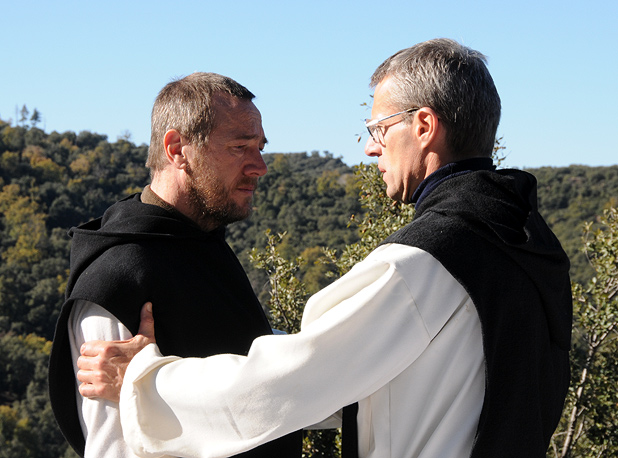
The French/Arabic-language film Of Gods And Men doesn’t have the type of subject matter that would normally bring in a large crowd. The film is about Cicstercian Monks living in a small village in Algeria facing threats from fundamentalist terrorist groups. Nevertheless those lucky enough to see it will love it for what it is.

This film is based on an incident that happened in 1996. Seven French monks from the Algerian village of Tibhirine were found decapitated. The film focuses on the days just before they were killed. They were a group of eight monks who lived in a monastery in Tibhirine. They devoted their lives to monk rituals of gardening, distributing medical help to locals and religious devotions. They were present at the village during times of celebration and they conversed with the villagers regularly. They all did this during a time of the Algerian Civil War. Religious extremists were committing acts of brutality amongst foreigners and their own people. The pressure was felt by the monks. Christian, the leader and resident religious scholar, tells authorities they will not go. However this is hotly debated with the other monks as some fear for their own safety. Christian then gives the men time to decide whether to leave or not. News gets grimmer by the moment. They even face potential threats of their own. Authorities of the Algerian government request they leave for their lives. The villagers however convince them of how vital they are to the community. In the end, as one brother pays a visit to the monastery, they all vote to stay. Late in the night, seven of the nine are found, captured and taken away. Those would be their last minutes known to be alive.

The film has many great qualities. Its best technical quality was the cinematography as it added to the film in showcasing the landscape in its best splendor. The film was well-directed and well-written by French director Xavier Beauvois. The script he co-wrote with Etienne Comar was excellent and very no-nonsense as it cut at the heart of the monks and the village they served. As important as it was to show the events that happened leading up to the times, the script’s biggest focus was on the monks and their lives. It was more about people than events. Even the scene of the last dinner with the music of Swan Lake in the background was done with the focus on the men. 

 The biggest strength of the movie is definitely the acting. Of all performances, the two that stood out were that of Christian the leader and Luc the doctor. Lambert Wilson’s performance of Christian was excellent and the most intense. Often he said more in his scenes of silence than he did with his spoken parts. Michael Lonsdale’s performance of Luc the Doctor was the best supporting performance. There wasn’t a hint of phoniness in it.

As for the monks as a whole, the most remarkable thing about the film is its ability to give three-dimensional portrayal of monk characters. The film not only showed them in their prayer life but also showed the devotion during their prayers. The film showed them in their occupations and how important they were to the village. The film showed their convictions and their beliefs. The film showed the bond between the men. Above all, it was alll done in a three-dimensional manner. This is very rare for a film to accomplish that feat. Even back during the days of the Hays Code–where one of the rules was that religious figures were to be depicted in a positive manner–religious figures were still two-dimensional at the most. Even the negative depictions of religious figures that came once the Hays Code was dropped in the 60’s as ‘censorship’ or ‘restrictive of creativity’–were also two dimensional and often too stockish. This film has to be the most realistic and inside-out portrayal of religious characters, in both character and their vocation, that I’ve ever seen on the big screen. Even 1997’s The Apostle doesn’t compare as Robert Duvall’s portrayal of a minister had more focus on his passion and personal demons than on his vocation.

Also vital is the ending of the film. It is not known who exactly killed the monks. An Islamic extremist group has claimed responsibility but recent documents from the French secret service claim that the Algerian army carried it out as a mistake during the rescue attempt. The film doesn’t pick one group at fault as the monks are captured in the dead of night with the darkness hiding their identity.

There may be some nervous in seeing this film, feeling it might try to ‘convert’ them to Catholicism. For the record, director Xavier Beauvois has not directed a religious film in the past. One thing we should note is that while the monks lived at the monastery, there’s no scene of them trying to convert any of the villagers from Islam. In fact Brother Christian was as knowledgeable about the Koran as he was about the Bible. When religion extremists threatened to shoot the brothers in one instance, Brother Christian quoted a passage from the Koran which caused the leader to drop his gun and order his followers to leave. I believe Beauvois wanted to show that for the monks, the faith was mightier than the sword. Also in the script was a scene where the monks talk about the difference between the Islamics and ‘Islamists’. This is good for a time when religion faces a lot of flack from religious dissenters. I believe that may have been another point from Beauvois that it’s important for one to recognize the believers from the ‘beliefists’.

This film has won a lot of accolades. It won the Grand Prix and the Prize of the Ecumenical Jury at the 2010 Cannes Film Festival. The Grand Prix is second to the Palme d’Or as the most prestigious award at the Festival. Other nominations and awards have followed such as wins at France’s Cesar Awards, nominations at the European Film Awards, nominated for Best Film Not In The English Language at Britain’s BAFTA awards and was France’s official entry for the 2010 Academy Award for the Best Foreign Language Film category. The film was well received by critics here in North America and has a 91% approval rating at Rotten Tomatoes.

Although this is a movie that makes for excellent viewing for Catholic communities, it’s not completely 100% ‘safe’ for everyone. There is a few profanities utters, including one by a monk. There are also some scenes of violence. The most violence is the scene of soldiers being cut at the throat by the extremists. Most of the violence is only seen through news footage.

For writers and directors with religious values, this film offers a ray of hope for those who want to break into film making. It shows that a film showcasing religious values can not only be shown on the big screen but also be written and produced well. That has long been the dilemma ever since the Hays Code has been lifted. This was best summed up in a quote by Catholic scriptwriter/acting school director Barbara Nicolosi-Harrington: 

I realized coming (to Hollywood) that it’s not so much Hollywood is persecuting the Church as much as it was the Church was committing suicide in Hollywood. Big difference. So I basically wrote an article about it saying that Hollywood isn’t anti-Christian as so much as it’s anti-bad art, and we’re just giving it schlock.

She states a major hurdle here as all too often a lot of Christian writers have written a lot of scrpits viewed by Hollywood as sub-standard in skill while the more liberal writers seem to know how to write for the screen. It’s a hugely difficult task to write a film of positive values or strong faith for the general audience without crossing the line of being schmaltzy or manipulative. Of Gods And Men shows that it can be done and it’s just a matter of learning how to do things right.

If you’re fortunate enough to have it come to your city, I highly recommend you see Of Gods And Men. Even if you don’t buy the Catholic faith or want a movie with preachy religious themes, it’s a film worth watching. It’s as much about people and their devotion to their beliefs as it is about an incident that happened. Even with the tragic ending, it tells a lot about the human spirit that will stay with the viewer once they leave the theatre.

2010 Oscars Best Picture Nominee: Winter’s Bone

A girl in the Ozarks attempts to find her father dead or alive, even if it means risking her life. This doesn’t make for the most attention-getting of movies but this is the story in Winter’s Bone. The movie itself is a mystery bound to keep you intrigued.

It all starts when a teenage girl names Ree is told by the police that her father posted the house as bail for a drug trial and unless he shows, the family will lose it all and be split up. This is hard to do for Ree in their poor settings as she not only has to tend to her mentally ill mother but be the parent figure for her younger brother and sister. She knows her father’s in the drug trade and has been gone for a year but is determined to find him. Attempting to find him puts her own life in danger as she tries to search for him in a house that burned down from a meth explosion and faces death threats from villagers and even distant family members. Her father’s brother tells her he may be dead but she continues on. She finally gets the answer she’s after through bizarre circumstances in the end.

The biggest theme of the movie is about Ozark life and about keeping secrets. Through watching the film, you learn of the difficulties growing up in the Ozark and that the villagers have secrets to hide. The teen parents whom Ree is friends with shows how growing up in the Ozarks stars early.  Over time you witness what Hillbilly life or Ozark life is like and you’d see why Ree would best serve the role as parent for her siblings. The film is an adaptation of a 2006 novel and director/writer Debra Granik did an excellent job of showing the story and portraying Ozark life’s significance to the plot. Even the addition of Ozark country music added to the atmosphere of the story. Young Jennifer Lawrence was excellent in portraying Ree in her grittiness and inner strength. Those that saw the movie would know that her role was very physically demanding. John Hawkes was also excellent as the brother with secrets to hide, despite how much they haunt him.

This film was a hit at the 2010 Sundance and did moderately successful as an indie hit film. If you have the chance, I recommend you rent the DVD of Winter’s Bone. It’s a thriller for all its mystery and bizarreness is worth it.