2023 Oscars Best Picture Review: Barbie

Margot Robbie (right) stars as Barbie and Ryan Gosling (left) star as Ken as Barbie bring the legendary dolls to life.

DISCLAIMER: This is from a blog of four reviews I originally posted on March 2, 2024. The original blog has been removed.

Unless you’ve been under a rock, you would know that Barbie was the big hit movie of 2023. You may also ask did it deserve its box office success or its Oscar acclaim?

I actually learned about the Barbie movie over a year before its release. I saw photos of it on social media. During the time, I thought it was odd. A movie about the Barbie doll coming to life? Could it work? Would it be a dud? I know Greta Gerwig was directing it. I already knew Greta had established herself as a force to be reckoned with in films like Lady Bird and her adaptation of Little Women. Nevertheless I was skeptical that even a director with her accomplishments could make a good film about the Barbie doll. It was up for the release and the reception to tell the full story.

I have to say before I saw it in theatres, I first thought this would be a fail waiting to happen. A big-budget movie about Barbie dolls coming to life didn’t sound like a winner to me at all. Then once the film hit the theatres, it was obvious Greta created a winner. Instead of the film about Barbie dolls, the film’s focus was about feminism and how the patriarchy had made it hard and continues to make it hard. One would ask “Why would one make a movie with a feminist focus by including Barbie dolls?” Simple. Ever since the Barbie doll came, it has been widely blamed for the image problems of young women and commonly seen as “setting the woman’s movement back.” We’ve all heard the arguments and the controversies for decades.

Here, Gerwig settles the score. She creates a world of different Barbie’s based on the owner’s own making of the Barbie. In the middle is “Stereotypical Barbie:” a carefree girl who lives a life of blissful joy which comes to a screeching halt as her owner goes through her frustrations of life. She attempts to go to the real world and the Mattel headquarters to sort things out, only for Ken to piggyback his way in and adopt a patriarchal attitude as a way to fix his own identity crisis.  That leads to the group of Ken’s overtaking Barbieland and claiming it as their own. Meanwhile Barbie’s frustrations grow and grow even after she meets her owner, who happens to be a Mattel employee. Her owner’s frustrations become her own. It’s through meeting women in the real world that don’t look like her and are happy that she gets a sense of what happiness is. Over time, Ken learns he doesn’t have to start the patriarchy in Barbieland to get his sense of self-worth back, but Barbie’s still in a struggle.

It isn’t until he finally meets Ruth Handler, the creator of the Barbie doll, that she finally gets her sense of self back. I feel that scene at the end where Barbie meets up with Ruth is the best scene as it settles the score on the Barbie doll debate, too. After decades of debate and dispute about the doll, we get a moment in the film that finally settles the score about the doll and the image it’s to project. It’s through that ending we learn Barbie was not meant to be the stereotypical ditzy blond we commonly see it as. The Barbie doll was meant to be the epitome of her daughter Barbara. Something beautiful. Mattel may have toyed with the Barbie doll over the decades, but that scene finally settles the score on the matter. The Barbie doll is the result of mother-daughter love. And Stereotypical Barbie finally gets a sense of the never ending story of herself, as well as the human touch which is better than anything she could get in Barbieland.

Top respect should go to Greta Gerwig. Even without the whole Barbie phenomenon of 2023, Gerwig, who directed and co-wrote the film with husband Noah Baumbach, deserves credit for making a hit and a critical success for something that many felt was a bomb waiting to happen. She takes a common theme about the Barbie doll, of how many feel it is a bad influence to young girls and feminism as a whole, and makes it thought-provoking. Despite it being a thought-provoking film, she also keeps it comical and even entertaining to watch. I mean we are talking about a movie about Barbie dolls. Nevertheless, the film shows it can be funny and entertaining and still be able to get its message across strongly. As well as settle the score on the Barbie doll itself. Not to mention, achieve the first ever billion-dollar blockbuster directed by a woman! Congratulations, Greta, for doing all what we thought was impossible!

The film also finds its strength firstly in the acting of Margot Robbie. To take a character like “stereotypical Barbie” and make her three-dimensional without compromising the comedy is an excellent effort. They always say comedy is the hardest thing to do. Try doing comedy while trying to send an important message at the same time. Robbie succeeds in doing that. Also succeeding in achieving that is Ryan Gosling as Ken. Ryan gives personality to the Ken doll that the actual Ken doll has seemed to lack over the years. He succeeds in making Ken an insecure one and one to see patriarchy as the answer to his self-esteem. The performance is as bizarre as it is comical and entertaining. He even manages to make comedy of the patriarchy. Also worthy of acclaim is the performance of America Ferrera. While Barbie and Ken bring on the entertainment, it’s the character of Gloria who brings the movie’s darkness. America succeeds in creating an insecure Mattel employee whose personal insecurities influence Barbie’s insecurities and finding herself happening along Barbie finding herself. Also adding to the film is the narration from Helen Mirren. Her narration adds more charm.

For technical credits, Barbie has to get the biggest respect. Creating something like Barbieland and the Barbie dolls that live there is as much of an accomplishment as the film itself. First, there’s set designers Sarah Greenwood and Katie Spencer. They succeeded in making Barbieland into a land of Barbies that we can’t see anyone else doing a better job. It’s as big and colorful as it should be. Also top respect for costume designer Jacqueline Durran for designing the right type of costumes that look like perfect looks for Barbie dolls but very wearable for the actors and actresses. And then there’s the music. Those who saw it will know there are musical moments without the film being a full musical. Songs like “What Was I Made For?” “Dance The Night,” and “I’m Just Ken” add to the entertainment factor of the film. You can thank the many established songwriters who added their talents to this film.

For technical credits, Barbie has to get the biggest respect. Creating something like Barbieland and the Barbie dolls that live there is as much of an accomplishment as the film itself. First, there’s set designers Sarah Greenwood and Katie Spencer. They succeeded in making Barbieland into a land of Barbies that we can’t see anyone else doing a better job. It’s as big and colorful as it should be. Also top respect for costume designer Jacqueline Durran for designing the right type of costumes that look like perfect looks for Barbie dolls but very wearable for the actors and actresses. And then there’s the music. Those who saw it will know there are musical moments without the film being a full musical. Songs like “What Was I Made For?” “Dance The Night,” and “I’m Just Ken” add to the entertainment factor of the film. You can thank the many established songwriters, and main musical writers Mark Ronson and Andrew Wyatt, who added their talents to this film.

Barbie is more than just a humorous story. It’s a story that takes on the patriarchy, highlights feminism and has something to say about a doll that has delighted billions of girls. And thousands of boys, too. It also lives up to all the “Barbenheimer” hype of the summer of 2023 and entertains the theatregoer easily.

VIFF 2018 Review: Edge Of The Knife (SG̲aawaay Ḵ’uuna)

Edge Knife
Tyler York plays a Haida man who’s inner monster overtakes him in Edge Of The Knife.

One of my goals each VIFF is to see a Canadian feature-length film. I had the good fortune when I went to see Edge Of The Knife. Not only is it a Canadian feature, but possibly the only feature-length film ever completely in the Haida language!

The film begins with the carving of a wooden mask and then burning it in a fire. The story begins with a meeting of two Haida families over at the Haida Gwaii in Northwestern BC in the 19th Century. It’s an annual fishing camp the families have together. Adiits’ii is the oldest son of and close to the family of Kwa and his son Gaas, who sees Adiits’ii as his mentor. Kwa’s wife Hlaaya finds his appetite for challenges to be too reckless for her son. However Adiits’ii often feels belittled by his own family. Sometimes Kwa makes him feel inferior.

In the evening, Adiits’ii decides to take Gaas onto the waters on boat. Overnight a storm hits the coast. The families fear the worst for Adiits’ii and Gaas. The next morning, the bad news. Gaas is found dead on the coast. Adiits’ii is missing and presumed dead. However Adiits’ii is still alive. He’s in a remote forested location and feels he can’t return because of the reactions from others he fears. Secluded, he becomes overtaken by a huge spirit. He transforms into a Gaagiid/Gaagiixiid — the legendary Haida Wildman  — and his behaviors become feral and even demonic. The whole family searches for Adiits’ii. Kwa and his wife are first to discover Adiits’ii, but lashes out at him wanting to kill him. The wife tries to stop him, but that leads Kwa to speak out his belief of who he thinks Gaas’ true father is. The families work to get Adiits’ii captured before they can free him from his possession. They set up a trap and they succeed. It’s at a ritualistic ceremony that involves prayer and piercing of the chest that they have to free Adiits’ii from the possession of the Gaagiixiid. The film ends with Adiits’ii carving out a mask out of wood, the very mask seen at the beginning, and burning it. At the end, we notice it’s in the image of how Adiits’ii was when possessed by the Gaagiixiid.

As far as film quality goes, this is a film I’d call great, but not excellent. The story is very good as it focuses on physical actions and unspoken feelings. However I have seen Canadian films with better dialogue and better story lines. Culturally, this is an excellent film as it captures the Haida culture and the Haida language without any interruption of the English language. Also it captures Haida mythology with excellence. It introduces us to the Gaagiixid. I am not familiar with Haida culture at all, but the film gives me a good understanding about the mythological belief of other beings. We should remember that Adiits’ii is a person with personal demons. He feels like the misfit and he feels like he’s belittled. Although he doesn’t say it, it’s obvious. After the accidental death of Gaas, it’s his guilt that gets the best of him and runs away. It’s there when he turns into the Gaagiixid. I believe the Gaagiixid is all about his personal demons and bad self-image. He had to conquer the Gaagiixid inside of him to truly come to peace with who he is and what he did.

SPOILER WARNING – Ending Revealed In This Paragraph: The film begins with the scene of a mask being carved of wood and then burned in a fire. At first one would wonder why would a person burn a mask that was just carved? Then it’s repeated at the end. At the end, you see that the mask is the image Adiits’ii had as he was fighting his inner demon. Then as you see it burn again, you see why. It’s like the final step in ending the demon inside. That scene is a good interpretation of Haida culture and Haida mythology.

This is an accomplishment of a film as far as culture goes. First off, this is a film done by not one, but two First Nations directors: Gwaii Edenshaw and Helen Haig-Brown. Secondly, this is a film done completely in the Haida language. This is a film that is essential for the language. At first, Haida was the only language the people spoke. However with the happenings of past history and with modernization, there are only twenty fluent Haida-speakers left. Even though there is educating young people inn the Haida language or even a resurgence of bringing back the language, the struggle is still there. This film does an excellent job in displaying the language and the culture of the Haida people. The idea of the film came back in 2011 by University professor Leonie Sandercock. In making the film, those involved received a Partnership Development Grant of $200,000 from the Social Sciences and Humanities Research Council, so even arts funds knew of the importance of this film to be made. Also to create a time before European settlers arrived really involved a lot of effort.

Also the film has been widely welcomed and celebrated by the Haida peoples and other First Nations peoples of BC. I remember a couple of times during the VIFF, I was waiting to see a film after Edge Of The Knife over at the theatre I was to attend. Each time I was in line, I was given the news that there would be a 30-40 minute delay of the start of my film. As Edge Of The Knife finished, I saw more than just people exiting. I saw some dressed in traditional First Nations costume. Some even brought drums and performed a song of celebration. When I saw that, I felt I had to see Edge Of The Knife when I had the chance. This was more than just something. I’m glad I did.

Gwaii Edenshaw and Helen Haig-Brown did an excellent job in directing and creating a world far back in the past and appear authentic. The script by Gwaai and Jaalen Edenshaw, Graham Richard and Sandercock was not too intense in terms of dialogue, but it does present a very good story that’s more about emotions and image-based. Tyler York did a very good job as Adiits’ii. His acting was more about what was inside of him rather than what he said. Willy Russ almost stole the show as Kwa. The actors involved are more of a Haida community rather than actors by profession. All did a very good job. The film was light on special effects, but the effects fit the film and the scenes right. It didn’t need more effects than necessary.

Edge Of The Knife may not be the best Canadian film I’ve seen or even the best of subject of First Nations peoples. However this is a very culturally-important film that deserves to be shown. It also tells its story in both an entertaining and mesmerizing way. Definitely worth seeing.

Movie Review: Saving Mr. Banks

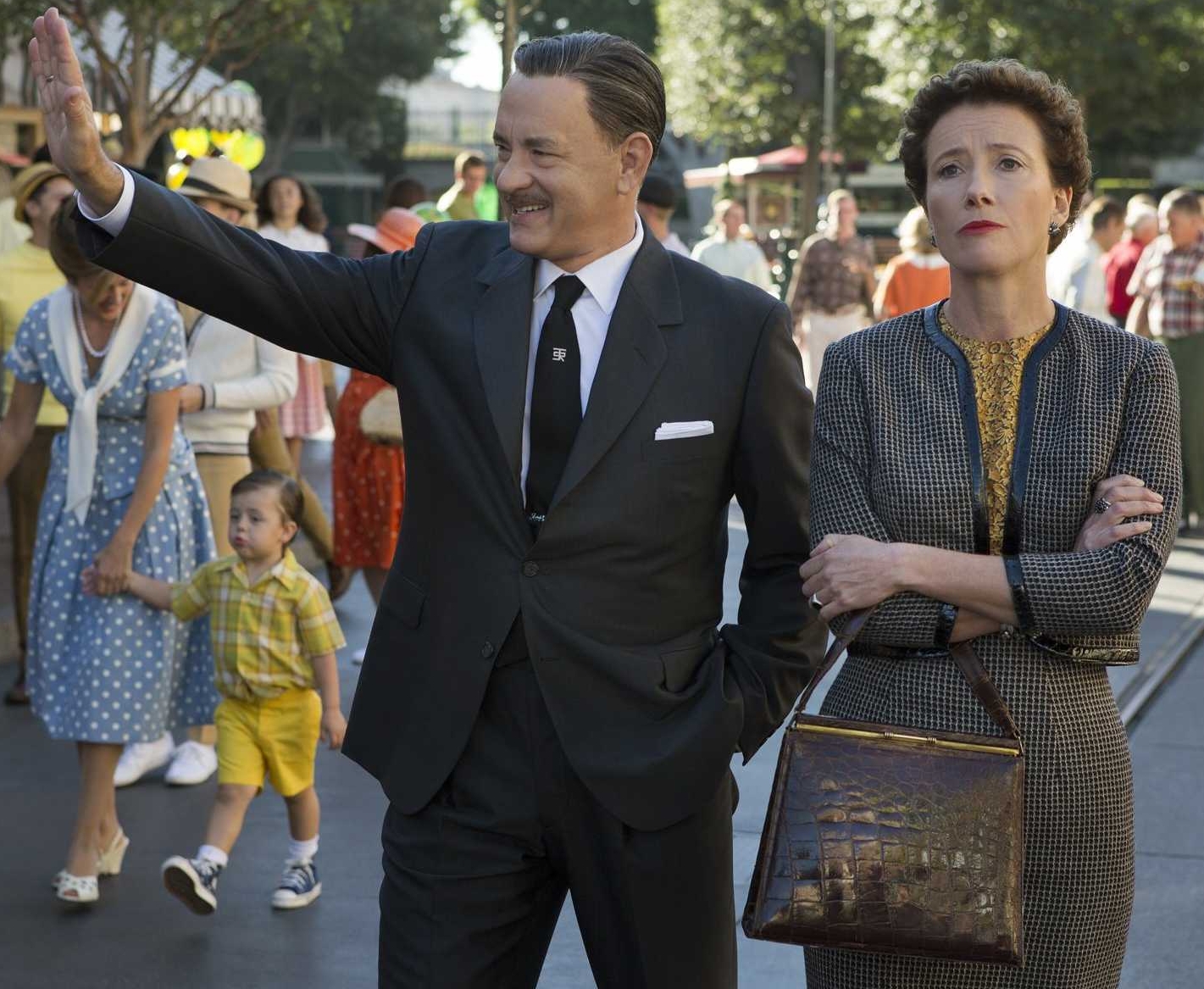
Emma Thompson portrays the author of Mary Poppins to be like someone we never expected her to be at all in Saving Mr. Banks.
Walt Disney (Tom Hanks) tries to get a stubborn P.L. Travers (Emma Thompson)  to agree to a movie version of Mary Poppins in Saving Mr. Banks.

Saving Mr. Banks is to be the story of how Walt Disney was able to bring Mary Poppins to the big screen. The question is not just will it bring the story to life but will it make people want to see it on the big screen?

It’s 1961 and Mary Poppins author P.L. Travers is struggling financially. Walt Disney has been trying to get Travers to agree to allow him to adapt Mary Poppins to the big screen for 20 years on account of a promise he made to his daughter. Travers finally agrees, albeit reluctantly but she’s extremely distrustful of Walt. She has stern expectations of Mary being adapted to the big screen such as no musical numbers, no Dick Van Dyke, none of the Disney frilliness and no animation.

Things do not start well for Mrs. Travers. She’s unhappy in Los Angeles with the carefree attitude of the city and by the happy ways Walt Disney, his co-workers and even Ralph the chauffeur do business. Not even Walt’s familiar manners warm up well to Travers.  Things get harder as Don DaGradi does the script, the Sherman brothers compose the music and Walt designs the characters. She even has a problem with Mary Poppins being the epitome of sentiment and whimsy, believing she’s the opposite of that. That surprises the Disney crew as they’ve always viewed Poppins as fantastical and known Travers to have a fantastical childhood, as seen through flashbacks.

However things take a turn for the worse when Travers sees the depiction of George Banks. She believes he is completely off-base  and leaves distraught. It’s then where the Disney studio realizes that Mary Poppins and its characters are very personal to Travers. It’s through flashbacks that we learn that Travers Goff, her father and the inspiration of George Banks, was indeed a banker but valued his imagination more than work in the real world. Things became too crushing for Travers and he would lose his job and his sanity to alcoholism. Her mother was the stern one of the family who even attempted suicide once.

The Disney team are persistent and try to work things out. Walt even offers to take Ms. Travers to Disneyland to lighten her mood. Things improve. The trip to Disneyland improves her embrace of the imagination, albeit slightly. Travers also has an unlikely friendship with Ralph the chauffeur as he tells her his handicapped daughter loves the novel. Things really improve when she walks in and hears George Banks is given a happier manner and has him singing ‘Let’s Go Fly A Kite’ at the end. But just when things seem to be working out, she learns of dancing penguins in a scene. That infuriates Travers to the point she refuses to Walt the film rites and flies back to London.

Once Disney learns that P.L. Travers is actually an Australian names Helen Goff, he departs to London for one last chance. Walt arrives at Travers’ home and opens up to her during his visit. He tells her that he too had a troubling childhood with a stern father and growing up poor. It was through his animation and his happy characters that he was able to heal and he tells Travers that having a creative imagination would also help in her healing of her disappointment with the world. She eventually agrees but she’s not invited to the 1964 premiere for fear of her panning it. Once news hits her, she shows up at Disney studios demanding to be invited. Her reactions at the premiere are unexpected but those of us who’ve seen Mary Poppins would know the movie would have a happy ending.

There have been movies before about the making some of the most famous children’s stories. I even remember seeing Finding Neverland a few years ago. The film of an adaptation of a novel to movie is not something one would call a fresh idea. Nevertheless it is unique this case of adapting the Mary Poppins novel to the big screen.

We should keep in mind that to make a film like this, it would have to be entertaining and keep audiences interested. It succeeds with some surprises. First is the personality of P.L. Travers. It’s funny that we see this uppity personally and we’re left thinking: “Are you sure this prig is the author of Mary Poppins?” Second is Travers’ feelings towards Disney’s style of creativity and how on earth it would ever be adapted. Crazy thing is we all know it was adapted. Even still the film makes you forget that and wonder if it will, even as the Sherman brothers sing the movie’s songs we all know. Third is that the biggest issue wasn’t the depiction of Mary but of George Banks. Travers designed George to be kind like her own father while Walt was in favor of a stern George Banks like his own father. You could understand how this would cause the two to collide.

The movie isn’t just of the dealmaking for the adaptation. The film is also of Travers’ own inspiration of Mary Poppins from her own childhood. We see how over time Travers had a nanny she thought as magical as her father was dying. We also see her father as a banker but one who believed in fantasy and the imagination. Even after he died, the spirit of his imagination lived on in Travers, even as she tended to her younger sisters and dealt with a troubled mother. Many of us are already familiar with Walt Disney and his fun ways. However we learn more of P.L. Travers and of her upbringing and her own imagination. That’s a good thing because I don’t think most of us ever did. None of us ever expected the author of Mary Poppins to be the stern type. However she was one who would try to come to terms with her imagination as noted in a scene where she’s in bed and confides to hugging a stuffed Pluto.

People should not be fooled too easily. There are many people who think this will be a family movie since this is done by Disney and since this a depiction of Walt trying to convince Mary Poppins to agree to let him adapt the novel to screen. However the film’s depiction of Travers’ troubled childhood as Ginty is what keeps it from being family friendly. Elements like an alcoholic father and a suicidal mother are not entirely for a family audience. It may be okay to bring older children to the film but younger ones are not a good idea.

It’s very rare for a female lead to steal a movie from Tom Hanks but Emma Thompson does just that. She was excellent in embodying P.L. Travers as an uptight prig who still harbored a love for the imagination, though only Walt knew it. She also depicted Travers as a person who still struggled with the memory of the father she cherished. We should be reminded that people that produced some of the most delightful entertainment came from troubled childhood, even Walt himself. Tom Hanks delivers a performance that is more a case of character acting than say mastering a difficult part like he did in Captain Phillips. He was very good at capturing Walt’s fun imaginative way of doing business and he made Walt seem like the Wizard Of Oz at times.

Colin Farrell also did a good job as Travers Goff, the father who was troubled by his job but valued his imagination. Paul Giamatti’s role as Ralph the chauffeur was small but he was able to get notice of his own. The other actors with smaller roles, especially those in Walt’s office, added their own pieces and elements to the movie as well. John Lee Hancock did a good job in directing but nothing that really stood out for this film year. Kelly Marcel and Sue Smith do their best in making a story for family audiences with their script. Technical items like the set design and costumes were excellently done in fitting the times they were made in. And Thomas Newman did a great job with the score.

Saving Mr. Banks is a delightful movie despite being too polished and ‘safe’ to excel amongst the top Oscar contenders of the year. It’s biggest success is the acting of its actors and the telling of the story of an author we never new. Even with scenes of the author’s troubled childhood, it succeeds in entertaining young and old.